Honours vs Ordinary Degree: What’s the Difference at UK Universities?
If you enrolled on a BA (Hons) or BSc (Hons), you probably assume you will graduate “with honours” as a matter of course. Most UK students do — but honours is not automatic. It is a specific award with credit thresholds, level requirements and classification rules, and falling short on any of them can leave you graduating with an ordinary degree instead: a real, valid degree, but unclassified and without the “(Hons)” suffix that employers and postgraduate admissions teams look for. Understanding the honours vs ordinary degree divide now — while there is still time to act — is one of the highest-value things a struggling or borderline student can do.
The confusion is understandable. Universities market honours programmes; prospectuses rarely dwell on the ordinary degree. Yet every UK university’s academic regulations contain detailed provisions for it: how many credits it requires (300 in England, 360 in Scotland), what happens to students who miss the honours requirements, and whether they can ever transfer back. In Scotland the picture is different again, where the ordinary degree is a standalone three-year qualification that students can actively choose.
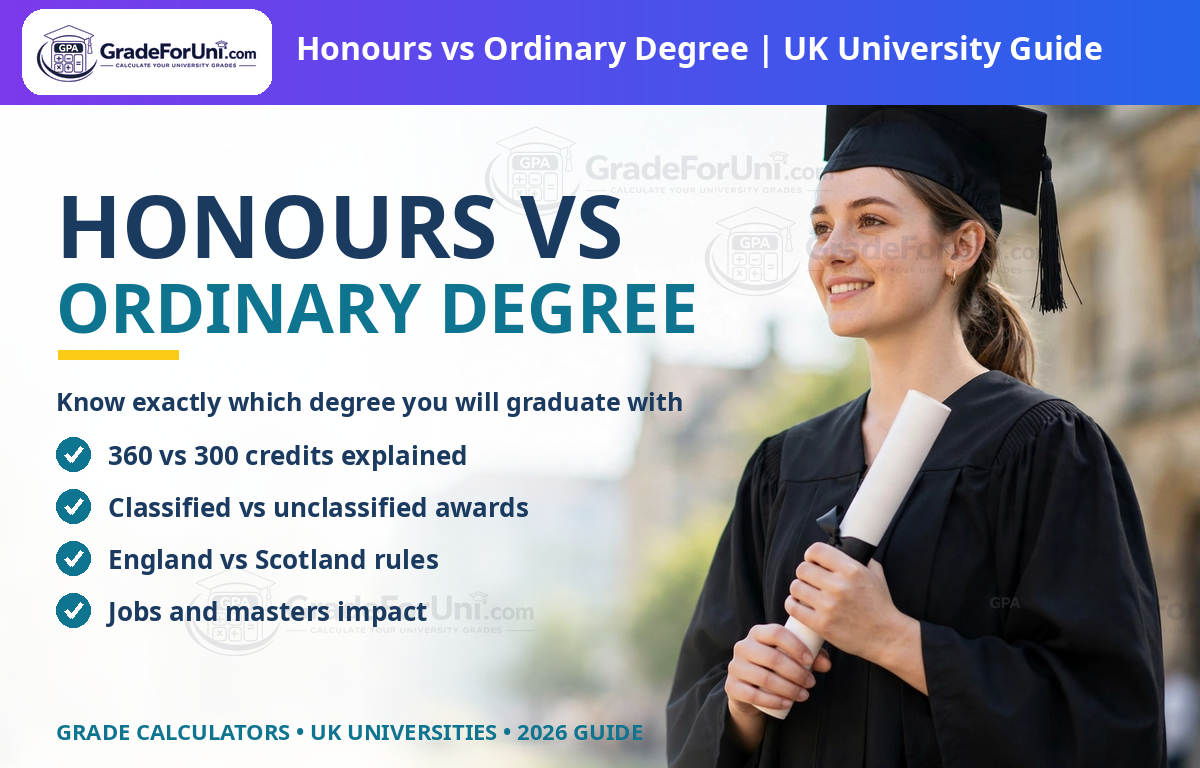
This guide explains exactly what each degree means, the credit maths that separates them, the five routes by which students end up with an ordinary degree, whether you can upgrade afterwards, and what each means for jobs and further study — with worked examples using real credit figures from actual university regulations.
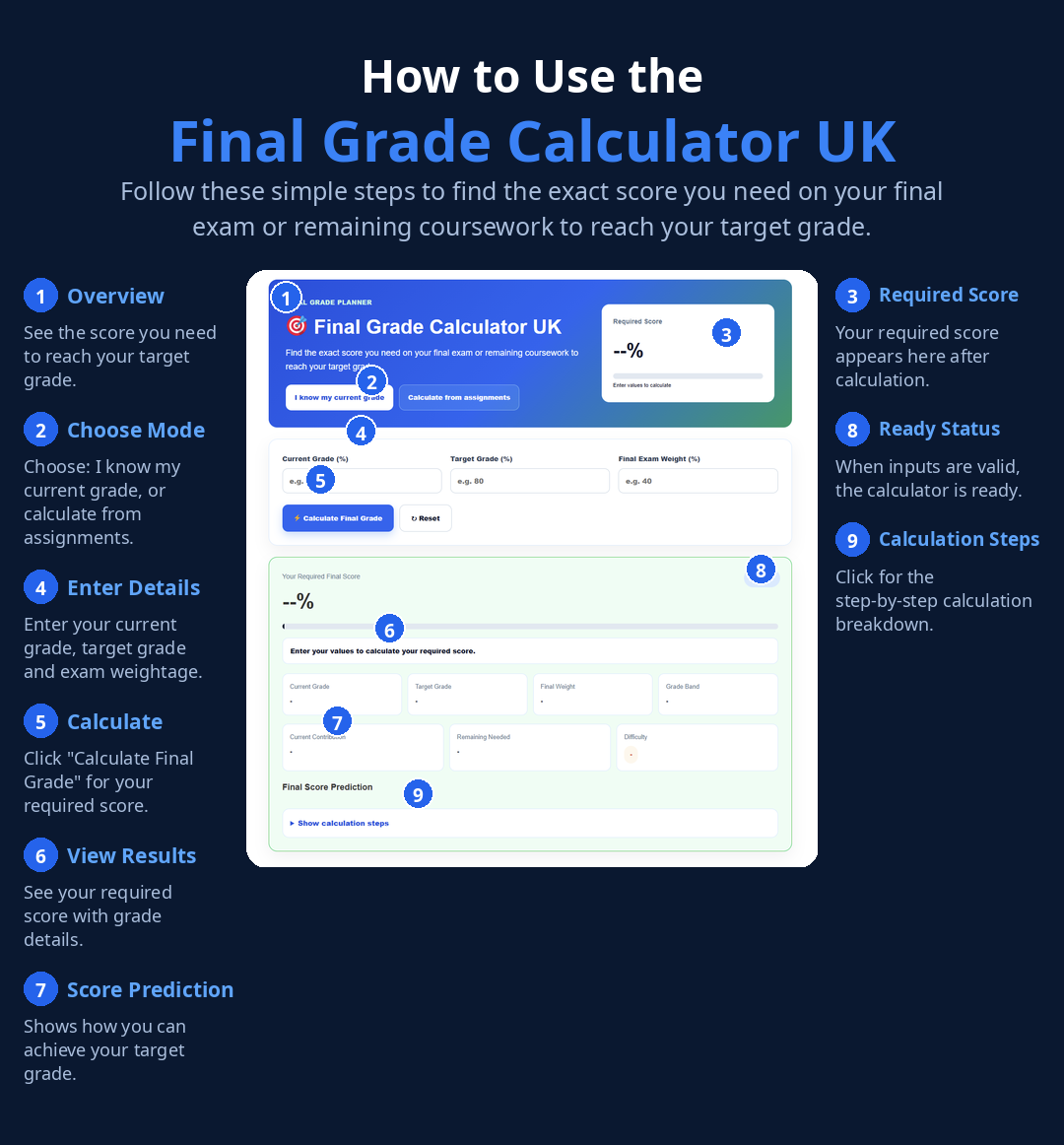
Click Here: Final Grade Calculator UK
What an Honours Degree Actually Is
An honours degree — written BA (Hons), BSc (Hons) and so on — is the standard undergraduate award at UK universities. “With honours” means your qualification meets the full requirements for a bachelor’s degree at level 6 of the Framework for Higher Education Qualifications (FHEQ), the national framework that defines what each qualification level means in England, Wales and Northern Ireland.
In concrete terms, an honours degree in England, Wales and Northern Ireland normally requires 360 credits, with at least 90 credits at level 6 (final-year level). Since a full-time year is 120 credits, that means three full years of passed study, including a full final year at honours level. In Scotland, where undergraduate degrees run a year longer, honours requires 480 credits over four years, with at least 90 credits at SCQF level 10 (the Scottish honours year) and 90 at level 9.
What makes honours distinctive is classification. Honours degrees are awarded in classes — First Class (70% and above), Upper Second or 2:1 (60–69%), Lower Second or 2:2 (50–59%), and Third Class (40–49%) — based on your weighted average across your degree. That classification is the single most-used signal in UK graduate recruitment and postgraduate admissions, which is why the difference between honours and ordinary matters so much. If you want the full picture of how classifications are calculated, read our guide to the UK university grading system and how to get a first-class honours degree.
Honours programmes also normally include a dissertation or major final-year project — typically a 30 to 40-credit piece of independent research. One curiosity worth knowing: the University of Oxford does not technically award honours with its standard BA, but it considers any student achieving a third class or better to have “achieved honours status” — a reminder that the fine print varies by institution.
What an Ordinary Degree Actually Is
An ordinary degree is not a failed degree. It is a complete, legally valid bachelor’s award — it just certifies a smaller volume of study than honours, and it is not classified. In England, Wales and Northern Ireland it normally requires 300 credits with at least 60 credits at level 6. Sixty credits short of honours, in other words — roughly one semester of final-year study.
Because it is unclassified, an ordinary degree is awarded as a simple pass. Your parchment will not say First, 2:1 or Third, and you cannot put “(Hons)” after your degree title. Some universities make the distinction explicit on the certificate itself: Queen’s University Belfast, for example, records its ordinary degree as a non-subject-specific, unclassified award — a “BSc (Ordinary Degree)” with no subject named and no mark attached, and it is not presented for professional-body accreditation.
In England, the ordinary degree is almost always a fallback rather than a choice. Exam boards award it as an exit award to students who have completed enough to merit a degree but not enough for honours — the University of Bristol’s regulations list it explicitly among the exit awards for honours programmes (alongside the undergraduate diploma and certificate), and the University of Edinburgh’s assessment regulations allow boards to propose an ordinary degree for students who meet its requirements but not the honours requirements. There is usually no direct entry: at Queen’s, for instance, students cannot enrol straight onto an ordinary degree and cannot transfer back to honours once moved across.
Scotland tells a different story. There, the ordinary (or “general”) degree is a qualification in its own right: a three-year, 360-credit degree with at least 60 credits at SCQF level 9. The first two years are identical to the honours route; students then either leave after third year with the ordinary degree or continue into the more specialised honours year with its dissertation. Scottish ordinary degrees may even be classified into pass, merit and distinction — unlike their unclassified English counterparts.
Honours vs Ordinary Degree: The Key Differences at a Glance
Here is the full comparison in one place. Keep in mind that individual universities set their own detailed regulations, so treat these as the national norms and check your own handbook for the exact rules that apply to you.
| Feature | Honours Degree | Ordinary Degree |
|---|---|---|
| Credits required (England, Wales, NI) | 360, with at least 90 at level 6 | 300, with at least 60 at level 6 |
| Credits required (Scotland) | 480 over 4 years (90 at SCQF level 10, 90 at level 9) | 360 over 3 years (60 at SCQF level 9) |
| Classification | First, 2:1, 2:2, Third | Unclassified pass (England); pass/merit/distinction possible in Scotland |
| Degree title | BA (Hons), BSc (Hons) — subject named | BA / BSc (Ordinary Degree) — sometimes with no subject named |
| Dissertation / major project | Usually required | Not usually required |
| How students get it | The standard enrolled route | Exit award after missing honours requirements (England); chosen route or fallback (Scotland) |
| Postgraduate study | Direct route — most masters ask for honours, often 2:1 or 2:2 | Usually not sufficient on its own; may need a top-up or bridging route |
| Graduate schemes | Eligible where a 2:1/2:2 is specified | Often filtered out by “honours degree required” criteria |
The single most important row in that table is the first: 60 credits. In England, the entire difference between graduating with honours and graduating with an ordinary degree can come down to one failed 20-credit module too many — the margin is that thin, which is why the credit-counting worked example later in this guide matters.
England vs Scotland: Two Completely Different Systems
The UK does not have one degree system — it has two frameworks, and the honours vs ordinary degree distinction works differently in each. In England, Wales and Northern Ireland, qualifications sit on the Framework for Higher Education Qualifications (FHEQ), where levels 4, 5 and 6 correspond to the first, second and third years of a bachelor’s degree. In Scotland, the Scottish Credit and Qualifications Framework (SCQF) runs from levels 7 to 12, with bachelor’s years at levels 7–10 and master’s level at 11.
This is why the credit numbers differ so much: a Scottish honours degree carries 480 credits because it includes a fourth year. The table below maps the main undergraduate awards in both systems.
| Award | England, Wales & NI (FHEQ) | Scotland (SCQF) |
|---|---|---|
| Certificate of Higher Education (CertHE) | 120 credits | 120 credits |
| Diploma of Higher Education (DipHE) | 240 credits | 240 credits |
| Ordinary / general degree | 300 credits (60 at level 6) | 360 credits (60 at level 9) |
| Bachelor’s degree with honours | 360 credits (90 at level 6) | 480 credits (90 at level 10, 90 at level 9) |
| Integrated master’s degree | 480 credits (120 at level 7) | 600 credits (120 at level 11) |
The practical consequence: in England, an ordinary degree is almost exclusively something that happens to you when honours slips away. In Scotland, it can be a deliberate, planned three-year route — although universities generally encourage students to take the honours year, since entry to it is not usually restricted and the ordinary degree offers less depth and specialisation. If you are studying in Scotland, the decision point typically comes at the end of second year, which is exactly what the second worked example below walks through.
Five Routes That Lead to an Ordinary Degree
Students rarely set out to earn an ordinary degree in England — they arrive at it through one of five routes. Recognising which one applies to you is the first step to changing the outcome, because some routes can still be reversed before the exam board meets.
1. Too few credits overall. The most common route: failed modules (after resits and any condoned or compensated credit) leave you below 360 passed credits but at or above 300. If you have failed modules on your record, read what happens when you fail a university module to understand resits, capping and compensation before you assume the credits are lost.
2. Enough credits, but too few at the right level. This is the trap students miss. Honours in England needs 90 credits at level 6 — not just 360 credits in total. A student with 340 passed credits but only 70 at level 6 fails the honours requirements yet comfortably clears the ordinary threshold (300 credits, 60 at level 6). Level-specific shortfalls are particularly common after failed final-year modules. Our guide to how many credits count toward your classification explains the level rules in detail.
3. A failed must-pass component. Some programmes designate certain modules — often the dissertation or a professional-practice unit — as must-pass. The University of Bristol’s regulations describe the scenario precisely: a student who fails a must-pass final-year unit after two attempts, but otherwise passes the year, cannot be awarded the intended honours degree and is instead considered for an alternative award set out in the programme specification — frequently the ordinary degree.
4. Transfer by the exam board. Boards of examiners can require or permit a struggling student to transfer from an honours programme to an ordinary degree pathway. The University of Nottingham’s regulations set out detailed transfer thresholds (combinations of passed credits and average marks), and Queen’s University Belfast allows transfer only after the student has attempted at least 120 credits above first-year level, with the head of school’s approval. Once transferred at some universities, there is no way back — Queen’s explicitly bars transfer from an ordinary degree back to honours.
5. The deliberate Scottish choice. In Scotland, leaving after third year with an ordinary degree is a legitimate planned outcome — three years of study, 360 credits, and a bachelor’s degree. It suits students who want to enter work sooner or avoid a fourth year of debt, but it means forgoing the dissertation, the classification, and the depth of the honours year.
Worked Example 1: The Credit Count That Decides Honours or Ordinary
Priya is in the final year of a BSc at an English university. Here is her credit record, module by module:
| Year | Credits attempted | Credits passed | Level | Notes |
|---|---|---|---|---|
| Year 1 | 120 | 120 | Level 4 | All passed |
| Year 2 | 120 | 100 | Level 5 | Failed one 20-credit module; resit failed, not condoned |
| Final year | 120 | 100 | Level 6 | Failed one 20-credit module; resit passed (capped at 40%) |
| Total | 360 | 320 | — | — |
Now apply the award rules. Honours requires 360 passed credits — Priya has 320, so honours is out, even though she passed 100 credits at level 6 (above the 90-credit level requirement). The ordinary degree requires 300 passed credits with at least 60 at level 6: Priya has 320 passed and 100 at level 6, so she clears both thresholds. Result: ordinary degree.
Notice how narrow the margin is. Had Priya’s second-year failed module been condoned — many universities condone up to 20 failed credits where the overall average is satisfactory — she would have 340 passed credits and still miss honours by 20. Had she passed both failed modules, 360 credits and honours. This is why students near the boundary should check condonation rules and resit options before accepting an ordinary degree as inevitable: a single recovered 20-credit module can be the difference between “BSc (Hons)” and “BSc (Ordinary Degree)” on a CV for the rest of a career.
Worked Example 2: The Scottish Third-Year Decision
Callum is finishing second year at a Scottish university with solid but unremarkable marks — averaging around 55%. He faces the choice that defines the Scottish system:
Option A — leave after third year with an ordinary degree. He completes 360 credits (60 at SCQF level 9), graduates a year early with a bachelor’s degree, and saves a full year of tuition fees and living costs — a significant sum. His degree may be classified as pass, merit or distinction depending on his university’s scheme, and he enters the workforce twelve months ahead of his peers.
Option B — take the honours year. He completes 480 credits including 90 at SCQF level 10, undertakes a dissertation, and graduates with a classified honours degree — the standard currency for postgraduate applications and many graduate schemes. Entry to the honours year is generally not restricted, and universities actively encourage it because of the depth it adds.
There is no universally right answer, but the decision should be made with open eyes. An ordinary degree closes the direct route to most taught master’s programmes, which typically require honours at 2:1 or 2:2. For Callum, averaging 55%, the honest calculation is whether a fourth year of stronger, more focused work could lift him into classified-honours territory — because a 2:2 with honours opens doors that an unclassified ordinary degree does not, whatever the marks behind it. Students making this call should discuss it with their personal tutor before the end of second year, not after third-year results arrive.
Can You Upgrade an Ordinary Degree to Honours?
This is the question every disappointed graduate asks, and the answer is: sometimes, but it depends entirely on your university — and you must ask before the award is finalised, not after.
Some universities offer top-up or bridging routes: you return (sometimes the following academic year) to complete the missing honours-level modules and the dissertation, converting the ordinary degree into an honours award. Others allow a repeat of the final stage of study — retaking the year with uncapped marks — where the exam board offers it as an alternative to accepting the ordinary degree. These options live in the detailed assessment regulations, not the prospectus, so most students only discover them by asking their department directly.
But there are hard limits. Queen’s University Belfast states plainly that students enrolled on an ordinary degree may not transfer back to an honours programme. And once an ordinary degree has been conferred, unpicking it is far harder than delaying acceptance while resit or repeat options are still on the table. The practical rule: if your results point toward an ordinary degree and you believe you can do better, speak to your personal tutor or programme director before the exam board meets. After the board’s decision is recorded, your negotiating position is much weaker.
One more route worth knowing: even where a direct upgrade is impossible, an ordinary degree plus relevant work experience — or a postgraduate certificate or diploma taken separately — can rebuild a path toward master’s-level study. It is longer and more expensive, but the door is not permanently shut.
What an Ordinary Degree Means for Jobs and Postgraduate Study
Let us be direct about the consequences, because vague reassurance helps nobody.
For jobs: an ordinary degree is a genuine bachelor’s degree, and for many roles that is all that matters — plenty of employers ask for “a degree” without specifying honours or classification. But a large share of formal graduate schemes specify an honours degree, typically at 2:1 or above, and automated application filters will screen out candidates who cannot tick that box. The critical rule for your CV is honesty: write “BSc” or “BSc (Ordinary)”, never “BSc (Hons)”. Misrepresenting an ordinary degree as honours is the kind of discrepancy that surfaces in background checks and destroys offers.
For postgraduate study: this is where the gap bites hardest. The standard entry requirement for a UK taught master’s is an honours degree — usually a 2:1, sometimes a 2:2. An unclassified ordinary degree does not evidence either, so most universities will not admit you directly. Realistic alternative routes include completing a top-up to honours first, taking a postgraduate diploma or certificate (which some universities will accept as a stepping stone), or applying with several years of strong professional experience, where some admissions tutors exercise discretion. None is as straightforward as the honours route.
For regulated professions: check carefully. Because some ordinary degrees are not presented for professional-body accreditation and may not even name your subject (as at Queen’s), they may not satisfy the academic requirements for careers like engineering, architecture or healthcare. If your career needs accredited-degree status, confirm with the relevant professional body before accepting an ordinary award.
The balanced view: an ordinary degree is worth far more than withdrawing with nothing — it sits above the diploma and certificate exit awards in the qualifications framework, and it represents three years of university-level achievement. But it is not interchangeable with honours, and anyone choosing between fighting for honours (through resits, repeats or a top-up year) and accepting the ordinary degree should weigh the lifetime cost of that “(Hons)” suffix honestly.
Is an ordinary degree a bad degree?
No. An ordinary degree is a complete, valid bachelor’s degree — it sits above the diploma and certificate exit awards in the UK qualifications framework and represents three years of university-level study. Its limitation is that it is unclassified, so it does not evidence a First, 2:1 or 2:2, which restricts access to graduate schemes and master’s programmes that specify honours.
How many credits do you need for an honours degree in the UK?
In England, Wales and Northern Ireland you need 360 credits with at least 90 at level 6 (final-year level). In Scotland you need 480 credits over four years, with at least 90 credits at SCQF level 10 and 90 at SCQF level 9. An ordinary degree needs 300 credits in England (60 at level 6) or 360 credits in Scotland (60 at level 9).
What is the difference between a BA and a BA (Hons)?
The (Hons) suffix means the degree was awarded with honours: the student met the full credit and level requirements and received a classification (First, 2:1, 2:2 or Third). A BA without (Hons) is normally an ordinary or pass degree — a valid bachelor’s degree, but unclassified.
Can I do a masters with an ordinary degree?
Usually not directly. Most UK taught master’s programmes require an honours degree, typically at 2:1 or 2:2. With an ordinary degree your realistic routes are topping up to honours first, completing a postgraduate diploma or certificate as a stepping stone, or applying with several years of relevant professional experience where the admissions tutor has discretion.
Can I upgrade an ordinary degree to an honours degree?
Sometimes. Some universities offer top-up or bridging routes where you return to complete the missing honours-level modules and dissertation, or allow you to repeat the final stage of study. But not everywhere: Queen’s University Belfast, for example, does not permit transfer back from an ordinary degree to honours. Ask your department before the exam board finalises your award.
Will employers know I have an ordinary degree rather than honours?
Yes. Your degree certificate and transcript will show the award without the (Hons) suffix and without a classification. Always write it honestly on your CV as BA or BSc (Ordinary) — claiming honours you were not awarded is misrepresentation and can cost you a job offer when background checks are run.
Is an ordinary degree the same as a third-class degree?
No, and the difference matters. A third is a classified honours degree (40–49% average) — it carries the (Hons) suffix and meets postgraduate entry requirements that ask for honours. An ordinary degree is unclassified and sits below a third in the hierarchy of awards.
Do I have to choose between honours and ordinary in Scotland?
In Scotland the decision typically comes after second year: you either leave after third year with a three-year ordinary degree (360 credits) or continue into the honours year (480 credits total, with dissertation and classification). Entry to the honours year is generally not restricted, and universities encourage students to take it because of the depth and postgraduate options it adds.
The honours vs ordinary degree question feels abstract until your own credit total is on the line. Add up your passed credits — and your level 6 credits specifically — today, using a final grade calculator to model where you stand. If you are below the 360-credit or 90-at-level-6 thresholds, talk to your personal tutor before the exam board meets: once an ordinary degree is awarded, some doors close that were still open the week before.
Conclusion
The honours-versus-ordinary question looks complicated because England and Scotland run entirely different systems — but underneath, it always comes down to one thing: credits. Hit the credit threshold with the required profile of marks, and the “(Hons)” follows; fall short, and the ordinary degree is the safety net that still recognises three (or four) years of work.
If you are on track for honours, the five routes to an ordinary degree in this guide are worth reading as a warning map — most students who end up with an ordinary degree didn’t plan to; they drifted there through failed modules, too many condoned credits, or simply not knowing the rules. Check your credit count now, not in final year.
And if an ordinary degree is where you’ve landed, don’t treat it as the end of the story. Upgrade routes exist, employers care far more about skills and experience than the “(Hons)” suffix, and postgraduate doors aren’t all closed. What matters most is understanding exactly where you stand — then making a deliberate plan from there.