
![You are currently viewing Academic Probation UK: What It Means at UK Universities [2026]](https://gradeforuni.com/wp-content/uploads/2026/10/featured-academic-probation-uk.png)
Academic Probation UK: What It Means for Students
Type “academic probation” into Google as a UK student and the results will confuse you. The top pages are HR documents for lecturers — Bath and Reading both publish “Academic Probation” procedures that govern newly appointed teaching staff, not students. Scroll further and you hit American universities explaining GPA thresholds, term GPAs and academic suspension. Neither tells you what happens to you, sitting in Manchester or Leeds with failed modules and a letter from the exam board.
Here is the honest translation: formal “academic probation” barely exists for UK undergraduates. UK universities do not use GPA warning systems. Instead they monitor something called academic progress — a set of credit and attempt rules decided by exam boards. Fail to meet them and you move down a ladder: trailing credits, repeating a year, and finally being “required to withdraw”. There is exactly one notable exception — Goldsmiths, University of London, which runs a genuine student probation policy — and this guide covers it.
Below: what replaces probation in the UK, the real progression ladder with numbers from actual university regulations, two worked examples with full calculations, and a recovery plan for when your progress is in danger.
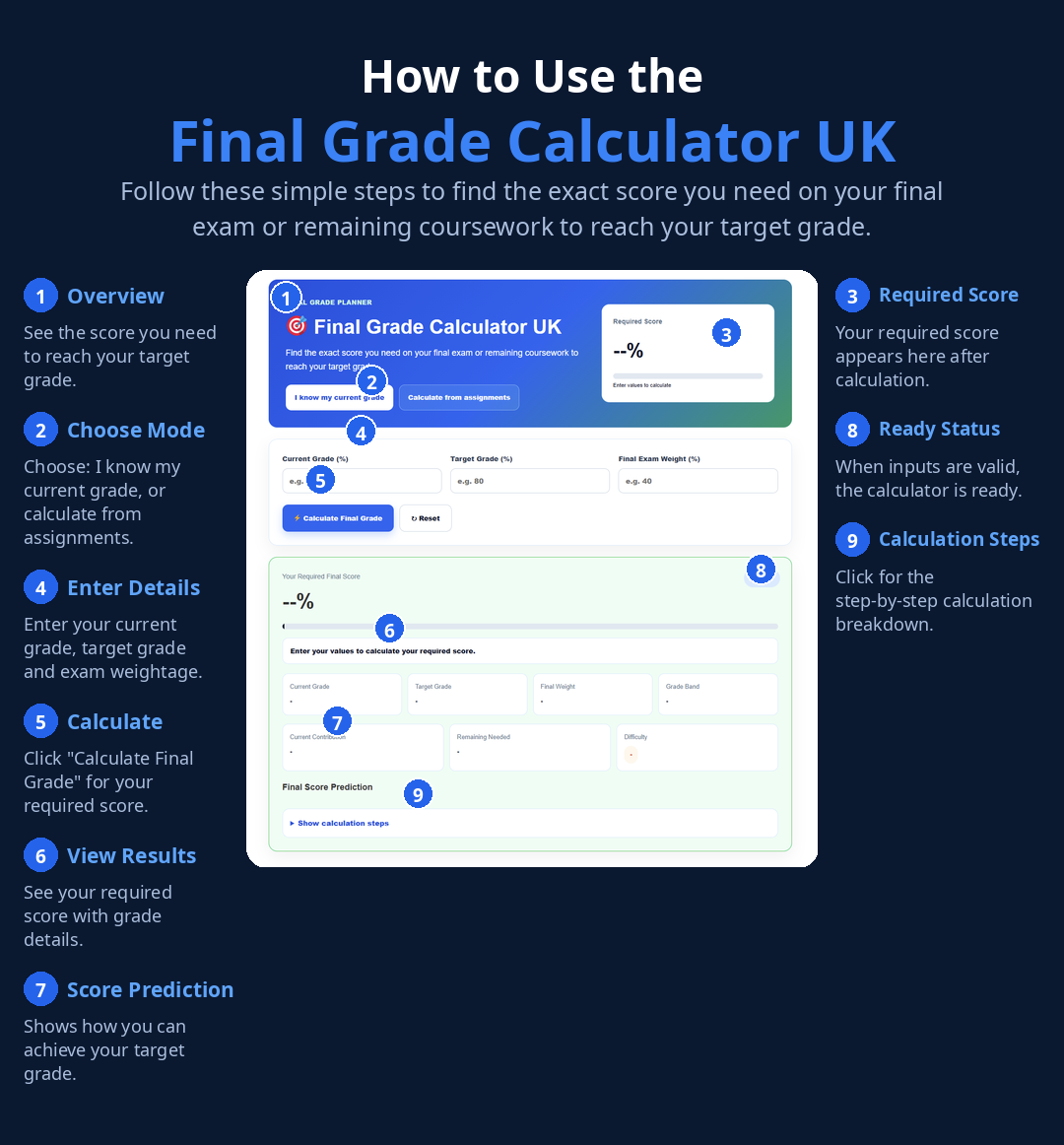
Click Here: Final Grade Calculator UK
Why “Academic Probation” Confuses UK Students
In the United States, academic probation is a formal status with a number attached. Fall below a cumulative GPA threshold — commonly 2.0 — and you are placed on probation. Raise your GPA within one term and you return to good standing; fail, and you move to academic suspension and then dismissal. It is a single, national-style system that every US student recognises.
The UK has nothing like it. British universities do not calculate GPAs for progression decisions, so there is no single number that triggers a warning. When UK students search the term, they land on staff policies: the University of Bath’s “Academic Probation” guide covers probationary lecturers transitioning to confirmed posts, and the University of Reading’s version governs newly appointed teaching staff over a three-year review cycle. Useful for lecturers; useless for a second-year who failed two modules.
This mismatch matters because it sends students looking for the wrong safety net. There is no UK-wide “get your GPA above 2.0 and you’re safe” rule. What actually decides your fate is your own university’s academic regulations — and those speak a different language: credits passed, reassessment attempts used, and exam board decisions. Learn that language and you can read any outcome letter you receive.
What UK Universities Use Instead: “Academic Progress” Monitoring
Rather than probation, UK universities continuously monitor whether you are making adequate academic progress. The details differ by institution, but the mechanism is the same: at the end of each year (or semester), an exam board checks your credits and decides what happens next. Three real examples show how strict this gets:
UCL requires students to complete every unit to progress — Year 1 students must complete all Year 1 units to enter Year 2, and final-year students need 12 complete units to graduate with honours. Failing a unit does not always mean it is incomplete (you can fail and still be marked complete), but skipping assessments or resits can block progression or cost you the honours degree entirely.
Swansea University is blunter: students who fail to proceed to the next year or fail to qualify for an award after the supplementary assessment period are required to withdraw from the University — no further attempts, no credit transfer to another Swansea programme, eligible only for an exit qualification.
St Mary’s University defines the endpoint as “No Academic Progress” (NAP): students who cannot complete their award within the permitted timelines may be withdrawn by the examinations board as a consequence of failing to meet the required academic standards.
The pattern: nobody puts you on a GPA watch-list. Instead, every failed module consumes one of a limited number of attempts, and the board’s decision letter — not a probation notice — is the document that changes your life.
The Progression Ladder: From Trailing Credits to Required Withdrawal
When UK exam boards meet, they work down a ladder of decisions. The exact thresholds vary, but the rungs are near-universal. This table maps each decision to a real university rule:
| Board decision | What it means | Real regulation |
|---|---|---|
| Clean progression | Pass all 120 credits; move up normally | Standard everywhere |
| Trailing credits | Progress carrying failed resits into next year | Essex: up to 30 non-core credits; Sheffield Hallam: up to 20 failed / 40 continued-reassessment credits |
| Capped reassessment | One resit attempt per failed block, usually capped at the pass mark | Brunel: one reassessment per block, max 60 credits in-year |
| Repeat year (retake) | Failed too much to trail; redo the failed modules next year at your own expense | UCLan: 30/90 or 0/120 credit splits; Trinity Laban: retake with attendance, uncapped marks, no further resits |
| Required to withdraw | Attempts exhausted; studies terminated, exit award only | Swansea; Essex (trailed credits failed after final attempt); Bristol (three attempts to meet the progression standard) |
The University of Central Lancashire publishes one of the clearest ladders. Its assessment board rules read like a scoreboard: pass 120 credits and you progress; pass 90 and fail 30 and you progress trailing the 30; pass only 60 and you retake the failed 60 the next semester; pass 30 or 0 and you face a fail-repeat-year or fail-withdraw decision. Your whole academic future, decided by which row of that table you land on.
Brunel adds the attempt limit that catches students out: you get only one reassessment attempt per block, and only 60 credits of reassessment can be taken within the current academic year. Fail more than 60 credits’ worth and you cannot fix it in-year at all — you repeat a term or a full year, which delays your degree.
Worked Example 1: Amara’s 30 Failed Credits — Trailing vs Condonement
Amara finishes Year 1 with eight 15-credit modules. Her marks:
| Module | Credits | Mark | Result |
|---|---|---|---|
| Research Methods | 15 | 61 | Pass |
| Academic Writing | 15 | 58 | Pass |
| Psychology | 15 | 55 | Pass |
| Statistics | 15 | 52 | Pass |
| Economics | 15 | 49 | Pass |
| Sociology | 15 | 47 | Pass |
| Programming | 15 | 37 | Fail |
| Calculus | 15 | 34 | Fail |
She has passed 90 credits and failed 30 — the classic borderline. Under Essex-style rules, her two failed modules are non-core with marginal fails, so the board offers her a choice: condonement (the fails are forgiven and she progresses cleanly) or trailing (she resits both modules alongside Year 2, with resit marks capped at 40). If you are weighing this choice, our condoned pass guide explains the forgiveness route in full.
The maths decides it. Suppose she resits and scores 55 and 62 — both capped to 40:
Trailing route: (61 + 58 + 55 + 52 + 49 + 47 + 40 + 40) ÷ 8 = 402 ÷ 8 = 50.25% Year 1 average.
Condonement route: (61 + 58 + 55 + 52 + 49 + 47 + 37 + 34) ÷ 8 = 393 ÷ 8 = 49.1% Year 1 average.
Trailing wins by 1.15 percentage points here, because capped 40s beat her original 34 and 37. But it is not free: her Year 2 workload becomes 120 new credits plus two resits, and Essex rules forbid trailing twice — Year 1 credits trailed into Year 2 must be passed or condoned before Year 3; there is no trailing them into the final year. Fail the trailed resits and the ladder drops her straight to repeat-or-withdraw territory. This is exactly the calculation our Final Grade Calculator is built for: plug in your real module marks and see what each route does to your average before you choose.
Worked Example 2: James and the “Required to Withdraw” Ladder
James has a worse year: six 20-credit modules, and after first attempts his best mark is 38. He has passed 0 of 120 credits. On the UCLan-style ladder that is the bottom row — fail-repeat-year at best, fail-withdraw at worst. He takes his resits and fails three of the six again.
Now the board’s options narrow brutally. Swansea’s regulation G12 describes the endpoint precisely: students who fail to qualify after the supplementary assessment period are required to withdraw, with no further attempts to redeem the modules and no credit transfer within the university. He would be eligible only for an exit qualification — with 120 Level 4 credits that typically means a Certificate of Higher Education (CertHE), not a degree.
The financial arithmetic of the alternative — repeating the year — is worth spelling out. A repeat year means paying tuition again at your own expense: up to around £9,535 for a home undergraduate year, plus roughly £8,000–£9,000 in living costs, so one failed year costs on the order of £17,500–£18,500. Trinity Laban’s regulations confirm the retake is “at the student’s own expense”, though marks for modules already passed are retained and retake marks are not capped. One partial cushion: Student Finance England normally funds your degree length plus one extra “gift year”, so a single repeat year is often still covered by the tuition fee loan — but a second repeat usually is not. Check your funding entitlement before you assume anything.
For international students the ladder has an extra trapdoor. The University of Stirling’s regulations require the university to notify the Home Office when a Student visa holder withdraws or finishes early — and a required withdrawal is a withdrawal. That can mean visa curtailment: you may have to leave the UK or urgently switch immigration routes. Any international student facing a board decision should speak to the university’s international office before accepting a withdrawal or repeat-year outcome, because a repeat year may also require a brand-new CAS (Confirmation of Acceptance for Studies).
The One UK Exception: Goldsmiths’ Formal Probation Policy
Goldsmiths, University of London genuinely does what the search results promise: it runs an Academic Progress and Probation Policy and Procedures for students. If your performance or attendance is judged unacceptable, the Head of Department places you on probation in writing, giving reasons and warning that you may be dismissed unless you improve.
Probation lasts four term-time weeks. Afterwards, the Head either lifts it — or refers you to the Academic Progress Committee, which can take no action, permanently dismiss you, temporarily suspend you, or require you to repeat some or all of the previous year full-time or part-time. You can appeal the committee’s decision.
Why does this matter if you are not at Goldsmiths? Because it shows what the word means when a UK university actually uses it: a short, written, closely monitored warning period ending in a committee with the power to end your studies. If anyone at your university ever says “probation”, ask for the policy name in writing — you want to know whether you are getting Goldsmiths-style formal probation or just a tutor’s informal warning.
Probation vs the 7 Terms That Actually Appear in UK Letters
Exam boards and departments rarely say “probation”. Here is the vocabulary your outcome letter will actually use, and what each term commits you to:
| Term you’ll see | What it means | Key consequence |
|---|---|---|
| Academic probation | Formal written warning period (rare) | Committee review at the end — Goldsmiths only |
| Trailing | Carry failed resits into next year | Heavier workload; cannot trail twice (Essex) |
| Condoned pass | Marginal fail forgiven; you progress | Fail stays on transcript; see our condoned pass guide |
| Referral / resit | Second attempt at failed assessment | Usually capped at 40; see our referrals guide |
| EC deferral | Illness/crisis gives a fresh attempt | Uncapped first attempt; see our extenuating circumstances guide |
| Retake / repeat year | Redo failed modules or the whole year | At your own expense; passed-module marks kept |
| Required to withdraw | Studies terminated | No further attempts; exit award only; visa risk |
| Suspension | Temporary removal with return route | Distinct from withdrawal — you come back |

7-Step Recovery Plan When Your Progress Is in Danger
If you have failed modules or received a worrying letter, work this list in order. Each step protects a different right:
1. Read the board’s exact decision word by word. “Trailing”, “repeat year” and “required to withdraw” are different legal outcomes with different rights attached. Do not summarise it to yourself as “probation” — the precise term determines what you can still do.
2. Email your personal tutor within 48 hours. Ask which regulation the decision was made under and what your remaining attempts are. Tutors see these letters every year; they know which outcomes are negotiable and which are automatic.
3. Check extenuating circumstances immediately. If illness, bereavement or another crisis affected your exams, an accepted EC claim can convert a capped resit into an uncapped fresh attempt — the single most valuable upgrade available. Deadlines are brutally short, usually days after results.
4. Visit your students’ union advice centre. It is free, independent of your department, and advisers routinely accompany students to exam-board appeals and progress committees. They know your university’s regulations better than most academics do.
5. Do the trailing-vs-condonement maths before you choose. Run both scenarios with your real marks, as in Amara’s example above — the right choice depends on your numbers, not on vibes. A condoned 37 keeps your workload light; a trailed resit capped at 40 can lift your average but doubles your exam season.
6. Appeal only if the procedure was wrong. Grade appeals challenge process, not marks — a misapplied regulation, a lost EC form, bias in the board. Our appeal guide covers valid grounds and deadlines. “I disagree with the decision” is not grounds; “the board ignored my accepted EC” is.
7. Budget for a repeat year now, not later. Around £9,500 in tuition plus living costs, usually at your own expense, with Student Finance’s “gift year” covering one repeat for most students. Knowing the money works removes the panic from the decision — and if you withdraw instead, request your transcript promptly (our transcript guide shows how) because those credits are your currency for any future return to study.
The Bottom Line
“Academic probation” is the wrong search term for the UK — but it is the right worry. What you are actually afraid of is the progression ladder: trailing, repeating, being required to withdraw. That ladder is written down in your university’s academic regulations, it runs on credits and attempts rather than GPAs, and every rung has a defined way up. Read your board letter literally, run the numbers on your options, use your EC rights and your SU advice centre, and act within days — because in the UK system, the students who recover are the ones who treat the letter as the start of a process, not the end of one.
Does academic probation exist at UK universities?
Almost never for students. The phrase “academic probation” in the UK almost always refers to probationary periods for newly appointed lecturers (e.g. at Bath and Reading), not students. The one notable exception is Goldsmiths, University of London, which has a formal Academic Progress and Probation Policy placing struggling students on a four-week written probation. Everywhere else, the equivalent system is called academic progress monitoring.
What is the UK equivalent of academic probation?
UK universities monitor “academic progress” through exam-board decisions instead of GPA thresholds. If you fall short you move down a ladder: trailing failed credits into the next year, capped resits, repeating the year (retake), and finally being “required to withdraw”. The specific credit thresholds and attempt limits are set in each university’s academic regulations.
Can a UK university expel me for bad grades?
Yes. Universities can “require you to withdraw” once you have exhausted your permitted attempts — for example, Swansea’s regulations state that students who fail to proceed after the supplementary assessment period are required to withdraw with no further attempts, eligible only for an exit qualification. You can usually appeal, but appeals challenge the procedure, not the marks.
How many failed credits can I trail into the next year?
It varies by university: Essex allows up to 30 non-core credits to be trailed into the next year, Sheffield Hallam allows up to 20 credits of failure (or 40 of continued reassessment), and UCLan’s board rules send students with 90 passed / 30 failed credits forward trailing the 30. Trailing is normally only allowed from one year into the next — you cannot trail the same credits twice.
Will a repeat year cost me extra tuition fees?
Yes — a repeat year is normally at your own expense, up to around £9,535 in tuition for a home undergraduate year plus living costs. The partial cushion is that Student Finance England usually funds your degree length plus one extra “gift year”, so one repeat year is often still covered by the tuition fee loan, but a second repeat usually is not.
Do capped resit marks hurt my degree classification?
They can. Resits are usually capped at the pass mark (40 for undergraduates), and the capped mark is what counts toward your average — a resit you actually scored 65 on still counts as 40. Trailed reassessment marks are recorded as part of the previous year’s marks. This is why the trailing-vs-condonement calculation in this guide matters: sometimes accepting the fail costs you less than a capped pass.
I am an international student and cannot progress — what happens to my visa?
A required withdrawal counts as a withdrawal, and universities must notify the Home Office when a Student visa holder withdraws or finishes early — which can lead to your visa being curtailed. A repeat year may require a brand-new CAS. Speak to your university’s international student office before accepting any withdrawal or repeat-year decision.
How do I recover if I am failing my degree?
Read your exam board letter literally to identify the exact decision, contact your personal tutor within 48 hours, check whether extenuating circumstances apply (accepted EC can give uncapped fresh attempts), visit your students’ union advice centre for free independent help, run the numbers on trailing vs condonement with your real marks, appeal only on procedural grounds, and budget early if a repeat year is likely.
Conclusion
The most important thing to take away is that “academic probation” barely exists as a formal status at UK universities — with Goldsmiths as the notable exception. What you will actually encounter is academic progress monitoring: a ladder that runs from trailing a few credits, through condonement and repeat years, all the way to required withdrawal. Knowing exactly which rung you are on matters far more than the label anyone puts on it.
If your marks are slipping, the worst move is waiting. Check your university’s progression rules now — how many credits you can trail, what gets condoned, and what triggers a formal review — then talk to your personal tutor before the exam board meets, not after. The system is designed to keep you progressing, not to push you out, but it can only help if it sees you engaging.
And if you are aiming higher than survival, use the same rules in reverse. Understanding condonement, capping, and progression thresholds is also how you protect a 2:1 or push toward a First. Run your numbers through a grade calculator, know your boundaries, and make the regulations work for you.

![Read more about the article ECTS Credits Explained: How ECTS Works and Converts to UK Credits [2026]](https://gradeforuni.com/wp-content/uploads/2026/10/featured-ects-credits-300x192.png)
![Read more about the article What Is a Good UCAT Score for UK Medicine? Final 2026 Deciles Explained [2026]](https://gradeforuni.com/wp-content/uploads/2026/10/featured-good-ucat-score-300x192.png)
![Read more about the article Degree Apprenticeship Grading Explained: How EPA, Merit and Distinction Work [2026]](https://gradeforuni.com/wp-content/uploads/2026/10/featured-degree-apprenticeship-grading-300x192.png)