

On almost every UK degree, 40% means pass. On a pharmacy degree, you can score 68% on an exam and still fail the module — fail the year — because the General Pharmaceutical Council requires safety-critical assessments to be passed at their own thresholds, not the university’s.
That single fact rearranges everything you thought you knew about how pharmacy degrees graded in the UK actually work: pharmacy is not just an honours degree with Honours boundaries; it is an honours degree with a professional licence wrapped around it, and the licence sets its own pass marks.
This guide decodes the full grading architecture of the UK MPharm (Master of Pharmacy): the four-year integrated master’s, how universities weight your years into a First, 2:1, 2:2 or Third, the 70%-threshold pharmaceutical calculations exams and OSCEs that carry no-compensation rules, the attendance gates that can block progression, and the 52-week foundation training year plus the GPhC registration assessment that stand between your degree and the protected title of pharmacist. The regulations cited are real — Reading, UCL, Bath, Newcastle and Strathclyde programme documents — and the worked examples show the full arithmetic.
Here is the shortest honest version of how pharmacy degrees are graded: your degree class comes from your university’s weighted average across years 2, 3 and 4 — year 1 never counts toward classification at any verified school — but you only get a classification if you have cleared every safety-critical component first. Two gates, one degree. Miss the second gate and a strong average is worth nothing.
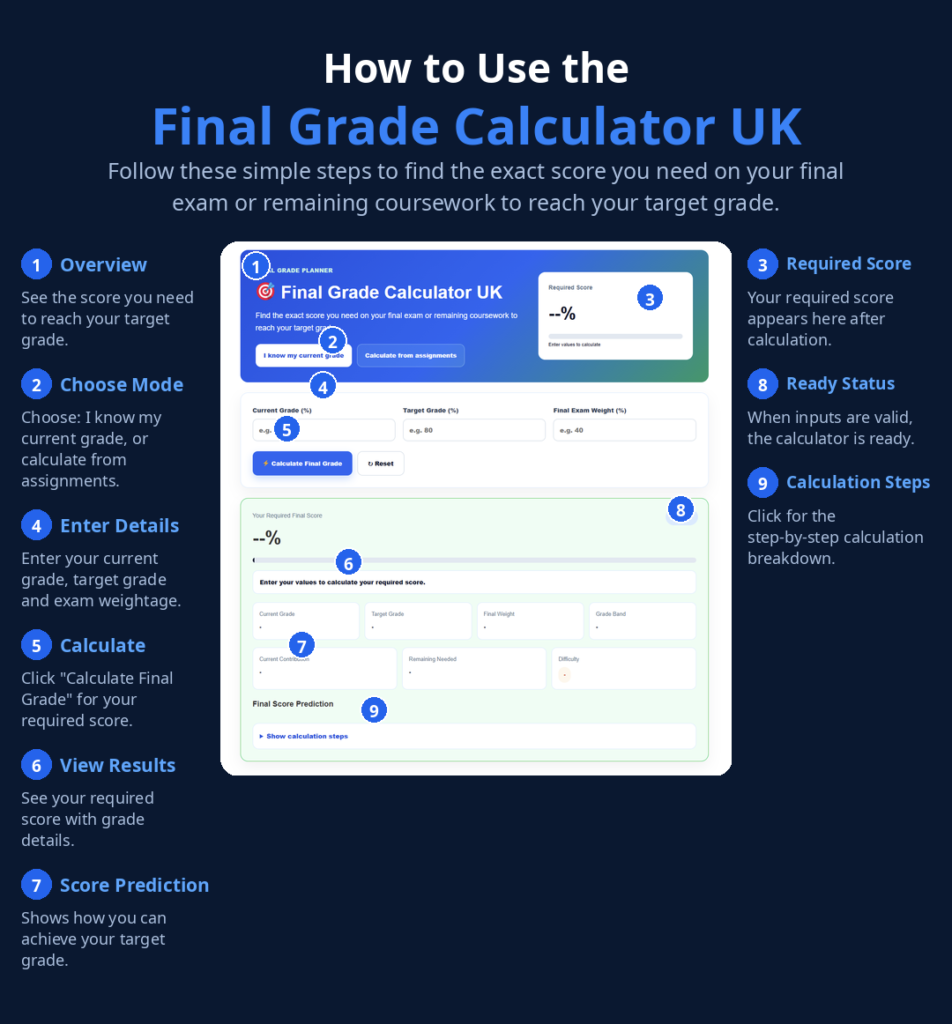
Click Here: Final Grade Calculator UK
Gate One: the degree route — MPharm, foundation year, registration
The MPharm is a four-year, full-time integrated master’s degree and the first part of the route to registration as a pharmacist in Great Britain. The General Pharmaceutical Council (GPhC) accredits every programme: its current list runs to 40 provider entries, including newcomers working towards accreditation — Leicester, Liverpool, Teesside, Sheffield, Bangor, Anglia Ruskin, Coventry, Suffolk and Worcester — while London Metropolitan’s programme (LJMU) is closed to further intakes and Bradford is no longer accepting applications. The standard format is the four-year MPharm, but the GPhC also accredits variants: four-year 2+2 programmes partly taught overseas, five-year routes with a preparatory year, and five-year integrated programmes with foundation training built in — UCL’s five-year MPharm with integrated foundation training was accredited in January 2026.
The standards governing these degrees were rewritten in January 2021. A detail worth getting right, because many summaries garble it: the 2021 standards are not “10 standards” — that numbering belongs to the old May 2011 document. The current framework has two parts: Part 1 sets the learning outcomes across four domains, and Part 2 sets two groups of numbered standards — Standards 1–5 for the MPharm degree itself (including curriculum design) and Standards 1–9 for the foundation training year. For grading purposes, what matters is the philosophy behind them: patient safety sits above academic convention, and it shows up directly in the pass marks.
After the degree comes the second half of the route. Standard 8.1 requires 52 weeks of practical training designated as the foundation training year, supervised by a designated supervisor (a pharmacist) plus a designated prescribing practitioner — and since the 2021 standards took effect, the foundation year also includes at least 90 hours of supervised practice directly related to independent prescribing. Sign-off requires more than one person to agree, every assessment must be passed first, and a trainee cannot be signed off while fitness-to-practise concerns are outstanding. From 2026, pharmacists qualifying under the 2021 standards register as pharmacist independent prescribers from initial registration — June 2026 saw the first registration-assessment sitting by trainees trained under the new standards.
Then the registration assessment itself: two papers sat on the same day. Part 1 is 40 calculation questions in two hours with a calculator allowed; Part 2 is 120 questions — 90 single-best-answer plus 30 extended matching — in two and a half hours with no calculator. You must reach the pass mark on each paper independently. Here is another number that surprises students: the pass mark is not fixed at 70%. The GPhC sets it by standard-setting for each sitting, and has publicly rebutted the “must score 70%” claim. Recent published results: June 2025 — 77% overall (2,247 of 2,913 passed; 80% of first-time sitters); November 2025 — 61.5% overall (722 of 1,174; 60% first-time); June 2026 — 83% overall (2,748 of 3,326), the highest summer pass rate since 2021. Candidates get a maximum of three attempts in a lifetime — which makes the in-degree safety culture below look a lot less eccentric.
How your degree class is actually calculated
First, clear up a common misconception: the MPharm is an integrated master’s, but it is classified with Honours bands — First, Upper Second (2:1), Lower Second (2:2), Third — not Merit and Distinction. Reading’s programme specification gives the canonical scheme: 70–100% First, 60–69% Upper Second, 50–59% Lower Second, 40–49% Third. (Newcastle sets the Stage 4 pass mark at 50, reflecting master’s-level final-year modules, but the degree class bands remain the Honours ones.)
Second, and more distinctive: because it is an integrated master’s, your first year never counts toward your classification. At every verified school the counting starts at year 2, and the final year carries roughly half the total weight. The exact schemes are university-specific — there is no national formula — but the verified examples cluster tightly:
| University | Year 1 | Year 2 | Year 3 | Year 4 |
|---|---|---|---|---|
| Reading | 0% | 20% | 30% | 50% |
| UCL | 0% | 20% | 30% | 50% |
| Bath | 0% | 16% | 34% | 50% |
| Newcastle (Stages 2–4 at 1:2:3) | 0% | ≈16.7% | ≈33.3% | 50% |
The Pharmacy Schools Council’s mapping research found the same pattern across the sector: the final year contributed an average of 58% of the final classification (ranging 40–70% between schools), while the practice component’s contribution ranged 21–63%. The practical upshot is that pharmacy degrees are among the most back-loaded in UK higher education — a weak second year hurts far less than a weak fourth year, which is exactly why students who coast through year 2 thinking “it’s early days” are misreading the maths. If you want to model your own position under your university’s scheme, the degree classification calculator handles multi-year weightings directly.
The safety-critical assessments: the 70% that fails you
Now the part that makes pharmacy grading genuinely different from, say, how medical degrees are graded. Pharmaceutical calculations exams are pass/fail components with thresholds set for patient safety, not for academic spread. At the Medway School of Pharmacy (Greenwich/Kent), the Pharmaceutical Calculations Exam requires 70% to pass in all four years — and year 4 also has a pass/fail OSCE. Bradford’s programme specification sets the same 70% threshold for the stage calculations exam, noting it is in line with GPhC requirements, with a 50% threshold standard for pharmacy law; the GPhC specifies that any assessed aspects of law or calculations must be passed. Some schools use rigorous standard-setting instead of a fixed number — so do not assume your school uses 70% — but the principle is universal: these components are gates, not averages.
The gate extends well beyond calculations. Bradford assesses through OSCEs/OSPEs, vivas, lab practicals, dispensing assessments and skills logs that record repeatable competent performance. Newcastle’s regulations state the rule bluntly: there is no cross-compensation between assessment elements — every assessment detailed in each unit of study must be passed. The GPhC’s own glossary defines compensation (allowing a small failure margin on the basis of satisfactory overall performance) and condonation, but universities disapply both for safety-critical elements. A 38% on a dispensary-safety component cannot be rescued by an 85% coursework average, at any threshold. If you are used to thinking in terms of condoned passes, pharmacy is the degree where that mechanism runs into its hard limit.
There are attendance gates too. Medway requires minimum 80% attendance (excluding lectures) plus 100% placement attendance to pass; Leicester’s student learning contract demands minimum 90% attendance to progress each year, with missed placement time made up — placements can include evenings and weekends. And professional conduct is assessed from day one: Leicester students sign an Annual Declaration of Good Health and Good Character and must report patient-safety or conduct concerns immediately, UCLan requires a clear enhanced DBS check, and at the GPhC level the 2021 standards prohibit signing off a foundation trainee while fitness-to-practise concerns are outstanding.
Worked example 1: how an MPharm classification is worked out
Take Amara, a third-year at a school using the Reading 0/20/30/50 scheme — year 1 excluded, year 2 at 20%, year 3 at 30%, year 4 at 50%. Her year averages: year 2 58%, year 3 64%, year 4 68%. The classification arithmetic:
0.20 × 58 = 11.6; 0.30 × 64 = 19.2; 0.50 × 68 = 34.0. Total: 11.6 + 19.2 + 34.0 = 64.8% — an Upper Second (2:1), comfortably clear of the 60% boundary but 5.2 marks short of a First. Note what does not appear anywhere in the calculation: her year 1 average of 55%. It is genuinely irrelevant — year 1 never counts at any verified school.
Now the question every finalist asks: what would Amara have needed in year 4 to reach a First? Her years 2 and 3 contribute a fixed 30.8 marks. She needs 70 − 30.8 = 39.2 marks from the final year, and 39.2 ÷ 0.50 = 78.4 — so a 79% final-year average would do it. The counterfactuals show how steep that slope is: a 72% final year gives 11.6 + 19.2 + 36.0 = 66.8% (still 2:1); even 76% gives 68.8%. When half your degree rests on one year, the difference between classifications is measured in single marks — which is why borderline rules matter so much to finalists.
As a cross-check, run the same profile through Newcastle’s 1:2:3 scheme (stages 2–4 weighted 1/6, 1/3, 1/2): 58/6 = 9.67; 64/3 = 21.33; 68/2 = 34.0. Total: 65.0%. Near-identical — the back-loaded structure dominates whichever of these schemes your school uses.
Worked example 2: the capped resit and the gate that cannot be averaged away
Daniel is in year 3 (Newcastle Stage 3) on a 20-credit module: a written exam worth 70% of the module, and an OSCE worth 30%. He scores 62% on the exam but fails the OSCE below its threshold. Under Newcastle’s rules a second attempt is automatic — but resit marks are capped at 40 for Stages 1–3. He passes the OSCE resit, so his recorded component mark is 40, not his true resit score. Module mark: 0.70 × 62 + 0.30 × 40 = 43.4 + 12.0 = 55.4%. If the cap did not exist and he had recorded, say, 55% on the resit, the module would be 43.4 + 16.5 = 59.9% — the cap cost him 4.5 module marks.
How much does that cost the degree? The module is one-sixth of his year 3 (six 20-credit modules), and year 3 is one-third of the degree under the 1:2:3 scheme: 4.5 ÷ 6 ÷ 3 ≈ 0.25 percentage points off his final average. That is the honest lesson of resit capping on an MPharm (UCL phrases the same rule as capping resit components at the minimum pass mark): the cap rarely destroys a degree — it destroys the upside. A resit can save your progression; it can never rescue your classification.
Now the sharper scenario — the gate. Amara’s counterpart at a Medway-style school has a module that is 70% coursework (she scores 85%) and 30% pharmaceutical calculations exam (she scores 68%). Weighted average: 0.70 × 85 + 0.30 × 68 = 59.5 + 20.4 = 79.9% — a first-class module mark on paper. But the calculations component requires 70% to pass, so 68% fails it, and with no compensation between assessment elements the module fails. She must resit the calculations exam and reach the 70% threshold; the 85% coursework cannot average her through. This is the moment pharmacy students describe as the culture shock of the degree: everything you learned about “your average will cover it” stops applying at the exact assessments where patient safety begins.
Placements: the hours that teach, not the marks that count
The 2021 standards do not fix a number of placement hours inside the degree — schools set their own timetables — but the direction of travel is unmistakable. At Manchester, total placement time grew from 6 to 23 days across the MPharm after the 2021 standards launched, with 2,160 timetabled placement hours delivered to 763 students in 2024/25. Nottingham runs professional placements in each year of the course. These placements are where the competency architecture is built: pre-work, ward visits, peer observation, presentations and tutor assessment feed the skills logs and the professional judgement that OSCEs later examine.
The money behind this is visible too: MPharm placements in England attract the NHS Education and Training Tariff — £5,343 plus a market forces factor per full-time-equivalent of 40.8 weeks at 37.5 hours per week — which is one reason schools can resource ward-level supervision. And the 90-hour supervised prescribing-practice requirement in the foundation year (the “period of learning in practice”) means the degree’s placement pattern is really a four-year runway to a prescribing role: from 2026, new registrants under the 2021 standards prescribe from day one.

What happens if you fail: resits, caps and the exit routes
Resit rules on the MPharm are more restrictive than on a standard BSc, and the differences are deliberate. UCL offers resits in all four years but caps resit components at the minimum pass mark. Newcastle grants a second attempt automatically but caps resit marks at 40 (Stages 1–3) or 50 (Stage 4). Strathclyde is the strictest of the verified schools: students must pass all 120 credits each year to progress, with normally a maximum of two attempts at each module; failing up to 40 credits transfers you to the BSc (Hons) Biochemistry and Pharmacology, and failing more than 40 credits means withdrawal with the relevant exit award — typically a BSc in Pharmaceutical Sciences for those who do not meet the MPharm award requirements.
Those exit awards matter, because the MPharm has one of the hardest “no plan B” edges in UK higher education: the GPhC does not accept Aegrotat degrees for entry to foundation training or the registration assessment — an unclassified or compassionate award does not get you to registration. And remember the lifetime cap at the end of the route: the registration assessment can be attempted a maximum of three times, ever. The whole pipeline — degree, foundation year, assessment — is designed so that struggling students are redirected early rather than carried along, which is why understanding the resit rules in your own programme handbook matters more here than on almost any other degree.
One final, uncomfortable fact worth knowing rather than discovering: the Pharmaceutical Journal’s analysis of HESA data for 2017/18–2018/19 MPharm graduates found that 91% of white students were awarded a First or Upper Second, compared with 79% of Black, Asian and minority-ethnic students — a 12 percentage-point awarding gap. Schools have published action plans in response, but applicants and students should know the sector’s own numbers.
The two-gate checklist: auditing your own position
Pull the whole system together and it reduces to two gates you must pass in order. Students who audit only Gate 1 — the classification maths — are the ones blindsided by Gate 2 in year 3 or 4. Run this check on yourself at the start of every academic year:
| Gate 1: the degree | Gate 2: the profession | |
|---|---|---|
| What is measured | Weighted average across years 2–4 (year 1 never counts) | Safety-critical components: calculations, OSCE/OSPE, dispensing, law |
| Threshold | 40% module pass; Honours bands 40/50/60/70 | Component-specific: commonly 70% for calculations; threshold set by standard-setting for OSCEs |
| Compensation | Standard university rules apply to ordinary modules | None — no cross-compensation; each assessment must be passed |
| Resits | Capped at minimum pass mark (UCL) or 40/50 (Newcastle) | Must clear the threshold itself; capped resits can block progression |
| Attendance | Standard expectations | 80–90% minimums; 100% placement attendance at some schools |
| Who sets the rules | Your university’s regulations | The GPhC’s 2021 standards + your university’s professional requirements |
| What failure costs | Classification damage (limited by resit caps) | Progression blocks, transfer to exit awards, or loss of the route to registration |
That table is the article in miniature. Model your classification with the year weightings; respect the gates; and check your programme handbook for the two numbers that matter most — your school’s calculations threshold and its resit cap — because those are the numbers that decide whether a bad week becomes a bad degree.
Frequently asked questions
What degree do you need to become a pharmacist in the UK?
You need an MPharm — a four-year full-time integrated master’s degree accredited by the General Pharmaceutical Council (GPhC). The degree is only the first part of the route: after it comes a 52-week foundation training year and the GPhC registration assessment. Only when all three are complete can you register as a pharmacist and use the protected title.
Do pharmacy degrees have a Merit or Distinction?
No. Although the MPharm is an integrated master’s, it is classified with Honours bands — First (70%+), Upper Second 2:1 (60–69%), Lower Second 2:2 (50–59%) and Third (40–49%) — not Merit and Distinction. The one wrinkle is that some schools set the final-year pass mark at 50% to reflect master’s-level study, but the degree class bands stay the same.
Is 40% a pass on an MPharm?
For ordinary modules, yes — 40% is the standard pass mark. But safety-critical assessments carry their own thresholds: pharmaceutical calculations exams commonly require 70% (verified at Medway and Bradford), pharmacy law has its own threshold, and OSCEs use threshold marks set by rigorous standard-setting. There is no compensation between assessment elements, so a 40%-plus average cannot carry a failed safety-critical component.
Does the first year of an MPharm count toward your degree class?
No. At every verified school — Reading, UCL, Bath and Newcastle — year 1 carries zero weighting toward classification. The counting schemes all start at year 2, typically 20% / 30% / 50% for years 2, 3 and 4 (Bath uses 16% / 34% / 50%; Newcastle weights stages 2–4 at 1:2:3). Year 1 still has to be passed to progress, but its marks do not affect your final class.
What happens if you fail a calculations exam on a pharmacy degree?
You must resit it and reach the threshold (commonly 70%) — your other marks cannot compensate for it. Depending on your university, the resit may be capped at the minimum pass mark (UCL) or at 40 for stages 1–3 (Newcastle). Failing to clear the threshold blocks progression even if your overall average is strong, because calculations is a safety-critical gate, not an averageable component.
Do placements count toward your final MPharm grade?
Placement hours themselves are not usually percentage-marked components — their contribution is indirect but real. Placements build the competencies examined in OSCEs, dispensing assessments and skills logs, and schools enforce attendance gates (up to 100% placement attendance at Medway, 90% overall attendance at Leicester). The Pharmacy Schools Council found the practice component contributed between 21% and 63% of the final classification across schools.
How hard is the GPhC registration assessment?
It is a genuine filter: recent pass rates were 77% (June 2025), 61.5% (November 2025) and 83% (June 2026, the highest since 2021). It has two papers on the same day — 40 calculation questions with a calculator, then 120 questions without — and you must reach the pass mark on each paper independently. The pass mark is set by standard-setting per sitting, not fixed at 70%, and candidates get a maximum of three attempts in a lifetime.
Can you resit a failed year on an MPharm?
Usually yes, within tight limits: UCL offers resits in all four years, Newcastle grants an automatic second attempt, and Strathclyde normally allows a maximum of two attempts per module. Resit marks are capped, so resits protect progression rather than classifications. Fail beyond the limits and you may be transferred to an exit award such as a BSc in Pharmaceutical Sciences — and note that the GPhC does not accept Aegrotat degrees for entry to foundation training.
Conclusion
Pharmacy is the UK degree where the grading system is most honestly described as two systems in one. Your classification is pure arithmetic — a back-loaded weighted average across years 2 to 4, with year 1 discarded and the final year carrying roughly half the total — and you can model it precisely with the Final Grade Calculator once you know your school’s scheme. But the average only converts into a degree if you have passed the second system: the safety-critical gates — calculations thresholds, OSCE standards, dispensing competence, attendance minimums — where compensation is disallowed and a 68% can be a fail.
That structure is not an accident; it is the GPhC’s patient-safety philosophy expressed in marks. The students who thrive are the ones who budget their effort accordingly: they chase the classification with their final-year modules, and they treat the calculations exams and OSCEs with the disproportionate seriousness the thresholds demand. Pass both gates and the rest of the route — the 52-week foundation year, the registration assessment with its three lifetime attempts — becomes a professional formality rather than a cliff edge. For how pharmacy compares with the other regulated health degrees, see how medical degrees are graded and how nursing degrees are graded in the UK.