
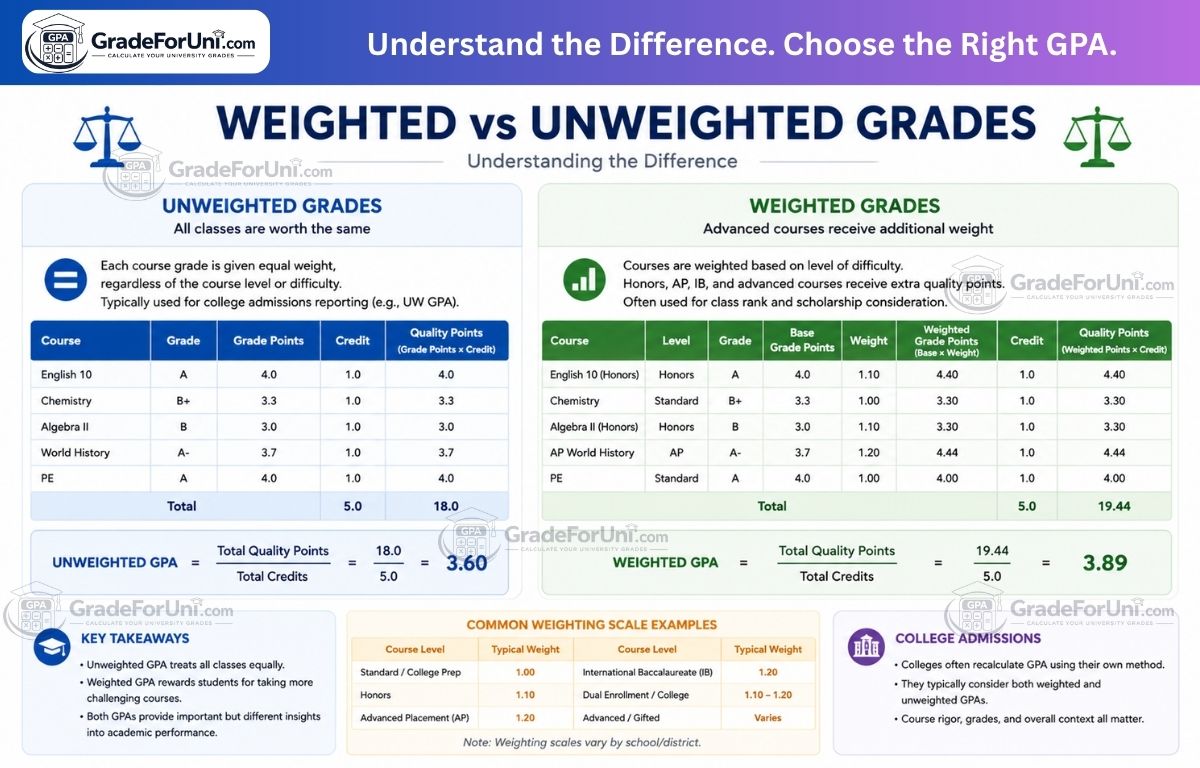
Weighted vs Unweighted Grades If you’ve ever looked at two students with the same average score and wondered why one ranks higher than the other, the answer usually comes down to one thing: weighting. Grades aren’t always treated equally, and understanding the difference between weighted and unweighted grades can change how you read your own results — or how you plan your next semester.
Let’s break this down in plain terms, no confusing jargon.
Visit Now: https://www.taxsal.com/
What Is an Unweighted Grade?
An unweighted grade treats every subject, module, or assignment exactly the same, regardless of how much work, difficulty, or credit value it carries. You simply add up all your scores and divide by the number of items.
Formula:
Unweighted average = (Score 1 + Score 2 + Score 3 + …) ÷ Number of items
So if you scored 70%, 60%, and 80% across three modules, your unweighted average is:
(70 + 60 + 80) ÷ 3 = 70%
Simple, clean, and easy to calculate by hand. The downside? It assumes every module matters equally — which often isn’t true in real academic life.
Read More: GPA Calculator – Calculate Your
What Is a Weighted Grade?
A weighted grade takes importance into account. Some modules carry more credit hours, more difficulty, or simply count for more toward your final degree or GPA. In a weighted system, higher-value subjects pull your average more than lower-value ones.
Formula:
Weighted average = (Score₁ × Weight₁ + Score₂ × Weight₂ + …) ÷ (Weight₁ + Weight₂ + …)
Let’s use the same scores as before, but now assign credit weights:
| Module | Score (%) | Credits |
| Module A | 70 | 20 |
| Module B | 60 | 10 |
| Module C | 80 | 10 |
Weighted average = (70×20 + 60×10 + 80×10) ÷ (20+10+10) = (1400+600+800) ÷ 40 = 70%
In this case it happens to land on the same number, but that’s only because the weights are somewhat balanced. Change the credit values even slightly, and the result shifts — which is exactly the point. Weighted grades reflect how your university (or school) actually values each piece of your coursework, not just a flat average.
A Clearer Example of Why It Matters
Imagine two modules:
- Module X: 90% score, but only worth 5 credits
- Module Y: 55% score, worth 25 credits
Unweighted average: (90 + 55) ÷ 2 = 72.5%
Weighted average: (90×5 + 55×25) ÷ (5+25) = (450 + 1375) ÷ 30 = 60.8%
That’s a huge gap — nearly 12 percentage points. If your university uses weighted averages (most do, especially for final degree classification), relying on the unweighted number would give you a completely false sense of where you stand. This is exactly why students sometimes feel confused when their “average” doesn’t match what shows up on their official transcript.
Where You’ll See Each Type Used
Unweighted grades are common in:
- Early school years where every subject is treated as equally important
- Simple module averages with no credit system
- Quick self-checks where you just want a rough idea of performance
Weighted grades are common in:
- University degree classifications (UK universities almost always weight by credit hours)
- GPA systems in the US, where course difficulty (honors, AP, etc.) can add extra weight
- Final-year academic results, where later years often count more than earlier ones
- Any course structure where assignments, exams, and coursework carry different percentages of the final grade
Read More: How to Improve Your University
Weighted Grades and GPA
In many US-based GPA systems, weighting goes a step further — it’s not just about credit hours, but also course difficulty. An Honors or AP class might add extra points to your GPA scale specifically because it’s considered harder than a standard class. So a “B” in an AP course might actually count for more than an “A” in a regular one, depending on the school’s policy.
This is a different kind of weighting than credit-based weighting, but the underlying idea is the same: not all grades are created equal, and the system tries to reflect that.
Common Mistakes Students Make
Assuming all grades count the same. Many students calculate a quick mental average and panic — or celebrate too early — without realizing their university applies credit weighting behind the scenes.
Ignoring year-based weighting. Some degree programs weight later years more heavily than earlier ones. For example, a common UK structure gives Year 1 zero weight, Year 2 around 33%, and Year 3 around 67% toward the final degree result. If you only look at a flat average across all three years, you’ll miss this entirely.
Mixing up weighted and unweighted GPA scales. A 4.0 unweighted GPA and a 4.0 weighted GPA don’t mean the same thing — weighted scales often go above 4.0 (sometimes up to 5.0) because of bonus points from harder courses.
Not checking the official policy. Every institution has its own rules. Some round differently, some use slightly different weight splits, and some have unique grade boundaries. Always confirm with your university or school handbook rather than assuming a general formula applies exactly.
How to Check Which One Applies to You
The quickest way to know is to check your course handbook, syllabus, or academic transcript guidelines. Look for terms like “credit-weighted,” “GPA scale,” or specific percentage breakdowns for each year or module. If your university publishes a formula for calculating your final degree classification, it’s almost certainly weighted — flat averages are rare at the degree-classification level.
If you’re unsure, a grade calculator that supports both weighted and unweighted modes is the easiest way to compare your real standing. Enter your scores both ways and see how different the results look — it usually clears up any confusion in seconds.
Read More: UK University Grading System Explained
Final Thoughts
The difference between weighted and unweighted grades isn’t just academic trivia — it can directly affect how you interpret your own performance, how much effort you put into specific modules, and even what classification or GPA you end up with. Unweighted grades give you a quick, rough snapshot. Weighted grades give you the real picture, the one your university actually uses to calculate your official results.
If your course has any credit system at all, assume weighting matters and check your numbers properly. It only takes a minute, and it can save you from some unpleasant surprises at results time.
FAQ’s
What is the difference in Weighted vs Unweighted Grades?
The main difference in weighted vs unweighted grades is that weighted grades account for credit hours or course difficulty, while unweighted grades treat every score equally.
Which is more accurate, weighted or unweighted grades?
Weighted grades are generally more accurate because they reflect how your university actually calculates your final result, unlike a simple flat average.
How do I calculate Weighted vs Unweighted Grades manually?
For weighted vs unweighted grades, use the unweighted formula (sum of scores ÷ number of items) for a flat average, or the weighted formula (score × credit, summed and divided by total credits) for an accurate result.
Do universities use weighted or unweighted grades?
Most universities use weighted grades for final degree classifications, since modules with more credits naturally count for more.
Why does the Weighted vs Unweighted Grades comparison matter for GPA?
In the weighted vs unweighted grades comparison, GPA scales can differ significantly — a weighted GPA may exceed 4.0 due to bonus points from harder courses like AP or Honors classes.
Can weighted and unweighted grades give the same result?
Yes, if all your subjects carry equal credit weight, weighted vs unweighted grades will produce the same number. Once credits differ, the results diverge.
How much can the Weighted vs Unweighted Grades difference be?
The gap between weighted vs unweighted grades can be significant — sometimes 10 percentage points or more — depending on how unevenly credits are distributed across modules.
Which type should I check before exams?
Always check whether your institution uses weighted or unweighted grading before exams, since planning around the wrong system can give you a false sense of your standing.
Is the Weighted vs Unweighted Grades formula the same everywhere?
No, the weighted vs unweighted grades formula structure stays similar, but exact credit values, rounding rules, and grade boundaries vary by university or school.
How can I quickly check Weighted vs Unweighted Grades for my modules?
The easiest way to compare weighted vs unweighted grades is to use an online grade calculator that supports both modes — enter your scores once and see both results instantly.