
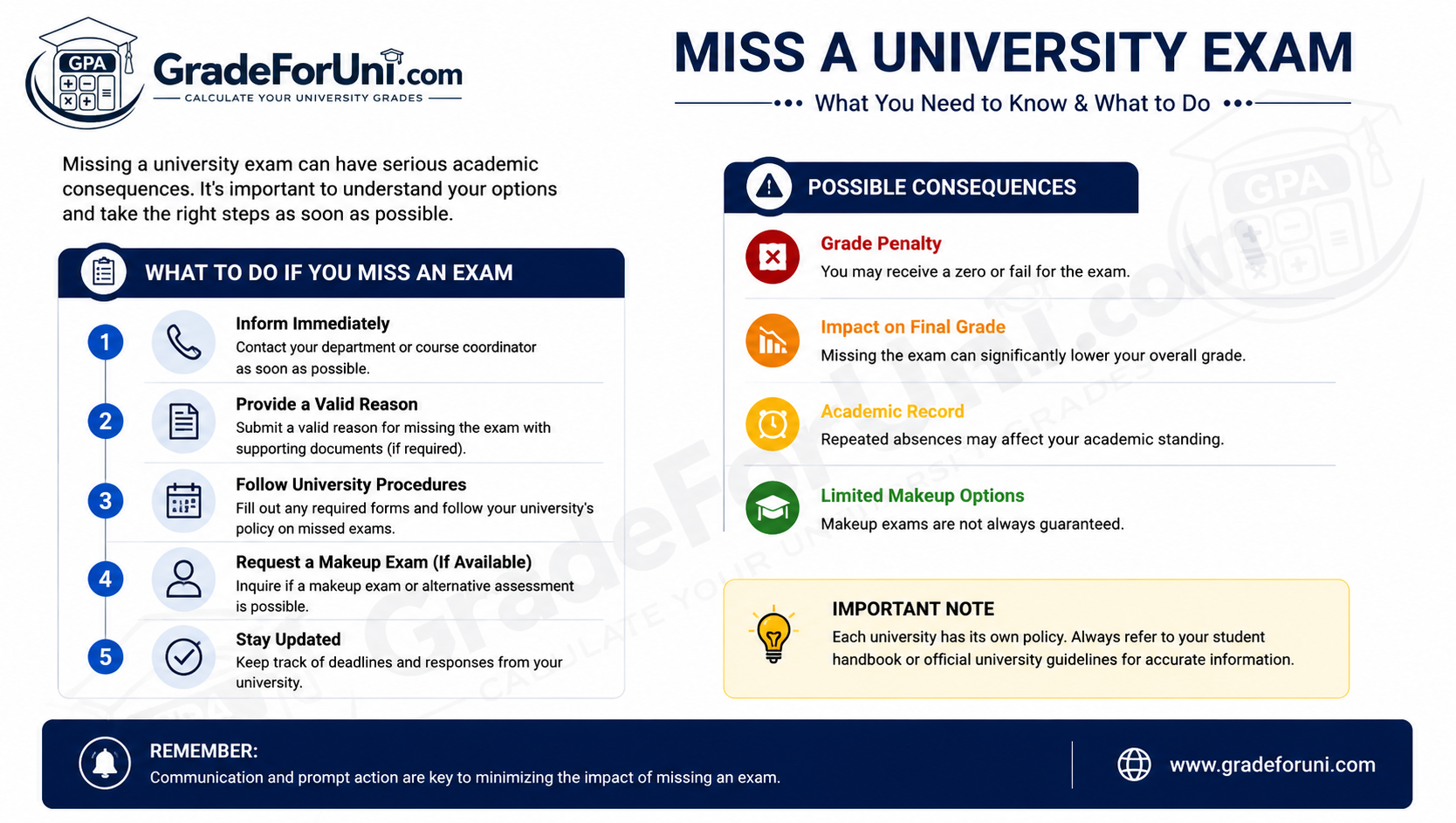
Missing a University Exam feels like one of those moments where your stomach drops and your brain refuses to think straight. Miss a University Exam: Maybe you slept through your alarm. Maybe you were violently ill the night before. Maybe a family emergency came out of nowhere and exams were the last thing on your mind. Miss a University Exam: Whatever the reason, the panic that follows is real, and the first thing most students do is Google exactly what you’re doing right now.
Here’s the reassuring part: if you miss a university exam, it is very rarely the end of the world. Miss a University Exam: UK universities deal with missed exams every single assessment period, and there are established processes for handling exactly this situation. Miss a University Exam: What matters is what you do in the hours and days immediately afterward.
This guide walks you through what actually happens when you miss an exam, what your options are, and how to give yourself the best possible chance of a fair outcome.
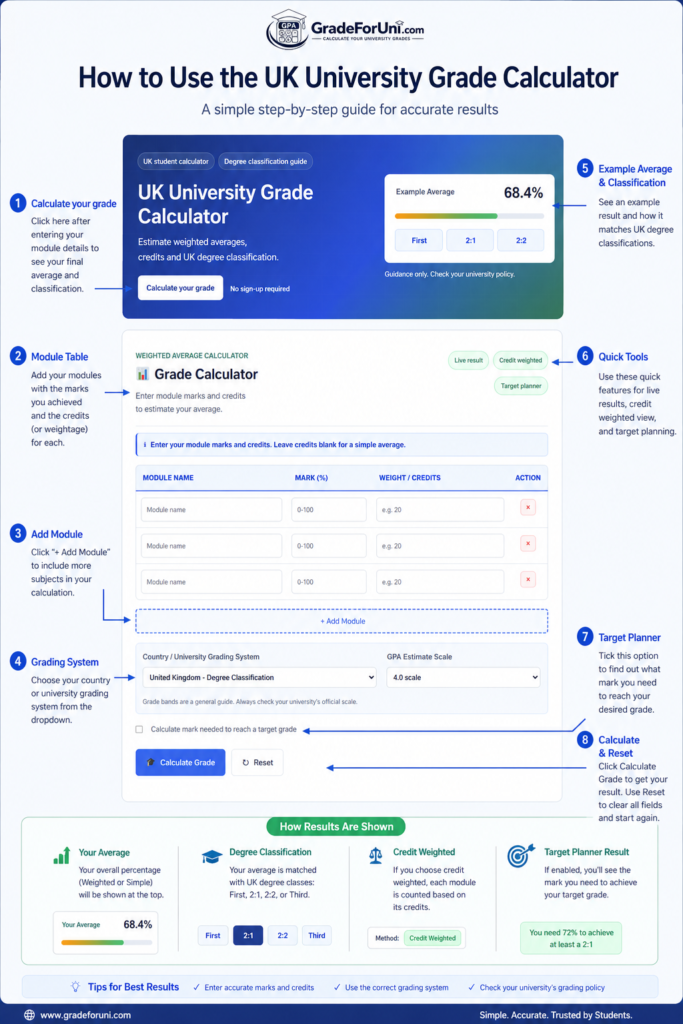
Click Here: UK University Grade Calculator
How to Use the UK University Grade Calculator
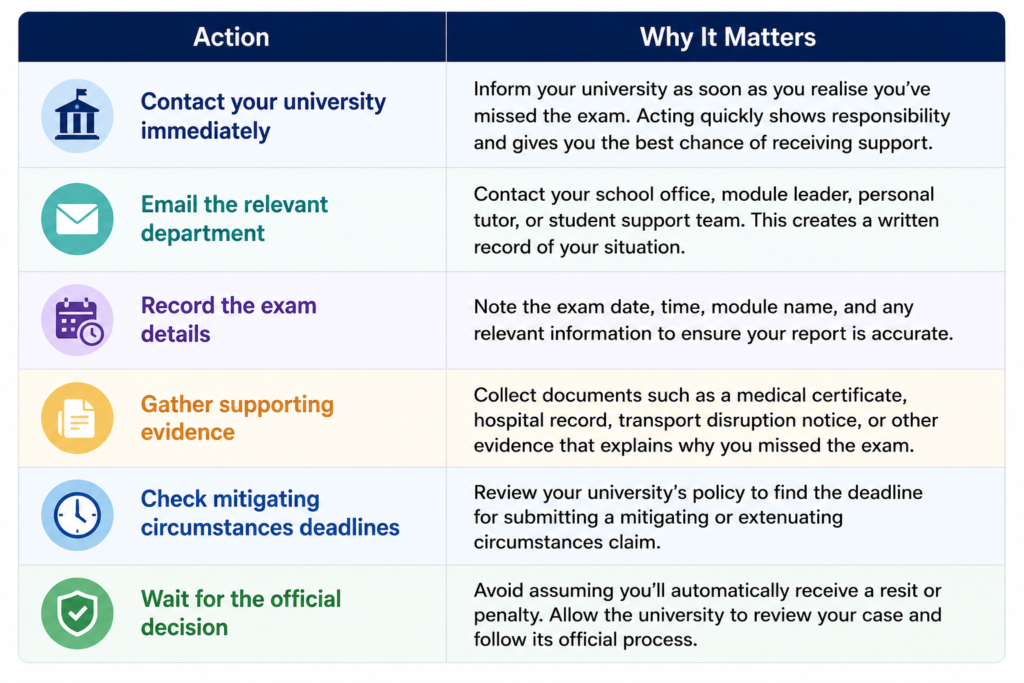
The First Thing to Do When You Miss an Exam
| Action | Why It Matters |
|---|---|
| Contact your university immediately | Inform your university as soon as you realise you’ve missed the exam. Acting quickly shows responsibility and gives you the best chance of receiving support. |
| Email the relevant department | Contact your school office, module leader, personal tutor, or student support team. This creates a written record of your situation. |
| Record the exam details | Note the exam date, time, module name, and any relevant information to ensure your report is accurate. |
| Gather supporting evidence | Collect documents such as a medical certificate, hospital record, transport disruption notice, or other evidence that explains why you missed the exam. |
| Check mitigating circumstances deadlines | Review your university’s policy to find the deadline for submitting a mitigating or extenuating circumstances claim. |
| Wait for the official decision | Avoid assuming you’ll automatically receive a resit or penalty. Allow the university to review your case and follow its official process. |
Why Universities Have a Process for This at All
Miss a University Exam: It might seem surprising that something as serious as a missed exam has a fairly standard, well-worn process behind it. Miss a University Exam: But universities know that students get sick, have accidents, experience bereavements, or face circumstances entirely outside their control. Miss a University Exam: Rather than treating every missed exam as an automatic fail, most UK institutions run what’s called a mitigating circumstances process (sometimes called extenuating circumstances, depending on the university).
This process exists to answer one core question: was there a genuine, unforeseeable reason you couldn’t sit the exam, and can you provide evidence of it?
If the answer is yes, your university has several ways to make things fair. Miss a University Exam: If the answer is no, or if you can’t provide evidence, the outcome is usually less forgiving — though still not always catastrophic.
Read More: University Marking Criteria Explained – How Your Work Is Assessed
What Counts as a Valid Reason to Miss an Exam?
Universities aren’t looking for excuses; they’re looking for circumstances that were genuinely outside your control and that you couldn’t have reasonably planned around. Miss a University Exam Here’s how it generally breaks down: Miss a University Exam.
Reasons that are typically accepted
- Sudden illness or injury (with medical evidence)
- Hospitalisation, whether your own or a close family member’s
- Bereavement of a close family member or friend
- A diagnosed mental health crisis
- Being a victim of a crime close to the exam date
- Jury service or a legal obligation like a court summons
- A traumatic or unexpected personal event, such as a serious accident
Reasons that are usually not accepted
- Oversleeping without an underlying medical explanation.
- General exam stress or nerves that aren’t linked to a diagnosed condition.
- Poor planning, such as double-booking travel or work.
- Minor illnesses like a common cold or a mild headache.
- Technology issues that could have been avoided with earlier preparation.
- Holidays or events you knew about in advance.
The key phrase you’ll see in most university policies is that circumstances must be unforeseeable and outside your control. If it’s something you could have planned around, it’s unlikely to be accepted. Miss a University Exam.
It’s important to remember that universities expect students to take reasonable steps to prepare for assessments. Miss a University Exam. While unexpected emergencies are often considered, situations caused by avoidable mistakes or a lack of preparation are generally viewed differently. For example, forgetting the exam date, arriving late because you didn’t leave enough travel time, or failing to check your timetable will rarely be accepted as valid mitigating circumstances.
Similarly, routine responsibilities such as work commitments, social events, or pre-arranged holidays are usually considered personal choices rather than unforeseen events. Miss a University Exam: Universities typically expect students to organise these commitments around their academic assessments wherever possible.
Every university has its own mitigating circumstances policy, so the exact rules may differ. However, the underlying principle is usually the same: you must show that the situation was genuinely beyond your control and that it directly affected your ability to attend or complete the exam. Providing clear evidence and reporting the issue promptly can make a significant difference when your claim is reviewed.
Read More: taxsal.comThe “Fit to Sit” Policy: A Rule Every Student Should Know ( Miss a University Exam )
Here’s something that catches a lot of students off guard. Many UK universities operate what’s known as a fit to sit policy. Miss a University Exam: In plain English, this means: if you show up and attempt the exam, you’re telling the university that you consider yourself well enough and prepared enough to do so.
This matters because it means you generally can’t sit an exam, feel it went badly because you were unwell, and then apply for mitigating circumstances afterward. Miss a University Exam: If you know you’re not in a fit state to sit an exam, the safer move — assuming your situation allows it — is to not attempt it and instead report your circumstances immediately, rather than sitting it and hoping for leniency afterward.
Read More: Can You Improve Your Degree Classification? – Everything You Need to Know
What Evidence Do You Need?
Evidence is the backbone of any mitigating circumstances claim. Miss a University Exam: Universities can’t simply take your word for it (as understandable as that might feel in the moment), so you’ll usually need independent documentation.
| Situation | Typical Evidence Required |
|---|---|
| Illness or injury | GP letter, hospital discharge note, or medical certificate |
| Bereavement | Death certificate, order of service, or a letter confirming the relationship |
| Mental health crisis | Letter from a counsellor, GP, or crisis service |
| Accident or emergency | Police report, hospital records, or incident report |
| Jury service or legal obligation | Official court or jury summons letter |
| Victim of crime | Crime reference number or police correspondence |
If you’re struggling to get evidence quickly, most universities will still let you submit your claim and follow up with documentation shortly afterward. Don’t let the absence of paperwork stop you from reporting the issue on time — the golden rule is to report first, gather evidence second.
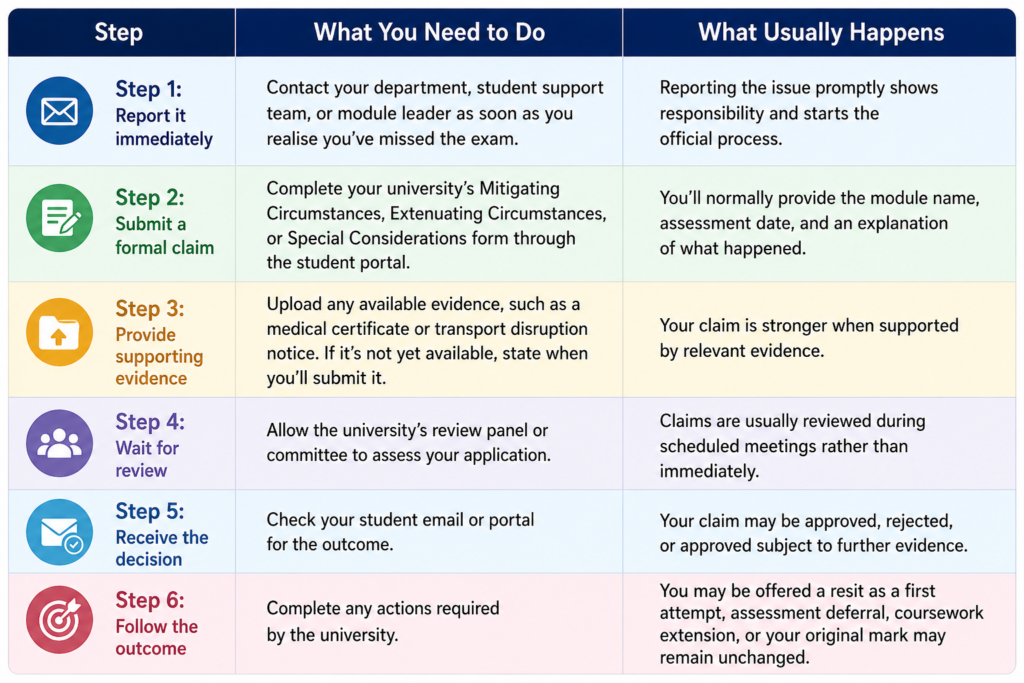
| Step | What You Need to Do | What Usually Happens |
|---|---|---|
| Step 1: Report it immediately | Contact your department, student support team, or module leader as soon as you realise you’ve missed the exam. | Reporting the issue promptly shows responsibility and starts the official process. |
| Step 2: Submit a formal claim | Complete your university’s Mitigating Circumstances, Extenuating Circumstances, or Special Considerations form through the student portal. | You’ll normally provide the module name, assessment date, and an explanation of what happened. |
| Step 3: Provide supporting evidence | Upload any available evidence, such as a medical certificate or transport disruption notice. If it’s not yet available, state when you’ll submit it. | Your claim is stronger when supported by relevant evidence. |
| Step 4: Wait for review | Allow the university’s review panel or committee to assess your application. | Claims are usually reviewed during scheduled meetings rather than immediately. |
| Step 5: Receive the decision | Check your student email or portal for the outcome. | Your claim may be approved, rejected, or approved subject to further evidence. |
| Step 6: Follow the outcome | Complete any actions required by the university. | You may be offered a resit as a first attempt, assessment deferral, coursework extension, or your original mark may remain unchanged. |
What Happens If Your Claim Is Accepted?
If your mitigating circumstances claim is approved, universities typically offer one of the following outcomes, depending on the situation and their specific policy:
- A deferred attempt, meaning you sit the exam at the next available opportunity as if it were your first attempt, with no mark cap
- An extension, if the missed assessment is coursework rather than an exam
- A borderline classification review, in some cases, if the missed assessment affected your overall degree outcome
The crucial detail here is the phrase “as a first attempt.” This matters enormously. Missing a University Exam because a first attempt is usually uncapped, meaning you can achieve your full potential mark. Compare that to a standard resit following a fail, which is often capped at the pass mark, usually 40% for undergraduate study.
What Happens If Your Claim Is Rejected?
If your claim doesn’t meet the criteria, or the evidence isn’t sufficient, the missed exam is typically recorded as a non-attendance, and you’ll usually be given a mark of zero for that assessment. Miss a University Exam: You may still be offered a resit opportunity, but it will likely be treated as a capped resit rather than a first attempt.
This is exactly why timing and evidence matter so much. Miss a University Exam: A rejected claim isn’t necessarily final either — most universities have an appeals process if you believe your claim was assessed unfairly or if you can provide additional evidence afterward.
How Missing an Exam Affects Your Final Grade
This is often the real worry behind the question, and it’s worth being straightforward about it. If your mitigating circumstances claim is successful and you’re given an uncapped resit, your final module and degree classification are protected in the same way they would have been if you’d sat the original exam on time.
If your claim is rejected and the resit is capped, your maximum possible mark for that module will usually be limited, which can, in some cases, pull down your overall average. This is one of many reasons students often use a grade calculator to model different scenarios and understand exactly how one capped module might affect their final classification, rather than guessing and worrying about missing a University Exam unnecessarily.
Common Myths About Missing a University Exam
Many students hear advice from friends or social media that simply isn’t accurate. Believing these myths can lead to unnecessary panic or poor decisions. Understanding the facts can help you respond appropriately if you ever miss an assessment.
Myth 1: “Missing one exam means automatic failure of the year.”
Reality: Not true. A single missed exam, properly reported and evidenced, is a routine situation universities are well equipped to handle.
Keep in mind:
- Universities have established procedures for missed assessments.
- Your overall academic outcome depends on your university’s regulations.
- Reporting the issue promptly gives you the best chance of receiving support.
Myth 2: “You need to submit evidence on the same day.”
Reality: Also not true. Miss a University Exam: What matters most is reporting the situation promptly. Evidence can often follow within a set number of working days.
Remember:
- Contact your university as soon as possible.
- Ask about the deadline for submitting supporting documents.
- Provide evidence as soon as it becomes available.
Myth 3: “Mitigating circumstances claims are rarely approved.”
Reality: In reality, claims backed by genuine, unforeseeable circumstances and solid evidence are approved regularly. Universities aren’t looking to catch students out.
A stronger claim usually includes:
- A clear explanation of what happened.
- Relevant supporting evidence.
- Submission within the university’s stated deadline.
- Honest and accurate information throughout the process.
Myth 4: “If you’re too embarrassed to explain what happened, it’s better to say nothing.”
Reality: This is genuinely one of the worst things you can do. Committees consistently note that personal embarrassment isn’t considered a valid reason for late reporting, and staying silent only removes your chance of a fair outcome.
Instead, you should:
- Contact your department or student support team immediately.
- Explain the situation honestly and professionally.
- Follow the official process rather than delaying your response.
Myth 5: “Every university follows the same rules.”
Reality: While the overall process is similar across UK universities, each institution has its own academic regulations, deadlines, and mitigating circumstances policy.
Always check:
- Your university’s student handbook.
- The mitigating or extenuating circumstances policy.
- Submission deadlines and evidence requirements.
- Any guidance provided by your department or student support team.
Myth 6: “If your claim is rejected, you have no further options.”
Reality: A rejected claim doesn’t always mean the end of the process. Depending on your university’s regulations, you may be able to request a review, submit additional evidence, or explore other academic support options.
Before taking further action:
- Read the decision carefully.
- Check whether an appeal or review process is available.
- Speak to your student support service or academic adviser if you need guidance.
By understanding these common myths, you can make informed decisions and avoid unnecessary stress. The most important thing is to act quickly, communicate with your university, and follow the official procedures rather than relying on rumours or advice from other students..
Practical Example
Imagine a second-year student, Sam, wakes up with a severe migraine on the morning of a 9 am exam, something they’ve never experienced before and have no history of. Sam emails their department immediately, explains the situation, and visits a GP that same day, who confirms the migraine and advises rest.
Because Sam reported the issue straight away and followed up with medical evidence within the university’s required window, their mitigating circumstances claim is accepted. Miss a University Exam: Sam is offered a deferred sitting of the exam in the next assessment period, treated as a first attempt, with no cap on the mark. Had Sam stayed quiet, tried to push through revision that evening, and only mentioned it weeks later when results came out, the outcome would likely have been very different.
Read More: GPA vs Percentage: 7 Essential Differences Every Student Should Know
FAQ’s
What happens if you miss a university exam without a valid reason?
You’ll usually be recorded as a non-attendance and given a mark of zero for that assessment, though you may still be offered a capped resit depending on your university’s policy. Miss a University Exam.
Can you still pass the year if you miss one exam?
Yes, in most cases. Miss a University Exam. A single missed exam, especially one covered by an accepted mitigating circumstances claim, doesn’t automatically prevent you from passing the year.
How long do I have to report a missed exam?
This varies by university, but many require you to report within a matter of days, sometimes as little as five to ten working days. Always report as soon as possible rather than waiting for the deadline.
Do I need medical evidence to miss a university exam?
Anything beyond a very short-term issue: yes, most universities require independent evidence such as a GP letter or hospital documentation.
What is a “fit to sit” policy?
It means that if you attend and attempt an exam, you’re confirming you consider yourself fit to do so, which generally rules out claiming mitigating circumstances for that same exam afterward.
Will a missed exam show up on my degree transcript?
Generally, no. Miss a University Exam If your mitigating circumstances claim is accepted and you’re given a deferred first attempt, your transcript typically reflects the resit mark as if it were your original attempt.
Can I appeal if my mitigating circumstances claim is rejected?
Yes, most universities have a formal appeals process, especially if you can provide additional evidence or believe the original decision wasn’t handled correctly.
Is a capped resit worse than a first attempt?
Yes, usually. Miss a University Exam: A capped resit typically limits your mark to the pass threshold, often 40% for undergraduate courses, while a first attempt allows you to achieve your full potential mark.
What should I do the moment I realise I’m going to miss an exam?
Contact your department or student support team immediately, note down exactly what’s happening, and begin gathering any evidence, even if you can only submit it a few days later.
Does missing an exam always require a formal panel review?
Most universities do route claims through a mitigating circumstances panel or committee, though minor short-term issues may sometimes be handled through a simpler self-certification process. Miss a University Exam.
Final Thoughts
Missing a university exam is stressful, but it’s also one of the most well-documented situations in UK higher education. Miss a University Exam The system exists precisely because life doesn’t pause for assessment periods. Universities understand that genuine emergencies, illnesses, and unexpected circumstances can affect even the most organised students. That’s why procedures such as mitigating circumstances, extenuating circumstances, and special considerations are in place—to ensure students are treated fairly when unforeseen events occur.
The single most important thing you can do is act immediately: tell your university what’s happened, follow their process closely, and gather evidence as soon as you reasonably can. Acting quickly demonstrates responsibility, gives your university the information it needs to assess your case, and may improve your chances of receiving the appropriate academic support. Keeping copies of emails, forms, and supporting documents can also help ensure there is a clear record of your communication throughout the process.
Panic is normal. But panic shouldn’t stop you from taking the one action that actually protects your outcome: picking up your phone or laptop and reporting the situation the moment it happens. Miss a University Exam. Once you’ve reported the issue, allow the university to review your circumstances and avoid making assumptions about the final decision until you’ve received an official response.
Remember that every university has its own academic regulations and deadlines, so always check your institution’s guidance and follow the instructions provided by your department or student support team. Even if the outcome isn’t exactly what you hoped for, responding promptly and following the correct procedure gives you the best possible opportunity to move forward and continue your studies with confidence.