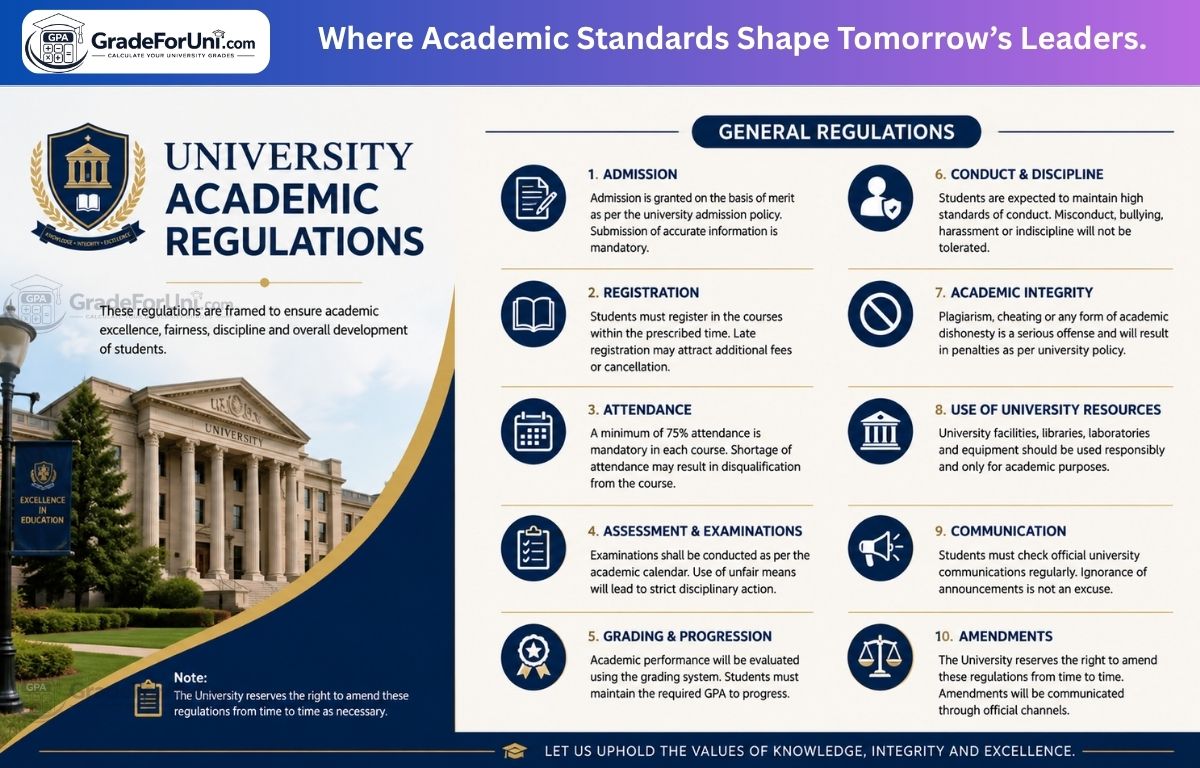
University Academic Regulations: Get pulled up for submitting an assignment two hours late and told it’s now capped at 40%, and it’s easy to feel like the rule came out of nowhere. University Academic Regulations: It didn’t. Somewhere in a document you were sent during freshers’ week — and probably never opened — is a full explanation of exactly why that happened. That document is your university’s academic regulations, and most students go through an entire degree without really understanding what’s in it.
That’s a problem, because University Academic Regulations aren’t just admin paperwork. They decide how your grades are calculated, what happens if you’re ill during an exam, whether you can resit a failed module, and even how your final degree classification gets rounded. This guide breaks down what these rules actually cover, in plain language, so you know exactly where you stand before you need to.
Click Here: UK University Grade Calculator
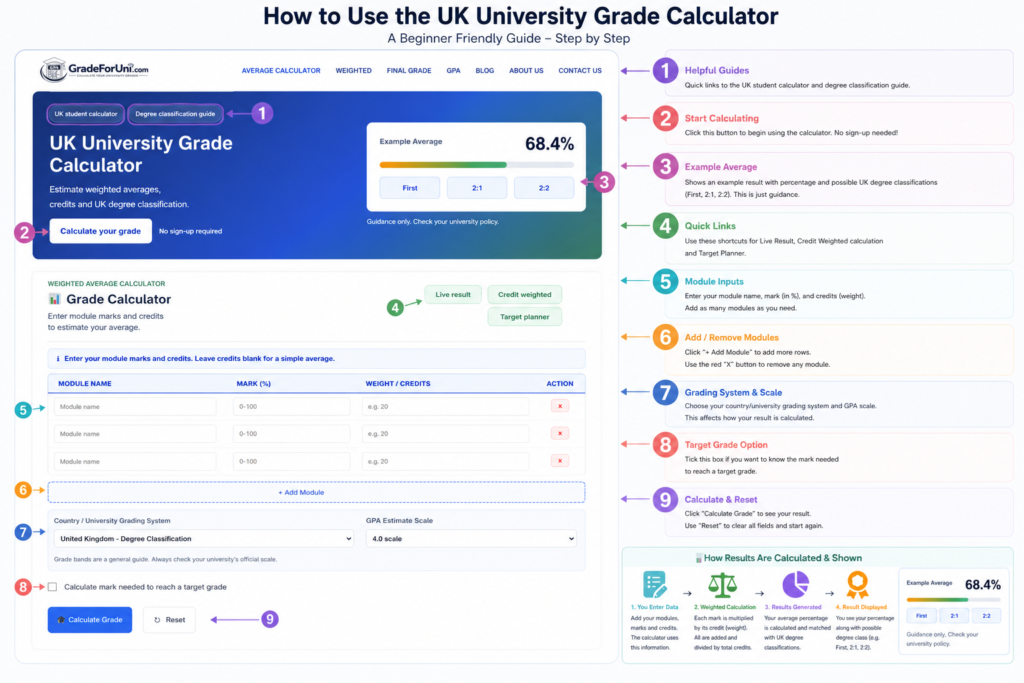
How to use the UK University Grade Calculator
How University Academic Regulations Affect Your Degree
University Academic Regulations influence almost every stage of your academic journey, from your first assessment to your final degree classification. University Academic Regulations: These regulations determine how module marks are calculated, how credits are awarded, what pass marks you must achieve, and how different years of study contribute to your final result. They also explain the rules for resits, compensation, mitigating circumstances, academic appeals, and progression to the next stage of your course.
Understanding these regulations helps you make informed academic decisions and avoid common misunderstandings. For example, knowing whether your first year contributes to your final classification or how a failed module affects your progression can make a significant difference to your study planning. University Academic Regulations: Rather than relying on assumptions or advice from other students, referring to your university’s official regulations ensures you understand exactly how your performance will be assessed.
Although many UK universities follow similar principles, each institution has its own academic policies and procedures. University Academic Regulations: Taking the time to read your course handbook and university regulations can help you stay on track, protect your academic standing, and work confidently towards your target degree classification.
Read More: Taxsal.comWhat Are University Academic Regulations?
University academic regulations are the official rulebook that governs how a university runs its degree programmes. They set out things like:
- How modules are assessed and marked
- The minimum marks needed to pass a year
- What counts as a valid reason to defer an exam
- How degree classifications are calculated
- The process for appeals, resits, and academic misconduct cases
Every UK university publishes its own version, usually as a PDF on the student portal or intranet, and it’s reviewed by an academic board most years. The wording differs between institutions, but the underlying structure — progression rules, assessment rules, classification rules — is broadly similar across the sector.
Think of it as the constitution for your degree. Your lecturers don’t personally decide what happens if you fail a module twice; the regulations already say what happens, and everyone has to follow them.
Read More: What Happens If You Miss a University Exam? Complete Student Guide
Why These Rules Exist in the First Place
It might feel like regulations exist purely to catch students out, but the actual purpose is closer to the opposite. University Academic Regulations exist to make sure every student on a course is treated the same way, regardless of who’s marking their work or which personal tutor they happen to have.
Ensuring Fairness for Every Student
Without a shared rulebook, two students in identical situations — say, both missing an exam due to illness — could end up with completely different outcomes depending on who reviewed their case. Regulations remove that inconsistency by setting a fixed process everyone follows.
Protecting the Value of Your Degree
They also protect the value of the degree itself. If classification rules varied wildly by department, a First from one course wouldn’t mean the same thing as a First from another, and that undermines the qualification for every graduate, not just the ones affected by an inconsistent decision.
Maintaining Academic Standards
Academic regulations also help universities maintain consistent academic standards from year to year. They set clear expectations for assessment methods, pass marks, progression requirements, and degree classifications, ensuring that every qualification reflects the same level of knowledge and achievement.
Providing Transparency and Accountability
Having published regulations means students know exactly how important academic decisions are made. From calculating weighted averages to handling appeals, mitigating circumstances, and academic misconduct, the rules provide transparency and help ensure that decisions can be explained and justified.
Supporting Equal Opportunities
University regulations are designed to give every student an equal opportunity to succeed. By applying the same procedures, deadlines, and assessment rules to everyone, universities reduce the risk of unfair treatment and create a more consistent learning environment across all programmes.
The Core Areas Every Set of Regulations Covers
Most university handbooks organise their regulations into a handful of recurring categories. Here’s what each one actually deals with.
1. Assessment and Marking Rules
This section explains how coursework, exams, and other assessments are marked, including moderation processes, anonymous marking policies, and how final module marks are calculated when there are multiple components (say, 40% coursework and 60% exam).
2. Progression Rules
Progression regulations set the minimum average — and sometimes the minimum in every individual module — needed to move from one year of study to the next. Many UK courses require a 40% overall average with no more than one or two failed modules to progress, though the exact figures vary by university and course.
3. Resit and Referral Rules
If you fail a module, this section tells you whether you’re entitled to a resit, whether that resit is capped at the pass mark (usually 40%), and how many resit attempts you’re allowed before more serious action is taken.
4. Mitigating Circumstances
This covers what happens if illness, bereavement, or another serious situation affects your ability to complete an assessment on time. University Academic Regulations typically list acceptable evidence, submission deadlines for claims, and possible outcomes such as a deadline extension or a deferred attempt with no penalty.
5. Degree Classification Rules
This section explains exactly how your final degree grade is worked out — which years count, how much weight each one carries, and how borderline cases are handled.
6. Academic Misconduct
Plagiarism, collusion, and exam misconduct all fall under this heading, along with the penalties attached to each, ranging from a mark deduction to more serious sanctions for repeat offences.
7. Appeals Process
If you believe a decision was made incorrectly, this section explains the formal grounds for appeal and the steps you need to follow.
Read More: University Marking Criteria Explained – How Your Work Is Assessed
How Progression and Classification Rules Typically Work
To make this concrete, here’s a simplified example of how a UK undergraduate degree is often structured under standard progression regulations.
| Year | Typical Minimum Requirement | Counts Toward Final Degree? |
|---|---|---|
| Year 1 | Pass overall average (often 40%) | Usually 0% |
| Year 2 | Pass overall average | Often around 20–33% |
| Year 3 (Final) | Pass overall average | Often around 67–80% |
Note that these figures are illustrative. Some universities weight Year 2 and Year 3 equally, some run a four-year sandwich degree with a placement year, and some give Year 1 a small weighting instead of none. University Academic Regulations always specify the exact split for your course, so this table is a starting point for understanding the pattern, not a number to rely on directly.
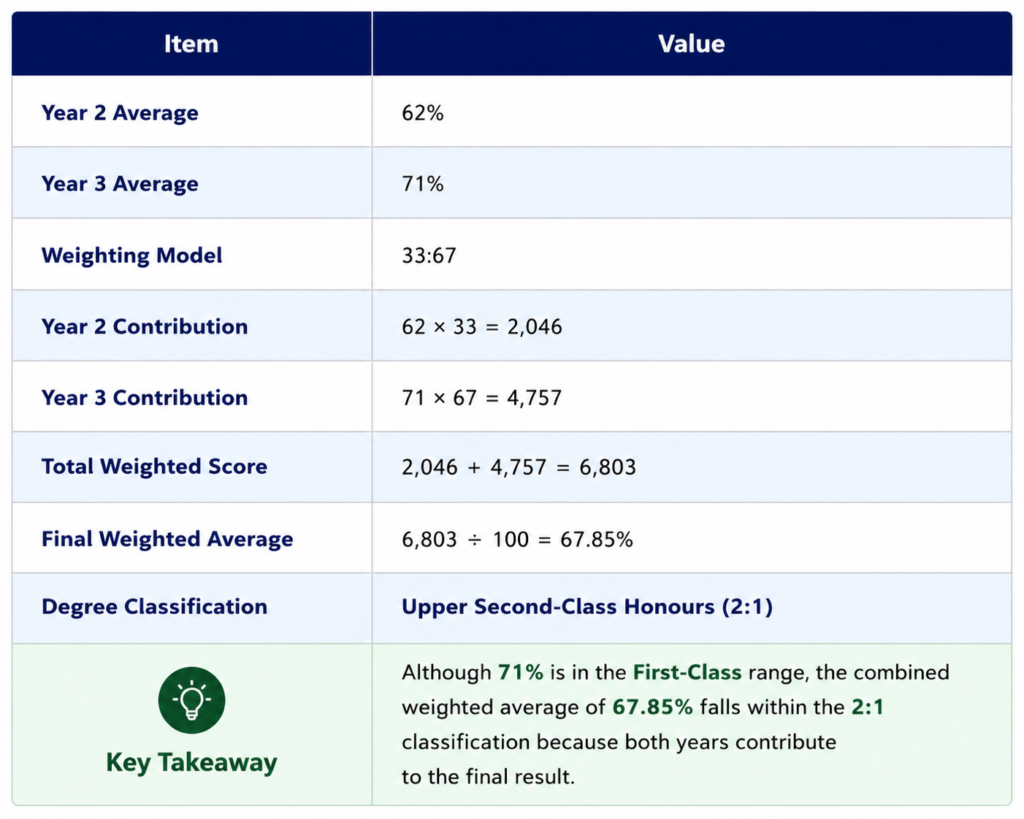
A Practical Example
| Item | Value |
|---|---|
| Year 2 Average | 62% |
| Year 3 Average | 71% |
| Weighting Model | 33:67 |
| Year 2 Contribution | 62 × 33 = 2,046 |
| Year 3 Contribution | 71 × 67 = 4,757 |
| Total Weighted Score | 2,046 + 4,757 = 6,803 |
| Final Weighted Average | 6,803 ÷ 100 = 67.85% |
| Degree Classification | Upper Second-Class Honours (2:1) |
| Key Takeaway | Although 71% is in the First-Class range, the combined weighted average of 67.85% falls within the 2:1 classification because both years contribute to the final result. |
Mitigating Circumstances: What Actually Counts
One of the most misunderstood parts of any regulations document is the mitigating circumstances process. Students often assume any stressful situation qualifies, but most universities apply fairly specific criteria.
Circumstances That Are Usually Accepted
The following situations are commonly accepted, provided you can supply appropriate supporting evidence:
- Sudden serious illness, supported by a doctor’s note or medical certificate.
- Bereavement of a close family member.
- A significant, unexpected personal crisis, documented where possible.
- Technical failure during an online exam, if reported immediately and supported by evidence where required.
Circumstances That Are Usually Not Accepted on Their Own
Some situations are unlikely to qualify unless accompanied by exceptional circumstances or additional evidence:
- General exam stress or anxiety without supporting medical evidence.
- Poor time management or having multiple deadlines in the same week.
- Minor illness, such as a common cold, unless it directly prevented attendance or submission.
Provide Supporting Evidence
Most universities require independent evidence to assess a mitigating circumstances claim fairly. This may include medical certificates, hospital records, official letters, death certificates, or other documentation relevant to your situation. Claims submitted without evidence are often rejected unless exceptional circumstances apply.
Submit Your Claim on Time
Mitigating circumstances requests normally have strict deadlines. Universities often expect students to submit their claim as soon as possible after the affected assessment or examination. Delayed applications may only be accepted if there is a valid reason for the delay.
Possible Outcomes If Your Claim Is Accepted
If your claim is accepted, the usual outcomes are either a short extension, a deferred attempt at the assessment with no mark penalty, or in more serious cases, a recommendation to the exam board. What you rarely get is an automatic grade boost—mitigating circumstances usually give you a fair second chance, not extra marks.
Remember That Every University Is Different
Although the principles are broadly similar across UK universities, the exact rules, evidence requirements, deadlines, and available outcomes vary by institution. Always check your university’s academic regulations or mitigating circumstances policy before submitting a claim.
Academic Misconduct: Where the Lines Are Drawn
Academic misconduct rules tend to be the strictest part of any regulations document, and for good reason — they protect the credibility of every degree the university awards.
| Type of Misconduct | Example | Typical First-Offence Outcome |
|---|---|---|
| Plagiarism | Copying text without proper citation | Mark deduction or capped mark |
| Collusion | Submitting work jointly written but presented as individual | Mark deduction or module fail |
| Exam misconduct | Using unauthorised notes or devices | Module fail or formal hearing |
| Contract cheating | Paying someone else to write an assignment | Suspension or expulsion in serious cases |
The severity of the outcome usually depends on intent and whether it’s a repeat offence. A first-time referencing mistake handled honestly is treated very differently from deliberate, repeated copying. University Academic Regulations almost always include a formal investigation process before any penalty is applied, so students get a chance to explain what happened.
The Appeals Process, Step by Step
If you think a university decision was wrong, most institutions follow a similar appeals procedure. While the exact process and deadlines vary, the steps below reflect how academic appeals are commonly handled across UK universities.
Check the Valid Grounds for Appeal
Most universities only accept appeals based on a procedural error, new evidence that was not available at the time, or evidence of bias or unfair treatment. Simply disagreeing with the mark awarded is not usually considered a valid reason for an appeal.
Submit a Formal Appeal
Complete and submit your university’s official appeal form within the required deadline, which is typically 10 to 20 working days after the assessment decision or results are published. Missing the deadline may result in your appeal not being considered.
Provide Supporting Evidence
Include any documents that support your case, such as medical certificates, independent professional evidence, emails, or records showing a procedural issue. Strong, relevant evidence is essential for an appeal to be reviewed fairly.
Wait for an Independent Review
Once your appeal is submitted, it is normally reviewed by an academic or panel that was not involved in the original decision. This helps ensure the process is impartial and follows the university’s academic regulations.
Receive the Final Outcome
After the review, the university will notify you of the outcome. The decision may uphold the original result, amend the decision, or recommend a fresh assessment or reassessment, depending on the circumstances and evidence provided.
Remember What Appeals Cannot Do
Appeals based purely on “I don’t think I deserved this mark” are almost always rejected because academic judgement itself is rarely open to appeal. Under standard University Academic Regulations, appeals focus on whether the assessment process was conducted fairly and correctly—not whether a different mark should have been awarded.
Where to Actually Find Your Regulations
Every UK university is required to make its regulations publicly accessible to enrolled students, usually in one of these places:
- The student portal or intranet, often under “Academic Registry” or “Quality Office”
- Your course or module handbook, which frequently summarises the relevant sections
- The university’s main website, under a “Policies and Regulations” or “Governance” page
If you can’t find it, your student services or academic registry office can point you to the exact document — and it’s genuinely worth reading the sections on progression, resits, and classification before you actually need them, rather than after something’s gone wrong.
Read More: Can You Improve Your Degree Classification? – Everything You Need to Know
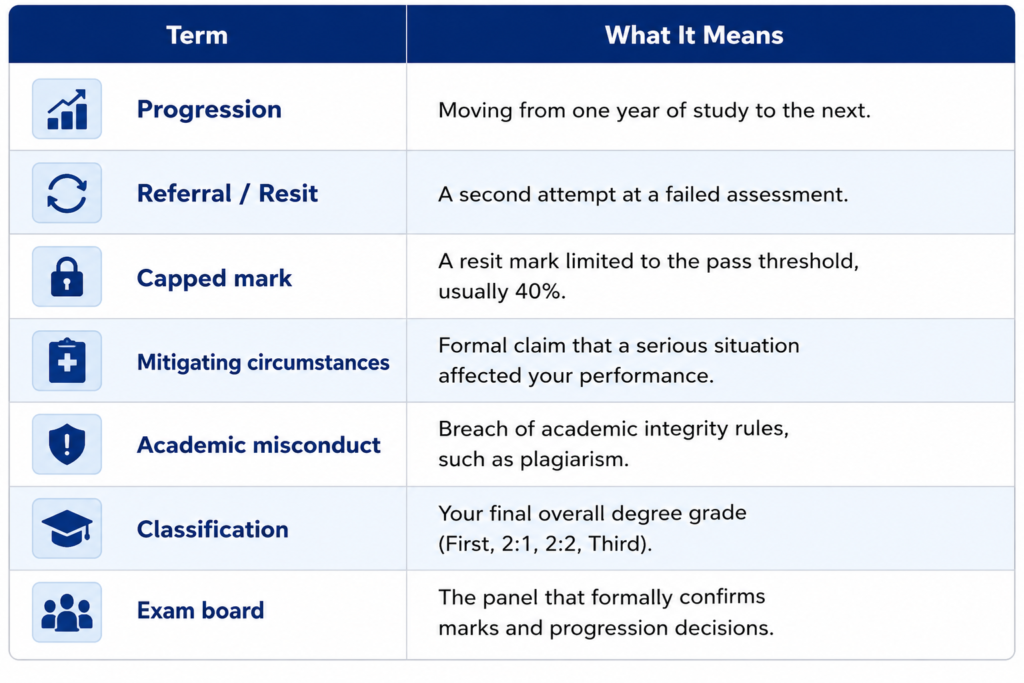
Quick Reference: Key Terms in University Academic Regulations
| Term | What It Means |
|---|---|
| Progression | Moving from one year of study to the next |
| Referral / Resit | A second attempt at a failed assessment |
| Capped mark | A resit mark limited to the pass threshold, usually 40% |
| Mitigating circumstances | Formal claim that a serious situation affected your performance |
| Academic misconduct | Breach of academic integrity rules, such as plagiarism |
| Classification | Your final overall degree grade (First, 2:1, 2:2, Third) |
| Exam board | The panel that formally confirms marks and progression decisions |
Tips for Staying Compliant with University Regulations
Following your university’s academic regulations is much easier when you understand the key requirements from the beginning of your course. University Academic Regulations: A few simple habits can help you avoid unnecessary problems and keep your academic progress on track.
Read Your Course Handbook
Your course handbook and programme specification explain the regulations that apply specifically to your degree. They cover assessment methods, credit requirements, pass marks, year weightings, and progression rules, making them the best source of accurate information.
Keep Track of Assessment Deadlines
Missing coursework deadlines or examination dates can lead to penalties or failed assessments. Use a calendar or planner to stay organised and submit your work on time whenever possible.
Understand How Your Degree Is Calculated
Learn how your university calculates weighted averages, module credits, and degree classifications. Knowing which years or modules carry the most weight can help you prioritise your studies more effectively.
Save Important Documentation
Keep copies of assessment submissions, feedback, medical certificates, emails, and any correspondence with your university. These documents can be valuable if you need to submit a mitigating circumstances claim or academic appeal.
Ask for Help Early
If you’re experiencing academic or personal difficulties, contact your personal tutor, module leader, or student support services as soon as possible. Seeking advice early often provides more options than waiting until after assessment deadlines have passed.
Maintain Academic Integrity
Always complete your work honestly, reference your sources correctly, and follow your university’s academic integrity policies. Avoid plagiarism, collusion, contract cheating, and any other form of academic misconduct that could result in disciplinary action.
Regularly Check University Updates
Universities occasionally update their academic regulations, assessment policies, or deadlines. Check your student portal and university emails regularly so you stay informed about any changes that may affect your studies.
By understanding and following your university’s academic regulations, you can reduce unnecessary stress, avoid common mistakes, and focus on achieving the best possible results throughout your degree.
FAQ’s
What are university academic regulations?
University academic regulations are the official rules that govern how a university assesses, progresses, and classifies its students, covering everything from marking to appeals.
Are university academic regulations the same at every UK university?
No. While most follow a similar structure, the specific percentages, deadlines, and processes in university academic regulations vary between institutions and even between courses.
Can I appeal a grade because I don’t agree with it?
Generally, no. University academic regulations usually only allow appeals based on procedural errors, new evidence, or bias, not simple disagreement with a mark.
What happens if I fail a module under university academic regulations?
Most universities allow a resit, though the mark for a passed resit is often capped at the standard pass threshold, typically 40%.
Do university academic regulations count my first year toward my final degree?
Often not, or only at a small weighting. Final classification usually relies most heavily on your second and final years, though this depends on your specific course.
What counts as mitigating circumstances under university academic regulations?
Serious, documented situations like sudden illness or bereavement are typically accepted, while general stress or poor planning usually isn’t, according to most university academic regulations.
Where can I read my university’s academic regulations?
Most universities publish their academic regulations on the student portal, in course handbooks, or through the academic registry office.
How strict are university academic regulations around plagiarism?
Very strict. Most university academic regulations treat plagiarism as a serious offence, with penalties ranging from a mark deduction to formal disciplinary action for repeat cases.
Can university academic regulations change during my degree?
Yes, though universities typically apply the regulations that were in place when you started your course, unless a change is required by law or professional accreditation.
Why should I read my university’s academic regulations before I need them?
Understanding your university’s academic regulations in advance means you know exactly what to expect around resits, mitigating circumstances, and classification, rather than finding out during a stressful situation.
Final Thoughts
University academic regulations aren’t the most exciting document you’ll read during your degree, but they’re one of the most useful. University Academic Regulations explain exactly how your marks turn into a classification, what happens if things go wrong, and what your rights are if you disagree with a decision. University Academic Regulations: Reading them early means fewer surprises later — and if you ever need to understand exactly how a set of module marks affects your overall standing, pairing that knowledge with a proper grade calculation makes the whole picture a lot clearer.
Understanding these regulations can also help you make better academic decisions throughout your degree. University Academic Regulations: Whether you’re planning your module choices, preparing for assessments, considering a resit, or checking how compensation and progression rules apply to you, knowing the official policies allows you to avoid common misunderstandings and unnecessary stress.
It’s also worth remembering that while many UK universities follow similar principles, each institution has its own regulations regarding pass marks, degree classifications, appeals, academic misconduct, mitigating circumstances, and assessment weightings. Always refer to your university’s handbook or programme specification for the rules that apply to your course.
By combining a clear understanding of your university’s academic regulations with accurate tools such as a University Grade Calculator, Degree Percentage Calculator, or Degree Classification Calculator, you can monitor your progress with confidence, set realistic academic goals, and stay informed about the decisions that affect your final degree outcome. Being proactive today can make achieving your target classification much easier tomorrow.