
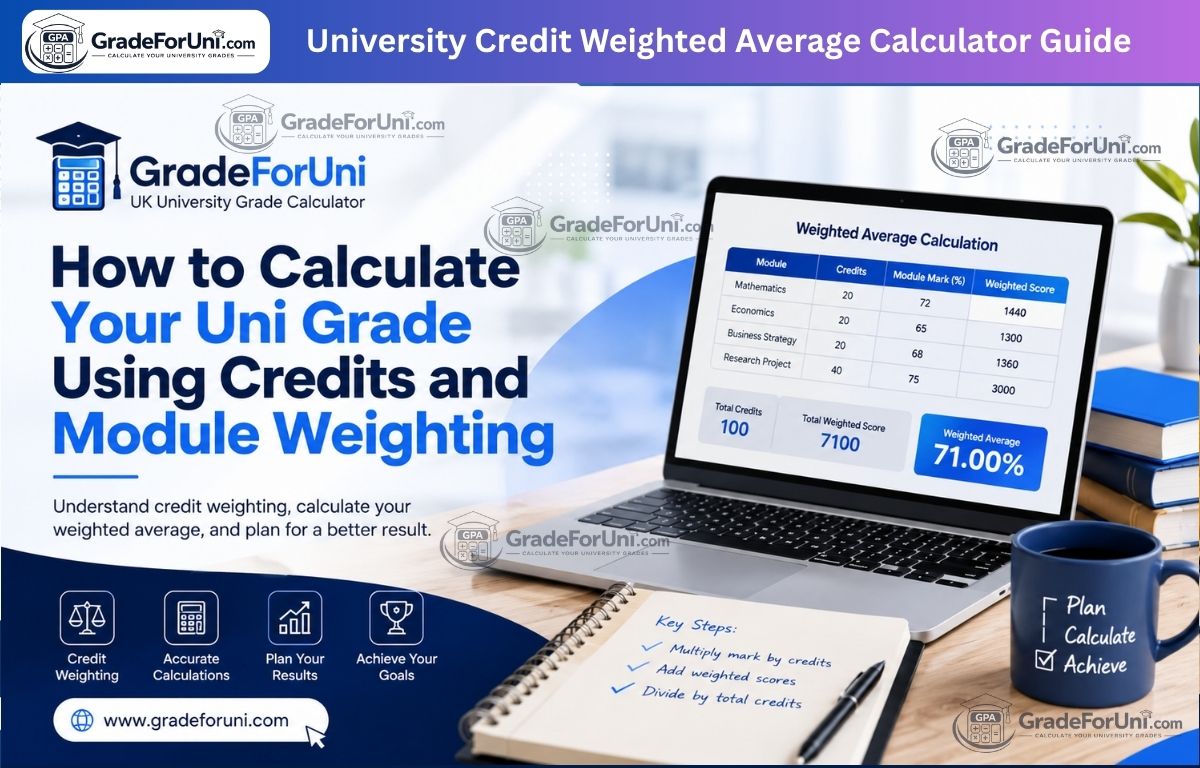
Credit Weighted Average Calculator If you’ve ever added up your grades and divided by the number of modules, you’ve probably ended up with a number that doesn’t match what’s on your transcript. Credit Weighted Average Calculator That’s because most university grading systems don’t treat every module equally. Credit Weighted Average Calculator A module worth 20 credits should count for more than one worth 10 credits — and a simple average ignores that completely Credit Weighted Average Calculator.
This is where a credit weighted average calculator comes in. It’s the tool — and the method — that universities themselves use to calculate your overall average, year grade, or final degree classification Credit Weighted Average Calculator.
Featured Snippet Answer: A credit weighted average calculator works out your average grade by multiplying each module’s mark by its credit value, adding those totals together, then dividing by the total number of credits. Credit Weighted Average Calculator This gives more influence to larger modules and produces the same average your university uses on your official transcript Credit Weighted Average Calculator Credit Weighted Average Calculator.
In this guide, you’ll learn exactly how this calculation works, why it matters, and how to do it yourself — whether you’re checking your own numbers, planning your final year, or trying to understand what your university actually means by “weighted average Credit Weighted Average Calculator.”
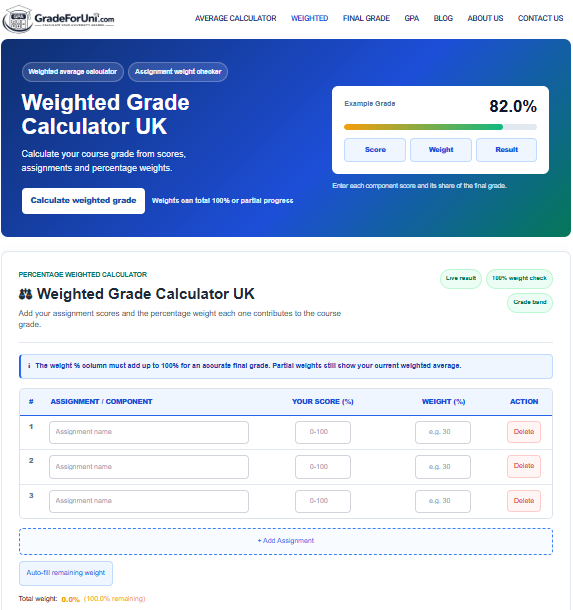
Click Here: UK University Grade Calculator
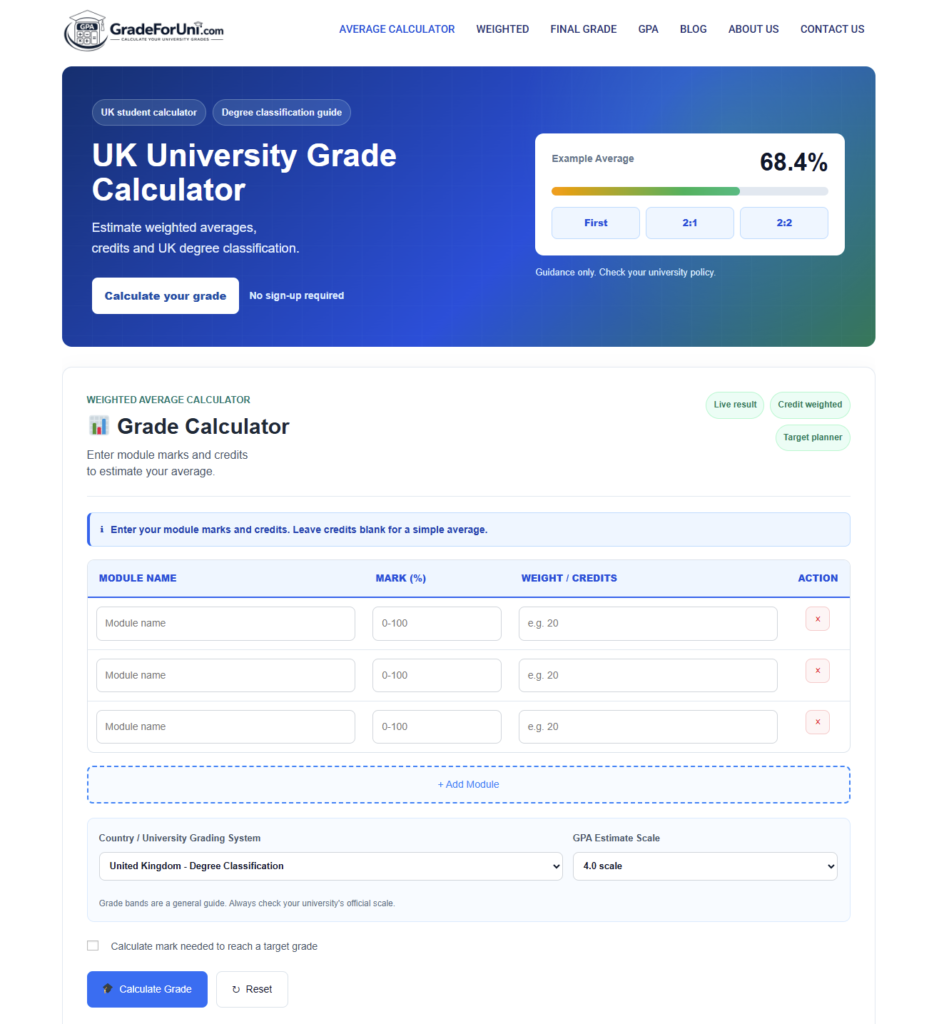
How to Use the UK University Grade Calculator
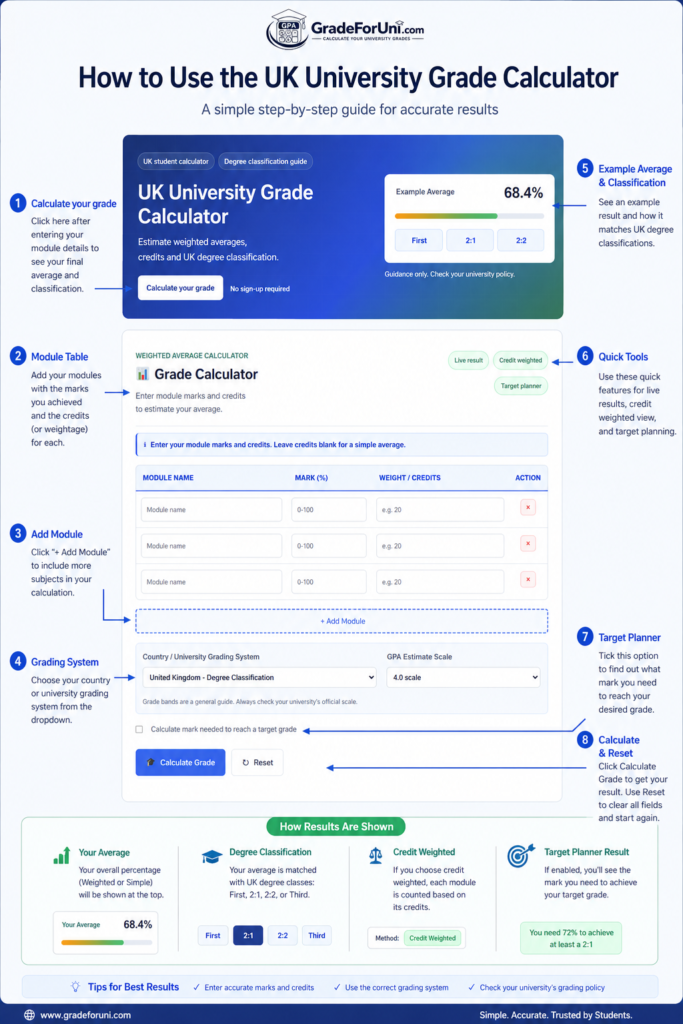
What This Guide Covers( Credit Weighted Average Calculator )
Credit Weighted Average Calculator This guide walks through everything you need to calculate your own university average correctly — starting with the concepts behind credit weighting, moving through the exact formula and worked examples, and finishing with the advanced scenarios that trip students up most often: year-weighting, resits, and GPA conversion Credit Weighted Average Calculator.
By the end, you’ll be able to calculate your own weighted average with confidence, understand why it might differ slightly from your official transcript, and know exactly which figures to check before you rely on any number Credit Weighted Average Calculator.
Background: How University Averages Actually Work
Every module you take at university is assigned a credit value. In the UK, most undergraduate degrees follow a 120-credit-per-year structure, with individual modules typically worth 10, 15, 20, or 30 credits. Credit Weighted Average Calculator In the US, this is expressed differently — through credit hours — but the underlying idea is the same: not all classes carry the same academic weight Credit Weighted Average Calculator.
A 30-credit dissertation, for example, represents a far larger share of your workload and learning outcomes than a 10-credit optional module taken over a single semester. Credit Weighted Average Calculator So when your university calculates your final average, it doesn’t just average your grades — it averages them in proportion to how many credits each module was worth Credit Weighted Average Calculator.
This is why two students can have the exact same set of grades — say, three 60s and one 80 — and still end up with different overall averages, simply because the credit values behind those grades were different Credit Weighted Average Calculator.
Understanding this distinction is the first step to calculating, or even just interpreting, your own average correctly Credit Weighted Average Calculator.
Key Terms You Need to Understand
Credit Weighted Average Calculator Before working through the calculation, it helps to be clear on the terminology, since universities don’t always use the same words for the same thing Credit Weighted Average Calculator.
| Term | What It Means |
| Credit value | The number of credits assigned to a module, reflecting its size and workload |
| Module mark | The final percentage or grade achieved in a specific module |
| Weighted average | An average that accounts for credit value, not just the raw grade |
| Simple average | An average that treats every module equally, regardless of credits |
| Credit hours (US) | The US equivalent of credit value, usually tied to weekly class time |
| Classification | The final degree band (First, 2:1, 2:2, Third) determined largely by your weighted average |
| Non-credit-bearing module | A module that doesn’t count toward your final average, even if it’s compulsory to pass |
Mixing up these terms — particularly confusing a simple average with a weighted one — is one of the most common reasons students miscalculate their own results Credit Weighted Average Calculator.
Why Credit Weighting Matters
It’s tempting to think a percentage point is a percentage point, regardless of which module it came from. Credit Weighted Average Calculator But credit weighting exists for good reason: it ensures your final grade genuinely reflects the balance of your studies Credit Weighted Average Calculator Credit Credit Weighted Average Calculator .
- Bigger modules should count for more. A 40-credit final-year project reflects a much larger, more sustained piece of work than a 10-credit elective, so it’s fair that it carries more weight in your final number Credit Weighted Average Calculator .
- It affects your degree classification. Many universities set classification boundaries (First, 2:1, 2:2, Third) based on the weighted average, not a simple one. A difference of even 1–2% can shift you into a different bandCredit Weighted Average Calculator .
- It changes how strategic decisions play out. When choosing optional modules, or deciding where to focus your effort between a large dissertation and a smaller module, understanding the weighting helps you see where your effort actually has the most impact Credit Weighted Average Calculator.
- It’s what your university actually uses. The number on your official transcript, and the figure used to determine your final classification, is very likely a credit weighted average — so understanding it means understanding your real academic standing Credit Weighted Average Calculator.
Common Misconceptions About University Averages
A handful of mistakes come up again and again when students try to calculate their own average, so it’s worth clearing them up early
“I can just average all my percentages together”
This only works if every module has the exact same credit value. Credit Weighted Average Calculator The moment your modules differ in size — true for almost every degree — a simple average will give you the wrong number Credit Weighted Average Calculator .
“Every module counts toward my final average”
Not necessarily. Credit Weighted Average Calculator Some modules are pass/fail only, some are non-credit-bearing, and some years — commonly first year at UK universities — don’t count toward final classification at all, even though you still need to pass them Credit Weighted Average Calculator .
“A higher percentage in a small module matters less”
Only partly true. It still matters — just proportionally less than the same percentage in a larger module. Credit Weighted Average Calculator Small modules aren’t irrelevant; their influence on the overall average is simply smaller Credit Weighted Average Calculator .
“Weighted average and GPA are the same thing”
They’re related, but not identical. Credit Weighted Average Calculator GPA (Grade Point Average) uses a points scale, commonly 0–4.0, rather than raw percentages, and the conversion between percentage-based systems and GPA varies by country and institution. We’ll cover this properly later in the guide Credit Weighted Average Calculator .
Visit Now: Calculez vos heures de travail avec clarté.
Worked Example: Weighted vs. Simple Average
To see why this matters, look at a simplified example with two modules:
| Module | Credits | Mark |
| Module A | 10 | 90% |
| Module B | 30 | 60% |
Simple average: (90 + 60) ÷ 2 = 75%
Weighted average: ((90 × 10) + (60 × 30)) ÷ 40 = (900 + 1,800) ÷ 40 = 67.5%
That’s a 7.5 percentage point difference — potentially the gap between one degree classification and the next. This is exactly why relying on a simple average can give you a misleading picture of where you stand Credit Weighted Average Calculator .
Step-by-Step Guide: How to Calculate Your Credit Weighted Average
Now that the concepts are clear, here’s the actual process. Credit Weighted Average Calculator The formula itself isn’t complicated — most students find it far easier than expected once it’s broken into steps Credit Weighted Average Calculator .
The Formula
Weighted Average = (Sum of (Module Mark × Module Credits)) ÷ Total Credits
Every module gets multiplied by its own credit value, those totals are added together, and the sum is divided by the total number of credits Credit Weighted Average Calculator .
Step 1: List Every Module You’re Including
Write out every module that counts toward the average you’re calculating — whether that’s your full year average, your final degree average, or a single semester. Be careful here: this is where most errors happen, because it’s easy to accidentally include a module that shouldn’t count Credit Weighted Average Calculator .
Step 2: Note the Credit Value for Each Module
Next to each module, record its credit value from your course handbook, module catalogue, or student portal. Credit Weighted Average Calculator Don’t rely on memory — credit values can vary even within the same course, especially for optional modules Credit Weighted Average Calculator .
Step 3: Multiply Each Mark by Its Credit Value
For every module, multiply the percentage mark by the number of credits. This gives you a “weighted score” for that module Credit Weighted Average Calculator .
Step 4: Add Up All the Weighted Scores
Add together every weighted score from Step 3.
Step 5: Add Up the Total Credits
Separately, total the credit values of every module included.
Step 6: Divide
Divide the total from Step 4 by the total from Step 5. The result is your credit weighted average Credit Weighted Average Calculator .
Worked Example: Four Modules, Different Credit Values
Here’s a realistic example using four modules of varying sizes Credit Weighted Average Calculator .
| Module | Credits | Mark | Weighted Score (Mark × Credits) |
| Research Methods | 15 | 72% | 1,080 |
| Data Analysis | 15 | 65% | 975 |
| Dissertation | 30 | 68% | 2,040 |
| Elective: Psychology | 10 | 80% | 800 |
| Total | 70 | — | 4,895 |
Weighted average = 4,895 ÷ 70 = 69.9%
Compare that to a simple average of the same four marks: (72 + 65 + 68 + 80) ÷ 4 = 71.25%. Credit Weighted Average Calculator That’s a difference of more than a full percentage point — again, enough to matter at classification boundaries Credit Weighted Average Calculator .
Real-Life Scenario: Handling a Failed Module and a Resit
Grades rarely come in as cleanly as a textbook example. Credit Weighted Average Calculator A common situation: a student fails one module, resits it, and needs to know which mark to use in the calculation Credit Weighted Average Calculator .
Most universities apply one of two approaches:
- Capped resit mark — Many UK universities cap a resit mark at the pass mark (commonly 40%), regardless of the actual resit score. Credit Weighted Average Calculator If this applies to you, it’s the capped mark — not your real resit score — that goes into the weighted average Credit Weighted Average Calculator .
- Uncapped resit mark — Some institutions, particularly for first-year modules that don’t count toward final classification, use the actual resit mark with no cap Credit Weighted Average Calculator .
Credit Weighted Average Calculator This varies significantly between universities and even between departments, so always check your specific institution’s assessment regulations before assuming which policy applies to you. Using the wrong figure here is one of the most common calculation errors students make Credit Weighted Average Calculator .
Real-Life Scenario: Excluding Non-Counting Modules
At many UK universities, first-year (Level 4) grades don’t count toward final degree classification — you simply need to pass them. If you’re calculating your classification average, these modules should be left out entirely, not included at a weight of zero Credit Weighted Average Calculator .
This catches out a lot of students who assume “doesn’t count” means “counts as 0%,” which would incorrectly drag the average down. Credit Weighted Average Calculator If a module doesn’t contribute to the average, it shouldn’t appear anywhere in the formula — neither its mark nor its credits Credit Weighted Average Calculator .
Simple Average vs. Weighted Average vs. GPA
It helps to see these three approaches side by side, since students often confuse them Credit Weighted Average Calculator .
| Method | How It Works | Where It’s Used |
| Simple average | Adds marks, divides by number of modules | Rarely used officially; sometimes used informally by students |
| Credit weighted average | Adds (mark × credits), divides by total credits | Standard method at most UK and many international universities |
| GPA (points-based) | Converts grades to points (e.g. 0–4.0), often weighted by credit hours | Common in the US and Canada, and increasingly used for international comparisons |
We’ll go deeper into GPA conversion later in this guide, since it uses a different scale entirely and trips people up in different ways Credit Weighted Average Calculator .
Common Mistakes to Avoid( Credit Weighted Average Calculator )
Even once you understand the formula, small errors can throw off your final number Credit Weighted Average Calculator .
- Forgetting to include all modules. Missing even one module changes both the numerator and denominator of your calculation.
- Using the wrong credit values. Double-check against your official module catalogue rather than relying on memory.
- Including non-counting modules. If a module doesn’t contribute to your classification, it shouldn’t be in the formula at all.
- Mixing up capped and uncapped resit marks. Always confirm your university’s specific resit policy.
- Rounding too early. Round only your final answer, not the intermediate weighted scores — early rounding can shift your final average by a decimal point or more, which occasionally matters at classification boundaries.
- Confusing percentage-based and points-based systems. If your university uses a different scale, like GPA, don’t apply the percentage formula without converting first.
Best Practices and Expert Tips
A few habits make this process far more reliable:
- Keep a running spreadsheet, updated after every module result is released, rather than reconstructing everything at the end of the year.
- Check credit values against official documents, not what you remember from enrolment.
- Calculate both a simple and a weighted average as a sanity check — if they’re wildly different, it’s worth confirming you haven’t misapplied a credit value.
- Ask your student services or academic advisor to confirm your university’s specific rules on resits, exclusions, and rounding, since these vary by institution.
- Recalculate after every semester, not just at year-end — this helps you spot early whether you’re on track for the classification you’re aiming for.
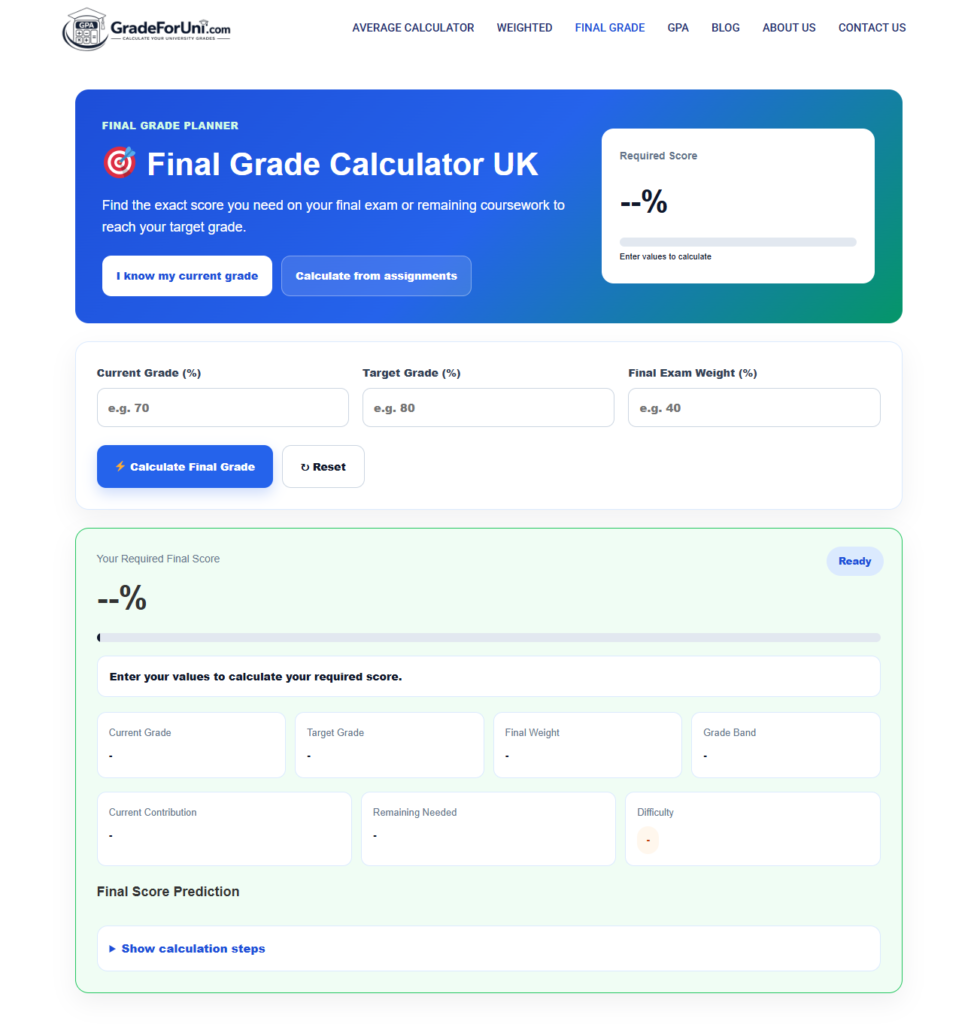
Year-Weighting: How Multiple Years Combine Into One Final Average
Module-level weighting is only part of the picture. For students on multi-year degrees, most universities also weight entire years differently when calculating final classification.
A common UK model looks something like this:
| Year | Typical Weighting | Notes |
| Year 1 | 0% | Usually must be passed, but doesn’t count toward classification |
| Year 2 | 20–33% | Weighting varies significantly by institution |
| Year 3 (Final Year) | 67–80% | Usually carries the most weight |
So if your university uses a 1:3 weighting between second and third year, your final classification average would be calculated as:
Final Average = (Year 2 Average × 1) + (Year 3 Average × 3), divided by 4
This is a separate calculation from the module-level weighting covered earlier — and it’s the step students most often forget when estimating their final degree classification. You can have your module-level maths perfectly correct and still end up with the wrong final number if you skip this layer. Always check your specific course handbook for the exact year-weighting ratio, since it varies not just between universities but sometimes between departments at the same institution.
Converting Between Percentage Averages and GPA
If you’re applying for postgraduate study abroad, an exchange programme, or a role that asks for a GPA, you may need to convert your percentage-based weighted average into a GPA figure.
There’s no single universal conversion — the exact scale depends on the country and sometimes the individual institution — but a commonly used approximate UK-to-US conversion looks like this:
| UK Percentage | Approximate US GPA |
| 70%+ (First) | 3.7 – 4.0 |
| 60–69% (2:1) | 3.3 – 3.6 |
| 50–59% (2:2) | 2.7 – 3.2 |
| 40–49% (Third) | 2.0 – 2.6 |
Treat this as a general guide rather than an exact formula. If a specific university or employer needs your GPA, check whether they publish their own official conversion table — many admissions offices do.
Frequently Overlooked Information
A few details catch students out even after they’ve understood the core formula:
- Compensated modules aren’t always treated the same way. If you narrowly fail a module but pass overall through “compensation” rules, some universities still use your original, uncapped mark in the average, while others cap it at the pass mark. Confirm this directly with your department.
- Audited or non-assessed modules don’t belong in the calculation at all — not even at zero credits or zero marks.
- Your self-calculated average and your official transcript average can differ slightly due to internal rounding conventions. A gap of one or two decimal points is normal and not usually a cause for concern.
- Some universities recalculate your average after every resit period, meaning the figure on your student portal may update several times before your final classification is confirmed.
- Joint honours or double major degrees often split credit weighting between two subject areas, adding a layer of calculation that single-honours students don’t need to think about.
Key Takeaways
- A credit weighted average multiplies each module mark by its credit value, then divides by total credits — this is the standard method used by most universities, not a simple average.
- Bigger modules, like dissertations, influence your final average more than smaller ones, which is intentional and reflects their academic weight.
- Not every module counts toward your final classification — check which years and modules are actually included before calculating anything.
- Resit marks are often capped at the pass mark, but this depends entirely on your university’s specific policy.
- Many universities also apply year-weighting on top of module-weighting, combining yearly averages using a separate ratio, usually favouring final year most heavily.
- Percentage averages and GPA are related but not interchangeable — check for an official conversion table if you need to report your GPA.
- Small errors — wrong credit values, early rounding, or including non-counting modules — are the most common reasons a self-calculated average doesn’t match the official one.
What This Guide Covers
This guide walks through everything you need to calculate your own university average correctly — starting with the concepts behind credit weighting, moving through the exact formula and worked examples, and finishing with the advanced scenarios that trip students up most often: year-weighting, resits, and GPA conversion.
By the end, you’ll be able to calculate your own weighted average with confidence, understand why it might differ slightly from your official transcript, and know exactly which figures to check before you rely on any number.
Background: How University Averages Actually Work
Every module you take at university is assigned a credit value. In the UK, most undergraduate degrees follow a 120-credit-per-year structure, with individual modules typically worth 10, 15, 20, or 30 credits. In the US, this is expressed differently — through credit hours — but the underlying idea is the same: not all classes carry the same academic weight.
A 30-credit dissertation, for example, represents a far larger share of your workload and learning outcomes than a 10-credit optional module taken over a single semester. So when your university calculates your final average, it doesn’t just average your grades — it averages them in proportion to how many credits each module was worth.
This is why two students can have the exact same set of grades — say, three 60s and one 80 — and still end up with different overall averages, simply because the credit values behind those grades were different.
Understanding this distinction is the first step to calculating, or even just interpreting, your own average correctly.
Key Terms You Need to Understand
Before working through the calculation, it helps to be clear on the terminology, since universities don’t always use the same words for the same thing.
| Term | What It Means |
| Credit value | The number of credits assigned to a module, reflecting its size and workload |
| Module mark | The final percentage or grade achieved in a specific module |
| Weighted average | An average that accounts for credit value, not just the raw grade |
| Simple average | An average that treats every module equally, regardless of credits |
| Credit hours (US) | The US equivalent of credit value, usually tied to weekly class time |
| Classification | The final degree band (First, 2:1, 2:2, Third) determined largely by your weighted average |
| Non-credit-bearing module | A module that doesn’t count toward your final average, even if it’s compulsory to pass |
Mixing up these terms — particularly confusing a simple average with a weighted one — is one of the most common reasons students miscalculate their own results.
Read More:
Final Thoughts
Working out your real university average takes more than adding up percentages and dividing by the number of modules. A credit weighted average calculator reflects how your university actually assesses your performance — giving more influence to larger modules, accounting for year-weighting, and following the specific rules your institution applies to resits and excluded modules.
Once you understand the formula and the common pitfalls covered in this guide, calculating your own credit weighted average becomes a straightforward process you can repeat confidently after every set of results. Whether you’re tracking your progress toward a particular classification or simply want an accurate picture of where you stand, taking the time to calculate it properly — rather than relying on a simple average — gives you a far more reliable number to work from.
FAQ’s
What is a credit weighted average calculator?
A credit weighted average calculator is a tool that works out your overall university average by multiplying each module’s mark by its credit value, adding those totals together, and dividing by the total number of credits. This mirrors the method most universities use officially, rather than a simple average of your grades.
Is a weighted average the same as GPA?
No. A weighted average is typically expressed as a percentage and based on credit values, while GPA uses a points-based scale, commonly 0–4.0. They’re related concepts used in different grading systems, and converting between them requires an approximate conversion table rather than a direct formula.
Why is my weighted average different from a simple average of my grades?
Because a weighted average accounts for credit value, while a simple average treats every module as equally important. If your modules have different credit values — true for almost all degrees — these two numbers will usually differ.
Does my first year count toward my final degree classification?
At many UK universities, first year (Level 4) must be passed but doesn’t count toward the final classification average. This varies by institution, so confirm it in your course handbook rather than assuming.
How are resit marks calculated in a weighted average?
Many universities cap resit marks at the pass mark, commonly 40%, for classification purposes, regardless of the actual score achieved. Some institutions use the uncapped mark instead, particularly for non-counting years, so check your university’s specific assessment regulations.
What credit value should I use if my university doesn’t list one?
Check your official course handbook, module catalogue, or student portal rather than estimating. Credit values can vary even between modules on the same course, so confirmation matters more than assumption.
Do all universities weight years the same way?
No. Year-weighting ratios vary significantly between institutions and sometimes between departments. Some universities exclude first year entirely, while others give it a small percentage weighting, so always check your specific course regulations.
Can I calculate my final degree classification myself?
Yes, as long as you know your module marks, credit values, which years count, and your university’s year-weighting ratio. Combining module-level weighting with year-level weighting gives an accurate estimate, though your official transcript figure may differ slightly due to internal rounding conventions.
Why does my self-calculated average not match my transcript exactly?
Small differences usually come down to rounding conventions, capped resit marks, or a module being included or excluded incorrectly. A gap of one or two decimal points is common and not usually a sign of an error.
What’s the easiest way to check my weighted average is correct?
Calculate it twice using slightly different approaches — work out your simple average and your weighted average separately, then check that the difference makes sense given your module credit values. If the numbers seem far apart, double-check your credit values and confirm which modules should actually be included.