
![You are currently viewing How Are Psychology Degrees Graded in the UK? BSc Marks, Placements & BPS Rules [2026]](https://gradeforuni.com/wp-content/uploads/2026/10/featured-psychology-degrees-graded.png)
Psychology is one of the most popular degree subjects in Britain — but it is graded under two rulers at once, and most students only learn about the second one when it is nearly too late. The first ruler is the academic one: module marks, credit weightings, and the familiar 70/60/50/40 classification boundaries that decide whether you graduate with a First, a 2:1, or a 2:2. The second ruler belongs to the British Psychological Society (BPS): its accreditation rules decide whether your degree opens the door to chartered careers at all.
That second ruler has a sharp edge. On a BPS-accredited degree, you need at least a 2:2 — and you must pass your empirical psychology project — to be eligible for Graduate Basis for Chartered Membership (GBC). Miss either, and the degree on your certificate is the same, but the career routes behind it quietly close. For the most competitive postgraduate route of all, the Doctorate in Clinical Psychology (DClinPsy), the bar sits higher still: a 2:1 is the stated minimum at almost every course.
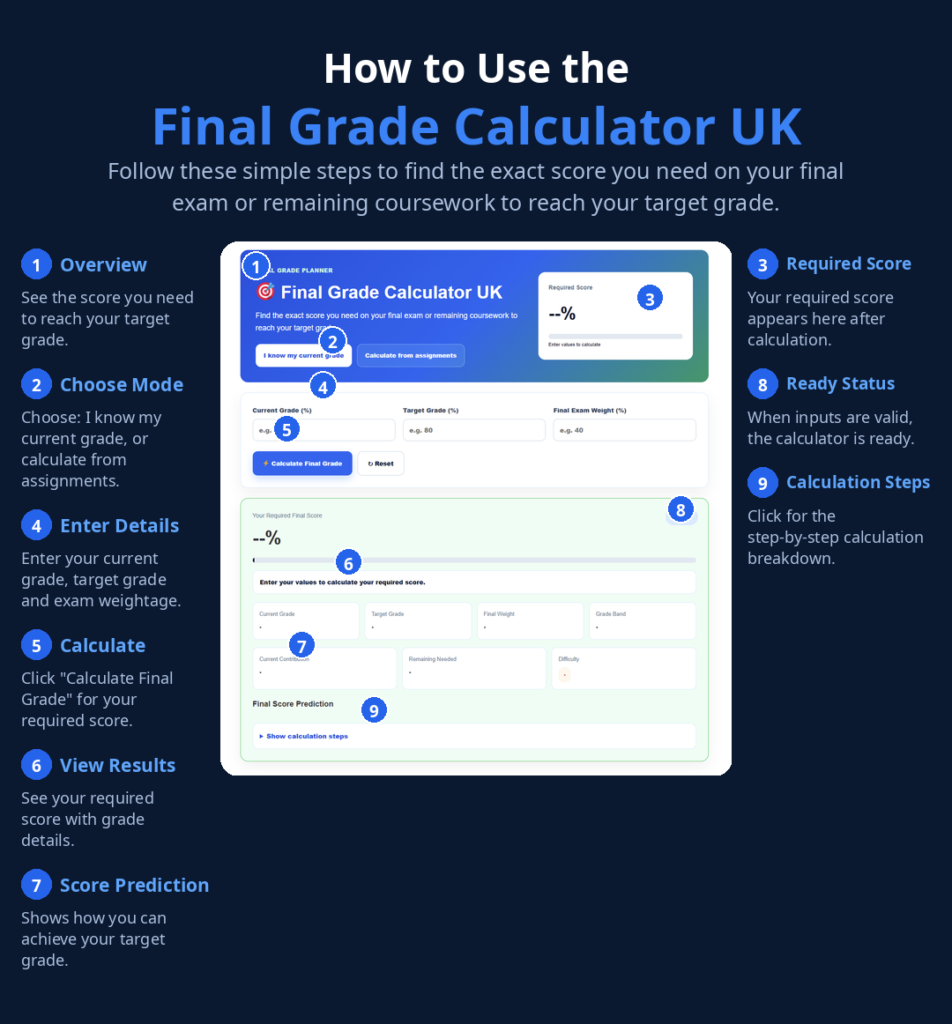
This guide explains exactly how psychology degrees are graded in the UK: what you are marked on, how exams and coursework are split across the years, which years actually count toward your classification, and how the B Bookmark this psychology degrees graded guide and pair it with our final grade calculator to see exactly what your remaining marks are worth.This guide explains exactly how psychology degrees are graded in the UK: what you are marked on, how exams and coursework are split across the years, which years actually count toward your classification, and how the BPS rules turn certain marks — the project, statistics modules — into make-or-break numbers. Two fully worked examples show the arithmetic that decides real outcomes. Bookmark this psychology degrees graded guide and pair it with our final grade calculator to see exactly what your remaining marks are worth.PS rules turn certain marks — the project, statistics modules — into make-or-break numbers. Two fully worked examples show the arithmetic that decides real outcomes.
Click Here: Final Grade Calculator UK
Two Rulers, One Degree: The Framework Most Students Miss
Every UK psychology student is measured twice, and the two measurements answer different questions.
Ruler one — the academic ruler — asks: what class of degree did you earn? Your university converts your module marks into a weighted average, usually across your second and final years, and maps it onto the standard boundaries: 70+ is a First, 60–69 a 2:1, 50–59 a 2:2, 40–49 a Third. This ruler is operated entirely by your university’s regulations — year weightings, compensation rules, resit caps — and it is what appears on your degree certificate.
Ruler two — the professional ruler — asks: does this degree qualify you for the next step? The BPS, as the professional body for psychologists in the UK, accredits undergraduate and conversion programmes. Its accreditation standards require providers to tell students plainly: to be eligible for GBC you must gain at least a Lower Second Class Honours degree (or equivalent) and pass the empirical psychology project. For a master’s conversion route, the requirement is an overall pass of at least 50% plus a passed empirical project, with no exemption allowed against the project.
The two rulers interact in ways that surprise students. A 2:2 with a passed project keeps every professional route open. A 2:1 with a failed project does not — for GBC purposes, the project is non-exemptible. And the DClinPsy, the funded doctorate that trains NHS clinical psychologists, applies its own stricter ruler on top: a 2:1 minimum almost everywhere, regardless of what the BPS minimum says.
Keep this framework in mind as you read the grading detail below. The same mark means different things depending on which ruler is measuring it.
What You Are Actually Marked On: The Five Core Areas
BPS accreditation standards require every accredited degree to summatively assess five core content areas (plus research methods and the empirical project). This is why psychology degrees look structurally similar across universities even when the branding differs:
| Core area | Typical module content | How it is usually assessed |
|---|---|---|
| Biological psychology | Brain and behaviour, neuropsychology, psychopharmacology | Exams, lab reports |
| Cognitive psychology | Memory, attention, perception, language | Exams, essays, lab reports |
| Developmental psychology | Child development, lifespan, ageing | Essays, exams, presentations |
| Social psychology | Groups, attitudes, persuasion, prejudice | Essays, exams, group projects |
| Individual differences | Personality, intelligence, psychometrics | Exams, stats-heavy coursework |
| Research methods & statistics | SPSS/R analysis, experimental design, ethics | Practical reports, timed stats tests |
| Empirical project | Your own research study, final year | Dissertation (usually 30–40 credits) |
Conceptual and historical issues in psychology run through the programme as a cross-cutting theme. The practical consequence: psychology is a writing-and-numbers hybrid. You cannot hide from statistics (methods modules are typically examined every year), and you cannot hide from academic writing either — lab reports follow a strict IMRaD format (Introduction, Methods, Results, Discussion) that examiners mark against published criteria.
Exams vs Coursework: The Split Shifts Every Year
One of the most distinctive features of psychology grading is how the assessment balance tilts as you progress. Universities publish the split in their course documentation, and the pattern is consistent: exams dominate early, independent work dominates later.
At the University of Westminster’s BSc Psychology, the published 2025/26 figures show the shift clearly: Year 1 is 16% written exams, 12% practical assessments and 72% coursework; Year 2 moves to 20% exams, 5% practical and 75% coursework; the final year drops written exams almost entirely — 0% exams, 10% practical and 90% coursework. The final year is dominated by the dissertation and option-module coursework.
The University of Birmingham’s BSc Psychology shows a similar arc with different numbers: Year 1 is 39% coursework, 50% written exam and 11% practical exam; Year 2 is 32% coursework, 50% written exam and 18% practical; the final year settles at roughly 35% coursework, 30% written exam and 35% practical — the exact balance depending on your option choices.
| University | Year 1 (exams / coursework / practical) | Final year (exams / coursework / practical) |
|---|---|---|
| Westminster | 16% / 72% / 12% | 0% / 90% / 10% |
| Birmingham | 50% / 39% / 11% | ~30% / ~35% / ~35% |
What this means for your marks: students who are strong exam-takers often find their best year is Year 2, while coursework-strong students peak in the final year. Since final-year marks are weighted most heavily (see below), the students whose strengths match the final-year assessment mix get a structural advantage. Knowing the split for your own course — check your programme handbook — lets you plan where your effort earns the most.
Which Years Count: The Weighting That Decides Your Class
First year almost never counts toward your classification. At the University of Reading, for example, the BSc Psychology programme specification sets the weighting explicitly: for three-year programmes, Part 2 (second year) counts one-third and Part 3 (final year) counts two-thirds. Part 1 must simply be passed. This 1:2 weighting is the most common pattern across UK universities, though some use 40:60 or weight the best 100 credits.
The pass rules per year still bite. Reading sets the module pass mark at 40%. Leicester’s programme specification is stricter on progression: to move from Year 1 to Year 2 you need an overall weighted average of at least 40 with no honours modules below 40; to move from Year 2 to Year 3 you must pass all Year 2 modules with no honours module below 40 and no non-honours module below 35. Fail to meet progression requirements and you can be required to withdraw — a reminder that “Year 1 doesn’t count” never means “Year 1 doesn’t matter.”
The weighting arithmetic is unforgiving in one direction and generous in another: a strong final year can rescue a mediocre second year, but a weak final year is very hard to offset. The worked example below makes this concrete.
Worked Example 1: Amara’s 2:1 Push — How the Dissertation Swings It
Amara finishes her second year with an average of 58.4% — a solid 2:2. Her university uses the standard 1:2 weighting (second year one-third, final year two-thirds). She needs a final-year average that lifts her overall to 60.0%.
The required final-year average is: (60.0 × 3 − 58.4) ÷ 2 = (180.0 − 58.4) ÷ 2 = 121.6 ÷ 2 = 60.8%. So she needs 60.8% in her final year to scrape a 2:1. Her actual final-year modules come in at an average of 66.2%, giving an overall degree mark of (58.4 + 2 × 66.2) ÷ 3 = (58.4 + 132.4) ÷ 3 = 190.8 ÷ 3 = 63.6% — a comfortable 2:1.
Now the counterfactual that shows why the dissertation is the single highest-leverage module in a psychology degree. Amara’s dissertation is a 40-credit module, and she scored 68 on it. Suppose instead she had scored 45:
- The 23-mark drop on a 40-credit module costs her 23 × 40 ÷ 120 = 7.7 percentage points on her final-year average.
- Her final year falls from 66.2% to 58.5%.
- Her degree mark becomes (58.4 + 2 × 58.5) ÷ 3 = (58.4 + 117.0) ÷ 3 = 175.4 ÷ 3 = 58.5% — a 2:2.
One module — worth a third of her final year — moves her an entire degree class: 63.6% versus 58.5%. And under the BPS ruler, a passed dissertation at any mark ≥40% keeps her GBC eligible; the project must be passed, not excelled at, for professional eligibility. (Plug your own year averages into the final grade calculator to see what your remaining marks are worth.)
The Dissertation Rule: Fail the Project, Lose the Professional Route
This is the rule students most need to hear early. The BPS accreditation standards state that providers must advise students that GBC eligibility requires passing the empirical psychology project — and for conversion master’s degrees, the standards are explicit that no exemption may be granted against it. The University of Essex’s accredited programme pages spell out the undergraduate version: eligibility for GBC requires at least a Lower Second-Class (2:2) Honours degree overall and passing the final psychology project with a minimum mark of 40%.
Consider what that means in practice. A student can graduate with a 2:1 overall, collect their certificate, and still be ineligible for GBC if the empirical project was failed — because the project is a named, non-exemptible requirement, not just another 40 credits. Resit rules then apply: the resat project is typically capped at the pass mark (40%), which may drag the year’s average down even if the resit itself is passed.
The practical advice follows directly: the empirical project deserves disproportionate attention relative to its credit weight. It is the only module on a psychology degree that gates a professional qualification. Start ethics applications early, keep your supervisor relationship active, and treat the project deadline as immovable — late-submission penalties on a 40-credit module are devastating.
Worked Example 2: Daniel’s Conversion Route — When 50% Overall Is Not Enough
Daniel graduated with a 2:2 in history and wants to become a psychologist, so he enrols on a BPS-accredited MSc Psychology conversion course. The BPS standard for conversion degrees: pass the empirical psychology project and achieve an overall pass mark of at least 50%. Staffordshire’s programme regulations add the detail: core modules must be passed at 50% and cannot be compensated — only option modules can be considered for compensation at 30–39%.
Daniel’s results: his taught modules (120 credits) average 52%, and his 60-credit empirical project scores 47%.
- Overall mark: (52 × 120 + 47 × 60) ÷ 180 = (6,240 + 2,820) ÷ 180 = 9,060 ÷ 180 = 50.3%.
- He clears the 50% overall bar — but his project is below 50%.
- Result: no GBC eligibility, despite a passing overall mark. The project cannot be exempted or compensated.
The Wrexham programme specification states the consequence plainly: students who complete everything but fall short of the conversion requirements exit with a non-accredited award (MSc Psychology Studies at 40%+) instead of the accredited conversion degree. Daniel’s 50.3% earns him a master’s, but not the professional gateway he enrolled for. On a conversion course, the project is everything: a 47 that would be a comfortable pass at undergraduate level is a career-blocking fail here.
The DClinPsy Gate: Why a 2:1 Is the Real Floor
The Doctorate in Clinical Psychology is the most sought-after postgraduate route in the discipline — a funded, three-year NHS doctorate — and its entry bar sits well above the BPS minimum. The BPS’s GBC gets you through the door; the degree class decides whether you are shortlisted.
| Course | Minimum degree requirement |
|---|---|
| KCL DClinPsy | 2:1 in psychology (or 2:1 + GBC conversion); below that needs doctoral-level evidence such as a PhD |
| UCL DClinPsy | Good 2:1 in BPS-accredited psychology + relevant clinical experience |
| Oxford DClinPsych | 2:1 in psychology + GBC + clinical experience |
| Southampton DClinPsych | 2:1 expected + GBC + one year full-time equivalent relevant experience |
| Plymouth DClinPsy | 2:1 or First; exceptionally 2:2 with Merit/Distinction postgraduate study or completed PhD |
| Nottingham DClinPsy | 1st or 2:1 with GBC; 2:2 considered with a master’s or contextual indicators |
| Bath DClinPsy | 1st or 2:1 in psychology (or non-psychology degree + Merit/Distinction conversion) |
| QUB DClinPsy | 2:1 accredited; 2:2 accepted with a higher degree (master’s or PhD) |
The pattern is unambiguous: 2:1 is the stated floor nearly everywhere, and “exceptionally” clauses for 2:2 holders demand substantial compensation — a Merit/Distinction master’s, a PhD, or strong contextual grounds. Bath goes further, accepting only 1st or 2:1 outright. Every course also demands GBC (or eligibility for it) plus genuine clinical experience, usually at least a year’s worth. (Course-by-course entry data compiled from universities’ published requirements via The Profs’ DClinPsy guide.)
This is where ruler one and ruler two compound. A 2:2 keeps you eligible for BPS membership and for chartered training routes in counselling, forensic, occupational and educational psychology — but for clinical psychology, the 2:2 is a starting deficit you must actively repair. Our 2:2-to-2:1 recovery guide shows the final-year arithmetic, and the masters with a 2:2 guide covers the postgraduate repair route.
Statistics Modules Carry More Weight Than You Think
Research methods and statistics are the hidden load-bearing wall of a psychology degree. Three reasons they matter disproportionately:
First, they are examined every year. Unlike a social psychology essay you write once, statistics and methods modules run through all three years, and the BPS requires the empirical project — a statistics-heavy piece of work — to be passed for GBC. Weak quantitative skills therefore tax you repeatedly, not once.
Second, they gate progression. Leicester’s specification illustrates the mechanism: no honours module below 40 for progression. A 35 in a Year 2 statistics module is not a bad mark you can offset elsewhere — it is a progression failure that can trigger a resit, a capped mark, or withdrawal proceedings. Methods modules are among the most commonly failed components of psychology degrees precisely because students underestimate them.
Third, they shape your final-year options. Advanced final-year options in cognitive neuroscience, psychometrics or behavioural science assume quantitative competence. A weak methods record narrows the modules available to you and makes the dissertation — the highest-credit module — harder. If you invest effort anywhere early, invest it in statistics: it pays compound interest across the degree.
Five Mistakes Psychology Students Make (and What They Cost)
| Mistake | What it costs |
|---|---|
| Leaving the dissertation until the final term | A 40-credit module worth a third of your final year, with ethics and data collection that cannot be rushed — plus it is non-exemptible for GBC |
| Assuming Year 1 “doesn’t count” | It doesn’t count toward classification, but progression rules (≥40 average, no honours module below 40 at Leicester) can still end your degree |
| Treating statistics as a write-off | Repeatedly examined, gates progression, and underpins the dissertation — the highest-leverage module you have |
| Enrolling on a non-accredited degree for a psychology career | No GBC route at graduation; you would need a full accredited conversion course (and 50%+ with a passed project) to recover |
| Thinking any 2:1 guarantees a DClinPsy place | The 2:1 is the minimum ticket, not the prize — courses also demand GBC, a year’s clinical experience, and strong references |
If your degree is not BPS-accredited and you want a chartered psychology career, the conversion route is well-established but demanding: an overall 50%+ with a passed empirical project, core modules uncompensatable. Check your course’s BPS accreditation status for your intake year before you commit to anything — the BPS maintains a searchable register of accredited courses.

What grades do you need to graduate with a psychology degree in the UK?
You need to pass each module, which usually means scoring at least 40%. To progress between years you typically need an overall weighted average of 40 with no honours-level module below 40. Your final classification is calculated from your second and final years at most universities, commonly weighted one-third to two-thirds.
What degree classification do you need for BPS Graduate Basis for Chartered Membership?
You need at least a Lower Second Class Honours degree (2:2) on a BPS-accredited programme, and you must pass the empirical psychology project. Both conditions are required. For a master’s conversion course, the requirement is an overall pass of at least 50% plus a passed empirical project, with no exemption allowed against the project.
Is a psychology degree mostly exams or coursework?
It changes as you progress. Published course data shows written exams dominate the early years (around 50% at Birmingham in Years 1 and 2) while coursework and the dissertation dominate the final year (up to 90% coursework at Westminster). Check your own programme handbook, because option choices shift the balance.
Does first year count towards your psychology degree classification?
At most UK universities it does not count toward your final classification, which is calculated from your second and final years. But first year still matters: you must pass your modules and meet progression requirements (usually a 40 average with no honours module below 40) or you can be required to withdraw.
What happens if you fail your psychology dissertation?
You would normally resit it, with the resit mark typically capped at the 40% pass mark. More seriously, on a BPS-accredited degree you cannot gain Graduate Basis for Chartered Membership without passing the empirical project, so a failed project blocks the professional route even if your overall average is strong.
What grade do you need for clinical psychology training (DClinPsy)?
Almost every UK DClinPsy course requires a minimum 2:1 in psychology (or a 2:1 plus a BPS-accredited conversion), alongside Graduate Basis for Chartered Membership and at least a year’s relevant clinical experience. A small number of courses consider 2:2 holders who also hold a master’s, PhD or strong contextual grounds.
Can you become a psychologist with a non-psychology degree?
Yes, through a BPS-accredited psychology conversion course. To gain Graduate Basis for Chartered Membership you must pass the empirical psychology project and achieve an overall mark of at least 50%. Core modules typically must be passed at 50% and cannot be compensated, so the conversion route is demanding.
Is psychology a hard degree to get a First in?
It is demanding because it tests two different skill sets: essay and lab-report writing, and statistics. Students who are strong at only one of the two often stall in the 2:1 range. The final year, usually weighted at two-thirds, is dominated by coursework and the dissertation, so students whose strengths match independent research have the best route to 70+.
Conclusion
Psychology degrees are graded like most UK degrees on the surface — module marks, credit weightings, and the 70/60/50/40 boundaries — but the professional ruler running underneath changes which marks matter most. A 2:2 plus a passed empirical project unlocks Graduate Basis for Chartered Membership and every chartered training route beyond it; a stronger overall average without that passed project does not. That single asymmetry should shape how you allocate your effort from day one: the dissertation is the highest-leverage module in the degree, and statistics is the skill that compounds across every year.
The other practical lesson is arithmetic, not effort. Because the final year typically carries two-thirds of your classification, a mediocre second year is recoverable and a strong final year is the most efficient route to the next class up — as Amara’s 63.6% shows. Work out exactly what your remaining marks are worth with the final grade calculator, check your course’s BPS accreditation status for your intake year, and treat the empirical project as what it is: the one module that can block a career, not just cost you marks.