
![You are currently viewing What Is a Starred First? How Cambridge & Oxford Award the UK’s Highest Honour [2026]](https://gradeforuni.com/wp-content/uploads/2026/10/featured-starred-first-uk.png)
What Is a Starred First? How Cambridge & Oxford Award the UK’s Highest Honour [2026]
A First is the top degree classification at almost every UK university. But at two universities, there is a level above it — an honour so unusual that most students never see one awarded in their subject during their entire degree. At Cambridge it is called a starred first; at Oxford, a congratulatory first.
Students ask about it every year. On The Student Room, the questions come in a steady rhythm: “I’ve heard a few universities do a special degree class called a first with distinction — how hard is it actually to get?” and “a guy I know got a starred first in his first and second year at Oxford — what does that mean?” The answers that follow are a fog of half-remembered rules, invented percentages and confident claims about universities that have never awarded one.
This guide clears the fog. A starred first is not a secret higher classification band, and there is no universal 80% rule — it is a discretionary mark of distinction attached to a First, awarded by examiners, and defined differently in every subject. Below: what it actually is, how Cambridge and Oxford decide, how rare it really is with the numbers, what appears on your transcript, and which popular claims about it are simply wrong.
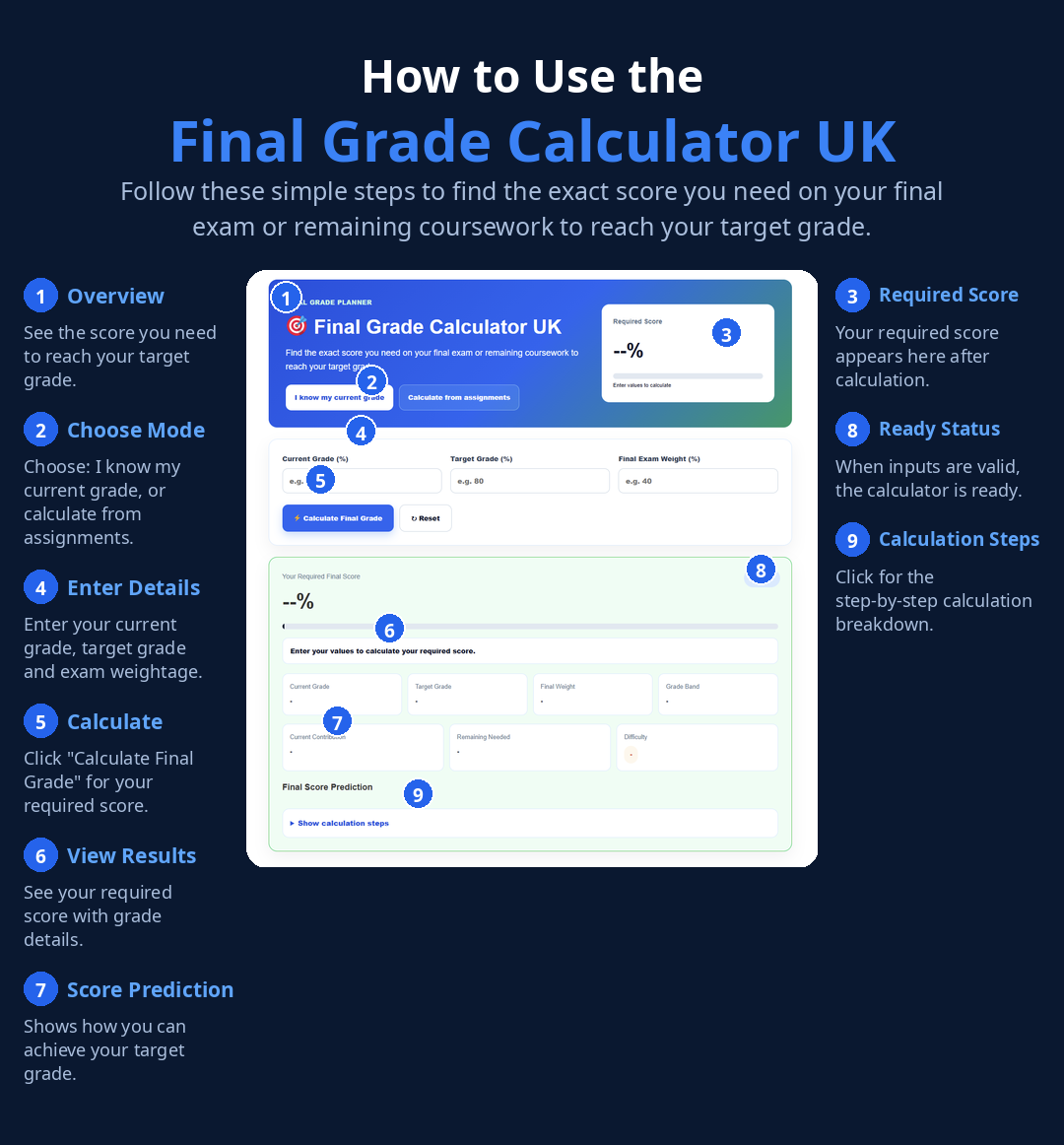
Click Here: Final Grade Calculator UK
What a “starred first” really is: Cambridge’s mark of distinction
The name comes from the class list. When Cambridge publishes its examination results, a candidate awarded this honour gets an asterisk — a star — printed beside their name. Hence “starred first”: a First, with a star.
Here is the first thing most explainers get wrong: there is no single university-wide definition at Cambridge. The rules are set faculty by faculty, Tripos by Tripos, and they genuinely differ. What is consistent is the concept — a mark of distinction for work that goes beyond an ordinary First — and the mechanism: it is awarded at the complete discretion of the examiners, not earned automatically by crossing a percentage line.
The official wording varies in revealing ways. The Faculty of Philosophy’s guidelines for examiners say examiners “have discretion to award a mark of distinction (‘starred first’) to candidates whose scripts exhibit the qualities of first class answers to an exceptional degree” — a qualitative test, deliberately so. The Faculty of Divinity takes the opposite approach and writes the rule down as arithmetic: “a candidate who has first class marks in all papers and a mean average of at least 72 will be awarded a starred First (or ‘distinction’).” Cambridge’s own guidebook for exchange students splits the difference: “in rare occasions, a Class I With Distinction can be awarded to students who have performed exceptionally well in their exams… at the complete discretion of the examiners. This is also referred to as a ‘starred first’.”
Three consequences follow from the way the honour is constructed. First, it is awarded per Tripos part, not per degree — each part has its own class list, so the honour attaches to a part. That is why Cambridge students talk informally about “double” or “triple” starred firsts: starred firsts in multiple parts. Second, some Triposes do not award it at all. Chemical Engineering awards starred firsts in Parts IIA and IIB but not in Part I; the Mathematical Tripos awards no starred first in Part II — the examiners, as one official discussion puts it, “have no authority under the ordinances to give them a starred first” — offering instead a distinction in Part III. Third, you cannot “bank” one early and relax: because it is discretionary and per-part, there is no cumulative threshold to chase.
Oxford’s version: the congratulatory first
Oxford does not use the term “starred first” — its equivalent is the congratulatory first, and it is even less formally defined. A search of Oxford’s central Examination Regulations finds no definition of the term at all. Instead, the honour lives in two places: examiners’ reports and college announcements.
The examiners’ reports give the clearest picture of how it is actually decided. The History & Economics examiners’ report for Final Honour Schools 2024 records: “The top performing candidate achieved a Congratulatory First (no marks below 70).” The History & Modern Languages report for 2023 describes it as going to “the top performing candidate in the cohort,” who had “achieved first class marks in every paper — an extraordinary feat across nine papers.” The pattern is consistent: it goes to the top-performing candidate in the cohort, typically someone with first-class marks in every single paper.
Colleges then announce these results with visible pride. Balliol College reported Samuel Myers receiving “a Congratulatory First in Final Honours Schools” in French; St Anne’s College has listed named recipients across subjects; Somerville College notes that the author Penelope Fitzgerald graduated “with a congratulatory First” back in 1935. These announcements matter because, in the absence of a central regulation, they are the public record that the honour exists and is awarded.
Two Oxford-specific notes. The honour is a Finals phenomenon — it attaches to Final Honour Schools results, not to first-year exams. And by its nature it is a winner’s honour: where Cambridge’s per-Tripos rules can in principle produce several starred firsts in a large cohort, Oxford’s reports show it going to the single top candidate in a subject.
Starred first vs congratulatory first: how they compare
| Cambridge: starred first | Oxford: congratulatory first | |
|---|---|---|
| Official name | “Starred first” / “mark of distinction” / “Class I With Distinction” | “Congratulatory first” |
| Defined where | Faculty examiner guidelines (varies by Tripos) | Nowhere central — documented in examiners’ reports and college news |
| Decided by | Examiners’ discretion, per Tripos part | Examiners’ discretion, at Finals |
| Typical basis | Varies: e.g. first-class marks in every paper plus a 72+ average (Divinity); qualitative “exceptional degree” test (Philosophy) | Top candidate in the cohort; first-class marks in every Finals paper |
| How it is recorded | Asterisk beside the name on the published class list | Named in the examiners’ report; announced by the college |
| Scope | Per Tripos part — “double/triple starred first” is informal slang for several | Final Honour Schools only |
The table makes the essential point: neither university runs a single national-style rule. Both honours are examiner judgement applied to exceptional cases, which is exactly why the folk rules about them (“it’s 80%”, “it’s automatic”) keep being wrong.
How rare is a starred first? The real numbers
Rare enough that entire cohorts graduate without seeing one. The honest numbers, all sourced rather than estimated:
| Source | What it says |
|---|---|
| TSR, Cambridge Chemical Engineering students | Typically 0–3 starred firsts per year, per part, out of 60–70 students — and some years none are awarded at all |
| TSR, Cambridge departments generally | “You can expect to see maybe 1 or 2 handed out by each dept at Cambridge each year, although often there won’t be any” |
| The Tab (2012), anonymous recipient interview | Recipient scored 87% — “one of the highest in my subject” — and first saw the result on CAMSIS |
| Oxford examiners’ reports | Typically one per subject cohort — the top-performing candidate |
For context on the pool these are drawn from: roughly a third of Cambridge and Oxford graduates now receive a First (33.3% and 34.1% respectively in the most recent OfS-era figures reported in January 2026). The starred and congratulatory firsts are a tiny discretionary slice of that third. Note the Chemical Engineering detail that some years produce zero: if nobody’s work reaches the examiners’ standard, the honour simply is not awarded. It is not a quota, and it is not curved — which distinguishes it sharply from the standard grade boundaries that govern ordinary classifications.
The 72% rule: how one Tripos actually decides it
Because the rules are per-subject, the cleanest way to understand a starred first is to watch one faculty’s rule operate. The Faculty of Divinity publishes the most mechanical version: first-class marks in all papers AND a mean average of at least 72. Both conditions must hold. That “and” does real work, as these two candidates show.
Candidate A — Amara. Her four paper marks are 74, 71, 73 and 70. Every paper sits in the first-class band (70+), so condition one is satisfied. Her mean is (74 + 71 + 73 + 70) ÷ 4 = 288 ÷ 4 = 72.0 — exactly on the threshold, so condition two is satisfied. Amara is awarded a starred first. Note what this required: not brilliance in one paper, but unbroken first-class performance across every paper.
Candidate B — Josh. His four paper marks are 69, 78, 74 and 72. His mean is (69 + 78 + 74 + 72) ÷ 4 = 293 ÷ 4 = 73.25 — more than a full point higher than Amara’s. But his first paper, at 69, is a 2:1 mark, so condition one fails. Josh does not get a starred first, despite the higher average. One paper below the first-class line disqualifies the whole attempt, no matter how strong the rest of the script.
| Candidate | Paper marks | Mean | First-class in every paper? | Starred first? |
|---|---|---|---|---|
| Amara | 74, 71, 73, 70 | 72.0 | Yes | Yes |
| Josh | 69, 78, 74, 72 | 73.25 | No (one 69) | No |
The lesson generalises beyond Divinity: starred-first rules are conjunctive — every condition must hold — where ordinary classification is compensatory, with strong modules balancing weak ones in a weighted average. That is why a student can sit comfortably inside the First-class band on average and still be nowhere near a starred first: one 68 in a nine-paper Finals, and the “first in every paper” formulations used at both universities quietly rule it out.
What a starred first means on paper: transcript, class list and certificate
Where does the honour actually show up? The answer is more modest than the mythology.
The class list: yes — this is the whole point. The asterisk beside the name on the published class list is the original and defining record of a Cambridge starred first. Oxford’s equivalent record is the examiners’ report naming the top candidate, amplified by the college’s announcement.
The transcript: yes, according to student reports. Cambridge students report that the starred first does appear on the academic transcript, and Cambridge college and fund biographies routinely describe alumni as having “graduated with a starred first (first-class honours with distinction)” — the parenthetical showing how institutions translate it for outsiders.
The degree certificate: do not assume. This is the one claim to handle with care. Anecdotal reports conflict — one widely quoted student account insists starred firsts “don’t show up on the actual certificates” and are “effectively just prizes” — and no official Cambridge or Oxford statement either way has surfaced. The safe, sourced position is: recognised on your transcript and class list; no verified claim about the certificate itself. Any article that tells you otherwise is guessing.
And a word on what it is worth beyond the university gates: outside Oxford and Cambridge, most employers and recruiters have never heard of it. On a CV it reads as one strong line — “First Class Honours with Starred First (top 2% of cohort)” is the honest translation — but no graduate recruiter filters on it, because no recruiter outside the two universities knows to ask. Its value is overwhelmingly academic: it matters enormously for PhD applications and academic references, and barely at all for anything else.
Do other UK universities award one? The myths, checked
This is where the internet is at its worst. Search “starred first” and you will find confident assertions about half a dozen universities. Checked against actual sources, the picture collapses:
| Claim | Verdict |
|---|---|
| Imperial College London awards a starred-first equivalent | No evidence. The “First Class Honours with Distinction” results for Imperial are postgraduate MSc distinctions — a different qualification level entirely. Do not conflate them. |
| University of York awards it for 85%+ over three years | Anecdotal only. The claim traces to a self-described York student’s forum post; no york.ac.uk source exists. Worse, the only official “first class with distinction” policy found belongs to York University in Toronto, Canada — a different university in a different country. A naming trap, not a policy. |
| UEA awards one | Unsourced. Nothing beyond the assertion itself. |
| There is a fixed 80% rule everywhere | False as a universal claim. Thresholds vary by Tripos and part; Philosophy uses a qualitative examiner test with no number at all. |
The reliable, sourced position is narrower than the folklore: the named starred-first / congratulatory-first honours are a Cambridge and Oxford phenomenon. Other universities certainly recognise exceptional performance — prizes, Dean’s lists, distinctions on postgraduate courses — but the specific discretionary mark of distinction described in this guide is documented, with official sources, at those two universities only. If a university’s own regulations do not name it, it does not exist there, whatever a forum post claims.

The famous recipients — only the sourced ones
Lists of famous starred-first recipients circulate online, and most are unsourced. The verification rule used for this guide is simple: name only recipients confirmed by the university itself.
Dame Brenda Hale — Girton College, Cambridge records that she “received a starred First for exceptional distinction.” She went on to become President of the Supreme Court of the United Kingdom.
Penelope Fitzgerald — Somerville College, Oxford records the novelist as “graduating with a congratulatory First” in 1935, decades before the Booker Prize.
That is the complete sourced list used here. Widely repeated names without a university source behind them — and there are several in circulation — have been left out deliberately. A reader who wants the full folklore can find it; a reader who wants the facts gets these two.
Should you aim for a starred first?
Here is the honest answer, and it is the least satisfying part of the guide: you cannot aim at a starred first the way you aim at a grade boundary. A boundary is a number — score 70 and the classification follows mechanically, which is why tools like a final grade calculator can tell you exactly what you need. A starred first is a judgement. No calculator can tell you what “scripts exhibiting the qualities of first class answers to an exceptional degree” looks like in your subject, because the examiners decide what it looks like after reading the scripts.
What you can do is notice where the two candidates in this guide diverged. Amara did not win on brilliance; she won on unbroken consistency — no weak paper for the conjunctive rule to catch on. The actionable version of “chase a starred first” is therefore identical to the actionable version of “chase a strong first”: eliminate your weakest paper, not polish your strongest. If you are choosing where an extra week of revision goes, the Divinity arithmetic says put it on the module currently sitting at 68, not the one at 76.
And keep the economics of it in view. The behaviours that produce a starred first — deep understanding, original argument, flawless exam technique across every paper — are exactly the behaviours that produce a high First, and a high First is recognised by every employer, university and borderline committee in the country. The star itself is recognised by almost nobody outside two universities. Chase the substance and the First follows; the star, if it comes, is a footnote to work you would have done anyway.
What is a starred first?
A starred first is a discretionary mark of distinction awarded at the University of Cambridge to candidates whose examination work goes beyond an ordinary First. It is recorded as an asterisk beside the candidate’s name on the published class list — hence the name. It is not a separate degree classification: the degree itself is still a First.
Is a starred first a higher degree classification than a First?
No. A starred first is not a higher band above First Class Honours — it is a mark of distinction attached to a First. Your degree classification remains a First; the star is an additional honour recognising exceptional performance within that band.
What percentage do you need for a starred first at Cambridge?
There is no single university-wide percentage. The rules are set per Tripos and per part: the Faculty of Divinity requires first-class marks in every paper plus a mean average of at least 72, while the Faculty of Philosophy uses a qualitative test — scripts showing first-class qualities to an exceptional degree — with no number at all. Claims of a universal 80% rule are wrong.
Does Oxford award starred firsts?
Oxford does not use the term starred first. Its equivalent is the congratulatory first, awarded at Finals to the top-performing candidate in a cohort — typically someone with first-class marks in every paper. It is documented in examiners’ reports and college announcements rather than in the central Examination Regulations.
How many starred firsts are awarded each year?
Very few, and some years none at all. Cambridge departments typically award one or two per year, and often award none if no candidate reaches the examiners’ standard — for example, Chemical Engineering reports 0 to 3 per part per year out of 60 to 70 students. At Oxford, examiners’ reports show the congratulatory first going to a single top candidate per subject cohort.
Does a starred first appear on your degree certificate?
This is unverified. A starred first definitely appears on the published class list (the asterisk is the whole point) and is reported to appear on the academic transcript. But anecdotal claims about the degree certificate conflict, and no official Cambridge or Oxford statement either way has been found — so no reliable guide should claim it does.
Do universities besides Oxford and Cambridge award starred firsts?
Not with any official source behind the claim. Assertions about Imperial, York and UEA collapse on checking: Imperial’s distinctions are postgraduate MSc awards, the official York distinction policy belongs to York University in Canada, and the UEA claim is unsourced. The documented starred-first and congratulatory-first honours are a Cambridge and Oxford phenomenon.
Is a starred first worth chasing for your career?
Mostly for academic careers. It carries real weight for PhD applications and academic references, but almost no employer outside Oxford and Cambridge has heard of it, and no graduate recruiter filters on it. The work that earns one — unbroken first-class performance across every paper — is the same work that earns a strong First, which every employer does recognise.
Conclusion
A starred first is the most misunderstood honour in UK higher education, and the misunderstanding is understandable: it sounds like a grade, behaves like a prize, and is explained by almost nobody official in one place. Strip away the folklore and what remains is precise. At Cambridge, examiners may attach a mark of distinction — the star on the class list — to a First, under rules that each faculty writes for itself. At Oxford, examiners may congratulate the top candidate of a Finals cohort. Both are discretionary, both are rare, both are recorded on the class list and transcript, and neither is a higher classification band.
Two practical things follow. First, the arithmetic of the Divinity example is the closest thing to a strategy the honour admits: because the rules are conjunctive — every paper, every condition — the marginal week of revision belongs on your weakest paper, not your strongest. That is true whether or not a star is ever in play, because it is also the strategy for a strong First. Second, treat every unsourced claim about starred firsts the way this guide has treated them: check the faculty, check the regulations, and if neither names it, it does not exist there. The star is real, but only where the examiners say it is.
![Read more about the article Can You Do a PhD with a 2:2? UK Doctorate Entry Requirements Explained [2026]](https://gradeforuni.com/wp-content/uploads/2026/10/featured-phd-with-2-2-300x192.png)