
![You are currently viewing Can You Do a PhD with a 2:2? UK Doctorate Entry Requirements Explained [2026]](https://gradeforuni.com/wp-content/uploads/2026/10/featured-phd-with-2-2.png)
“PhD with a 2.2 BA and Merit MSc?” That is a real question posted on The Student Room — and it is asked in some form every single week. Does a masters rescue a 2:2? Is the doctorate dream over the moment your final average lands at 58%? The short answer is no, it is not over. But the 2:1 line is real, it is enforced by most universities, and the routes around it cost time, money, or both. This guide maps every one of them honestly, with the actual entry requirements universities publish, the real funding maths, and a five-step plan that works.
Some context first. Roughly one in five UK graduates leaves with a 2:2 — HESA data for 2022/23 put firsts at about 30%, 2:1s at about 48%, and 2:2s at about 20%. So you are not an edge case; you are a large slice of the graduate population. And yet nearly every funded PhD advert you will read says the same thing: “2:1 minimum.” UK Research and Innovation, which funds thousands of doctoral studentships, sets the standard wording as “a relevant undergraduate degree with at least a 2.1 (or equivalent).” That parenthetical — or equivalent — is where your entire strategy lives, because UKRI’s own training grant guidance tells universities they may use their discretion on who is suitable for research training. The bar is real, but it is a judgement, not a statute.
Below: what “or equivalent” actually means in practice, the six universities’ published requirements side by side, the funded routes that explicitly accept 2:2 holders, the masters grade that converts an ineligible profile into an eligible one, the honest self-funding arithmetic, and the mistakes that sink most 2:2 applications before they start.
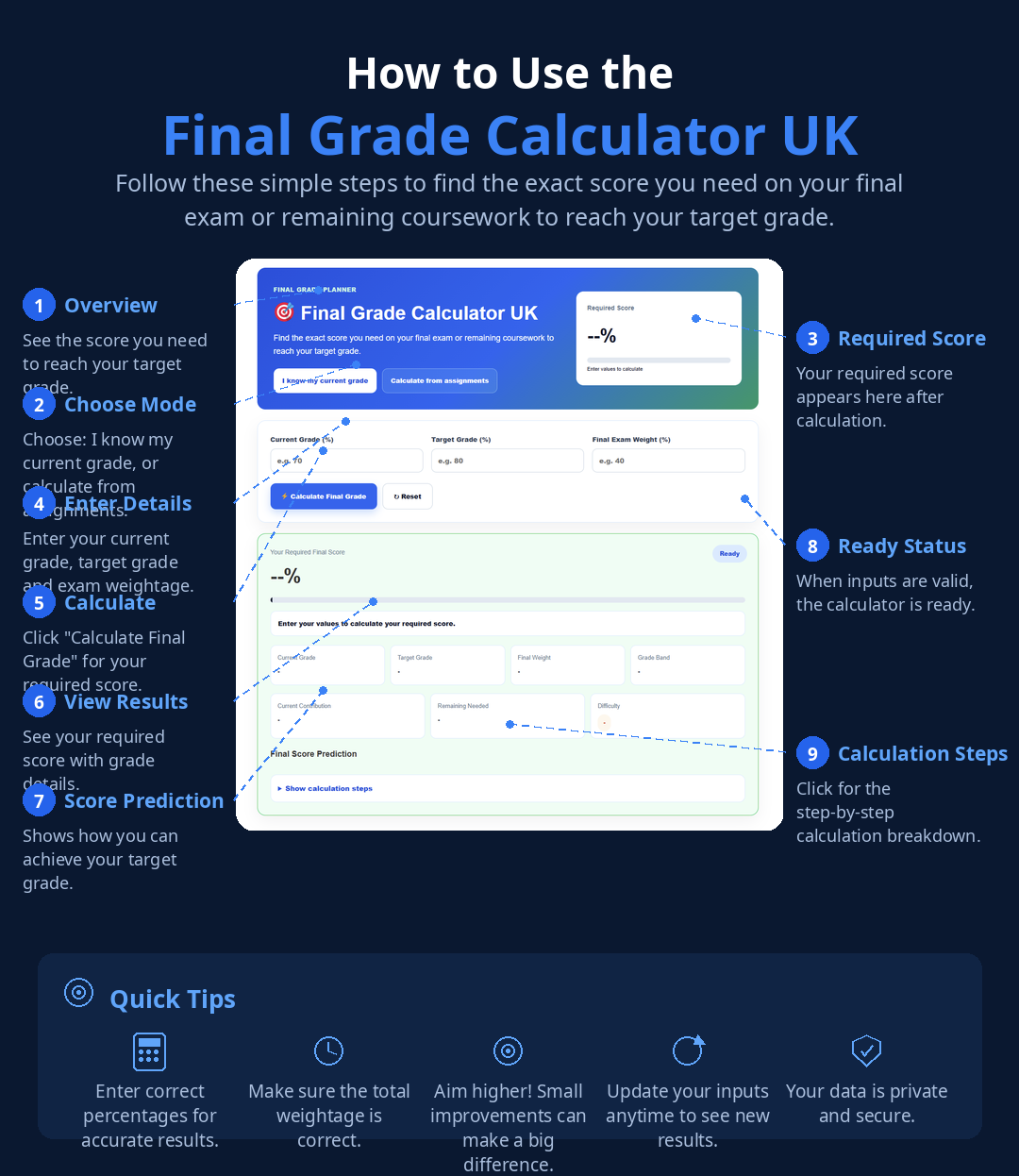
Click Here: Final Grade Calculator UK
The Short Answer: Yes — but the 2:1 Line Is Real
Can you do a PhD with a 2:2? Yes. Can you walk straight from a 2:2 into a funded PhD at a Russell Group university with no masters, no experience, and no mitigating story? Almost certainly not. Between those two extremes sit three realistic doors, and which one is open to you depends on what you are willing to invest.
Door one: the masters-first route. This is the strongest and most common path. A 2:2 plus a masters with Merit (60–69%) or Distinction (70%+) satisfies the published entry formula of a growing number of programmes — Nottingham’s Food Sciences PhD states it outright: “2:2 in a relevant subject with a merit at masters.” Your undergraduate classification stops being the deciding factor the moment your postgraduate grade clears the bar.
Door two: the professional doctorate. EngDs, DBAs and similar qualifications weight professional experience alongside — sometimes above — degree classification. Oxford Brookes’ EngD in Engineering sets its minimum at a 2:2, not a 2:1. If you have years of relevant work behind you, this door is wider than the academic PhD route.
Door three: the supervisor-led self-funded route. When a supervisor wants you and you bring your own funding — the government’s Doctoral Loan, savings, an employer sponsor — universities have formal flexibility. Oxford Brookes’ standard MPhil/PhD route says applications holding other qualifications “will be considered on their merits.” One Durham graduate on The Student Room with a 2:2 and a Merit MSc was offered exactly this kind of self-funded place. The catch, as we will show with real numbers below, is that self-funding a PhD on the Doctoral Loan alone leaves roughly £3,600 a year for living costs after fees.
Why the 2:1 Rule Exists — and What “Or Equivalent” Really Means
Universities are not being snobbish; they are managing risk. Doctoral completion rates matter to them — to their funding, their reputation, and their supervisors’ time. A 2:1 is used as a rough proxy for “this person can sustain independent research for three to four years.” It is an imperfect proxy, and universities know it, which is why the requirement is almost always phrased as “2:1 or equivalent” rather than an absolute cutoff.
The most important sentence in this whole debate comes from UKRI’s own Training Grant Guidance: “You can use your discretion in deciding whether candidates are suitable for research training, making reference to any Council-specific expectations.” In other words, UKRI — the body paying for thousands of doctoral studentships — does not impose a hard 2:1 floor. The floor is imposed by individual universities and doctoral training partnerships, and each one defines “equivalent” differently. Here is what that looks like in practice:
- Qualification combinations: Manchester’s Earth Science PhD requires a 2:1 in a relevant discipline — or any 2:1 plus a masters at Merit — and adds that “other combinations of qualifications and research or work experience may also be considered.” The masters grade can substitute for subject relevance or classification shortfall.
- Professional experience as equivalence: Nottingham’s Anatomy, Physiology and Nutrition MRes admits 2:2 holders, and even below-2:2 applicants with “detailed significant work experience.” Years in a relevant lab, clinic, or industry role count.
- Mitigating circumstances: Sheffield’s clinical psychology doctorate shortlisting guidance states that 2:2 degrees “will be considered if there is clear evidence on the application form of mitigating circumstances.” If illness, bereavement, or another documented factor depressed your final-year marks, say so — formally, with evidence.
- International equivalents: “Or equivalent” also covers overseas degrees via each university’s country-specific pages — worth knowing if your degree is from outside the UK.
The practical takeaway: never self-reject from a programme whose wording includes “or equivalent,” “may also be considered,” or “considered on their merits.” Email the admissions tutor or prospective supervisor and ask. The worst outcome is a polite no; the best is a funded place you assumed was closed to you.
What Universities Actually Ask For: Six Published Requirements Compared
To stop this being abstract, here are six real, current entry requirements — five for academic doctorates and one professional doctorate — showing exactly where the 2:2 line sits at each.
| University / programme | Published requirement | 2:2 route? |
|---|---|---|
| Manchester — PhD Earth Science | 2:1 in a relevant discipline, or any 2:1 plus a masters at Merit; “other combinations of qualifications and research or work experience may also be considered” | Discretionary — ask |
| Leeds — Law research degrees | 2:1 undergraduate plus a masters with Merit, both in appropriate disciplines | No explicit route |
| Durham — Law PhD | “Good 2:1 or above” plus a masters degree with an average of 65 or above | No — masters bar is 65%+ |
| Sheffield — Economics PhD | Undergraduate degree at 2:1 level plus a masters degree with Merit | No explicit route |
| Reading — Politics & International Relations PhD | Bachelor’s of “at least 2:1 level (or equivalent), or a master’s degree” — a masters alone can substitute for the 2:1 | Yes — via masters |
| Oxford Brookes — EngD Engineering | “Minimum of a second class honours degree (2:2)” in Engineering or a cognate area | Yes — 2:2 minimum |
The pattern is unmistakable. Standard academic PhDs want a 2:1 plus a masters with Merit — the 2:2 holder’s job is to supply the second half of that formula. Reading’s wording is the friendliest of the academic routes: a masters degree on its own can stand in for the 2:1. And the professional doctorate plays by different rules entirely, with Brookes accepting a straight 2:2. If your profile is “2:2, no masters, no experience,” the honest answer is that the academic PhD door is closed until you add one of those three things.
Funded Routes That Explicitly Accept a 2:2
“Funded” is the word that matters most in this guide, because anyone can theoretically self-fund — the question is who will pay you to do the doctorate. The default position across UKRI studentships is a 2:1 minimum imposed by the host university. But several funded routes name 2:2 acceptance in their published criteria:
| Funded route | 2:2 position (published) | What it takes |
|---|---|---|
| GW4 BioMed3 MRC Doctoral Landscape studentships (Bath, Bristol, Cardiff, Exeter) | “Applicants with a lower second-class degree may be considered if they also hold a master’s degree” | 2:2 + masters; UKRI-funded |
| Commonwealth PhD Scholarships | Normally 2:1; “candidates with a lower second-class degree may qualify where they also hold an appropriate postgraduate qualification, normally a Master’s degree” | 2:2 + masters; fully funded |
| Swansea SURES studentship (Psychology) | 2:1, or current masters students with “a pass with a minimum grade average of at least 70% for your part-one master’s degree modules” | 70%+ taught masters average |
| 1+3 / 1+3.5 DTP routes (e.g. South Coast ESRC DTP) | Funded masters-plus-PhD packages — but the grade bar typically still sits at 2:1 “or equivalent” | Removes the need to self-fund a masters; does not automatically admit 2:2s |
| Standard UKRI studentships | “At least a 2.1 (or equivalent)” — universities impose the norm, UKRI allows discretion | 2:1 norm; exceptions via supervisor advocacy |
Two nuances deserve emphasis. First, the 1+3 and 1+3.5 doctoral training routes — where a funded masters year is bolted onto the PhD — are often misread as a 2:2 back door. They are not, quite: the grade bar for the package usually remains 2:1-or-equivalent. What they remove is the need to self-fund a masters before applying, which is a financial barrier, not an academic one. Second, timing matters enormously for funded routes. UKRI studentship applications typically run from October–November to January–February for an autumn start — for example, Edinburgh’s SGSSS ESRC competition for autumn 2027 entry required the admissions application by 9 November 2026 and the funding application by 24 November 2026. Miss the window and the route does not exist that year, whatever your grades.
One more number worth knowing: the UKRI minimum doctoral stipend for 2026/27 is £21,805 per year outside London (£23,805 with the £2,000 London weighting), up 4.9% from £20,780 in 2025/26, with a minimum fee contribution of £5,238. That is the benchmark every self-funding calculation below is measured against.
The Masters-First Route: The Grade That Actually Matters
If there is one sentence to take from this guide, it is this: after a 2:2, your masters grade matters more than your undergraduate classification. Every published 2:2-to-PhD formula pivots on it. The bars, from real programme pages:
| Programme | Masters grade that unlocks the PhD |
|---|---|
| Nottingham — Food Sciences PhD | 2:2 + “a merit at masters” |
| Durham — Law PhD | Masters average of 65 or above |
| Swansea — SURES studentship | 70%+ average across part-one masters modules |
| Reading — Politics/IR PhD | A masters degree can substitute for the 2:1 entirely |
| GW4 BioMed3 MRC studentships | Lower-second degree + a masters degree |
In plain terms: Merit (60–69%) is the minimum that converts a 2:2 into an eligible profile, and Distinction (70%+) makes the conversion comfortable. A bare Pass at masters level does not do the job — it leaves you exactly where you started, one expensive year poorer. This is the single most common mistake 2:2 graduates make: treating any masters as a stepping stone, when only a graded masters at Merit or above functions as one. If you are weighing up taught masters options, our guides to what Merit and Distinction actually require and doing a masters with a 2:2 break down the entry requirements and the grade boundaries you will need to hit.
Worked scenario — the grade rescue. Amara graduates with a 2:2 (56% average) in Biomedical Science and wants a funded bioscience PhD. She takes a one-year MSc, targets Distinction, and finishes with 72%. Her profile now reads “2:2 + Distinction MSc” — which satisfies Nottingham’s published “2:2 with a merit at masters” formula with room to spare, meets the GW4 BioMed3 “lower-second plus a master’s” criterion for MRC-funded studentships, and clears Swansea-style 70%+ bars. The 2:2 has not been erased — it will still appear on her transcript — but it is no longer the deciding line on the application. The masters grade did the rescuing, which is precisely why choosing a masters you can genuinely excel in matters more than choosing a prestigious one.
Professional Doctorates: The 2:2-Friendliest Route
Professional doctorates — the EngD, DBA, DClinPsy, EdD and their cousins — are designed for experienced practitioners, and their entry criteria reflect that. Where the academic PhD asks “can you do research?”, the professional doctorate asks “can you do research and have you done the job?” That second question is where 2:2 holders with work experience win.
| Professional doctorate | Published 2:2 position |
|---|---|
| Oxford Brookes — EngD Engineering | 2:2 minimum in Engineering or a cognate area; other qualifications “considered on their merits” |
| Teesside — DBA | Masters plus 3 years’ managerial experience |
| Warwick — DBA | 2:1 plus a good MBA/masters plus 7 years’ senior management experience |
| Northampton — DBA | Business masters plus 5 years’ relevant senior work experience |
| Clinical psychology doctorate (DClinPsy) | Strict: usually 2:1 in a BPS-accredited degree minimum; Queen’s Belfast considers 2:2 + a higher degree; Sheffield considers 2:2 with clear mitigating circumstances; UCL expects a high 2:1 (67%+) |
The honest summary: engineering and business professional doctorates are structurally friendlier to 2:2 holders than academic PhDs, because experience is a formal part of the entry formula. Clinical psychology is the exception that proves the rule — the DClinPsy is the most competitive doctorate in the country, and a bare 2:2 without a higher degree, mitigating circumstances, and 12-plus months of clinically relevant experience will not clear shortlisting. Do not confuse “professional doctorate” with “easy doctorate”: the bar moves from grades to experience, it does not disappear.

Self-Funded: The Honest Maths
The self-funded route is where 2:2 holders most often end up — and where the fewest do the arithmetic before committing. Here it is, with the current official figures.
Worked scenario — Priya’s funding comparison. Priya has a 2:2 and a Merit MSc, and a supervisor is willing to take her on for a 3.5-year PhD. Two versions of the next three and a half years:
| UKRI-funded studentship | Self-funded (Doctoral Loan) | |
|---|---|---|
| Living support | £21,805/year tax-free × 3.5 = £76,317 | £31,122 total ÷ 3.5 = £8,892/year |
| Tuition fees | Paid in full (£5,238/year minimum covered) | ~£5,238/year out of the loan |
| Left for living costs | £21,805/year | ~£3,654/year |
| Can combine with Doctoral Loan? | n/a | No — the loan cannot be combined with Research Council funding |
Read that last row twice. £3,654 a year for rent, food, and everything else is not a funding plan — it is a funding gap. Self-funding works only with savings, substantial part-time work, an employer sponsor, or family support on top of the loan. That matches what experienced voices on student forums tell 2:2 holders considering self-funded offers: the Doctoral Loan covers roughly £3,000–£4,000 a year of living costs once fees are paid, and you need a real plan for the rest. Before accepting any self-funded offer, write down where every pound of years one to three comes from. If you cannot, the offer is not really an offer — it is a liability. And think hard about the career rationale too: a self-funded PhD followed by an academic job market that never materialises is the most expensive version of this story. Our guide to whether your degree classification matters to employers is a useful reality check before you commit.
Your 5-Step Application Plan
Step 1 — Audit your transcript honestly. Pull your full module record, not just the classification. Supervisors read transcripts, and a 2:2 built on strong final-year marks plus one disastrous second-year semester tells a better story than a flat 55% throughout. If anything on the record is wrong, fix it now — see our guide to reading and fixing your university transcript.
Step 2 — Pick your route before you pick your universities. Masters-first, 1+3 DTP package, professional doctorate, or self-funded: each has different deadlines, costs, and grade bars. A 2:2 holder applying scattergun to standard funded adverts with no route strategy wastes the October–January window. Decide the route, then shortlist programmes whose published criteria name your profile.
Step 3 — Target the masters grade, not just the masters. If you go the masters-first route, Merit is the floor and Distinction is the target. Choose a programme whose assessment style suits you and whose dissertation you can genuinely excel in — a Distinction from a less famous university beats a Pass from a famous one for PhD entry purposes. Grade boundaries and what each classification demands are covered in our Merit vs Distinction guide.
Step 4 — Email supervisors before you apply. For the discretionary and “considered on their merits” routes, the supervisor’s advocacy is the mechanism by which exceptions happen. Write a short, specific email: who you are, your grades stated plainly (do not hide the 2:2 — they will see the transcript), your research idea in three sentences, and why their work specifically. Departments told directly about a 2:2 with a credible proposal respond far better than anonymous applications to a faceless portal.
Step 5 — Respect the funding calendar. Funded studentship applications typically run October–November to January–February for autumn entry. Build backwards from those dates: proposal drafted by early autumn, references secured before Christmas, funding application in well before the deadline. A strong application submitted in March is a strong application to a closed competition.
3 Mistakes That Sink Most 2:2 Applications
Mistake 1 — Treating any masters as a stepping stone. A Pass at masters level does not rescue a 2:2; it just moves the same profile one expensive year forward. The published formulas all say Merit, 65%+, or 70%+. If you cannot commit to chasing that grade, the masters-first route is not your route.
Mistake 2 — Applying only to 2:1-minimum funded adverts with no plan B. Every cycle, 2:2 holders fire applications at standard UKRI studentships, get filtered at shortlisting, and conclude the system is closed. The system is not closed — but the open doors (named 2:2-accepting studentships, 1+3 packages, professional doctorates, supervisor-led self-funded places) are different doors. Aim at those.
Mistake 3 — Hiding the 2:2 instead of framing it. Omitting your classification, or burying it and hoping nobody notices, backfires the moment the transcript arrives. State it plainly, then give the reader the better story: the Distinction masters, the mitigating circumstances with evidence, the three years of lab experience, the dissertation that won a departmental prize. Admissions tutors respect candour paired with evidence; they do not respect being managed.
Frequently Asked Questions
Can I do a PhD with a 2:2 and no masters?
Very rarely through funded routes. Most UK PhD programmes require a 2:1 minimum, and UKRI studentships are normally advertised at 2:1 or above. The realistic exceptions are programmes whose wording includes "or equivalent" or "considered on their merits" — where significant professional or research experience can substitute — and professional doctorates such as the EngD, where Oxford Brookes accepts a straight 2:2. For the standard academic PhD, a masters at Merit or above is the expected next step.
Will a Merit at masters cancel out my 2:2?
Often, yes. Several programmes publish exactly this formula: Nottingham’s Food Sciences PhD accepts "2:2 in a relevant subject with a merit at masters," Reading’s Politics PhD lets a masters degree substitute for the 2:1 entirely, and the GW4 BioMed3 MRC studentships consider lower-second graduates who hold a masters. A Distinction (70%+) makes the conversion more comfortable — Durham’s Law PhD wants a masters average of 65 or above. A bare Pass at masters level does not do the job.
Can I get a fully funded PhD with a 2:2?
Yes, through named routes. The GW4 BioMed3 MRC Doctoral Landscape studentships state that lower-second graduates with a masters may be considered, and Commonwealth PhD Scholarships allow 2:2 holders with an appropriate postgraduate qualification. Mainstream UKRI studentships remain 2:1-norm in practice, though UKRI’s own guidance gives universities discretion over who is suitable for research training — so supervisor advocacy can create exceptions.
What does UKRI require for a doctoral studentship?
The standard published wording is "a relevant undergraduate degree with at least a 2.1 (or equivalent)" plus evidence of suitability for research. UKRI’s Training Grant Guidance adds that universities may use their discretion in deciding who is suitable. The UKRI minimum stipend for 2026/27 is £21,805 per year outside London (£23,805 in London), with a minimum fee contribution of £5,238.
Can I do a clinical psychology doctorate with a 2:2?
It is the hardest doctorate to enter with a 2:2. Most DClinPsy programmes require a 2:1 in a BPS-accredited psychology degree as a minimum. The published exceptions: Queen’s Belfast considers 2:2 holders who also possess a higher degree, and Sheffield considers 2:2 degrees where there is clear evidence of mitigating circumstances. You would also need 12 or more months of clinically relevant experience and research competence on top.
Is a self-funded PhD worth it with a 2:2?
Do the maths first. The government’s Doctoral Loan is worth up to £31,122 in total — about £8,892 a year over 3.5 years — and after roughly £5,238 a year in fees, around £3,650 a year remains for living costs. Self-funding only works with savings, substantial part-time work, or an employer sponsor on top. Also weigh the career rationale honestly: a self-funded doctorate is a major investment, so be clear about what it buys you afterwards.
Can I combine the Doctoral Loan with a UKRI studentship?
No. The postgraduate Doctoral Loan cannot be combined with Research Council (UKRI) funding. It is designed for students who are self-funding or funded through other means, and it is non-means-tested, paid in equal instalments across the length of your doctorate.
Do universities ever waive the 2:1 requirement?
Yes — "waive" is the wrong word, but exceptions are real and published. Manchester’s PhD entry pages invite "other combinations of qualifications and research or work experience"; Sheffield’s clinical psychology shortlisting considers 2:2 degrees with clear mitigating circumstances; Nottingham’s MRes routes admit below-2:2 applicants with significant work experience. The mechanism is almost always a supervisor or admissions tutor exercising stated discretion, which is why contacting them directly matters.
Conclusion
A 2:2 closes the default door to a PhD, but it opens three others — and all three are real, published, and used every year. The masters-first route is the strongest: a Merit or Distinction at postgraduate level converts a 2:2 into an eligible profile at programmes that print the formula on their entry pages. The professional doctorate route rewards what the academic route ignores, with the EngD accepting a straight 2:2 and DBAs weighting years of senior experience. And the self-funded route exists wherever a supervisor will advocate for you — but only makes sense if you have done the funding arithmetic and can genuinely cover the £3,600-a-year reality the Doctoral Loan leaves behind.
What does not work is pretending the 2:1 line is not there. Do not fire uncrafted applications at 2:1-minimum funded adverts and hope. Read the entry pages for the words “or equivalent” and “considered on their merits,” email the supervisor with your grades stated plainly and a real research idea, and build backwards from the October–January funding window. The students who make it from a 2:2 to a doctorate are not the ones with the best excuses for their classification — they are the ones with the clearest evidence of what comes next: a Distinction-level masters, a decade of professional practice, or a proposal a supervisor wants to read. Supply one of those, and the 2:2 becomes a footnote on your transcript rather than the end of the story.