
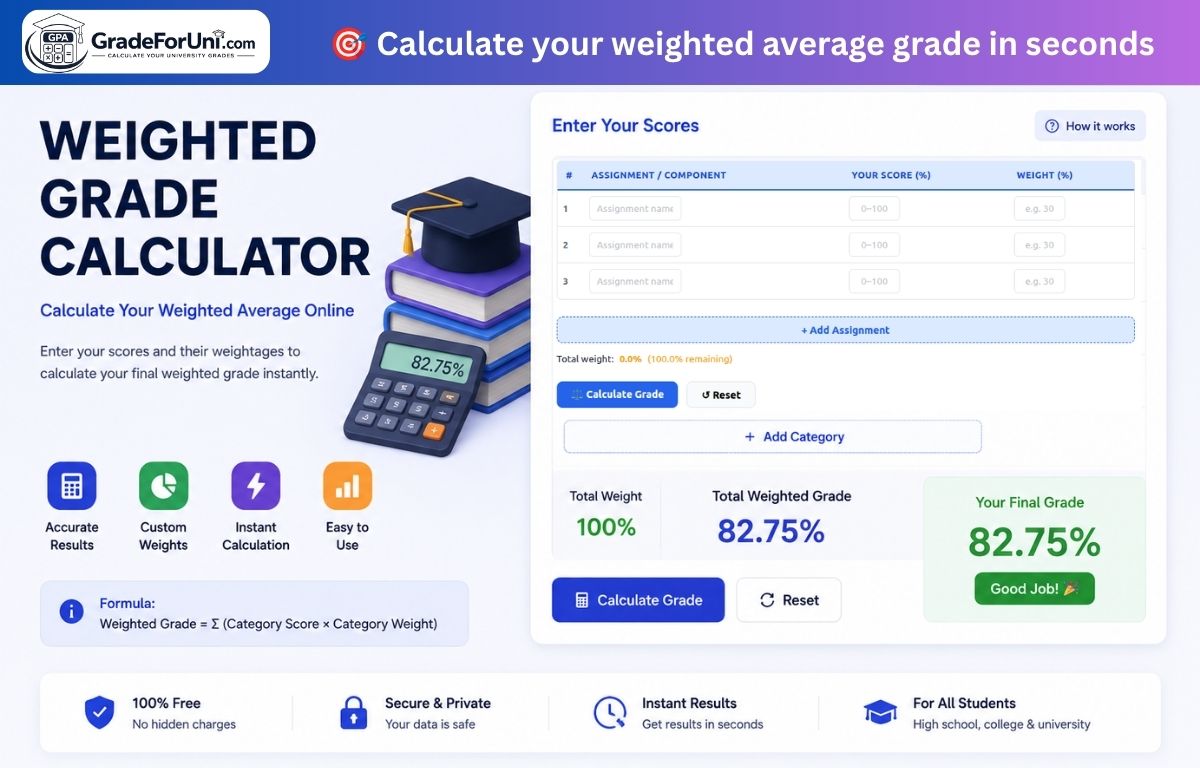
A weighted grade calculator is a tool that is used to calculate your Curriculum grade when different tasks have different levels of marks.
It calculates your grades by customizing percentage weights to each assignment, exam, or studies.
Calculate: Weighted Grade Calculator
How Does a Weighted Grade Calculator Work?
A weighted grade calculator works by multiplying each of your grades by its rate weight, adding those Items, and dividing by the total weight of the finished
During the current semester, the system automatically adjusts the math to keep your grade correct. weighted grade calculator It does this by dividing your earned points only by the total weight of the categories you have actually completed.
Check This: University Grade Calculator
Why Are Weighted Grades Important?
Weighted grades matter because they reflect the actual importance and discipline of your work.
By assigning higher values to major exams, projects, or advanced classes, this system encourages mastery of core material, balances out minor mistakes, and gives students a competitive edge for college and scholarships.
Benefits
Encourages strict standards: Giving a numerical boost to challenging courses (like Honors or AP classes) encourages students to take harder subjects, building critical thinking skills.
Reflects genuine knowledge: Major tests and final projects require deeper comprehension than daily homework. Contribution: Weighting them accordingly ensures grades represent actual knowledge.
Read More: Salary and Tax Estimator USA
How to Calculate a Weighted Grade (Step-by-Step)
A weighted grade is calculated by scaling each assignment, quiz, exam, or contribution score by its assigned weight and then putting the results together.
Step 1: Convert Weights into Percentages
Ensure each category has a percentage Weight given to it.
Example:
- Quizzes = 20%
- Midterm Exam = 30%
- Overall Exam = 50%
Step 2: Multiply Each Score by Its Weight
| Category | Score | Weight | Weighted Score |
|---|---|---|---|
| Quizzes | 80% | 20% | 16 |
| Midterm | 70% | 30% | 21 |
| Final Exam | 90% | 50% | 45 |
| Total | — | 100% | 82 |
Weighted Grade = 16 + 21 + 45 = 82% ✅
Step 3: Put the Weighted Scores
Formula
Weighted Grade = (Score × Weight) + (Score × Weight) + (Score × Weight) + …
Quick Example
Suppose you scored:
| Category | Score | Weight |
|---|---|---|
| Homework | 85% | 20% |
| Midterm | 75% | 30% |
| Final Exam | 90% | 50% |
Calculation
| Category | Calculation | Weighted Score |
|---|---|---|
| Homework | 85 × 0.20 | 17 |
| Midterm | 75 × 0.30 | 22.5 |
| Final Exam | 90 × 0.50 | 45 |
| Total Grade | 17 + 22.5 + 45 | 84.5% |
Overall Weighted Grade = 84.5%
This means your final weighted grade is 84.5% after taking the importance (weight) of each category into account.
Read More: University Grade Calculator
Weighted Grade Formula
Weighted Grade = (Score × Weight) + (Score × Weight) + (Score × Weight)
Weighted Grade Formula Explained
The weighted grade formula calculates your overall grade by multiplying by each mark by its assigned weight and then putting the results together. This method lets makes sure that assignments, quizzes, and exams contribute to your final grade according to their importance.
The Formula
Final Grade = Σ (Category Weight × Category Average)
Simply put, multiply each category’s grade by its weight (as a decimal), then add them all up.
Example
Say your class is graded like this:
| Category | Weight | Your Score |
|---|---|---|
| Exams | 50% | 82 |
| Homework | 30% | 95 |
| Participation | 20% | 100 |
Calculation
| Category | Calculation | Weighted Score |
|---|---|---|
| Exams | 0.50 × 82 | 41 |
| Homework | 0.30 × 95 | 28.5 |
| Participation | 0.20 × 100 | 20 |
| Final Grade | 41 + 28.5 + 20 | 89.5 |
Final Grade = 89.5%
Formula Example
Let’s say, your course uses the following grading weights:
- Assignments = 30%
- Quizzes = 20%
- Midterm Exam = 20%
- Final Exam = 30%
Your marks are:
- Assignments = 85%
- Quizzes = 90%
- Midterm Exam = 75%
- Final Exam = 80%
Using the weighted grade formula:
Weighted Grade = (85 × 0.30) + (90 × 0.20) + (75 × 0.20) + (80 × 0.30)
Calculation:
- Assignments: 85 × 0.30 = 25.5
- Quizzes: 90 × 0.20 = 18
- Midterm Exam: 75 × 0.20 = 15
- Final Exam: 80 × 0.30 = 24
Final Weighted Grade = 25.5 + 18 + 15 + 24 = 82.5%
This example demonstrates how each category contributes to the final grade based on its assigned weight. weighted grade calculator Categories with higher weights have a greater impact on the overall result.
Read More: University Grade Calculator
Weighted Grade Calculation Examples
How weighted grades work is simple with real examples. There are three common examples showing how to apply the weighted grade formula step by step.
Example 1: Assignment & Quiz
Let’s say your course has two components: a quiz worth 40% and an assignment worth 60%. You scored 72% on the quiz and 85% on the assignment.
| Category | Weight | Score |
|---|---|---|
| Quiz | 40% | 72% |
| Assignment | 60% | 85% |
To find your weighted grade, multiply by each marks by its weight and add the results:
| Calculation |
|---|
| (62 × 30%) + (75 × 50%) = 56.1% |
Example 2: Coursework & Final Exam
Many courses separate marks between current coursework and a single final exam. Here,
| Category | Weight | Score |
|---|---|---|
| Study Tasks | 30% | 88% |
| Final Exam | 70% | 61% |
Study tasks are worth 30% and the final exam is worth 70%. You scored 88% on coursework and 61% on the overall exam.
| Calculation |
|---|
| (77 × 0.20) + (51 × 0.60) = |
Example 3: University Module Grades
At university, grades are usually weighted by credit value rather than a simple rate. Suppose you completed three modules: Module 1 worth 40 credits (74%), Module 2 worth 20 credits (68%), and Module 3 worth 20 credits (81%). Your total is 80 credits.
| Module | Credits | Grade |
|---|---|---|
| Module 1 | 40 | 74% |
| Module 2 | 20 | 68% |
| Module 3 | 20 | 81% |
| Total | 80 | — |
Convert each credit value to a weight out of 100: Module 1 = 50%, Module 2 = 25%, Module 3 = 25%.
| Module | Weight |
|---|---|
| Module 1 | 50% |
| Module 2 | 25% |
| Module 3 | 25% |
| Calculation |
|---|
| (74 × 0.50) + (68 × 0.25) + (81 × 0.25) = 37.0 + 17.0 + 20.25 = 74.25% |
This credit-weighted approach is standard at UK universities and is used to calculate degree classification averages.
Weighted Grade vs Simple Average
A weighted grade and a simple average are both used to calculate study performance, but they calculate results in many ways.
A simple average treats every mark equally. weighted grade calculator Each assignment, quiz, or exam has the same effect on the final result, regardless of its importance.
A weighted grade, on the other hand, gives different rates to different types . weighted grade calculator Assessments with higher weights contribute more to the final grade than those with lower weights.
Calculate: Weighted Grade Calculator
Example
Scores
| Assessment | Score |
|---|---|
| Quiz | 80% |
| Midterm | 70% |
| Final Exam | 90% |
Weights
| Assessment | Weight |
|---|---|
| Quiz | 20% |
| Midterm | 30% |
| Final Exam | 50% |
Simple Average
| Calculation | Result |
|---|---|
| (80 + 70 + 90) ÷ 3 | 80% |
Weighted Grade
| Assessment | Calculation | Weighted Score |
|---|---|---|
| Quiz | 80 × 0.20 | 16 |
| Midterm | 70 × 0.30 | 21 |
| Final Exam | 90 × 0.50 | 45 |
| Total Weighted Grade |
|---|
| 16 + 21 + 45 = 82% |
How Grade Weight Percentages Works
It works on different levels of value to different groups of work in a course. weighted grade calculator Rather than treating every assignment equally, weighted grading shows how much each group counts toward your final grade.
Each group (like homework, tests, or a final exam) is applied for a percentage. All the rates must add up to 100%. Your score in each group is then multiplied by its weight to produce your final grade.
Read More: University Grade Calculator
Formula:
Final Grade = Σ (Category Score × Category Weight)
Example
| Category | Weight | Your Score |
|---|---|---|
| Homework | 20% | 90% |
| Quizzes | 15% | 80% |
| Midterm Exam | 25% | 75% |
| Final Exam | 40% | 85% |
Calculation:
| Category | Calculation | Weighted Score |
|---|---|---|
| Homework | 90 × 0.20 | 18.0 |
| Quizzes | 80 × 0.15 | 12.0 |
| Midterm | 75 × 0.25 | 18.75 |
| Final Exam | 85 × 0.40 | 34.0 |
| Final Grade |
|---|
| 18.0 + 12.0 + 18.75 + 34.0 = 82.75% |
Common Mistakes When Calculating Weighted Grades
Considering all Tasks equally rather than applying their assigned weights. For example, averaging a 90% homework grade and a 70% exam grade as 80% when the exam is really worth 70% of the grade gives a wrong result.
If category weights for example (Homework 20%, Quizzes 20%, Exams 50%, contribution 10%) don’t sum to 100%, the final percentage will be misleading .Always double-check totals before finding
Combining totals across groups with different maximum points for example (a quiz out of 10 vs. an exam out of 100) without converting to rates first leads to incorrect weighting weighted grade calculator .
Benefits of Using Our Weighted Grade Calculator
1. No more by hand math errors or miscalculated percentages. Our calculator automatically applies the correct weighted formula, so you get a precise grad
2. You’re tracking homework, quizzes, exams, or participant
3. Instead of doing boring calculations by hand or building complex spreadsheets, get instant results in seconds. Just add your scores and weights and we handle the rest.
4. Avoid the typical errors people make combining raw points with percentages forgetting to convert weights to decimals, or applying weights at the wrong level. The calculator does it accurately behind the scenes.
5. No technical or math background required. Simple input fields make it accessible for students, parents, and teachers alike.
Calculate: Weighted Grade Calculator
Who Can Use This Weighted Grade Calculator?
University Students
Easily calculate module and course grades that mix up coursework, midterms, finals, and contribution marks. weighted grade calculator fast check where you stand and what scores you need on next assessments to hit your target grade or degree classification.
College Students
Watch grades across classes with different grading formats If it’s homework, quizzes, projects, or exams. Stay on top of your GPA and know exactly how each assignment affects your final course grade.
Teachers & Educators
Check weighted grade calculations fastly and correctly for honesty with students and parents. Double-check gradebook totals, set up grading outlines for new courses, and save time on by hand calculations.
Online Learners
If you’re taking a MOOC, certification course, or remote class, easily calculate your progress across modules, quizzes, and final projects even when platforms don’t show clear weighted outlines.
Tips to Improve Your Weighted Grade
1. Know Your Weights First
Before doing anything else, find out exactly how much each category (homework, quizzes, exams, participation) is worth. You can’t plan effectively if you don’t know what counts most.
2. Focus Effort on High-Weight Categories
If your final exam is worth 40% and a quiz is worth 5%, spend your study time as needed. weighted grade calculator Don’t pour hours into low-weight assignments while ignoring big-impact ones.
3. Calculate “What You Need” Early
Use a weighted grade calculator to figure out what score you need on remaining assignments to hit your target grade. Knowing this early helps you plan instead of guessing at the end weighted grade calculator.
4. Don’t Ignore Small Assignments
Low-weight items add up. Skipping homework or quizzes because . weighted grade calculator They don’t count much can still drag your average down over time especially if there are many of them.
5. Ask About Extra Credit
If you’re close to a grade boundary, ask your teacher or professor if extra credit opportunities exist. Even a small boost can push you over the edge.
What Is a Weighted Grade?
weighted grade calculator A weighted grade is a final score calculated by giving different assignments or categories different levels of importance, rather than treating them all equally. For example, a final exam might count for 40% of your grade while a quiz only counts for 5%.
How Do You Calculate a Weighted Grade?
Multiply each grade by its assigned weight (as a decimal), then add up all the results. Each category should first be converted to a percentage before applying its weight, especially if assignments within it have different point totals.
What Is the Formula for a Weighted Grade?
Weighted Grade = (Grade₁ × Weight₁) + (Grade₂ × Weight₂) + … + (Gradeₙ × Weightₙ)
Where each weight is expressed as a decimal (e.g., 20% = 0.20) and all weights add up to 1.0 (100%).
What Happens If the Weights Do Not Equal 100%?
If your weights don’t add up to 100%, your final grade calculation will be inaccurate — either too high or too low. Always double-check that all category weights sum correctly before calculating, and adjust if your instructor’s syllabus shows different totals.
Is a Weighted Grade More Accurate Than a Simple Average?
Yes, when assignments carry different levels of importance. A simple average treats every assignment equally, which can misrepresent your true performance — for example, making a low-stakes quiz count as much as a major final exam. Weighted grades reflect the actual structure of your course.
Can I Calculate University Module Grades?
Yes. Most university modules use a weighted system combining coursework, exams, and participation. Just input the exact weights from your module handbook, and keep in mind some universities also apply separate rules like pass thresholds or compensation for failed components.
Is This Weighted Grade Calculator Free?
Yes, it’s completely free to use, with no sign-up, download, or installation required.
Does This Calculator Work for UK Universities?
Yes. It supports the percentage-based, weighted-module systems common in UK universities. Just note that final degree classifications often apply additional year-weighting (e.g., Year 2/Year 3 splits), which is a separate calculation from individual module grades.
Can I Use It for School, College, and University?
Yes. The calculator is flexible enough to handle grading systems at any level — from school report cards to college course grades to university module weightings.
How Accurate Is This Calculator?
The calculator applies the standard weighted average formula precisely, eliminating common manual errors like rounding too early or mixing raw points with percentages. Results are only as accurate as the weights and scores you enter, so double-check those against your official syllabus or module handbook.
Try Our Free Weighted Grade Calculator
Stop guessing your final grade. Enter your scores and weights below to get an instant, accurate result: no sign-up, no downloads, just simple, reliable calculations whenever you need them.
Conclusion
Calculating weighted grades doesn’t have to be confusing or time-consuming. By understanding how weights work, avoiding common mistakes like mixing up raw points and percentages, and using the right formula, you can always know exactly where you stand whether you’re in school, college, or university.
Our free weighted grade calculator takes the guesswork out of the process, giving you instant, accurate results so you can focus on what matters most: improving your grades, not doing math by hand. Try it today and stay on top of your academic progress with confidence.