
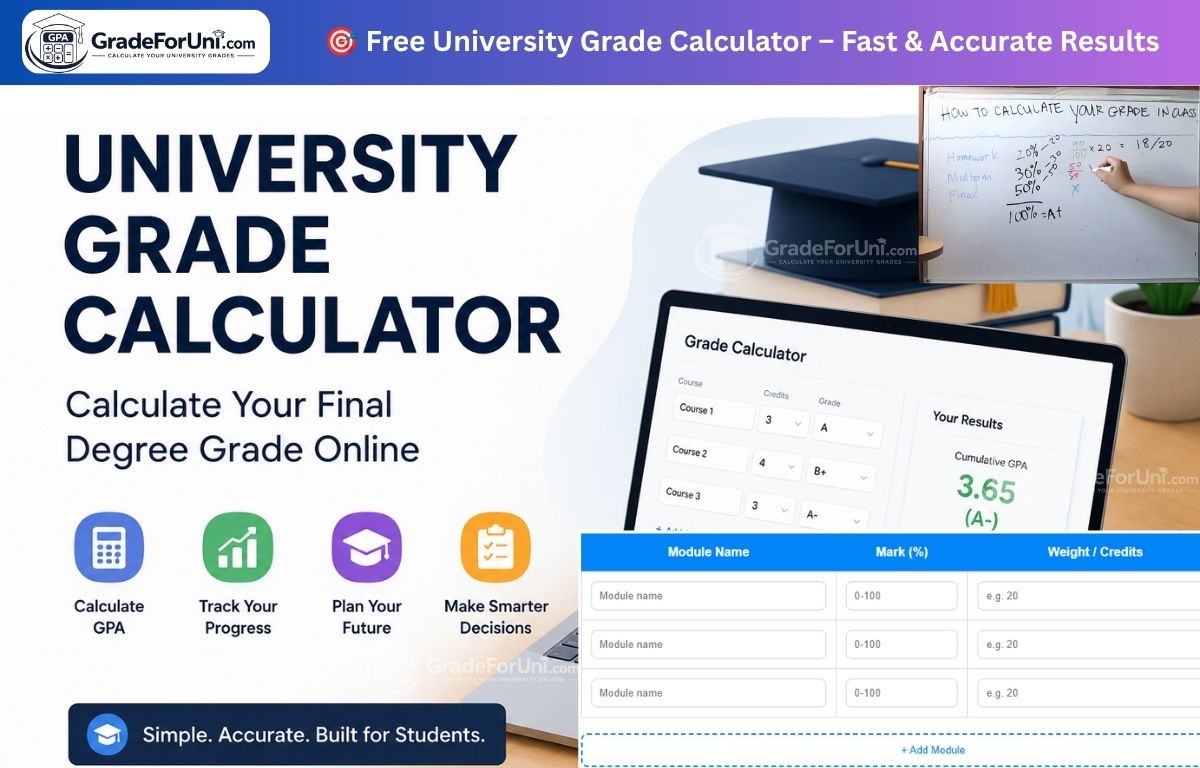
University life is full of assignments, quizzes, coursework, presentations, practical work, midterm exams, and final examinations. Every assessment contributes differently to your overall result, making it difficult for students to calculate their grades manually. Even a small calculation mistake can give the wrong impression of your academic performance.
This is where University Grade Calculators become useful. Instead of spending time working out complex formulas, students can instantly calculate their current grade, estimate future grades, and understand what scores they need to achieve their academic goals.
Whether you are studying for a bachelor’s degree, master’s degree, diploma, foundation programme, or postgraduate qualification, a reliable grade calculator helps you stay informed throughout the semester.
Students often ask questions like:
- Am I currently passing this module?
- What mark do I need in my final exam?
- Can I still achieve a First Class degree?
- How will one assignment affect my GPA?
- What happens if I fail one assessment?
- How much do my credits affect my final degree classification?
Instead of manually calculating every percentage and credit weighting, University Grade Calculators provide accurate answers within seconds.
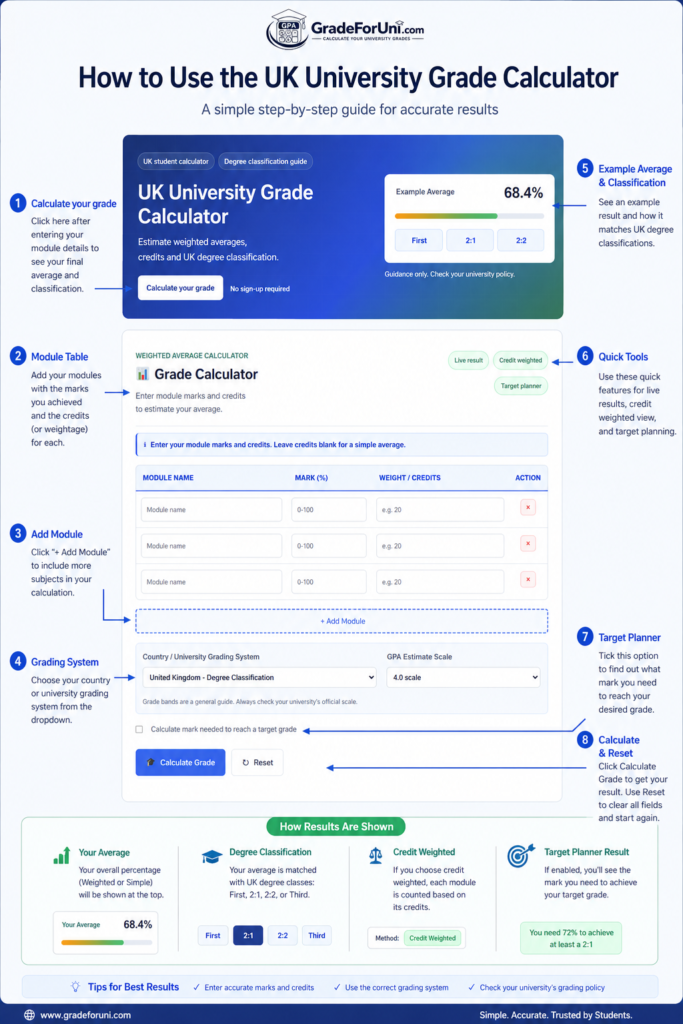
Click Here: UK University Grade Calculator
How to Use the UK Grade Calculator
What Can University Grade Calculators Calculate?
Modern University Grade Calculators are much more than simple GPA calculators. Depending on your university and grading system, they can calculate various academic results.
These include:
| Calculation | Purpose |
|---|---|
| Semester GPA | Calculates GPA for one semester |
| Overall GPA | Calculates cumulative GPA |
| Final Grade | Estimates your overall course result |
| Weighted Grade | Applies assignment and exam weightings |
| Credit-Based Grade | Calculates grades using credit hours |
| Required Final Exam Score | Shows what score you need to reach a target grade |
| Degree Classification | Estimates honours classification where applicable |
| Percentage Grade | Converts weighted marks into percentages |
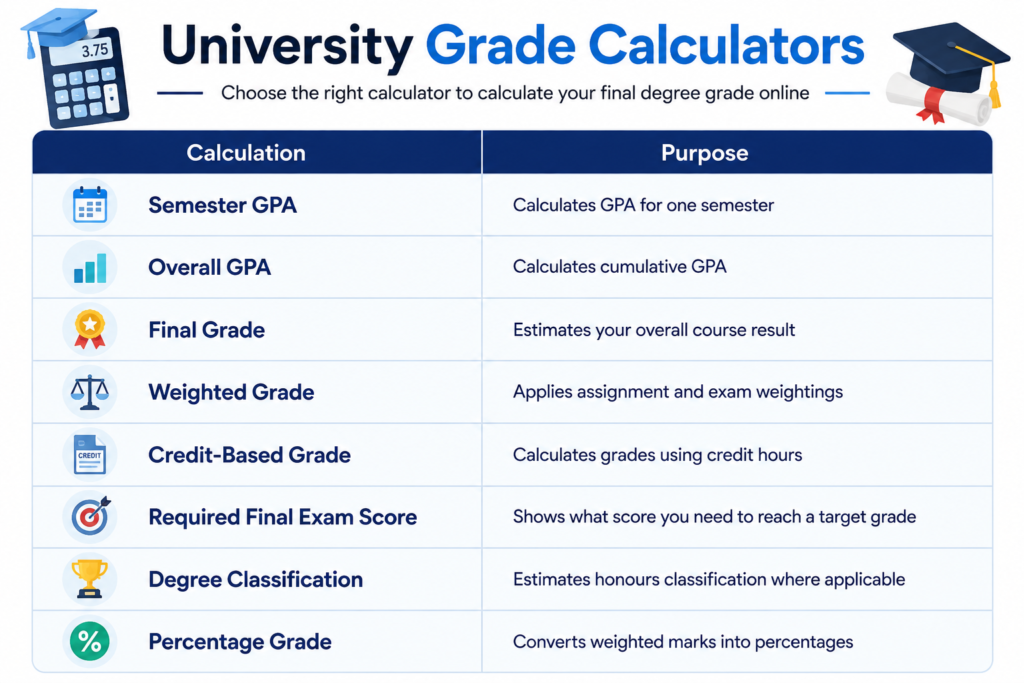
These calculations help students understand their academic standing before official university results are released.
Why Manual Grade Calculations Are Difficult
Many students still calculate grades using calculators, spreadsheets, or handwritten notes. While this works for simple courses, university grading quickly becomes more complicated.
For example, one course may include:
- Coursework – 20%
- Group Project – 15%
- Practical Assessment – 15%
- Midterm Exam – 20%
- Final Examination – 30%
Each component carries a different weight. Missing just one weighting can completely change the final result.
Universities also use:
- Credit-weighted modules
- GPA scales
- Percentage systems
- Letter grades
- Honours classifications
- Grade point systems
Keeping track of all these manually becomes difficult throughout the academic year.
Visit Now: Taxsal.comBenefits of Using University Grade Calculators Throughout the Semester
Many students only calculate grades after receiving their final exam results. However, using University Grade Calculators throughout the semester provides much greater benefits.
Better Academic Planning
Knowing your current grade allows you to plan your study schedule more effectively. Instead of guessing where you stand, you can identify weak subjects early.
Goal Tracking
Students aiming for distinctions, scholarships, or postgraduate admission can regularly monitor their progress towards their target grades.
Reduced Stress
Not knowing your academic standing creates unnecessary anxiety. Grade calculators provide a clear picture of your progress.
Faster Decision Making
Students can decide whether they need extra revision, tutoring, or additional practice before important assessments.
Accurate Predictions
Although final university results always depend on official grading policies, accurate calculators provide reliable estimates based on available marks.
How University Grade Calculators Save Time
Imagine calculating grades for six university modules.
For each module, you would need to:
- Find each assignment mark
- Multiply every mark by its weighting
- Add all weighted marks together
- Calculate credit values
- Work out averages
- Double-check calculations
Repeating this process for every semester takes considerable time.
An online calculator performs the same calculations instantly while reducing the chance of human error.
Who Benefits Most from University Grade Calculators?
Although these tools are mainly designed for university students, many other users also benefit from them.
Undergraduate Students
Track module performance throughout every semester.
Postgraduate Students
Estimate dissertation and coursework contributions towards final classifications.
International Students
Understand unfamiliar grading systems used by universities abroad.
Transfer Students
Estimate GPA conversions when moving between institutions.
Academic Advisors
Help students plan realistic academic targets.
Parents
Gain a better understanding of their child’s academic progress.
Common Situations Where Students Use University Grade Calculators
Students use grade calculators for many different reasons during the academic year.
Some common situations include:
- Before submitting final coursework
- Before sitting the final exams
- After receiving assignment feedback
- When applying for scholarships
- Before university progression decisions
- During academic probation
- While preparing for graduation
- Before applying for postgraduate courses
- When transferring universities
- Before placement or internship applications
Having accurate grade estimates allows students to make informed academic decisions.
What Information Do You Need Before Using University Grade Calculators?
Before calculating your results, it is helpful to collect all relevant academic information.
This may include:
- Assignment marks
- Coursework scores
- Quiz results
- Midterm grades
- Final examination marks
- Credit hours
- Module weightings
- Letter grades
- Percentage scores
- University grading scale
Having accurate information ensures the calculator produces reliable results.
Are University Grade Calculators Accurate?
One of the most common questions students ask is whether online grade calculators are accurate.
The answer depends on the information entered.
Most University Grade Calculators use standard mathematical formulas. If you enter the correct:
- Marks
- Credits
- Assessment weightings
- Grade scale
The calculated result is usually very close to your official university calculation.
However, universities sometimes apply additional academic regulations such as:
- Grade rounding
- Module compensation
- Capped resits
- Pass requirements
- Honours weighting
- Academic penalties
These policies vary between institutions, so students should always compare calculator estimates with their university’s official grading regulations.
Understanding GPA, CGPA, SGPA and Final Degree Grades
Many university students become confused by academic terms like GPA, CGPA, SGPA, weighted grades, grade points, and degree classifications. Although these terms are related, they measure different parts of your academic performance.
Understanding these concepts helps you use University Grade Calculators correctly and interpret your results with confidence.
What Is GPA?
GPA (Grade Point Average) measures your academic performance for a particular semester or study period.
Instead of using percentages alone, many universities convert grades into grade points. These points are then averaged according to the credit hours of each course.
For example:
| Course | Credits | Grade | Grade Points |
|---|---|---|---|
| Mathematics | 3 | A | 4.0 |
| Biology | 4 | B+ | 3.3 |
| English | 3 | A- | 3.7 |
A GPA calculator multiplies each grade point by the course credits before calculating the average.
Example CGPA Calculation
| Semester | GPA |
|---|---|
| Semester 1 | 3.45 |
| Semester 2 | 3.72 |
| Semester 3 | 3.58 |
| Semester 4 | 3.80 |
| Estimated CGPA | 3.64 |
Note: The CGPA above is calculated as the average of all semester GPAs for this example. Some universities calculate CGPA using credit-weighted averages, so the official result may vary depending on your institution’s grading policy.
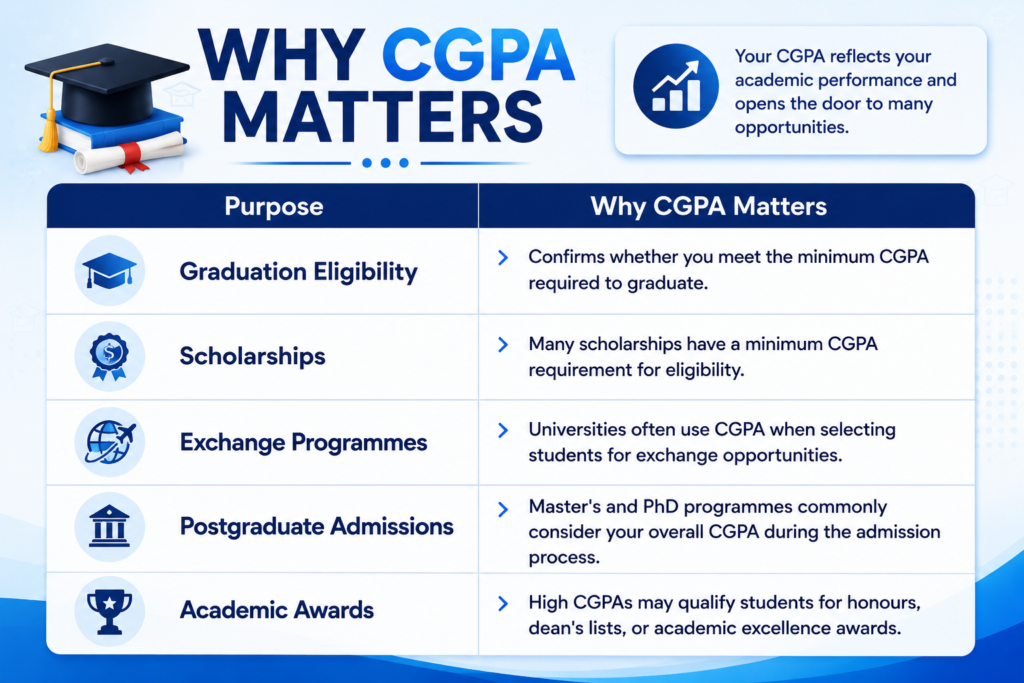
Common Uses of CGPA
| Purpose | Why CGPA Matters |
|---|---|
| Graduation Eligibility | Confirms whether you meet the minimum CGPA required to graduate. |
| Scholarships | Many scholarships have a minimum CGPA requirement for eligibility. |
| Exchange Programmes | Universities often use CGPA when selecting students for exchange opportunities. |
| Postgraduate Admissions | Master’s and PhD programmes commonly consider your overall CGPA during the admission process. |
| Academic Awards | High CGPAs may qualify students for honours, dean’s lists, or academic excellence awards. |
What Is SGPA?
Some universities use Semester Grade Point Average (SGPA) instead of GPA.
In practice, both represent the average performance for a single semester.
Students often calculate SGPA before official results are released to estimate their semester performance.
Difference Between GPA and CGPA
| GPA | CGPA |
|---|---|
| Covers one semester | Covers the entire degree |
| Changes every semester | Updates after every semester |
| Measures short-term performance | Measures overall academic progress |
| Used for semester evaluation | Used for graduation and honours |
Knowing the difference prevents students from confusing temporary results with overall degree performance.
What Are Credit Hours?
Every university course carries a certain number of credits.
Credits represent the amount of academic work required for a module.
For example:
| Module | Credits |
|---|---|
| Mathematics | 20 |
| Programming | 20 |
| Physics | 20 |
| Statistics | 20 |
| Research Skills | 20 |
| Communication | 20 |
Total Credits = 120
Credit values are extremely important because they determine how much each module contributes to your overall degree.
Why Credits Matter
Suppose you score:
Mathematics (20 Credits) = 80%
Programming (20 Credits) = 75%
Research Project (40 Credits) = 70%
Although the Research Project has the lowest percentage, it contributes more because it carries double the credits.
That is why University Grade Calculators always include both marks and credits when calculating final grades.
What Are Grade Points?
Many universities convert percentages into grade points.
Example:
| Percentage | Letter Grade | Grade Point |
|---|---|---|
| 90–100 | A | 4.0 |
| 80–89 | A- | 3.7 |
| 70–79 | B+ | 3.3 |
| 60–69 | B | 3.0 |
| 50–59 | C | 2.0 |
| Below 50 | F | 0.0 |
Universities may use different scales, so always follow your institution’s official grading policy.
Step 1: Multiply Credits by Grade Points
| Course | Credits | Grade Point | Calculation | Grade Points Earned |
|---|---|---|---|---|
| Mathematics | 3 | 4.0 | 3 × 4.0 | 12.0 |
| Programming | 4 | 3.5 | 4 × 3.5 | 14.0 |
| English | 3 | 3.7 | 3 × 3.7 | 11.1 |
| Total | 10 | — | — | 37.1 |
Step 2: Add the Grade Points
| Calculation | Result |
|---|---|
| 12.0 + 14.0 + 11.1 | 37.1 |
Step 3: Divide by Total Credits
| Total Grade Points | Total Credits | GPA Formula | Final GPA |
|---|---|---|---|
| 37.1 | 10 | 37.1 ÷ 10 | 3.71 |
Final GPA = 3.71
37.1 ÷ 10 = 3.71 GPA
Example of a Weighted University Grade
Assessment Scores and Weighted Calculation
| Assessment | Weight | Score | Calculation | Weighted Score |
|---|---|---|---|---|
| Assignment | 20% | 80% | 80 × 20% | 16.0 |
| Quiz | 10% | 75% | 75 × 10% | 7.5 |
| Project | 20% | 85% | 85 × 20% | 17.0 |
| Midterm Exam | 20% | 70% | 70 × 20% | 14.0 |
| Final Exam | 30% | 78% | 78 × 30% | 23.4 |
| Total | 100% | — | — | 77.9% |
Final Grade Summary
| Total Weighted Score | Final Grade |
|---|---|
| 16 + 7.5 + 17 + 14 + 23.4 = 77.9 | 77.9% |
Final Grade = 77.9%
A University Grade Calculator performs these calculations automatically, saving time and reducing the risk of manual calculation errors.
University Grading Systems Around the World
Different countries use different grading systems.
United Kingdom
Many UK universities classify degrees as:
| Average | Classification |
|---|---|
| 70%+ | First Class Honours |
| 60–69% | Upper Second (2:1) |
| 50–59% | Lower Second (2:2) |
| 40–49% | Third Class |
| Below 40% | Fail |
United States
Most universities use the 4.0 GPA scale.
| GPA | Performance |
|---|---|
| 4.0 | Excellent |
| 3.5 | Very Good |
| 3.0 | Good |
| 2.0 | Pass |
| Below 2.0 | Academic Risk |
Comparison of University Grading Systems in Canada and Australia
| Country | Common Grading System | Typical Grade Levels | Notes |
|---|---|---|---|
| Canada | Percentage, Letter Grades, and GPA | A+, A, B+, B, C, D, F (varies by university) | Many Canadian universities combine percentage grades with GPA conversions. Some institutions also use a 4.0 or 4.33 GPA scale. |
| Australia | Percentage Classification | High Distinction (HD), Distinction (D), Credit (CR), Pass (P), Fail (F) | Australian universities generally classify results using percentage ranges, although grading scales may vary between institutions. |
Typical Australian Grade Classification
| Grade | Abbreviation | Typical Percentage Range* |
|---|---|---|
| High Distinction | HD | 85–100% |
| Distinction | D | 75–84% |
| Credit | CR | 65–74% |
| Pass | P | 50–64% |
| Fail | F | Below 50% |
Why Different Universities Produce Different Results
Students are often surprised when two universities calculate grades differently.
This happens because institutions may use different:
- Credit structures
- Assessment weightings
- Grade boundaries
- GPA scales
- Degree classifications
- Honours calculations
- Pass requirements
- Resit policies
For this reason, students should always compare calculator results with their university handbook.
Tips for Getting Accurate Results
Before using any University Grade Calculators, make sure you:
- Enter every assignment mark.
- Include all quizzes and coursework.
- Use the correct credit values.
- Check assessment weightings carefully.
- Verify percentages before calculating.
- Update your grades whenever new results are released.
Even one incorrect mark can change your estimated GPA or final degree classification.
Real-Life Examples of Using University Grade Calculators
Many students think grade calculators are only useful after exams. In reality, they can help throughout the semester. Below are some common situations where University Grade Calculators make academic planning much easier.
Scenario 1: Calculating Your Current Semester Grade
Emma is studying four university modules.
Her current marks are:
| Module | Current Mark |
|---|---|
| Business Management | 72% |
| Marketing | 68% |
| Economics | 75% |
| Accounting | 64% |
Instead of manually averaging every module, she enters her marks into a university grade calculator and immediately sees her estimated semester average.
This helps her identify that Accounting is her weakest subject and needs extra attention.
Scenario 2: Finding the Required Final Exam Score
Example: Required Final Exam Score
Current Academic Progress
| Item | Value |
|---|---|
| Student | James |
| Coursework Completed | 70% |
| Current Average | 74% |
| Final Exam Weight | 30% |
| Target Final Grade | 80% |
Why James Uses a University Grade Calculator
| Goal | Benefit |
|---|---|
| Determine the required final exam score | Calculates the minimum mark needed to achieve the target grade. |
| Plan revision effectively | Helps focus study time based on the required result. |
| Set realistic goals | Shows whether the target grade is achievable before the exam. |
| Reduce guesswork | Uses accurate weighted calculations instead of manual estimates. |
Example: By entering his current average (74%), the final exam weighting (30%), and his target grade (80%) into a University Grade Calculator, James can instantly see the score he needs in the final exam. This helps him create a realistic study plan and prepare more effectively before exam season.
Scenario 3: Improving a Low GPA
Sophia completed her first semester with a GPA of 2.8.
Her goal is to graduate with a CGPA above 3.5.
Using a grade calculator each semester, she tracks her progress and learns how higher grades in future modules gradually increase her cumulative GPA.
Without regular calculations, it would be difficult to understand how each semester affects her final result.
Scenario 4: Monitoring Coursework Performance
Many university courses divide marks between:
- Assignments
- Practical work
- Coursework
- Projects
- Presentations
- Final examinations
Rather than waiting until the end of the semester, students can calculate their current standing after every assessment.
This helps them understand whether they are improving or falling behind.
Manual Grade Calculation vs University Grade Calculators
Students often wonder whether they should calculate grades manually or use an online calculator.
| Manual Calculation | University Grade Calculators |
|---|---|
| Takes more time | Produces instant results |
| Easy to make mistakes | Reduces calculation errors |
| Requires formulas | Automatic calculations |
| Difficult for weighted grades | Supports weighted assessments |
| Hard to update repeatedly | Can be updated anytime |
| Better for learning formulas | Better for regular progress tracking |
Both methods are useful, but online calculators are usually faster and more convenient for day-to-day academic planning.
How University Grade Calculators Help Throughout the Academic Year
Students often use calculators at different stages of the semester.
Beginning of the Semester
Estimate the grades needed to reach a target GPA.
During Coursework
Track assignments, quizzes, presentations, and project marks.
Before Midterms
Check current averages and identify weaker subjects.
Before Final Exams
Calculate the minimum score required to achieve the desired final grade.
After Exams
Estimate overall results before official university grades are released.
Common Reasons Students Lose Marks
Many students focus only on exams while forgetting that smaller assessments also contribute to the final grade.
Common reasons include:
- Missing assignment deadlines
- Poor attendance
- Ignoring coursework
- Late project submissions
- Weak time management
- Lack of revision
- Not checking grading rubrics
- Misunderstanding assessment instructions
Regularly checking your grades helps identify these problems before they significantly affect your final results.
Study Strategies That Can Improve Your Final Grade
Improving university grades usually depends on consistent habits rather than last-minute studying.
Some effective strategies include:
Create a Weekly Study Schedule
Studying a little every week is more effective than trying to learn everything before exams.
Prioritise High-Weight Assessments
If a final exam counts for 50% of your module, it deserves more preparation time than a quiz worth only 5%.
Review Feedback Carefully
Assignment feedback often highlights mistakes that can be avoided in future assessments.
Ask Questions Early
If you struggle with a topic, speak to your lecturer or tutor before the next assessment.
Track Every Assessment
After receiving each assignment mark, update your University Grade Calculator.
This provides a more accurate picture of your academic progress.
How to Set Realistic Grade Goals
Many students aim for perfect grades but become discouraged if they fall slightly short.
Instead, set achievable goals.
For example:
Current Average: 62%
Target Next Semester: 66%
Long-Term Goal: 70%
Small improvements each semester usually produce better long-term results than unrealistic expectations.
Why Consistency Matters More Than One High Exam Score
Some students believe one excellent exam can completely transform their degree classification.
In reality, universities usually calculate grades from multiple assessments completed over several semesters.
Consistent performance in:
- Assignments
- Coursework
- Projects
- Practical assessments
- Exams
normally produces better final results than relying on one outstanding examination.
Mistakes to Avoid When Using University Grade Calculators
Although calculators are highly accurate, incorrect information can lead to misleading estimates.
Avoid these common mistakes:
- Entering incorrect percentages
- Forgetting completed assignments
- Using the wrong credit values
- Ignoring assessment weightings
- Selecting the wrong grading scale
- Mixing marks from different modules
- Forgetting recently published grades
Always double-check your information before calculating.
Can University Grade Calculators Predict Final Results?
University grade calculators provide estimates based on the information available.
However, official results may differ because universities sometimes apply additional academic rules, including:
- Grade moderation
- Scaling
- Capped resits
- Compensation policies
- Borderline classifications
- Academic misconduct penalties
For this reason, calculators should be viewed as planning tools rather than replacements for official university results.
Frequently Asked Questions (FAQs)
1. How do University Grade Calculators work?
University Grade Calculators use the marks, credits, and assessment weightings you enter to calculate your estimated GPA, percentage, or final grade. They automatically apply the correct mathematical formulas, making the process faster and more accurate than manual calculations. As long as you enter the correct information, the results are usually very reliable.
2. Can University Grade Calculators predict my final degree classification?
Yes, many University Grade Calculators can estimate your final degree classification based on your current grades and credit weightings. However, the final classification awarded by your university may differ slightly because of institution-specific rules, grade rounding, moderation, or resit policies.
3. Are University Grade Calculators suitable for first-year students?
Absolutely. First-year students can use University Grade Calculators to monitor their academic progress from the beginning of their studies. Regularly checking grades helps students understand how assignments and exams affect their overall performance and encourages better study planning.
4. Can I calculate grades for multiple modules at the same time?
Yes. Many University Grade Calculators allow you to enter marks for several modules, along with their credit values and assessment weightings. This makes it easy to calculate your semester average or estimate your overall academic performance in one place.
5. Do University Grade Calculators support weighted assessments?
Yes. Most University Grade Calculators are designed to calculate weighted grades by considering the percentage contribution of assignments, coursework, quizzes, projects, practical work, and final exams. This provides a much more accurate estimate than simply averaging all ma
6. Can international students use University Grade Calculators?
Yes. International students can use University Grade Calculators to better understand their academic progress, especially when studying in countries with different grading systems. Some calculators also help compare grading scales used by universities around the world.
7. How often should I use a University Grade Calculator?
It is a good idea to use a University Grade Calculator whenever new assessment results are released. Updating your grades regularly helps you monitor your progress, identify weaker subjects, and understand what marks you need in future assessments.
8. Can University Grade Calculators help improve my grades?
While University Grade Calculators do not improve grades directly, they help students make better academic decisions. By tracking progress and identifying areas that need improvement, students can focus their efforts on important assessments and work towards higher results.
9. What information do I need before using a University Grade Calculator?
Before using University Grade Calculators, gather your assignment marks, exam scores, coursework results, module credits, and assessment weightings. Entering complete and accurate information ensures the calculator provides the most reliable estimate of your final grade.
10. Why should I use University Grade Calculators instead of calculating grades manually?
Manual grade calculations can be time-consuming and are more likely to include mathematical errors, especially when dealing with weighted assessments and credit hours. University Grade Calculators automate the entire process, providing quick, accurate, and easy-to-understand results that help students monitor their academic performance with confidence.
Final Thoughts Before Checking Your Grades
University success is not only about achieving high marks but also about understanding your academic progress throughout the year.
Using University Grade Calculators regularly allows students to:
- Monitor performance
- Set realistic goals
- Identify weaker subjects
- Prepare for future assessments
- Reduce calculation errors
- Stay motivated throughout the semester
Instead of waiting until the end of the academic year, tracking your grades after every assessment provides a much clearer picture of your progress and helps you make informed decisions about your studies.



Pingback: Free Weighted Grade Calculator | Calculate Grades Online