When discussing GPA vs Percentage, let us consider two students applying for the same scholarship. One proudly presents a GPA of 3.7, while the other highlights a study score of 85%. Both seem impressive.
This situation is amazingly common for students studying higher education, applying for international programs, or entering selective job markets. Some institutions ask for GPA, others require percentages, and many students find themselves considering which system carries more value than the other.
The confusion becomes even greater when universities request changes between the two systems. Is a 3.5 GPA equal to 80%? Does a high percentage always translate into a strong GPA?
Understanding the difference between GPA and percentage can help students to make better decisions, compare study performance correctly, and use admissions requirements with confidence.
Visit Now :taxsal.com
What Is GPA?
Grade Point Average, commonly known as GPA, is a uniform method used by many educational institutions to calculate study performance over time.
Instead of expressing grades as percentages, GPA changes marks into numerical points that show final achievement.
GPA is calculated by assigning grade points to each course and then averaging those points based on credit hours.
GPA Formula
GPA=Total Credit HoursTotal Grade Points Earned
Example
| Course | Grade | Grade Points | Credit Hours |
|---|---|---|---|
| Mathematics | A | 4.0 | 3 |
| English | B+ | 3.3 | 3 |
| Biology | A- | 3.7 | 4 |
| Total | — | — | 10 |
GPA Calculation
| Step | Calculation | Result |
|---|---|---|
| Mathematics | 4.0 × 3 | 12.0 |
| English | 3.3 × 3 | 9.9 |
| Biology | 3.7 × 4 | 14.8 |
| Total Grade Points Earned | 12.0 + 9.9 + 14.8 | 36.7 |
| Total Credit Hours | 3 + 3 + 4 | 10 |
| GPA | 36.7 ÷ 10 | 3.67 |
Final Result
| Metric | Value |
|---|---|
| Total Grade Points Earned | 36.7 |
| Total Credit Hours | 10 |
| GPA | 3.67 |
Common GPA Scales Used Worldwide
Common GPA Scales
Different educational institutions use different GPA systems.
| GPA Scale | Maximum Score |
|---|---|
| 4.0 Scale | 4.0 |
| 5.0 Scale | 5.0 |
| 7.0 Scale | 7.0 |
| 10.0 Scale | 10.0 |
GPA Scale Comparison
| Scale Type | Maximum GPA | Common Usage |
|---|---|---|
| 4.0 Scale | 4.0 | Most widely used internationally |
| 5.0 Scale | 5.0 | Honors and advanced courses |
| 7.0 Scale | 7.0 | Used by some universities and institutions |
| 10.0 Scale | 10.0 | Common in several international grading systems |
Why Universities Use GPA Systems
Universities usually prefer GPA because it provides a balanced test of student performance.
It reduces the impact of small percentage differences and offers a common framework for comparing candidates from different study backgrounds.
GPA also allows institutions to account for course difficulty, credit weighting, and long-term study consistency.
What is a percentage?
Percentage is one of the oldest and most straightforward grading systems used worldwide.
It expresses student performance as a proportion out of 100.
Read More:How to Calculate Your FinalHow Percentage Scores Are Calculated
Percentage Formula
Percentage=(Total MarksMarks Obtained)×100
Example
| Metric | Value |
|---|---|
| Marks Obtained | 450 |
| Total Marks | 500 |
| Percentage | 90% |
Step-by-Step Calculation
| Step | Formula | Result |
|---|---|---|
| Divide Marks Obtained by Total Marks | 450 ÷ 500 | 0.90 |
| Multiply by 100 | 0.90 × 100 | 90% |
Final Result
| Metric | Value |
|---|---|
| Marks Obtained | 450 |
| Total Marks | 500 |
| Percentage | 90% |
Percentage Grading Systems in Different Countries
Many countries continue to rely heavily on percentage-based evaluations.
| Country | Common Grading System |
|---|---|
| India | Percentage |
| Pakistan | Percentage |
| Bangladesh | Percentage |
| UAE | Percentage |
| Saudi Arabia | Percentage |
Advantages of Percentage-Based Evaluation
Percentages offer several practical benefits.
They provide correct measurements, allow easy ranking among students, and are widely accepted in common educational environments.
Employers often find percentages easier to interpret because they directly reflect study achievement.
GPA vs Percentage: Key Differences Explained
At first, the View GPA and percentage may appear similar.
However, they measure study performance in fundamentally different ways.
Calculation Method
Percentage focuses on marks earned relative to total marks available.
GPA converts grades into point values and averages them over time.
One focuses on exact numerical scores.
The other highlights cumulative academic performance.
Read More:Weighted vs Unweighted GradesGPA vs Percentage Comparison
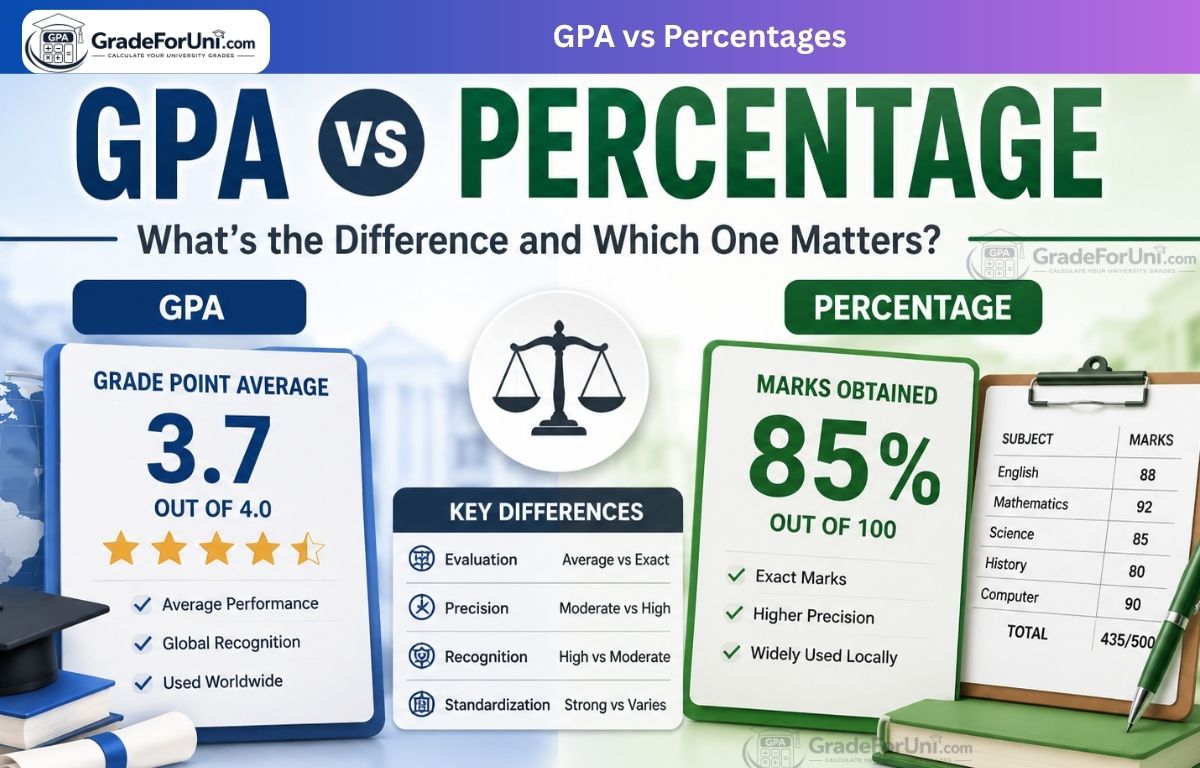
| Feature | GPA | Percentage |
|---|---|---|
| Scale | 4.0, 5.0, or 10.0 | 100 |
| Evaluation | Average Academic Performance | Exact Marks Obtained |
| International Recognition | High | Moderate |
| Precision | Moderate | High |
| Standardization | Strong | Varies |
Percentage systems can differentiate even minor differences between students.
Example: GPA vs Percentage Sensitivity
Percentage systems can differentiate even minor differences between students.
| Student | Percentage | GPA Category* | Difference |
|---|---|---|---|
| Student A | 88% | 3.7 GPA | — |
| Student B | 89% | 3.7 GPA | +1% |
Comparison Summary
| Metric | Percentage System | GPA System |
|---|---|---|
| Sensitivity to Small Differences | High | Moderate |
| Student A vs Student B | Ranked Separately | May Fall in the Same GPA Range |
| Best For | Exact Performance Comparison | Overall Academic Evaluation |
Ease of Understanding and Interpretation
For many people, percentages feel intuitive
Seeing 92% instantly communicates strong academic achievement.
A GPA of 3.7, however, often requires interpretation, especially for individuals unfamiliar with GPA scales.
Despite this, GPA provides greater consistency when comparing students from different institutions.
Read More:UK University Grading System ExplainedGPA vs Percentage Comparison Table
The debate between GPA vs Percentage often depends on context.
GPA vs Percentage: Which System Is Better?
| Factor | GPA | Percentage |
|---|---|---|
| Global Acceptance | Excellent | Limited |
| Scholarship Applications | Preferred | Sometimes Accepted |
| Local Employment | Moderate | Common |
| International Admissions | Widely Used | Requires Conversion |
| Ranking Precision | Lower | Higher |
| Simplicity | Moderate | High |
GPA to Percentage Conversion
Percentage = GPA × 25
Conversion Examples
| GPA | Approximate Percentage |
|---|---|
| 4.0 | 100% |
| 3.8 | 95% |
| 3.5 | 87.5% |
| 3.2 | 80% |
| 3.0 | 75% |
GPA to Percentage Comparison
| GPA Score | Equivalent Percentage | Performance Level |
|---|---|---|
| 4.0 | 100% | Excellent |
| 3.8 | 95% | Outstanding |
| 3.5 | 87.5% | Very Good |
| 3.2 | 80% | Good |
| 3.0 | 75% | Satisfactory |
Sample Academic Records Comparison
Example Comparison Between GPA and Percentage
| Student | Grading System | Score |
|---|---|---|
| Student A | Percentage | 84% |
| Student B | GPA | 3.4 |
Comparison Challenge
| Factor | Student A | Student B |
|---|---|---|
| Evaluation Method | Percentage | GPA |
| Direct Comparison | Difficult | Difficult |
| Requires Conversion | Yes | Yes |
| Standardization | Varies by Institution | Varies by Institution |
Which Is Better: GPA or Percentage?
The answer depends completely on your goals.
No system is universally superior.
Each serves a different purpose.
For University Admissions
International universities frequently prefer GPA.
A GPA allows admissions officers to compare applicants from various educational systems more efficiently.
This becomes particularly important when evaluating thousands of candidates from multiple countries.
For Scholarships and Financial Aid
Many scholarship programs specify minimum GPA requirements.
GPA vs Percentage – What’s the Difference and Which One Matters?↗
Read More:How to Improve Your University GradesGPA Requirements for Scholarships
| Scholarship Category | Minimum GPA Requirement |
|---|---|
| Minimum Eligibility | 3.0 |
| Competitive Scholarships | 3.5+ |
| Highly Selective Scholarships | 3.8+ |
Scholarship Competitiveness Comparison
| GPA Range | Scholarship Opportunities |
|---|---|
| 3.0 – 3.4 | Meets basic eligibility requirements |
| 3.5 – 3.7 | Competitive for many merit-based scholarships |
| 3.8 – 4.0 | Strong candidate for highly selective scholarships |
For Job Applications
Employers often interpret percentages more easily.
A score of 90% immediately signals academic excellence.
However, multinational companies increasingly recognize GPA systems, especially for graduate recruitment.
For International Study Opportunities
GPA tends to dominate global higher education.
Countries such as the United States and Canada commonly request GPA transcripts.
Applicants from percentage-based systems often undergo credential evaluations before admission decisions are made.
How to Convert GPA to Percentage
Converting GPA into a percentage is one of the most common concerns among students.
Unfortunately, there is no single universally accepted formula.
Several institutions use different methods to convert GPA into percentages.
| Formula | Description |
|---|---|
| Percentage = GPA × 25 | Common for 4.0 GPA scales |
| Percentage = (GPA − 0.75) × 10 | Used by some universities for equivalency calculations |
| Percentage = GPA × 9.5 | Common for 10-point GPA systems |
Conversion Examples
| GPA | Formula Used | Percentage |
|---|---|---|
| 3.0 | GPA × 25 | 75% |
| 3.5 | GPA × 25 | 87.5% |
| 8.0 / 10 GPA | GPA × 9.5 | 76% |
| 9.0 / 10 GPA | GPA × 9.5 | 85.5% |
Formula Comparison
| Conversion Method | Typical Usage |
|---|---|
| GPA × 25 | Standard 4.0 GPA scales |
| (GPA − 0.75) × 10 | Institution-specific conversions |
| GPA × 9.5 | 10-point GPA systems |
Factors That Affect Conversion Methods
conversion methods depend on:
- University policies
- Country-specific standards
- GPA scale used
- Grade distribution systems
- Accreditation requirements
Always consult your institution before making official conversions.
How to Convert Percentage to GPA
The reverse process is equally important.
Students applying abroad often need GPA equivalents.
Standard Conversion Approaches
These conversions provide a general estimate and may vary between institutions.
| Percentage Range | GPA Equivalent |
|---|---|
| 90–100% | 4.0 |
| 85–89% | 3.7 |
| 80–84% | 3.3 |
| 75–79% | 3.0 |
| 70–74% | 2.7 |
| 65–69% | 2.3 |
Comparison Overview
| Percentage | Approximate GPA | Academic Standing |
|---|---|---|
| 90–100% | 4.0 | Excellent |
| 85–89% | 3.7 | Very Good |
| 80–84% | 3.3 | Good |
| 75–79% | 3.0 | Above Average |
| 70–74% | 2.7 | Satisfactory |
| 65–69% | 2.3 | Fair |
Limitations of GPA Conversion
Conversions should always be considered estimates.
Two universities may assign entirely different GPA values to the same percentage score.
Course difficulty, grading policies, and credit weighting also influence outcomes.
As a result, unofficial online conversions should be used cautiously.
Grading Systems Around the World
Educational traditions shape grading systems across different countries.
| Country/Region | Common Grading System | Key Characteristics |
|---|---|---|
| United States | GPA (4.0 Scale) | Most universities use a 4.0 GPA scale, while weighted GPA systems are common in high schools. |
| United Kingdom | Degree Classifications | Universities award classifications such as First-Class, 2:1, and 2:2 Honours. Percentage marks remain important for assessments. |
| Canada | GPA (4.0 or 4.33 Scale) | Institutions commonly use GPA systems, with both 4.0 and 4.33 scales in practice. |
| India | Percentage and GPA | Percentage grading remains prevalent, although many universities now provide GPA equivalents. |
| Pakistan | Percentage and GPA | Percentage-based evaluation is widely used, with GPA systems increasingly adopted for international recognition. |
Degree Classification Examples in the United Kingdom
| Classification | Common Name |
|---|---|
| First-Class Honours | First |
| Upper Second-Class Honours | 2:1 |
| Lower Second-Class Honours | 2:2 |
Common Mistakes Students Make When Comparing GPA and Percentage
Students frequently misunderstand how grading systems operate.
These misconceptions can affect admissions and scholarship opportunities.
Assuming One System Is Universally Accepted
No grading method is accepted everywhere.
Each institution establishes its own academic standards.
Understanding those requirements can save significant time and effort.
Ignoring Institutional Conversion Policies
Many students rely on unofficial calculators.
However, universities often publish approved conversion guidelines.
Following official standards is essential.
Misunderstanding Weighted and Unweighted GPA
Weighted GPA accounts for course difficulty.
An unweighted GPA treats every subject equally.
Failing to distinguish between these systems can create misleading comparisons.
When Does GPA Matter More Than Percentage?
GPA becomes more important when:
- Applying to international universities
- Looking for graduate admissions
- Competing for scholarships
- Transferring to study credits
- Applying to research programs
In these situations, GPA provides a standardized benchmark for evaluation.
When Does Percentage Matter More Than GPA?
Percentage tends to matter more in:
- Local university admissions
- National entrance examinations
- Common education systems
- Government recruitment processes
- Merit-based rankings
In percentage-based environments, exact marks often determine eligibility.
Tips for Improving Your GPA or Percentage Scores
Academic improvement rarely happens overnight.
Small strategies often produce significant results.
Focus on high-credit courses because they influence GPA more heavily.
Track your academic progress regularly instead of waiting until the semester ends.
Understand grading rubrics before assignments are submitted.
Seek feedback from instructors to identify weak areas.
Most importantly, consistency usually matters more than occasional outstanding performances.
A steady improvement pattern often produces better long-term outcomes.
Frequently Asked Questions (FAQs)
Is GPA Better Than Percentage?
Neither is inherently better. GPA offers greater standardization, while percentages provide more precise numerical evaluation.
Can GPA and Percentage Represent the Same Performance?
Yes. They can reflect similar academic achievement, although conversion methods vary between institutions.
What is a Good GPA Equivalent to 80%?
In many systems, 80% roughly corresponds to a GPA between 3.2 and 3.4, depending on institutional policies.
Do Employers Prefer GPA or Percentage?
It depends on the industry and country. Local employers often prefer percentages, while international organizations frequently consider GPA.
Which System Is More Common Internationally?
GPA is generally more recognized in international education, particularly in North America and many global scholarship programs.
Conclusion
The discussion around GPA vs Percentage is not about choosing a winner. It is about understanding context, academic goals, and institutional expectations.
Knowing how each system works allows students to present their achievements effectively, make smarter educational decisions, and navigate opportunities with greater confidence.