
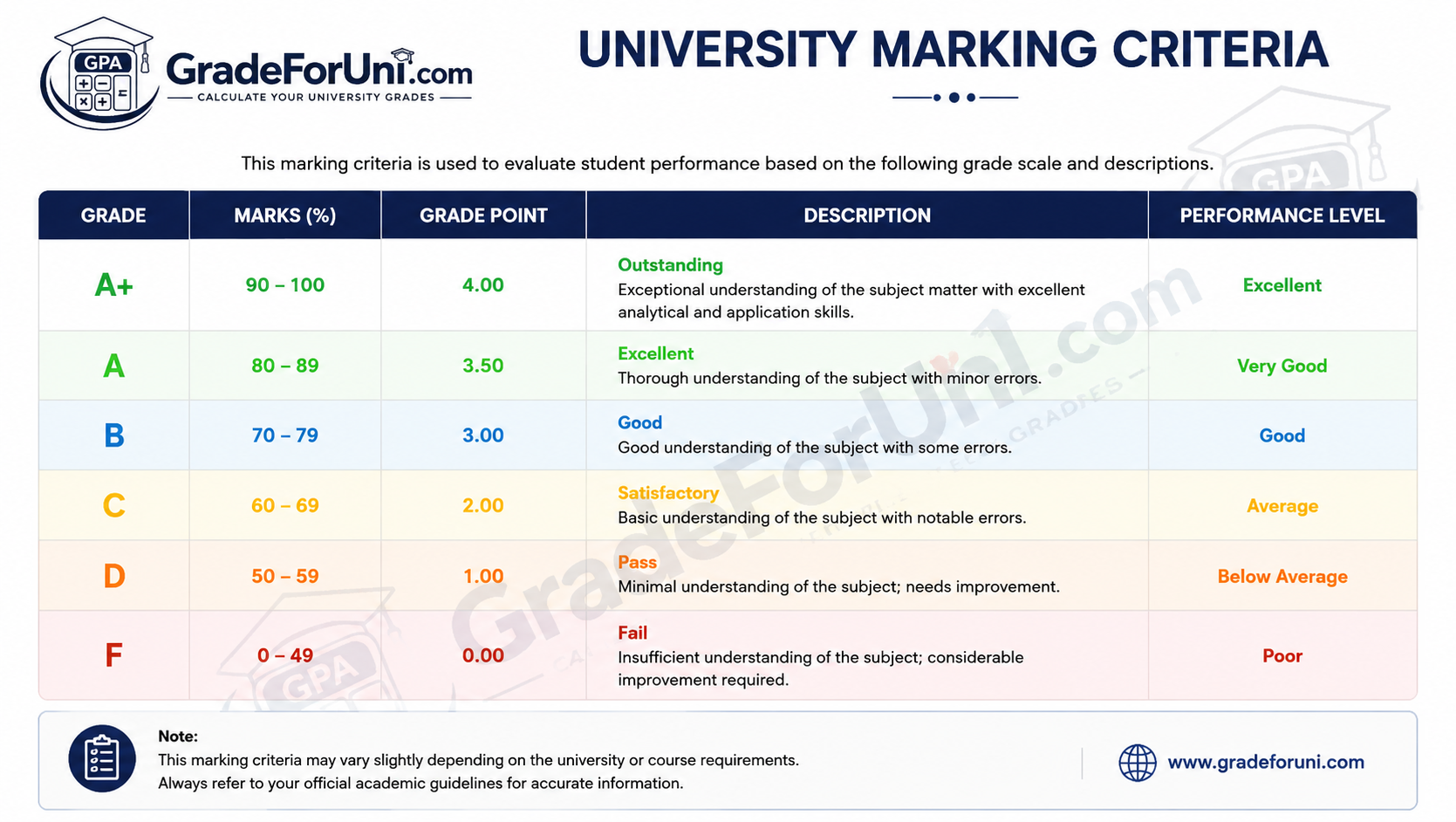
University Marking Criteria Get an essay back with a 62% and no real explanation of why, and it’s easy to assume the marker just didn’t like your writing. Most of the time, though, something far less personal is going on. Every piece of work you submit is checked against a set of standards called university marking criteria — a structured rubric that decides exactly how many marks you earn for argument, evidence, structure, and analysis.
Once you understand how that rubric actually works, marks stop feeling random. University Marking Criteria This guide breaks down what university marking criteria really cover, how markers use them, and what separates a solid 2:1 answer from one that scrapes into the First Class band.
Visit Now: https://wishlio.site/
What Are University Marking Criteria?
University marking criteria are the official standards a marker uses to grade your assignment, exam, or dissertation. Instead of judging your work on gut feeling, markers work through a document — often called a marking rubric or assessment grid — that breaks your submission into categories like:
- Knowledge and understanding of the topic
- Structure and organisation
- Use of evidence and research
- Critical analysis and argument
- Referencing and academic style
- Presentation and clarity
Each category carries a percentage band, and your final mark is built up from how well you perform across all of them, not just how confidently you write.
Most UK universities publish generic marking criteria for each degree classification (First, 2:1, 2:2, Third), and many departments also create assignment-specific criteria tailored to a particular essay, report, or exam question. University Marking Criteria If you’ve never actually opened your module handbook to read this section, it’s worth doing — it often tells you exactly what a marker is looking for before you’ve written a single word.
Read More: Can You Improve Your Degree Classification? – Everything You Need to Know
Why Marking Criteria Exist
Marking criteria aren’t there to make grading harder. They exist to keep marking consistent and fair. Without a shared rubric, two markers could read the same essay and land on completely different marks based on personal taste.
Marking criteria solve that by giving every marker the same checklist. This is also why your work often goes through second marking or moderation — another academic reviews a sample of graded work to confirm the criteria were applied consistently across the cohort.
The Core Categories Markers Actually Assess
While the exact wording varies by university, most marking criteria are built around the same handful of categories. Here’s what each one really means in practice.
1. Knowledge and Understanding
This is the foundation. University Marking Criteria Markers want to see that you genuinely understand the topic, not just that you’ve copied definitions from a textbook. A strong answer shows accurate, relevant knowledge that’s clearly connected to the question being asked.
2. Structure and Organisation
An essay with brilliant ideas scattered in the wrong order will still lose marks. University Marking Criteria Markers look for a clear introduction, a logical flow between paragraphs, and a conclusion that actually follows from your argument — not one that just repeats the introduction with different words.
3. Evidence and Research
This covers how well you’ve used academic sources to support your points. University Marking Criteria Markers are checking whether you’ve gone beyond lecture slides and one core textbook, and whether the sources you’ve chosen are credible, current, and relevant to your argument.
4. Critical Analysis and Argument
This is usually where marks are won or lost between a 2:2 and a First. Description tells the reader what a theory says. Analysis tells the reader why it matters, where it falls short, and how it compares to competing ideas. If your essay only summarises what others have said, you’re describing — and description alone rarely reaches the top bands.
5. Referencing and Academic Style
Correct referencing (Harvard, APA, or whatever your department requires) isn’t just a formality — it’s part of your mark. Inconsistent citations or a messy reference list can pull a strong essay down a full grade band in some departments.
6. Presentation and Clarity ( University Marking Criteria )
Word count compliance, formatting, spelling, and grammar all sit here. It’s usually a smaller percentage of your overall mark, but sloppy presentation can still cost you points that add up across your degree University Marking Criteria.
Read More: GPA vs Percentage: 7 Essential Differences Every Student Should Know
How Marking Criteria Map to Grade Bands
Here’s a simplified version of how these categories typically translate into the UK degree classification system.
| Grade Band | Percentage | What Markers Expect |
|---|---|---|
| First Class | 70%+ | Original, critical analysis; excellent structure; wide, well-integrated research; near-flawless referencing |
| Upper Second (2:1) | 60–69% | Strong understanding with some critical analysis; clear structure; solid research base |
| Lower Second (2:2) | 50–59% | Mostly descriptive with limited analysis; adequate structure; narrower range of sources |
| Third Class | 40–49% | Basic understanding; weak structure; minimal use of evidence; largely descriptive |
| Fail | Below 40% | Significant gaps in understanding; poor structure; little or no relevant evidence |
Keep in mind these bands are a general guide. Always check your own department’s assessment criteria, since exact wording and weighting can differ between universities and even between modules.
A Practical Example: 2:2 vs 2:1 vs First
It helps to see this in action. Imagine three students answer the exact same essay question about the causes of a historical event.
- 2:2-level answer: Lists three causes accurately, using information mostly from the set reading list. Structure is present but paragraphs jump between points without clear transitions University Marking Criteria.
- 2:1-level answer: Covers the same three causes, but explains how they interacted with each other, references four or five academic sources beyond the reading list, and includes a brief evaluation of which cause mattered most.
- First-level answer: Does everything the 2:1 answer does, but also engages with historiographical debate — showing awareness that historians disagree on the relative importance of these causes — and builds an original, well-supported argument rather than simply reporting the debate.
Notice that all three students likely “know” similar facts. What separates the grades is depth of analysis and how the evidence is used, not just how much information is included.
How Markers Use the Rubric When Grading
Most markers don’t read your essay once and assign a number. The typical process looks like this:
- First read-through to get an overall impression and check the argument makes sense.
- Checking against the rubric, category by category, noting where the work sits within each band.
- Writing feedback that explains strengths and weaknesses relative to those categories.
- Calculating the final mark, either as a straight average across categories or using weighted percentages if some criteria (like critical analysis) count for more than others.
This is exactly why feedback comments often echo the language of the rubric itself — phrases like “limited critical engagement” or “clear structure throughout” aren’t random observations; they’re direct references to specific marking criteria.
Common Mistakes That Cost Marks ( University Marking Criteria )
A lot of the marks students lose aren’t about a lack of knowledge — they’re about missing what the criteria are actually rewarding.
- Describing instead of analysing. Explaining what a theory says without evaluating it keeps your essay in the descriptive, University Marking Criteria lower-mark territory.
- Ignoring the specific question. Strong general knowledge on a topic still loses marks if it doesn’t directly answer what was asked.
- Relying on too few sources. Markers notice when every paragraph cites the same one or two references.
- Weak conclusions. A conclusion that just restates the introduction, rather than synthesising your argument, signals to markers that your analysis didn’t fully develop.
- Overlooking referencing consistency. Small, repeated referencing errors add up and are often penalised more heavily than students expect.
- Missing word count guidance. Being significantly under or over the word limit can trigger penalties under most universities’ marking policies.
How to Use Marking Criteria to Improve Your Grade
The most underused resource on most courses is the criteria document itself. Before you start writing, read it properly and treat it like a checklist:
- Match each paragraph to a specific criterion — does it show analysis, not just description?
- Check your reference list against the required style before submission, not after University Marking Criteria.
- Compare your draft conclusion to what “excellent” looks like in the First Class column of your rubric.
- Ask your tutor for a past example of a 2:1 or First-class essay, if your department allows it — seeing the standard in practice makes the criteria far easier to apply.
If you’re also trying to work out how a strong mark on this assignment affects your overall year or degree average, running your marks through a weighted grade calculator can show you exactly where you stand and what you’d need on remaining assignments to hit your target classification.
Read More: GPA Scale Explained – 4.0, 5.0 and Percentage Conversion Guide
Marking Criteria for Exams vs Coursework ( University Marking Criteria )
It’s worth noting that marking criteria shift slightly depending on the type of assessment.
| Assessment Type | What Gets Extra Weight |
|---|---|
| Essays | Argument structure, depth of research, referencing |
| Exams | Accuracy under time pressure, breadth of knowledge, clear exam technique |
| Dissertations | Originality, methodology, sustained critical analysis across a longer piece |
| Group projects | Individual contribution alongside collective output, often assessed separately |
Exams, in particular, tend to reward clear, well-organised knowledge more than exhaustive referencing, simply because you don’t have access to sources in the room. Dissertations sit at the other end, placing heavy weight on original contribution and methodological rigour.
Getting Feedback on Marking Criteria: What to Ask Your Tutor
If your feedback feels vague, don’t just accept it and move on. Most tutors are happy to clarify exactly which part of the marking criteria pulled your mark down, but you usually have to ask the right question. Instead of “why did I get 62%?”, try something more specific:
- “Which category on the rubric held this essay back the most?”
- “Can you show me what moves this from a 2:1 into First Class territory?”
- “Was my argument seen as analytical enough, or mostly descriptive?”
Framing your question around the actual criteria, rather than the mark itself, tends to get you a far more useful answer — and one you can actually apply to your next assignment.
Read More: Final Grade Calculator: 7 Easy Tips to Know What Grade You Need on Your Final Exam
Final Thoughts
University marking criteria can feel like a mystery until you actually read them properly — and once you do, grading stops feeling arbitrary. University Marking Criteria Every mark you receive is tied to specific, checkable standards around knowledge, structure, evidence, and analysis. Learn what your own department’s rubric rewards, write with those categories in mind, and you’ll find your marks becoming a lot more predictable, and a lot easier to improve University Marking Criteria.
FAQ’s
What are university marking criteria?
University marking criteria are the official standards markers use to assess your work, covering categories such as knowledge, structure, evidence, and critical analysis.
Why do different universities have different marking criteria?
Each university sets its own academic standards and assessment policies, so wording and weighting of criteria can vary, even though most follow similar broad categories.
What’s the difference between a 2:2 and a 2:1 under marking criteria?
A 2:2 tends to be mostly descriptive with limited analysis, while a 2:1 shows clearer critical engagement and a stronger range of research.
How much does referencing affect my mark?
Referencing usually falls under academic style criteria and can meaningfully affect your grade, especially if errors are frequent or inconsistent.
Do exams use the same marking criteria as essays?
Exams generally use similar core categories but place more weight on accuracy and breadth of knowledge under time pressure rather than extensive referencing.
Can I see my university’s marking criteria before submitting an assignment?
Yes, most departments publish generic marking criteria in module handbooks, and many provide assignment-specific criteria alongside the coursework brief.
What is the biggest factor in reaching a First Class mark?
Original, well-supported critical analysis is usually the biggest differentiator between a First and a 2:1 answer.
Does word count affect my mark under university marking criteria?
Yes, most universities apply penalties for significantly exceeding or falling under the word count, as outlined in their assessment policies.
Why did I get good feedback but a lower mark than expected?
Feedback often highlights strengths in one category, like structure, while lower marks in another category, like critical analysis, pull your overall grade down.
How can I use marking criteria to improve future assignments?
Read the rubric before you start writing, structure your paragraphs around its categories, and check your draft against the top-band descriptors before submitting.