
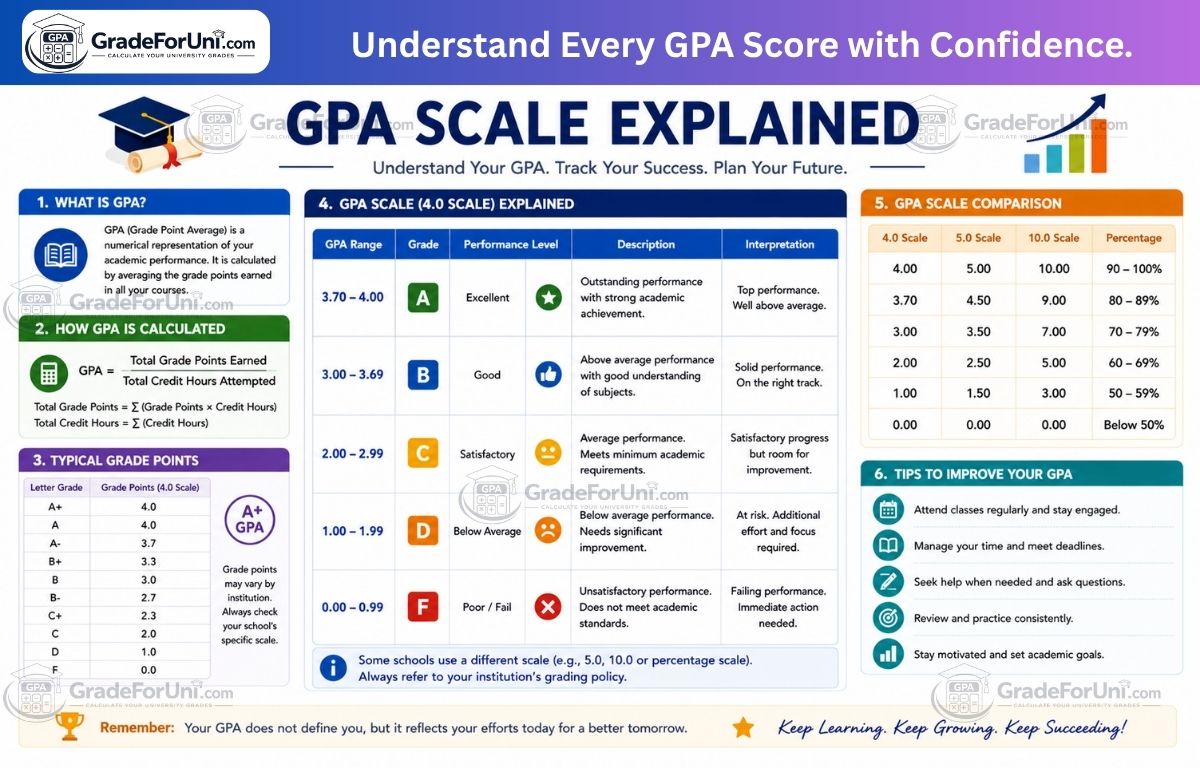
GPA Scale Explained If you’ve ever looked at your transcript and wondered why your GPA doesn’t match what a friend at another school reports — even though you both got mostly A’s — you’re running into one of the most confusing parts of academic grading: there isn’t just one GPA scale. Some schools use a 4.0 scale, others use a 5.0 scale for weighted courses, and plenty of countries grade purely on percentages. This guide breaks down how each system works and how to convert between them without the guesswork.
Visit Now: https://www.taxsal.com/
What Is a GPA Scale, Really?
A GPA scale is simply the numerical range a school uses to represent your academic performance. GPA Scale Explained Instead of listing every letter grade separately, schools convert each grade into points, then average those points across all your courses. The result is a single number — your Grade Point Average — that colleges, employers, and scholarship committees can use to compare students quickly.
The problem is that “quickly compare” only works if everyone is using the same scale. And they’re not.
Read More: Final Grade Calculator: 7 Easy
The 4.0 Scale: The Standard Baseline ( GPA Scale Explained )
The 4.0 scale is the most widely used system in American high schools and colleges, and it’s the one most people picture when they hear “GPA.” It’s unweighted, meaning every class counts the same regardless of difficulty. GPA Scale Explained Here’s how it typically breaks down:
| Letter Grade | GPA Points | Typical Percentage |
| A | 4.0 | 90–100% |
| B | 3.0 | 80–89% |
| C | 2.0 | 70–79% |
| D | 1.0 | 60–69% |
| F | 0.0 | Below 60% |
Some schools go further and use plus/minus grading (A- = 3.7, B+ = 3.3, and so on), which gives a more precise picture but also means two students with the same letter grades can end up with slightly different GPAs. The percentage cutoffs above aren’t universal either — they shift from school to school, so your institution’s official grading policy is always the final word GPA Scale Explained.
The 5.0 Scale: Where Weighted Grades Come In
The 5.0 scale exists to reward students who take on harder coursework — Honors, AP, or IB classes. On this scale, an A in a regular class is still worth 4.0, but an A in an AP or Honors class can be worth 5.0. That extra point reflects the added difficulty, and it’s why some students report GPAs above 4.0 without it being a mistake.
GPA Scale Explained This is also where a lot of confusion creeps in. A 3.8 weighted GPA and a 3.8 unweighted GPA are not the same academic performance — the weighted number could reflect a student carrying several tough AP classes while the unweighted one reflects a straight-A student in standard courses. When you’re comparing GPAs, or reporting yours somewhere, it always helps to specify which scale you’re using and whether it’s weighted or unweighted GPA Scale Explained.
Read More: How to Calculate Your Final
Percentage Conversion: The Part Everyone Gets Stuck On
Here’s the honest truth: there is no single, universally accepted formula for converting a percentage to GPA. Different schools, countries, and even individual programs handle it differently. That said, the most common approach is a straightforward proportional method — you divide your percentage (or your GPA) by the scale’s maximum, then scale it to whichever system you’re converting into.
A simplified example: if 94% is generally treated as a 4.0 on a standard scale, then a percentage in the high 80s typically lands somewhere around 3.3–3.7, depending on your school’s exact cutoffs. GPA Scale Explained The same logic applies when converting between a 4.0 and 5.0 scale, or even a 10-point scale used in many countries outside the US — you’re essentially asking, “what fraction of the maximum does this grade represent,” and applying that same fraction to the new scale.
This proportional method is also what credential evaluation services like WES (World Education Services) rely on when assessing international transcripts, because it treats every scale fairly instead of assuming a fixed letter-grade equivalent.
Quick Comparison: 4.0 vs. 5.0 vs. Percentage
| Scale | Best For | Max Possible | Key Trait |
| 4.0 (unweighted) | Standard grading, most US schools | 4.0 | Treats all classes equally |
| 5.0 (weighted) | Honors, AP, IB coursework | 5.0 (sometimes higher) | Rewards academic rigor |
| Percentage | International systems, many universities outside the US | 100% | Direct, granular scoring |
A Few Mistakes Worth Avoiding
- Assuming your GPA transfers automatically. A 3.5 on a 5.0 weighted scale is not the same achievement as a 3.5 on a standard 4.0 scale, even though the number looks identical.
- Using a fixed letter-grade table instead of proportional math. Looking up “A = 4.0” and calling it done ignores where you actually fall within your grading system. Most official evaluators use proportional conversion instead.
- Forgetting to state your scale. When reporting your GPA on an application or resume, always mention the scale — “3.7/4.0” tells a much clearer story than “3.7” on its own.
- Treating a converted GPA as official. Self-calculated conversions are useful for planning, but competitive schools and employers often require an official transcript or a formal credential evaluation before they’ll accept the number.
Read More: Weighted vs Unweighted Grades –
Why This Matters Beyond the Number
Understanding your GPA scale isn’t just an academic exercise — it affects college applications, scholarship eligibility, and sometimes even job offers. Knowing exactly how your grades translate, and being able to explain the difference between a weighted and unweighted score, puts you in a much stronger position when someone asks “what’s your GPA?” instead of just handing over a number without context.
If you’re not sure which scale your school uses, check your transcript’s grading policy or ask your academic advisor directly — it’s a five-minute conversation that can save a lot of confusion later.
FAQ’s
What does GPA Scale Explained actually mean?
It simply refers to understanding how schools convert your letter grades or percentages into a single numerical average, and how that average changes depending on which scale — 4.0, 5.0, or percentage — your institution uses.
What’s the main difference between a 4.0 and a 5.0 scale?
The 4.0 scale is unweighted, so every class counts the same. The 5.0 scale is weighted, giving extra points for Honors, AP, or IB courses to reflect their added difficulty.
Can my GPA go above 4.0?
Yes, but only on a weighted scale. If your school uses a 5.0 system for advanced courses, an A in an AP class can push your GPA past 4.0 — a detail that often confuses people new to GPA Scale Explained comparisons.
How do I convert a percentage to GPA?
Most schools use a proportional method — dividing your percentage by 100 and scaling it to your GPA maximum. There’s no single universal formula, so always check your school’s official conversion chart.
Why does GPA Scale Explained matter for college applications?
Because admissions officers need context. A 3.5 GPA means something different depending on whether it’s weighted or unweighted, so understanding your scale helps you present your grades accurately.
Is a 10-point scale the same as a percentage?
Not exactly, but it’s close. A 10-point scale, common in many countries outside the US, aligns closely with percentages — an 8.5 is roughly equivalent to 85%.
Do all schools use the same percentage cutoffs for letter grades?
No. Percentage ranges for A, B, C, and so on vary from school to school, which is one of the trickiest parts of GPA Scale Explained conversions.
Should I report my weighted or unweighted GPA?
It depends on what’s being asked. Many colleges want both, since weighted GPA shows academic rigor while unweighted GPA offers a standardized comparison.
Can I trust an online GPA converter for official use?
Online converters are great for planning and estimates as part of GPA Scale Explained research, but competitive schools and employers usually require an official transcript or a formal credential evaluation for anything official.
What’s the easiest way to understand GPA Scale Explained without confusion?
Start with your own transcript: check whether your school uses 4.0, 5.0, or percentage grading, note if it’s weighted, and compare it against a simple conversion chart. Once you see it applied to your own grades, the whole system becomes much clearer.