
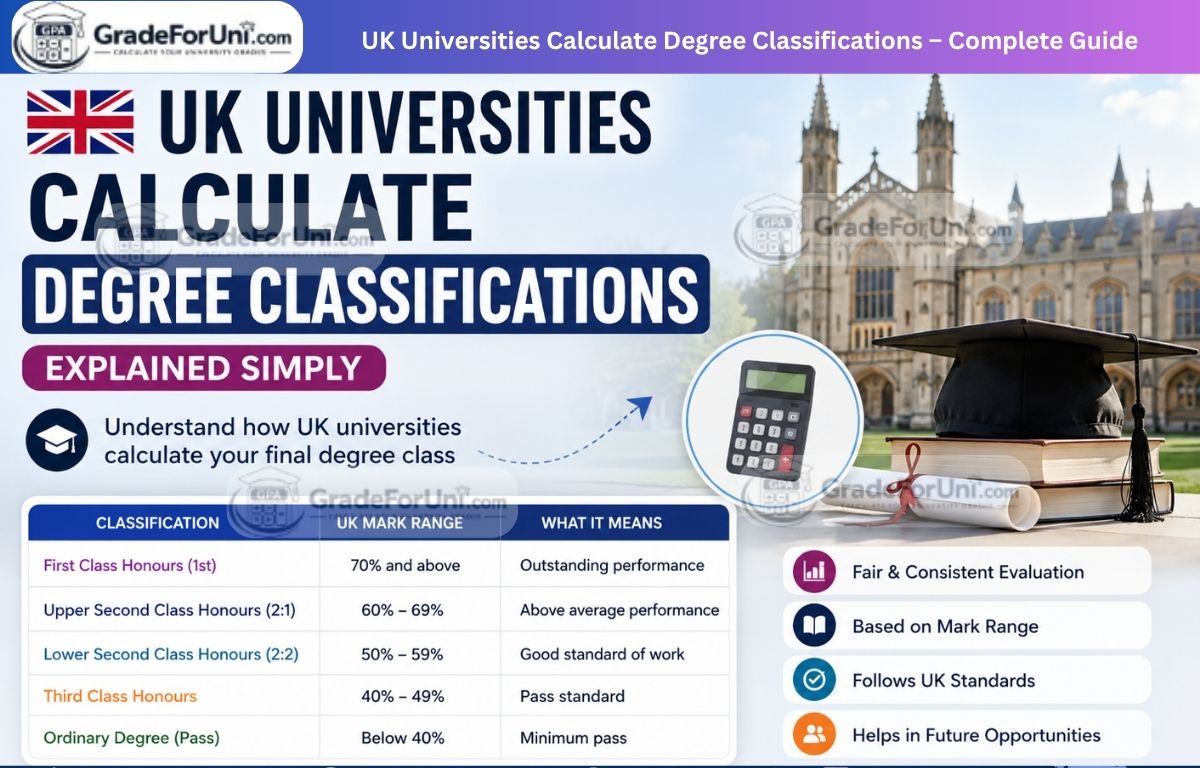
UK Universities Calculate Degree Classifications — Imagine you’re nearing the end of your university degree. Your coursework has been submitted, your final exams are over, and graduation is only a few months away. Friends begin asking the same question: “What degree classification do you think you’ll get?”
You log into your university portal and find dozens of module marks, different credit values and percentages. One classmate says only your final year matters, another insists every year counts equally, while someone else claims a resit automatically rules out a First-Class degree. With so much conflicting advice, it’s easy to feel unsure about how your final result is actually calculated.
That’s why many UK students look for a clear explanation of the degree classification process. Understanding how universities calculate your final result helps you track your academic progress, focus on the modules that matter most, and estimate the classification you’re likely to achieve.
Click Here: UK University Grade Calculator
How to Use the Final Grade Calculator UK
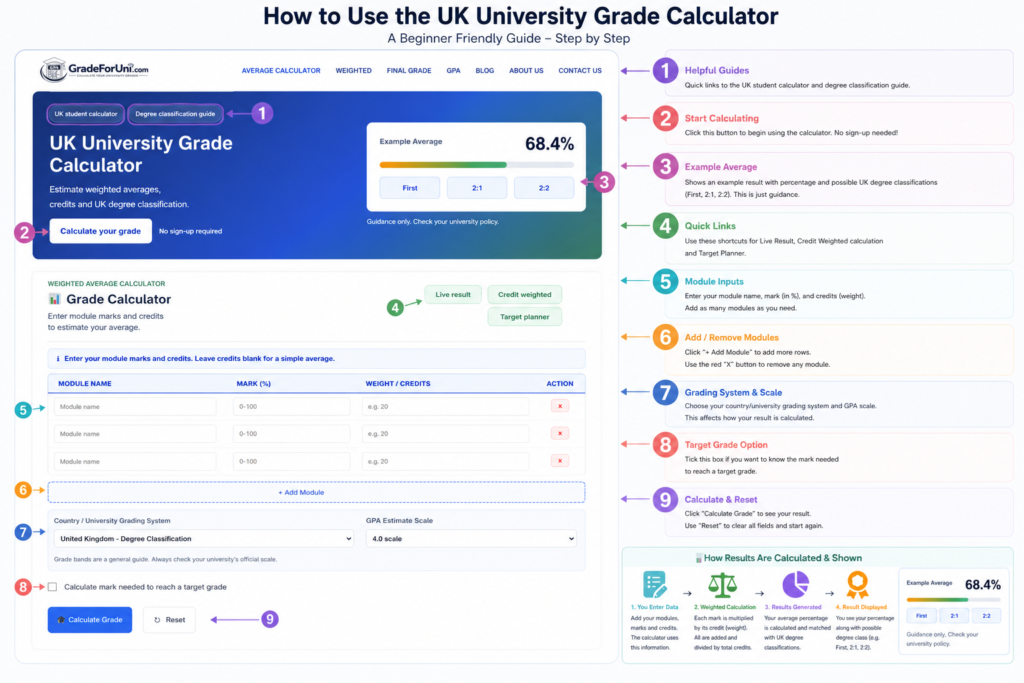
Calculate Your Degree Classification in Minutes
UK Universities Calculate Degree Classifications with our Degree Classification Calculator; you can estimate your final honours classification instead of calculating weighted averages manually. Enter your module marks and credit values to see your estimated result instantly.
UK universities usually calculate degree classifications by combining your marks from the academic years that contribute to your final award. Each module carries a credit value, and each year may have a different weighting depending on your university’s regulations. A weighted average is then compared with the university’s classification boundaries to determine whether you achieve a First-Class Honours, Upper Second-Class (2:1), Lower Second-Class (2:2), Third-Class Honours or another award. Always check your university’s assessment regulations because weighting models can vary.
Read More: taxsal.comWhat Is a UK Degree Classification?
A degree classification is the final academic award given to students after completing an undergraduate honours degree in the UK. Rather than showing only a single percentage, universities group final results into recognised classifications that employers, postgraduate providers and professional organisations understand.
Your classification reflects your overall academic performance across the years that count towards your degree. Instead of focusing on one exam or one assignment, it considers your performance across multiple modules using your university’s approved calculation method.
For many graduates, the classification becomes an important part of their CV and academic record.
Why UK Universities Use Degree Classifications
Universities assess students through coursework, examinations, presentations, laboratory work, dissertations and practical assessments. Because every course contains different types of assessment, a standard classification system allows universities to summarise overall achievement consistently.
The system also helps:
- Compare academic performance fairly
- Recognise sustained achievement over time
- Support postgraduate admissions
- Provide employers with an easily understood academic outcome
- Maintain national academic standards
A classification is therefore much more than a final percentage. It represents your performance throughout the assessed stages of your degree.
Read more:University Grade Guide – UK Percentages, GPA and Degree Classes ExplainedThe Different Honours Classifications Explained
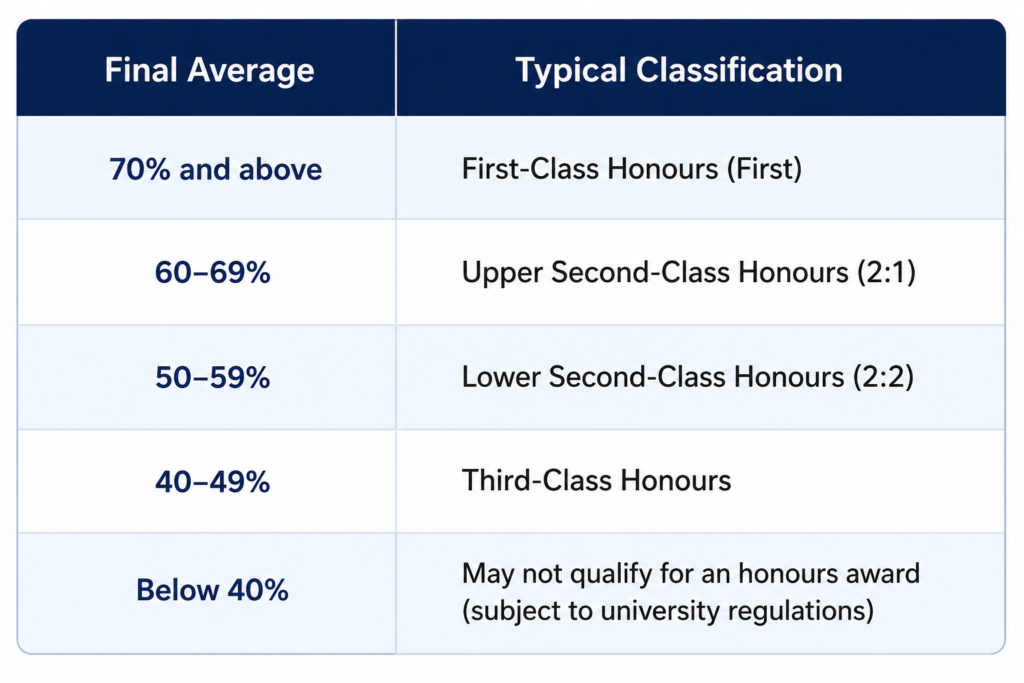
Most UK universities award honours degrees using classification bands similar to those below.
| Final Average | Typical Classification |
|---|---|
| 70% and above | First-Class Honours (First) |
| 60–69% | Upper Second-Class Honours (2:1) |
| 50–59% | Lower Second-Class Honours (2:2) |
| 40–49% | Third-Class Honours |
| Below 40% | May not qualify for an honours award (subject to university regulations) |
How Do UK Universities Calculate Degree Classifications?
Module Assessment Example
| Module | Assessment Method | Weight |
|---|---|---|
| Business Management | Coursework | 40% |
| Business Management | Final Examination | 60% |
| Dissertation | Dissertation Project | 100% |
| Research Methods | Coursework Only | 100% |
Example of Credit Weighting
| Module | Credits | Final Mark |
|---|---|---|
| Business Strategy | 20 | 72% |
| Marketing | 20 | 68% |
| Finance | 40 | 64% |
| Dissertation | 40 | 75% |
| Total | 120 | — |
Note: The dissertation is worth 40 credits, so it contributes more to the overall degree classification than a 20-credit module.
Weighted Average Calculation
| Module | Credits | Final Mark | Weighted Contribution (Mark × Credits) |
|---|---|---|---|
| Module A | 20 | 70% | 1,400 |
| Module B | 20 | 65% | 1,300 |
| Module C | 40 | 68% | 2,720 |
| Module D | 40 | 75% | 3,000 |
| Total | 120 | — | 8,420 |
Final Calculation
| Calculation | Result |
|---|---|
| Total Weighted Marks | 8,420 |
| Total Credits | 120 |
| Weighted Average | 70.2% |
Formula
Weighted Average = Total Weighted Marks ÷ Total Credits
= 8,420 ÷ 120 = 70.2%
Example Degree Classification
| Weighted Average | Degree Classification |
|---|---|
| 71.4% | First-Class Honours (1st) |
| 66.2% | Upper Second-Class Honours (2:1) |
| 57.8% | Lower Second-Class Honours (2:2) |
How Academic Credits Affect Your Final Degree
Credits determine how much each module contributes to your final degree calculation. They do not represent your grade. A module with more credits has a greater impact on your overall weighted average than a module with fewer credits.
Why Some Modules Carry More Weight
Universities assign higher credit values to modules that require more study time or demonstrate more advanced learning outcomes.
Examples include:
- Final-year dissertations
- Research projects
- Capstone modules
- Professional placements (where applicable)
A strong performance in these modules can have a noticeable impact on your overall classification.
How Credits Influence Your Overall Average
Consider two students who both achieve an average mark of around 68% in their modules. If one student scores particularly well in higher-credit modules while the other performs better only in lower-credit modules, their final weighted averages may be different.
Understanding this relationship helps you prioritise your study time more effectively. Rather than treating every module equally, pay particular attention to those with higher credit values.
How Different Academic Years Are Weighted
Not every year of your degree contributes equally to your final classification. One of the biggest misconceptions among students is that universities simply average all three years together. In reality, most UK universities place greater emphasis on your later years because they reflect your ability to perform at a higher academic level.
However, the exact weighting varies between institutions, so you should always check your university’s academic regulations.
Does First Year Count?
For many undergraduate honours degrees, Level 4 (Year 1) helps you progress to the next stage but does not contribute directly to your final degree classification.
Some universities and specific programmes, such as integrated master’s or professional degrees, may include a small contribution from Year 1. Always check your university’s course handbook, as regulations vary between institutions.
Typical Year Weighting Models Used by UK Universities
Although every university sets its own assessment regulations, the following weighting models are commonly used.
| Academic Year | Example Model A | Example Model B | Example Model C |
|---|---|---|---|
| Year 1 (Level 4) | 0% | 10% | 20% |
| Year 2 (Level 5) | 30% | 30% | 40% |
| Final Year (Level 6) | 70% | 60% | 40% |
These are examples only. Your university may use a completely different model.
Why Final Year Usually Has the Biggest Impact
Your final year often contains:
- Advanced subject modules
- A dissertation or research project
- Optional specialist modules
- Higher academic expectations
Because these modules demonstrate your highest level of achievement, universities generally assign them the greatest weighting.
For students aiming to improve their overall classification, strong performance during the final year can make a significant difference.
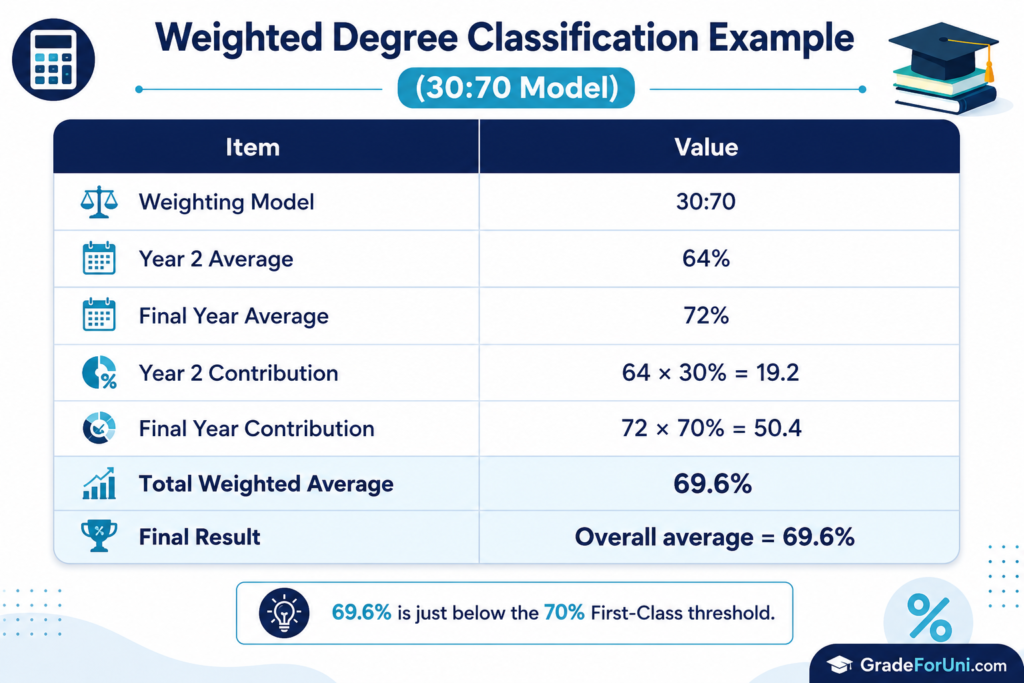
Worked Example
| Item | Value |
|---|---|
| Weighting Model | 30:70 |
| Year 2 Average | 64% |
| Final Year Average | 72% |
| Year 2 Contribution | 64 × 30% = 19.2 |
| Final Year Contribution | 72 × 70% = 50.4 |
| Total Weighted Average | 69.6% |
| Final Result | Overall average = 69.6% |
Understanding Weighted Averages in Simple Terms
Many students hear the term weighted average but are unsure what it actually means. Fortunately, the concept is straightforward once you understand why universities use it.
What Is a Weighted Average?
A weighted average gives more importance to certain marks than others.
Rather than treating every module equally, the university considers the credit value of each module. Modules worth more credits have a greater influence on your final result.
This approach creates a fairer calculation because larger modules usually require more study time and assess more learning outcomes.
Weighted Average vs Simple Average
The difference becomes much clearer with an example.
| Module | Credits | Mark |
|---|---|---|
| Module A | 20 | 80% |
| Module B | 20 | 75% |
| Module C | 40 | 60% |
| Module D | 40 | 65% |
A simple average would ignore the credit values and produce a different result from the weighted calculation.
| Calculation Method | Result |
|---|---|
| Simple Average | 70% |
| Weighted Average | 67.5% |
This example shows why students should avoid averaging module percentages manually.
Read more:How to Calculate Your Uni Grade Using Credits and Module WeightingDegree Classification Boundaries Explained
After your weighted average has been calculated, the university compares it with its degree classification boundaries.
These boundaries help determine which honours award you receive.
Typical UK Classification Boundaries
Although slight variations can exist between universities, the following ranges are widely used.
| Final Average | Typical Award |
|---|---|
| 70% and above | First-Class Honours |
| 60–69% | Upper Second-Class Honours (2:1) |
| 50–59% | Lower Second-Class Honours (2:2) |
| 40–49% | Third-Class Honours |
| Below 40% | Normally below honours standard |
These boundaries provide a useful guide, but your university’s official regulations always take priority.
Borderline Classifications
A borderline classification occurs when a student’s final average falls close to the next classification threshold.
For example:
- 69.8%
- 59.7%
- 49.9%
Many universities have specific regulations for reviewing borderline cases.
The review may consider factors such as:
- Performance in higher-level modules
- Number of credits achieved in the higher classification band
- Final-year performance
- Academic regulations approved by the university
This means two students with similar averages may receive different outcomes if their universities apply different borderline policies.
How Resits, Repeat Modules and Compensation Can Affect Your Classification
A failed assessment does not always mean your degree classification is permanently affected. Most UK universities have procedures that allow students to recover from setbacks, but the impact depends on your university’s academic regulations.
Understanding how resits, repeat modules and compensated passes work can help you make informed decisions if you don’t achieve the required mark the first time.
Do Resits Change Your Final Classification?
A resit gives you another opportunity to pass a failed assessment or module. However, the way the resit affects your degree classification varies between universities.
Common approaches include:
- Capped resit marks: Even if you score much higher in the resit, the recorded mark may be capped at the pass mark (often 40% for undergraduate modules).
- Uncapped resit marks: Some universities or exceptional circumstances may allow the full resit mark to count.
- Progression only: A resit may allow you to continue your course without significantly changing your overall classification.
Because policies differ, never assume the same rule applies at every institution.
Worked Example
| Assessment | Original Mark | Resit Mark | Recorded Mark* |
|---|---|---|---|
| Research Methods | 35% | 68% | 40% |
*Example of a capped resit. Your university may apply different rules.
This example shows why understanding your university’s resit policy is essential before estimating your final degree classification.
How Repeat Modules Are Treated
If you do not pass a module after a resit, your university may require you to repeat the module.
Repeating a module usually means:
- Attending classes again
- Completing all required assessments
- Paying any applicable tuition fees
- Delaying progression or graduation in some cases
The repeated module may replace the previous attempt or remain subject to marking rules depending on university regulations.
For this reason, students should always discuss repeat options with their academic adviser before making a decision.
Compensated Passes Explained
Some universities allow a compensated pass, sometimes called compensation, in limited circumstances.
This means you may receive credit for a module even if you score slightly below the standard pass mark, provided you meet specific academic requirements.
Compensation is not available on every course and often depends on factors such as:
- Overall average
- Number of failed credits
- Professional accreditation rules
- Course-specific regulations
It should never be assumed that compensation will automatically apply.
Does Coursework, Exams and Your Dissertation Affect Your Final Result?
Many students assume that only their final exam results matter. In reality, your final classification is usually based on the combined performance of all assessed work within each module.
Exactly how much each assessment contributes depends on the module specification.
Coursework Weighting
Coursework often includes:
- Essays
- Reports
- Case studies
- Portfolios
- Online assessments
- Reflective journals
Some modules are assessed entirely through coursework, while others combine coursework with examinations.
Consistently performing well in coursework can strengthen your overall module mark, particularly if multiple assignments contribute throughout the academic year.
Exam Weighting
Traditional written examinations remain an important assessment method in many UK degree programmes.
Depending on the module, exams may account for:
- 40%
- 50%
- 60%
- 70%
- or even 100% of the module mark.
Exam-heavy modules often require careful revision planning because one assessment can have a substantial impact on the final module result.
Dissertation Weighting
For many undergraduate courses, the dissertation is one of the largest individual pieces of assessed work.
It often carries:
- Higher credit values
- Greater academic expectations
- Independent research requirements
Because dissertations commonly carry 30, 40 or even 60 credits, strong performance can noticeably improve your weighted average.
Conversely, underperforming in a high-credit dissertation can reduce your final classification more than a low-credit optional module.
Which Assessments Usually Carry the Most Marks?
The answer depends on your programme, but a typical honours degree may look like this:
| Assessment Type | Typical Influence |
|---|---|
| Coursework | Moderate to High |
| Written Exams | Moderate to High |
| Practical Assessments | Varies by course |
| Dissertation | Often High |
| Presentations | Usually Moderate |
Rather than focusing on only one type of assessment, aim for consistent performance across all assessed work.
Worked Examples of Degree Classification Calculations
Example 1 – Calculating a First-Class Degree
Sophie studies four final-year modules.
| Module | Credits | Mark |
|---|---|---|
| Dissertation | 40 | 74% |
| Marketing | 20 | 71% |
| Finance | 20 | 69% |
| Strategy | 40 | 72% |
Weighted average:
= 71.5%
Estimated outcome:
First-Class Honours
Example 2 – Achieving a 2:1 with Strong Final-Year Performance
Daniel struggled during Year 2 but significantly improved in his final year.
- Year 2 Average: 61%
- Final Year Average: 69%
Using a 30:70 weighting model, his overall weighted average is 66.6%, placing him comfortably within the Upper Second-Class (2:1) range.
This demonstrates how a strong final year can improve your overall classification when later years carry greater weighting.
Example 3 – Effect of Different Credit Weightings
Olivia receives the following marks:
| Module | Credits | Mark |
|---|---|---|
| Module A | 20 | 78% |
| Module B | 20 | 76% |
| Module C | 40 | 61% |
| Dissertation | 40 | 64% |
Although her highest marks are impressive, the lower marks occur in the higher-credit modules. As a result, her weighted average is lower than a simple average would suggest.
This highlights why credit weighting should always be considered when estimating your degree classification.
Example 4 – Resit Impact on Final Classification
Jacob fails one 20-credit module with 37% and later passes the resit.
If his university records the resit at the capped pass mark, the module contributes 40% rather than the higher resit score.
Even though he completes the module, the capped mark slightly reduces his overall weighted average compared with passing on the first attempt.
Example 5 – Borderline Classification Decision
Emily finishes with a weighted average of 69.8%.
Her university’s regulations state that students within a defined borderline range may be reviewed if most final-year credits are within the higher classification band.
Because Emily achieved over two-thirds of her final-year credits above 70%, the assessment board awards First-Class Honours under the university’s borderline policy.
Another university may have reached a different decision, which is why institutional regulations matter.
Real-Life Student Scenarios
Scenario 1 – Strong Coursework but Weak Exam Performance
Amira consistently scores above 70% in essays and coursework but struggles in timed examinations, where her marks are closer to 55%.
Because several of her modules are assessed using both coursework and exams, her strong coursework helps balance the lower exam scores. However, she still needs to improve her exam technique because exam-heavy modules can significantly affect her weighted average.
Key takeaway: Excelling in one assessment type does not always offset weaker performance in another. Check the assessment weighting for each module.
Scenario 2 – One Failed Module Before Graduation
Ryan completes almost every module successfully but fails a single 20-credit module with 38%.
His university allows a resit, which he passes. Although the module mark is capped according to university regulations, he earns the required credits and graduates with an honours degree.
Key takeaway: Failing one module does not automatically prevent graduation, but it can affect your overall classification depending on the university’s resit policy.
Scenario 3 – Significant Improvement in Final Year
During Year 2, Chloe averages 59%, placing her close to a 2:2 classification.
She changes her study routine, attends academic support sessions, and starts preparing for assessments earlier. In her final year, she averages 71%.
Because her university gives greater weight to the final year, her overall classification improves to a 2:1.
Key takeaway: A strong final-year performance can make a meaningful difference when later years carry more weighting.
Scenario 4 – Placement Year Student
Ethan completes a placement year between Levels 5 and 6.
Although the placement develops valuable workplace skills and strengthens his CV, it does not directly contribute to his final degree classification because his university treats it as a pass/fail requirement.
Key takeaway: Placement years are handled differently across universities. Always check whether they contribute to your final classification.
Scenario 5 – Student Close to a First-Class Boundary
Sophie’s final weighted average is 69.9%.
Her university reviews borderline classifications and considers that most of her final-year credits were awarded above 70%.
Following the university’s published regulations, she is awarded First-Class Honours.
Key takeaway: Borderline reviews depend entirely on your university’s academic regulations and should never be assumed.
Common Mistakes When Calculating Degree Classifications
Even students who understand the basics can make errors when estimating their final result. Avoiding the following mistakes will help you make a more accurate calculation.
Assuming Every Year Counts Equally
Many students simply average their marks across all academic years.
In reality, universities often assign different weightings to each year, and some do not include Year 1 in the final classification at all.
Ignoring Credit Weighting
Modules with higher credit values have a greater influence on your final average.
Treating every module equally can produce an inaccurate estimate of your degree classification.
Using a Simple Average Instead of a Weighted Average
Adding all module marks together and dividing by the number of modules is one of the most common mistakes.
A weighted average provides a more accurate reflection of your academic performance because it takes credit values into account.
Forgetting Dissertation Weighting
Dissertations often carry more credits than standard modules.
A high dissertation mark can significantly improve your overall average, while a low mark can have the opposite effect.
Misunderstanding Resit Rules
Many students believe that passing a resit completely replaces the original mark.
Some universities cap resit marks at the pass mark, while others use different approaches. Always check your institution’s regulations.
Expert Tips to Improve Your Final Degree Classification
Improving your degree classification is about making informed academic decisions throughout your course rather than relying on last-minute revision.
Focus on High-Credit Modules
Higher-credit modules contribute more to your weighted average.
Prioritise revision and assignment preparation for these modules, especially if they form a significant proportion of your final-year credits.
Monitor Your Weighted Average Throughout the Year
Don’t wait until the end of your degree to estimate your classification.
Regularly calculating your weighted average helps you understand your current position and identify where improvements are needed.
Using a reliable Degree Classification Calculator can make this process much quicker and more accurate.
Plan Your Dissertation Carefully
Your dissertation is often one of the most influential assessments in your degree.
Start planning early by:
- Choosing a realistic research topic
- Meeting your supervisor regularly
- Setting weekly writing goals
- Leaving enough time for editing and proofreading
Understand Your University’s Assessment Regulations
Every university publishes assessment regulations covering:
- Degree calculations
- Credit requirements
- Classification boundaries
- Resit policies
- Borderline decisions
Use a Degree Classification Calculator Before Every Assessment
As new marks become available, update your calculations.
This allows you to answer practical questions such as:
- What mark do I need in my dissertation?
- Can I still achieve a First?
- How much could one module improve my average?
- What happens if I score lower than expected?
Read more:University Assessment Methods Explained – UK Guide to Exams, Coursework and PresentationsFrequently Asked Questions
How do UK universities calculate degree classifications?
Most universities calculate a weighted average using your module marks, credit values and the weighting assigned to each academic year. The final average is then compared with the university’s classification boundaries.
Does first year count towards my final degree?
Not always. Many universities use Year 1 to determine progression only, while Years 2 and 3 contribute to the final honours classification. However, some institutions use different weighting models, so always check your course regulations.
What percentage do I need for a First-Class degree?
At many UK universities, a weighted average of 70% or above is typically required for a First-Class Honours degree. Borderline rules may also apply depending on the institution.
How is a weighted average calculated?
A weighted average multiplies each module mark by its credit value, totals the results, and divides the figure by the total number of credits that contribute to the calculation.
Can a dissertation improve my degree classification?
Yes. Because dissertations often carry a higher credit value than standard modules, a strong dissertation mark can significantly improve your weighted average.
Do resits affect my final classification?
They can. Some universities cap resit marks at the pass mark, while others apply different rules. The impact depends on your university’s academic regulations.
What happens if I’m on a classification boundary?
Your university may review your academic profile according to its published borderline regulations. The outcome varies between institutions.
Can I still graduate if I fail one module?
In many cases, yes. You may be offered a resit, a repeat module or another approved option depending on your university’s policies and the number of credits affected.
Do all UK universities use the same classification system?
No. Although the honours classifications are broadly similar, universities may use different weighting models, credit rules and assessment regulations.
How accurate are online degree classification calculators?
A calculator can provide a useful estimate when you enter the correct marks, credits and weighting. However, the final classification is always determined by your university’s official regulations.
Conclusion
Understanding how UK universities calculate degree classifications doesn’t have to be complicated. Once you know how module marks, credit values and weighted averages work together, estimating your final result becomes much more straightforward.
Remember that your overall classification is based on much more than a single exam or assignment. High-credit modules, final-year performance, dissertations and your university’s academic regulations all play an important role in determining the outcome.
If you’re planning your studies or waiting for final results, use a Degree Classification Calculator alongside your university’s published assessment regulations to estimate your honours classification with greater confidence.
Whether you’re aiming for a First-Class Honours, a 2:1, or simply want to understand how your marks contribute to your final award, knowing the calculation process will help you make informed decisions throughout your university journey.