
Imagine it’s the final semester of your degree. You’ve submitted your dissertation, completed your last exam, and now you’re refreshing your university portal every few hours—First Class Honours. Friends are already guessing what classification they’ll receive. One says a 70% average guarantees a First, while another insists only the final year matters.
With so much conflicting advice, it’s easy to feel uncertain.
This is why thousands of UK students search for information about First Class Honours every year. They want to know what marks they need, how universities calculate degree classifications, and whether they’re on track to achieve the highest award.
This guide explains everything in simple, clear language to help you understand how First Class Honours works and what you can do to improve your chances.
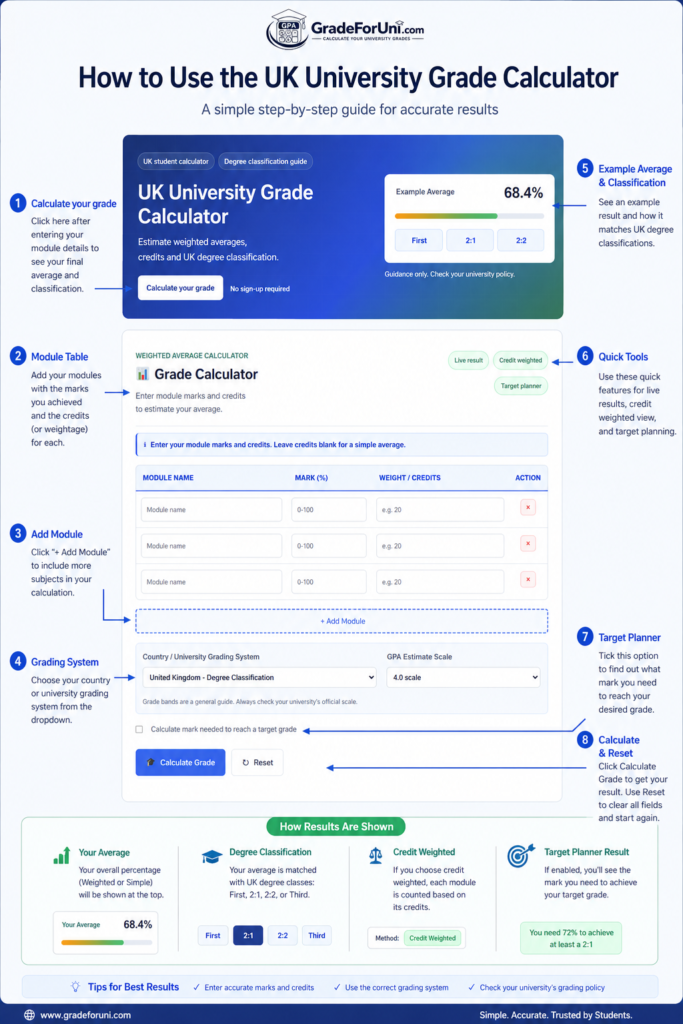
Click Here: UK University Grade Calculator
How to Use the UK University Grade Calculator
A First Class Honours (often called a First) is the highest undergraduate degree classification awarded by most UK universities. In many cases, students need an overall weighted average of 70% or higher, although the exact calculation method varies by university. First Class Honours: Factors such as credit weighting, year weighting, dissertation marks, and university regulations can all influence the final classification. Always check your own university’s academic regulations before estimating your result.
What Is First Class Honours?
First Class Honours is the highest classification awarded for most undergraduate honours degrees in the UK. First Class Honours recognises consistently excellent academic performance across the parts of your course that count towards your final classification.
Receiving a First demonstrates that you have performed at an outstanding level in your assessments. First Class Honours: Employers, postgraduate admissions teams and professional organisations often recognise it as evidence of strong academic ability, independent learning and effective problem-solving skills.
Although many people simply refer to it as “getting a First”, the official award shown on your degree certificate is usually First Class Honours
Visit Now: Taxsal.comWhat Does “Honours” Mean?
An honours degree involves studying a subject in greater depth than a standard bachelor’s degree. It usually includes more advanced academic work, independent research and specialist modules.
Most honours programmes require students to:
- Complete the required number of academic credits.
- Pass compulsory modules.
- Meet progression requirements.
- Successfully finish the final year of study.
Many courses also include a dissertation or major research project, allowing students to investigate a topic independently while demonstrating research, analytical and academic writing skills.
Where First Class Sits in the UK Degree Classification System
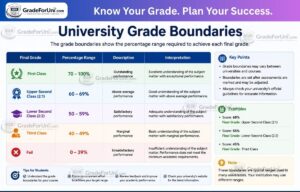
Most UK universities use five main honours classifications.
| Classification | Typical Overall Average |
|---|---|
| First Class Honours (First) | 70% and above |
| Upper Second-Class Honours (2:1) | 60–69% |
| Lower Second-Class Honours (2:2) | 50–59% |
| Third-Class Honours | 40–49% |
| Fail | Below 40% |
These percentage ranges are widely used across the UK, but universities may apply their own academic regulations, weighting systems and borderline policies.
Helpful Reading:
Read More: How UK Universities Calculate Degree Classifications
What Marks Do You Need for First Class Honours?
For most universities, students generally need an overall weighted average of 70% or higher to achieve First Class Honours.
However, this does not necessarily mean every individual module must be above 70%.
For example:
| Module | Credit | Mark |
|---|---|---|
| Marketing | 20 | 74% |
| Finance | 20 | 69% |
| Economics | 20 | 72% |
| Dissertation | 40 | 75% |
| Strategy | 20 | 68% |
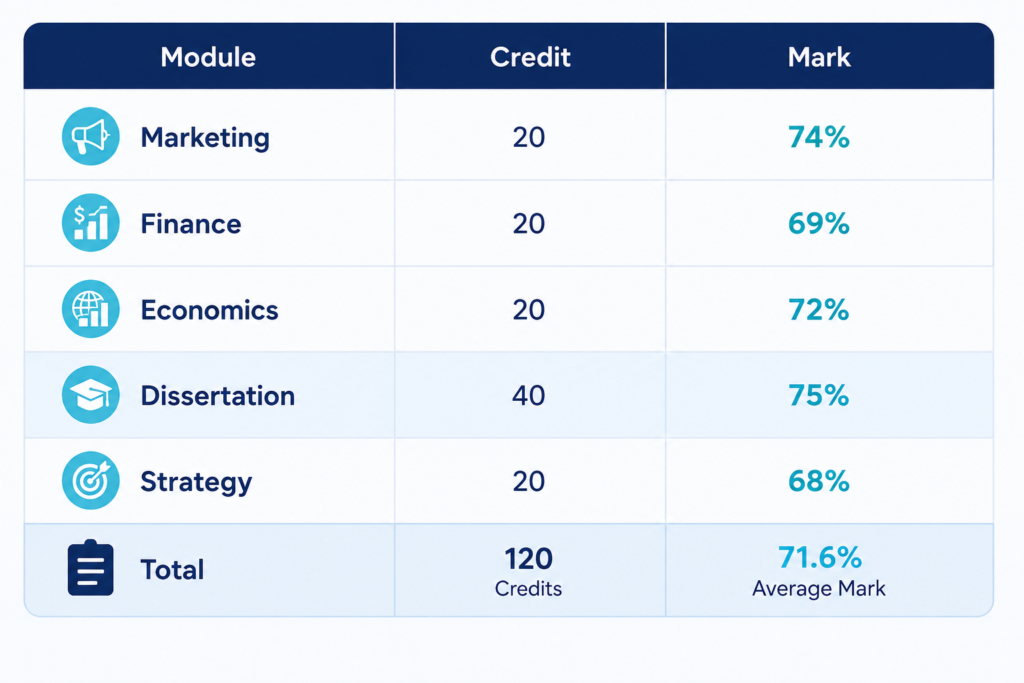
Because modules carry different credit values, your overall average is calculated using weighted marks rather than a simple arithmetic average.
Why 70% Is Usually the Benchmark
A mark of 70% represents work that demonstrates:
- Strong subject knowledge
- Critical thinking
- Independent analysis
- Well-supported arguments
- Excellent academic writing
- Accurate referencing
- Clear structure
- High-quality research
Unlike school examinations, university marking focuses heavily on the quality of analysis rather than simply providing correct answers.
Do Universities Use Different Classification Rules?
Yes.
Although many universities follow similar percentage boundaries, the way they calculate classifications can differ.
Some universities:
- Weight only the final year.
- Weight both the second and final year.
- Use different credit distributions.
- Apply borderline consideration.
- Use multiple calculation methods before selecting the highest eligible classification.
Because of these differences, two students with identical module marks at different universities could receive different final classifications.
Always check your institution’s academic handbook rather than relying solely on general advice.
Understanding Borderline Classifications
Many students become concerned when their average is just below 70%.
students average calculators
For example:
- 69.4%
- 69.6%
- 69.8%
Some universities have borderline regulations that allow academic boards to review students whose averages fall slightly below a classification boundary.
These decisions are not automatic.
Universities may consider factors such as:
- Performance in higher-level modules.
- Number of credits achieved above 70%.
- Final-year performance.
- Dissertation results.
- Academic regulations.
Because policies vary, students should never assume that an average of 69.8% will automatically become a First.
How Do UK Universities Calculate First Class Honours?
Understanding the calculation process helps you identify where you can improve your overall result.
Many students concentrate only on individual marks without appreciating how weighting works.
Credit-Weighted Average Explained
Most universities assign each module a credit value.
Common examples include:
- 15 credits
- 20 credits
- 30 credits
- 40 credits
- 60 credits
Higher-credit modules have a greater impact on your final classification.
For example:
| Module | Credits | Mark |
|---|---|---|
| Module A | 20 | 80% |
| Module B | 20 | 70% |
| Dissertation | 60 | 68% |
Although the dissertation mark is slightly lower, it contributes much more because it carries three times as many credits as the other modules.
How Module Credits Affect Your Final Example: How Dissertation Credits Affect Your Final Result
| Student | Dissertation (60 Credits) | Four Taught Modules (20 Credits Each) | Impact on Final Result |
|---|---|---|---|
| Emma | 74% | 67% average | Emma’s high dissertation mark carries significant weight, helping to increase her overall weighted average. |
| Oliver | 62% | 74% average | Despite strong marks in the taught modules, Oliver’s lower dissertation score has a greater negative impact because the dissertation is worth more credits. |
Which Years Usually Count?
Every university sets its own regulations, but many undergraduate degrees follow a structure similar to this:
| Year | Typical Contribution |
|---|---|
| First Year (Level 4) | Progression only |
| Second Year (Level 5) | Partial weighting |
| Final Year (Level 6) | Highest weighting |
The first year often determines whether you progress to the next stage but may not contribute directly to your final classification.
However, this is not universal. Some institutions include every year, while integrated master’s programmes may use different calculation methods.
Why Final Year Weighting Matters
Many universities place greater emphasis on your final year because it reflects your highest level of academic achievement.
For example:
| Year | Average | Weight |
|---|---|---|
| Second Year | 66% | 30% |
| Final Year | 73% | 70% |
Weighted calculation:
(66 × 30%) + (73 × 70%)
= 19.8 + 51.1
= 70.9%
In this example, the student’s stronger final-year performance increases the overall classification to a First. First Class Honours
Do Optional Modules Count?
In many degree programmes, yes.
Optional modules usually carry the same credit value as compulsory modules unless university regulations state otherwise.
This means choosing modules that match your strengths can positively influence your overall performance.
means modules positively influence overall performance; strengths modules match performance
However, module selection should never be based solely on perceived ease.
- Personal interest
- Career goals
- Assessment style
- Existing strengths
- Workload balance
Choosing modules you genuinely enjoy often leads to better engagement and stronger academic performance.
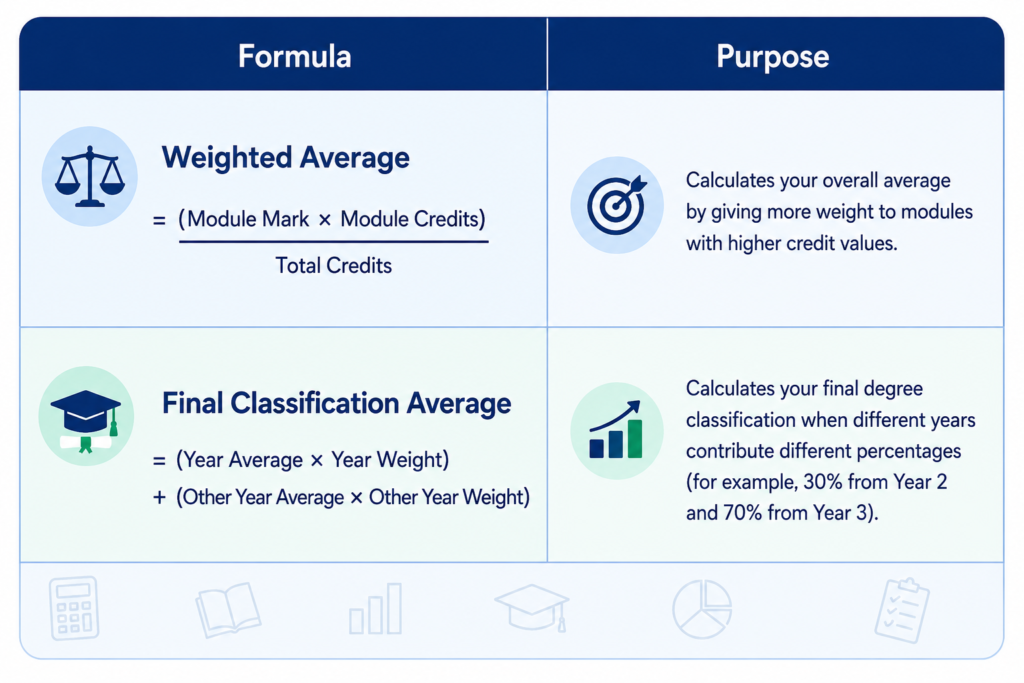
| Formula | Purpose |
|---|---|
| Weighted Average = (Module Mark × Module Credits) ÷ Total Credits | Calculates your overall average by giving more weight to modules with higher credit values. |
| Final Classification Average = (Year Average × Year Weight) + (Other Year Average × Other Year Weight) | Calculates your final degree classification when different years contribute different percentages (for example, 30% from Year 2 and 70% from Year 3). |
Worked Example
Sophie’s final-year modules:
| Module | Credits | Mark |
|---|---|---|
| Dissertation | 40 | 76% |
| Education Policy | 20 | 71% |
| Research Methods | 20 | 69% |
| Psychology | 20 | 73% |
| Leadership | 20 | 72% |
Because the dissertation carries twice as many credits as the other modules, its excellent mark has a significant positive impact on Sophie’s overall weighted average.
Rather than looking only at simple percentages, the university calculates each module’s contribution based on its credit value.
Understanding this principle helps students decide where additional revision time can have the greatest benefit.
Can You Still Get First Class Honours If Things Go Wrong?
Not every student has a perfect academic record. A disappointing exam, a difficult semester, illness, or personal circumstances can affect your marks. Fortunately, one setback does not always prevent you from graduating with First Class Honours. First Class Honours
The outcome depends on your overall weighted average, university regulations, and how much of your course remains.
After One Low Module Mark
One lower mark is rarely enough to prevent a First, particularly if the module carries relatively few credits.
For example, imagine your results look like this:
| Module | Credits | Mark |
|---|---|---|
| Dissertation | 40 | 75% |
| Module A | 20 | 73% |
| Module B | 20 | 72% |
| Module C | 20 | 69% |
| Module D | 20 | 58% |
Although one module is significantly lower than the others, the strong performance across the remaining credits may still leave your overall average above the First Class threshold.
Instead of focusing on one disappointing result, always look at the overall picture.
After Failing a Module
Failing a module creates additional challenges, but it does not automatically end your chances of graduating with a First.
The outcome depends on factors such as:
- The number of failed credits
- Whether the module can be compensated
- Whether a resit is required
- Whether the resit mark is capped
- Your university’s assessment regulations
Some universities require students to pass every compulsory module before awarding an honours degree, while others allow limited compensation under specific circumstances.
If you fail a module, speak with your course team as early as possible so you understand the available options.
After a Resit
Resits are common across UK universities.
However, many institutions cap the recorded resit mark at the pass mark, even if your actual exam score is much higher.
For example:
| Original Mark | Resit Score | Recorded Mark |
|---|---|---|
| 34% | 71% | 40% (capped) |
This means your transcript may show only the capped mark for classification purposes.
Some universities have different rules for first attempts affected by accepted mitigating circumstances, so always check your institution’s academic regulations.
Helpful Reading:
Read More: University Resit Exams Explained
If Your Average Is Just Below 70%
Many students become anxious when their calculated average is somewhere between 69% and 70%.
Although some universities operate borderline classification procedures, these are never guaranteed.
Academic boards may review factors such as:
- Final-year performance
- Credits achieved above 70%
- Dissertation performance
- Overall consistency
- University regulations
A student with an average of 69.8% and consistently high final-year marks may be considered differently from someone whose marks fluctuate throughout the course.
Because each university sets its own policies, avoid relying on stories from students at other universities.
How University Regulations Can Affect the Outcome
University has flexible classification
Universities have significant flexibility when determining how honours classifications are awarded.
Differences may include:
- Year weighting
- Credit weighting
- Borderline rules
- Compensation policies
- Treatment of optional modules
- Resit regulations
For this reason, your university handbook is always the most reliable source of information.
Practical Scenario
| Academic Stage | Result | Impact on Final Classification |
|---|---|---|
| Second Year (Level 5) | 64% Average | Daniel initially believes a First Class Honours degree is out of reach. |
| University Weighting | 30% (Level 5) / 70% (Level 6) | The final year carries the greatest influence on the overall classification. |
| Dissertation | 78% | A high dissertation mark significantly boosts the weighted average. |
| Marketing Strategy | 75% | Strong final-year performance contributes positively to the overall result. |
| International Business | 73% | Helps raise the final weighted average. |
| Leadership | 74% | Consistent high marks strengthen the overall classification. |
| Final Outcome | First Class Honours | Daniel’s excellent Level 6 performance increases his weighted average above 70%. |
Worked Examples of First Class Calculations
The following examples demonstrate how different situations can affect your final degree classification.
Example 1 – Simple Weighted Average
Emily studies Psychology.
Her weighted yearly averages are:
| Year | Average | Weight |
|---|---|---|
| Level 5 | 68% | 30% |
| Level 6 | 72% | 70% |
Calculation:
(68 × 0.30) + (72 × 0.70)
= 20.4 + 50.4
= 70.8%
Emily graduates with First Class Honours.
Example 2 – Credit-Weighted Calculation
Jack completes six modules.
| Credits | Mark |
|---|---|
| 20 | 72% |
| 20 | 70% |
| 20 | 74% |
| 20 | 69% |
| 20 | 73% |
| 20 | 71% |
His weighted average remains above 70%, so he qualifies for a First under the university’s standard classification rules.
Example 3 – Borderline Classification
Amira finishes with an overall average of 69.8%.
She also achieves:
- Dissertation: 76%
- Final-year average: 72%
- More than half of Level 6 credits above 70%
Depending on her university’s regulations, the examination board may review her case under borderline classification procedures. First Class Honours
Whether she receives a First depends entirely on institutional policy rather than a universal UK rule
Example 4 – Dissertation Improving Overall Average
Nathan performs consistently throughout his course.
However, he excels in his dissertation.
| Assessment | Credits | Mark |
|---|---|---|
| Dissertation | 40 | 80% |
| Remaining Modules | 80 | 69% |
Because the dissertation carries substantial credit, it increases Nathan’s overall weighted average enough to secure a First.
Example 5 – Recovering After a Difficult Second Year
Sophia’s second-year average is only 63%.
Instead of becoming discouraged, she:
- Meets regularly with tutors.
- Improves her academic writing.
- Learns how marking criteria work.
- Starts assignments earlier.
- Uses detailed feedback from previous coursework.
By the end of her final year, she averages 75%.
Her university’s weighting system allows the stronger Level 6 performance to have the greatest influence on her final classification.
This demonstrates how academic improvement over time can significantly affect the outcome.
Common Myths About First Class Honours
There are many misconceptions about how First Class Honours is awarded. Understanding the facts can help you make better academic decisions.
decision making academic progress honours help
Myth: Every University Uses the Same Rules
Although UK universities use similar classification ranges, each institution has its own academic regulations and calculation methods.
Myth: First Year Always Counts
Some universities use the first year only for progression, while others include it in the final classification. Always check your university’s policy.
Myth: One Failed Module Ends Your Chances
A failed module does not automatically prevent you from achieving a First. The outcome depends on your university’s regulations and your overall academic performance.
Myth: 70% Automatically Guarantees a First
A 70% average is the usual benchmark, but your final classification is still subject to your university’s academic regulations.
Myth: Only Exam Marks Matter
Benefits of Achieving First Class Honours
A First Class Honours degree can strengthen your academic and career opportunities. While employers and universities also consider skills and experience, a First demonstrates a high standard of academic achievement. First Class Honours
Career Opportunities
Many employers value candidates with a strong academic record. A First may strengthen applications for:
- Graduate schemes
- Competitive internships
- Research assistant roles
- Professional training programmes
Postgraduate Study
A First can make you more competitive when applying for:
- Master’s degrees
- Research programmes
- Funded postgraduate opportunities
- Doctoral (PhD) study
Scholarships and Funding
Some universities and funding organisations consider academic performance when awarding scholarships or bursaries. A First may improve your chances, although eligibility varies by institution.
Professional Reputation
Achieving a First shows that you can:
- Produce high-quality academic work
- Analyse complex information
- Manage deadlines effectively
- Think critically and work independently
These skills are valued by employers across many industries, making a First Class Honours degree a valuable achievement beyond university.
Tips to Improve Your Chances of Getting First Class Honours
Although every student’s circumstances are different, there are practical strategies that can significantly improve your academic performance.
Understand Your University’s Assessment Regulations
Many students focus only on revision and coursework without understanding how their degree is actually classified.
Before planning your study schedule, find out:
- Which years contribute to your final classification.
- How much each year is weighted.
- How module credits affect your average.
- Whether borderline rules exist.
- How resits are treated.
Understanding these regulations helps you prioritise your time more effectively.
Read More:Taxsaal.com
Priorities High-Credit Modules
Not every module has the same influence on your final result.
For example:
| Module | Credits |
|---|---|
| Dissertation | 40 |
| Marketing | 20 |
| Economics | 20 |
| Business Law | 20 |
| Finance | 20 |
Spending additional time on a 40-credit dissertation may have a greater impact than making a small improvement in a lower-credit module.
This doesn’t mean ignoring smaller modules, but it does mean allocating your study time strategically.
Focus on Heavily Weighted Assessments
Within individual modules, assessments may also have different weightings.
For example:
| Assessment | Weight |
|---|---|
| Coursework | 30% |
| Presentation | 20% |
| Final Exam | 50% |
If the final examination carries half the available marks, it deserves proportionate preparation.
Understanding assessment weightings helps you avoid spending equal time on tasks that contribute very different amounts to your final grade.
Plan Your Dissertation Early
The dissertation is often one of the largest pieces of work in an undergraduate degree.
Students who leave research until the final weeks frequently struggle with:
- Finding reliable sources.
- Organising ideas.
- Managing references.
- Editing effectively.
Starting early allows you to improve each draft through feedback rather than rushing to meet the deadline.
Monitor Your Weighted Average Regularly
Don’t wait until the end of your degree to estimate your classification.
After each assessment:
- Record your mark.
- Record the module credits.
- Update your weighted average.
- Identify areas needing improvement.
Using a degree calculator throughout the academic year can help you make informed decisions about where to focus your efforts.
Helpful Reading:
[Internal Link: UK Degree Classification Calculator]
Use Feedback to Improve Future Assignments
Feedback is one of the most valuable learning tools available.
Instead of looking only at your mark, ask yourself:
- Why were marks deducted?
- Which assessment criteria were strongest?
- Which skills need improvement?
Applying feedback consistently often leads to greater improvements than simply studying for longer.
Prepare Effectively for Exams
Effective revision involves more than reading notes repeatedly.
Try to:
- Practise past exam questions.
- Review examiner feedback where available.
- Create revision summaries.
- Test yourself regularly.
- Study difficult topics first.
Active revision techniques usually improve long-term understanding better than passive reading.
Use University Support Services
Most universities provide support that many students overlook.
These services may include:
- Academic writing workshops
- Study skills sessions
- Library support
- Maths and statistics help
- Referencing guidance
- Wellbeing services
Seeking support early can prevent small problems from becoming major obstacles later in the course.
Expert Tips
- Read the marking rubric before starting every assignment.
- Begin coursework well before the deadline.
- Prioritise modules with the highest credit values.
- Keep track of your weighted average after every result.
- Ask tutors for clarification if feedback is unclear.
- Balance revision across all assessed topics.
- Improve academic referencing to avoid unnecessary mark deductions.
- Work on critical analysis rather than simple description.
- Proofread every assignment carefully before submission.
- Use official university regulations instead of relying on online rumours.
Common Mistakes That Prevent Students from Achieving a First
Even capable students sometimes miss out on First Class Honours because of avoidable mistakes.
Ignoring Credit Weightings
Some students spend the same amount of time on every module.
In reality, a 40-credit module usually has much greater influence than a 20-credit module.
Understanding weighting helps you allocate your effort more effectively.
Misunderstanding Degree Calculations
Many students calculate a simple average instead of a weighted average.
This often produces an inaccurate estimate of the final classification.
Always use credit values and year weightings where appropriate.
Leaving Dissertation Preparation Too Late
The dissertation often carries substantial credit.
Starting late limits the time available for:
- Research
- Drafting
- Feedback
- Editing
Planning ahead usually results in stronger work.
Depending Only on Final Exams
Strong coursework can provide valuable marks before the examination period begins.
Students who neglect coursework may place unnecessary pressure on themselves during final exams.
Not Tracking Overall Progress
Waiting until graduation to estimate your degree classification makes it difficult to adjust your study strategy.
Regularly reviewing your progress helps you identify weaknesses while there is still time to improve.
Misinterpreting University Regulations
Every university has its own academic policies.
Assuming another institution follows identical rules can lead to unrealistic expectations.
Always consult official guidance.
Relying on Unofficial Grade Estimates
Advice shared on forums or social media may not apply to your university.
Whenever possible, use official regulations and trusted calculation tools instead of assumptions.
Use Our First Class Honours Calculator
Estimating your degree classification manually can become complicated, especially when different modules carry different credit values or your university applies year weighting.
Our calculator simplifies the process.
Simply enter:
- Your module marks.
- Credit values.
- Year weightings (where applicable).
The calculator estimates your likely degree classification in seconds, helping you understand how future assessments could affect your final result.
[INSERT CALCULATOR HERE]
Frequently Asked Questions
What is First Class Honours?
First Class Honours is the highest undergraduate degree classification awarded by most UK universities. It usually requires an overall weighted average of around 70% or above, although regulations vary between institutions.
What percentage is needed for a First Class degree?
For many universities, the benchmark is 70%. However, the exact calculation depends on your university’s academic regulations and weighting system.
Is 70% always enough to get a First?
Usually, yes, but not always. Some universities apply additional regulations or classification methods, so you should check your institution’s official guidance.
Does first year count towards First Class Honours?
Many universities use the first year for progression only, while others include it in the final classification. The answer depends on your course regulations.
Can I still get a First after failing a module?
Possibly. It depends on the number of failed credits, resit rules, compensation policies and your overall weighted average.
Do resits affect First Class Honours?
They can. Some universities cap resit marks at the pass mark, while others apply different rules where approved mitigating circumstances exist.
How do universities calculate First Class degrees?
Most universities use a weighted average based on module credits and, in many cases, year weighting. The exact method varies between institutions.
Can a dissertation improve my final classification?
Yes. Because dissertations often carry a high credit value, a strong dissertation mark can significantly improve your overall weighted average.
Do all UK universities use the same classification system?
No. While classification boundaries are broadly similar, each university sets its own academic regulations and calculation methods.
Is First Class Honours worth it?
For many students, yes. A First can strengthen applications for graduate jobs and postgraduate study, but employers also value practical experience, transferable skills and personal qualities.
Conclusion
Achieving First Class Honours involves more than simply reaching a 70% average. Understanding your university’s classification method, credit weighting and assessment structure can help you make better academic decisions throughout your degree.
Track your weighted average regularly, focus on high-credit assessments and use tutor feedback to improve your performance. Small improvements across multiple modules can make a significant difference to your final classification.
If you’re unsure where you stand, use a First Class Honours Calculator to estimate your degree classification and plan your remaining assessments more effectively.