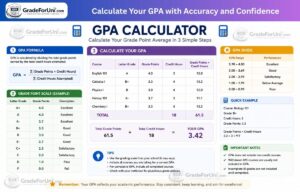

After every assignment, exam, or coursework submission, many students wonder how their latest mark affects their overall university average.
A University Marks Calculator makes this easy by calculating your weighted average using your module marks and credit values. University Marks Calculator: It helps you quickly see your current academic performance and understand how each result contributes to your overall degree average.
Click Here: UK University Grade Calculator
How to use the UK University Grade Calculator
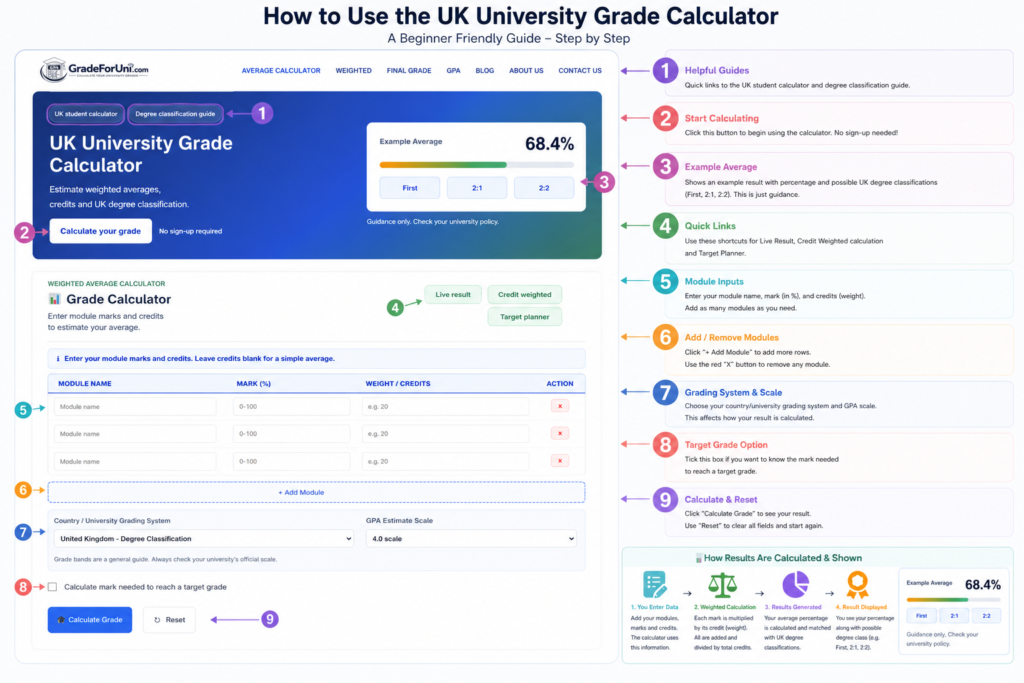
A University Marks Calculator helps you calculate your overall university average using your module marks, credit values and assessment weightings. It uses a weighted average to provide a more accurate estimate of your final mark and potential degree classification.
What Is a University Marks Calculator?
AA University Marks Calculator estimates your overall academic average by combining your module marks while taking credit values into account for a more accurate result. University Marks Calculator
You simply enter your module marks and credit values, and the calculator automatically calculates your weighted average. This helps you track your academic performance throughout the year and see how each module contributes to your overall average.
Read more: Taxsal.comWho Should Use This Calculator?
A University Marks Calculator can benefit students at different stages of higher education. University Marks Calculator
It is particularly useful for:
- First-year students learning how university grading works
- Second and third-year students monitoring their overall average
- Final-year students estimating their degree classification
- Master’s students calculating taught module averages
- Students preparing for resits
- Students applying for postgraduate courses that require a minimum classification
Even if your university eventually provides your overall average, calculating it yourself allows you to make informed decisions before final results are released.
What Results Can You Expect?
Most university marks calculators provide:
- Overall weighted average
- Percentage mark
- Estimated academic performance
- Progress towards a target classification
- Average across completed modules
Some calculators also estimate your degree classification, although the final result will always depend on your university’s academic regulations.
How Are University Marks Calculated in the UK?
Understanding how marks are calculated makes it easier to interpret your results and use a calculator correctly.
Most UK universities do not simply average all module marks together. Instead, they apply weightings to ensure larger or more important modules contribute proportionally to the final result. University Marks Calculator
Understanding Weighted Averages
A weighted average gives greater importance to modules carrying more credits.
For example:
| Module | Mark | Credits |
|---|---|---|
| Marketing | 72% | 20 |
| Finance | 65% | 20 |
| Dissertation | 68% | 40 |
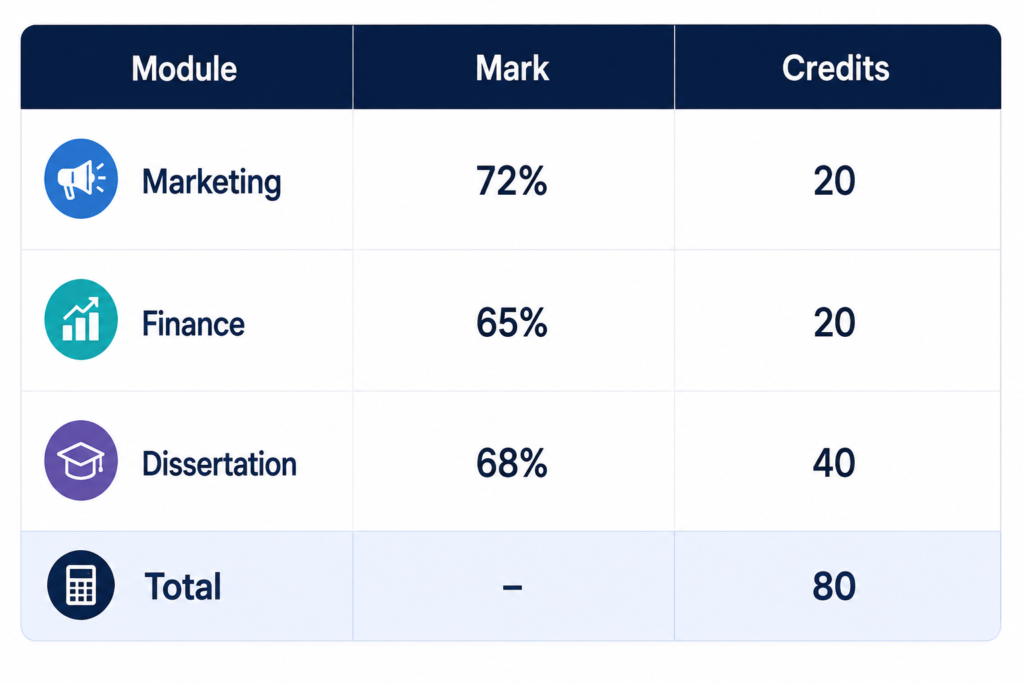
Although there are only three modules, the dissertation contributes twice as much because it carries twice the number of credits.
How Module Credits Affect Your Overall Mark
Credits represent the academic workload of each module.
Common credit values include:
| Module Type | Typical Credits |
|---|---|
| Standard module | 20 |
| Optional module | 10–20 |
| Large project | 30 |
| Dissertation | 40–60 |
A higher-credit module has a greater influence on your final average.
For instance, improving a 40-credit dissertation by five marks generally has a larger impact than improving a single 10-credit optional module by the same amount.
This is why students often focus extra effort on higher-credit assessments.
How Coursework and Exams Are Combined
Many modules include multiple assessments.
A typical module may consist of:
- Coursework: 40%
- Final exam: 60%
Suppose you achieve:
- Coursework = 70%
- Exam = 62%
The final module mark is calculated using the assessment weightings.
Formula
Example: Calculating a Final Module Mark
| Assessment | Mark | Weight | Contribution |
|---|---|---|---|
| Coursework | 70% | 40% | 28.0% |
| Exam | 62% | 60% | 37.2% |
| Final Module Mark | — | — | 65.2% |
The 65.2% final module mark is then used to calculate your overall university average, weighted by the module’s credit value.
Different courses use different assessment structures, so always check your module handbook before entering values into the calculator.
How Dissertation Marks Influence Your Final Average
For many undergraduate degrees, the dissertation is one of the most significant pieces of assessed work.
It usually:
- Carries more credits than standard modules
- Demonstrates independent research
- Covers an extended period of study
- Has a noticeable effect on your overall average
Because dissertations often carry 40 or 60 credits, even a modest improvement can raise your overall university mark.
Likewise, underperforming in a dissertation can have a greater impact than receiving a similar mark in a smaller module.
Planning your dissertation early and seeking regular feedback can therefore make a meaningful difference to your final result.
Formula Box
| Formula | Meaning |
|---|---|
| Overall Average = Σ (Module Mark × Credits) ÷ Σ Credits | Calculates your weighted university average by considering both module marks and credit values. |
Example
| Module | Mark | Credits | Mark × Credits |
|---|---|---|---|
| Business | 72 | 20 | 1,440 |
| Economics | 66 | 20 | 1,320 |
| Finance | 61 | 20 | 1,220 |
| Dissertation | 69 | 40 | 2,760 |
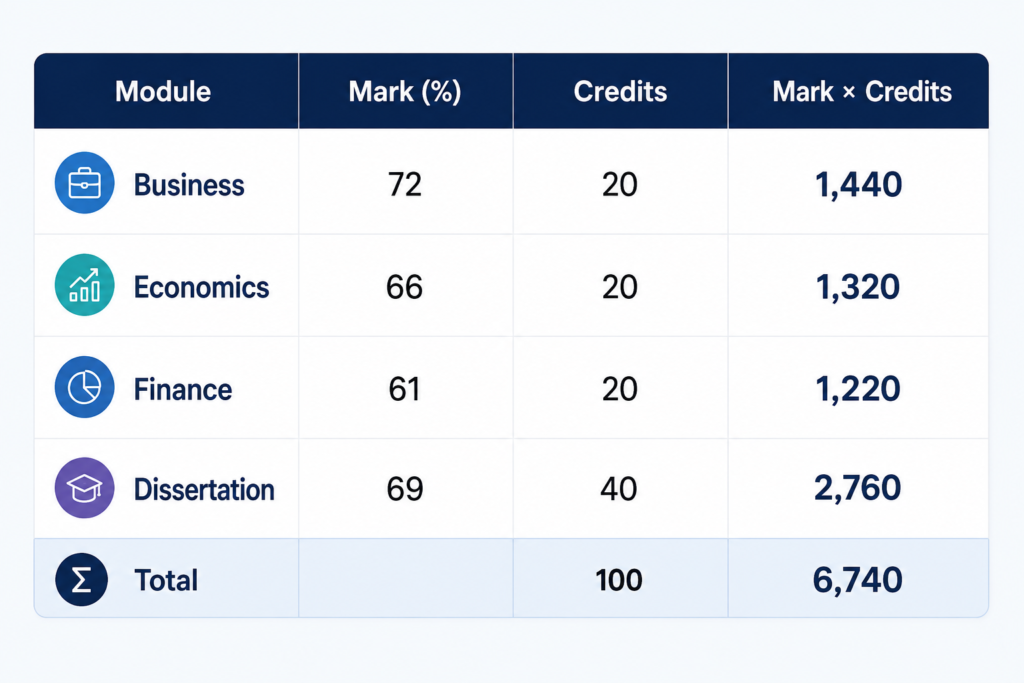
Total weighted marks = 6,740
Total credits = 100
Overall average = 67.4%
Although the calculation looks complicated, a University Marks Calculator performs it instantly and reduces the risk of manual errors.
How to Calculate Your University Marks Manually
Using an online calculator is the quickest option, but understanding the process helps you verify your results and identify any mistakes.
Step 1 – List Your Module Marks
Begin by recording every completed module.
For example:
| Module | Mark |
|---|---|
| Accounting | 67 |
| Economics | 71 |
| Marketing | 69 |
| Business Law | 63 |
If a module has not yet been completed, leave it out or estimate the mark separately.
Step 2 – Identify Each Module’s Credit Value
Next, record the number of credits attached to each module.
Most undergraduate modules are worth:
- 20 credits
- 30 credits
- 40 credits
- 60 credits
Never assume all modules carry the same weight.
Step 3 – Multiply Marks by Credits
Multiply each module mark by its credit value.
Example:
| Module | Mark | Credits | Score |
|---|---|---|---|
| Accounting | 67 | 20 | 1,340 |
| Economics | 71 | 20 | 1,420 |
| Marketing | 69 | 20 | 1,380 |
| Business Law | 63 | 20 | 1,260 |
| Module | Mark (%) | Credits | Mark × Credits |
|---|---|---|---|
| Module 1 | 67 | 20 | 1,340 |
| Module 2 | 71 | 20 | 1,420 |
| Module 3 | 69 | 20 | 1,380 |
| Module 4 | 63 | 20 | 1,260 |
| Total | — | 80 | 5,400 |
Weighted Average Calculation
| Step | Calculation | Result |
|---|---|---|
| Total Weighted Score | 1,340 + 1,420 + 1,380 + 1,260 | 5,400 |
| Total Credits | 20 + 20 + 20 + 20 | 80 |
| Weighted University Average | 5,400 ÷ 80 | 67.5% |
Worked Examples of University Marks Calculations
Seeing the calculation in action makes it much easier to understand how your overall average is produced. The examples below use realistic UK university marking scenarios.
Example 1 – Five Equal-Credit Modules
Emma studies five modules, each worth 20 credits.
| Module | Mark | Credits | Weighted Score |
|---|---|---|---|
| Marketing | 72 | 20 | 1,440 |
| Finance | 68 | 20 | 1,360 |
| Economics | 65 | 20 | 1,300 |
| Business Law | 70 | 20 | 1,400 |
| HR Management | 75 | 20 | 1,500 |
Total weighted score: 7,000
Total credits: 100
Overall average: 70.0%
Emma is currently achieving a First-Class average.
Example 2 – Different Credit Weightings
James has modules with different credit values.
| Module | Mark | Credits | Weighted Score |
|---|---|---|---|
| Accounting | 66 | 20 | 1,320 |
| Economics | 70 | 20 | 1,400 |
| Research Project | 74 | 40 | 2,960 |
| Business Ethics | 63 | 20 | 1,260 |
Total weighted score: 6,940
Total credits: 100
Overall average: 69.4%
Although James scored highest in his research project, it also carried the greatest number of credits, so it had the biggest impact on his final average.
Example 3 – Coursework and Exam Weighting
A
| Assessment | Student Mark | Weight | Contribution |
|---|
| Coursework | 78% | 30% | 23.4% |
| Final Exam | 61% | 70% | 42.7% |
| Final Module Mark | — | — | 66.1% |
Example 4 – Including a Dissertation Module
Sophie’s final year includes a dissertation worth 40 credits.
| Module | Mark | Credits |
|---|---|---|
| Marketing | 69 | 20 |
| Finance | 71 | 20 |
| Strategy | 67 | 20 |
| Dissertation | 74 | 40 |
Weighted calculation:
- Marketing = 1,380
- Finance = 1,420
- Strategy = 1,340
- Dissertation = 2,960
Total weighted score = 7,100
Total credits = 100
Overall average = 71.0%
The strong dissertation mark pushed Sophie’s average above the 70% threshold.
Example 5 – Year Weighting (Level 5 and Level 6)
Many UK universities place greater emphasis on the final year.
Suppose the weighting is:
- Level 5 = 30%
- Level 6 = 70%
Student averages:
| Academic Year | Average |
|---|---|
| Level 5 | 64% |
| Level 6 | 72% |
Calculation:
64 × 0.30 = 19.2
72 × 0.70 = 50.4
Overall degree average:
69.6%
Despite an excellent final year, the student narrowly misses 70%, showing why understanding year weightings is important when setting academic goals.
Understanding Module Credits and Weightings
Module credits are one of the biggest reasons students calculate their averages incorrectly. Two marks that look similar on paper can affect your final result very differently depending on how many credits each module carries.
Why Credits Matter More Than Simple Averages
A simple average treats every module equally.
A weighted average reflects the academic value assigned to each module.
For example:
- Module A: 80% (10 credits)
- Module B: 65% (40 credits)
Although Module A has the higher mark, Module B contributes four times as much towards the overall average.
Ignoring credits often produces misleading results.
Common Credit Structures at UK Universities
While universities have different programme structures, you’ll often encounter patterns like these:
| Module Type | Typical Credits |
|---|---|
| Standard taught module | 20 |
| Half module | 10 |
| Research project | 30 |
| Dissertation | 40–60 |
| Placement module | Varies |
Knowing the credit value before entering marks into a calculator helps ensure your estimate is as accurate as possible.
Optional Modules vs Core Modules
Most degree programmes include both compulsory and optional modules. University Marks Calculator
Core modules are essential for completing the course, while optional modules allow students to specialise in areas of interest.
From a calculation perspective, what matters most is not whether a module is optional but how many credits it carries.
An optional 20-credit module can influence your average just as much as a compulsory 20-credit module.
options
Do Failed Modules Affect Your Overall Average?
answes
The answer depends on your university’s academic regulations.
A failed module may:
- Count towards your average.
- Be replaced after a successful resit.
- Be capped at the pass mark.
- Be compensated if university regulations allow.
Always check your programme handbook before assuming how failed modules are treated.
Read More: How University Credits and GradesHow University Marks Relate to Degree Classifications
Your overall university average is often used to determine your final honours classification. Although each university publishes its own academic regulations, the percentage bands below are widely recognised across the UK.
Typical UK Degree Classification Bands
| Overall Average | Classification |
|---|---|
| 70% and above | First-Class Honours |
| 60–69% | Upper Second-Class (2:1) |
| 50–59% | Lower Second-Class (2:2) |
| 40–49% | Third-Class / Pass (depending on regulations) |
| Below 40% | Fail |
These ranges are general guidance. Some universities also apply borderline or discretionary rules.
What Overall Mark Is Needed for a First?
Achieving a First usually requires an overall average of 70% or higher.
If your current average is slightly below this threshold, identify your remaining high-credit modules and estimate the marks needed to reach your target.
Planning is often more effective than trying to recover after final assessments.
What Is Needed for a 2:1, 2:2 or Third?
Students aiming for postgraduate study or graduate schemes often target at least a 2:1, which typically requires an overall average of 60%-69%.
A 2:2 usually falls between 50% and 59%, while marks below this may result in a Third-Class degree or another outcome depending on university regulations. University Marks Calculator
Understanding these boundaries can help you prioritise revision and coursework throughout the year.
Do Universities Use Different Classification Rules?
Yes.
Although percentage bands are similar, universities may differ in areas such as:
- Year weightings.
- Borderline decisions.
- Treatment of resits.
- Credit requirements.
- Classification algorithms.
This is why your University Marks Calculator provides an estimate rather than an official result. University Marks Calculator
Comparison Table: Overall Mark vs Degree Classification
Read More: First Class Honours Explained
Factors That Can Affect Your Final University Marks
Your overall university mark is influenced by more than just the percentages shown on your transcript. University Marks Calculator: Understanding the factors below will help you make more informed decisions throughout your degree and interpret your calculator results more accurately.
Coursework Weighting
Coursework often contributes between 20% and 100% of a module, depending on the subject.
Examples of coursework include:
- Essays
- Reports
- Group projects
- Presentations
- Practical assignments
- Laboratory work
- Portfolios
If coursework carries a high weighting, consistent performance throughout the semester can significantly improve your final module mark, even before the exam takes place.
Final Exams
Many traditional academic subjects rely heavily on examinations.
For example:
| Subject | Typical Exam Weight |
|---|---|
| Mathematics | 70–100% |
| Economics | 60–80% |
| Law | 60–80% |
| Business | 40–70% |
| Engineering | 50–80% |
When exams carry most of the weight, strong revision strategies become particularly important because a single assessment can have a major influence on your final result.
Dissertation Weighting
The dissertation is usually completed during the final year and often carries 40 or 60 credits.
Because of its higher credit value, it can have a noticeable impact on your overall average.
To maximise your dissertation mark:
- Choose a topic you’re genuinely interested in.
- Start researching early.
- Meet your supervisor regularly.
- Plan your writing schedule.
- Leave enough time for editing and proofreading.
A well-planned dissertation can often improve your overall degree classification.
Resits and Capped Marks
If you fail a module, your university may allow a resit or reassessment.
However, many institutions cap the recorded mark at the pass threshold, even if you score much higher in the resit.
For example:
| Original Mark | Resit Mark | Recorded Mark |
|---|---|---|
| 34% | 72% | 40% |
Always check your university’s regulations, as policies differ between institutions and programmes.
Placement or Study Abroad Years
Some degree programmes include:
- Industrial placements
- Sandwich years
- Study abroad opportunities
These years may:
- Count towards your final classification.
- Be recorded separately.
- Carry reduced weighting.
- Be assessed on a pass/fail basis.
Before using a University Marks Calculator, confirm whether these credits contribute to your final average. University Marks Calculator
University-Specific Assessment Policies
No two universities operate in the same way.
Differences may include:
- Assessment weighting
- Credit structures
- Borderline rules
- Compensation policies
- Classification methods
- Rounding procedures
For the most accurate estimate, always compare your calculator results with your university’s official assessment regulations.
Read More: University Assessment Methods Explained]Why Your Calculated Average May Differ from Your University’s Result
Students are often surprised when their own calculation doesn’t exactly match the official result published by the university.
In many cases, the difference is perfectly normal.
Different Weighting Models
Some universities calculate the final average based solely on the final year.
Others may use a structure such as:
- Level 5: 30%
- Level 6: 70%
Others include additional years or professional placements.
If you use the wrong weighting model, your estimate may differ from the official calculation.
Rounding Rules
Universities apply different rounding methods.
For example:
- Round only the final average.
- Round each module before calculating.
- Round to one decimal place.
- Use exact decimal values until the final result.
Even small differences can slightly change the overall percentage.
Excluded or Non-Contributing Modules
Not every completed module necessarily contributes towards your final classification.
Some universities exclude:
- Foundation year modules
- Certain placement modules
- Pass/fail assessments
- Non-credit-bearing activities
Including these marks in your calculation may produce an inaccurate average.
Borderline Classification Policies
Many universities have academic regulations for students who narrowly miss a higher classification. University Marks Calculator
For example, a student with an average of 69.5% may still receive a First-Class degree if other academic criteria are satisfied.
Borderline rules vary considerably, so your calculator should be treated as a guide rather than an official decision.
Academic Regulations That Affect Final Marks
Universities may also apply regulations relating to:
- Academic misconduct
- Extenuating circumstances
- Compensation
- Credit deficiencies
- Repeat years
- Professional accreditation requirements
These factors cannot usually be incorporated into an online calculator, which is why official university results always take precedence.
Comparison Tables
Table 1 – Assessment Types vs Typical Weighting
| Assessment Type | Typical Weighting |
|---|---|
| Coursework | 20–50% |
| Examination | 40–80% |
| Presentation | 10–30% |
| Practical Assessment | 20–60% |
| Dissertation | 100% of dissertation module |
Table 2 – Module Credits vs Overall Impact
| Credits | Relative Impact |
|---|---|
| 10 | Low |
| 20 | Moderate |
| 30 | High |
| 40 | Very High |
| 60 | Highest |
Table 3 – Coursework vs Exam Contribution
| Coursework | Exam | Final Assessment Balance |
|---|---|---|
| 100% | 0% | Coursework Only |
| 70% | 30% | Coursework Focused |
| 50% | 50% | Balanced Assessment |
| 40% | 60% | Exam Focused |
| 30% | 70% | Strong Exam Emphasis |
Table 4 – Manual Calculation vs Calculator Calculation
| Manual Method | Online Calculator |
|---|---|
| Time-consuming | Instant results |
| Greater chance of mistakes | Reduced calculation errors |
| Requires formulas | Automatic calculation |
| Must calculate credits manually | Credits handled automatically |
| Suitable for checking results | Ideal for everyday use |
Table 5 – Common UK University Weighting Models
| Model | Example |
|---|---|
| Final Year Only | 100% Level 6 |
| 30:70 | Level 5 + Level 6 |
| 40:60 | Second Year + Final Year |
| Integrated Master’s | Multiple weighted years |
| Programme Specific | University regulations apply |
Practical Student Scenarios
Scenario 1 – Aiming for a First-Class Degree
A student has a current average of 68.8% with two assessments remaining.
A University Marks Calculator helps estimate the marks needed in the remaining assessments to achieve an overall average of 70% or above.
Scenario 2 – Recovering After Failing One Module
After failing a 20-credit module, a student can use a University Marks Calculator to estimate how a capped resit mark will affect their overall average.
Scenario 3 – Improving Marks Through a Resit
After passing a resit, a student can use a University Marks Calculator to estimate how the new mark affects their overall average or degree classification.
Scenario 4 – Predicting Your Final Degree Before Graduation
A final-year student can use a University Marks Calculator to estimate their final university average by entering an expected dissertation mark.
Scenario 5 – Working Out the Mark Needed in Your Dissertation
A student currently has an average of 67.8% and wants to graduate with a First-Class degree.
By entering their completed module marks, the calculator estimates the dissertation mark needed to reach their target classification.
Common Mistakes When Calculating University Marks
Common Mistakes to Avoid
Even with a University Marks Calculator, entering incorrect information can lead to inaccurate results.
Ignoring Module Credits
Treating every module equally can produce the wrong overall average. Always enter the correct credit value for each module.
Using a Simple Average Instead of a Weighted Average
A simple average does not account for different module credit values. Use a weighted average to calculate your overall university mark accurately.
Forgetting Coursework Weightings
Modules are frequently assessed using more than one component.
For example:
- Coursework: 40%
- Exam: 60%
If you only enter your exam mark, you’ll ignore a significant part of your assessment and produce an inaccurate result.
Always calculate the final module mark before adding it to your overall average.
Miscalculating Dissertation Contributions
Dissertations often carry more credits than standard modules.
Some students mistakenly give the dissertation the same importance as a 20-credit module, even though it may be worth 40 or 60 credits.
Because of its higher weighting, your dissertation can substantially increase—or decrease—your final university average.
Including Modules That Do Not Count
Not every completed module contributes to your final classification.
Depending on your course, this may include:
- Foundation year modules
- Pass/fail modules
- Placement activities
- Non-credit-bearing assessments
Before calculating your average, check which modules are included under your university’s regulations.
Rounding Too Early
Rounding each module before completing the calculation may slightly change the final result.
Instead:
- Use full decimal values throughout the calculation.
- Round only the final overall average unless your university specifies a different method.
Forgetting Resit Caps
A common misunderstanding is assuming your resit mark automatically replaces your original mark. University Marks Calculator
Many universities cap successful resits at the pass mark.
For example, achieving 70% in a capped resit may still result in a recorded mark of 40%.
Always confirm your institution’s reassessment policy.
Confusing Percentages with Weighted Scores
A module mark and its weighted contribution are not the same thing.
For example:
- Module mark: 72%
- Credits: 20
The weighted score is calculated by multiplying the mark by the credit value.
Entering percentages without applying the correct weighting can distort your overall average.
Assuming Every University Uses the Same Rules
Although UK universities follow similar principles, assessment policies differ.
Areas that commonly vary include:
- Year weightings
- Classification boundaries
- Borderline decisions
- Resit policies
- Rounding rules
Treat your calculator as an estimate unless it has been configured to match your university’s regulations.
Misunderstanding Pass Marks
Many students believe every assessment requires at least 40%.
In reality, pass requirements can differ depending on:
- Undergraduate or postgraduate study
- Professional accreditation
- Individual module regulations
- Overall programme requirements
Always check the official handbook for your course before making assumptions.
Expert Tips for Accurately Tracking Your University Marks
Calculating your university marks isn’t just about knowing your current average—it can also help you make smarter academic decisions throughout your degree.
Check Your University’s Assessment Regulations
Before using any calculator, review your university’s academic handbook.
Pay particular attention to:
- Credit requirements
- Assessment weightings
- Year weightings
- Degree classification rules
- Resit policies
This ensures your calculations reflect how your institution awards final results.
Monitor Your Average Throughout the Academic Year
Don’t wait until the end of the semester.
Updating your average after each assessment allows you to:
- Spot declining performance early.
- Set realistic improvement goals.
- Reduce unnecessary stress before final exams.
Prioritise High-Credit Modules
Improving a high-credit module often has a greater impact than improving several smaller modules.
If your time is limited, focus revision on assessments that contribute most towards your overall average.
Double-Check Every Calculation
Even small data entry mistakes can affect the final result.
Before relying on any estimate:
- Confirm every module mark.
- Check all credit values.
- Review assessment weightings.
- Verify any manually calculated module averages.
Keep Assessment Records Updated
Maintain a simple spreadsheet or document containing:
- Module names
- Credit values
- Coursework marks
- Exam marks
- Final module marks
Having everything in one place makes future calculations much quicker.
Plan Using Target Grades
Rather than asking, “What is my average?”, ask:
“What mark do I need in my remaining assessments?”
A University Marks Calculator can help you estimate the scores needed to reach:
- A First-Class degree
- A 2:1
- A scholarship requirement
- A postgraduate entry requirement
Understand Dissertation Weighting Early
Your dissertation is usually one of the largest contributors to your final average.
Starting your research early gives you more time to:
- Refine your topic.
- Gather quality sources.
- Improve drafts through supervisor feedback.
- Produce stronger final work.
Use a Calculator Alongside Manual Checks
Online calculators are quick and convenient, but understanding the underlying calculation helps you identify potential mistakes.
If the calculator produces an unexpected result, a manual check can often reveal incorrect inputs. University Marks Calculator
Verify Results Against Official Transcripts
Whenever new marks are released, compare them with your own records.
This ensures your calculator reflects the most up-to-date information and reduces the risk of working with outdated figures.
Review Your Progress Before Each Assessment
Use your current average to decide where your effort will have the greatest impact.
For example:
- If you’re comfortably above your target, focus on maintaining consistency.
- If you’re just below a classification boundary, prioritise high-weighted assessments.
Making informed decisions throughout the year is often more effective than trying to recover after results are published.
Frequently Asked Questions
What is a University Marks Calculator?
A University Marks Calculator estimates your overall university average by combining your module marks with their credit values and assessment weightings. It provides a quick way to monitor your academic progress before official results are released.
How do I calculate my university marks?
Multiply each module mark by its credit value, add all weighted scores together, then divide by the total number of credits. A calculator automates this process and reduces the chance of manual errors.
How are university marks weighted?
Most UK universities use a weighted average. Modules with more credits contribute more to your final average than those with fewer credits.
Do module credits affect my overall average?
Yes. Credit values determine how much each module contributes to your final university mark. Higher-credit modules have a greater impact on your overall result.
Does first year count towards my final degree?
It depends on your university. Many institutions use first year as a qualifying stage only, while others include it in the overall calculation. Always check your programme regulations.
How are coursework and exam marks combined?
Each assessment is multiplied by its weighting. For example, if coursework is worth 40% and the exam 60%, both scores are combined to produce the final module mark.
Can I calculate my final degree classification?
Yes. Once you know your weighted average, you can compare it with the typical UK degree classification bands. However, your university’s official regulations always determine the final award.
Do resit marks affect my final average?
They can. Some universities replace the original mark, while others cap successful resits at the pass mark. Check your institution’s reassessment policy for details.
Why is my calculated average different from my university’s?
Differences can arise because of year weightings, rounding methods, excluded modules, borderline policies or other academic regulations that vary between universities.
What overall mark do I need for a First-Class degree?
At most UK universities, an overall average of 70% or above is required for a First-Class Honours degree, although some institutions also apply borderline rules.
Conclusion
A University Marks Calculator helps you track your academic progress by estimating your overall average using your module marks and credit values. University Marks Calculator
For the most accurate results, enter the correct marks and credits, and remember that your university’s assessment regulations determine your final degree classification.