

How to Predict Your Final How to Predict Your Final Degree Classification Before Results DayYou’ve just finished your last exam. Your dissertation is submitted, your final assignments are marked, and now you’re stuck in that strange waiting period where every notification makes your stomach drop. Somewhere between now and the official results release, you’ll ask yourself the same question thousands of UK students ask every summer: what classification am I actually going to get?
The good news is you don’t need to wait for results day to find out. If you know your module marks, your credit values, and how your university weights each year, you can work out a highly accurate estimate of your final classification weeks in advance. This isn’t guesswork — it’s the same maths your university’s exam board applies when it calculates your degree. How to Predict Your Final This guide walks you through exactly how to do that, using real numbers rather than vague reassurance.
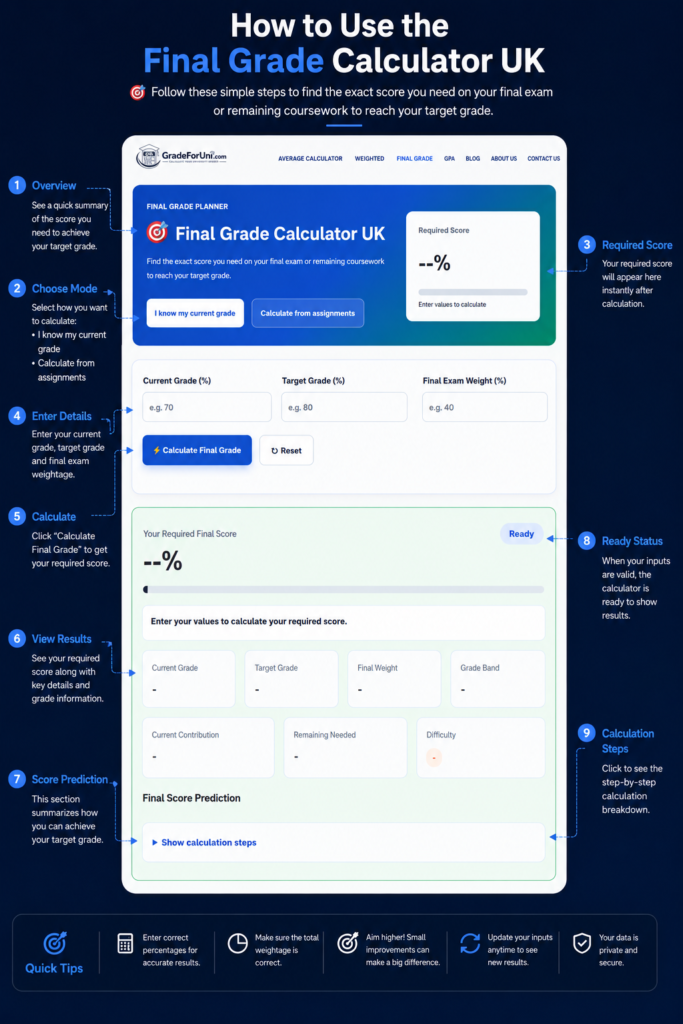
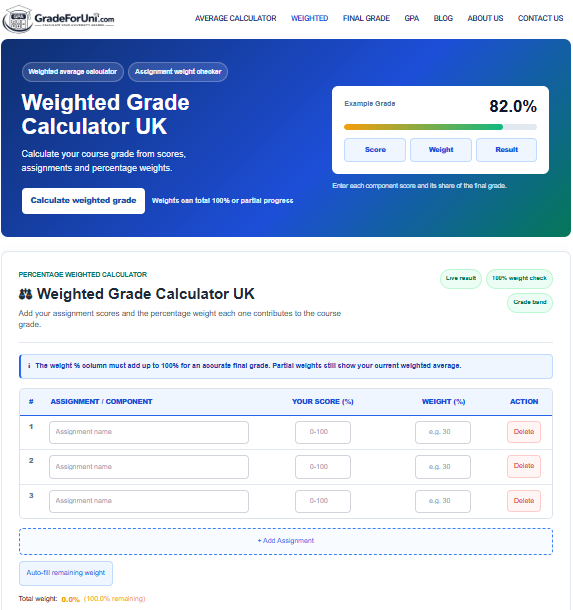
Click Here: UK University Grade Calculator
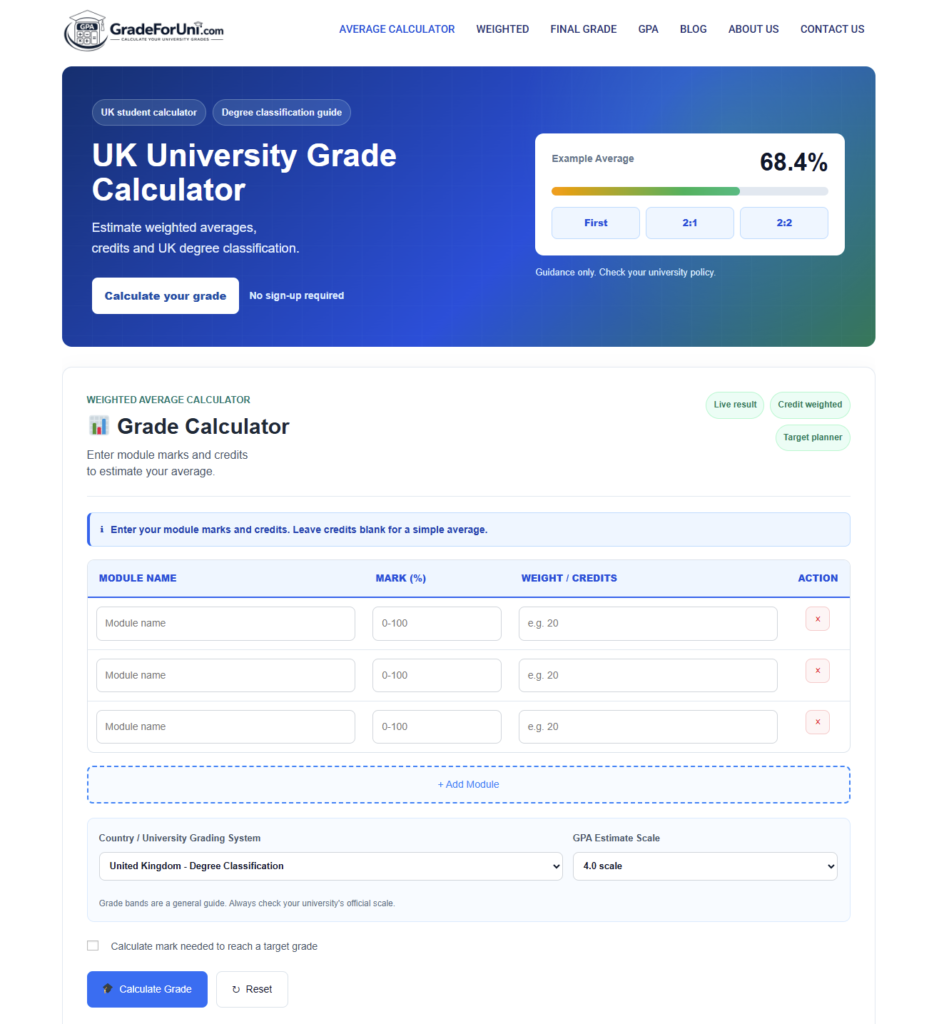
How to use the UK University Grade Calculator
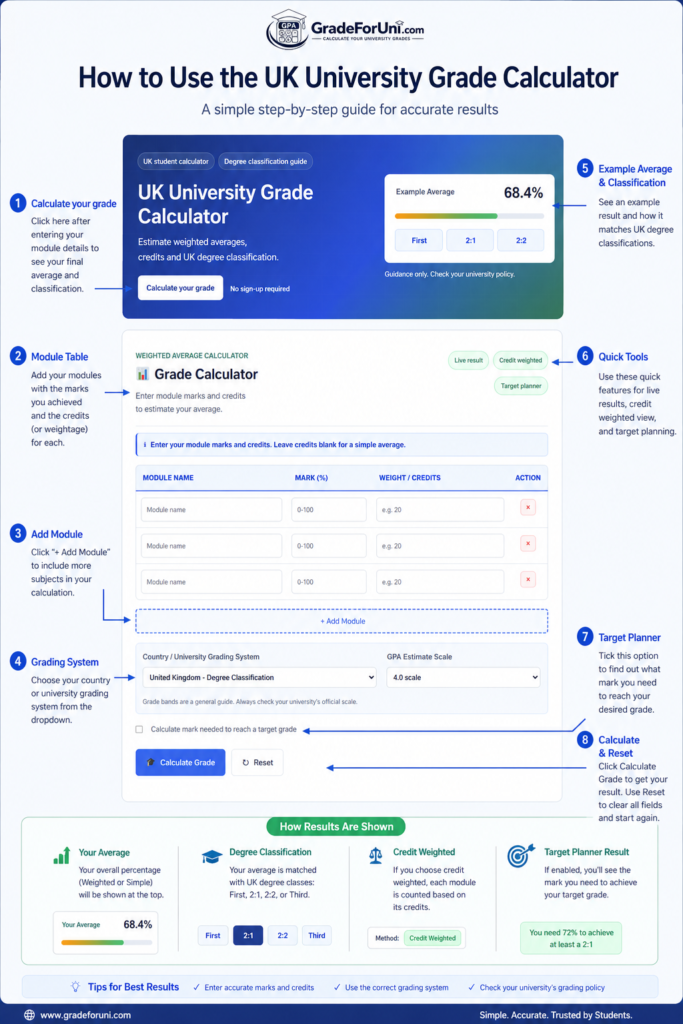
Quick Answer
To predict your final degree classification before results day, multiply each module mark by its credit value, add these together, then divide by your total credits to get a weighted average. How to Predict Your Final Apply your university’s year weighting (commonly a 33:67 split between Year 2 and Year 3) if multiple years count towards your final result, then match the resulting percentage against the UK classification bands: First (70%+), Upper Second/2:1 (60–69%), Lower Second/2:2 (50–59%), and Third (40–49%). This mirrors how most UK exam boards calculate final results, giving you a reliable estimate before official confirmation.
What This Guide Covers
This guide takes you from the basic building blocks of classification prediction through to a complete, ready-to-use method for your own transcript.
We’ll start with the background you need before doing any calculations — the key terms, the logic behind weighting, and the misunderstandings that trip up even careful students. How to Predict Your Final From there, we’ll move into the actual step-by-step prediction method, including how it plays out in real scenarios. How to Predict Your Final Finally, we’ll cover how to handle incomplete results, resits, and borderline averages, so you can build a reliable prediction even before every mark is in.
By the end, you’ll be able to open your own module results, work through the maths yourself, and arrive at a prediction that’s genuinely close to what appears on your final transcript.
Visit Now: Mauricette-calculette
Why Predicting Your Classification Matters
There’s a practical reason to work this out early, beyond simple curiosity. Knowing roughly where you stand lets you make decisions while you still have time to act. If your prediction lands close to a classification boundary, that tells you whether a strong final assignment could push you up a band or whether your position is already secure. If you’re applying for graduate jobs or postgraduate courses that specify a minimum classification, you’ll often need to state your predicted or expected result before your final transcript is issued.
There’s also a stress-management angle. Vague uncertainty tends to feel worse than a concrete number, even one that isn’t guaranteed. Students who calculate their own prediction properly — using credits and weighting rather than a rough guess — usually find results day far less nerve-wracking, simply because they already have a realistic idea of what to expect.
None of this replaces your official results. Exam boards apply institution-specific rules, and there can be small adjustments for things like mitigating circumstances or borderline reviews. But a properly calculated prediction gets you close enough to plan around with confidence.
Key Concepts You Need to Understand First
Before you can predict anything accurately, a few terms need to be clear. How to Predict Your Final Skipping this step is where most self-calculated predictions go wrong.
Weighted Average vs Simple Average
A simple average treats every module the same, regardless of size: add up your marks, divide by the number of modules. It’s quick, but it’s rarely how your university actually calculates your degree result.
A weighted average accounts for the fact that modules aren’t equal in size. A 40-credit dissertation represents far more study time and assessment than a 10-credit elective, so it should — and does — influence your average more. How to Predict Your Final Almost every UK university uses weighted averages, not simple ones, for official classification purposes:
Weighted Average = (Mark₁ × Credit₁ + Mark₂ × Credit₂ + …) ÷ Total Credits
We’ll put this formula to work shortly.
Credits
Credits are the units your university uses to measure the size and workload of a module. Most full-time undergraduate years carry 120 credits in total, usually split across modules worth 10, 15, 20, 30, or 40 credits each. How to Predict Your Final A standard three-year Honours degree adds up to 360 credits overall.
The credit value of a module is what determines how much pull it has over your final average — not how hard it felt, or how much you enjoyed it.
Read More: First Class Honours Explained: 7 Amazing Requirements, Marks & Tips
Year Weighting
Once you’re combining results from more than one academic year, year weighting comes into play. How to Predict Your Final Most UK undergraduate degrees give little or no weight to Year 1 (though you usually still need to pass it to progress), then split the remaining weight between Year 2 and Year 3. A 33:67 split is common, though some universities use 40:60, and integrated master’s courses often add a fourth year into the mix.
This is one of the most misunderstood parts of the whole process, since students often assume every year counts equally. It rarely does.
Classification Boundaries
Once your final weighted, year-adjusted average is calculated, it gets matched against your university’s classification bands. The standard UK bands look like this:
| Classification | Percentage Range | Abbreviation |
|---|---|---|
| First Class | 70% – 100% | 1st |
| Upper Second Class | 60% – 69% | 2:1 |
| Lower Second Class | 50% – 59% | 2:2 |
| Third Class | 40% – 49% | 3rd |
| Fail | Below 40% | — |
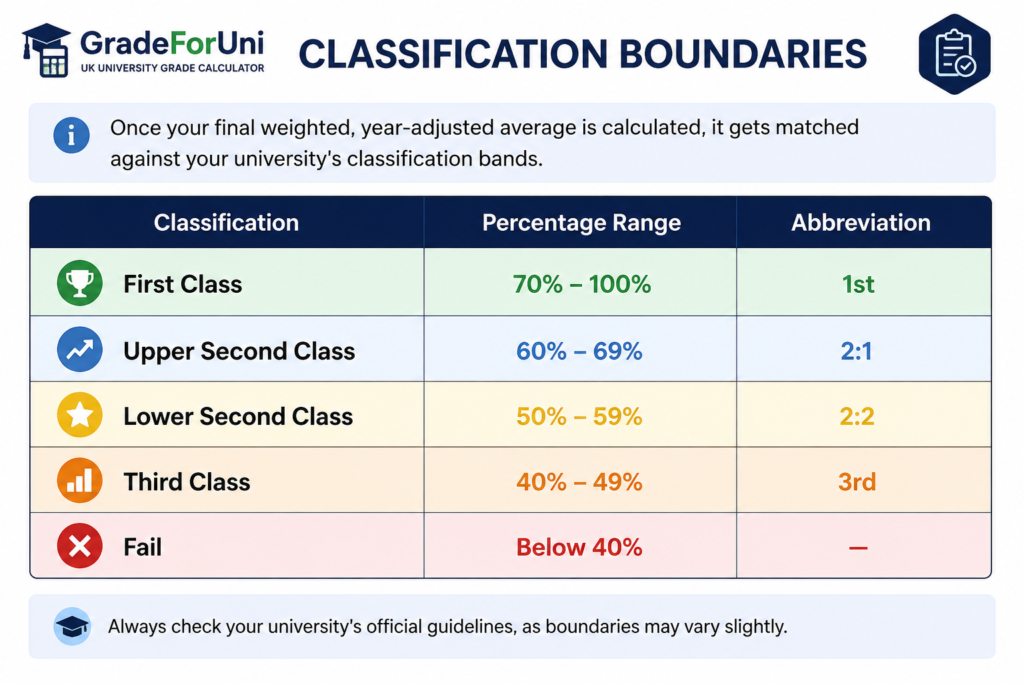
These bands are widely used, but individual universities can apply slightly different boundaries or borderline policies, so it’s worth checking your own institution’s handbook alongside this guide How to Predict Your Final.
Common Misconceptions About Predicting Your Grade
A surprising number of students calculate their prediction incorrectly without realising it. Here are the mistakes that show up most often.
“My average across all three years is what counts.” For most UK degrees, Year 1 barely factors in, if at all. Averaging all three years together usually produces a misleadingly low prediction.
“Every module counts the same.” Unless your university explicitly uses simple averaging, credit value changes everything. A strong mark in a 10-credit module won’t rescue a weak mark in a 40-credit dissertation.
“70% in my last module means I’ll get a First overall.” One module’s mark, however high, is diluted by every other module’s credits. A single strong result rarely shifts your overall average as much as students expect.
“If my average is 69%, I’m basically getting a First anyway.” Borderline reviews exist at some universities, but they’re not automatic, and they’re never guaranteed. Treat your calculated percentage as your real classification unless your university explicitly tells you otherwise.
A Quick Worked Example
Here’s a simplified example to show the difference weighting makes. Imagine a Year 3 student with these three modules:
| Module | Mark | Credits | Contribution |
|---|---|---|---|
| Strategic Management | 74% | 20 | 74 × 20 = 1,480 |
| International Business | 69% | 20 | 69 × 20 = 1,380 |
| Dissertation | 72% | 40 | 72 × 40 = 2,880 |
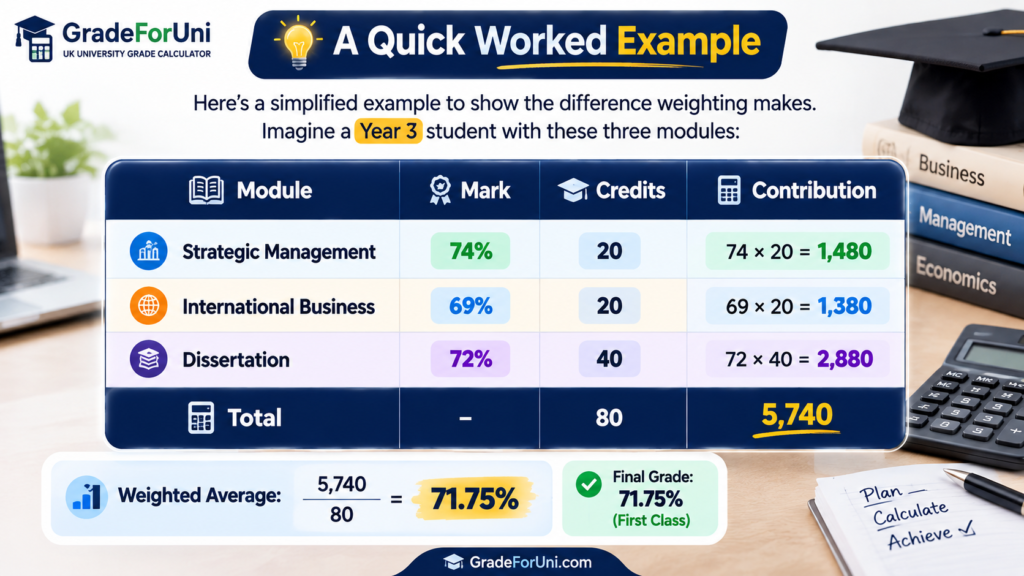
A simple average of these three marks would be 71.7%. How to Predict Your Final The weighted average — the one that actually reflects credit value — comes out at (1,480 + 1,380 + 2,880) ÷ 80 = 71.75%. How to Predict Your Final In this case the two numbers land close together, but as module marks spread further apart, the gap between simple and weighted averages grows fast, and it’s the weighted figure that matches what your university will use.
Step-by-Step Method to Predict Your Final Classification
With the groundwork in place, here’s the actual process. Work through these steps in order, using your real module marks and credits.
List Every Module That Counts Towards Your Final Result
Pull up your module handbook or student portal and list only the modules that contribute to your final classification. This usually means Year 2 and Year 3, but check your specific course structure — some universities include How to Predict Your Final Year 1 at a small percentage, and integrated Masters courses typically add a fourth year.
Don’t include modules that are pass/fail only or modules explicitly marked as non-contributing in your handbook. Including modules that don’t actually count is one of the most common reasons student predictions come out wrong.
Record Each Module’s Mark and Credit Value
Next to each module, write down your percentage mark and its credit value. How to Predict Your Final If you don’t have a mark yet for a module, note that too — you’ll deal with incomplete results a little further on.
At this stage, your list might look something like this:
| Module | Year | Credits | Mark |
|---|---|---|---|
| Consumer Behaviour | 2 | 20 | 61% |
| Digital Marketing | 2 | 20 | 67% |
| Market Research Methods | 2 | 20 | 58% |
| Strategic Brand Management | 3 | 20 | 74% |
| International Marketing | 3 | 20 | 69% |
| Dissertation | 3 | 40 | 72% |
Calculate Each Year’s Weighted Average Separately
Rather than combining every module into one giant calculation, work out each year’s average on its own first. How to Predict Your Final This makes it far easier to spot mistakes, and it matches how most exam boards structure the calculation internally.
For Year 2 in the table above:
(61 × 20) + (67 × 20) + (58 × 20) = 1,220 + 1,340 + 1,160 = 3,720
3,720 ÷ 60 credits = 62.0%
For Year 3:
(74 × 20) + (69 × 20) + (72 × 40) = 1,480 + 1,380 + 2,880 = 5,740
5,740 ÷ 80 credits = 71.75%
Notice that the dissertation, worth double the credits of the other modules, pulls the Year 3 average up more than a simple average would suggest.
Apply Your University’s Year Weighting
Once you have each year’s average, combine them using your university’s year-weighting split. How to Predict Your Final If you’re not sure what split your university uses, check your academic regulations or module handbook—it’s usually stated clearly, often as something like “Year 2: 30%, Year 3: 70%” or “Year 2: 33%, Year 3: 67%.”
Using a 33:67 split on the example above:
Final Average = (Year 2 Average × 0.33) + (Year 3 Average × 0.67)
(62.0 × 0.33) + (71.75 × 0.67) = 20.46 + 48.07 = 68.5%
This lands the student in the Upper Second Class (2:1) band, just short of a First — useful information, since it shows exactly how much ground they’d need to make up if a First was the target.
Match Your Result Against the Classification Boundaries
Take your final percentage and compare it against the bands set out earlier: 70%+ for a First, 60–69% for a 2:1, 50–59% for a 2:2, and 40–49% for a third. How to Predict Your Final This gives you your predicted classification.
If your result lands close to a boundary — within a percentage point or two — treat that as important information rather than a rounding error. It usually means one remaining assessment could shift your final band in either direction, which is worth knowing before results day, not after.
Real-Life Scenario: Comparing Two Students
To show how differently two students with similar-looking marks can end up, consider Priya and Tom, both in their final semester of a biology degree.
| Priya | Tom | |
|---|---|---|
| Cell Biology (10 credits) | 78% | 55% |
| Genetics (20 credits) | 65% | 62% |
| Ecology Fieldwork Project (30 credits) | 60% | 70% |
At first glance, Priya’s marks look stronger — she has the highest single score of either student. But once credits are applied, the picture changes:
Priya’s weighted average: (78 × 10 + 65 × 20 + 60 × 30) ÷ 60 = (780 + 1,300 + 1,800) ÷ 60 = 64.7%
Tom’s weighted average: (55 × 10 + 62 × 20 + 70 × 30) ÷ 60 = (550 + 1,240 + 2,100) ÷ 60 = 64.8%
Despite Priya’s higher top mark, the two students end up almost identical, because Tom’s strongest result sits in his highest-credit module while Priya’s strongest result sits in her lowest-credit one. How to Predict Your Final This is exactly why looking only at your best or most recent marks gives a misleading impression of where you actually stand.
Simple Average vs Weighted Average at a Glance
It’s worth seeing the two methods side by side, because the gap between them is often bigger than students expect.
| Method | Formula | When It’s Used |
|---|---|---|
| Simple Average | (Mark₁ + Mark₂ + …) ÷ Number of Modules | Rarely used officially; sometimes used informally to get a rough sense of performance |
| Weighted Average | (Mark × Credit for each module, summed) ÷ Total Credits | Standard method used by almost all UK universities for official classification |
Using Priya’s marks from the scenario above, her simple average would be (78 + 65 + 60) ÷ 3 = 67.7% — nearly three full percentage points higher than her actual weighted average of 64.7%. How to Predict Your Final That difference is enough to change a predicted classification band entirely in some cases, which is why relying on a simple average can leave students with a false sense of security.
Read More: University Marks Calculator: 7 Easy Ways to Calculate Your Overall…
Common Mistakes to Avoid at This Stage
Even students who understand the theory sometimes trip up on execution. Watch out for these:
Forgetting to separate years before combining them. Lumping every module from every year into one giant weighted average, without applying year weighting, produces a number that doesn’t match how your university actually calculates results.
Using the wrong credit values. Credit values sometimes change between module handbook editions, or differ slightly from a friend’s on a different course pathway. Always check your own official transcript or module catalogue rather than assuming.
Leaving out the dissertation. Because dissertations are often worth double or triple the credits of a standard module, omitting it — even temporarily, while waiting for the mark — can massively distort your prediction. It’s better to estimate a dissertation mark and label it clearly as provisional than to leave it out entirely.
Applying the wrong year-weighting split. Assuming a standard 33:67 split when your university actually uses 40:60 (or vice versa) will shift your final prediction by a percentage point or more, which can be the difference between two classification bands if you’re near a boundary.
Expert Tips for a More Accurate Prediction
- Recalculate after every new result, not just at the end of the year. This helps you catch entry errors early, while there’s still time to fix them.
- Keep a running spreadsheet, or use a calculator tool that stores your data, rather than redoing the maths from scratch each time.
- Check your year-weighting split directly against your university’s academic regulations document, not against what a coursemate tells you.
- If you’re unsure whether a module counts towards your final classification, ask your course administrator directly rather than guessing.
- Treat any prediction within 1–2% of a classification boundary as unresolved until your final mark is confirmed, and plan your remaining effort accordingly.
Predicting Your Classification With Incomplete Results
This method works well once you have a complete, confirmed set of marks. How to Predict Your Final But most students calculating a prediction before results day are working with an incomplete picture — a dissertation mark still pending, a resit not yet sat, or a final exam still to come. Here’s how to build an accurate prediction anyway.
Using Provisional or Estimated Marks
For any module you haven’t received a result for yet, use a realistic estimate rather than either your best-case hope or your worst-case fear. How to Predict Your Final A good starting point is your average performance across similar assessments so far — if your coursework has consistently landed around 68%, it’s reasonable to plug in 68% for a pending exam in the same module, rather than assuming a sudden jump to 75%.
Label these entries clearly as provisional, and recalculate as soon as each real mark comes in. How to Predict Your Final Treat the running total as a moving prediction, not a fixed number.
Handling a Pending Dissertation
Because dissertations typically carry disproportionately high credit values, an unconfirmed dissertation mark is usually the single biggest source of uncertainty in any prediction. How to Predict Your Final If you’ve had formative feedback or a supervisor’s informal impression of your draft, use that as a guide for your estimate rather than guessing blind.
It’s worth running your prediction twice — once with a cautious dissertation estimate and once with an optimistic one — so you can see the realistic range your final classification could fall within, rather than relying on a single number.
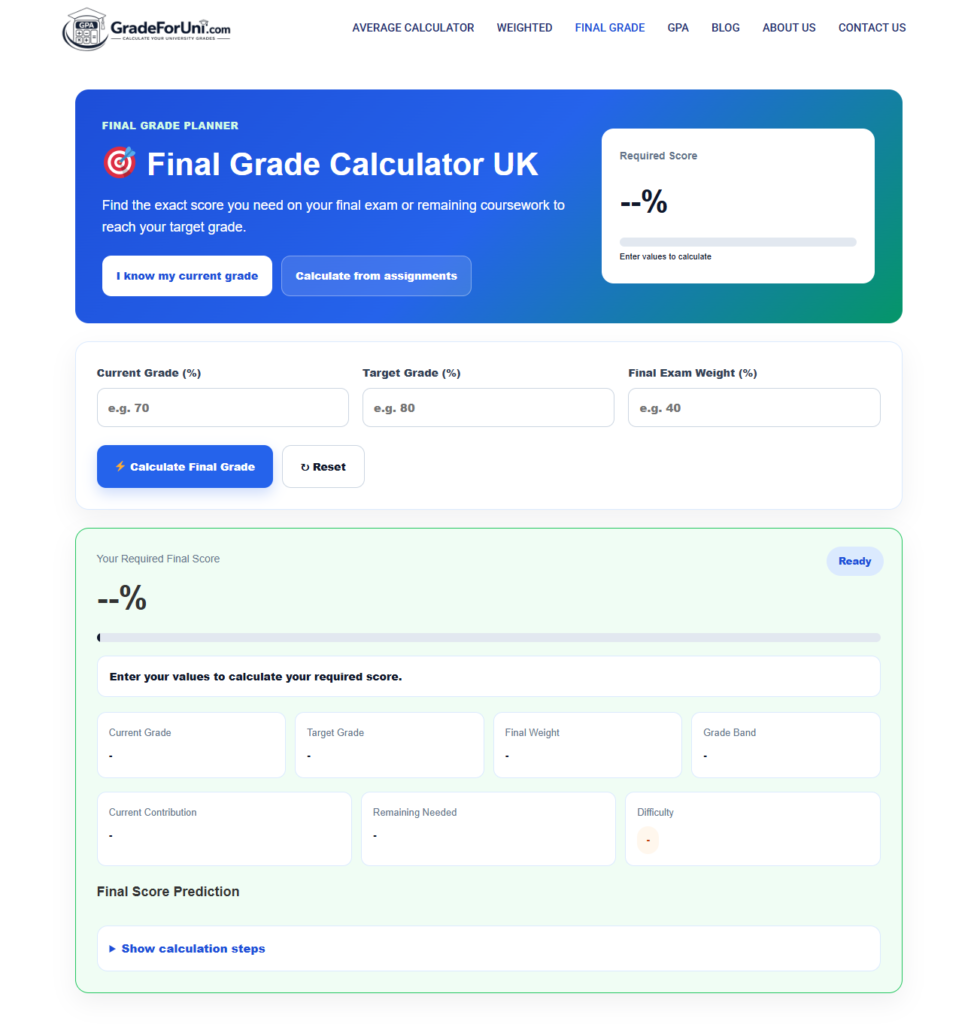
Working Backwards From a Target Grade
If you’d rather know what you need instead of what you’re likely to get, you can rearrange the weighted average formula to solve for the mark required in your remaining assessments:
Mark Needed = [(Target Average × Total Credits) − Sum of (Existing Marks × Credits)] ÷ Remaining Credits
For example, a student with 62.5% across 40 completed credits, aiming for a First (70%) across 80 total credits, would need:
[(70 × 80) − (62.5 × 40)] ÷ 40 = (5,600 − 2,500) ÷ 40 = 77.5%
That’s a concrete, actionable number — far more useful than a vague sense of “needing to do well” in the remaining work.
Frequently Overlooked Factors
A few details get missed even by students who otherwise calculate carefully.
Resit caps. Many universities cap a resit mark at the pass boundary — often 40% — regardless of the actual score achieved. If you’re predicting your classification after a resit, use the capped figure, not your raw exam performance, or your prediction will be too optimistic.
Compensation rules. Some universities allow a strong mark in one module to compensate for a narrowly failed mark in another, without requiring a resit at all. If this applies to your course, it can change which modules you need to include in your calculation.
Borderline classification reviews. These aren’t automatic, and they don’t apply at every university. If your predicted average sits within a percentage point of a boundary, treat your calculated classification as the one you’ll receive — anything better is a possible bonus, not a guarantee.
Rounding conventions. Some universities round your final average to the nearest whole number before applying classification boundaries; others don’t round at all. A predicted 69.6% might become a First at a university that rounds up, and a 2:1 at one that doesn’t. Check your regulations if your prediction lands close to a boundary.
Read More: How University Credits and Grades Work Together – Student Guide
Prediction Accuracy at Each Stage
How reliable your prediction is depends heavily on how much of your final year is actually confirmed How to Predict Your Final. This table gives a realistic sense of that.
| Stage | What’s Typically Confirmed | Prediction Reliability |
|---|---|---|
| Start of final year | Year 1 and 2 results only | Low — final year still entirely open |
| Mid final year | Coursework marks, some module results | Moderate — dissertation and exams still pending |
| After exams, before dissertation | Most taught modules confirmed | High — only dissertation remains uncertain |
| After dissertation submitted, before marking | All work submitted, no marks released | High, if estimate is realistic |
| After all results released (unofficial) | Everything confirmed except official ratification | Very high — should closely match official result |
The takeaway here is simple: your prediction gets more reliable as your final year progresses, so it’s worth recalculating regularly rather than treating an early estimate as fixed.
Key Takeaways
- Recalculating regularly throughout your final year, rather than once at the end, gives you the most accurate and actionable picture.
- Predicting your final classification accurately means using a weighted average, not a simple one, and applying your university’s actual year-weighting split.
- Credit values determine how much each module influences your final result — always check them against your official transcript, not assumptions.
- Dissertations and high-credit modules have an outsized effect on your average, so they deserve the most attention when estimating pending results.
- Resit marks are often capped at the pass boundary, and should be entered as the capped figure when predicting your classification.
- A prediction within 1–2% of a classification boundary should be treated as unresolved rather than assumed to round in your favour.
Conclusion
Learning how to predict your final degree classification before results day comes down to a handful of core principles: weighted averages instead of simple ones, correct credit values, your university’s specific year-weighting split, and realistic estimates for anything still pending. Once you’ve applied these consistently, your prediction should sit close enough to your official result to plan around with genuine confidence How to Predict Your Final.
The waiting period before results day doesn’t have to be pure uncertainty. How to Predict Your Final With your module marks, your credits, and a clear method, you can work out where you stand well before your university confirms it officially — and use that information to focus your remaining effort exactly where it matters most.
FAQ’s
How accurate is a How to Predict Your Final self-calculated degree prediction?
When you use correct credit values, the right year-weighting split, and realistic estimates for any pending marks, a self-calculated prediction is usually very close to your official result — often within a percentage point. How to Predict Your Final Accuracy depends mainly on how many of your marks are still provisional.
Can I predict my classification before How to Predict Your Final my dissertation mark is confirmed?
Yes, by using a realistic estimate based on supervisor feedback or your performance in similar assessments. Because dissertations typically carry high credit value, it’s worth running your prediction with both a cautious and an optimistic estimate to see the possible range How to Predict Your Final.
Does a resit affect my predicted classification differently to a normal mark?
Often, yes. How to Predict Your Final Many universities cap resit marks at the pass boundary regardless of your actual score, so you should use the capped figure in your calculation rather than your raw exam result.
What if my predicted average is exactly on a classification boundary?
Treat it as the lower classification unless your university has confirmed borderline review policies that apply to your case. Boundaries aren’t rounded up automatically at most institutions How to Predict Your Final.
Do all UK universities use the same year-weighting split?
No. A 33:67 split between Year 2 and Year 3 is common, but plenty of universities use 40:60, and integrated master’s courses often add a fourth year with its own weighting. How to Predict Your Final Always check your specific academic regulations.
Should I include Year 1 marks in my prediction?
Usually not, since most UK undergraduate degrees don’t count Year 1 towards the final classification, even though you need to pass it to progress. Some universities are an exception, so confirm this with your course handbook How to Predict Your Final.
How do I predict my classification if I still have exams left?
Estimate a realistic mark for each remaining exam based on your coursework performance in that module, label it as provisional, and recalculate as soon as your actual results come in How to Predict Your Final.
Can compensation rules change my predicted classification?
Yes. How to Predict Your Final If your university allows a strong mark in one module to offset a narrowly failed mark elsewhere without a resit, this can change which modules count and how your final average is calculated.
Is a weighted average always higher than a simple average?
Not necessarily — it depends on where your strongest and weakest marks fall relative to credit values. How to Predict Your Final A weighted average is higher when your best marks are in higher-credit modules and lower when they’re in smaller ones.
What should I do if my prediction and my gut feeling don’t match?
Trust the calculation over intuition. How to Predict Your Final Predictions based on gut feeling tend to overweight your most recent or most memorable results, while a proper weighted average reflects your actual overall performance across every credit.