
What Happens to Your Degree If Your University Closes? [2026]
On Tuesday 13 October 2026, every student at the University of Sunderland received the same email: the university must cut £40 million from its budget before September 2027, after a sharp fall in international student income. Two days later, on 15 October, the University and College Union declared a formal dispute and warned that strike action could be “inevitable”. For students watching their own university appear in headlines like these, one question drowns out all the others: what happens to my degree if my university closes?
Here is the short answer, and it is more reassuring than the headlines suggest. No UK university has ever closed through insolvency. Every registered university is legally required to hold a student protection plan that spells out exactly what happens to current students if the worst occurs — including teach-out arrangements so you can finish the course you started. Your earned credits are yours: 120 credits per full-time year is the national norm, and they can be converted into recognised exit awards even if your degree is interrupted. And if you do end up finishing elsewhere, there is a clear rule for who decides your final classification: the university that awards your degree applies its own algorithm.
This guide explains the whole protection machinery from the student’s point of view: what the official risk picture actually says, what your university’s protection plan must contain, how credit accumulation keeps your marks safe, how your classification is recomputed if you transfer mid-degree (with two fully worked examples), what the regulator can and cannot do, and a seven-step checklist to run this week if your university is in the news. The finance headlines are the context — your grades are the story.
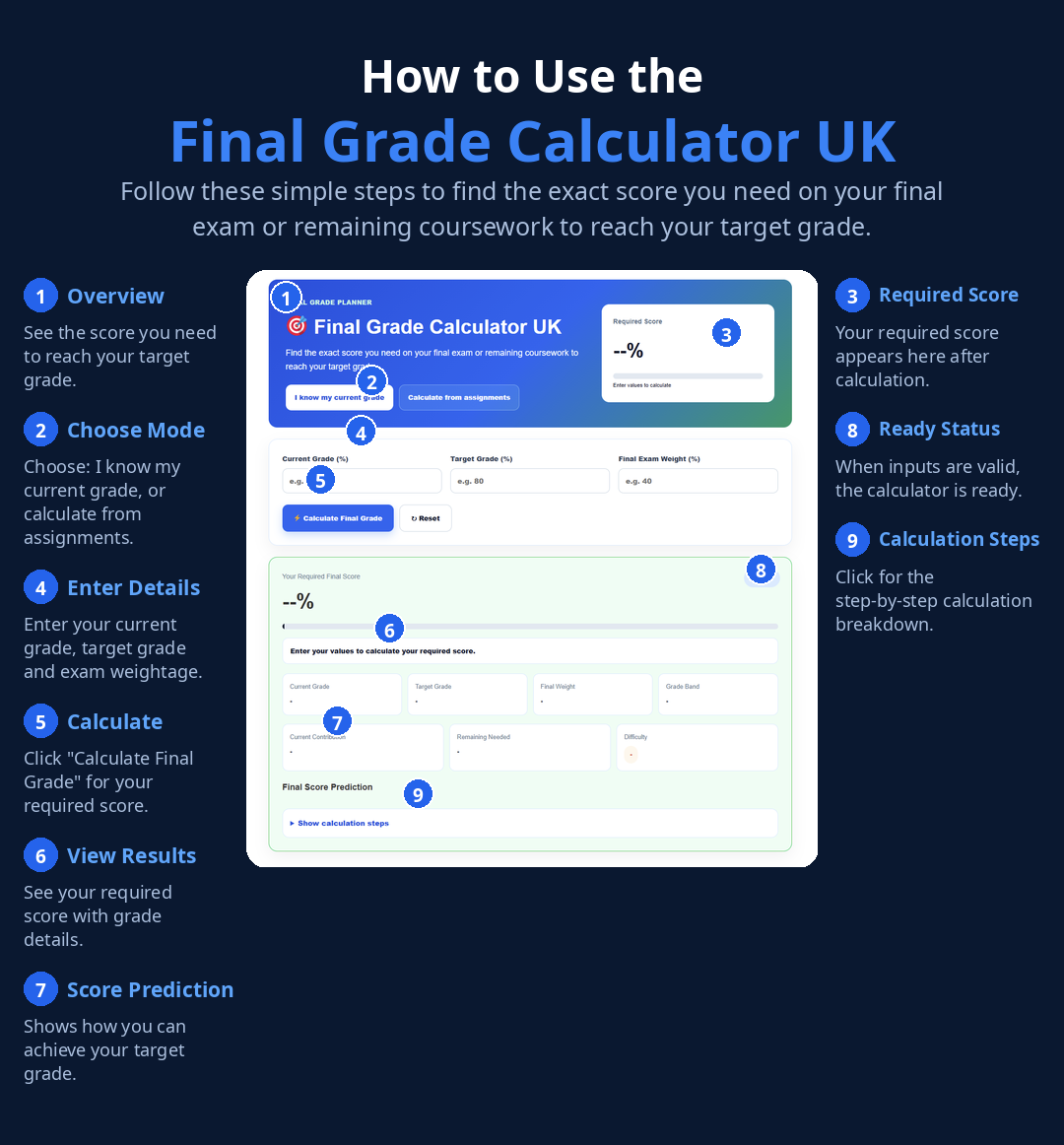
Click Here: Final Grade Calculator UK
The official picture: no closures yet, but the risk is on the record
Let us separate what is documented from what is feared. In May 2026, the House of Commons Education Committee published the findings of its inquiry into higher education funding, and the numbers were stark. The Office for Students — England’s higher education regulator — had told MPs that 24 providers were at risk of insolvency and market exit within 12 months, seven of them serving more than 3,000 students each, and that 45% of higher education providers could be facing a deficit in 2025/26.
The committee’s verdict: the sector faces “a financial crisis that now poses a real risk of institutional insolvency,” with “a clear possibility of a university closing.” In the same breath, the committee confirmed the fact that matters most to students: while no university has ever closed in England due to insolvency, the risk is now officially on the record.
The drivers are not mysterious: domestic tuition fees frozen for years while costs rise, and a sharp fall in international student income. Sunderland is the live case study. Its chief financial officer, Ben Dale, told staff the £40 million in savings must be “recurrent and permanent” — not a one-year squeeze — and blamed pressures “exacerbated by a sudden and immediate impact of increased visa refusals.”
Since 1 June 2026, the Home Office has halved the maximum student-visa refusal rate a sponsoring university may run, from 10% to 5%, and study-visa refusals doubled in the first half of 2026 compared with the same period in 2025. The university has already closed its National Glass Centre in summer 2026, has not ruled out job cuts, and now faces a formal UCU dispute over plans to employ new academic tutors through a subsidiary company outside the Teachers’ Pension Scheme. E
dinburgh and Dundee are also on strike. This is a sector-wide squeeze, not a single-university story.
One precedent is worth knowing, because it shows the system has handled a provider failure before — just not a public university. GSM London, a large for-profit private higher-education provider, went into administration in 2019, leaving students mid-course. Its degrees were validated by the University of Plymouth — and that validation is exactly why those students’ awards had a backstop. Public universities are a different legal animal (more on that below), but the principle is the same one that protects you: in UK higher education, the award and the teaching can be separated, and your completed work is documented independently of your provider’s finances.
Not every worrying headline means the same thing. Here is a quick decoder for the signals you might see:
| What you hear | What it actually signals | What it means for your grades |
|---|---|---|
| A savings or restructuring plan (e.g. Sunderland’s £40m) | Budget pressure; management expects lower income to persist | Usually nothing immediate — but read your student protection plan now |
| A formal union dispute / strike ballot | Staff contesting job cuts or contract changes | Possible teaching disruption; your completed marks are unaffected (see our university strikes and grades guide) |
| Course or campus closures | Strategic retreat, not institutional collapse | Teach-out rules apply — see our course closures and grades guide |
| OfS “market exit risk” warnings | The regulator is actively monitoring a provider | Student protection directions can be imposed — the machinery below kicks in |
Your student protection plan: the document most students never read
Here is the single most important fact in this guide: every university registered with the Office for Students must maintain a published student protection plan. It is a condition of registration, not a courtesy. The plan must set out, in advance, what the provider will do for current students if a specified risk materialises — and the specified risks explicitly include the provider closing courses, campuses, or exiting the market altogether.
The OfS’s Condition C4 spells out the measures such plans must cover. In plain terms, your university’s plan has to address seven things:
| Measure | What it means for you |
|---|---|
| Teach-out | You can complete your intended course and achieve the qualification you could reasonably have expected — or at least finish the current year or term |
| Student transfer | Support to move to another provider to continue and complete your studies, with administrative arrangements to make it happen |
| Exit awards and unit certification | A formal record of what you have achieved so far, even if you cannot finish the full degree |
| Information, advice and guidance | Clear communication about your options — not silence while decisions are made about you |
| Complaints | A working complaints process for students affected by the disruption |
| Refunds and compensation | Refunds of tuition and other costs where your continuation of study is disrupted, plus compensation for financial costs incurred |
| Archiving | Your academic records stored — including with third parties if necessary — so you can prove your achievements years later |
Find yours today: it is normally published on your university’s website alongside student policies or terms and conditions, and it names the specific commitments your provider has made. Look in particular for the teach-out promise — the strongest plans commit to teaching out every enrolled cohort — and for any published policy on transfers. If the OfS itself judges that a provider faces a material risk of market exit, it can go further and issue Student Protection Directions: binding instructions telling the provider exactly which protective measures to put in place. For the full teach-out mechanics when a course (rather than a whole university) closes, our course closures guide walks through the OfS framework in detail — what follows here is about your marks and your classification.
Your earned credits are real: the 120-credit safety net
UK degrees run on a credit system, and the arithmetic is standardised across the sector. A full-time undergraduate year is normally 120 credits (one credit represents roughly ten hours of learning time), and an honours degree requires 360 credits — 120 at each of Levels 4, 5 and 6. That standardisation is your safety net: credits are the common currency of UK higher education, and they do not evaporate because your provider is in trouble.
If your studies are interrupted part-way, the system converts banked credits into recognised qualifications — exit awards. The thresholds are consistent across universities:
| Exit award | Credits required | What it recognises |
|---|---|---|
| Certificate of Higher Education (CertHE) | 120 credits at Level 4 | One successful full-time year |
| Diploma of Higher Education (DipHE) | 240 credits (at least 120 at Level 5) | Two successful full-time years |
| Ordinary (unclassified) degree | 300 credits (at least 60 at Level 6) | Near-complete honours study |
| Honours degree | 360 credits | The full degree, classified |
Two details matter here. First, exit awards are graded but not classified — your transcript will show the marks you earned, but a DipHE does not come with a 2:1 attached. Second, the OfS requires archiving arrangements precisely so that your record of achievement survives any institutional failure: your transcript, your module marks and your credit total must remain accessible to you, stored with a third party if necessary. Practically, that means the single most useful thing you can do this week is boring but powerful: download and save your official transcript, your credit summary and your module handbooks now, while access is routine. If you ever need to prove your 240 credits to a new provider — or to an employer — in a hurry, you will already hold the evidence.

If you move universities mid-degree: who decides your classification?
This is the question students ask once the reassurance sinks in — and it has a clean, definite answer. Your degree classification is decided by the university that awards your degree, using its own classification algorithm. It does not matter where you earned your first- or second-year marks; the awarding body’s regulations govern how the final number is computed. That single rule explains almost everything about transfers, teach-outs and mergers.
In a teach-out, the rule works in your favour: your original university remains the awarding body, teaches your cohort through to completion, and classifies you under the algorithm you signed up to. In a transfer, the rule moves with you: the new university becomes the awarding body, and its algorithm — its year weightings, its borderline rules, its treatment of imported marks — now decides your class. This is also why universities are so reluctant to admit students directly into the final year of an honours degree: no institution wants to award its honours classification on the basis of work almost entirely assessed elsewhere. Final-year transfer is, in practice, close to impossible across the sector.
The hinge you must check is how the new provider treats imported marks. Receiving universities differ, and the difference is enormous:
- Imported marks counted: your second-year average feeds into the classification formula alongside your final-year marks, exactly as if you had earned them at the new university. Your banked performance cushions your final year.
- Credits recognised, marks excluded: the new university accepts your 240 credits toward the 360-credit degree requirement, but computes your classification from its own final-year marks alone. Your final year then carries the entire classification — every mark point swings the average one-for-one.
Neither approach is universal, and universities do not always advertise which one they use — so ask the admissions team directly, in writing, before you commit to anything. One related protection: if your course is validated (taught by one provider, degree awarded by another — the arrangement that backstopped GSM London’s students through the University of Plymouth), the validating university owns your award regardless of what happens to the teaching provider. Check your course documentation for the words “validated by” or “awarded by”: they name the institution whose algorithm will classify you. Our transfer universities guide covers the full mechanics of moving — entry years, credit recognition and the UCAS process — while the degree classification calculator lets you model any weighting scheme against your own marks.
Worked example: Amara’s transfer and the classification cushion
Amara is in the second year of a BSc Business degree at University A (a fictional example with stated assumptions). Her weighted averages: Year 1, 61%; Year 2, 66%. She has banked 240 credits at Levels 4 and 5. Suppose her course cannot be taught out and she transfers to University B for her final year, where she achieves 68% across her 120 final-year credits. University B’s published algorithm weights Level 5 and Level 6 at 40:60 — a common UK pattern, and the same structure many universities use for non-transfer students.
Case 1 — University B counts her imported marks. Her final average is computed exactly like any other student’s:
0.40 × 66% (imported Year 2) + 0.60 × 68% (final year at B) = 26.4 + 40.8 = 67.2% → Upper second-class honours (2:1).
Case 2 — University B recognises the credits but excludes the imported marks. The 240 credits count toward the 360-credit degree, but the classification is computed from B’s own final-year marks alone:
Final average = 68.0% → still a 2:1 here, but notice what changed: every final-year mark point now moves her average one-for-one instead of 0.6-for-one. Her cushion is gone.
Now the counterfactual that shows why this matters. Suppose her final year at University B goes less well — 58% instead of 68%:
- Case 1: 0.40 × 66 + 0.60 × 58 = 26.4 + 34.8 = 61.2% → still a 2:1. Her banked Year 2 performance cushions the dip.
- Case 2: 58.0% → a 2:2. The identical student, the identical work, a full classification lower — because the imported marks were excluded.
The lesson is not that one policy is fairer than the other; it is that the policy is knowable in advance and changes everything. Before accepting any transfer place, get the receiving university’s answer to this exact question in writing: “Are my imported module marks included in the classification average, or are my credits recognised with marks excluded?” Then run both scenarios through the degree classification calculator so you can see the range of possible outcomes before you decide.
Worked example: what partial study is worth if teaching stops
Daniel has completed two full years — 240 credits, 120 at Level 4 and 120 at Level 5 — with a weighted average of 62.4% across both years. If his provider cannot teach out his final year and he does not transfer, his 240 credits convert into a Diploma of Higher Education (DipHE): 240 credits with at least 120 at Level 5 clears the threshold exactly. His transcript records the 62.4% he earned, but the DipHE itself carries no classification — exit awards are graded, not classified.
Had Daniel completed only his first year — 120 credits at Level 4 — the same machinery would have awarded him a Certificate of Higher Education (CertHE). And this is where the OfS archiving requirement earns its keep: even years later, Daniel can evidence his 240 credits and 62.4% average to a new provider, which may admit him with advanced standing, or to an employer, for whom a DipHE with a 62.4% transcript is a concrete, verifiable qualification — not a story about a university that ran into trouble.
Degree-awarding powers: what the OfS can and cannot do
It helps to be precise about the regulator’s role, because misconceptions here cause real anxiety. Only providers holding degree-awarding powers can award UK degrees. The Office for Students regulates those providers — it sets registration conditions, monitors financial sustainability, and can issue binding Student Protection Directions — but it cannot award degrees, reclassify your marks, or conjure a qualification into existence. Your degree comes from a university, never from the regulator.
There is also an honest uncertainty the sector has not resolved. The Education Committee’s inquiry found “no clearly understood protocol for how the government might respond to a situation of a provider at risk of imminent insolvency, which is a very serious problem.” Ministers have argued that an insolvent university would not need to be liquidated — higher education minister Jacqui Smith told the committee that students could instead be taught out or transferred, with their records and achievements protected. But legal specialists told the same committee that liquidation would normally require the immediate cessation of trading — potentially meaning sudden mid-term closure — and that the uncertainty is worst for older universities holding Royal Charters and most post-1992 universities, which sit outside the standard company-insolvency process that applies to private providers. The committee’s recommendation is blunt: every institution should hold a tested plan for teaching out and transferring its students in an insolvency scenario.
In practice, the sector’s historic answer to failing institutions has been the merger, not the liquidation: 27 university mergers since 1997, most of them quiet. For students, a merger almost always means teach-out or transfer under the plans described above — not lost credits. The protection machinery was built for exactly this world.
Check this week: 7 steps if your university is in the news
If your university is making headlines for its finances, work through this list now — in this order:
- Find your student protection plan. It is on your university’s website, usually with student policies or terms and conditions. Read the teach-out commitment first: does it promise to complete your course?
- Check for announced restrictions. Look for module-choice limits, campus changes or suspended recruitment on your course — these are the earliest concrete effects of a savings plan.
- Download your records today. Your official transcript, credit summary and module handbooks — while access is routine. This is your evidence if you ever need it quickly.
- Know the complaints ladder. Internal complaints process first, then the Office of the Independent Adjudicator (OIA) once internal procedures are exhausted. Our course closures guide maps the full ladder.
- Do not withdraw pre-emptively. Never leave your course without a confirmed offer elsewhere. A teach-out may let you finish exactly the degree you started — walking away early forfeits that.
- International students: check your sponsor position separately. Financial trouble and sponsor-licence trouble are different risks. Confirm your CAS status with your university’s compliance team; our guide to withdrawn offers and the 2026 visa rules explains the licence mechanics.
- Keep studying. It sounds obvious, but marks you earn now are banked regardless of what happens next. A strong Year 2 average is the cushion our worked example showed you — protect it.
5 myths about university closures and your grades
| Myth | Reality |
|---|---|
| “My credits vanish if my university closes” | No. Credits are the sector’s common currency — 120 per full-time year is the norm — and exit awards (CertHE, DipHE) plus mandatory archiving mean your achievements are documented independently of your provider. |
| “The government will always bail a university out” | No. The OfS explicitly contemplates market exit, has flagged 24 providers as at risk, and ministers talk about teach-out and transfer — not bailouts. |
| “A merged university means a weaker degree” | No. Your certificate comes from the awarding body and your classification is computed under its published algorithm. Employers verify the award, not the merger history. |
| “I should transfer immediately, before anything happens” | Usually wrong. Check your protection plan first, never withdraw without a confirmed offer, and remember final-year transfer is close to impossible — a rushed move can cost you more than waiting. |
| “If my uni is struggling, this year’s marks don’t count” | No. Marks already earned stand, exam boards continue during any teach-out, and a strong banked average is exactly what cushions your classification if you move. |
Can a UK university actually close down?
No UK university has ever closed through insolvency — a fact confirmed by the House of Commons Education Committee in May 2026. A large private provider, GSM London, did go into administration in 2019, and its students’ validated degrees were backstopped by the University of Plymouth. The Office for Students has, however, told MPs that 24 providers are at risk of insolvency and market exit, and the committee warned of a ‘real risk of institutional insolvency’ for the first time. So: unprecedented, but no longer unthinkable — which is why protection plans are mandatory.
What is a student protection plan?
A published document every OfS-registered university must maintain as a condition of registration. It sets out in advance what the provider will do for current students if a serious risk materialises — including course, campus or whole-provider closure. Under OfS Condition C4 it must cover teach-out, transfer to another provider, exit awards and certification, information and guidance, complaints, refunds and compensation, and archiving of your records. Find yours on your university’s website, usually alongside student policies.
What does teach-out mean for my degree?
Teach-out means your university continues teaching your cohort until you can complete your intended course and achieve the qualification you could reasonably have expected — or at minimum finish the current academic year or term. Your original university remains the awarding body, so your classification is computed under the algorithm you signed up to. Teach-out is the default protection outcome; transfer is the fallback if teach-out is not possible.
Do I keep my credits if my university closes?
Yes. UK degrees run on a standardised credit system — normally 120 credits per full-time year, 360 for an honours degree — and credits do not evaporate with your provider. If your studies are interrupted, banked credits convert into recognised exit awards: 120 credits at Level 4 earns a Certificate of Higher Education (CertHE), 240 credits with 120 at Level 5 earns a Diploma of Higher Education (DipHE). The OfS also requires archiving arrangements so your transcript and marks remain accessible.
If I transfer to another university, who decides my degree classification?
The university that awards your degree applies its own classification algorithm — its year weightings, borderline rules and treatment of imported marks. Receiving universities differ: some include your imported marks in the classification average, others recognise the credits but exclude the marks, leaving your final year to carry the whole classification. Ask the new provider, in writing, exactly how imported marks feed the average before you commit — the same marks can produce different classifications under different policies.
Will my degree be worth less if my university merges or closes?
No. Your certificate is issued by the awarding body and your classification is computed under its published algorithm, whatever happens to the institution’s corporate form. The sector’s historic answer to failing institutions has been merger (27 since 1997), and students in merged institutions are taught out or transferred — not devalued. If your course is validated by another university, that validating university owns your award regardless.
What should I do right now if my university is in financial trouble?
Read your student protection plan (especially the teach-out commitment), check for announced module or campus restrictions, and download your transcript, credit summary and module handbooks while access is routine. Know the complaints ladder — internal process first, then the Office of the Independent Adjudicator. Do not withdraw without a confirmed offer elsewhere, and keep studying: marks you bank now cushion your classification whatever happens next.
I am an international student — what happens to my visa if my university closes?
Financial trouble and sponsor-licence trouble are separate risks. Student protection plans must cover international students continuing their studies, and the Education Committee has recommended explicit guarantees on this point. But your visa position depends on your sponsor licence and CAS, so confirm your status with your university’s compliance team directly. Our guide to withdrawn offers and the 2026 visa rules explains the licence mechanics in detail.
Conclusion
The headlines about university finances are real, and they deserve to be taken seriously — but they are about institutions, not about your marks. Your degree rests on three separate foundations, and all three are designed to survive any single university’s troubles: your credits, banked at 120 per full-time year and convertible into recognised exit awards; your protection plan, a mandatory published commitment covering teach-out, transfer and archiving; and the awarding-body rule, which guarantees that whoever issues your certificate computes your classification under published, knowable regulations.
The two things within your control are simple. First, read your own university’s student protection plan this week and save your transcript and credit records while access is routine — ten minutes of admin that buys you options later. Second, keep earning the marks: as Amara’s worked example showed, a banked 66% second year is the difference between a cushioned 2:1 and a bare 2:2 if you ever finish elsewhere. Run your own numbers through the final grade calculator and see exactly what your final year needs to deliver — whatever logo ends up on your certificate.