
![You are currently viewing Do University Strikes Affect Your Grades? What UK Universities Do to Protect Students [2026]](https://gradeforuni.com/wp-content/uploads/2026/10/featured-university-strikes-grades.png)
Do University Strikes Affect Your Grades? What UK Universities Do to Protect Students [2026]
The short answer most students are looking for is this: strikes are not supposed to cost you marks. UK universities have detailed, published procedures for exactly this situation — rescheduling assessments, testing only what was actually taught, adjusting module marks at exam boards, and in some cases letting you graduate on estimated marks while you wait for the real ones. So do university strikes affect your grades? In practice, they can delay them, reshape how you are assessed, and — if your university handles it badly — dent them. But a whole ladder of protections sits between industrial action and your degree classification, and knowing how each rung works is what keeps you in control.
This matters right now because the autumn of 2026 has brought one of the biggest strike waves UK higher education has seen in years. At the University of Nottingham, UCU members walked out on 30 September and 1 October and are now in sustained strike action running from 5 October to 11 December — a 67-day stretch in the middle of the autumn term, on top of a marking and assessment boycott that disrupted graduations in the summer. Nottingham is not alone: seven other universities are striking or balloting this autumn over job cuts — Dundee, Edinburgh, Glasgow Caledonian, Heriot-Watt, Essex, Exeter and Sussex (full list of the eight striking universities) If you study at any of them, this guide walks you through the full timeline of what happens to your teaching and assessments, the exact protections universities must apply, the numbers behind strike-hit module marks, and your rights to compensation and fee refunds.
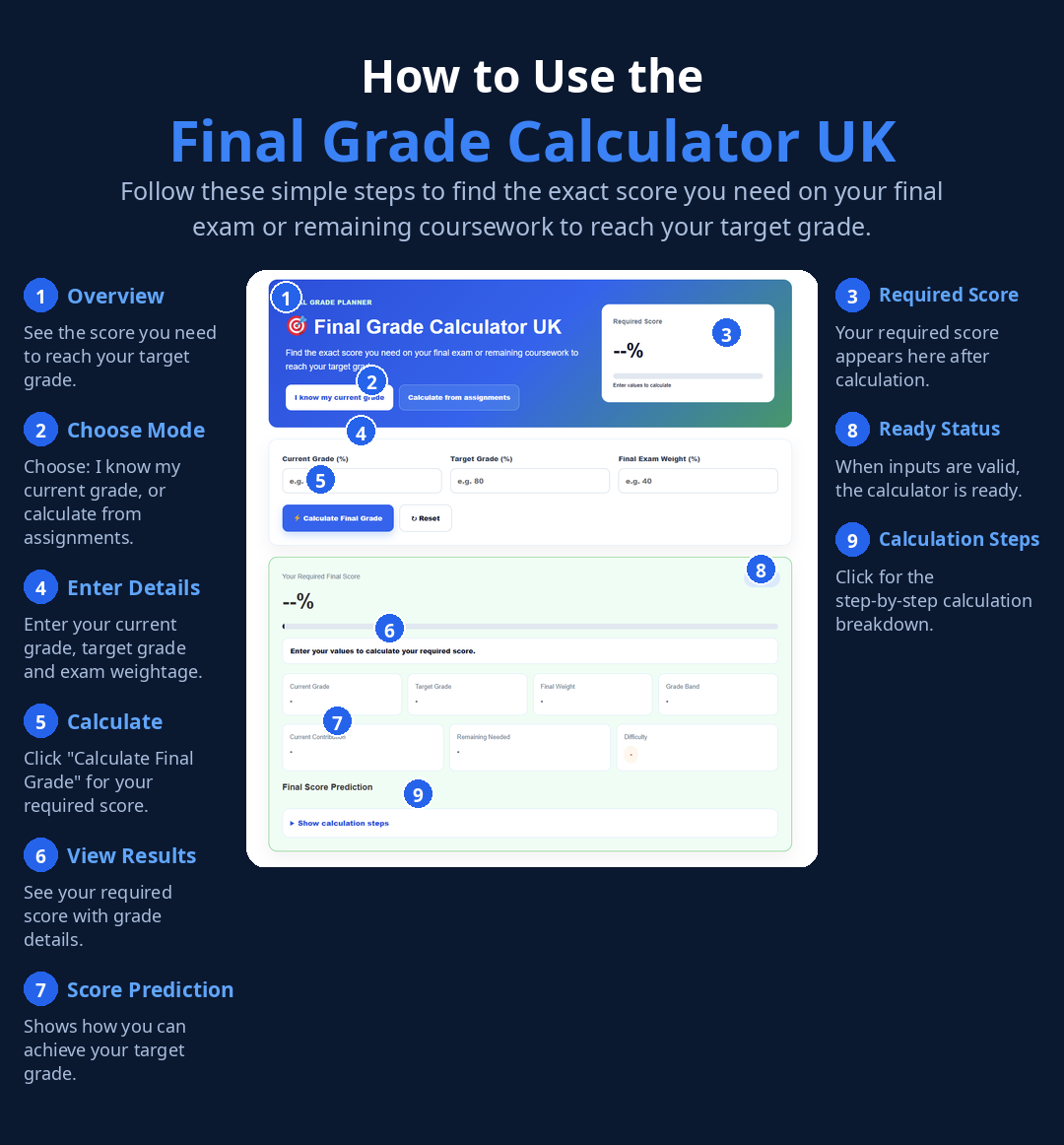
Click Here: Final Grade Calculator: What Grade Do You Need on Your Final Exam?
The Autumn 2026 Strike Wave: A Timeline of What’s Actually Happening
Every dispute in this wave has the same root cause: universities cutting jobs and courses to close budget gaps, and staff striking to stop it. The details differ by institution, but the pattern is consistent — ballots over compulsory redundancies, followed by strikes timed to hit the start of the academic year, when universities are most sensitive to disruption.
| University | Strike dates (autumn 2026) | Dispute |
|---|---|---|
| University of Nottingham | 30 Sep–1 Oct, then 5 Oct–11 Dec (67 days) | Future Nottingham restructuring: ~609 roles and ~50 courses at risk; £85m deficit |
| University of Edinburgh | 28 Sep–30 Oct (weekdays, 5 weeks) | £140m cuts programme; UCU cites ~1,800 jobs at risk |
| University of Dundee | 21 Sep–23 Oct (weekdays) | 675 jobs cut since 2024; 200 more announced |
| Glasgow Caledonian University | 21–23 Sep, plus 11 days in October | £10m savings plan; 100 jobs at risk |
| Heriot-Watt University | 14–15 Sep | Job losses in languages and the Scholar programme |
| University of Essex | 21 Sep (one-day walkout) | £24m savings plan; 400 jobs at risk |
| University of Exeter | Dates to be confirmed (91% voted for action) | 200 staff at risk, mainly in humanities and social sciences |
| University of Sussex | Dates to be confirmed | 200 jobs at risk in £35m savings plan |
Nottingham’s is the longest and most grade-relevant of the lot. The branch struck through 2025, ran a marking and assessment boycott in the summer of 2026 that left some students graduating with estimated degree classifications instead of marked ones, and has now escalated to sustained autumn action. Edinburgh’s story is similar: a marking boycott from May 2026 forced the university’s Senate to approve emergency variations to its assessment regulations so finalists could graduate at all. These two cases are worth understanding in detail, because they show exactly what happens to marks when the normal machinery of assessment breaks down — and what universities are obliged to do about it.
How Strikes Actually Touch Your Grades: Three Pressure Points
Strikes reach your transcript through three distinct pressure points, and each one triggers a different protection. Confusing them is the most common mistake students make — it leads to missed deadlines for claims and to accepting outcomes you could have challenged.
Pressure point 1: missed teaching. When lectures and seminars are cancelled, the immediate risk is being examined on material you were never taught. Universities handle this the same way almost everywhere: assessments must reflect only the learning that actually took place. Nottingham’s published student FAQ puts it plainly — schools must ensure that exams, coursework and other assignments reflect only the learning that has taken place, and any exam question requiring disrupted learning “would usually be changed or replaced with an equivalent question or task covering material which has been delivered”. Assessment weightings stay the same (so a 60% exam stays a 60% exam), but the content shifts to what you were actually taught.
Pressure point 2: disrupted assessments. Exams, vivas, presentations and practicals that fall on strike days get rescheduled — sometimes by days, sometimes by weeks, occasionally into the next term. Where rescheduling is impossible, departments switch to alternative assessments: a timed online paper instead of an invigilated exam, or a coursework portfolio instead of a presentation. The grade boundaries do not move — a First is still 70+ — but the format you are judged in can change, which is why it pays to ask your school exactly what the replacement assessment will look like rather than assuming it mirrors the original.
Pressure point 3: marking delays and estimated marks. This is the one that genuinely hurt students in 2026. When staff boycott marking — as at Nottingham and Edinburgh in the summer — your work may not be marked by graduation. Universities then deploy contingency regulations: students progress or graduate on estimated or interim marks, with the real marks following later. At Nottingham, some finalists graduated with estimated degree classifications; at Edinburgh, the Senate allowed honours students to graduate with a simple pass/fail or with “credit on aggregate” where no course outcome was available. Estimated marks are a stopgap, not a sentence — and as we will see, you can usually decline them.
The Protections Ladder: Eight Rungs Between a Strike and Your Degree
Think of your university’s response as a ladder. Each rung catches students the previous one missed. In a well-run strike response, almost nobody falls past rung four; the upper rungs exist for when things go wrong.
| Rung | Protection | What happens | Your move |
|---|---|---|---|
| 1 | Teaching is made up | Cancelled sessions rescheduled; catch-up materials and recordings provided; deadlines extended | Attend everything offered; download materials promptly |
| 2 | Exams cover taught material only | Questions on missed topics are changed or replaced with equivalents on delivered material | Check with your module leader which topics are examinable |
| 3 | Alternative assessments | Struck exams become online papers, coursework or presentations; vivas rescheduled | Confirm the new format and its marking criteria in writing |
| 4 | Exam-board mark adjustments | Boards uplift module marks where disruption cannot be designed out; no claim needed | Nothing — but keep evidence of what you missed |
| 5 | Mitigating circumstances claim | Your personal claim for disruption the general measures missed (e.g. visa stress, lost supervision) | Submit an EC claim with evidence before the deadline |
| 6 | Contingency marks you can decline | Estimated/interim marks let you progress or graduate; you may wait for real marks instead | Decide whether to accept the estimate or wait |
| 7 | Academic appeal | Challenge a board decision affected by procedural error or overlooked disruption | Appeal within your university’s deadline, with evidence |
| 8 | Complaint, OIA and compensation | Internal complaint, then the ombudsman; fee refunds under consumer law | Escalate if the university’s response was inadequate |
Rung 4 deserves a closer look, because it is the closest thing UK universities have to a “no detriment” guarantee during strikes. Nottingham’s published position is that where an assessment cannot be changed to avoid disrupted material, boards of examiners “would make overall adjustments to marks in recognition of the additional difficulties faced by the students on the affected module” — with the stated intention “to ensure that the cancellation of teaching has no detrimental effect on any student in terms of the marks they receive”. Crucially, you do not need to submit an extenuating circumstances claim to benefit: the adjustment is applied to the whole affected cohort automatically. That is a genuinely strong protection — but it only covers what the board knows about, which is why rung 5 (your own EC claim) still matters for personal impacts the cohort-wide adjustment cannot see, such as disrupted dissertation supervision or the anxiety of not knowing whether your exam will happen.
If you need to make that personal claim, our full guide to extenuating circumstances and how they affect university grades walks through evidence, deadlines and what counts as a valid claim at most UK universities.

Worked Example 1: What a Struck Module Does to Your Final Average
Abstract reassurances are cheap; arithmetic is not. Here is a realistic final-year scenario showing exactly how a strike-hit module flows through to your degree classification — including the board adjustment from rung 4 of the ladder.
Take Amara, a final-year student taking six 20-credit modules. One of them — a 20-credit module assessed 40% coursework and 60% exam — is hit by the autumn strikes. Her coursework was submitted and marked before the action began: 65. Her December exam falls inside the strike window and is rescheduled as an unseen online paper in January; the disruption to her revision and the unfamiliar format leave her with 55.
Her module mark before any adjustment:
| Component | Weight | Mark | Contribution |
|---|---|---|---|
| Coursework | 40% | 65 | 0.40 × 65 = 26.0 |
| Rescheduled exam | 60% | 55 | 0.60 × 55 = 33.0 |
| Module total | 100% | 59.0 → 59 |
Three of the module’s ten lectures were cancelled and never rescheduled, so the exam board applies a cohort-wide +2 adjustment for the disrupted teaching (the rung-4 mechanism Nottingham describes in its published guidance). Her module mark becomes 61. Now the year average across her six 20-credit modules — 72, 68, 65, 61, 70 and 66:
72 + 68 + 65 + 61 + 70 + 66 = 402 → 402 ÷ 6 = 67.0. Without the board’s adjustment, the same sum would have been 400 ÷ 6 = 66.67, which also rounds to 67 — so in Amara’s case the adjustment confirms rather than changes her average. But watch what happens at the classification boundary. Many UK universities weight the second year at 40% and the final year at 60%. With a second-year average of 66 and this final-year average of 67.0, her degree mark is (0.40 × 66) + (0.60 × 67.0) = 26.4 + 40.2 = 66.6 → 67, a solid 2:1. If two of her modules had each received a +2 strike adjustment instead of one, her final-year average would rise by 0.67 to 67.67, and her degree mark to 67.0 — still a 2:1, but now noticeably closer to the borderline zone where boards consider uplifts. The lesson is concrete: strike adjustments are typically small in absolute terms, which is exactly why documenting every disrupted session matters — the students who benefit are the ones whose files show the board what was missed.
Borderline zones are where these small movements decide degree classes. If your average is hovering near 68–70, read our guide to how to get a first-class degree to understand how borderline uplift rules work at UK universities.
Marking Delays, Estimated Marks and Graduation: What the Summer of 2026 Taught Us
The summer 2026 marking boycotts are the clearest real-world evidence of how far universities will go to protect graduation — and where the protection frays. At Nottingham, the boycott meant many finalists graduated with estimated degree classifications rather than fully marked ones, leaving some students feeling “betrayed”. At Edinburgh, the university’s Senate approved emergency variations to its taught assessment regulations: honours students could graduate with a simple pass/fail or be awarded “credit on aggregate” where industrial action meant no course outcome was available. Some Edinburgh finalists received unclassified degrees — one philosophy and psychology student described turning up to graduation alongside friends with classified degrees as “a bit of a mockery” — and another saw her classification drop from a First to a 2:1 because two modules went unmarked.
Three practical points follow from this. First, estimated marks are designed to let you progress or graduate on time; they are not your final academic record. Second, at Nottingham students were explicitly told they were not required to accept an outcome based on contingency regulations — they could decline the estimated marks and wait for their actual marks to be awarded. If you are heading for a job or a master’s offer that depends on your exact classification, waiting can be the right call. Third, if your transcript ends up with credit awarded on aggregate for modules you effectively did not pass, that is uncomfortably close to the territory our guide to condoned passes covers — worth understanding, because employers and postgraduate admissions tutors will ask what those transcript entries mean.
One caution from Edinburgh’s experience: when the Times asked the university whether it could guarantee final marks for graduates with postgraduate offers or visa deadlines, the university declined to give that assurance. If your right to remain in the UK or a master’s place depends on exact results, raise it with your school in writing now — do not assume the contingency machinery knows about your deadline.
Your Four Options When an Assessment Is Struck
When disruption lands on a specific assessment, you generally face four options. They are not mutually exclusive — most students will use the first and keep the others in reserve — but choosing deliberately beats drifting.
| Option | Best when | Watch out for |
|---|---|---|
| 1. Sit the rescheduled or alternative assessment | The new date or format is workable and the taught-material guarantee (rung 2) applies | Confirm the format, weighting and marking criteria in writing — alternative assessments are sometimes marked to different rubrics |
| 2. Submit a mitigating-circumstances claim | Disruption hit you personally in ways the cohort-wide measures miss — lost supervision, timetable clashes from rescheduling, acute stress | Deadlines are strict and evidence is required; a strike alone, without personal impact, is rarely enough |
| 3. Accept the board’s adjusted mark — or decline an estimate | The board has applied a cohort adjustment, or you have been offered contingency/estimated marks to graduate on time | At Nottingham you may decline contingency marks and wait for real ones — weigh graduation timing against accuracy |
| 4. Appeal, complain and claim compensation | A board decision looks procedurally wrong, or the university’s response left you materially worse off | Appeals have short windows; complaints must go through the university first, then the OIA |
Options 2 and 4 have their own full guides on this site: extenuating circumstances for the claims process, and how to appeal a university grade for challenging board decisions — including the evidence you need and the deadlines that catch students out.
Your Money: Fee Refunds, Compensation and the Complaint Route
Grades are only half the story. You are also a consumer paying up to £9,250 a year, and the regulator has been unusually blunt about what that means during strikes. The Office for Students has told universities they are subject to consumer protection law throughout industrial action and should consider how to make up for disruption — including rescheduling missed teaching, delivering topics differently, or considering whether partial refunds of tuition fees are appropriate. Its chief executive’s message to the sector was direct: students should not be disadvantaged academically because of disruption. In 2025 the OfS went further, telling providers they should “pay appropriate compensation” to students affected by strikes — specifically for missed teaching that was never repeated or replaced, materially delayed marking and feedback, and delayed progression or award decisions, particularly where those delays affect job offers, further study or visa status.
Universities cannot simply hide behind “force majeure” clauses in their terms and conditions. After the OfS referred Oxford Brookes to National Trading Standards, the university was required to remove both its blanket industrial-action liability exclusion and a clause capping its liability at 150% of tuition fees — Trading Standards considered the terms unfair. That precedent matters: if your university’s contract claims it owes you nothing for strike disruption, that clause may not survive scrutiny.
Real payouts have happened, and the numbers are public. After the 2023 marking boycott, the University of Manchester paid £500 to any student whose degree award was delayed beyond their graduation ceremony date (£150 if the delay was resolved before ceremonies began); Bristol handed out £500 goodwill payments; Brighton offered free graduation ceremonies. The student ombudsman — the Office of the Independent Adjudicator (OIA) — has ordered larger sums in individual cases: one part-time student received £1,154 after proving cancelled lectures cost them lost earnings, and an international student was recommended a £1,283.75 refund for lost teaching hours. These are individual case outcomes, not entitlements, but they show the scale tribunals consider reasonable. According to OfS figures reported in 2026, around 9% of students affected by the 2023 marking boycott applied for and received financial compensation from their universities — which also means the overwhelming majority never claimed.
Worked Example 2: How Strike Compensation Is Actually Calculated
Compensation math is pro-rata: you are refunded the value of what you paid for but did not receive. Here is how the arithmetic works, using the kind of formula universities and campaign groups actually apply.
Start with the annual fee of £9,250 and a standard teaching year of 30 weeks. That values each teaching week at £9,250 ÷ 30 = £308.33. Nottingham’s sustained action runs 5 October to 11 December — roughly 10 weeks of term. The fee value of those 10 weeks is 10 × £308.33 = £3,083.33. Now suppose a student can evidence that 25% of their scheduled teaching across that period was cancelled and never made up — no rescheduled sessions, no equivalent materials. The pro-rata value of the missed teaching is 25% × £3,083.33 = £770.83.
What a university actually offers depends on its policy. Campaigners at Sheffield have argued compensation should be half the value of missed teaching hours — on that formula, our student would claim £770.83 ÷ 2 = £385.42. An OIA adjudicator, weighing lost earnings and distress on top of missed teaching, has awarded over £1,150 in a single case. And flat goodwill schemes have paid £500 regardless of individual loss. The honest summary: for a student who misses a quarter of a 10-week strike window’s teaching, realistic outcomes in past cases range from a few hundred pounds to over a thousand — which is precisely why the complaint route below is worth knowing.
| Route | Who it covers | What to do | Realistic outcome |
|---|---|---|---|
| University internal complaint | All students | Complain in writing, evidencing missed teaching and impact; escalate through the university’s stages | Goodwill payment or fee reduction (£150–£500 in past schemes) |
| OIA (England & Wales) | Students at English and Welsh providers | After the internal process ends, complain within 12 months; group complaints allowed for cohorts | Binding recommendations; £300–£1,283 in reported strike cases |
| SPSO / NIPSO (Scotland / NI) | Students at Scottish / Northern Irish providers | Same principle via the Scottish or Northern Ireland ombudsman | Recommendations to the university |
| Consumer law / county court | All students | Last resort: claim breach of contract under the Consumer Rights Act 2015 | Price reduction or damages; rarely needed if OIA route works |
Two practical notes. First, the OIA can handle large group complaints collectively — introduced in 2021 precisely so cohorts of students hit by the same industrial action do not each have to fight alone. If your whole module was disrupted, organise. Second, keep every email: the students who won the reported payouts above won because they could prove, session by session, what was cancelled and never replaced. A diary of missed teaching is the single most valuable document in a compensation claim.
What To Do This Week: A Five-Step Checklist
If your university is in the strike wave, do these five things now rather than waiting for the disruption to reach you.
1. Read your school’s industrial-action page, not just the headlines. Edinburgh’s registry publishes a dedicated industrial-action page for students; Nottingham runs student FAQs and a disruption-notification form. Your school’s page is where rescheduled dates, alternative assessments and EC deadline changes will actually appear.
2. Assume assessments go ahead unless told otherwise. Universities consistently tell students to keep attending exams and submitting work as normal during action — papers are set in advance and invigilation is usually covered. Missing an exam that did run is far worse than turning up to one that is cancelled.
3. Start a disruption diary today. Date, module, session type, what was cancelled, whether it was rescheduled, and any assessment impact. This diary feeds your EC claim (rung 5), your appeal (rung 7) and any compensation complaint (rung 8). Memory fades; contemporaneous notes win cases.
4. Ask two questions in writing. Email your module leader: (a) which topics are examinable given the missed teaching, and (b) what the contingency is if the assessment itself is disrupted. Written answers are evidence; verbal reassurances are not.
5. Know your deadlines before you need them. EC claim windows, appeal windows and the 12-month OIA limit all run whether or not you are paying attention. Bookmark them now. If your degree classification ends up depending on an honours-versus-ordinary distinction after credit-on-aggregate awards, our honours vs ordinary degree guide explains what each outcome means for your transcript.
Do university strikes affect your grades directly?
Strikes are not supposed to reduce your marks. Universities must ensure assessments reflect only the teaching that actually took place, and exam boards can adjust module marks where disruption cannot be designed out. In practice, strikes can delay your marks, change assessment formats, and — where a university handles disruption badly — leave some students with estimated or unclassified outcomes, as happened at Nottingham and Edinburgh in summer 2026.
Can my university cancel an exam because of strike action?
Exams are rarely cancelled outright because papers are set well in advance and invigilation can be covered by non-striking staff. What usually happens is postponement: the exam is rescheduled, sometimes by weeks, or replaced with an alternative assessment such as an online paper or coursework. Your university should confirm the new format and its marking criteria in writing.
Will I be examined on lectures I never received?
No — this is one of the firmest protections. Universities including Nottingham publish a commitment that assessments will reflect only the learning that has taken place: exam questions covering disrupted material are changed or replaced with equivalent questions on material that was delivered, while assessment weightings stay the same.
What happens if my work is not marked before graduation?
Universities use contingency regulations so you can progress or graduate on time — for example, graduating on estimated marks, as many Nottingham finalists did in summer 2026, or with credit awarded on aggregate, as Edinburgh’s Senate allowed. At Nottingham, students were told they could decline contingency marks and wait for their actual marks instead, which is worth considering if a job or master’s offer depends on your exact classification.
Can I claim extenuating circumstances for strike disruption?
Yes, for personal impacts the general measures miss — such as lost dissertation supervision, timetable clashes caused by rescheduling, or acute stress. Note that where an exam board already applies a cohort-wide mark adjustment for disrupted teaching, you do not need to submit a claim to benefit from that adjustment. Our extenuating circumstances guide explains evidence and deadlines.
Can I appeal a grade that was affected by strikes?
You can appeal if you believe a board decision was procedurally flawed or overlooked the disruption you experienced — for example, if you were examined on untaught material or an EC claim about strike impact was mishandled. Appeals have short deadlines and need evidence, so keep your disruption diary and all written communications from your school.
Am I entitled to a tuition fee refund for missed teaching?
There is no automatic refund, but you have real routes. The Office for Students says universities are subject to consumer protection law during strikes and should consider partial fee refunds; in 2025 it told providers to pay appropriate compensation for missed teaching and delayed marking. Real payouts include £500 goodwill payments (Manchester, Bristol) and OIA-ordered awards over £1,150 in individual cases. Complain to your university first, then escalate to the OIA.
How do I complain if my university handled strike disruption badly?
First, complete your university’s internal complaints process and get its final response. Then complain to the Office of the Independent Adjudicator (OIA) in England and Wales — or the SPSO in Scotland — within 12 months. The OIA can consider large group complaints collectively, which suits cohorts hit by the same industrial action, and its recommendations on compensation are normally followed by universities.
Conclusion
So, do university strikes affect your grades? The honest answer is that they are designed not to — and most of the time, the machinery works. Missed teaching is made up or examined around, disrupted exams are rescheduled or replaced, exam boards adjust marks for what cannot be fixed, and contingency regulations keep graduations on track. The autumn 2026 wave, led by Nottingham’s 67-day action and Edinburgh’s five-week strike, is testing that machinery at scale, but the protections described in this guide are published, regulator-backed commitments, not favours.
What separates the students who come through unscathed from those who do not is rarely luck — it is paperwork. The students who won compensation after previous strikes won because they could prove, session by session, what was cancelled and never replaced. The students who benefited from board adjustments were the ones whose disruption was visible in the record. Start your diary now, get everything in writing, know your EC and appeal deadlines, and do not accept an estimated mark or a shrug where your degree classification is on the line. The ladder of protections only works if you climb it.



![Read more about the article What Is a Good UCAT Score for UK Medicine? Final 2026 Deciles Explained [2026]](https://gradeforuni.com/wp-content/uploads/2026/10/featured-good-ucat-score-300x192.png)