![You are currently viewing Oxbridge Interviews Explained: How Tutors Assess Grades & Thinking [2026]](https://gradeforuni.com/wp-content/uploads/2026/10/featured-oxbridge-interviews.png)
Oxbridge Interviews Explained: How Tutors Assess Grades & Thinking [2026]
The UCAS equal-consideration deadline for Oxford, Cambridge, and most medicine, dentistry and veterinary courses closes tomorrow — Thursday 15 October 2026, at 6pm UK time. If you applied, your personal statement is locked, your predicted grades are in your referee’s hands, and the UAT-UK admissions tests (TMUA, ESAT, TARA) are running right now, 12–16 October. That leaves exactly one milestone between you and an offer letter: the interview.
And the interview is the part applicants fear most, because it is the part they understand least. Most walk in imagining a knowledge interrogation — three tutors, a battery of questions, one wrong answer and it’s over. The official line from Oxford and Cambridge is nearly the opposite: interviews are not designed to catch people out, and they are not designed to test how much factual knowledge you have memorised. They are designed to watch how you think.
This guide explains what Oxbridge interviews actually assess, the verified timeline for the 2026/27 cycle, how shortlisting works (with real numbers from Oxford’s own admissions pages), why the number of interviews you get tells you nothing, and what still matters after the interview is over. If you are reading this before the deadline, also read our guides to predicted grades for UCAS and the UCAS personal statement’s new three-question format — they cover the two application components that feed the shortlist.
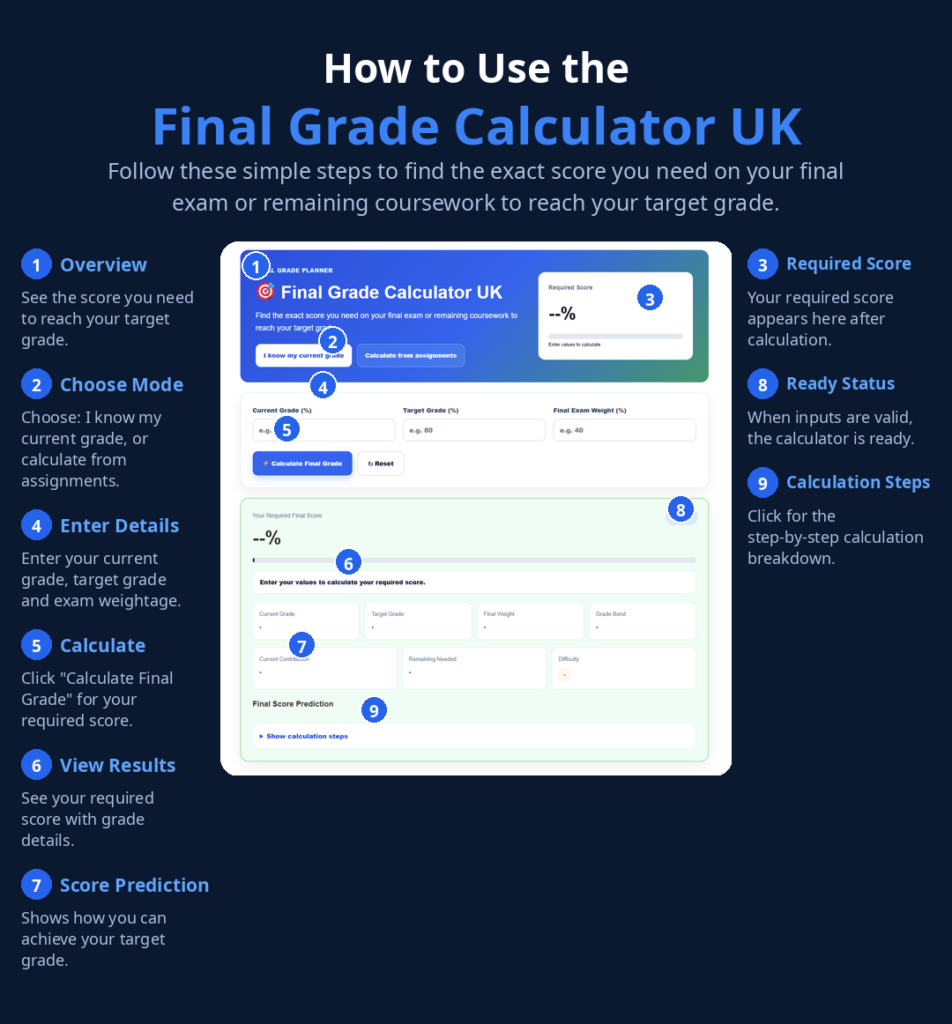
Click Here: Final Grade Calculator UK
Oxbridge Interviews: The Short Version
For the 2027 entry cycle, the essentials are these. Oxford interviews are held in December 2026 and will be online via Microsoft Teams for courses starting in October 2027 (confirmed on St Catherine’s College’s undergraduate admissions page). Interview invitations go out towards the end of November or in early December, and decisions arrive by letter in January 2027. Cambridge interviews are usually held early in December, with invitations in November; exact timing, location and format vary by college.
Your grades get you to the interview, not through it. Predicted grades and the admissions test get you shortlisted; the interview then assesses academic potential — how you think, react, reason and engage with unfamiliar problems. After the interview, colleges rank candidates on all available information and make conditional offers, which still demand the grades in summer 2027.
The single most misunderstood fact: no university publishes a fixed formula combining your test score, your interview performance and your predicted grades. Nobody can tell you that the interview counts for 30% or 40%. The only institution to publish anything resembling weighting arithmetic is Oxford’s Medical Sciences Division for shortlisting — and even it publishes a no-cut-off model. Treat any website that claims fixed weightings with suspicion.
The 2026/27 Interview Timeline (Verified Dates)
Every date below is from an official university or college page checked on 14 October 2026, not from an aggregator. Keep this table — everything after the deadline flows from it.
| Milestone | Date | Source |
|---|---|---|
| UCAS deadline (Oxbridge, medicine, dentistry, vet) | 15 Oct 2026, 18:00 UK time | UCAS / St Catherine’s College, Oxford |
| UAT-UK admissions tests (TMUA, ESAT, TARA) | 12–16 Oct 2026 | UAT-UK (see our admissions tests guide) |
| Written work deadline (some subjects) | 10 November 2026 | St Catherine’s College — coversheets + PDFs by email |
| Interview invitations | Late Nov – early Dec 2026 | St Catherine’s College (Oxford); Cambridge colleges in November |
| Interviews | December 2026 | Oxford (online, Microsoft Teams); Cambridge (usually early December) |
| Decisions | January 2027 | Oxford: letter by email and post |
| Summer grades | August 2027 | A-level / IB results; conditional offers confirmed |
Two practical notes from that table. First, “some subjects require samples of written work” — usually up to 2,000 words, produced as normal school work and marked by a teacher, submitted with a downloaded coversheet as a multipage PDF. If your subject asks for it, the 10 November deadline lands a month before your interview; treat it as part of the same assessment window. Second, colleges may notify applicants on different days, so do not panic if a classmate is invited early and you are not — the colleges themselves say exactly this.
The Admissions Funnel: Where Your Grades Sit
Think of Oxford and Cambridge admissions as a funnel with five gates. Every gate uses your grades, but each gate uses them differently.

Gate 1 — predicted grades and the reference. Your school predicts your A-level or IB grades, and your referee writes about your academic profile. For most courses, the typical published band is AAA–A*AA. Crucially, predictions are a ticket, not a verdict: tutors at both universities say openly that candidates predicted well above entry requirements are routinely disappointed. The prediction gets your file read properly; it does not get you in.
Gate 2 — the admissions test. This is the first objective filter. TMUA for maths-style subjects, ESAT for sciences and engineering, LNAT for law, UCAT for medicine, and course-specific written tests elsewhere. The tests run 12–16 October 2026 for this cycle. Tests are typically the sharpest filter of the lot — they are the main thing that separates the shortlisted from the rest of the AAA-predicted pile.
Gate 3 — interview shortlisting. Tutors combine predicted grades, the reference, the test and (for some subjects) submitted written work to decide who is invited to interview. Around 3 in 5 applicants to Oxford are interviewed in a typical year; the exact share varies by course.
Gate 4 — the interview. This is where the funnel changes character. Everything up to now measured attainment and aptitude on paper. The interview measures how you think — out loud, under gentle pressure, with unfamiliar material. Nobody is interviewed on the strength of predicted grades alone, and nobody survives on them alone.
Gate 5 — the conditional offer and summer grades. Colleges rank everyone they have seen on all available information, make conditional offers (typically A*AA, AAA or AAB depending on course), and confirm them when results arrive in August. Your interview cannot protect you from a missed grade — the final gate is pure attainment.
What Oxbridge Interviews Actually Assess (Not What You Fear)
Start with Oxford’s own words. St Catherine’s College tells applicants that the aim of interviews “is not to catch people out, nor simply to test the extent of their factual knowledge”. The stated aims: to see how applicants think and react, to test motivation and determination, to identify those who would do well at Oxford, and to check that the Oxford course is the right one for the applicant. The college adds that it expects applicants to have their reasons for applying to the course well worked out.
Cambridge’s law faculty gives an unusually concrete version of the same idea. Its interviews page says applicants are not required to have any prior knowledge of law at all. Instead, interviewers are interested in “your own ideas and thought processes, including your ability to form and defend a logical argument, to recognise counter arguments, and to explain any changes in your view in light of new information or new circumstances.”
A Cambridge college admissions presentation puts it in checklist form. Interviews assess academic potential: clear, flexible, analytical thought; the ability to apply existing knowledge to new and challenging contexts; willingness to engage; independent-mindedness; and informed enthusiasm. And it lists what interviews are not: not trick questions, not a memory or knowledge test, not a public-speaking contest, and not a test of polish, dress or manners.
Put those together and the pattern is clear. The interview is a tutorial in miniature. Oxbridge teaching is built on small-group discussion of difficult material; the interview tests whether you can do that kind of thinking. A strong candidate is one who thinks aloud, tests an idea, notices a flaw, adjusts, and stays engaged. A weak candidate is not one who gets the “answer” wrong — it is one who says nothing, guesses blindly, or treats every question as a memory test.
The myths worth killing explicitly:
| The myth | The official position |
|---|---|
| Interviews test what you know | Oxford: not designed “simply to test the extent of factual knowledge” — thinking and reacting matter more |
| You must be polished and formal | Cambridge: explicitly not “a test of polish, dress or manners” |
| It’s a trick-question interrogation | Cambridge: explicitly not trick questions; Oxford: “not to catch people out” |
| More interviews = closer to an offer | Oxford medicine: “you cannot predict whether your application has been successful by counting the number of interviews” |
| Interviewers know your test scores | Oxford medicine: interviewers “will not be aware of applicants’ UCAT scores” when interviewing |
| Interviewers favour your college choice | Oxford medicine: college interviewers are unaware of your college choice at the time |
Oxford vs Cambridge: The Interview Differences That Matter
The two universities share the philosophy but differ in the mechanics. Do not assume they work the same way.
| Oxford | Cambridge | |
|---|---|---|
| Interview timing | December 2026 | Usually early December |
| Format (2026/27 cycle) | Online via Microsoft Teams (confirmed: St Catherine’s) | Varies by college — check your inviting college’s letter |
| Interview invitations | Late November / early December; colleges notify on different days | November, college by college |
| How many interviews | Usually 2+ (your college choice plus allocated college for medicine) | Varies by college — number, length and topics all differ |
| Decisions | Letter by email and post in January 2027 | January 2027 |
| What interviewers assess | How you think and react; motivation; course fit | Academic potential: analytical thought, applying knowledge to new contexts, engagement, enthusiasm |
The format row is the one applicants miss. Oxford’s St Catherine’s page is explicit that interviews for October 2027 entry are online via Microsoft Teams, with technology requirements published separately. If you are applying to a different college, check your own college’s page — but do not prepare for an in-person trip that is not happening this cycle.
How Shortlisting Actually Works: The Oxford Medicine Example
Oxford’s Medical Sciences Division is the only part of either university to publish shortlisting mechanics in anything like quantitative detail — which makes it the best worked example of how “grades plus test” really behaves. The principles generalise; the exact numbers are medicine’s.
The published process: after the UCAS deadline (6pm BST, 15 October 2026) and the UCAT, the medical school builds a numerical ranking that combines UCAT results with GCSE results. For applicants who have GCSEs, the two carry equal weight in the first stage of shortlisting. For applicants without GCSEs, or who sat them in the summer-2020 to summer-2021 window (or who took five or fewer), the UCAT gets double weight instead. Situational Judgement scores are not used at this stage — only the cognitive subtest score.
For GCSE performance, the school looks at the number and proportion of passes at grades 8 and 9, and relates them to the performance of all students at the applicant’s school — a contextual element built into the ranking itself. Around 425 applicants are interviewed, roughly 25% of the medicine field, aiming for two to three interviewees per place. After the automatic shortlist, tutors review candidates who missed it — including anyone whose grades or test may have underestimated their potential — and add around 80 more.
The most important sentence on the page, and the one that kills a thousand forum rumours: there is no actual cut-off for either variable, because the same number of people are shortlisted each year. As the page says, it is impossible to advise how many 8/9 GCSE grades an applicant would “need”. A weaker GCSE profile can be offset by a stronger UCAT, and a lower UCAT can be offset by more 8/9s at GCSE. Among those interviewed there is always a spread in both variables.
Worked Example 1: The Shortlist Arithmetic
Take two medicine applicants, Amara and Josh, and a simplified version of the equal-weight ranking to show what “no cut-off, offsetting variables” means in practice. (This is illustrative — Oxford does not publish its exact ranking formula, and applicants should not treat any published calculation as the real one.)
Amara: 9 of her 10 GCSEs at grades 8–9; UCAT cognitive score 2,260 (in the 9th decile of the final 2026 statistics, which put the 9th decile at 2,250 and the median at 1,920).
Josh: 5 of his 10 GCSEs at grades 8–9; UCAT cognitive score 2,050 (comfortably above the 1,920 median, between the published deciles).
Suppose, for illustration only, that the shortlist ranking converts each variable into a percentile and averages them:
| Variable | Amara | Josh |
|---|---|---|
| GCSE 8/9 proportion (illustrative percentile) | 9/10 → ~90th percentile | 5/10 → ~50th percentile |
| UCAT cognitive (real 2026 deciles) | 2,260 → above the 9th decile (2,250) | 2,050 → roughly the 7th decile area |
| Illustrative equal-weight score | (90 + 91) / 2 ≈ 90.5 | (50 + 68) / 2 ≈ 59 |
Both are shortlisted or neither is — that depends entirely on where the automatic-shortlist line falls among that year’s ~425 interviews, which the medical school sets by ranking, not by score. The arithmetic shows the point Oxford itself makes: Amara’s UCAT carries her; Josh’s stronger UCAT than his GCSEs implies pulls him up. Neither variable has a “required” value, and a weaker side can be compensated. The same logic applies, in softer form, across every Oxbridge course: the shortlist is a ranking of the field, not a pass mark.
Two more medicine details worth knowing. First, shortlisted candidates are interviewed by two colleges — their college of choice (or allocation, for open applications) plus a second college allocated at random — with at least two academics and at least one practising clinician at each college. Second, the order colleges see you is arbitrary, and interviewers do not know your college choice or your UCAT score. The interview really does start from a clean slate.
Worked Example 2: Two Identical AAA Predictions, Two Different Outcomes
Now look at the same funnel for a non-medicine course — say, Oxford Chemistry, predicted AAA for both candidates — and see where predicted grades stop mattering.
Amara: predicted AAA; ESAT score in the upper third of her cohort (scoring is 1.0–9.0 per test, no pass mark); submitted written work on time. Invited to interview in late November. In the interview she thinks aloud through an unfamiliar problem, tests a hypothesis, spots the flaw the tutor hints at, and adjusts. She interviews at her college of choice and one allocated college. Ranked on all information available — test, interview, predictions, reference — she receives a conditional AAA offer in January and confirms it with her summer grades.
Josh: predicted AAA; ESAT score in the lower third. He is not shortlisted — not because his predicted grades failed (they matched Amara’s exactly) but because the objective filter, the admissions test, ranked him below the interview line. His predicted AAA still mattered enormously: without them his file would never have been read properly. They were a necessary condition that was not sufficient.
The counterfactual that hurts: if Josh’s school had predicted him AAB, and he had then been predicted up after a re-mark, nothing changes about the test — predictions do not compensate for the test, just as the test does not compensate for a missed conditional offer. Each gate has its own key. This is why grade-obsessed applicants mis-allocate their effort: after predictions are submitted, the marginal hour is better spent on test technique and thinking aloud than on polishing a personal statement that is already locked.
Why Extra Interviews Are Not a Verdict Signal
Three things applicants routinely misread. First, being interviewed by a second college is normal mechanics, not a verdict: Oxford medicine interviews every shortlisted candidate at two colleges by design. Second, if a college becomes oversubscribed at the interview stage, Oxford’s medical school re-allocates a small number of applicants to balance interview-to-place ratios — “in order to maximise your chances of success,” in their words. Third, at Cambridge, applicants can be pooled to other colleges (the winter pool) after the first round of interviews; pooled candidates are re-interviewed, which is a second chance, not a demotion.
Oxford medicine is blunt about the arithmetic of anxiety: “You cannot predict whether your application has been successful by counting the number of interviews you receive, so don’t become anxious if you receive either more or fewer than you expect!” More interviews can mean reallocation, pooling, or simply that your subject interviews everyone twice. It is not a scoreboard.
The Interview Format: Online via Teams in December
For the 2026/27 cycle, St Catherine’s College confirms that interviews for courses starting in October 2027 are held online via Microsoft Teams, with technology requirements published on a separate page. That has real implications:
Your setup is part of your preparation. A quiet room, a stable connection, a camera at eye level, and a plain background. Have paper and a pen ready — tutors in maths and science subjects routinely ask candidates to sketch or work through problems on camera. Test the technology before the week, not the morning of.
The online format changes the social texture, not the assessment. Tutors are still watching how you think. If anything, the flat medium makes think-aloud reasoning more important: in person, a tutor can read your hesitation; online, you have to narrate it. Say “I’m wondering whether…” out loud instead of going silent while you think.
Check your own college’s letter. St Catherine’s has published its position; Cambridge colleges vary, and your inviting college’s letter will specify timing, location and format. Never assume another applicant’s arrangement applies to you.
Seven Things That Actually Move the Needle at Interview
None of this is about being cleverer than the other applicants. It is about making the thinking you already do visible to the tutors assessing it.
| # | What to do | Why it works |
|---|---|---|
| 1 | Think aloud from the first sentence | The assessment target is your reasoning process, not your answer. Silent correct answers are worth less than narrated wrong ones. |
| 2 | Treat hints as part of the test | Tutors nudge candidates deliberately to see how they respond to new information — exactly what Cambridge law asks for. Accepting a hint and adjusting is the point. |
| 3 | Defend a view, then surrender it honestly | Forming and defending a logical argument — then changing it when the evidence shifts — is the core skill both universities name. |
| 4 | Ask what a word means before answering | Clarifying a term looks like analytical thinking, because it is. Answering a question you misunderstood is unrecoverable. |
| 5 | Know your course reasons cold | Oxford expects your reasons for applying to be well worked out. “Why this course” is the one question you can fully prepare. |
| 6 | Prepare your school-work, not new material | St Catherine’s asks for written work from normal school study, marked by a teacher. Interviews build on what you know — revise your actual syllabus, not university textbooks. |
| 7 | Ask the tutors a real question | Showing informed curiosity about the course signals the motivation both universities say they test. Ask something you genuinely want to know. |
Five Interview Mistakes That Quietly Cost Offers
Most rejected candidates do not commit a spectacular error. They lose points on small, avoidable habits — and on misunderstandings of what the interview is.
| Mistake | Why it costs you | Fix |
|---|---|---|
| Treating it as a knowledge test | You freeze on questions designed to be unfamiliar — which is most of them | Remember the official line: unfamiliar material is the point. Start reasoning from first principles. |
| Performing confidence instead of thinking | Interviewers assess thought processes, not polish; bluffing is visible and penalised | Cambridge says it outright: not “a test of polish”. Say “I don’t know — let me think” and think. |
| Ignoring the second college | At Oxford medicine you are ranked by both colleges; a thin second interview drags the combined rank | Prepare for the full interview load — every session feeds the final ranking. |
| Neglecting summer grades after January | Conditional offers are conditional. A missed grade is a missed offer, whatever the interview showed | From January to August, the interview is history. The grades are everything. |
| Panicking over invitation timing | Colleges notify on different days; an early invite elsewhere means nothing about your application | Wait for your own email. St Catherine’s says not to be concerned — believe them. |
After the Interview: Conditional Offers Still Demand Summer Grades
Following interviews, colleges rank all the candidates they have seen on the basis of all information available at that time. Offers follow in January, and they are conditional: typically A*AA, AAA or AAB depending on course and college. Your place is confirmed in August only if you meet the conditions.
This is the grade arithmetic applicants forget during interview season. Say your offer is AAA and your predicted grades were A*AA. In August you achieve AAB — one grade short. The university is not obliged to confirm your place; Oxford’s own admissions page says plainly: “If you have not achieved the required grades, we will let you know whether we are still able to offer you a place.” Sometimes they do (near-misses are reviewed), sometimes they do not — and you cannot negotiate it with interview performance. The interview is fully spent by January; the summer grades are the only currency left.
There is one mechanical point worth making for the grade-minded. If you narrowly miss your offer and are released into Clearing or consider a gap year, your achieved grades become the anchor of any re-application — predictions lose their power the moment results exist. And if you do land your place, the weighted-average thinking of the Final Grade Calculator becomes your daily companion for three years: once you are at university, degree classification is pure arithmetic.
How Oxbridge Interviews Differ From Normal UK University Admissions
For most UK courses, admission is a paperwork exercise: UCAS application, predicted grades, personal statement, reference — then an offer, usually conditional, sometimes unconditional, with no interview at all. Oxford and Cambridge add two extra filters most courses never use: the admissions test and the interview. Medicine, dentistry and some competitive courses elsewhere use interviews (often MMIs — multiple mini interviews), but the standard UK admissions process is grades-on-paper.
That difference is why Oxbridge rejects so many straight-A students. At a standard university, AAA is the whole argument. At Oxford and Cambridge, AAA is the price of admission to an argument about how you think — and the test plus the interview decide who wins it. If you are weighing Oxbridge against other options, our guides to the UCAS 2027 deadlines, Russell Group entry grades and the easiest UK universities to get into map the rest of the landscape.
Frequently Asked Questions
Do Oxford interviews really happen online in 2026?
Yes — for courses starting in October 2027, Oxford interviews are held online via Microsoft Teams. This is confirmed on St Catherine’s College’s undergraduate admissions page, which also notes a decision about future cycles’ format is yet to be made. Always check your own college’s letter for your exact arrangements.
When will I find out if I’ve been invited to an Oxbridge interview?
Oxford interview invitations go out towards the end of November or in early December, and colleges may notify applicants on different days — St Catherine’s explicitly says not to worry if a classmate is invited before you. Cambridge colleges invite in November for interviews usually held early in December.
What do Oxbridge interviews actually test?
How you think, not what you know. Oxford says interviews are designed to see how applicants think and react and to test motivation and determination, not to catch people out or test factual knowledge. Cambridge assesses academic potential: analytical thought, applying knowledge to new contexts, engagement and enthusiasm — explicitly not trick questions, memory tests or polish.
How much do my predicted grades matter at interview?
Predicted grades get you to the interview, not through it. They (with the reference, admissions test and sometimes written work) determine shortlisting. After the interview, colleges rank candidates on all available information, and the final offer is conditional on your actual summer grades.
How are Oxford medicine applicants shortlisted?
Oxford’s Medical Sciences Division builds a numerical ranking combining UCAT cognitive scores with GCSE results at equal weight (double UCAT weight for applicants without standard GCSEs). There is no fixed cut-off for either variable — a weaker GCSE profile can be offset by a stronger UCAT and vice versa. Around 425 applicants are interviewed, roughly 25% of the field, and interviewers do not see your UCAT score or college choice.
Does getting more interviews mean I’m more likely to get an offer?
No. Oxford medicine interviews every shortlisted candidate at two colleges by design, applicants are sometimes re-allocated between colleges to balance ratios, and Cambridge pools some candidates to other colleges for re-interview. Oxford’s own guidance says you cannot predict your chances by counting interviews.
Do I need to know my subject in depth before the interview?
No — and attempting to cram university-level material can backfire. Cambridge’s law faculty says no prior knowledge of law is required; Oxford asks for submitted written work drawn from normal school study. Revise your actual syllabus deeply instead, and be ready to reason from it about unfamiliar problems.
What happens after the interview?
Colleges rank everyone they interviewed on all available information and send decisions in January 2027 — at Oxford by letter via email and post, including any offer conditions. Conditional offers typically demand AAA–A*AA in summer 2027. Your place is confirmed only when you meet those grades in August.
Conclusion
The Oxbridge interview is not the ordeal applicants imagine, but it is not the formality some tutors pretend either. It is the one part of the admissions process that measures something your grades cannot: how you think when you do not already know the answer. The official guidance from both universities is remarkably consistent — Oxford’s “not to catch people out,” Cambridge’s “not trick questions” — and the applicants who take that guidance seriously, who think aloud, accept hints, defend and revise their views, are the ones the system was built to find.
The timeline, though, is unforgiving, and it is all grades. The UCAS deadline is tomorrow; the admissions tests are this week; written work is due on 10 November; interview invitations land in late November; interviews happen in December; decisions come in January; and the conditional offer still demands AAA or A*AA in August. Miss any grade at any gate and the interview performance behind you buys nothing. Respect the funnel — predictions and tests to get shortlisted, thinking aloud to get ranked, and summer grades to get in. If you get your place, the Final Grade Calculator will help you keep track of the averages that decide your degree classification for the next three years.