
Becoming a Barrister: What Degree Class You Need and What the Bar Exam Data Shows [2026]
Every autumn, thousands of law students ask the same blunt question: does my degree classification decide whether I can become a barrister? The Bar Standards Board’s Bar Training: Trends over time 2011–2025 report, published in October 2026, gives the bluntest answer in legal education. Among the 2024/25 Bar training cohort, 92% of those with a first-class degree had passed the course, compared with 78% of those with a 2:1 — and only 56% of those with a 2:2. Your degree class does not just open doors at the Bar; it predicts, with uncomfortable accuracy, whether you will get through them at all.
But “predicts” is not the same as “requires”, and that distinction is where most advice about becoming a barrister goes wrong. The BSB’s formal minimum for Call to the Bar is lower than most students think, while the informal filter applied by chambers at the pupillage stage is higher than the regulations suggest. Between those two lines sits the real question: what does each degree class actually buy you on the road to the Bar, and what can you do if yours is not the one you wanted?
This guide works through the full funnel with the published numbers. You will see the Bar exam pass rates broken down by degree class, the pupillage odds behind the most competitive training bottleneck in the professions, the 2:1 sift that chambers apply, and — crucially — the routes that still work for 2:2 graduates. Every figure comes from a named source, and where the data runs out, this guide says so instead of inventing a threshold.
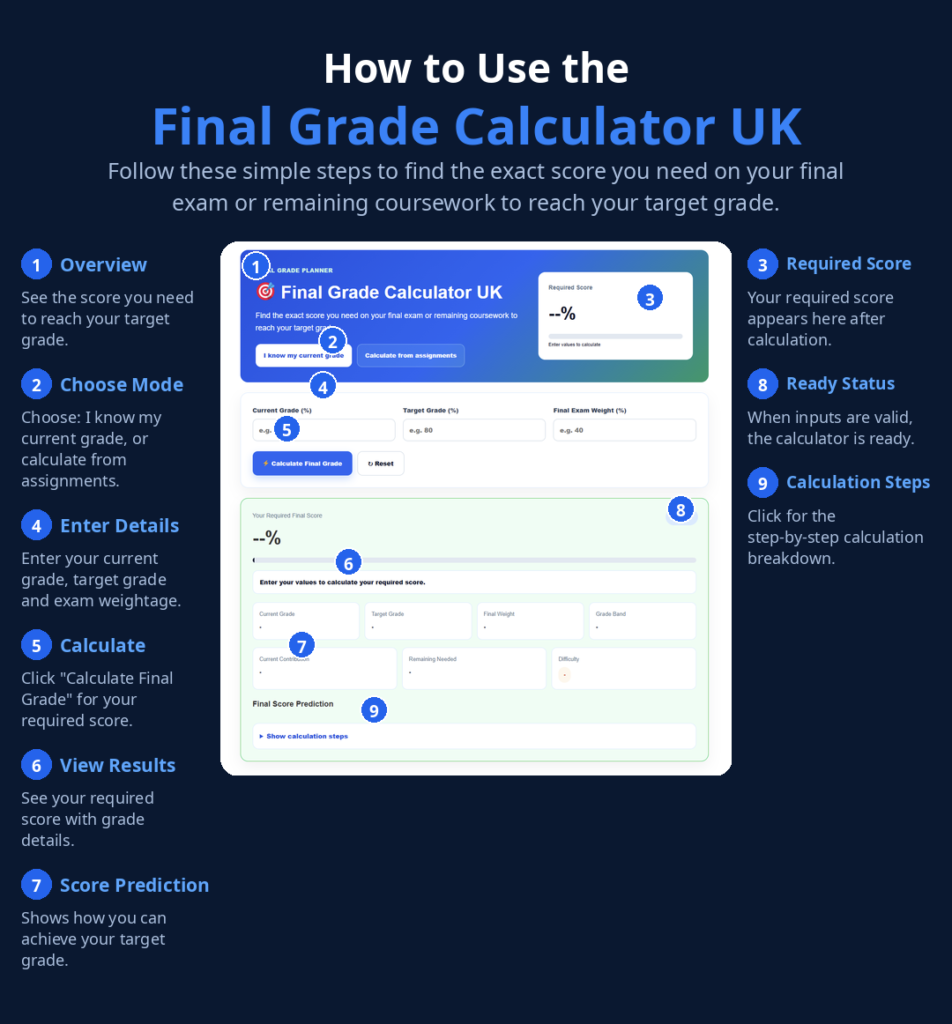
Click Here: Final Grade Calculator UK
The Bar exam pass rates by degree class
Start with the headline data, because everything else in this guide is commentary on it. The Bar Standards Board’s October 2026 Bar Training: Trends over time 2011–2025 report — announced under the headline “Fewer than half of UK Bar students gain pupillage” — breaks down vocational Bar training outcomes by the degree classification students arrived with. For the 2024/25 cohort (students who enrolled between July and October 2024), “passed the course” means passing all ten Bar assessments. The pattern is stark and it has held across cohorts:
| Degree classification | Passed all ten Bar assessments | What it means |
|---|---|---|
| First-class honours | 92% | Nearly everyone who reaches Bar training with a First completes it |
| Upper second (2:1) | 78% | A clear majority pass, but roughly one in five does not |
| Lower second (2:2) | 56% | Barely better than a coin flip — the steepest cliff in the table |
Read that table twice. The gap between a First and a 2:1 is 14 percentage points; the gap between a 2:1 and a 2:2 is 22. The damage is not linear. Dropping one class from a First costs you some safety margin. Dropping from a 2:1 to a 2:2 nearly halves your cushion, taking you from a four-in-five proposition to something uncomfortably close to evens.
Two footnotes keep the table honest. First, only 51% of this cohort passed all ten assessments at the first attempt — students get up to five years to retake, so these pass-to-date figures will rise, but the class gradient is unlikely to flatten. Second, the table answers a narrower question than it first appears to: among people good enough to start Bar training, how does degree class predict who finishes it? The answer is that it predicts it very well indeed. (BSB press release; Bar Council student guidance.)
Why degree class predicts Bar results so strongly
It is tempting to read the table as proof that a First somehow causes Bar success. The honest reading is less magical and more useful. Three mechanisms do the work, and understanding them tells you what you can actually change.
First, selection compounds. The students who earn Firsts are, on average, the same students who had the study habits, exam technique and sustained motivation that the Bar assessments also reward. The degree class is not causing the Bar pass; both are caused by the same underlying academic engine. That is good news and bad news: good, because the engine can be rebuilt; bad, because a new certificate alone does not rebuild it.
Second, the Bar assessments test the same skills as a law degree, at higher intensity. Centralised assessments in civil and criminal litigation, plus the advocacy and drafting components, reward exactly what First-class scripts show: precise issue-spotting, structured reasoning under time pressure, and the discipline to answer the question asked rather than the question you wish had been asked. A student whose degree scripts consistently hit those marks arrives pre-trained. A student whose scripts did not has further to travel in a shorter time.
Third, confidence and resourcing correlate with class. This is the uncomfortable one. Students with Firsts are more likely to secure Inn scholarships, more likely to be taken seriously at the pupillage sift, and more likely to train at providers with strong support structures. The 92% is not a pure measure of ability; it is ability plus every advantage that a First unlocks downstream. Which means the 56% for 2:2 graduates is not a pure measure of inability either — it is ability minus those advantages. Keep that asymmetry in mind when you read the pupillage numbers below.
The legal minimum: what the BSB actually requires
Here is the part most students get backwards. The Bar Standards Board does not require a 2:1, and it does not require a First. The BSB’s Bar Qualification Manual sets the formal academic floor at a lower second-class honours degree — a 2:2 — alongside the required law knowledge (a qualifying law degree or a law conversion course). If your degree falls below that, you must apply to the BSB for the exercise of its discretion; the 2:2 itself needs no permission.
That single fact reframes the whole table above. A 2:2 graduate is fully eligible to start Bar training, sit the assessments, and be Called to the Bar. The 56% pass rate is not a locked door; it is a warning about the difficulty of the corridor behind it. Nobody at the regulator will stop you. The question is whether you are prepared for what the statistics say about your odds — and whether you have a plan to beat them.
Two related minimums are worth stating plainly because myths cluster around them. You do not need a law degree specifically — non-law graduates take the conversion route and enter the same funnel. And no, there is no BSB rule that your degree must be from a particular university or a particular course. The regulator sets the floor; everything above the floor is set by the market — chambers, and the pupillage sift. (One watchpoint: in January 2024 the BSB consulted on scrapping the minimum degree requirement entirely in favour of a competence test, but the 2:2 floor remains the live rule on the BSB’s current pages.)
Becoming a barrister: where your degree class gets checked
Your class is not examined once; it is examined at every gate, by different people, for different reasons. Mapping the gates shows you where a weaker class hurts most — and where it barely registers.
| Stage | Who checks your class | How much it matters |
|---|---|---|
| Bar course admission | Training providers | Moderate — most require a 2:2 minimum; some set higher academic filters |
| Inn scholarships | The four Inns of Court | High — scholarship panels weight academics heavily and funds are limited |
| Pupillage sift | Individual chambers | Very high — the single hardest filter in the whole funnel |
| Tenancy decision | Your pupillage chambers | Low — by now they have a year of your actual advocacy to judge |
| Call to the Bar | The BSB via your Inn | None beyond the 2:2 floor — the vocational assessments are what count |
The shape of that table is the whole strategy. The class matters enormously at the pupillage sift, moderately at Bar course entry, and barely at all once you are inside a chambers. Everything you do should be aimed at surviving the sift — because the sift is where 2:2 graduates lose, and it is also where a well-built application can still win.
The pupillage funnel in hard numbers
Pupillage is the bottleneck that makes the Bar the Bar. The Bar Council’s Pupillage Gateway data puts hard numbers on it: 683 pupillages were advertised in the 2024/25 round, while 3,408 people applied in the 2023/24 round — roughly five applicants for every advertised place, and only 261 offers were made through the Gateway itself. The BSB records 614 pupils beginning pupillage in 2023–24. Against that, 2,445 students enrolled on Bar training courses between July 2024 and June 2025. Far more people start the vocational stage than the pupillage stage can absorb.
The BSB’s cohort tracking makes the funnel personal. Five years after enrolling on the Bar course, just 41% of UK-domiciled students from the 2020–21 cohort had obtained pupillage. Read that again: three in five UK students who started Bar training had not secured pupillage five years later. Some will have chosen other careers; many will not have chosen to leave. And the degree-class gradient runs straight through the funnel: in the 2022/23 Gateway round, 60.1% of pupillage offers went to Firsts and 36.1% to 2:1s — leaving barely 4% for everyone else combined.
None of this means the funnel is random. Chambers publish what they sift for, and the pattern is consistent enough to plan around. Which brings us to the filter itself.
The 2:1 sift: how chambers actually use your class
The Bar Council’s official student guidance states it plainly: “Most chambers and employers will ask for a 2:1 degree or higher when you apply for a pupillage.” And the Gateway outcomes show what that means in practice. In the most recent application round, candidates with a First were more than twice as likely to secure a pupillage offer as those with a 2:1 — and no candidate with a 2:2 or a Third secured a pupillage offer at all. The same zero-2:2 finding appeared the year before. As Chambers Student puts it: unless you can demonstrate truly remarkable alternative qualities, anything below a 2:1 will scupper your chances.
So the sift is not a rumour; it is the documented shape of the market. With around five applicants per advertised pupillage, panels need a first cut, and degree class is the fastest, most defensible blade they have. A 2:2 application needs a reason to survive the thirty seconds its academics get, while a First or 2:1 application gets the benefit of the doubt into the second read.
At the sharpest end of the market the filter is explicit. Blackstone Chambers, one elite commercial set, publishes that it generally requires either a first-class degree or a 2:1 plus a postgraduate distinction — with stated exceptions for contextual and exceptional-circumstances cases. That is one set, not the norm, but it shows where the ceiling sits.
Three things reliably buy a 2:2 application that second read. First, a trajectory: a weak first year followed by strong second and final years tells a better story than a flat 2:2, and panels do read transcripts, not just the classification line. Second, explained context: extenuating circumstances, properly documented, are weighed — chambers are staffed by advocates, and advocates understand that a bare number can mislead. Third, countervailing excellence: mooting finals, debating championships, published legal writing, or a genuinely outstanding Bar course result. One of these does not erase a 2:2; it gives the panel a reason to keep reading, which is all the first cut requires.
What does not work is pretending the class does not matter. Applications that bury a 2:2 on page four, or that lead with extracurriculars as though academics were optional, read as evasive. Panels notice evasion faster than they notice a low mark. Own the number, contextualise it once, and move the reader on to your evidence.
Worked example: the 2:1 borderline
This is where becoming a barrister becomes an arithmetic problem. Take Amara, a final-year law student on a standard 25:75 weighting — second year counts 25%, final year 75%. She finished second year on 58%. She wants the 2:1 that keeps her above the pupillage sift line. What final-year average does she need?
The equation is: (0.25 × 58) + (0.75 × final-year average) ≥ 60.
Second year contributes 14.5 percentage points. She needs 45.5 more from the 75% weighting: 45.5 ÷ 0.75 = 60.67%. So Amara needs a 60.67% final-year average — not 60%, because her second year sits two points below the boundary and the final year has to drag the average up.
Now run the counterfactual that shows why borderlines are cruel. If Amara’s second year had been 59% instead of 58%, she would need (60 − 14.75) ÷ 0.75 = 60.33%. A single percentage point in second year is worth a third of a point of breathing room in finals. And if her university runs a borderline policy — many do, typically uplifting students within 1–2% of a boundary with sufficient Level 6 credits in the higher band — then 59.4% might be rescued where 58.9% is not. The lesson: when you are near the 2:1 line, every module mark is doing double duty, because it counts once in the average and once in the borderline zone. Work out your own number with the Final Grade Calculator before you decide any module “doesn’t matter”.
Worked example: the 2:2 graduate’s route
Now take Josh, who graduated with a 2:2 (57%) and still wants the Bar. The table at the top says his Bar assessment odds are around 56%; the pupillage funnel says the sift will be brutal. What does a rational plan look like — not an optimistic one?
Step one is the only step with no shortcut: be realistic about the Bar course itself. A 56% pass rate means Josh should treat Bar training as a genuine academic risk, not a formality. The students who beat those odds tend to share a profile: they identified exactly why the degree underperformed (exam technique? issue-spotting? time management?) and fixed the mechanism before paying Bar course fees, often through a year of paralegal work or a master’s that rebuilds the academic record. Enrolling immediately, hoping the vocational stage will be different, is how the 44% happens.
Step two is sequencing. The strongest 2:2 applications the pupillage panels see share a shape: 2:2 degree, then a distinction-level postgraduate result (BPC/Bar course with very competent or outstanding, or a master’s with distinction), then pupillage applications that lead with the recent evidence. The postgraduate result does not delete the 2:2, but it answers the panel’s real question — “is this applicant’s academic ceiling actually higher than the degree suggests?” — with fresh data instead of excuses.
Step three is targeting. Not all chambers sift identically. Smaller regional sets, and sets in less oversubscribed practice areas, receive fewer applications per pupillage and read more of each one. The big London commercial sets running 500-applicant funnels are the worst place for a 2:2 application to land; a 40-applicant regional common-law set is a different contest. This is not settling — it is matching your application to the sift you can actually survive, then building the career outward.
None of this invents a threshold. No chambers publishes “2:2 with distinction at Bar course = pupillage”. The claim is narrower and fully defensible: each of these steps converts an application the panel would skim into one the panel reads, and being read is the entire battle at the sift.
The solicitor contrast: does the SQE care about your class?
It helps to see the Bar’s filter against its sibling profession. The Solicitors Qualifying Examination route has no degree-classification requirement at all: the SRA asks for a degree in any subject (or equivalent), plus SQE1, SQE2, two years of qualifying work experience, and character and suitability. The assessments are the same whatever class you arrived with.
That does not mean class is irrelevant for solicitors; it means the filter moved from the regulator to the firms. Most large City firms still list a 2:1 minimum for training contracts — Hogan Lovells, Kirkland & Ellis, Macfarlanes and Linklaters all state 2:1 or equivalent — while some firms, such as Irwin Mitchell, state no minimum. But the solicitor market is an order of magnitude larger — thousands of training contracts a year against a few hundred pupillages — so a 2:2 applicant has far more sets of eyes willing to read past the number. If your class rules out the Bar’s funnel economics, the solicitor route is not a consolation prize; for many 2:2 graduates it is the structurally better bet, and the SQE’s standardised assessments arguably level the academic playing field more than the old LPC did.
The honest comparison: at the Bar, your degree class predicts both your exam odds and your sift odds, and both gradients are steep. As a solicitor, your class still shapes which firms sift you in, but the assessments do not grade you on it and the market is deep enough to absorb the difference. Students choosing between the two professions should weight that asymmetry properly instead of treating “lawyer” as one career.
Six mistakes that cost aspiring barristers a year
These are the errors that recur every cycle, and each one is avoidable with the numbers above in front of you.
1. Starting the Bar course with a 2:2 and no plan. The 56% pass rate is not an abstract statistic once you have paid five figures in fees. If your degree underperformed, fix the cause first — a year of paralegal work plus targeted exam-technique rebuilding beats an immediate enrolment you are not ready for.
2. Applying for pupillage before the academics are defensible. The Gateway opens once a year and chambers remember repeat applicants. One strong, well-timed application beats three premature ones. If your transcript has an upward trajectory still in progress, wait until the trajectory is complete.
3. Hiding the 2:2 instead of framing it. Panels read hundreds of forms; evasion is the fastest way to be skimmed. State the class, give the one-line context, and spend your words on evidence — mooting, writing, advocacy — that answers the question the class raises.
4. Targeting only the biggest London sets. The 500-application funnels are where 2:2 applications go to be filtered. Regional and specialist sets read more of each application. Apply where your application will be read, not where the prestige is.
5. Ignoring the Inn scholarships. The four Inns of Court award substantial Bar course scholarships — and the data says funding shapes outcomes: applicants holding an Inn scholarship have been measured at three times more likely to receive a pupillage offer. The Inns publish no fixed grade threshold for the main awards, so check each Inn’s scholarship page rather than assuming you are ineligible — but treat the application as part of the financial plan, not an afterthought.
6. Treating “becoming a barrister” and “becoming a lawyer” as the same decision. The Bar’s funnel is uniquely brutal on academics. A student with a 2:2 who would thrive as a solicitor can waste years forcing the Bar route. Choose the profession whose filter fits your evidence.

For the full picture of how classification shapes graduate outcomes beyond law, see Does Your Degree Classification Matter? — and if you are still at university, the 2:2 to 2:1 recovery guide and how to predict your final classification show exactly how much each remaining module is worth. You can also calculate your degree classification directly to see where you stand.
Do you need a First to become a barrister?
No. The Bar Standards Board’s minimum is a 2:2, and plenty of barristers hold 2:1s. But the BSB’s October 2026 training data shows why the question keeps being asked: 92% of Firsts passed all ten Bar assessments, against 78% of 2:1s and 56% of 2:2s. And at the pupillage sift, the Bar Council notes most chambers ask for a 2:1 or higher — in the most recent Gateway round, no 2:2 or Third candidate secured an offer. A First is not required, but the data rewards aiming as high as you can.
Can you become a barrister with a 2:2?
Legally, yes — a 2:2 meets the BSB’s academic floor, and nobody at the regulator will stop you starting Bar training. Realistically it is the hardest route: the Bar assessment pass rate for 2:2 graduates is 56%, and the pupillage sift heavily favours 2:1s and above. What helps is evidence that answers the panel’s real question — is this applicant’s ceiling higher than the degree suggests? An upward transcript trajectory, documented extenuating circumstances, a distinction-level postgraduate result, and targeting chambers that read full applications rather than running 500-applicant funnels.
What is the minimum degree classification to be called to the Bar?
Lower second-class honours — a 2:2 — set out in the BSB’s Bar Qualification Manual, alongside the required legal knowledge (a qualifying law degree or a conversion course). If your degree falls below a 2:2, you must apply to the BSB for the exercise of its discretion. Note this is the regulator’s floor; chambers and Bar course providers set their own higher filters above it.
Do chambers require a 2:1 for pupillage?
Few publish a hard rule, but the Bar Council’s guidance says most chambers and employers ask for a 2:1 or higher — and the Gateway outcomes bear that out. In the most recent round, Firsts were more than twice as likely as 2:1s to secure an offer, and zero offers went to 2:2 or Third candidates. At the sharpest end it is explicit: Blackstone Chambers generally requires a First, or a 2:1 plus a postgraduate distinction. Treat the 2:1 as the working line and plan accordingly.
What are the odds of getting pupillage after the Bar course?
Steep. BSB cohort tracking found that five years after enrolling, just 41% of UK-domiciled students from the 2020–21 Bar course cohort had obtained pupillage. The annual numbers tell the same story: 683 pupillages were advertised in the 2024/25 Gateway round against 3,408 applicants in the 2023/24 round — roughly five applicants per place. Degree class runs through the funnel: 60.1% of offers went to Firsts and 36.1% to 2:1s.
Can you become a barrister without a law degree?
Yes. Non-law graduates take a law conversion course (the PGDL or equivalent) to gain the required legal knowledge, then enter exactly the same Bar training and pupillage funnel as law graduates. Your degree classification still counts the same way — the conversion does not reset the academic record, so the 2:1 sift and the Bar pass-rate gradient apply equally.
Is it easier to become a solicitor with a 2:2 than a barrister?
Structurally, yes. The SQE route has no degree-classification requirement — the SRA asks for a degree in any subject plus the SQE assessments and qualifying work experience. And the market is far deeper: thousands of training contracts a year against a few hundred pupillages. Large City firms still sift on academics (most list a 2:1 minimum; a few state no minimum), but there are many more firms willing to read past the number than there are chambers.
What if I get a Third — is the Bar still possible?
A Third sits below the BSB’s 2:2 academic floor, so the standard route to Call is closed unless the BSB exercises its discretion in your favour — a difficult application, not a formality. For most Third graduates the realistic paths run elsewhere: the solicitor route via the SQE (no class minimum), further study to rebuild the academic record, or adjacent legal careers. An honest assessment early saves years.
Conclusion
So: do you need a First to become a barrister? No — and the data is precise about what you actually need. The regulator asks for a 2:2. The Bar assessments reward a 2:1, with pass rates falling off a cliff below it: 92% for Firsts, 78% for 2:1s, 56% for 2:2s. And the pupillage sift, the hardest gate of all, effectively demands a 2:1 unless your application gives the panel a reason to keep reading.
The students who navigate this successfully share one habit: they treat their degree class as a number to be managed, not a verdict to be feared. If you are still studying, that means knowing your borderline arithmetic cold — a single percentage point in second year can be worth a third of a point of breathing room in finals, and the Final Grade Calculator will tell you exactly what each remaining module must deliver. If you have already graduated with a 2:2, it means sequencing honestly: rebuild the academic evidence first, target the sets that will actually read your application, and never confuse the regulator’s minimum with the market’s filter.
Becoming a barrister was never meant to be easy, but it was also never meant to be mysterious. The numbers are published. The gates are mapped. Work the arithmetic, respect the funnel, and make every application answer the one question every panel is really asking: is this person’s academic ceiling higher than their degree suggests?