
If you’ve just started university in the UK, there’s a good chance your first 60% mark gave you a small heart attack. Back in school, 60% might have felt average. At university, it’s a different story entirely — and once you understand why, the whole system starts to make a lot more sense.
This guide breaks down exactly how the UK university grading system works: what the percentages mean, how degree classifications are decided, and where most students go wrong when reading their results.
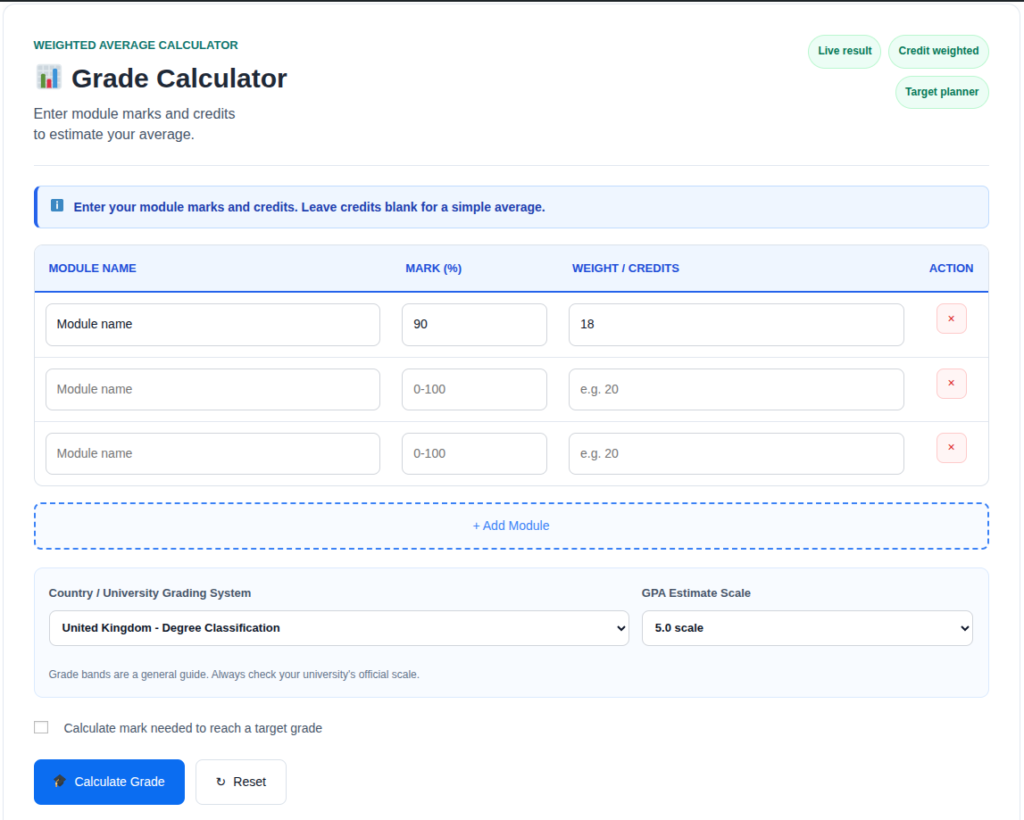
Click Here To Calculate: Estimate weighted averages,
credits and UK degree classification.
Results
How UK University Grading Actually Works
Unlike the US, where students track a cumulative GPA, UK universities use a classification system based on percentages. Your overall mark across your modules and years determines which “class” of degree you graduate with.
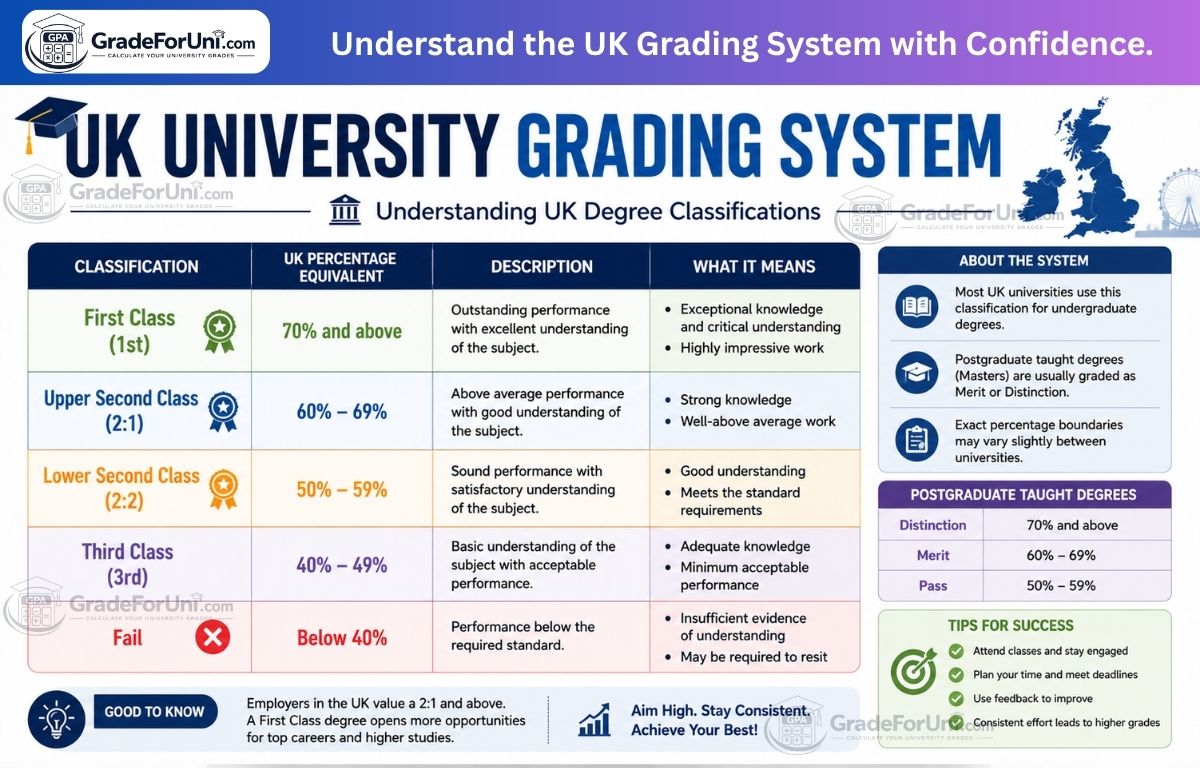
There are four main undergraduate classifications:
| Grade (%) | Classification | Honours |
| 70% and above | First Class | 1st |
| 60% – 69% | Upper Second Class | 2:1 |
| 50% – 59% | Lower Second Class | 2:2 |
| 40% – 49% | Third Class | 3rd |
| Below 40% | Fail | — |
That’s it. No letter grades, no curve, no extra credit. Just your weighted average mapped onto one of these bands.
Read More: University Credits Calculator – Calculate
Why 70% Feels So Hard to Reach
UK University Grading System Here’s the part that trips up most new students. At UK universities, marking is intentionally tough at the top end. Markers reserve the 80–100% range for work that goes genuinely beyond the brief — original thinking, exceptional insight, the kind of answer a marker doesn’t see very often.
That means a 65% essay isn’t a “bad” essay. It’s a solid, well-argued piece of work that sits comfortably within 2:1 territory, which is the most common classification awarded across UK universities. Knowing this early can save you a lot of unnecessary stress.
How Your Final Degree Mark Is Calculated
Your final classification isn’t just an average of every mark you’ve ever received. UK University Grading System It’s a credit-weighted average, and not every year counts equally.
The general formula looks like this:
Weighted Average = (Mark₁ × Credits₁ + Mark₂ × Credits₂ + …) ÷ (Total Credits)
Most English universities also weight years differently:
- Year 1 usually doesn’t count toward your final classification at all — it’s pass/fail to let you progress to Year 2
- Year 2 typically contributes around 30–33% of your final grade
- Final year usually carries the most weight, often 67–70%, including your dissertation
So a strong final year really can pull your overall classification up, even if Year 2 wasn’t your best work. The reverse is true too — coasting in your final year after a great Year 2 can cost you a classification band.
Read More: Calculez vos heures de travail avec clarté.A Quick Example
Say your weighted Year 2 average is 62%, and your final year average is 71%, under a typical 33/67 split:
(62 × 0.33) + (71 × 0.67) = 20.5 + 47.6 = 68.1%
That’s a solid 2:1, sitting close to the First Class boundary — which brings us to borderline cases.
What Happens If You’re Right on the Boundary?
If your average lands within a couple of percentage points below a classification boundary — say 68–69% — most universities have a borderline review process. Examiners typically look at how many of your individual modules sit in the higher band. If the majority do, you may be bumped up to the next classification.
This isn’t guaranteed, and policies vary between institutions, but it’s worth knowing it exists if you ever find yourself just short of a First or a 2:1.
Undergraduate vs Postgraduate Grading ( UK University Grading System )
Postgraduate (Masters-level) grading uses a different, simpler scale:
| Grade (%) | Classification |
| 70% and above | Distinction |
| 60% – 69% | Merit |
| 50% – 59% | Pass |
| Below 50% | Fail |
Notice the boundaries shift slightly compared to undergraduate study — Masters programmes generally expect a higher baseline, so a 50% pass at postgraduate level sits where a 2:2 would at undergraduate level.
Read More: University Average Calculator – Calculate
Honours vs Ordinary Degrees
Most students graduate with an Honours degree (BA Hons, BSc Hons), which comes with one of the classifications above. If a student passes their course but doesn’t quite meet the criteria for Honours, some universities award an Ordinary Degree, usually for marks in the 35–39% range — without a formal classification attached.
Why Your Classification Actually Matters
A 2:1 or above is the benchmark most UK graduate employers look for. UK University Grading System Many large graduate schemes — particularly in finance, law, and consulting — still list a 2:1 as their minimum entry requirement, and it’s also the standard expectation for most Masters programmes.
That doesn’t mean a 2:2 closes doors. Plenty of industries, especially creative fields, tech, and roles that value experience over academic record, are far more flexible. But if you’re aiming for competitive graduate schemes or postgraduate study, knowing where you stand early gives you time to plan.
Read More: Weighted Grade Calculator – Calculate
The Easiest Way to Track Your Progress
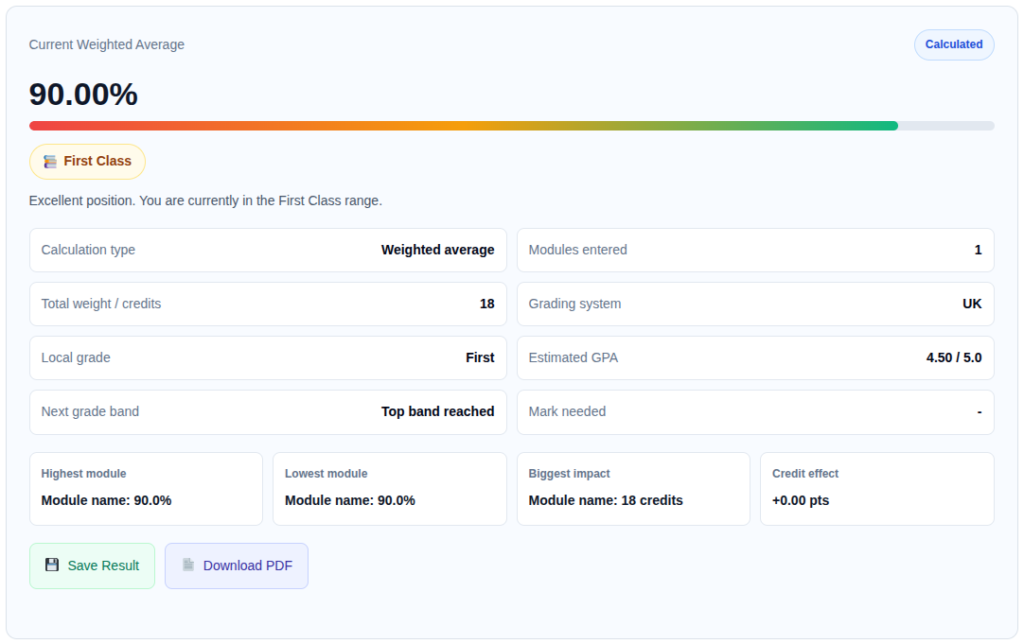
Doing this maths by hand every semester gets old fast, especially once you’re juggling modules with different credit values across multiple years. A grade calculator does the same credit-weighted calculation instantly, so you can see exactly where you stand and what you need in upcoming modules to hit your target classification.
Understanding the system is the first step. UK University Grading System Tracking your actual numbers as you go is what turns that understanding into a clear plan for the rest of your degree.
FAQ’s
What is the UK university grading system?
The UK university grading system is a percentage-based classification method used to assess undergraduate and postgraduate academic performance across British universities.
How does the UK university grading system differ from GPA?
Unlike the US GPA model, the UK university grading system uses degree classifications such as First, 2:1, 2:2, and Third instead of a cumulative grade point average.
What percentage is a First Class degree?
A First Class Honours degree requires a weighted average of 70% or above across your assessed modules.
What percentage is a 2:1?
A 2:1, or Upper Second Class Honours, requires a weighted average between 60% and 69%.
What percentage is a 2:2?
A 2:2, or Lower Second Class Honours, is awarded for a weighted average between 50% and 59% UK University Grading System.
What is the lowest passing classification?
Third Class Honours is the lowest classified pass, awarded for averages between 40% and 49%.
Does Year 1 count toward my final degree classification?
In most universities, Year 1 is pass/fail only and does not contribute to your final classification, though some institutions weight it slightly.
How much does Year 2 contribute to my final grade?
Year 2 typically contributes around 30–33% of your overall classification, depending on your university’s weighting policy.
How much does final year contribute?
Final year usually carries the heaviest weighting, often 67–70%, including your dissertation marks.
Why does the UK university grading system feel so strict at the top?
Markers reserve 80–100% for exceptional, original work, which is why even a 65% mark is considered a strong, respectable result.
What happens if my average is just below a boundary?
Many universities apply borderline review policies, where examiners check if most of your individual modules sit in the higher band before deciding on an uplift.
Is a 2:2 a bad degree?
No. A 2:2 still reflects solid academic achievement, though some competitive graduate schemes prefer a 2:1 or above.
How is postgraduate grading different under the UK university grading system?
Postgraduate study uses Distinction (70%+), Merit (60–69%), and Pass (50–59%) instead of undergraduate classifications.
What is an Ordinary Degree?
An Ordinary Degree is awarded without Honours classification, usually for marks between 35–39%, for students who pass but don’t meet Honours criteria.
How is the final classification actually calculated?
It’s calculated as a credit-weighted average: each module mark is multiplied by its credit value, summed, then divided by total credits.
Do all UK universities use the same boundaries?
Most follow the same broad bands, but exact policies on borderline cases and year weighting can vary by institution.
Why is the UK university grading system important for employers?
Many UK graduate employers, especially in finance, law, and consulting, use a 2:1 or above as a minimum screening requirement.
Can a strong final year improve my overall classification?
Yes, because final year carries the most weight, a strong performance there can lift your classification even if Year 2 was weaker.
How does the UK university grading system compare to other countries?
It’s quite different from percentage or GPA systems used elsewhere, since it groups overall performance into fixed classification bands rather than continuous scores.
Is there an easy way to track my classification as I go?
Yes, a grade calculator can apply the credit-weighted formula automatically, showing your current standing and what you need in remaining modules.