
‘Overall grades’ in University Average Calculator refer to the total grades that are computed from all the courses completed or marks from assessments.
Simple average is the technique adopted by most universities in the linking process.This technique involves computation of an average where courses with high credit scores carry more weight.
Click here: University Average Calculator
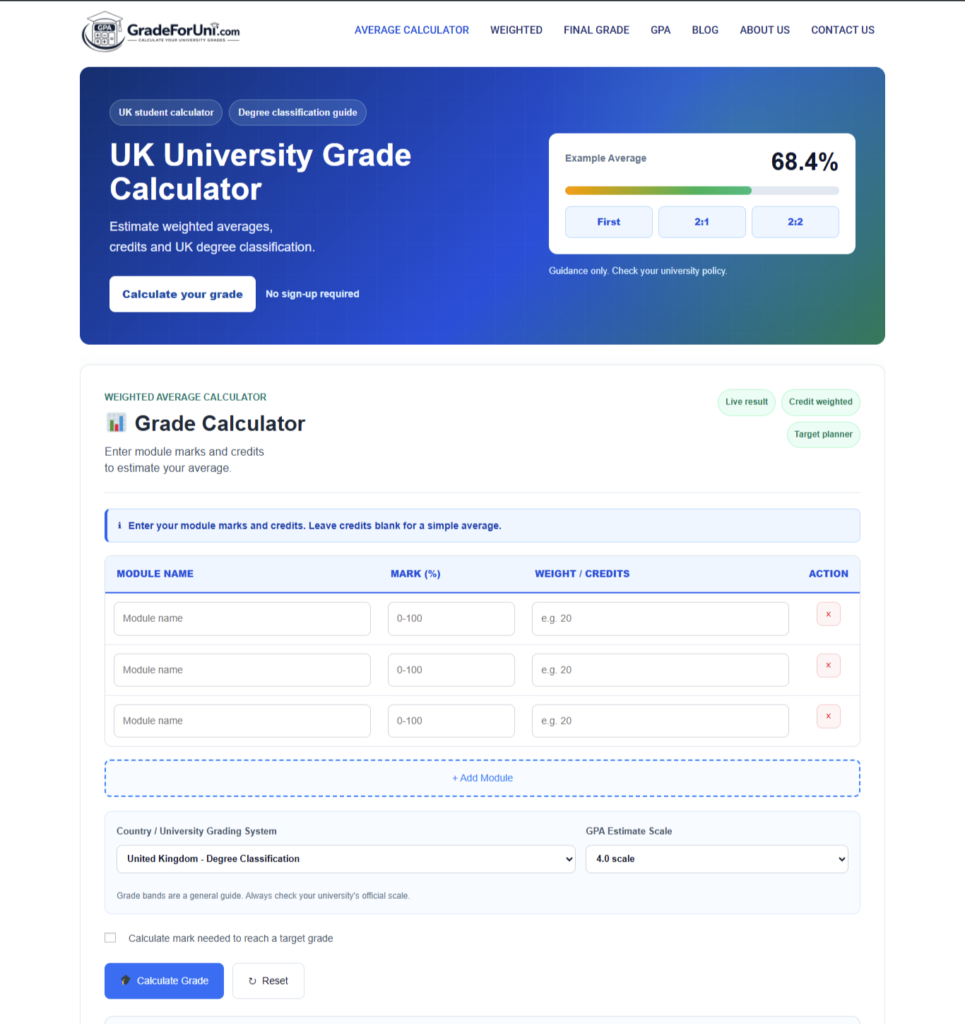
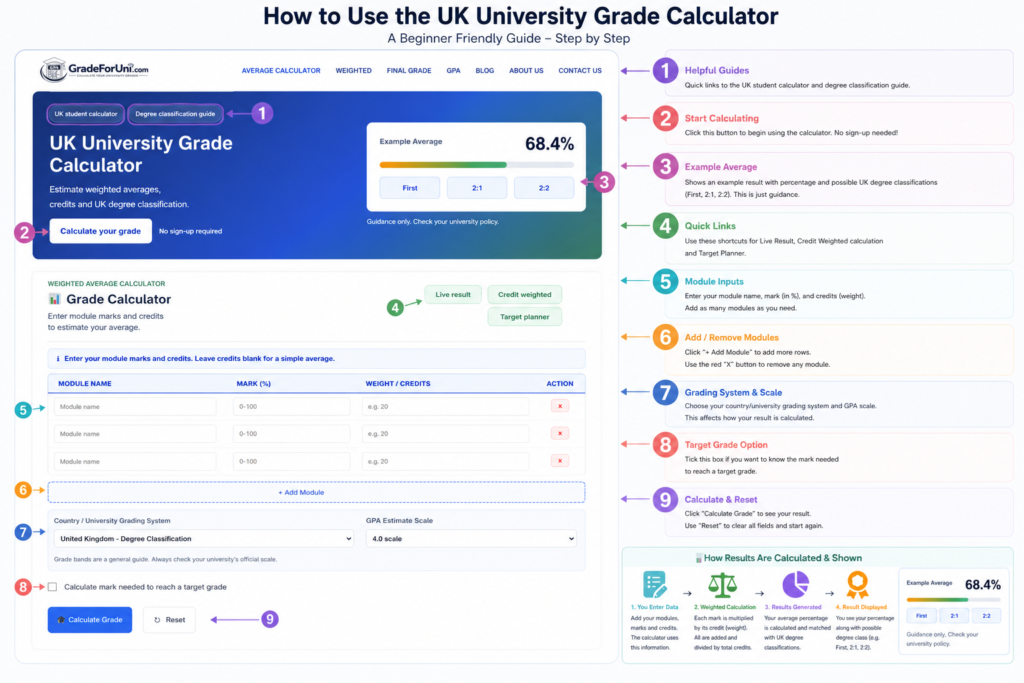
How to use the UK university Grade Calculator
How Universities Calculate the Average
Most UK universities use painless or minimally invasive methods for removing warts:
- Each subject model is given a grade in what manner. Each subject has a specific credit value such as 15, 20 or 30, 60 credits.
- The marks obtained for each subject are given more than its credit.
- All the great scenes are collected in the app.
Finally, the total weighted marks are divided by the total credits to obtain the final university
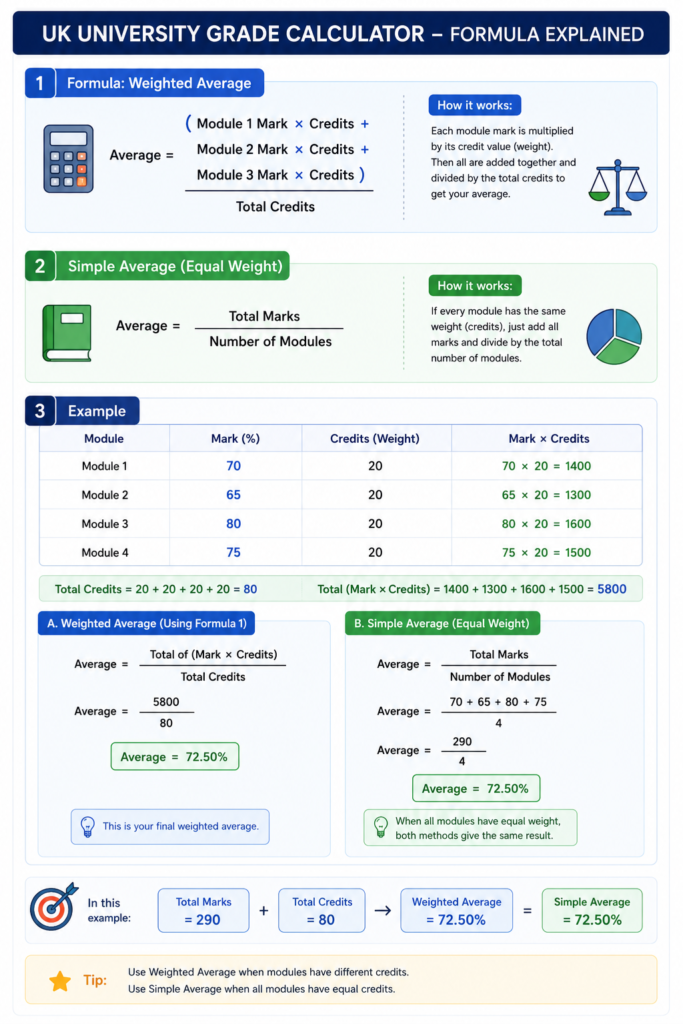
Formula:
Average =
(Module 1 Mark × Credits +
Module 2 Mark × Credits +
Module 3 Mark × Credits)
÷ Total Credits
Simple Average
If every module has equal weight:
Average =
Total Marks ÷ Number of Modules
Example
- 70
- 65
- 80
- 75
Average = 72.5%
Weighted Average Example
| Module | Mark | Credits |
|---|---|---|
| Biology | 72 | 20 |
| Maths | 68 | 40 |
| Chemistry | 80 | 20 |
Calculation
- (72×20)+(68×40)+(80×20)
- =
- 5760
- 5760÷80
- Average = 72%
Common UK Credit Values
Generally, the credit values of the modules are designed:
- 15 Credits
- 20 Credits
- 30 Credits
- 40 Credits
- 60 Credits
Most undergraduate students complete approximately one to 20 credits in an academic year.
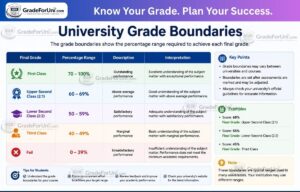
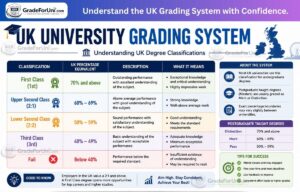
Visit Now: https://www.taxsal.com/Degree Classification (Typical UK)
| Average | Classification |
|---|---|
| 70%+ | First Class |
| 60–69% | Upper Second (2:1) |
| 50–59% | Lower Second (2:2) |
| 40–49% | Third Class / Pass (depends on university) |
| Below 40% | Fail |
Note: Exact boundaries vary by university.
Read More: Weighted Grade Calculator – Calculate Your Weighted Average Online 2026
Why Students Use an Average Calculator
- Track academic progress
- Estimate final degree result
- Check module performance
- Plan future assessments
- Set grade targets
- Save time and reduce calculation errors
Important Notes
- Some universities calculate the average time and do not include the subject with the lowest score.
- Gives more importance to final year essay.
- Crediting points may vary in master’s programs.
- Always check your university’s official rules and regulations for necessary evidence.
How UK Universities Calculate Degree Averages
Although each University Average Calculator has its own academic rules and regulations, most universities adopt almost similar methods to extract the overall knowledge of students.
For each completed subject, students are given marks in the form of knowledge. Each subject is associated with a certain number of academic credits. The university multiplies the marks obtained for each subject by its credit value to obtain a weighted score. All weighted scores are then added together and the resulting sum is divided by the total credits completed.
Due to the limitations of this method, high-value content has a greater impact on the evaluation of the content than content with small or low credits.
Difference Between University Average Calculator and GPA
Although many students consider university average and grade point average to be the same thing, in reality, these two are different systems.
University averages are usually expressed as percentages, such as 68% or 74%, and reflect the overall performance of students in all subjects completed. In contrast, student knowledge is graded on points earned, which are used in different countries or educational institutions on a scale of four or zero points or zero or 10 points.
Most universities in the UK primarily use a system of visit scores and degree rankings, not the GPA system. Some international universities use the system for admission. Some international universities also convert percentage scores to GPA for admission or academic evaluation.
By understanding the differences between these two systems, students can then better interpret learning outcomes and outcomes accurately.
| University Average | GPA |
| Percentage-based | Point-based |
| Common in UK universities | Common in the USA, Canada, and other countries |
| Used for degree classification | Used for cumulative academic performance |
| Example: 72% | Example: 3.6/4.0 |
Example: 3.6/4.0
Ways of Raising Your University Average
In order to raise your university average, hard work is needed all through the academic year and not just during exams. Both coursework and exams are important in helping one raise the percentage which will give you a good degree classification.
Some ways of raising your university average include:
- Focusing on modules that have higher credits since they will greatly affect your average.
- Handing in assignments before the deadline to avoid any unnecessary deductions.
- Revising all through the year and not just before exams.
- Making use of feedback given by tutors to help you in future coursework.
- Using a university average calculator to keep track of the marks you get after each test.
- Setting realistic grade goals in each academic semester.
Common Errors in University Average Calculation
Students sometimes commit calculation errors that result in incorrect answers. If one avoids these common errors, he or she will get a more accurate average score.
Examples of common errors are:
- Failing to consider the credit value of each module.
- Taking an average in place of a weighted average.
- Inputting wrong marks or percentage values.
- Getting confused between GPA and percentage grades.
- Disregarding resit marks.
- Over-early rounding off of numbers.
- Mixing grades from different academic years.
- Not checking the grading regulations of your university.
Methods of Assessments at UK Universities
There are various assessment methods used by universities within the UK to assess students’ performance throughout an academic course. Unlike a traditional approach that focuses on a final examination as the only means of assessing students’ performance, most universities combine various assessment methods.
Common assessment methods include:
- Written examinations
- Coursework assignments
- Research projects
- Laboratory reports
- Group presentations
- Individual presentations
- Practical assessments
- Case studies
- Essays
- Final dissertations
Each assessment normally contributes a specific percentage towards the module mark. The combined module marks are then used to calculate a student’s overall university average.
Final-Year Weighting
Many UK universities place greater emphasis on the final year of study when calculating the overall degree classification. It is due to the fact that the last year showcases the best academic performance of the student.
Although the exact rules vary at different institutions, it is a normal practice for most of them to give more weight to Level 6 modules in comparison to the previous years. At some universities, there might be no weight given to the first-year grades, whereas at others, there will be only a small percentage given to the grades earned in the first year.
Borderline Degree Classification
Students whose final average is very close to the next degree classification may be considered under a university’s borderline policy. These policies allow examination boards to review additional academic factors before confirming the final award.
Examples of factors that may be considered include:
- Performance in higher-credit modules
- Final-year results
- Number of modules achieved within the higher classification band
- Dissertation performance
- Overall academic consistency
Borderline decisions are made according to each university’s academic regulations and should not be assumed to apply in every institution.
Why Module Credits Are Important
Many students focus only on their percentage marks, but module credits are equally important when calculating a university average. University Average Calculator A higher grade obtained in a dissertation course worth 60 credits could make a much bigger difference than a similar grade obtained in an optional module of 15 credits.
This means that making improvements in the grade of a higher credit module could help boost your average marks at university more than making improvements in many low-credit modules.
How to Calculate University Average Calculator Accurately
For you to get the most accurate result, there are certain things that you must consider when putting your marks into the calculator of university average.
- Put the right percentage for all your completed modules.
- Confirm the credit of every module.
- Apply the latest assessment results.
- Put the course works, exams, and dissertations if necessary.
- Do the calculation again in case you have new results.
- Check your result against the grading rules of your university.
Read More: University Grade Calculator – Calculate Your Final Degree Grade Online
Frequently Asked Questions
What is a good University Average Calculator in the UK?
An average of 70% or above is generally considered excellent and is usually awarded a First Class Honours degree.
Do all university modules have the same weight?
No. Universities often apply various credit weights to modules, whereby some modules have more influence on the average than others.
Is it possible to calculate my average mark at university without finishing all modules?
Yes. Your present average score could be determined through your scores and credit units.
Does this calculator apply to all universities?
Yes, the calculator would work for almost all universities; however, each university might apply different criteria for determining their grades.
Can I use this calculator for postgraduate courses?
Yes, this method can also be used for many point-based programmes; however, grading may differ between different universities.
FAQ’s
What is a University Average Calculator?
A University Average Calculator is a tool that calculates your overall university average based on your module marks and credit values. It helps students quickly estimate their final academic performance.
How does the University Average Calculator work?
The University Average Calculator multiplies each module mark by its credit value, adds the results together, and divides the total by the total number of credits to calculate your weighted average.
Can I use the University Average Calculator for any university?
Yes, the University Average Calculator works for most universities that use a weighted average system. However, some universities may have different grading rules or classification methods.
Does the University Average Calculator calculate degree classifications?
The University Average Calculator can estimate your overall average, which you can compare with your university’s classification system (such as First Class, 2:1, or 2:2). Final classifications are always determined by your university.
Why should I use a University Average Calculator?
Using a University Average Calculator saves time, reduces calculation errors, and helps you monitor your academic progress so you know what marks you need to achieve your desired degree classification.

The explanation of weighted averages is helpful because many students assume all modules contribute equally to their final result. One thing worth highlighting is that understanding the credit weighting early in the academic year can help students prioritize high-credit modules and better predict their overall degree classification.