
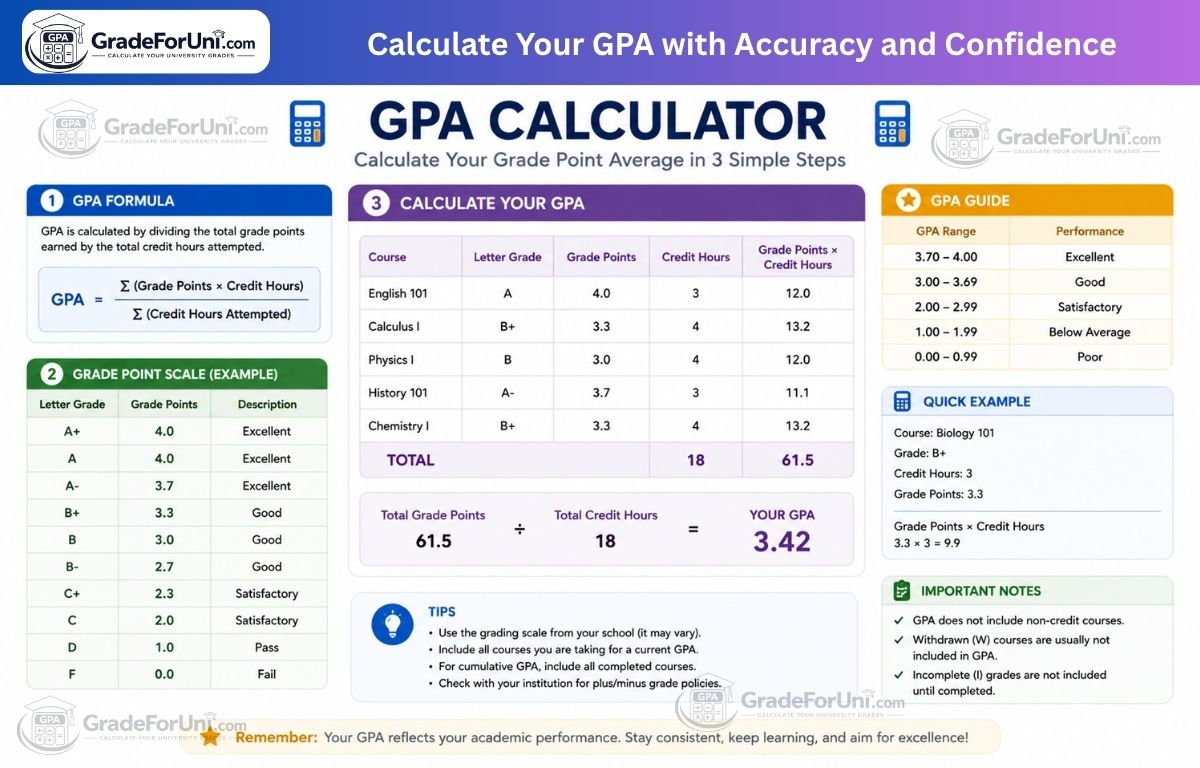
GPA, or Grade Point Average, is a consistent measure of a student’s academic performance. It represents the normal value of scores earned across all completed courses in a specific semester or across the entire study program.
GPA is simply calculated using a scoring scale, such as a 4.0 or 5.0 scale, where each letter grade corresponds to a specific number of grade points.
Check Our GPA Calculator:
What Is a GPA Calculator?
A GPA (Grade Point Average) Calculator is an online instrument that helps students quickly calculate their study performance based on course grades and credit hours.
It works on many calculations, and the calculator by itself finds your GPA using the scores and credits you add
It is useful for high school, college, and university students who want to check their progress and understand their academic performance.
A GPA (Grade Point Average) is more than just a number. It shows a student’s study progress and helps schools, universities, and employers assess their successes
Keeping a good GPA can open up chances in both education and career development.
Read More : Mauricette Feuille d'heures1. University Admissions
- Many colleges and universities use GPA as an important admission need
- A higher GPA can improve your chances of being accepted into competitive programs and institutions.
2. Scholarship Opportunities
Many scholarships and financial funding programs require students to meet a minimum GPA. Strong study results can help you qualify for more funding options.
3. Academic Progress Tracking
GPA helps students check their performance in their studies. It gives a clear picture of strong points and areas that may need betterment
4. Internship and Job Applications
Some recruiters and internship suppliers consider GPA when checking candidates for entry-level positions. A solid GPA can make your application more selective
5. Graduate School Admission
Students planning to do a master’s degree or a PhD often need a strong GPA to meet admission criteria for advanced study programs.
6. Personal Achievement
A good GPA can be a sign of regular effort, discipline, and focus on learning. It helps students set goals and measure their study success over time.
Read More: University Grade Calculators – Calculate Your Final Degree Grade OnlineHow Does a GPA Calculator Work?
A GPA calculator changes your grades into grade points and then measures an average based on the credit hours or weight of each course. It helps students quickly determine their study standing without doing the calculations on their own.
Step 1: Convert Grades to Grade Points
Each letter grade is assigned a numerical value on a GPA scale.
| Grade | Grade Points |
|---|---|
| A | 4.0 |
| B | 3.0 |
| C | 2.0 |
| D | 1.0 |
| F | 0.0 |
Step 2: Multiply by Credit Hours
For each course, multiply the grade points by the number of credit hours.
| Course | Grade | Grade Points | Credit Hours | Quality Points |
|---|---|---|---|---|
| Math | A | 4.0 | 3 | 12.0 |
| English | B | 3.0 | 4 | 12.0 |
| Science | A | 4.0 | 2 | 8.0 |
| Total | — | — | 9 | 32.0 |
Step 3: Add Total Quality Points
| Calculation | Total Quality Points |
|---|---|
| 12.0 + 12.0 + 8.0 | 32.0 |
Step 4: Add Total Credit Hours
| Calculation | Total Credit Hours |
|---|---|
| 3 + 4 + 2 | 9 |
Read More: Weighted Grade Calculator – Calculate Your Weighted Average Online 2026Step 5: Calculate GPA
GPA Formula
GPA=∑Credit Hours∑(Grade Points×Credit Hours)
| Formula | Calculation | Result |
|---|---|---|
| GPA = Total Quality Points ÷ Total Credit Hours | 32.0 ÷ 9 | 3.56 |
Final Result
| Metric | Value |
|---|---|
| Total Quality Points | 32.0 |
| Total Credit Hours | 9 |
| Student’s GPA | 3.56 |
So, the student’s GPA is 3.56.
Why Use a GPA Calculator?
less time and reduces calculation errors.
Helps check study progress.
Calculate semester and cumulative GPA.
Help with scholarship and admission requirements.
Makes it easier to plan future scores and study goals.
Read More: University Average Calculator – Calculate Your Average Grade Across ModulesGrade Points and Credit Hours
A GPA calculator makes these steps easier, permitting students to add their scores and credits and get an exact GPA quickly
Grade points and study hours are the two key components used to calculate a GPA. Understanding how they work helps students correctly measure their educational performance.
A GPA calculator makes these steps easier, permitting students to add their scores and credits and get an exact GPA quickly
Grade points and study hours are the two key components used to calculate a GPA. Understanding how they work helps students correctly measure their educational performance.
What Are Grade Points?
Grade points are numerical values assigned to letter grades. Each grade represents a specific level of achievement and is converted to points according to the institution’s GPA scale
That’s all scales into grades that totally that represents into many forms of grades.
Example on a 4.0 Scale
| Grade | Grade Points |
|---|---|
| A | 4.0 |
| B | 3.0 |
| C | 2.0 |
| D | 1.0 |
| F | 0.0 |
Grade Point Distribution
| Grade | Grade Points | GPA Impact |
|---|---|---|
| A | 4.0 | Highest impact on GPA |
| B | 3.0 | Strong positive impact |
| C | 2.0 | Moderate impact |
| D | 1.0 | Low impact |
| F | 0.0 | No positive contribution |
What Are Credit Hours?
Credit hours indicate the value or workload of a course. Courses that require more class time or study often carry more credit hours than shorter or less intensive courses.
Read More: University Credits Calculator – Calculate Credits Required for Your Degree
Credit Hour Examples
| Course | Credit Hours | Impact on GPA |
|---|---|---|
| Mathematics | 4 | Highest impact due to more credit hours |
| English | 3 | Moderate impact on GPA |
| History | 2 | Lower impact compared to other courses |
Credit Hour Comparison
| Credit Hours | Influence on GPA |
|---|---|
| 4 | Greater influence |
| 3 | Moderate influence |
| 2 | Lesser influence |
How do they work together?
To calculate GPA, grade points are multiplied by the credit hours for each course. The results are then added together and divided by the total number of credit hours.
Example
| Course | Grade Points | Credit Hours | Quality Points |
|---|---|---|---|
| Math | 4.0 | 3 | 12.0 |
| English | 3.0 | 4 | 12.0 |
| Total | — | 7 | 24.0 |
GPA Calculation Summary
| Metric | Value |
|---|---|
| Total Quality Points | 24.0 |
| Total Credit Hours | 7 |
| GPA | 3.43 |
Calculation
| Step | Formula | Result |
|---|---|---|
| Total Quality Points | 12.0 + 12.0 | 24.0 |
| Total Credit Hours | 3 + 4 | 7 |
| GPA | 24.0 ÷ 7 | 3.43 |
The GPA Calculation Formula
A GPA (Grade Point Average) is calculated by dividing the total quality points earned by the total credit hours completed. ( GPA Calculator ) This method ensures that courses with more credit hours have a greater impact on the final GPA.
GPA Formula
GPA=Total Credit HoursTotal Quality Points
Formula Components
| Term | Definition |
|---|---|
| Quality Points | Grade Points × Credit Hours |
| Total Quality Points | Sum of quality points from all courses |
| Total Credit Hours | Sum of credit hours from all courses |
Step-by-Step Example
Suppose a student has the following grades:
| Course | Grade Points | Credit Hours | Quality Points |
|---|---|---|---|
| Math | 4.0 | 3 | 12.0 |
| English | 3.0 | 4 | 12.0 |
| Science | 3.7 | 3 | 11.1 |
| Total | — | 10 | 35.1 |
GPA Calculation
| Step | Calculation | Result |
|---|---|---|
| Total Quality Points | 12.0 + 12.0 + 11.1 | 35.1 |
| Total Credit Hours | 3 + 4 + 3 | 10 |
| GPA | 35.1 ÷ 10 | 3.51 |
Final Result
| Metric | Value |
|---|---|
| Total Quality Points | 35.1 |
| Total Credit Hours | 10 |
| GPA | 3.51 |
Therefore, the student’s GPA is 3.51.
Step-by-Step GPA Calculation Example
Calculating GPA is simple when you follow the process step by step. The goal is to find the average grade points earned across all courses while considering their credit hours.
Step 1: List Your Courses and Grades
Suppose a student has completed the following courses:
| Course | Grade | Credit Hours |
|---|---|---|
| Math | A | 3 |
| English | B | 4 |
| Science | A | 2 |
| Total | — | 9 |
Step 2: Convert Grades to Grade Points
Using a standard 4.0 GPA scale:
| Grade | Grade Points |
|---|---|
| A | 4.0 |
| B | 3.0 |
Step 3: Calculate Quality Points
Multiply the grade points by the credit hours for each course.
| Course | Grade Points | Credit Hours | Quality Points |
|---|---|---|---|
| Math | 4.0 | 3 | 12.0 |
| English | 3.0 | 4 | 12.0 |
| Science | 4.0 | 2 | 8.0 |
| Total | — | 9 | 32.0 |
Step 4: Add the Quality Points
| Calculation | Total Quality Points |
|---|---|
| 12.0 + 12.0 + 8.0 | 32.0 |
Step 5: Add the Credit Hours
| Calculation | Total Credit Hours |
|---|---|
| 3 + 4 + 2 | 9 |
Step 6: Apply the GPA Formula
GPA=Total Credit HoursTotal Quality Points
| Formula | Calculation | Result |
|---|---|---|
| GPA = Total Quality Points ÷ Total Credit Hours | 32.0 ÷ 9 | 3.56 |
Final Result
| Metric | Value |
|---|---|
| Total Quality Points | 32.0 |
| Total Credit Hours | 9 |
| Student’s GPA | 3.56 |
The student’s GPA is 3.56.
By following these steps, you can calculate your GPA accurately for a semester or use the same method to determine your cumulative GPA across multiple semesters.
Read More: Weighted Grade Calculator – Calculate Your Weighted Average Online 2026Benefits of Using an Online GPA Calculator
Online GPA calculators make it much easier for students to understand and manage their academic performance. They automate the entire process, reducing effort and improving accuracy.
Save Time
An online GPA calculator quickly computes your GPA in seconds. Instead of manually converting grades and doing calculations, you simply enter your grades and credit hours, and the tool does the rest instantly.
Reduce Calculation Errors
Manual GPA calculations can often lead to mistakes, especially when handling multiple courses and different credit hours. Online calculators minimize errors by automatically applying the correct formula and scale.
Track Academic Progress
These tools allow students to monitor their semester and cumulative GPA easily. By regularly checking their GPA, students can identify trends, improve weak areas, and set realistic academic goals for future improvement.
Who Can Use This GPA Calculator?
A GPA calculator is a useful tool for students at different education levels. GPA Calculator Whether you are preparing for university admission, tracking semester results, or monitoring your overall academic performance, this calculator can help.
University Students
University students can use the GPA calculator to determine their semester GPA and cumulative GPA. It helps them monitor academic performance, meet graduation requirements, and stay eligible for scholarships or advanced study programs.
College Students
College students can calculate their grades quickly and accurately by entering course grades and credit hours. The calculator makes it easier to track progress throughout a program and plan for future semesters.
High School Students
High school students can use a GPA calculator to understand their academic standing and prepare for college or university applications. Keeping track of GPA can help students set academic goals and improve their chances of admission to competitive institutions.
Tips to Improve Your GPA
Carefully planning your upcoming courses can help you balance your workload. Choosing a manageable mix of difficult and easier subjects allows you to maintain steady performance and improve your GPA over time.
Improving your GPA requires consistent effort, smart planning, and regular monitoring of your academic performance. Small improvements in each course can significantly raise your overall GPA over time.
Focus on High-Credit Courses
Courses with higher credit hours have a greater impact on your GPA. By prioritizing these subjects and performing well in them, you can boost your overall academic score more effectively than focusing only on low-credit courses.
Track Grades Regularly
Regularly checking your grades helps you stay aware of your academic progress. It allows you to identify weak areas early and take corrective action before final exams or major assessments.
Plan Future Coursework
Carefully planning your upcoming courses can help you balance your workload. Choosing a manageable mix of difficult and easier subjects allows you to maintain steady performance and improve your GPA over time.
Frequently Asked Questions:
calculation formulas used by many schools, colleges, and universities.
Can I Calculate Cumulative GPA?
Yes. You can calculate your cumulative GPA by including all completed What Is a Good GPA?
A good GPA depends on your academic goals and the institution’s requirements. On a 4.0 scale, a GPA of 3.0 or higher is generally considered good, while a GPA above 3.5 is often viewed as very strong for scholarships, internships, and university admissions.
How Accurate Is This GPA Calculator?
This GPA calculator is highly accurate when you enter the correct grades, grade points, and credit hours. The results are based on standard GPA courses and credit hours from multiple semesters. The calculator joins this information to provide your overall GPA.
Does GPA Affect University Admissions?
Yes. Many universities consider GPA as an important factor during the admission process. A higher GPA can improve your chances of acceptance into competitive programs and may also help you qualify for scholarships.
Can I Calculate GPA on a 4.0 Scale?
Yes. This calculator supports the commonly used 4.0 GPA scale. Simply enter your grades and credit hours, and the calculator will determine your GPA based on the corresponding grade points.
What Is the Difference Between GPA and Percentage
GPA is a grade point average calculated using a specific grading scale, while a percentage represents the proportion of marks earned out of the total possible marks. GPA provides a standardized way to measure study performance, whereas percentages can vary between institutions and grading systems.
This process continues at the rate in percentages of GPA calculated into many categories, and you enter your marks into grades to find a good GPA calculated into many formulas, which gives the calculated results
Conclusion
A GPA looks like a single number, but it’s really a story about consistency: every course you’ve taken, weighted by its credits, compressed into one figure. That’s why the calculator asks for credit hours alongside grades — a strong mark in a 4-credit course genuinely matters more than the same mark in a 1-credit one, and your GPA reflects that.
The most useful way to use the calculator isn’t checking the past — it’s planning the future. Plug in projected grades for your current semester and watch how different scenarios move the number. You’ll quickly see the highest-leverage truth in GPA maths: improving a high-credit course you’re weak in moves your GPA far more than polishing one you’re already acing.
Track it every semester, not just at graduation. GPA rewards steady habits — regular tracking, honest projections, and effort aimed where the credits are. Calculate it, understand it, and let it guide where your study hours go.