
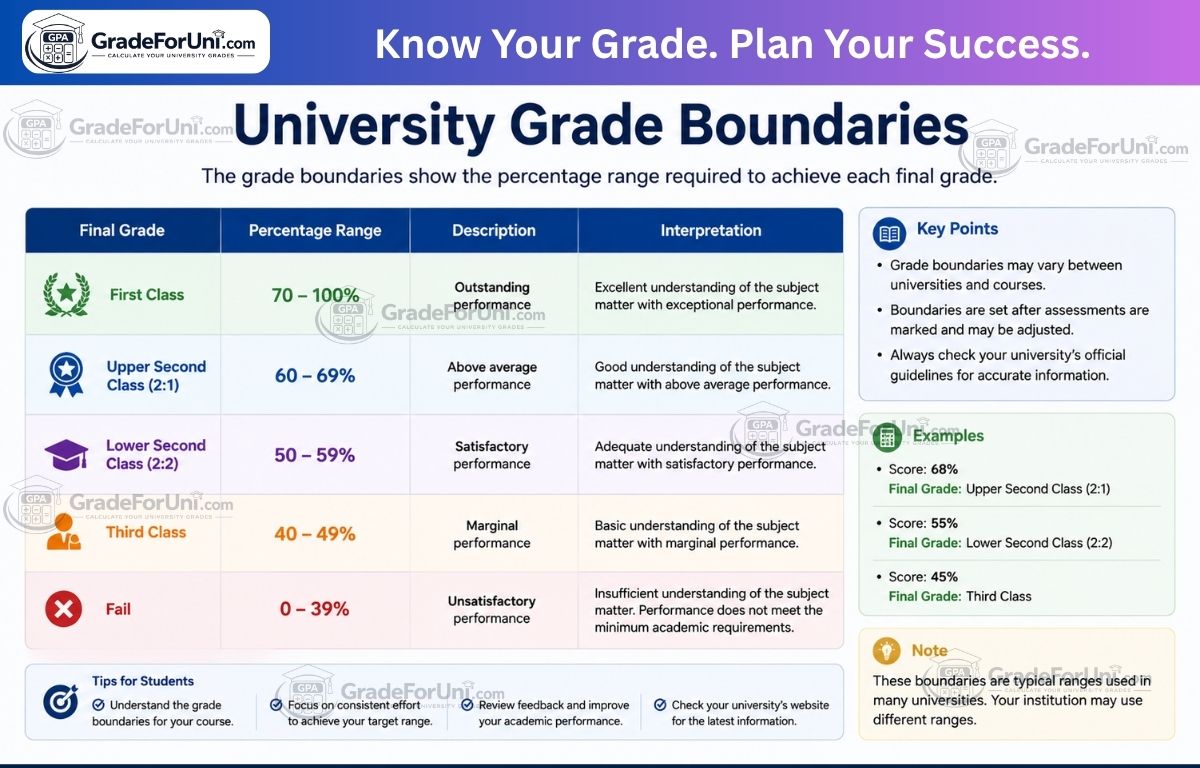
University Grade Boundaries: Have you received your university marks but aren’t sure whether you’ve passed? Are you wondering what score you need for a 2:1 or First-Class degree? Understanding University Grade Boundaries is one of the most important parts of university life, especially if you’re studying in the UK.
Many students assume that getting 40% simply means they have passed University Grade Boundaries. While that’s often true, there’s much more to university grading than just passing. Your marks determine your degree classification, progression to the next academic year, eligibility for scholarships, postgraduate study, and even some graduate job opportunities.
Every university sets grade boundaries to measure academic performance fairly. University Grade Boundaries: Although most UK universities follow a similar honours classification system, the exact rules can differ between institutions. Some universities use compensation rules, others apply borderline policies, and some calculate your final degree using weighted averages from different years of study.
University Grade Boundaries: This guide explains University Grade Boundaries in simple language. Whether you’re a first-year undergraduate, a final-year student, or preparing for university, you’ll learn how grade boundaries work, what marks you need, and how they affect your degree.
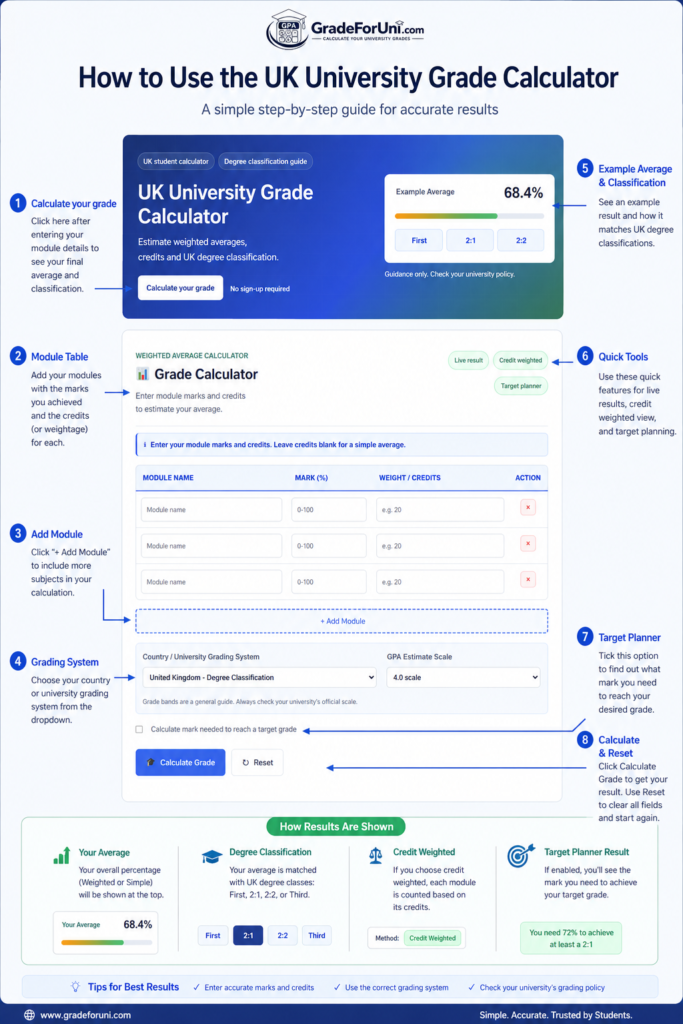
Click Here: UK University Grade Calculator
How to Use the UK University Grade Calculator
What Are University Grade Boundaries?
University Grade Boundaries are the mark ranges that determine whether you pass a module and which degree classification you achieve.
Instead of looking only at your overall percentage, universities compare your final marks against predefined boundaries. These boundaries help ensure that students are assessed consistently across different courses and departments.
For example, a mark of 72% is generally classified as a First-Class Honours, while 65% usually falls within the Upper Second-Class (2:1) category.
In simple terms, grade boundaries answer questions such as:
- Did you pass the module?
- Do you qualify for a First-Class degree?
- Will you progress to the next academic year?
- Do you need to resit an assessment?
- Are you eligible for graduation?
Without grade boundaries, universities would have no consistent way to classify academic achievement.
Read More: What Happens If You Fail a University Module? – Your Next Options Explained
Quick Answer: What Marks Do You Need to Pass?
If you’re looking for a quick answer, the table below shows the grade boundaries commonly used by UK universities.
| Overall Mark | Degree Classification | Result |
|---|---|---|
| 70% and above | First-Class Honours (First) | Excellent |
| 60–69% | Upper Second-Class (2:1) | Very Good |
| 50–59% | Lower Second-Class (2:2) | Good |
| 40–49% | Third-Class Honours | Pass |
| Below 40% | Fail | Resit or Repeat (depending on university rules) |
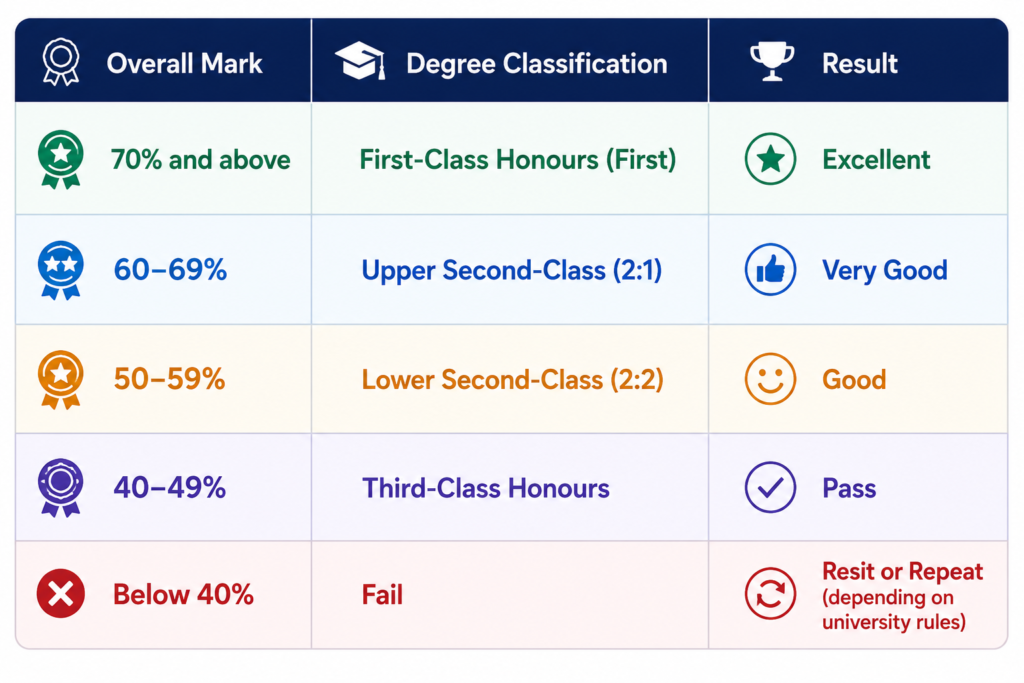
Important: These are the standard boundaries followed by many UK universities. Your institution may apply different progression rules, compensation policies, or assessment requirements.
Why Do University Grade Boundaries Matter?
Many students focus only on passing exams, but University Grade Boundaries influence far more than whether you pass a module.
They can affect:
- Your final degree classification
- Progression to the next academic year
- Eligibility for placements and internships
- Postgraduate admissions
- Graduate job applications
- Scholarships and academic awards
For example:
- Emily finishes her second year with an average of 69.4%.
- If her university has a borderline policy, she might still receive a First-Class Honours degree.
- If it doesn’t, she could graduate with a 2:1 instead.
- A difference of less than one percentage point can sometimes change the classification shown on your degree certificate.
Read More: Taxsal.comHow Do Universities Decide Grade Boundaries?
Universities don’t create grade boundaries randomly. University Grade Boundaries: They are based on academic regulations designed to maintain fairness and consistency across different courses.
Most universities consider several factors before applying grade boundaries.
National Academic Standards
UK universities generally follow national quality standards and qualifications frameworks. University Grade Boundaries: These provide guidance on the expected level of achievement for undergraduate degrees.
This helps ensure that a First-Class degree from one university represents a similar level of academic performance to a First-Class degree elsewhere, even though assessment methods may differ. University Grade Boundaries.
Module Learning Outcomes
Every module has learning outcomes that describe what students should know or be able to do by the end of the course.
Examiners assess whether your work meets these outcomes.
Higher marks usually demonstrate:
- Strong understanding of the subject
- Independent thinking
- Critical analysis
- Accurate use of evidence
- Well-structured arguments
Lower marks often indicate gaps in understanding or weaker application of knowledge.
Read More: University Module Mark Calculator – Find the Score You Need to Pass
Assessment Performance
Your final module mark may include several types of assessment.
Examples include:
- Written examinations
- Coursework
- Essays
- Laboratory reports
- Presentations
- Practical assessments
- Group projects
Each assessment usually contributes a percentage towards your overall module mark.
For example:
| Assessment | Weight | Score |
|---|---|---|
| Coursework | 40% | 68% |
| Final Exam | 60% | 62% |
Overall Module Mark:
(68 × 40%) + (62 × 60%)
= 64.4%
This falls within the Upper Second-Class (2:1) boundary.
Understanding Degree Classifications
- One of the biggest misconceptions is that every percentage has a unique meaning.
- Instead, percentages are grouped into classifications.
- These classifications appear on your degree certificate after graduation.
First-Class Honours (70%+)
A First-Class degree represents outstanding academic performance.
Students achieving this level typically:
- Demonstrate excellent understanding
- Produce high-quality coursework
- Analyse information critically
- Present well-supported arguments
- Show originality and independent thinking
Many competitive postgraduate programmes and graduate employers value First-Class degrees, although they are not essential for every career.
Upper Second-Class Honours (2:1)
A 2:1 is one of the most common degree classifications among successful graduates.
It demonstrates strong academic ability and is accepted for most graduate jobs and Master’s programmes.
Students with a 2:1 usually:
- Understand topics well
- Apply theories correctly
- Produce organised academic work
- Show good analytical skills
Many employers list a 2:1 as their preferred minimum requirement.
Lower Second-Class Honours (2:2)
A 2:2 indicates a solid pass with a good understanding of the course material.
Graduates with this classification still have many career opportunities.
Some postgraduate courses may require additional work experience instead of a 2:1, but a 2:2 remains a respected qualification.
Third-Class Honours
- Students receiving between 40% and 49% generally graduate with a Third-Class degree if they meet all university requirements.
- Although it is the lowest honours classification, it still represents successful completion of an undergraduate degree.
- Many graduates with Third-Class degrees build successful careers through professional experience and additional qualifications.
Fail
- Marks below the university pass mark usually result in a failed module.
- However, failing one module does not always mean failing your entire degree.
Depending on university regulations, you may be able to:
- Take a resit assessment
- Repeat the module
- Receive compensation if your overall performance is strong
- Progress with certain conditions
The exact outcome depends on your university’s academic regulations.
Module Marks vs Final Degree Classification
- One area that often confuses students is the difference between module marks and degree classification.
- These are not the same thing.
- A module mark is the score you receive for an individual subject.
A degree classification is based on your overall academic performance across multiple modules, usually with greater weighting given to later years of study.
For example:
| Module | Credits | Mark |
|---|---|---|
| Economics | 20 | 72% |
| Statistics | 20 | 66% |
| Business Law | 20 | 58% |
| Marketing | 20 | 64% |
Although one module achieved First-Class marks, your final classification depends on the weighted average of all modules according to your university’s regulations.
Do All UK Universities Use the Same Grade Boundaries?
The short answer is no.
While most universities follow the same honours classification ranges, they can differ in areas such as:
- Pass requirements for individual assessments
- Compensation rules
- Borderline classifications
- Credit requirements
- Resit policies
- Weighting of each academic year
- Professional accreditation requirements
This is why it’s always important to read your university’s academic regulations rather than relying on general advice alone.
Typical University Grade Boundaries in the UK
Although every university has its own academic regulations, most UK institutions use similar University Grade Boundaries for undergraduate honours degrees. Understanding these boundaries helps you set realistic goals and know exactly what you need to achieve.
The table below shows the standard classifications used by many universities.
| Percentage | Classification | What It Means |
|---|---|---|
| 70% and above | First-Class Honours (First) | Outstanding academic performance |
| 60–69% | Upper Second-Class Honours (2:1) | Strong performance |
| 50–59% | Lower Second-Class Honours (2:2) | Good performance |
| 40–49% | Third-Class Honours | Satisfactory pass |
| Below 40% | Fail | Usually requires a resit or repeat |
Remember that this table is only a general guide. Some universities may apply additional rules for professional courses such as Medicine, Nursing, Law, or Engineering.
Read More: University Academic Regulations Explained – Rules Every Student Should Know
What Is the University Pass Mark?
One of the most common questions students ask is:
“What mark do I need to pass university?”
For most undergraduate courses in the UK, the answer is:
40% is usually the minimum pass mark for an undergraduate module.
However, passing a module is not always enough to progress to the next academic year or graduate.
You may also need to:
- Pass a minimum number of credits.
- Meet progression requirements.
- Complete compulsory modules.
- Achieve minimum marks in practical or professional assessments.
For postgraduate taught courses, the pass mark is often higher.
| Study Level | Typical Pass Mark |
|---|---|
| Undergraduate | 40% |
| Postgraduate (Master’s) | 50% |
Always check your university handbook because these requirements can vary.
Understanding Borderline Grades
Sometimes your final average sits just below the next classification.
For example:
- 69.6%
- 59.8%
- 49.7%
These are known as borderline grades.
Many universities have regulations that allow exam boards to review borderline cases before confirming a student’s final degree classification.
Example
- David graduates with an overall average of 69.7%.
- Although this is technically below 70%, the exam board reviews his academic profile.
- If most of his final-year credits were above 70%, the board may decide to award him a First-Class Honours degree under the university’s borderline policy.
- Not every university follows the same approach, which is why students should never assume a borderline mark will automatically be rounded up.
Factors Universities May Consider
When reviewing borderline cases, universities may look at:
- Performance in the final year
- Number of credits above the higher boundary
- Improvement throughout the course
- Results in compulsory modules
- Overall academic profile
The final decision is normally made by the examination board according to university regulations.
What Is Compensation?
Another term students often hear is compensation.
Compensation means a university allows a student to pass a module even though the mark is slightly below the normal pass mark, provided their overall academic performance is strong University Grade Boundaries.
This policy recognises that one weak result should not necessarily prevent a capable student from progressing.
Example
Sarah studies four modules.
| Module | Mark |
|---|---|
| Psychology | 72% |
| Sociology | 68% |
| Research Methods | 64% |
| Statistics | 38% |
Although Sarah scored 38% in Statistics, her university may compensate for the failed module because:
- Her overall average is high.
- The failed mark falls within the compensatable range.
- She has earned enough credits in other modules.
Not every university offers compensation, and some courses—particularly professionally accredited programmes—do not allow it at all.
What Is a Condoned Pass?
A condoned pass is similar to compensation but has a different meaning. University Grade Boundaries
Instead of changing the failed mark, the university records that the student has met the overall requirements despite a small failure.
In other words:
- The original mark remains.
- Credits may still be awarded.
- The student can usually continue studying.
Condoned passes are subject to strict university regulations and are not available in every course.
What Happens If You Fail a Module?
Failing a module can feel disappointing, but it does not always mean your degree is over. University Grade Boundaries.
Most universities provide students with opportunities to recover.
The available options usually depend on:
- Your module mark
- The number of failed credits
- University regulations
- Previous academic performance
Common outcomes include:
Resit Assessment University Grade Boundaries
A resit allows you to take another exam or submit another assessment.
Many universities cap the resit mark at the pass mark, even if you score much higher.
For example:
Original mark: 32%
Resit mark: 68%
Recorded mark:
40% (Pass)
The exact rules vary by institution.
Repeat the Module
If a resit is unsuccessful or unavailable, you may need to repeat the module during the next teaching period.
This usually involves:
- Attending lectures again
- Completing coursework
- Taking examinations
- Paying additional tuition fees in some cases
Repeating a module may delay graduation depending on your programme.
Repeat the Academic Year University Grade Boundaries
Students who fail multiple modules or do not earn enough credits may need to repeat the academic year.
Although this extends the length of the degree, it provides another opportunity to complete the required credits successfully.
How Are Final Degree Classifications Calculated?
Many students assume that every year of university contributes equally to their final degree.
In reality, most UK universities place greater emphasis on later years because they reflect a student’s highest level of academic achievement.
A common weighting system looks like this:
| Academic Year | Typical Contribution |
|---|---|
| First Year | Often 0% or progression only |
| Second Year | 30%–40% |
| Final Year | 60%–70% |
This means that strong performance in your final year can significantly improve your overall classification.
Example
Emma receives:
| Year | Average |
|---|---|
| First Year | 58% |
| Second Year | 63% |
| Final Year | 72% |
Because her final year carries the greatest weighting, her overall degree classification may still be a First or a strong 2:1, depending on her university’s calculation method and University Grade Boundaries.
Common Mistakes Students Make
Many students misunderstand University Grade Boundaries, leading to unnecessary stress or poor academic planning.
Here are some common mistakes to avoid.
Assuming Every University Uses the Same Rules
Although the grading classifications are similar, progression rules, resits, compensation, and borderline policies vary between universities.
Always read your own institution’s academic regulations.
Focusing Only on Passing
Passing with 40% may allow you to progress, but consistently aiming for the minimum can make it difficult to achieve a higher degree classification later.
Setting higher targets from the beginning gives you more flexibility if one assessment doesn’t go as planned.
Ignoring Module Credit Weighting
Not every module contributes equally.
A 30-credit module has a greater impact on your average than a 10-credit module.
Prioritise your study time according to each module’s weighting.
Leaving Coursework Until the Deadline
Coursework often contributes a significant percentage of your final module mark.
Submitting high-quality assignments on time can improve your overall average before the final examination.
Not Asking for Academic Support
Universities offer a wide range of support services, including:
- Academic skills workshops
- Writing centres
- Personal tutors
- Study advisers
- Library support
- Peer mentoring
Seeking help early can make a noticeable difference to your performance.
Practical Tips to Achieve Higher Grade Boundaries
If your goal is to graduate with a First or a 2:1, consistent habits matter more than last-minute revision.
Here are some practical strategies:
- Read the marking criteria before starting any assignment.
- Break large assignments into smaller tasks with personal deadlines.
- Revise regularly instead of cramming before exams.
- Use feedback from previous coursework to improve future submissions.
- Ask lecturers for clarification if assignment requirements are unclear.
- Practise past exam questions whenever they are available.
- Form study groups to discuss challenging topics.
- Keep track of your module marks throughout the semester.
- Focus extra attention on higher-credit modules.
- Aim above the minimum pass mark to protect your overall average.
Small improvements across several modules can have a significant impact on your final degree classification.
Do University Grade Boundaries Change Every Year?
One question students often ask is whether University Grade Boundaries stay the same every academic year.
The answer is not always.
University Grade Boundaries: The overall honours classifications (First, 2:1, 2:2, Third, and Fail) remain largely consistent across UK universities. However, universities may update their academic regulations, assessment methods, progression rules, or borderline policies from time to time.
For example, a university may:
- Introduce new compensation or condonement rules.
- Change how final-year marks are weighted.
- Update resit regulations.
- Revise progression requirements for certain courses.
- Modify assessment formats or grading policies.
These changes are usually announced in the university’s academic handbook before the academic year begins.
Tip: Always check your university’s latest regulations instead of relying on advice from students who studied in previous years.
UK University Grade Boundaries vs Other Grading Systems
If you’re an international student, you may notice that UK universities grade students differently from schools or universities in other countries.
The table below provides a simple comparison.
| UK Classification | Typical Percentage | General Equivalent |
|---|---|---|
| First-Class Honours | 70%+ | Excellent |
| Upper Second (2:1) | 60–69% | Very Good |
| Lower Second (2:2) | 50–59% | Good |
| Third-Class | 40–49% | Satisfactory Pass |
| Fail | Below 40% | Not Passed |
Keep in mind that grading systems vary widely between countries. University Grade Boundaries A percentage that is considered excellent in one country may not directly correspond to a UK classification.
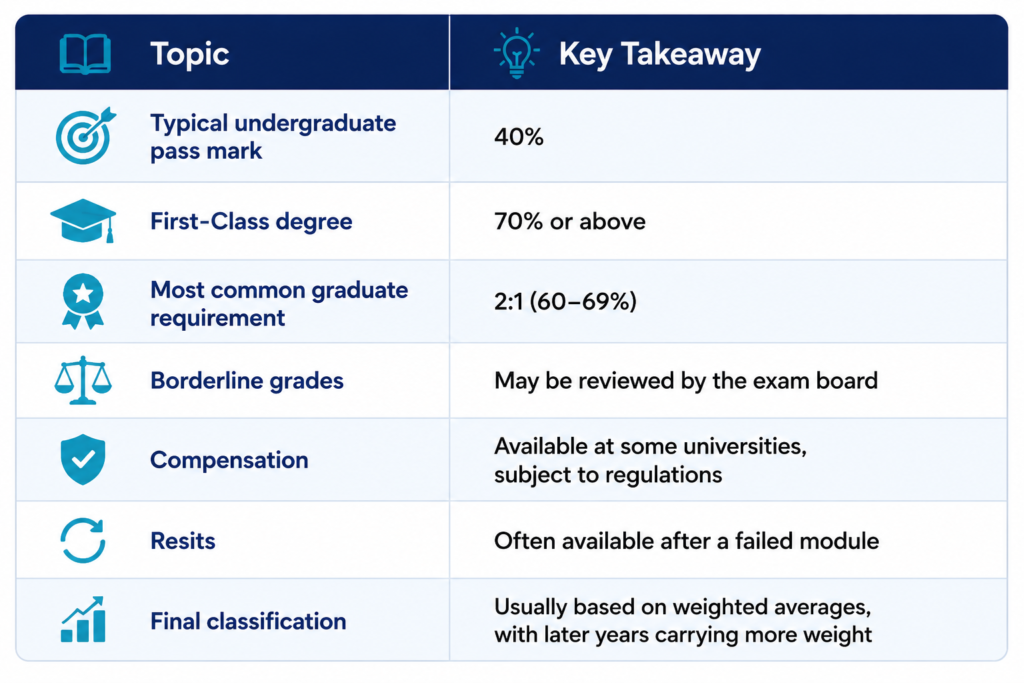
Quick Summary of University Grade Boundaries
If you only remember a few key points from this guide, make them these:
| Topic | Key Takeaway |
|---|---|
| Typical undergraduate pass mark | 40% |
| First-Class degree | 70% or above |
| Most common graduate requirement | 2:1 (60–69%) |
| Borderline grades | May be reviewed by the exam board |
| Compensation | Available at some universities, subject to regulations |
| Resits | Often available after a failed module |
| Final classification | Usually based on weighted averages, with later years carrying more weight |
How to Stay on Track Throughout Your Degree
Understanding University Grade Boundaries is only one part of academic success. The other part is monitoring your progress throughout the year.
A few good habits can make a big difference in University Grade Boundaries:
Keep a Record of Your Marks
Create a simple spreadsheet or use a grade calculator to record:
- Module names
- Credits
- Coursework marks
- Exam marks
- Overall module average
This helps you identify which modules need extra attention before final exams.
Understand Assessment Weightings
Some students spend the same amount of time on every assignment, even though they are not equally important.
For example:
| Assessment | Weight |
|---|---|
| Coursework | 20% |
| Mid-term Test | 20% |
| Final Exam | 60% |
Since the final exam contributes the largest share of your module mark, preparing thoroughly for it can have the biggest impact on your overall result.
Use Feedback to Improve
Feedback is more than just a mark. Lecturers often explain what you did well and where you can improve.
Before starting your next assignment:
- Read previous feedback carefully.
- Look for recurring comments.
- Apply those suggestions to your future work.
Small improvements over time can help move your average from a 2:2 to a 2:1—or from a 2:1 to a First.
Read More: University Marking Criteria Explained – How Your Work Is Assessed
FAQS
What are University Grade Boundaries?
University Grade Boundaries are the percentage ranges used to determine whether you pass a module and which degree classification you receive. Most UK universities use classifications such as First, 2:1, 2:2, Third, and Fail.
What percentage is a pass at a UK university?
For most undergraduate degrees, 40% is the standard pass mark. However, some professional or postgraduate courses may require higher marks.
Is 60% a good university grade?
Yes. A mark between 60% and 69% usually earns an Upper Second-Class Honours (2:1), which is considered a strong academic result and is accepted for many graduate jobs and postgraduate courses.
Is 70% a First-Class degree?
In most UK universities, 70% or above is classified as a First-Class Honours degree. Individual university regulations should always be checked.
Can I graduate if I fail one module?
Possibly. Depending on your university’s regulations, you may be offered a resit, be allowed to repeat the module, or qualify for compensation. The outcome depends on your overall academic performance and programme requirements.
Final Thoughts
Understanding University Grade Boundaries gives you a clearer picture of what your marks mean and how they affect your academic journey. While the percentage you earn is important, it’s equally important to understand the rules your university uses to calculate progression, module results, and your final degree classification.
Rather than focusing only on the minimum pass mark, aim to build consistent performance across all your modules. Paying attention to assessment weightings, using feedback to improve, and tracking your progress can make a significant difference to your final result.
Remember that every university has its own academic regulations. Before making decisions about resits, progression, or graduation, always refer to your university’s official handbook or speak with your academic adviser if you’re unsure.
Whether you’re aiming for a First-Class Honours, working towards a 2:1, or simply trying to understand your results better, knowing how University Grade Boundaries work will help you plan your studies with greater confidence and make informed decisions throughout your degree.