

University Grade Guide If you’ve ever stared at your student portal wondering what a 64% actually means for your degree, you’re not alone. Thousands of UK university students ask the same question every year: how do percentages, GPA and degree classifications actually connect?
This University Grade Guide brings everything together in one place. (University Grade Guide) Whether you’re a first-year trying to make sense of your first set of module marks, a final-year student working out your overall classification, or an international student trying to understand the UK system for the first time, this guide walks you through it from the ground up.
Grading in the UK works differently from many other countries. (University Grade Guide) Instead of a simple numerical GPA, most UK universities award a percentage-based mark that’s then converted into an honours classification like a First or a 2:1. That difference alone confuses a lot of students, especially those applying from the US, India, Pakistan, or elsewhere.
Quick Answer: UK universities grade coursework and exams as a percentage (0–100%). (University Grade Guide) Your overall average then maps to a degree classification: 70%+ is a First, 60–69% is a 2:1, 50–59% is a 2:2, 40–49% is a Third, and below 40% is a Fail. Some universities also provide a GPA equivalent for international applications, typically on a 4.0 or 5.0 scale.
Click Here: UK University Grade Calculator
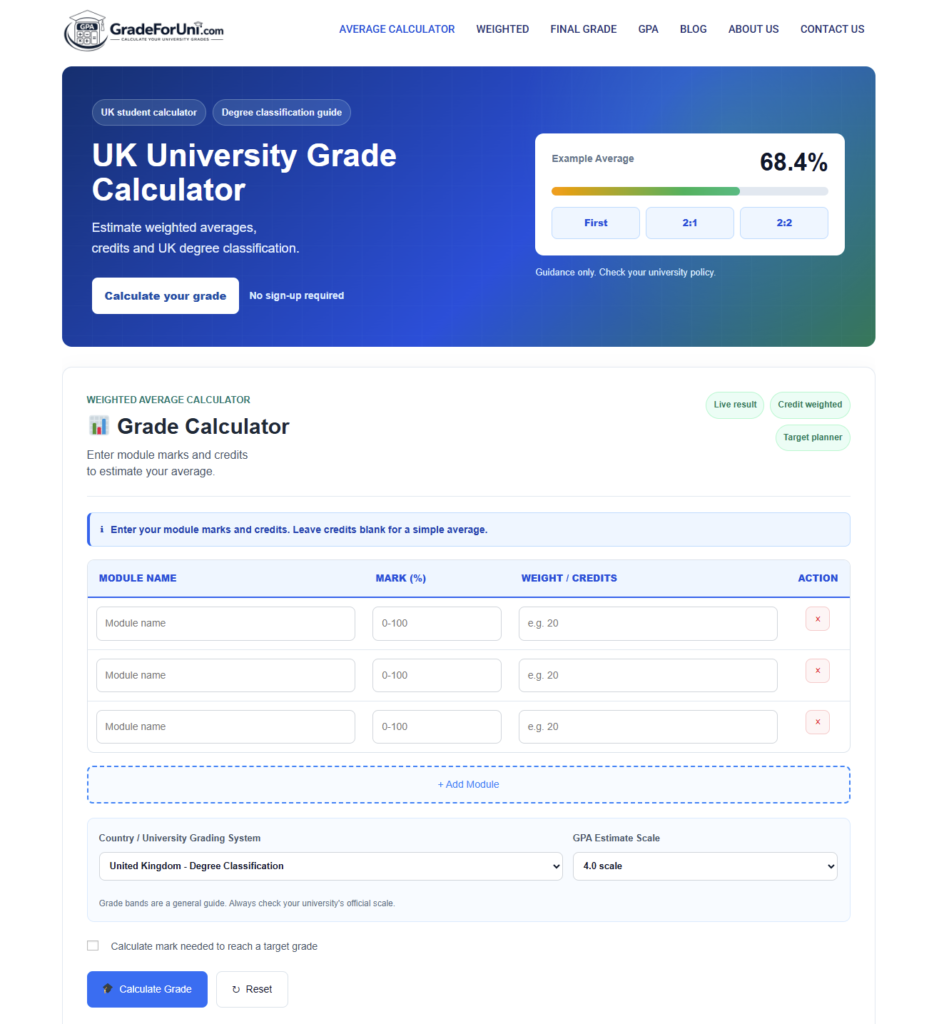
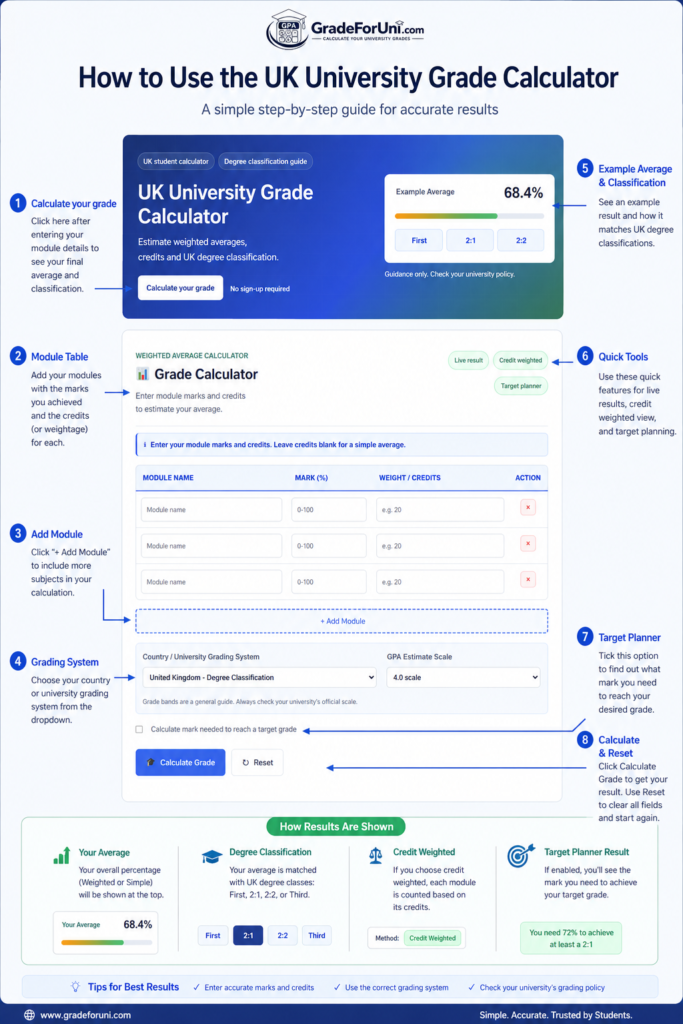
How to Use the UK University Grade Calculator
Why Understanding UK Grading Matters
Your grades aren’t just numbers on a transcript. (University Grade Guide) They influence:
- Whether you progress to the next academic year
- Your eligibility for placements, exchanges, and scholarships
- Entry requirements for postgraduate study
- Graduate job applications, since many employers still list a 2:1 as their preferred minimum
Because so much depends on your final classification, it’s worth understanding the system properly rather than guessing. (University Grade Guide) A one-percentage-point difference can sometimes be the gap between a 2:1 and a First on your actual degree certificate.
International students face an extra layer of complexity. (University Grade Guide) A grade considered outstanding under one country’s system might translate very differently under UK conventions, which is why GPA conversion causes so much confusion for exchange students and postgraduate applicants.
Key Terms You Need to Know
Before going any further, it helps to get comfortable with the vocabulary used throughout UK universities.
Module Mark – The percentage score you receive for one individual subject, usually made up of coursework, exams, or a mix of both.
Credits – A value assigned to each module based on its workload and importance. (University Grade Guide) A standard UK undergraduate year is usually worth 120 credits, with individual modules commonly worth 10, 20, or 30 credits each.
Weighted Average – An average that accounts for credit value, so a 30-credit module influences your final result more than a 10-credit module.
Degree Classification – The honours category your overall percentage maps to: First, Upper Second (2:1), Lower Second (2:2), Third, or Fail.
GPA (Grade Point Average) – A numerical scale, commonly out of 4.0 or 5.0, used mainly outside the UK and by some international application systems.
Pass Mark – The minimum percentage needed to pass a module, typically 40% for undergraduate courses and 50% for postgraduate taught courses.
Here’s how these terms fit together at a glance:
| Term | What It Measures | Typical Scale |
| Module Mark | One subject’s result | 0–100% |
| Credits | Workload/importance of a module | 10, 20, 30 (varies) |
| Weighted Average | Overall performance across modules | 0–100% |
| Degree Classification | Final honours category | First, 2:1, 2:2, Third, Fail |
| GPA | International equivalent scale | 4.0 or 5.0 |
How UK Percentage Grading Works
Most UK universities don’t grade individual pieces of work on a letter or a GPA point straight away. (University Grade Guide) Instead, everything starts as a percentage.
Each assessment — an exam, an essay, a lab report, a presentation — is marked out of 100%. (University Grade Guide) These individual scores are then combined, usually with credit weighting applied, to produce a module mark. Module marks across a year, or across your whole degree, are combined again to produce your overall average, which is what ultimately gets translated into a degree classification.
A simplified example:
A student takes three modules in their second year:
| Module | Mark | Credits |
| Marketing | 72% | 20 |
| Statistics | 58% | 20 |
| Business Law | 65% | 20 |
Since all three modules carry equal credits here, the average is a simple one: (72 + 58 + 65) ÷ 3 = 65%, which sits comfortably in the 2:1 range.
If the credit values had been different, the calculation would need to weight each mark according to its credit share rather than treating every module equally. (University Grade Guide) The next section walks through exactly how to do that.
Visit Now: Mauricette Calculette
Common Misconceptions About University Grades
A lot of unnecessary stress comes from misunderstanding how the system actually works. (University Grade Guide) Here are the assumptions worth clearing up early.
“Every percentage point matters equally.” In reality, marks are grouped into classification bands. (University Grade Guide) The practical difference between 61% and 68% is often small, since both sit within the 2:1 band, but the difference between 69% and 70% can change your entire classification.
“My first year counts the same as my final year.” Most UK universities weight later years more heavily than first year, and some don’t count first year towards your final classification at all.
“GPA and UK percentages convert on a simple fixed formula.” They don’t. Conversion depends on the scale being used and the institution’s own conversion table, which is why the same percentage can translate to different GPA figures depending on where you’re applying.
“A high module mark guarantees a high overall classification.” One strong module can be pulled down significantly by a low-credit or low-mark module elsewhere, especially if credit weighting isn’t factored in.
Percentages vs GPA: A Quick Comparison
Since GPA comes up constantly for international students, here’s a general sense of how the two systems tend to line up. Always check your specific institution’s official conversion table, since this varies (University Grade Guide).
| UK Percentage | Approx. UK Classification | General GPA Equivalent (4.0 scale) |
| 70%+ | First | 3.7 – 4.0 |
| 60–69% | 2:1 | 3.3 – 3.6 |
| 50–59% | 2:2 | 3.0 – 3.2 |
| 40–49% | Third | 2.0 – 2.9 |
| Below 40% | Fail | Below 2.0 |
Treat this as a general guide rather than an exact science. (University Grade Guide) Different universities and application systems use their own conversion scales, so it’s worth confirming the specific one that applies to you before relying on it for an application.
How to Calculate Your Weighted Average, Step by Step
With the terminology and general structure clear, here’s the calculation most students actually search for. (University Grade Guide) Once you’ve done it once, it becomes second nature.
List Every Module With Its Mark and Credit Value
Write down each module you’ve completed, its percentage mark, and how many credits it’s worth. (University Grade Guide) You’ll find credit values in your course handbook or student portal.
Multiply Each Mark by Its Credit Value (University Grade Guide)
This gives you the weighted contribution of each module.
Add All the Weighted Contributions Together
This gives you a single combined total.
Divide by the Total Number of Credits
This final step converts your combined total back into a percentage — your weighted average.
The formula looks like this:
Weighted Average = (Mark₁ × Credits₁ + Mark₂ × Credits₂ + …) ÷ (Credits₁ + Credits₂ + …)
Worked Example
A final-year student has four modules:
| Module | Mark | Credits |
| Dissertation | 68% | 40 |
| Advanced Economics | 74% | 20 |
| Financial Modelling | 61% | 20 |
| International Trade | 70% | 20 |

Applying the formula:
(68×40 + 74×20 + 61×20 + 70×20) ÷ (40+20+20+20)
= (2720 + 1480 + 1220 + 1400) ÷ 100
= 6820 ÷ 100
= 68.2%
That result sits just below the First-Class boundary, in the upper end of the 2:1 band. Notice how the dissertation, worth 40 credits, carries more weight than any single 20-credit module. (University Grade Guide) This is exactly why credit weighting matters — a strong dissertation mark can lift your entire average more than any other individual piece of work.
Converting Between Percentages and GPA
If you’re applying abroad, transferring credits, or simply want an international reference point, you’ll likely need to convert your UK percentage into a GPA figure.
There’s no single universal formula for this, since every institution and scholarship body sets its own conversion table. (University Grade Guide) Most conversions, however, follow a similar general pattern based on your degree classification band rather than your exact percentage.
A commonly used approximate scale:
| UK Percentage Range | 4.0 Scale | 5.0 Scale |
| 90–100% | 4.0 | 5.0 |
| 80–89% | 3.9 | 4.8 |
| 70–79% | 3.7 | 4.5 |
| 60–69% | 3.3 | 4.0 |
| 50–59% | 3.0 | 3.5 |
| 40–49% | 2.0 | 2.5 |
| Below 40% | 0.0 | 0.0 |
Important note: Some institutions use “banded” conversion, where your entire percentage falls into a fixed GPA value based on your classification. Others use a sliding scale that adjusts within each band. (University Grade Guide) Always check the specific conversion table provided by the university or organisation you’re applying to, rather than relying on a general guide like this one.
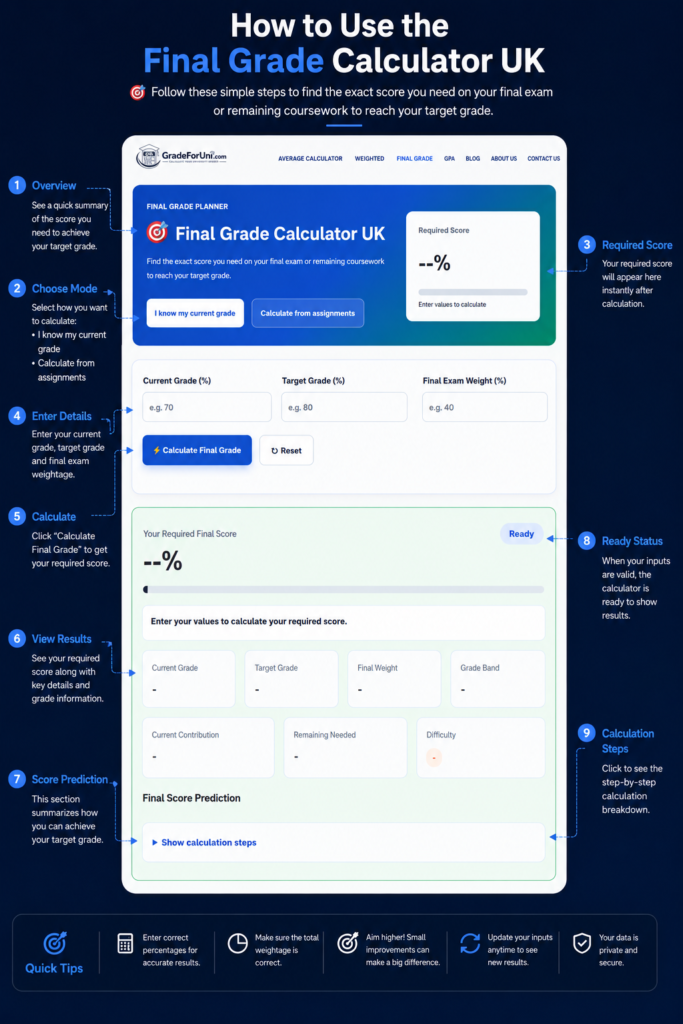
Final Grade Calculator UK (University Grade Guide)
Real-Life Scenario (University Grade Guide)
Aisha, a UK student with an overall average of 66%, applies for a postgraduate exchange programme in the US. (University Grade Guide) The programme asks for her GPA. Using the general 4.0 scale above, her 66% converts to approximately 3.3, placing her comfortably within the university’s minimum GPA requirement.
Had she relied on a flat conversion instead of checking the receiving institution’s actual scale, she might have submitted a GPA that under- or overstated her academic performance, which could have affected her application (University Grade Guide).
Comparing Grading Systems Side by Side
International students often find it easier to understand UK grading once they can see it next to systems they already know.
| System | Scale Used | Roughly Equivalent to a UK 2:1 (60–69%) |
| United Kingdom | Percentage (0–100%) | 60–69% |
| United States | Letter grade / 4.0 GPA | B to B+ (3.0–3.6) |
| Pakistan | Percentage / CGPA | 60–69% / 3.0–3.5 CGPA |
| India | Percentage / Division | First Division (60%+) |
| Australia | Honours band | Credit to Distinction |
| Canada | Percentage / Letter | B to B+ |
This table is a general guide rather than an official conversion, since every country and institution applies its own standards. (University Grade Guide) It’s still a useful reference point when explaining your UK grades to someone unfamiliar with the system, or when comparing offers from universities in different countries.
How Degree Classifications Are Actually Calculated
A weighted average across all your modules doesn’t always translate directly into your final degree classification. (University Grade Guide) Most UK universities apply an additional layer of weighting based on academic year.
A typical structure looks like this:
| Academic Year | Typical Weighting |
| Year 1 | 0% (progression only) |
| Year 2 | 25–40% |
| Final Year | 60–75% |
Your final year has a much bigger impact on your degree classification than your second year, and your first year often doesn’t count towards the final result at all — though it still needs to be passed to progress.
Worked Example
A student’s yearly averages are:
| Year | Average |
| Year 1 | 61% |
| Year 2 | 65% |
| Final Year | 74% |
If the university weights Year 2 at 30% and Final Year at 70%:
(65 × 30 + 74 × 70) ÷ 100
= (1950 + 5180) ÷ 100
= 71.3%
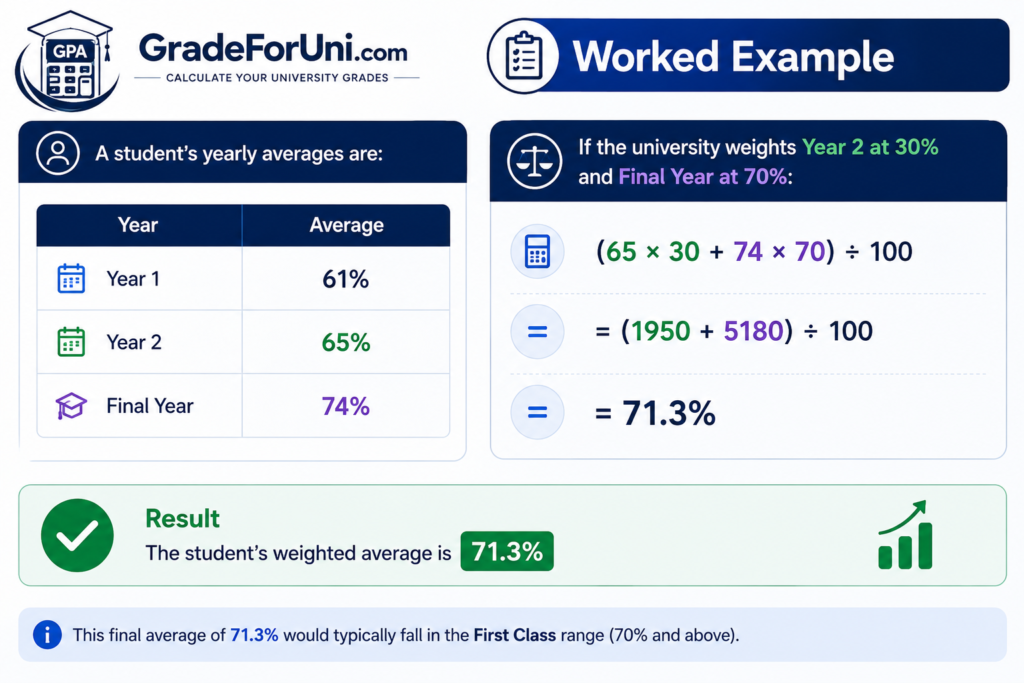
Despite a relatively modest Year 2 average, the strong final-year performance pushes the overall result comfortably into First-Class territory. This is a common pattern — students who improve steadily throughout their degree often end up with a higher classification than their early grades suggested.
Common Mistakes When Calculating Grades
Even students who understand the theory often make small errors that throw off their calculations.
Forgetting to weight by credits. Treating every module as equally important, even when credit values differ, produces an inaccurate average.
Mixing up year weighting with module weighting. These are two separate calculations. Module weighting combines individual subjects within a year; year weighting combines yearly averages into a final result.
Assuming every university uses the same weighting split. The 25/75 or 30/70 splits used above are common, but not universal. Some universities weight Year 2 and Final Year equally; others exclude Year 2 entirely.
Rounding too early. Rounding a module mark before including it in a larger calculation can shift your final result, especially across several modules. Keep numbers unrounded until the final step.
Ignoring resit caps. If you’ve resat a module, many universities cap the recorded mark at the pass threshold regardless of your actual resit score. Using your real resit mark instead of the capped mark will give you an inflated average.
Best Practices for Tracking Your Grades
- Keep a running spreadsheet with module names, credits, and marks as soon as results are released
- Separate your calculations by year so you can see both individual year performance and combined progress
- Recalculate your average after every new result rather than waiting until the end of the year
- Check your university’s specific weighting policy in your course handbook rather than assuming a standard split
- Use unrounded figures throughout your calculation and only round the final result
Expert tip: If you’re aiming for a specific classification, work backwards. Take your target percentage, subtract the weighted contribution of marks you’ve already secured, and divide the remainder by the credits still available. This tells you exactly what average you need across your remaining modules — a far more useful approach than simply hoping for the best in your final exams.
Advanced Tips for an Accurate Picture of Your Grades
Once you’ve got the basic calculations down, a few advanced habits can make your grade tracking genuinely useful rather than just a number on a spreadsheet.
Track your “movement zone.” Instead of only calculating your current average, work out the range of results still possible based on your remaining assessments. This shows you both your best-case and worst-case classification, which is far more useful for planning than a single static number.
Separate coursework and exam averages. If your modules are split between coursework and exams, tracking these separately can reveal patterns — for example, consistently stronger coursework marks might suggest exam technique is worth extra attention, rather than subject knowledge itself.
Watch for capped resit modules skewing your average. If a module mark has been capped after a resit, your recorded average may look lower than your actual academic ability. Keep a personal note of your uncapped scores so you understand your real performance, even if it’s not what appears on your transcript.
Recalculate after every published result, not just at year-end. Grade boundaries can feel abstract until you see how close you actually are. Updating your average regularly turns a vague target into something concrete you can act on.
Information Students Often Overlook
A few details get missed even by students who otherwise understand the system well.
Not all credits are academic. Some placement years, study-abroad terms, or pass/fail modules don’t count towards your classification average at all, even though they appear on your transcript. Check your handbook to confirm which modules are classified as “for classification” versus “for credit only.”
Classification isn’t always a strict cutoff. Many universities apply a borderline or “profiling” policy, reviewing students who fall just under a boundary — often within 1–2 percentage points — and checking whether the majority of their final-year credits sit in the higher band before confirming the lower classification.
GPA conversions can vary by scholarship or visa body, not just by university. A GPA calculated for a US graduate school application might differ from the GPA required for a specific scholarship or immigration pathway, even with the same underlying percentage.
Professional accreditation can override standard classification rules. Courses accredited by professional bodies — engineering, law, nursing, and similar — sometimes apply stricter pass marks or don’t allow compensation between modules, regardless of the university’s general policy.
Quick Reference: Percentage, Classification and GPA
| UK Percentage | Classification | Approx. GPA (4.0) | General Standing |
| 90–100% | First (exceptional) | 4.0 | Outstanding |
| 70–89% | First | 3.7–3.9 | Excellent |
| 60–69% | Upper Second (2:1) | 3.3 | Very Good |
| 50–59% | Lower Second (2:2) | 3.0 | Good |
| 40–49% | Third | 2.0–2.9 | Satisfactory |
| Below 40% | Fail | 0.0 | Not Passed |
Keep this table as a general reference point rather than an exact conversion, since individual institutions may apply slightly different boundaries or GPA scales.
Key Takeaways
- Keeping unrounded, up-to-date records of your marks gives you the clearest and most accurate picture of where you stand
- UK universities grade on a percentage scale (0–100%), which then maps to an honours classification
- Weighted averages account for credit value, so higher-credit modules — like dissertations — influence your result more than smaller modules
- Later academic years typically carry more weight than earlier ones, sometimes significantly more
- GPA conversion isn’t standardised, so always check the specific scale used by the institution or body you’re applying to
- Borderline results are sometimes reviewed rather than being a strict cutoff
Final Thoughts
(University Grade Guide) Understanding how UK grading actually works takes the guesswork out of a system that can otherwise feel confusing, especially when you’re juggling coursework deadlines alongside trying to figure out what your marks actually mean for your future.
This University Grade Guide has walked through the full picture: how percentages, credits, and weighted averages combine to form your module marks, how those marks build into a yearly and final classification, and how to translate all of it into GPA terms when you need to (University Grade Guide).
The most important habit to take away is a simple one — track your marks consistently, understand your university’s specific weighting policy rather than assuming a standard split, and recalculate your progress regularly rather than waiting until results day to find out where you stand. (University Grade Guide) With that approach, you’ll always have a clear, accurate picture of your academic progress and exactly what you need to reach your target classification.
FAQ’s
How is a UK university percentage different from GPA?
A UK percentage reflects your exact mark out of 100 for each piece of work, while GPA condenses performance into a smaller numerical scale, usually 4.0 or 5.0. (University Grade Guide) The two systems don’t convert on a single fixed formula, so any GPA figure is an approximation based on your classification band.
What percentage do I need for a First-Class degree?
Most UK universities set the First-Class boundary at 70% or above, though some borderline cases just under this mark may still be reviewed and upgraded depending on the university’s policy.
Does my first year count towards my final degree classification?
Usually not, or only minimally. Most UK universities require you to pass Year 1 to progress, but exclude it — or weight it at 0% — when calculating your final classification.
How do I calculate my weighted average manually?
Multiply each module’s mark by its credit value, add these totals together, then divide by the total number of credits. This gives you a credit-weighted percentage rather than a simple average.
Can a low mark in one module ruin my overall classification?
Not necessarily. (University Grade Guide) Depending on the module’s credit weighting and your university’s compensation policy, a single low mark can be balanced out by stronger results elsewhere, though this varies by institution and course.
Is a 2:2 a bad degree?
No. A Lower Second-Class (2:2) reflects a solid, respectable academic performance and remains a valid qualification for many careers, though some competitive graduate schemes list a 2:1 as their preferred minimum.
How accurate are GPA conversion tables?
They’re a useful general guide but not official. (University Grade Guide) Universities, scholarship providers, and visa authorities may each apply their own conversion scale, so it’s best to check directly with the specific organisation requesting your GPA.
What happens if my average falls right on a classification boundary?
Many universities review borderline results, particularly when a student’s final-year performance sits mostly within the higher band. This isn’t guaranteed, so it’s worth checking your institution’s specific borderline or profiling policy.
Do all UK universities weight academic years the same way?
No. While many follow a similar pattern of weighting later years more heavily, the exact split — such as 25/75 or 30/70 — varies between institutions and even between courses within the same university.
Should I use my capped resit mark or my actual resit score when calculating my average?
Use the mark officially recorded by your university, since this is what counts towards your classification. If your resit mark was capped at the pass threshold, your transcript will show the capped figure, not your original resit score.