

University Coursework: Imagine two students studying the same degree at the same university. Emma starts her assignments early, follows the marking criteria, and uses tutor feedback to improve. Daniel leaves most of his coursework until the last few days before the deadline, believing the final exam matters most.
This guide explains how university coursework affects your final grade, how assessment weightings work, and how to improve your overall academic performance.
Want to see how your coursework and exam marks affect your overall result?
Use our University Grade Calculator to estimate your module or final grade in seconds.
University coursework contributes directly to your module marks, which may then influence your overall degree classification. University Coursework: Depending on the module, coursework can account for 20% to 100% of the final mark, making strong coursework performance essential.
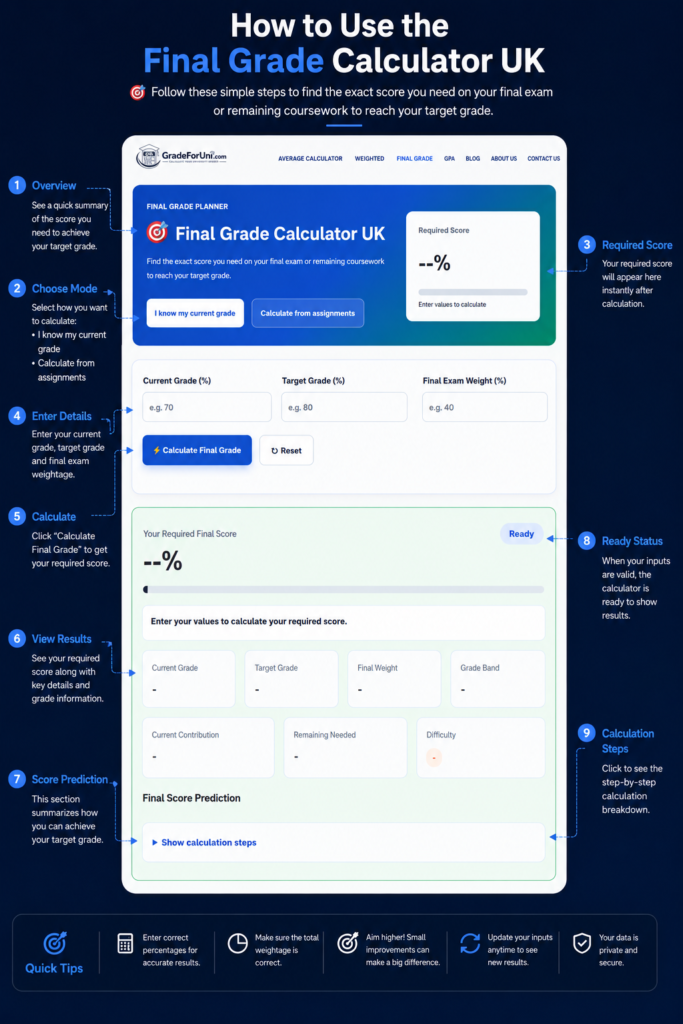
Click Here: Final Grade Calculator UK
How to use the Final Grade Calculator UK
What Is University Coursework?
University coursework is assessed work completed during a module that contributes towards your final module mark. University Coursework It may involve written assignments, projects, presentations, laboratory work, portfolios, or dissertations depending on the subject being studied.
Why Universities Use Coursework Instead of Only Exams
Examinations test knowledge at one specific moment, whereas coursework measures consistent academic performance over a longer period.
Universities increasingly use coursework because it helps students develop skills required in employment as well as higher education.
Benefits of coursework include:
- Encourages independent research
- Develops academic writing skills
- Improves critical thinking
- Allows practical application of theory
- Rewards consistent effort throughout the semester
- Provides detailed feedback for improvement
Coursework also gives students multiple opportunities to demonstrate their understanding rather than relying on a single exam day.
Read More: Taxsal.comCommon Types of University Coursework
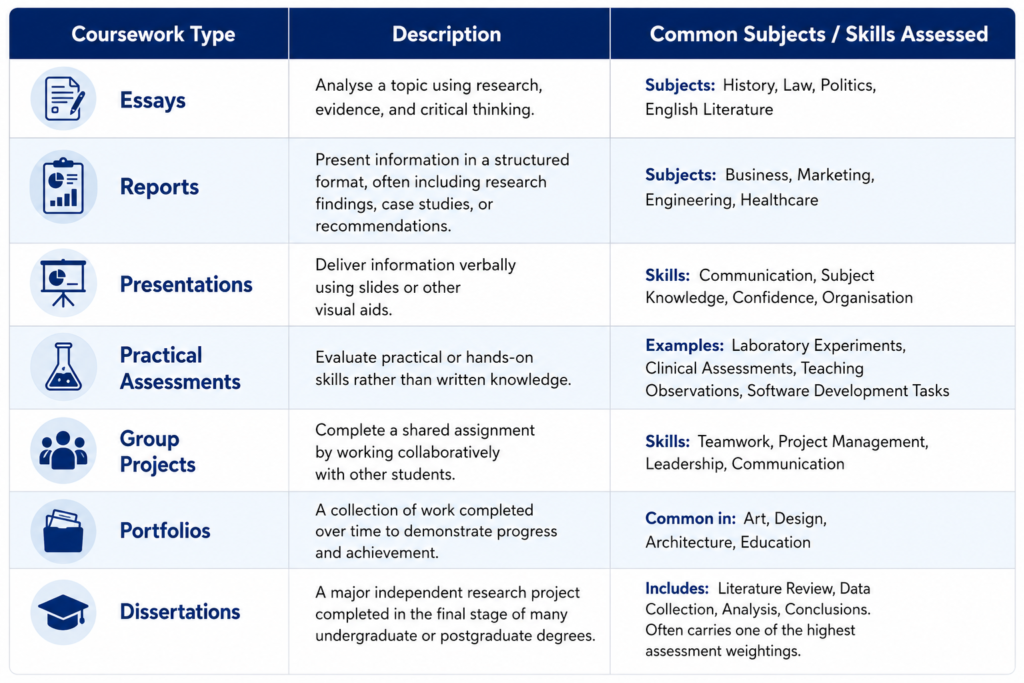
Some of the most common forms include:
Common Types of University Coursework
| Coursework Type | Description | Common Subjects / Skills Assessed |
|---|---|---|
| Essays | Analyse a topic using research, evidence, and critical thinking. | Subjects: History, Law, Politics, English Literature |
| Reports | Present information in a structured format, often including research findings, case studies, or recommendations. | Subjects: Business, Marketing, Engineering, Healthcare |
| Presentations | Deliver information verbally using slides or other visual aids. | Skills: Communication, Subject Knowledge, Confidence, Organisation |
| Practical Assessments | Evaluate practical or hands-on skills rather than written knowledge. | Examples: Laboratory Experiments, Clinical Assessments, Teaching Observations, Software Development Tasks |
| Group Projects | Complete a shared assignment by working collaboratively with other students. | Skills: Teamwork, Project Management, Leadership, Communication |
| Portfolios | A collection of work completed over time to demonstrate progress and achievement. | Common in: Art, Design, Architecture, Education |
| Dissertations | A major independent research project completed in the final stage of many undergraduate or postgraduate degrees. | Includes: Literature Review, Data Collection, Analysis, Conclusions. Often carries one of the highest assessment weightings. |
Does University Coursework Affect Your Final Grade?
Yes. In most UK universities, coursework contributes directly to your module marks, which are then used to calculate your overall academic performance. University Coursework: The impact depends on your assessment weighting, module credits, and university regulations.
Understanding these factors helps you make informed decisions about where to focus your efforts throughout the academic year.
How Coursework Contributes to Module Marks
Some modules are assessed entirely through coursework, while others combine coursework and exams.
For example:
| Assessment | Weight |
|---|---|
| Essay | 40% |
| Presentation | 20% |
| Final Exam | 40% |
Example: Calculating a Final Module Mark
| Assessment | Weight | Mark | Weighted Contribution |
|---|---|---|---|
| Essay | 40% | 72% | 28.8% |
| Presentation | 20% | 68% | 13.6% |
| Exam | 40% | 65% | 26.0% |
| Final Module Mark | 100% | — | 68.4% |
How Module Marks Affect Your Degree Classification
Every completed module usually carries credits.
These credits are combined to calculate yearly averages and, eventually, your degree classification.
For example:
| Module | Credits | Final Mark |
|---|---|---|
| Marketing | 20 | 72% |
| Accounting | 20 | 65% |
| Economics | 20 | 70% |
| Business Law | 20 | 68% |
| Management | 20 | 74% |
| Finance | 20 | 69% |
At many UK universities, later years carry greater weighting than earlier years when calculating the final honours classification.
Does Every Coursework Assignment Count Equally?
No.
Different assessments often have different percentage weightings.
For example:
| Coursework | Weight |
|---|---|
| Assignment 1 | 10% |
| Assignment 2 | 20% |
| Presentation | 20% |
| Final Project | 50% |
In this example, improving your final project by just a few percentage points has a much larger effect than improving Assignment 1.
Does Coursework Matter More Than Exams?
Whether coursework or exams matter more depends on your module’s assessment weighting.
Some examples include:
| Module Type | Coursework | Exam |
|---|---|---|
| Mathematics | 20% | 80% |
| Business | 50% | 50% |
| Computer Science | 60% | 40% |
| Design | 100% | 0% |
| Nursing Placement | 100% | 0% |
Always check your module handbook rather than making assumptions.
Read more:Degree Percentage Calculator – Convert Module Marks into Final PercentageHow University Coursework Is Weighted in UK Universities
One of the biggest misunderstandings among students is assuming every assessment contributes equally towards the final mark. University Coursework: In reality, universities assign different weightings to different assessments based on the learning outcomes of each module.
Understanding Assessment Weighting
Each assessment is allocated a percentage.
When all assessments are added together, they total 100%.
For example:
| Assessment | Weight |
|---|---|
| Essay | 25% |
| Case Study | 25% |
| Presentation | 20% |
| Final Exam | 30% |
| Total | 100% |
Typical Coursework and Exam Weightings
Below are some common examples you may come across.
| Module Type | Coursework | Exam |
|---|---|---|
| Business Management | 50% | 50% |
| Marketing | 70% | 30% |
| Accounting | 30% | 70% |
| Computer Science | 60% | 40% |
| Law | 40% | 60% |
| Engineering | 40% | 60% |
| Psychology | 50% | 50% |
| Design & Creative Arts | 100% | 0% |
| Nursing Placement | 100% | 0% |

Coursework Weighting by Module Type
| Module Type | How Coursework Is Commonly Assessed | Examples |
|---|---|---|
| Essay-Based Subjects | Greater emphasis on written assignments that assess research, critical thinking, and argument development. | History, Politics, English, Sociology |
| Practical Subjects | Focus on projects, portfolios, demonstrations, and practical work to assess applied skills. | Graphic Design, Architecture, Fine Art, Performing Arts |
| Technical Subjects | Combine coursework with examinations to evaluate both practical and theoretical knowledge. | Engineering, Computer Science, Mathematics, Economics |
| Professional Degrees | Often include placements, practical assessments, or professional practice alongside coursework. | Nursing, Teaching, Physiotherapy, Social Work |
Why Weighting Differs Between Courses
Assessment weightings vary because different subjects assess different knowledge and practical skills.
Factors influencing assessment weighting include:
- Professional accreditation requirements
- Practical skill development
- Research expectations
- Industry standards
- Learning outcomes
- Academic level of the module
Rather than comparing your assessments with students on other courses, focus on understanding the assessment structure for your own programme.
How Universities Calculate Coursework Marks
UK universities calculate coursework marks using weighted assessments, where each piece of coursework contributes according to its assigned percentage.
Individual Coursework Marks
| Assessment | Weight | Mark | Final Module Mark |
|---|---|---|---|
| Essay | 100% | 74% | 74% |
No additional calculation is required.
Credit Weighting Explained
After calculating module marks, universities usually combine them using credit weighting. Modules with more credits contribute more to your overall academic average.
| Module | Credits | Final Mark |
|---|---|---|
| Marketing | 20 | 70% |
| Finance | 20 | 68% |
| Economics | 20 | 66% |
| Dissertation | 40 | 75% |
Because the dissertation carries 40 credits, it has a greater impact on the final average than a standard 20-credit module.
Worked Example 1: Single Coursework Assessment
| Assessment | Weight | Mark | Final Module Mark |
|---|---|---|---|
| Report | 100% | 71% | 71% |
Worked Example 2: Multiple Coursework Assessments
| Assessment | Weight | Mark | Weighted Score |
|---|---|---|---|
| Essay | 20% | 68% | 13.6 |
| Presentation | 30% | 74% | 22.2 |
| Research Report | 50% | 79% | 39.5 |
| Final Coursework Mark | 100% | — | 75.3% |
Calculation:
(68 × 20%) + (74 × 30%) + (79 × 50%) = 75.3%
Worked Example 3: Coursework and Exam Calculation
| Assessment | Weight | Mark | Weighted Score |
|---|---|---|---|
| Coursework | 60% | 72% | 43.2 |
| Exam | 40% | 65% | 26.0 |
| Final Module Mark | 100% | — | 69.2% |
Calculation:
(72 × 60%) + (65 × 40%) = 69.2%
Read more:University Assessment Methods Explained – UK Guide to Exams, Coursework and PresentationsCoursework vs Exams – Which Has the Bigger Impact?
Whether coursework or exams have the greater impact depends on your module’s assessment weighting. Some modules rely mainly on coursework, while others place greater emphasis on examinations.
Key Differences
| Feature | Coursework | Exams |
|---|---|---|
| Completion Time | Days or weeks | Fixed exam period |
| Research Allowed | Usually yes | No |
| Feedback | Usually provided | Often after marking |
| Collaboration | Sometimes permitted | Individual only |
| Flexibility | High | Low |
| Time Pressure | Lower | Higher |
Coursework allows students to demonstrate sustained effort, while exams assess knowledge under timed conditions.
Advantages of Coursework
It allows you to:
- Research topics in depth.
- Improve your writing and analytical skills.
- Receive feedback before future assessments.
- Develop project management skills.
- Demonstrate practical understanding rather than memorisation.
- Build confidence through continuous assessment.
Advantages of Exams
Some advantages of exams include:
- Assessing individual understanding in a controlled environment
- Measuring knowledge across the entire module
- Encouraging revision and long-term retention
- Testing problem-solving under timed conditions
- Reducing the risk of outside assistance
Comparison Table: Coursework vs Exams
| Feature | Coursework | Exams |
|---|---|---|
| Assessment Period | Throughout the semester | Scheduled exam period |
| Research | Usually required | Usually not permitted |
| Feedback | Detailed feedback often available | Limited before final results |
| Time Available | Days or weeks | Fixed duration |
| Flexibility | Higher | Lower |
| Typical Assessment Types | Essays, reports, presentations, projects | Written, online or practical exams |
| Skills Assessed | Research, analysis, communication | Recall, application, problem-solving |
How Coursework Affects Your Final Degree Classification
Coursework contributes to module marks, which are then combined using credit values to calculate your overall academic average. Consistently strong coursework can therefore improve your final honours classification.
Module Marks and Degree Classification
Each completed module receives a final mark after combining coursework and examinations according to the module’s assessment weighting.
Those module marks are then combined using their credit values to calculate your academic average.
For example:
| Module | Credits | Final Mark |
|---|---|---|
| Marketing | 20 | 74% |
| Business Law | 20 | 70% |
| Economics | 20 | 66% |
| Finance | 20 | 68% |
| Management | 20 | 72% |
| Digital Strategy | 20 | 75% |
Credit Weighting Across Academic Years
Most UK universities do not calculate your final classification by averaging every year equally.
| Academic Year | Contribution to Final Classification |
|---|---|
| Year 1 | Often contributes little or not at all to the final classification |
| Year 2 | Usually contributes a percentage of the final degree |
| Final Year | Typically carries the greatest weighting |
Because of this, coursework completed in later years often has a greater influence on your final classification.
Always check your university regulations, as weighting policies differ between institutions.
Does First-Year Coursework Count?
This depends on your university.
At many UK universities, first-year marks are primarily used to determine progression to the next level rather than contributing directly to the final honours classification.
Although first-year marks may not contribute directly to your final classification at many universities, they help you build essential academic skills such as research, referencing, and time management.
Final-Year Coursework and Honours Classification
Final-year coursework is often among the most influential assessments you’ll complete.
Examples include:
- Dissertation
- Final research project
- Consultancy report
- Professional portfolio
- Capstone project
Final-year projects often carry higher credit values and can have a significant impact on your final degree classification.
Comparison Table: Typical UK Degree Classification Bands
| Overall Average | Degree Classification |
|---|---|
| 70% and above | First-Class Honours (1st) |
| 60–69% | Upper Second-Class Honours (2:1) |
| 50–59% | Lower Second-Class Honours (2:2) |
| 40–49% | Third-Class Honours |
| Below 40% | Fail (subject to university regulations) |
Worked Example 4: Improving a Degree Classification Through Coursework
Sarah has completed five modules.
| Module | Credits | Final Mark |
|---|---|---|
| Module 1 | 20 | 62% |
| Module 2 | 20 | 64% |
| Module 3 | 20 | 61% |
| Module 4 | 20 | 60% |
| Dissertation | 40 | 72% |
What Happens If You
| Question | Answer |
|---|---|
| Does failing coursework mean you fail the module? | No. Failing coursework does not automatically mean you have failed the module. Your overall module mark determines the final result. |
| Can you still pass the module? | Yes. If your combined coursework and exam marks meet your university’s pass mark, you can still pass the module. |
| Example | Assessment Weighting: Coursework 40%, Exam 60% Coursework: 35% → 14 marks Exam: 70% → 42 marks Final Module Mark: 56% (Pass) |
| If you fail the coursework | Most universities allow you to complete a reassessment, such as resubmitting the assignment, completing a new assignment, or taking an alternative assessment. |
| Impact on your final grade | Failing coursework can lower your module average, yearly average, or degree classification, depending on how much the coursework is worth. |
Practical Scenario: Failed Coursework but Passed the Exam
A student completes:
| Assessment | Weight | Mark |
|---|---|---|
| Coursework | 30% | 38% |
| Exam | 70% | 68% |
Weighted calculation:
Coursework:
38 × 30% = 11.4
Exam:
68 × 70% = 47.6
Final module mark:
59%
Although the coursework assessment was failed, the overall module mark is still a pass.
Practical Scenario: Coursework Requiring Reassessment
James submits a research report worth 50% of his module.
He receives 32%.
His university offers a reassessment.
After improving the report, he achieves a capped pass mark according to university regulations.
Although the capped mark may not significantly increase his average, it allows him to complete the module successfully and continue progressing through his degree. University Coursework
Late Coursework Submission and Academic Penalties
Submitting coursework on time is just as important as producing high-quality work. Even an excellent assignment can lose marks if it is handed in after the deadline, depending on your university’s regulations.
Most UK universities publish clear policies explaining how late submissions are handled. University Coursework: These policies are designed to ensure fairness for all students, but the exact rules vary between institutions.
Before every submission, check your module handbook or assessment guide so you understand the deadline, submission method, and any penalties that may apply.
Late Submission Rules
Universities usually expect coursework to be submitted before a specific date and time using their online learning platform or submission system. University Coursework
Late submission policies commonly fall into one of these categories:
- A fixed percentage deduction for each day late.
- A capped maximum mark for late work.
- Automatic failure after a certain number of days.
- Acceptance only where approved extensions have been granted.
Some universities may also distinguish between working days and calendar days when calculating penalties.
Missing the deadline by a few minutes can sometimes count as a late submission, so it’s sensible to upload your work well before the deadline.
Common Penalty Policies
Although regulations vary, the following table shows examples of how universities may apply penalties.
| Submission Status | Possible Outcome |
|---|---|
| Submitted on time | Full marking available |
| Submitted within the permitted late period | Mark may be reduced or capped |
| Submitted after the maximum late period | Assignment may receive zero marks |
| Approved extension granted | No late penalty if submitted by the revised deadline |
Always remember that these are examples only. Your university’s academic regulations take priority.
Extensions and Mitigating Circumstances
Sometimes circumstances beyond your control make it impossible to submit coursework on time.
Many universities allow students to apply for:
- Coursework extensions
- Deferrals
- Mitigating circumstances
- Exceptional circumstances claims
Common reasons include:
- Serious illness
- Hospital treatment
- Family emergencies
- Bereavement
- Unexpected caring responsibilities
- Significant technical issues supported by evidence
Whenever possible, submit your request before the deadline rather than afterwards.
Supporting evidence may also be required.
Academic Misconduct and Plagiarism
Submitting coursework is not only about meeting deadlines—it must also demonstrate academic integrity.
Academic misconduct may include:
- Plagiarism
- Contract cheating
- Collusion
- Fabricating research
- Falsifying references
- Using unauthorised AI tools where prohibited
Universities take these issues seriously.
Possible consequences range from reduced marks to module failure or disciplinary action, depending on the severity of the offence.
The safest approach is to:
- Reference all sources correctly.
- Follow your university’s academic integrity policy.
- Keep notes showing your research process.
- Produce your own original work.
Comparison Table: Late Submission Penalties
| Situation | Possible Academic Impact | Recommended Action |
|---|---|---|
| Assignment submitted on time | No penalty | Submit early where possible |
| Short delay without approval | Marks may be deducted | Contact your tutor immediately |
| Long delay | Mark capped or assignment rejected | Review reassessment options |
| Approved extension | No penalty within revised deadline | Keep confirmation records |
| Serious mitigating circumstances | Alternative assessment may be offered | Submit evidence promptly |
Read more:What Is a Passing Grade at University? Best UK Students Guide (2026)Common Mistakes Students Make with University Coursework
Even capable students lose marks because of avoidable mistakes rather than a lack of subject knowledge. Avoiding these common errors can improve your coursework and overall grades.
Ignoring Assessment Weightings
Not every assessment contributes equally to your final module mark. University Coursework: A research project worth 50% has a much greater impact than a quiz worth 10%. Prioritise your time based on the assessment weighting.
Misunderstanding the Marking Criteria
| Assessment Criteria |
|---|
| Critical analysis |
| Use of evidence |
| Structure |
| Academic writing |
| Referencing |
| Original thinking |
A strong assignment can still lose marks if it does not meet these criteria.
Leaving Coursework Until the Last Minute
Starting late often leads to weak research, rushed writing, proofreading mistakes, and unnecessary stress. University Coursework: Break your work into smaller stages, such as research, planning, writing, editing, and proofreading.
Poor Referencing
Incorrect or missing references can reduce marks and may lead to academic integrity concerns. University Coursework: Always use the referencing style required by your university, such as Harvard, APA, or OSCOLA.
Ignoring Tutor Feedback
Feedback highlights areas for improvement. Applying comments from previous assignments can help you achieve higher marks in future coursework.
Miscalculating Your Final Grade
Many students simply average their assessment marks, which is incorrect when assessments have different weightings. University Coursework: Calculate each assessment according to its percentage contribution, or use a University Grade Calculator for accurate results.
Missing Submission Deadlines
Late submissions may receive penalties, even if the work is of high quality. Keep track of deadlines, set reminders, and aim to submit your coursework early to avoid last-minute issues.
| Removed / Merged Sections | Reason |
|---|---|
| Repeated mentions of assessment weighting and deadlines throughout the article | Removed repeated information to improve readability and avoid duplication. |
| Forgetting Credit Weighting | Merged with Ignoring Assessment Weightings as both sections covered the same concept. |
| Assuming Exams Matter More | Removed because it covered the same idea as assessment weighting. |
| Not Checking University Regulations | Removed because it was not directly related to coursework mistakes and overlapped with other sections. |
Expert Tips to Improve Your Coursework Mark
Producing high-quality coursework is about working effectively, not just spending more time. These practical tips can help you improve your assignments and achieve better results.
Understand the Assessment Rubric
Read the marking criteria before you begin your assignment. Knowing what is being assessed helps you focus on the areas that carry the most marks.
Prioritise High-Weight Assessments
Give more time to assignments that contribute a larger percentage of your module grade. This can have a greater impact on your overall results.
Plan Ahead
Start coursework early and create a realistic study schedule. Good planning reduces stress and gives you enough time to research, write, and edit your work.
Use Tutor Feedback
Review feedback from previous assignments and apply it to future coursework. Learning from your mistakes is one of the best ways to improve your marks.
Track Your Progress
Keep a record of your assessment marks and monitor your module average throughout the semester. This helps you understand your progress and set realistic goals.
Maintain Academic Integrity
Submit original work, reference your sources correctly, and follow your university’s academic guidelines to avoid plagiarism.
Back Up Your Work
Save your coursework regularly and keep backup copies using cloud storage or an external drive to prevent losing important files.
Use Grade Calculators Before Submission
Although calculators cannot predict future marks with certainty, they can help you estimate different outcomes.
| You can calculate |
|---|
| Your current module average |
| The mark needed in the final assessment |
| The impact of improving coursework by a few percentage points |
This makes it easier to set realistic academic goals.
What is university coursework?
University coursework is assessed academic work completed during a module. It may include essays, reports, presentations, projects, portfolios, practical assessments, or dissertations that contribute towards your final module mark.
Does coursework affect my final degree classification?
Yes. Coursework contributes to module marks, which may then contribute to your yearly average and final degree classification, depending on your university’s assessment regulations.
How much does coursework count towards my final grade?
It varies by module and university. Coursework may account for as little as 20% or as much as 100% of a module’s final mark.
Can I pass a module if I fail the coursework?
Sometimes. If your overall weighted module mark meets the required pass mark, you may still pass. The outcome depends on the coursework weighting and your university’s regulations.
What happens if I submit coursework late?
Late submissions may receive mark deductions, capped grades, or, in some cases, zero marks. The exact penalty depends on your university’s academic policies.
Can coursework be resubmitted after failing?
Many universities offer reassessment opportunities, such as resubmitting coursework or completing an alternative assessment. The rules and any mark caps vary between institutions.
Does first-year coursework count towards my final degree?
At many UK universities, first-year marks are used mainly for progression rather than final classification. However, this differs between universities, so always check your programme regulations.
How is coursework marked in UK universities?
Coursework is assessed against published marking criteria, which may include subject knowledge, critical analysis, research quality, structure, academic writing, referencing, and achievement of the module’s learning outcomes.
Can coursework improve my honours classification?
Yes. Strong coursework—particularly in high-credit or heavily weighted modules such as dissertations—can raise your overall average and improve your final degree classification.
What is the difference between coursework and exams?
Coursework is completed over an extended period and often involves research, writing, or practical work. Exams assess knowledge within a fixed time under controlled conditions. Many modules combine both assessment methods.
Conclusion
University coursework is an important part of your overall academic performance. University Coursework contributes significantly to your final marks and helps demonstrate your understanding, research skills, and ability to apply knowledge. University Coursework
By understanding assessment weightings, following marking criteria, and managing your time effectively, you can improve your coursework results throughout the academic year.
Whether your goal is to pass a module or achieve a higher degree classification, taking coursework seriously from the start of the semester can make a real difference to your outcome.