

university credits and grades You’ve just logged into your student portal and seen two numbers staring back at you: a percentage mark and a credit value sitting next to it. The percentage makes sense. university credits and grades The credit value, less so. Does a 20-credit module count more than a 10-credit one? Does it count twice as much? And why does your friend on the same course seem to calculate their average completely differently to you?
This confusion is one of the most common reasons students miscalculate their own progress. Marks and credits aren’t two separate numbers sitting side by side — they work together, and understanding exactly how is the difference between a rough guess at your average and an accurate picture of where you actually stand university credits and grades.
Click Here: UK University Grade Calculator.
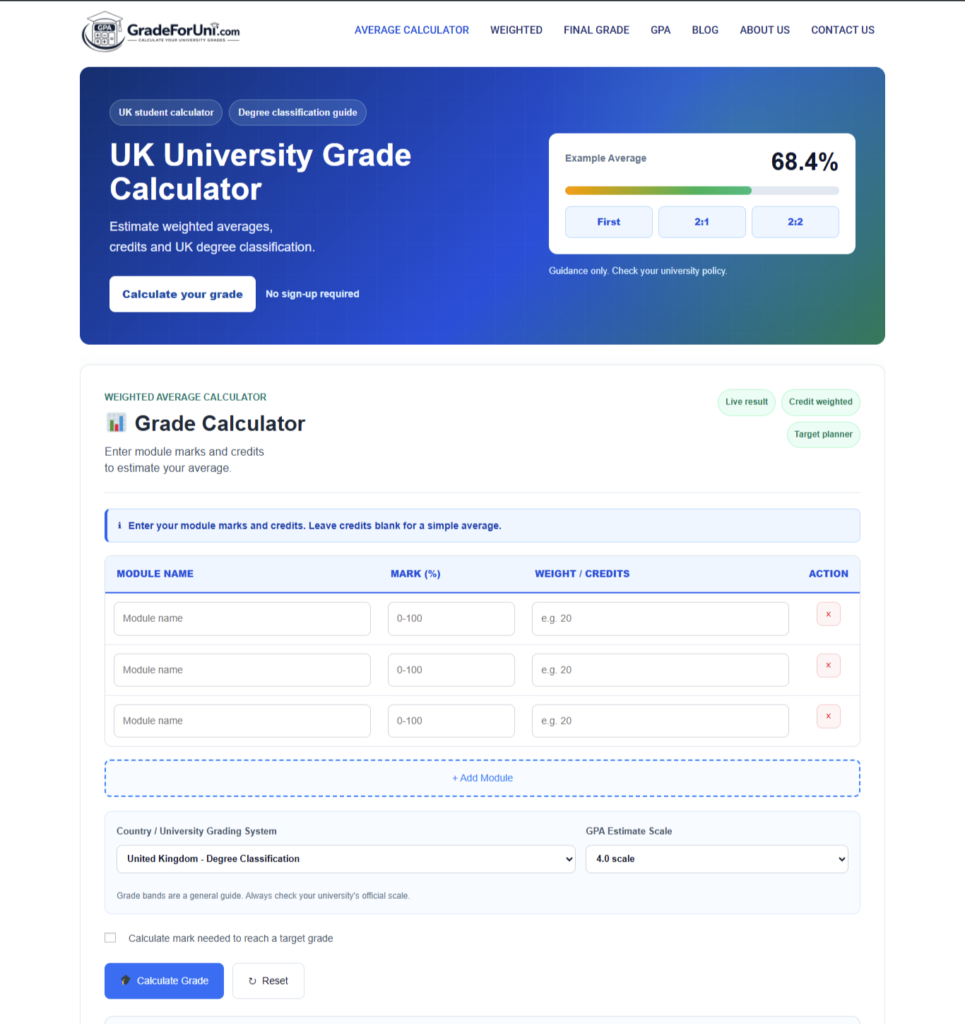
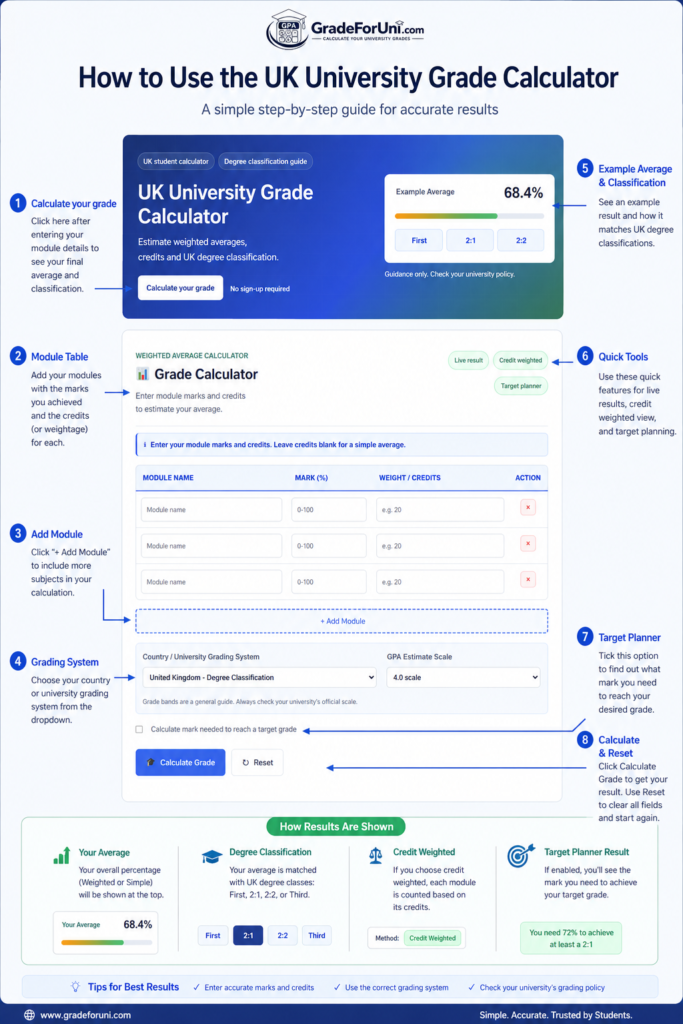
How to Use the UK University Grade Calculator
Visit Now: Mauricette-calculette
Quick Answer
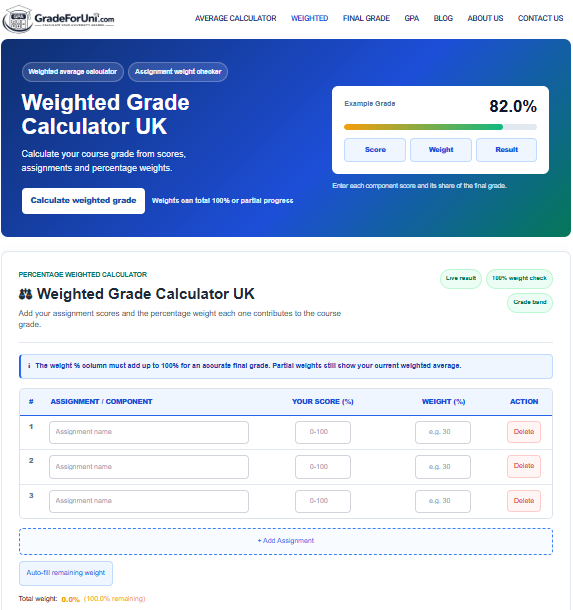
University credits and grades work together through a system called weighted averaging. Each module you take has a credit value — usually 10, 15, 20, 30 or 40 credits — that reflects how much study time and assessment weight it carries. university credits and grades To find your true average, your mark in each module is multiplied by its credit value, those figures are added together, then divided by your total credits. This means a 40-credit module influences your final average far more than a 10-credit one, even if you scored the same percentage in both. You can check your own figures using our Weighted Average Calculator.
The Basic Relationship Between Credits and Grades
Every module on a UK degree has two separate pieces of information attached to it: the mark you achieve and the credit value assigned to it. On their own, neither tells you much about your overall academic standing. Combined, they form the basis of how UK universities calculate degree results.
Here’s the part that catches a lot of students out: a mark by itself is not a measure of importance. A 68% in a 10-credit module and a 68% in a 40-credit module look identical on paper, but they don’t carry the same weight in your final average. university credits and grades The 40-credit module represents four times the study time, four times the assessment, and four times the pull on your overall result.
This is why simply adding up your percentages and dividing by the number of modules — a simple average — rarely matches the number your university confirms at the end of the year. university credits and grades Real degree classifications are almost always based on a weighted average, which factors credit size into the calculation from the start.
| Credit Value | Typical Module Type | Relative Pull on Your Average |
|---|---|---|
| 10 credits | Short optional module | Low |
| 15 credits | Standard single-term module | Low to moderate |
| 20 credits | Standard full-term module | Moderate (most common size) |
| 30 credits | Larger module or mini-project | High |
| 40 credits | Dissertation or year-long module | Very high |
Most full-time undergraduate years carry 120 credits in total, split across a mix of module sizes. Across a standard three-year Honours degree, that adds up to 360 credits overall — though, as this guide covers later, not every one of those credits necessarily feeds into your final classification.
Read More: First Class Degree Calculator – How Close Are You to…
Key Terms You Need to Understand First
Before going any further, it helps to be clear on a handful of terms that get used loosely but actually mean specific things when your university calculates your result university credits and grades.
Credit value — the number of credits a module is worth, based on its workload, contact hours, and assessment depth. Set by the university, not something you can influence.
Mark — your percentage score in a given module, usually shown to one or two decimal places once all assessment components have been combined.
Weighted average — an average calculated by multiplying each mark by its credit value, adding the results together, then dividing by total credits. This is the method almost all UK universities use for official classifications.
Simple average — an average that treats every module equally, ignoring credit values entirely. Occasionally used for quick comparisons, but rarely how a real degree result is calculated.
Total credits — the combined credit value of every module included in a particular calculation, whether that’s one semester, one year, or your entire degree.
Mixing up “weighted” and “simple” averages is one of the most frequent causes of students calculating a number that doesn’t match their official transcript.
Why It Matters How Credits and Grades Interact
It’s easy to assume every mark you earn contributes equally to your final result. university credits and grades In practice, understanding how credits and grades interact changes how you approach your studies in a few very practical ways:
- It tells you where extra effort actually pays off. Spending disproportionate revision time on a 10-credit module while neglecting a 40-credit one is rarely the smartest trade-off, even if the smaller module feels more urgent.
- It keeps your self-calculated average honest. A simple average that ignores credit values can make your position look better — or worse — than it really is.
- It explains sudden shifts in your running average. A strong mark in a heavily weighted module can lift your overall average noticeably more than the same mark in a smaller one.
- It helps you set realistic targets. Knowing which modules carry the most weight lets you calculate, with real precision, what you need in upcoming assessments.
Common Misconceptions About Credits and Grades
A few misunderstandings come up again and again when students try to work out their own average.
“A higher mark always matters more than a higher credit value”
Not necessarily. A 75% in a 10-credit module can be outweighed by a 65% in a 40-credit module, simply because the second module carries four times the influence on your overall figure.
“Every module counts the same unless I’m told otherwise”
The opposite is closer to the truth. university credits and grades Unless your university explicitly uses a simple average, credit weighting is applied automatically, whether you’re aware of it or not.
“My provisional average will match my final transcript exactly”
Not always. Provisional marks can change after moderation, resits, or late submissions are factored in, so treat any self-calculated figure as a close estimate rather than a guaranteed outcome.
Read More: Uni Calculator – Free UK University Grade Calculator in 5…
Worked Example: Same Marks, Different Averages
Two students, Ryan and Priya, both study a similar course and both score exactly the same three marks: university credits and grades 60%, 65%, and 70%. The only difference is how their credits are distributed.
Ryan’s modules:
| Module | Mark | Credits |
|---|---|---|
| Module A | 60% | 20 |
| Module B | 65% | 20 |
| Module C | 70% | 20 |
Ryan’s average (equal credits): (60 + 65 + 70) ÷ 3 = 65.0%
Priya’s modules:
| Module | Mark | Credits |
|---|---|---|
| Module A | 60% | 10 |
| Module B | 65% | 20 |
| Module C | 70% | 40 |
Priya’s weighted average: (60×10 + 65×20 + 70×40) ÷ 70 = (600 + 1,300 + 2,800) ÷ 70 = 67.0%
Same three marks, same order — but Priya ends up two full percentage points higher, purely because her strongest mark sits in her largest module. This is exactly the kind of gap that catches students out when they assume identical marks must produce an identical average.
With the basic relationship established, the next step is applying it across a full academic year rather than just a handful of modules.
Step-by-Step: Combining Marks and Credits Into a Full-Year Average
Working out one module’s contribution is straightforward once you understand weighting. university credits and grades The real skill is combining every module across a full year — and later, across your whole degree — without losing accuracy along the way.
Step 1: List every module with its mark and credit value. Pull this directly from your student portal or module handbook rather than relying on memory, since even a small credit error skews the entire result.
Step 2: Multiply each mark by its credit value. This gives you that module’s weighted contribution, not its raw percentage.
Step 3: Add all the weighted contributions together. This produces a single combined figure across every module you’ve entered.
Step 4: Add up the total credits. This is simply every module’s credit value added together, regardless of the marks attached to them.
Step 5: Divide the combined weighted total by total credits. The result is your credit-weighted average for that year — the number that actually reflects how your university would calculate it.
The formula:
Weighted Average = (Mark₁ × Credit₁ + Mark₂ × Credit₂ + …) ÷ (Credit₁ + Credit₂ + …)
Real-Life Scenario: A Full Academic Year
Take a Computer Science student, Alex, working through Year 2. Alex’s modules and marks look like this:
| Module | Mark | Credits | Weighted Contribution |
|---|---|---|---|
| Algorithms | 72% | 20 | 1,440 |
| Databases | 58% | 20 | 1,160 |
| Software Engineering | 65% | 20 | 1,300 |
| Group Project | 69% | 40 | 2,760 |
| Web Development | 61% | 20 | 1,220 |
Total weighted contribution: 1,440 + 1,160 + 1,300 + 2,760 + 1,220 = 7,880
Total credits: 20 + 20 + 20 + 40 + 20 = 120
Weighted Average = 7,880 ÷ 120 = 65.7%
Notice how the Group Project, with double the credits of the smaller modules, pulls the average upward more than its mark alone would suggest. If Alex had scored the same 69% in a 20-credit module instead, the overall average would land closer to 65.0% — a small but meaningful difference that only shows up once credit values are properly applied.
This single-year figure is useful on its own, but it isn’t the end of the calculation. university credits and grades Most degrees combine multiple counted years using a year-weighting split, covered in detail later in this guide university credits and grades. For now, it’s worth knowing that the same weighting principle — multiply, add, divide — applies at every level of the university credits and grades calculation, whether you’re working within one module, one year, or your entire degree.
Read More: First Class Honours Explained: 7 Amazing Requirements, Marks & Tips
Comparing Weighted vs. Simple Averages Side by Side
It’s worth seeing directly how much of a difference weighting makes, since the gap isn’t always small. Using Alex’s same five modules, here’s what a simple average would produce instead university credits and grades:
| Calculation Method | Formula Used | Result |
|---|---|---|
| Weighted Average | Marks × Credits ÷ Total Credits | 65.7% |
| Simple Average | Sum of Marks ÷ Number of Modules | 65.0% |
In Alex’s case, the gap is under one percentage point — small, but potentially the difference between two classification bands if the average sits right on a boundary. university credits and grades In other cases, particularly when marks vary more widely across modules of different sizes, the gap between a weighted and simple average can stretch to two or three percentage points or more. university credits and grades Given that classification boundaries are fixed points — 70%, 60%, 50%, 40% — even a small miscalculation can lead you to believe you’re in a different band than you actually are.
Common Mistakes to Avoid
A handful of errors come up repeatedly when students try to calculate this on their own.
- Using a simple average by default. Unless credits genuinely aren’t provided, always check whether your university applies credit weighting before assuming an equal split.
- Mixing up mark and credit columns. It sounds obvious, but transposing which number is the mark and which is the credit value produces a wildly inaccurate result, especially when done manually.
- Forgetting to include every module. Leaving out a single module, particularly a large one like a dissertation or group project, understates your total credits and distorts the entire average.
- Rounding too early in the process. Round only your final answer, not the intermediate weighted contributions — early rounding compounds small errors across multiple modules.
- Assuming a provisional mark is final. Moderation, second marking, and exam boards can adjust marks after they first appear on your portal, so treat early figures as estimates.
- Applying the wrong credit value. Credit values occasionally change between cohorts if a course is restructured, so always check the figure listed for your specific intake year.
Best Practices and Expert Tips
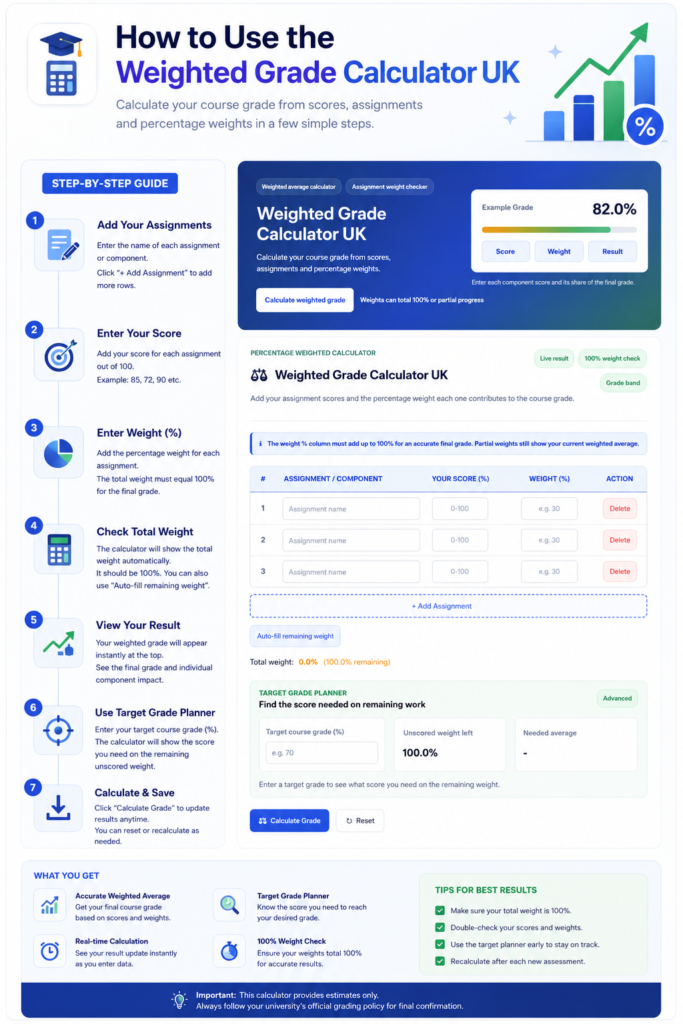
- Keep a running spreadsheet or use a calculator built for this, rather than recalculating from scratch every time a new mark comes in. Our Weighted Average Calculator does this automatically, including saving your entries as the year progresses.
- Cross-check your figure against your student portal whenever it displays a running average, since most UK universities now show this directly.
- Record credit values as soon as you enrol in a module, rather than trying to track them down later from memory or old emails.
- Separate provisional and confirmed marks in your own notes, so you always know which parts of your calculation are still subject to change.
- Recalculate after every result, not just at year-end. This keeps you aware of your trajectory in real time, rather than facing a surprise once everything is confirmed.
When Assessment Components Add Another Layer
So far, this guide has treated each module as a single mark. In reality, many modules are themselves made up of multiple assessment components — an exam worth 60%, a coursework essay worth 40%, for example — each with its own internal weighting before they combine into that module’s overall mark.
This means credit weighting and assessment weighting operate at two different levels:
| Level | What’s Being Weighted | Example |
|---|---|---|
| Within a module | Individual assessments (exams, essays, presentations) | 60% exam + 40% coursework = module mark |
| Across modules | Module marks by credit value | Module marks × credits ÷ total credits |
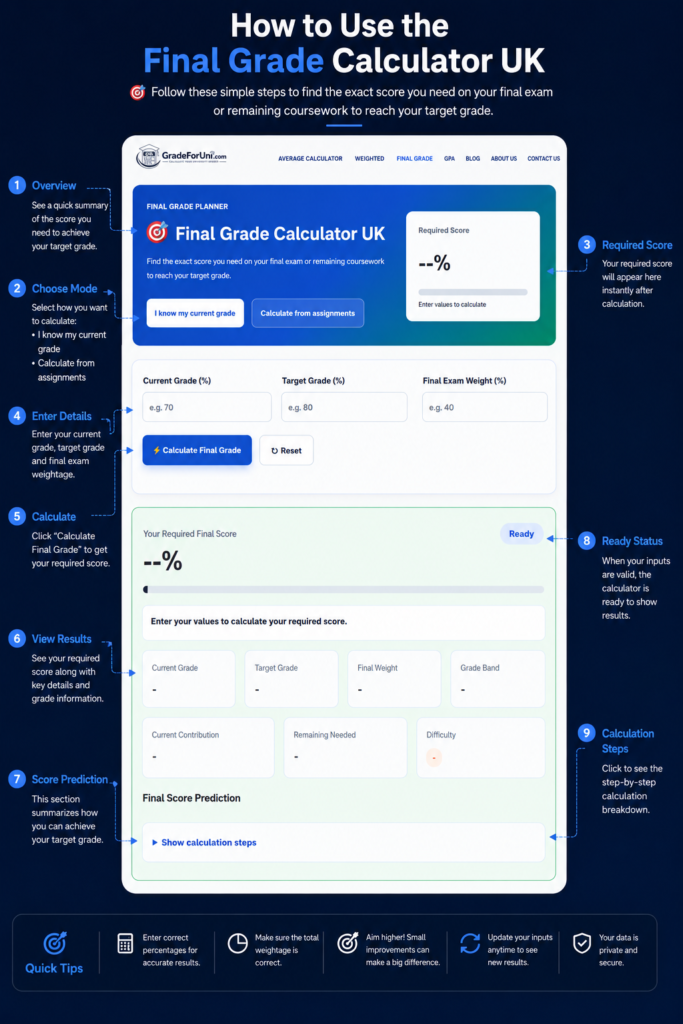
It’s a common mix-up to apply credit weighting to individual assessments rather than to the finished module mark. university credits and grades Credits belong to the module as a whole, not to any single piece of coursework within it. If you’re trying to work out your mark within a single module before it even reaches the credit-weighting stage, our Weighted Average Calculator handles assessment-level weighting separately from credit-level weighting, so the two don’t get blended together by mistake university credits and grades.
Real-Life Scenario: A Module With Uneven Assessment Weighting
Consider a Law student taking a 20-credit module made up of a 70% final exam and a 30% coursework essay. university credits and grades The student scores 74% on the exam and 61% on the coursework.
Module Mark = (74 × 0.70) + (61 × 0.30) = 51.8 + 18.3 = 70.1%
This 70.1% is now the single figure that gets carried forward into the credit-weighted calculation across the rest of the student’s modules — the 70:30 exam-coursework split has already been resolved before credits ever come into play. university credits and grades Applying the 20 credits directly to the exam and coursework marks separately, rather than to this combined 70.1% module mark, would produce an incorrect result.
Getting comfortable with this two-layer structure — assessment weighting first, then credit weighting — is one of the clearest signs a student has genuinely understood how their degree average is built, rather than just memorising a single formula university credits and grades.
With the module-level and year-level mechanics covered, the next question is how these weighted averages translate into an actual degree classification.
How Year Weighting Turns Your Averages Into a Final Classification
Once you have a credit-weighted average for each counted year, one more layer sits between that number and your official degree classification: year weighting. university credits and grades This is where your Year 2 and Year 3 averages — or Years 2 to 4, on some courses — are combined using a split set by your university, not by you.
The most common structure looks like this:
Final Classification Average = (Year 2 Average × Year 2 Weight) + (Year 3 Average × Year 3 Weight)
A 33:67 split is widely used, meaning Year 2 contributes roughly a third and Year 3 contributes roughly two-thirds. Some universities instead use a 40:60 split, and a small number weight the years even more heavily toward the final one. university credits and grades There’s no single figure that applies everywhere, so this is one detail worth confirming directly in your course handbook rather than assuming.
Once this final percentage is calculated, it’s matched against your university’s published classification boundaries:
| Classification | Percentage Range | Honours Abbreviation |
|---|---|---|
| First Class | 70% – 100% | 1st |
| Upper Second Class | 60% – 69% | 2:1 |
| Lower Second Class | 50% – 59% | 2:2 |
| Third Class | 40% – 49% | 3rd |
| Fail | Below 40% | — |
These bands are broadly consistent across UK universities, but the exact boundary figures can shift slightly by institution, so treat them as a strong general guide rather than a guaranteed match to your own transcript university credits and grades.
Read More: 1 Degree Calculator – Check If You Are on Track…
Converting Your Weighted Average Into an Estimated GPA
If you’re applying for study, work, or scholarships outside the UK, you’ll often be asked for a GPA rather than a percentage. university credits and grades Since UK universities don’t use GPA natively, this figure has to be estimated from your weighted average using a conversion scale.
A simplified conversion looks like this:
GPA = (UK Percentage ÷ 100) × 4.0
| UK Classification | Percentage Boundary | Approximate GPA Range |
|---|---|---|
| First Class | 70%+ | 3.7 – 4.0 |
| Upper Second (2:1) | 60% – 69% | 3.3 – 3.6 |
| Lower Second (2:2) | 50% – 59% | 2.7 – 3.2 |
| Third Class | 40% – 49% | 2.0 – 2.6 |
| Fail | Below 40% | Below 2.0 |
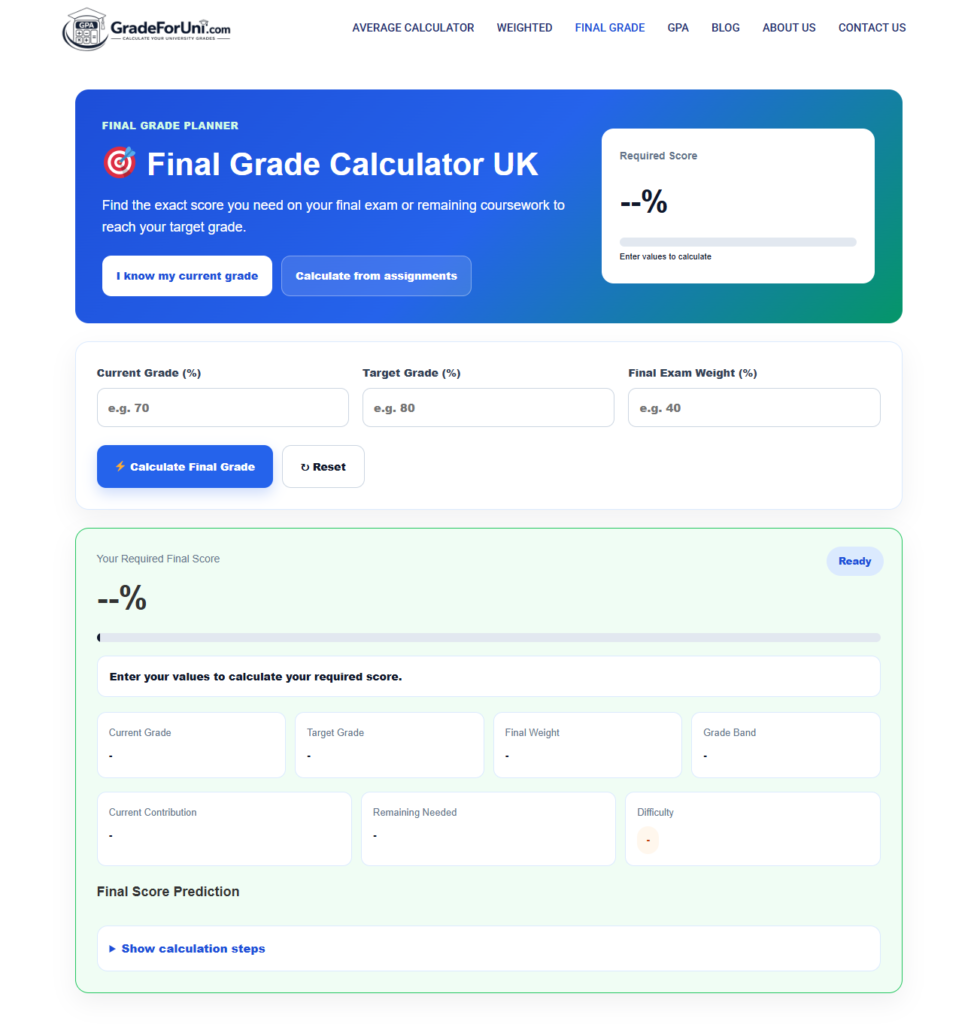
Treat this as an estimate rather than an official conversion. Different institutions and countries apply slightly different formulas, and some scholarship bodies or graduate schools use their own conversion tables entirely. If a precise figure matters for an application, check the exact method requested by whoever is asking for it, rather than relying on a general approximation. Our GPA Calculator can help you generate a closer estimate based on your full module breakdown.
Advanced Tips for Tracking Credits and Grades Accurately
- Separate “counted” credits from “total” credits in your own tracking. Not every credit you earn necessarily factors into your final classification — Year 1 credits, for instance, are commonly required for progression but excluded from the classification calculation entirely.
- Watch for compensated passes. If you narrowly fail a module but your university compensates it, the credits and original mark are usually still counted in full, rather than excluded or capped.
- Check how resits are capped. Many universities cap a resit mark at the pass boundary, typically 40%, even if you scored higher when you resat the assessment. This affects your weighted average differently than an uncapped mark would.
- Don’t assume placement years carry weight. Sandwich degrees with an industry placement year usually grade that year pass/fail, contributing 0% to your classification percentage despite appearing on your transcript.
- Confirm whether your integrated Masters year is blended in. On MEng, MSci and similar courses, the final Masters-level year is sometimes reported separately rather than folded into the standard percentage scale.
Frequently Overlooked Information
A few details continue to trip students up even once they’ve understood the core formula.
- Borderline classifications often trigger a review, not just a strict cutoff. If your average lands close to a boundary — say 69.6% — many universities apply a borderline policy that looks at the distribution of your marks, not just the headline number, before confirming your classification.
- Rounding conventions vary by institution. Some universities round 69.5% up to 70%, others don’t. This single rule can be the difference between two classification bands, so check your specific university’s policy rather than assuming standard rounding applies.
- Credit values can differ even for similarly named modules. Two students on related courses might both take a “Research Methods” module, but one version could be worth 20 credits and the other 15, depending on the department.
- Your degree transcript may show more detail than your official classification. Many universities issue a Higher Education Achievement Report (HEAR) alongside your degree certificate, breaking down module-level performance in more depth than the single classification figure.
Key Takeaways
- Checking your own calculation against your student portal, and against your university’s specific academic regulations, is the most reliable way to catch errors early.
- University credits and grades work together through weighted averaging: each mark is multiplied by its credit value before being combined into an overall percentage.
- A higher mark in a smaller module can still be outweighed by a lower mark in a larger one, since credit size directly affects influence on your final average.
- Assessment-level weighting (within a module) and credit-level weighting (across modules) are two separate layers, and mixing them up leads to inaccurate results.
- Year weighting — commonly a 33:67 or 40:60 split between Year 2 and Year 3 — is applied after module-level averages are calculated, not before.
- GPA conversions from UK percentages are estimates, not official scales, and can vary between institutions and countries.
Conclusion
Understanding how university credits and grades work together changes the way you look at your entire academic record, not just your final year. university credits and grades A percentage mark on its own tells you how well you performed in one module — but it’s only once that mark is combined with its credit value, layered against your other modules university credits and grades, and weighted across your counted years that you get a figure that actually matches what your university will confirm university credits and grades.
Whether you’re checking your current standing, working out how much a single dissertation mark could shift your average, or converting your result into an estimated GPA for an application abroad, the same principle holds throughout: credits and grades aren’t two separate numbers to track individually, they’re two halves of the same calculation. university credits and grades Once you understand how university credits and grades work together, university credits and grades tracking your real academic position becomes far less guesswork and far more precision.
FAQ’s
How do university credits and grades work together?
Each module’s mark is multiplied by its credit value, these figures are added together across all your modules, and the total is divided by your combined credit value. university credits and grades This produces a weighted average, which is how most UK universities calculate degree results, rather than a simple average that treats every module equally.
Does a higher credit value always mean a module matters more?
Generally yes, assuming its mark differs from your other modules. university credits and grades A module worth more credits has a stronger pull on your overall weighted average, whether that mark is higher or lower than the rest of your results.
What’s the difference between a weighted and simple average?
A weighted average factors in each module’s credit value, so larger modules count more toward your final figure. university credits and grades A simple average ignores credit values and treats every module as equally important, which rarely matches how real degree classifications are calculated university credits and grades.
Do all my credits count toward my final classification?
Not always. university credits and grades Many UK degrees only count credits from Year 2 and Year 3 toward the final classification, while Year 1 credits typically need to be passed but don’t factor into the calculation. This varies by university, so check your own course regulations university credits and grades.
How is my degree classification calculated from my weighted average?
Once your credit-weighted average is combined across your counted years using your university’s year-weighting split, the resulting percentage is matched against classification boundaries — commonly 70%+ for a First, 60–69% for a 2:1, 50–59% for a 2:2, and 40–49% for a Third university credits and grades.
Can I calculate my average without knowing my credit values?
You can calculate a simple average without credits, but it won’t reflect how your university actually determines your classification university credits and grades . Checking your module handbook or student portal for exact credit values gives a far more accurate picture.
How accurate is a GPA estimate converted from UK percentages?
It’s a reasonable approximation, not an official scale. Since GPA conversion methods vary between universities and countries, confirm the exact formula required if you’re applying somewhere specific.
What happens if I get my credit values wrong?
Even a small error in credit values can noticeably shift your calculated average, particularly if the mistake involves a larger module like a dissertation. Always double-check figures directly against your module handbook or transcript.
Do resit marks affect my weighted average differently?
Often yes. Many universities cap resit marks at the pass boundary, so a resat module may contribute a lower figure to your weighted average than an uncapped first-attempt mark would, even if your actual resit performance was strong.
Is it worth calculating my average manually, or should I use a calculator?
A calculator reduces the risk of small errors compounding across multiple modules, especially once you’re combining several years with different credit values and weightings. Our University Grade Calculator handles the full calculation automatically, including credit weighting, year weighting, and GPA conversion.