

Imagine opening your university results and seeing 58% for an exam, 72% for coursework, and then a module mark that is neither 58% nor 72%.
It can be confusing. You may wonder whether the exam mark is your final grade and whether strong coursework can make up for a disappointing exam.
The answer depends on how each assessment is weighted. An exam worth 70% of a module can have a very different effect from one worth 30%, even when you achieve the same exam mark.
Understanding exam weighting can also help you work out what mark you need in an upcoming exam and how much improving your exam score could change your overall module result.
Click Here: Weighted Grade Calculator UK
How to Use the Weighted Grade Calculator UK
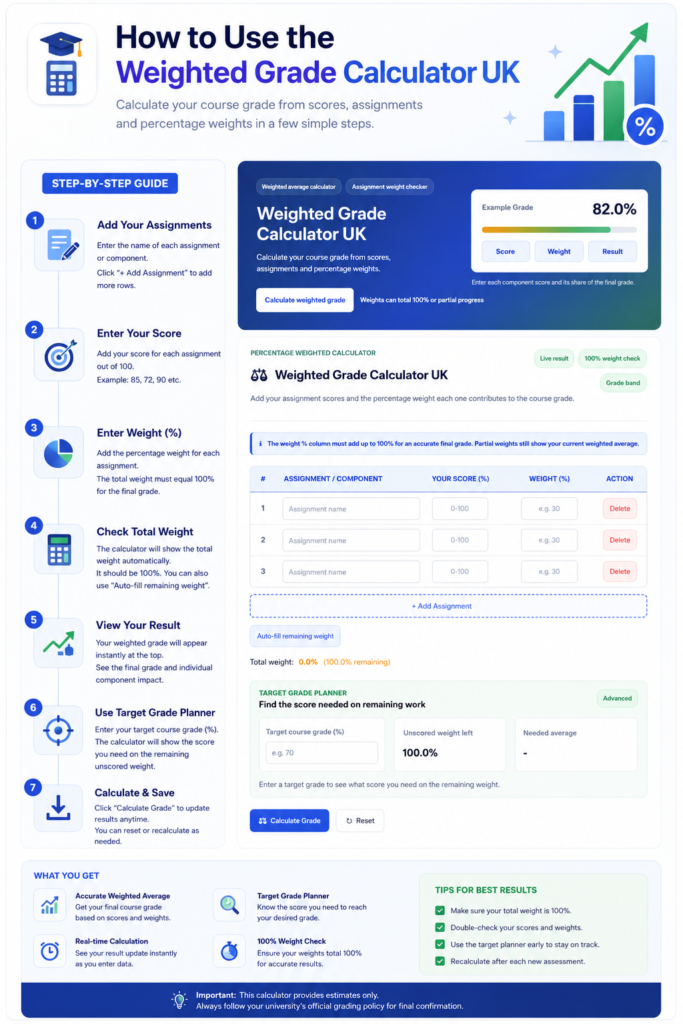
Exam weighting determines how much your exam contributes to your overall module mark. For example, if you score 60% in an exam worth 70% of the module:
60 × 0.70 = 42
Your exam contributes 42% to the module mark, with the remaining 30% coming from other assessments.
What Does Exam Weighting Mean at University?
Exam weighting is the percentage of a module’s total assessment mark that comes from an examination.
For example, a module could be assessed as:
- Exam: 60%
- Coursework: 40%
This means the exam contributes 60% of the module result, while coursework contributes the remaining 40%.
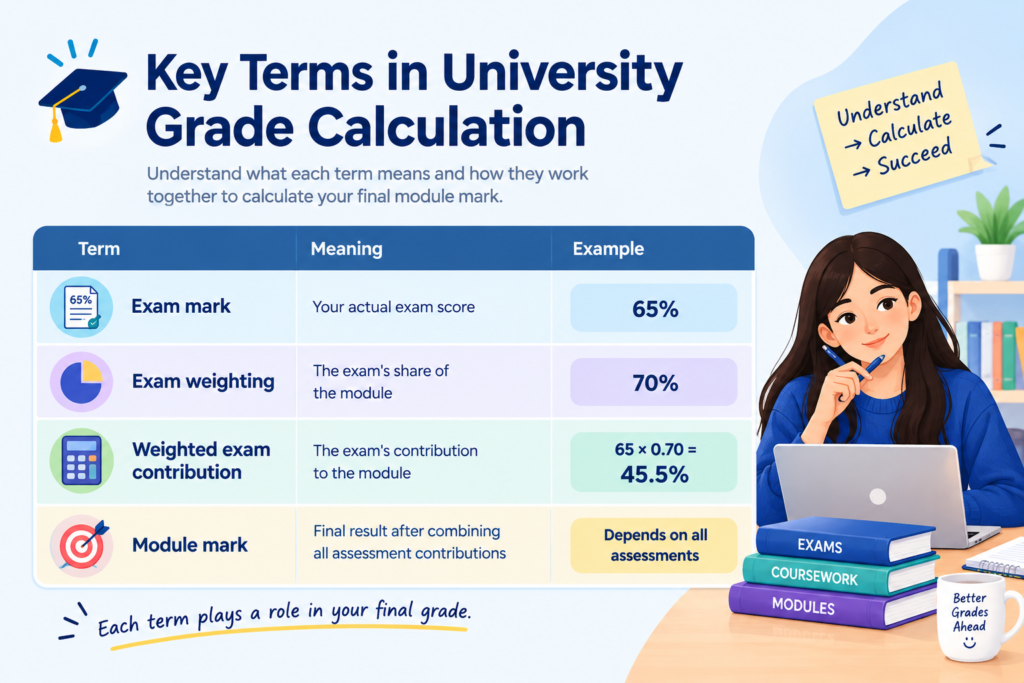
Visit Now: taxsal.comExam Mark vs Exam Weighting vs Module Mark
| Term | Meaning | Example |
|---|---|---|
| Exam mark | Your actual exam score | 65% |
| Exam weighting | The exam’s share of the module | 70% |
| Weighted exam contribution | The exam’s contribution to the module | 65 × 0.70 = 45.5% |
| Module mark | Final result after combining all assessment contributions | Depends on all assessments |
Why Does Exam Weighting Matter?
| Exam Weighting | Exam Improvement | Increase in Module Mark |
|---|---|---|
| 30% | +10 marks | +3 points |
| 50% | +10 marks | +5 points |
| 70% | +10 marks | +7 points |
A higher exam weighting means the same improvement in your exam has a greater impact on your module mark.
Where Can You Find Your Exam Weighting?
Your exact weighting should come from your university or module documentation rather than a general UK rule.
Check:
- Module handbook
- Module descriptor
- Programme specification
- Assessment brief
- Virtual learning environment such as Moodle
- University academic regulations
If your module has several assessments, make sure you identify the weighting for the specific assessment you are calculating.
Read More: How Are University Exam Marks Calculated in the UK?How Is an Exam’s Weighted Contribution Calculated?
The basic calculation is a straight Formula
Weighted exam contribution = Exam mark × Exam weighting
| Assessment | Mark | Weighting | Weighted Contribution |
|---|---|---|---|
| Exam | 64% | 70% | 44.8% |
| Coursework | 72% | 30% | 21.6% |
| Overall Module Mark | 100% | 66.4% |
| Calculation | Formula | Result |
|---|---|---|
| Exam contribution | 64 × 0.70 | 44.8% |
| Coursework contribution | 72 × 0.30 | 21.6% |
| Module mark | 44.8 + 21.6 | 66.4% |
How Much Does Each 1% in an Exam Affect Your Module?
The effect of one additional percentage point depends entirely on the weighting.
| Exam Weighting | Effect of 1 Extra Exam Mark |
|---|---|
| 30% | +0.3 module points |
| 40% | +0.4 module points |
| 50% | +0.5 module points |
| 60% | +0.6 module points |
| 70% | +0.7 module points |
| 100% | +1.0 module points |
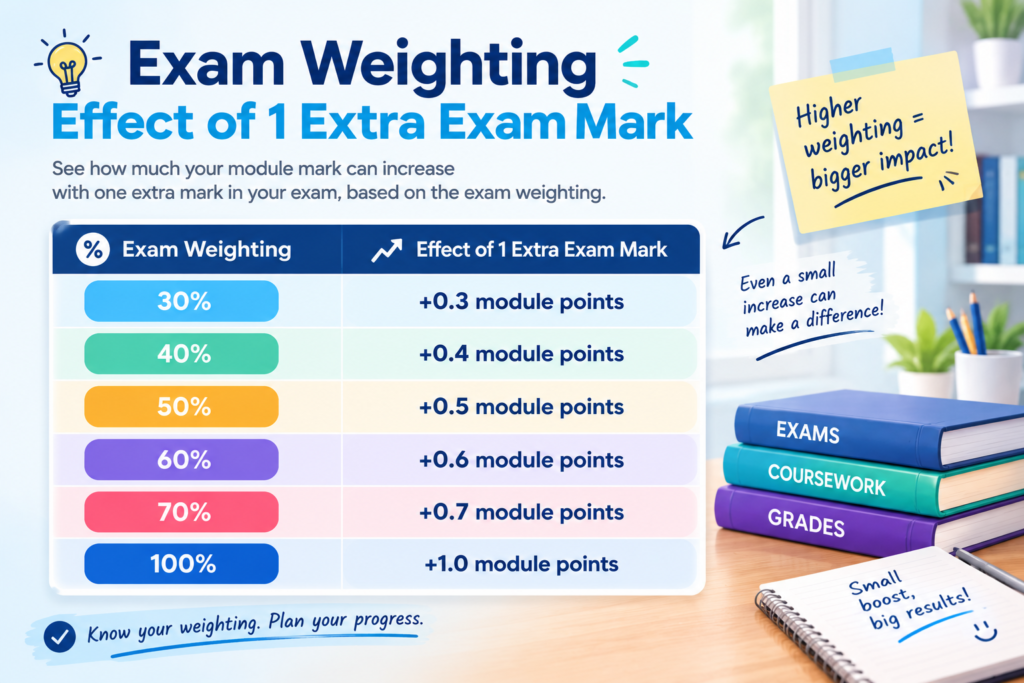
This gives you a useful way to understand the importance of an assessment.
If an exam is worth 70%, then every additional 10 marks on that exam is worth 7 marks in the module result, assuming no separate rules affect the calculation.
How Do Exam and Coursework Marks Combine?
The calculation depends on the weighting assigned to each assessment.
| Exam Weighting | Coursework Weighting | Exam Mark | Coursework Mark | Exam Contribution | Coursework Contribution | Module Mark |
|---|---|---|---|---|---|---|
| 50% | 50% | 62% | 74% | 31% | 37% | 68% |
| 70% | 30% | 58% | 72% | 40.6% | 21.6% | 62.2% |
| 60% | 40% | 65% | 70% | 39% | 28% | 67% |
| 40% | 60% | 45% | 75% | 18% | 45% | 63% |
| 100% | 0% | 67% | — | 67% | — | 67% |
Common Exam Weightings
| Exam Weighting | Other Assessment | Relative Exam Influence |
|---|---|---|
| 100% | 0% | Entire module |
| 70% | 30% | Very high |
| 60% | 40% | High |
| 50% | 50% | Equal |
| 40% | 60% | Moderate |
| 30% | 70% | Lower |
There is no single weighting that applies to every UK university or every course. Always use the assessment structure for your own module.
How Do You Calculate Your Overall University Module Mark?
For a module with multiple assessments, calculate each contribution separately and then add them together.
Modules With Two Assessments
For two assessments:
Module mark = (Assessment 1 × weighting) + (Assessment 2 × weighting)
For example:
- Exam = 64%, worth 50%
- Coursework = 72%, worth 50%
64 × 0.50 + 72 × 0.50 = 68%
Modules With Three or More Assessments
The same principle applies when there are three or more assessments.
Module assessments more than once focus on keywords
Modules with three or more assessments
For example:
- Exam: 64%, worth 50%
- Coursework: 72%, worth 30%
- Presentation: 80%, worth 20%
Calculations:
64 × 0.50 = 32
72 × 0.30 = 21.6
80 × 0.20 = 16
Total:
32 + 21.6 + 16 = 69.6%
The important point is that you should not simply average the three marks. A simple average would give a different answer because the assessments have different weightings.
How to Check Your Calculation
Before accepting your result, check:
- You have used the correct assessment marks.
- You have used the correct weighting for each assessment.
- The applicable weightings add up to 100%.
- You converted percentages into decimals correctly.
- You calculated each contribution separately.
- You did not round intermediate calculations unnecessarily.
- You checked for any separate assessment requirements.
Read More: Weighted Grade Calculator – Calculate Your Weighted Average Online 2026What Exam Mark Do You Need to Reach Your Target University Grade?
Working backwards can be more useful than simply calculating your current result.
If you already know your coursework mark and weighting, you can calculate the exam score required to reach a particular target.
How to Calculate the Exam Mark Needed for 40%
| Target Module Mark | Coursework Mark | Coursework Weight | Exam Weight | Required Exam Mark |
|---|---|---|---|---|
| 40% | 55% | 40% | 60% | 30% |
| 50% | 60% | 30% | 70% | 45.7% |
| 60% | 65% | 30% | 70% | 57.9% |
| 70% | 68% | 30% | 70% | 70.9% |
How to Calculate the Required Exam Mark From Your Coursework Result
The general formula is:
Required exam mark = (Target module mark − Coursework contribution) ÷ Exam weighting
Or, when there are two assessments:
Required exam mark = [Target − (Coursework mark × Coursework weighting)] ÷ Exam weighting
This is useful when planning for a particular target rather than simply asking what your final mark will be.
If the required exam mark is above 100%, your target is mathematically unattainable from the remaining assessment alone. That is a useful warning because it tells you to review your target or check whether other assessments are still outstanding.
Can Coursework Compensate for a Low Exam Mark?
Sometimes it can, but the effect depends on the weight
| Scenario | Exam Mark | Exam Weight | Coursework Mark | Coursework Weight | Module Mark |
|---|---|---|---|---|---|
| Low exam, strong coursework | 42% | 70% | 82% | 30% | 54% |
| Strong exam, weak coursework | 78% | 60% | 48% | 40% | 66% |
| Exam Weighting | Exam Mark | Coursework Mark | Module Mark |
|---|---|---|---|
| 30% | 60% | 70% | 67% |
| 50% | 60% | 70% | 65% |
| 70% | 60% | 70% | 63% |
| Exam Improvement | 30% Weight | 50% Weight | 70% Weight |
|---|---|---|---|
| +5 marks | +1.5 | +2.5 | +3.5 |
| +10 marks | +3 | +5 | +7 |
What Happens If Your Module Has a Minimum Exam or Assessment Threshold?
A weighted calculation does not necessarily match the assessment threshold
Some modules have additional requirements for individual assessments. Your weighted module result may be above the pass mark, while your exam result is below the required minimum.
The exact rule depends on your university and programme regulations.
Can You Pass the Module If You Fail the Exam?
It depends on your university’s rules. A strong performance in other assessments may be enough to reach the module pass mark, but a separate minimum exam requirement can change the outcome.
Why Professional or Programme-Specific Requirements Matter
Some programmes require students to achieve a minimum mark in specific assessments. Check your programme regulations before relying only on the weighted average.
Where to Check the Exact Rule
Check your:
Check exact rules
Check specific matter
- Module regulations
- Programme regulations
- Module handbook
- Assessment brief
- Programme specification
- University academic regulations
Exam Weighting vs Credit Weighting: What’s the Difference?
Exam weighting determines how much an exam contributes to a module. Credit weighting determines how a module may contribute to a wider university average.
What Exam Weighting Controls
| Assessment | Weighting |
|---|---|
| Exam | 60% |
| Coursework | 40% |
| Total | 100% |
The 60% is the exam’s share of the module assessment.
What Module Credits Control
Credits represent the academic value of a module. A 20-credit module and a 40-credit module may have different influences on a credit-weighted average.
What Year Weighting Controls
Year weighting determines how each academic year contributes to the final degree calculation. This is separate from exam weighting within a module.
How These Weightings Work Together
Assessment marks → Module mark → Credit/year weighting → Overall degree calculation
How Does Exam Weighting Affect Your Final Degree Classification?
Exam weighting can affect your final degree indirectly because your exam contributes to a module mark, which may then contribute to your overall university average.
How Module Marks Feed Into Wider University Averages
Exam result → Weighted module result → Wider average → Degree classification
The exact calculation depends on your university and programme.
Why a Heavily Weighted Exam Can Matter More at the Module Level
| Exam Weighting | 10-Point Exam Improvement | Module Increase |
|---|---|---|
| 30% | +10 | +3 |
| 50% | +10 | +5 |
| 70% | +10 | +7 |
The effect on your final degree also depends on module credits and your university’s classification rules.
Why Degree Classification Rules Vary
Universities and programmes may use different rules for:
- Year weighting
- Module credits
- Classification calculations
- Rounding
- Minimum requirements
- Borderline classifications
How to Find the Correct Exam Weighting for Your Module
Use the official assessment information for your current module.
Check Your Module Handbook
Look for the assessment breakdown and percentage assigned to each component.
Check Your Module Descriptor or Programme Specification
These documents can provide the formal assessment structure for your module or programme.
Check Your Assessment Brief or VLE
Your assessment brief or VLE may show the weighting for each assessment. Make sure you are checking the correct module and academic year.
Check University Academic Regulations
University regulations can explain how marks are calculated and whether additional requirements apply.
Confirm Whether Any Minimum Assessment Requirement Applies
Check whether your module requires a minimum mark in a particular assessment before deciding whether your weighted result is enough.
Worked Exam Weighting Examples
| Example | Exam Mark | Exam Weight | Coursework Mark | Coursework Weight | Other Assessment | Module Mark |
|---|---|---|---|---|---|---|
| 1. Equal weighting | 62% | 50% | 74% | 50% | — | 68% |
| 2. Higher exam weighting | 58% | 70% | 72% | 30% | — | 62.2% |
| 3. 60:40 weighting | 65% | 60% | 70% | 40% | — | 67% |
| 4. 100% exam | 67% | 100% | — | 0% | — | 67% |
| 5. Three assessments | 64% | 50% | 72% | 30% | Presentation: 80% × 20% | 69.6% |
| 6. Low exam, strong coursework | 42% | 70% | 82% | 30% | — | 54% |
| 7. Target of 70% | 70.86% required | 70% | 68% | 30% | — | 70% target |
| 8. 10-mark exam improvement | 55% → 65% | 70% | — | — | — | +7 module points |
| 9. Higher coursework weighting | 45% | 40% | 75% | 60% | — | 63% |
| 10. Exam mark needed to pass | 30% required | 60% | 55% | 40% | — | 40% target |
Practical Exam Weighting Scenarios
| Scenario | Key Calculation | Result |
|---|---|---|
| Worried about a low exam | Check the exam weighting before judging the result | Depends on weighting |
| Exam worth 70% | 10-mark improvement × 0.70 | +7 module points |
| Targeting 70% | 68% coursework × 30% + required exam × 70% | 70.86% exam needed |
| Strong exam, weak coursework | 78% × 0.60 + 48% × 0.40 | 66% |
| The exam is below the minimum threshold | Check university regulations | May affect the pass |
| 20-credit module, 60% exam | Credits and assessment weighting are separate | 20 credits + 60% exam |
Common Exam Weighting Mistakes to Avoid
| Mistake | Correct Approach |
|---|---|
| Treating your exam mark as the final module mark | Apply the exam weighting alongside other assessments |
| Adding raw marks | Multiply each mark by its weighting first |
| Using the wrong weighting | Check the weighting for your exact module |
| Forgetting to convert percentages | 70% = 0.70, 50% = 0.50, 30% = 0.30 |
| Ignoring assessment thresholds | Check for separate minimum pass requirements |
| Confusing assessment weighting with credit weighting | Keep module assessment weightings separate from credits |
| Confusing module and degree weighting | Check each stage of the calculation separately |
| Rounding too early | Keep precise figures until the final calculation |
| Assuming all UK universities use the same rules | Check your university’s regulations |
| Assuming a failed exam means a failed module | Check the weighting and any assessment requirements |
Expert Tips for Managing Exam Weighting
| Expert Tip | What to Do |
|---|---|
| Check the official weighting | Use your current module documentation |
| Prioritise heavily weighted assessments | Focus more revision time where marks have greater impact |
| Use reverse calculations | Work out the exam mark needed for your target |
| Compare possible exam scores | Calculate the effect of different results |
| Check assessment thresholds | Look for the minimum marks required in individual assessments |
| Separate raw and weighted marks | Keep the original score separate from its contribution |
| Check rounding rules | Follow your university’s official calculation method |
| Check resit rules | Find out how reassessment marks are treated |
| Check programme requirements | Review any additional assessment conditions |
| Calculate credits separately | Establish the module mark before applying credit weighting |
Frequently Asked Questions
What does exam weighting mean at university?
Exam weighting is the percentage of a module’s assessment result assigned to the examination. A 70% exam weighting means the exam contributes 70% to the module’s overall grade, with the remaining 30% coming from other assessments.
How does exam weighting affect your university mark?
A higher exam weighting gives the exam a greater influence over the module mark. For example, improving a 70%-weighted exam by 10 marks increases the module result by 7 points, before considering any other rules.
How do I calculate my exam contribution?
Multiply your exam mark by the exam weighting expressed as a decimal.
For example:
60 × 0.70 = 42
The exam contributes 42 percentage points to the module result.
What does 50% exam weighting mean?
It means the exam accounts for half of the module’s assessment calculation. If coursework accounts for the other 50%, both assessment marks have equal weighting.
What does 60% exam weighting mean?
It means 60% of the module’s grade comes from the exam, and the remaining 40% comes from the other assessment (s).
What does 70% exam weighting mean?
A 70% weighting means the exam has a substantial influence on the module mark. The remaining 30% comes from other assessments, assuming the module uses a 70:30 structure.
What does 100% exam weighting mean?
It means the exam accounts for the entire assessment calculation for that module. However, you should still check the module rules for any specific requirements.
Does my exam mark equal my module mark?
Not necessarily. If the module includes coursework or other assessments, your exam mark is weighted alongside those results.
How do exam and coursework marks combine?
Multiply each assessment mark by its weighting and add the resulting contributions.
For example:
Exam × exam weighting + coursework × coursework weighting
What exam mark do I need to pass my module?
You can calculate the mathematical exam mark required to reach the module pass mark, but you must also check whether your university has a separate minimum exam or assessment threshold.
What exam mark do I need to get 60% overall?
It depends on your existing coursework mark and the weighting of each assessment. Use the reverse-weighting formula:
Required exam = (Target − coursework contribution) ÷ exam weighting
Conclusion
Exam weighting can make a significant difference to your university module mark. A 70%-weighted exam has a much greater impact than a 30%-weighted exam, even when the exam marks are identical.
To calculate your result, multiply each assessment mark by its weighting and add the contributions together. For example, a 64% exam worth 70% contributes 44.8 percentage points to the module mark.
If you are working towards a specific target, use the same method in reverse to calculate the exam mark you need. Always check your university’s module regulations, as minimum assessment thresholds, rounding rules, and other requirements can affect the final result.
Understanding exam weighting at university makes it easier to interpret your marks, set realistic targets, and see where improvements can have the greatest impact.