
How Are Dentistry Degrees Graded in the UK? [2026]
If you arrive at dental school expecting the familiar machinery of British university grading — First, 2:1, 2:2, Third, degree algorithms, the lot — dentistry will surprise you. Most UK dental schools do not award a standard honours classification at all. You can complete five gruelling years, never hear the words “two-one” applied to your degree, and still walk out with a perfectly respectable Bachelor of Dental Surgery.
That does not mean dentistry degrees are not graded. They are graded intensely — in some ways more ruthlessly than any conventional degree. Marks follow you through written papers, OSCEs, clinical competency tests and professionalism reviews; a single failed clinical component can block the whole award even when your average looks comfortable; and first-attempt marks are the only ones that count toward honours at several schools. Dentistry degrees are graded like almost nothing else in UK higher education because two different authorities are watching you at once: your university, which awards the degree, and the General Dental Council (GDC), which must be satisfied you are safe to register as a dentist.
This guide explains exactly how dentistry degrees are graded in the UK in 2026: what award you actually get, how written and clinical assessment works, the must-pass gates, how honours is decided, what happens if you fail a year, and the twist nobody tells you at open days — your dental school marks play no part in getting your first job. Every school scheme described here comes from that school’s own published pages or the GDC’s own documents, read at the time of writing.
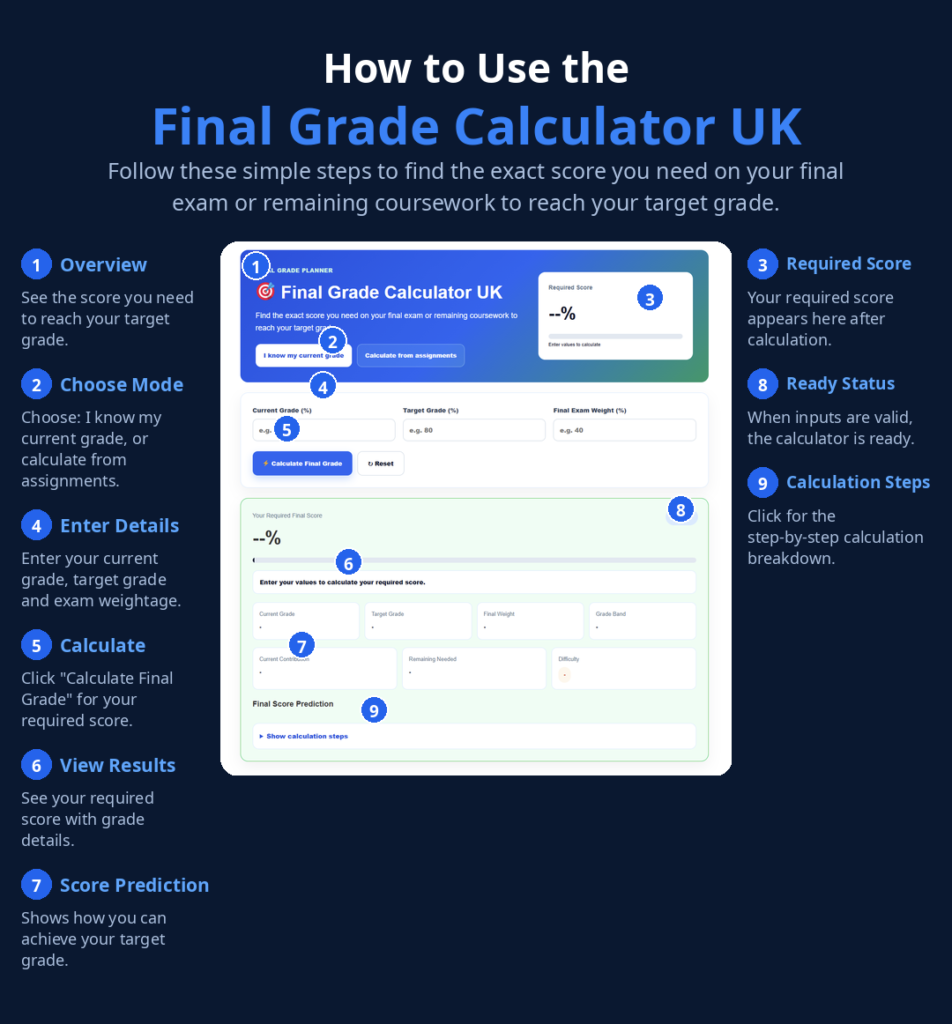
Click Here: Final Grade Calculator UK
The two markbooks: your degree and your registration
The single most important thing to understand about dentistry degrees graded in the UK is that your results feed two separate judgements. Your university awards you a degree (BDS, BChD or similar, five years, full-time). The General Dental Council, acting under its statutory functions in the Dentists Act 1984, sets the standards for education and must be satisfied that every graduate meets them before registration. Schools therefore assess you across the GDC’s four areas — clinical knowledge and skills, interpersonal skills, professionalism and self-management — as Cardiff’s own BDS course page confirms, referencing the GDC’s current curriculum document.
That curriculum document matters, because it changed recently. In November 2023 the GDC published The Safe Practitioner: a framework of behaviours and outcomes for dental professional education, which replaced Preparing for Practice as the curriculum document for all UK undergraduate dental programmes from September 2025. The GDC’s updated Standards for Education were finalised in September 2025 and come into use for its quality-assurance activity from the 2026–27 academic year. So if you are reading anything about dentistry grading that still talks about “Preparing for Practice”, it is out of date.
The practical consequence of the two-markbooks setup is that dental schools build gates into their grading: things that must be passed outright and cannot be averaged away. That is the biggest structural difference from a normal UK degree, where compensation rules often let a strong module carry a weak one. In dentistry, compensation is frequently banned — sometimes by explicit regulation, as we will see at Glasgow.
There is (usually) no 2:1 in dentistry: what you actually get
Here is the answer most applicants are looking for: the majority of UK dental schools do not use the standard First / 2:1 / 2:2 / Third classification ladder for the BDS. Instead, each school runs its own award scheme. The schemes below are taken from the schools’ own published pages — thresholds vary, and anything you read on a forum claiming a universal rule (there are several, and they are wrong) should be ignored.
| School | Award scheme (school’s own pages) | How honours is decided |
|---|---|---|
| University of Glasgow | Three award categories: honours, commendation or pass. “A candidate who is not placed in one of the three categories shall have failed the programme.” (§16.38, Code of Assessment) | A formula in the BDS Student Toolkit “incorporates every examination result throughout the BDS programme and the elective grade. The candidate’s first attempt at an examination will be counted.” |
| University of Central Lancashire (UCLan) | “BDS with Honours” recognised at an average percentage mark (APM) of 70% or above (Academic Regulations, effective Sept 2023) | Highest outcome of two routes: weighted average of 12 Stage-3 modules, or weighted average of 18 Stage-2/3 modules |
| King’s College London | Official award title “BDS (Hons) Dentistry”, 5 years full-time (Discover Uni, official GOV source) | Scheme not published in the pages checked — do not assume thresholds |
| University of Sheffield | “The award of the degree will depend upon satisfactory performance in all the modules.” (BDS programme specification) | No published honours formula in the pages checked |
A few things jump out. First, Glasgow’s scheme is explicit that the BDS is not classified on the normal ladder — its Code of Assessment technically maps grades A–D onto “Honours Class” columns, but the BDS regulations override that: the only categories are honours, commendation and pass. Second, at UCLan the university takes the better of two different averages — an unusually generous rule we will use for a worked example below. Third, individual exams are still graded with marks and grades everywhere; it is the final award that breaks from the norm, not day-to-day marking.
If you want to see how these schemes differ from the ordinary system, compare with how a conventional degree is computed — our Degree Classification Calculator UK walks through standard weighted-average rules, most of which simply do not apply to the BDS.
How dental schools actually mark you
Dental assessment is a mixture of written, practical, clinical and professional assessment, and the mix is heavy on things no lecture-hall degree uses. Two schools’ own assessment lists show the range:
| Assessment type | Manchester (own course page) | Sheffield (own programme spec) |
|---|---|---|
| Written exams | Multiple choice questions; short-answer written papers | Written exams (digital and paper-based) |
| Practicals / OSCEs | OSCEs “incorporating clinical competency tests” | Practicals; OSCEs |
| Clinical cases | “Presentation of completed cases with companion oral examinations (sometimes known as vivas)” | “Oral exams discussing clinical cases”; clinical exams based on “an ability to diagnose and treatment plan cases not seen previously” |
| Coursework & projects | Assessed projects; reflective journal writing; peer assessment | A research project; reflective reports; “A Dentistry Portfolio, where you will detail and reflect on every clinical encounter” |
Cardiff adds the framework these sit inside: its students are assessed across the GDC’s four areas — clinical knowledge and skills, interpersonal skills, professionalism and self-management — and its BDS course page stresses that assessments are “an opportunity to show that you’ve reached the required standards to receive your Bachelor’s degree, and have achieved the General Dental Council’s (GDC) required competency and standards to qualify as an independent practicing dental surgeon.” In other words, the exams are not only testing knowledge; they are testing whether you are safe to practise.
The gates you cannot average your way through
This is where dentistry grading gets genuinely different. In most UK degrees, if you bomb one module, the compensation (condonement) rules may let the rest of your marks carry you — we have a full guide to what a condoned pass is. In dentistry, compensation is routinely switched off, because the GDC will not register someone who is clinically unsafe even if their written papers were excellent. Glasgow says it in the starkest possible terms: §16.52 of its Code of Assessment — the compensation rule — “does not apply” to BDS assessments. To be eligible for the award, a Glasgow candidate “must attain grade D or above in each of the three components which constitute the Final professional examinations.”
The same must-pass logic appears everywhere:
- Aberdeen: “Candidates shall not be permitted to progress to the next programme year unless they have successfully achieved all summative assessments in one academic year.” No trailing a failed year.
- Sheffield: clinical competencies in Years 3, 4 and 5, plus clinical targets, must both be met “alongside completion of all summative assessments and satisfactory professionalism” — per the GDC’s own inspection report of the programme.
- Cardiff: “gateway assessments” between years using professionalism vivas, OSCEs, Structured Clinical Operative Tests (SCOTs) and observed clinical tests — again per the GDC’s own inspection report.
Note what this means in practice: your average can be perfectly respectable and you can still fail. That is not a quirk of dentistry grading — it is the design. A dentist who is brilliant at written papers but cannot pass a clinical competency test must not be registered.
Worked example 1: the honours line at UCLan
UCLan’s scheme gives us a clean piece of arithmetic, because it is a genuine percentage threshold with a genuine choice of route. Recall the rule from the university’s own Academic Regulations: “an APM of 70% or above may be recognised by the award of BDS with Honours”, where the APM (average percentage mark) is the highest outcome from (a) the weighted average of 12 Stage-3 modules, or (b) the weighted average of 18 Stage-2/3 modules.
Take Ayesha, whose 12 Stage-3 modules are equally weighted at 10 credits each. Her module marks are: 68, 72, 75, 69, 71, 74, 66, 70, 73, 67, 71, 72.
Adding them: 68 + 72 = 140; + 75 = 215; + 69 = 284; + 71 = 355; + 74 = 429; + 66 = 495; + 70 = 565; + 73 = 638; + 67 = 705; + 71 = 776; + 72 = 848. Her APM under route (a) is 848 ÷ 12 = 70.67%. That is 0.67 percentage points above the 70% line — BDS with Honours under route (a).
Now the interesting part: suppose her 18 Stage-2/3 modules under route (b) average 68.4% — below the honours line. The regulations take the highest outcome, so route (a) stands and the weaker Stage-2 results do not drag her down. This is the opposite of most conventional degree algorithms, where your worst year is usually weighted in. At UCLan, the structure actively rewards a strong finish: a student whose early modules were average but whose Stage-3 performance is excellent gets the better route.
Worked example 2: the failed component that blocks everything
Now the other side of dentistry grading — the case where the average lies. Under Glasgow’s scheme, a candidate must attain grade D or above in each of the three components of the Final professional examinations, and the normal compensation rule is switched off. Glasgow’s grade scale (Schedule A of its Code of Assessment) assigns grade points: A1 = 22 down to A5 = 18 (“Excellent”), B1–B3 = 17–15, C1–C3 = 14–12, D1–D3 = 11–9 (“Satisfactory”), and then E1–E3 = 8–6, classed as Fail.
Take Daniel’s finals: Written paper B2 (16 points), Clinical OSCE D1 (11 points), Portfolio E2 (7 points). His mean grade point is (16 + 11 + 7) ÷ 3 = 34 ÷ 3 = 11.33 — a figure that sits inside the “Satisfactory” band and would pass on a normal averaging system. But the Portfolio’s E2 is below grade D (the minimum is D3 = 9 points), and E grades are classed as Fail. With compensation excluded, Daniel fails the Final professional examination overall and must resit the failed component — the portfolio — even though he passed two of the three.
This is the cleanest demonstration of how dentistry degrees are graded differently from everything else on this site: one failed clinical element can block the degree regardless of the average. If you run Daniel’s numbers through our Final Grade Calculator UK, it would cheerfully tell you he passed — which is exactly why that calculator comes with the warning that professional degrees play by different rules.

What counts toward honours: every exam, first attempt only
Another feature that separates dentistry grading from conventional degrees is how much of your history counts. At Glasgow, the honours/commendation decision uses a formula that “incorporates every examination result throughout the BDS programme and the elective grade” — not a weighted final-year calculation, but the whole five years. And critically: “The candidate’s first attempt at an examination will be counted.” A resit mark that rescues your progression does not rewrite your honours record.
UCLan’s two-route scheme is gentler, but the principle is the same: sustained performance is what gets recognised. There is no equivalent of the “drop your lowest module” tactics some universities allow on conventional degrees — and given the OfS has now called discounting lowest marks “inherently inflationary” for ordinary degrees, dental schools are even less likely to adopt them. The honours systems in dentistry reward students who were strong from the start and stayed strong, not students who peaked in finals.
Failing a year: resits, repeat years and the hard stop
Dental schools generally let you resit or repeat rather than removing you at the first failure — but the allowances are tighter than on many conventional courses, and the rules are written down precisely.
- Sheffield (per the GDC’s own inspection report): resits are offered six months later or alongside the next cohort, and “only those assessments in which the student was unsuccessful will be re-examined” — you do not redo the whole year for one failed component.
- Aberdeen (university’s own supplementary regulations for Medicine and Dentistry): you cannot progress until you have “successfully achieved all summative assessments in one academic year”. Students are “normally… entitled to a maximum of one repeat year across the BDS Programme” — with one exception: the final year carries an automatic repeat-year entitlement “regardless of whether a repeat year has previously been undertaken”. Fail the repeat year, and “candidates… shall be required to discontinue their studies”.
The Aberdeen rule is worth absorbing: one repeat year across the entire five-year programme, and failing it ends your studies. Combined with the first-attempt-only honours rule, a repeated year costs you twice — once in time, once in honours eligibility. Dental schools are not trying to be cruel; the GDC requires every registrant to have met every standard, and a student who cannot meet them after a repeat year is, by definition, not progressing toward registration.
The twist: your dental school marks do not get you a foundation post
Here is the fact that surprises dental students most. After five years of marks that matter enormously — honours, commendation, must-pass gates — you apply for Dental Foundation Training (DFT), the salaried first post that almost every new graduate takes. And the national ranking that decides which training scheme you get is based, in the NHS Dental Hub’s own words, on one thing only: “Your total score is made up of 100% of your score equalling your mark on the SJT” — the Situational Judgement Test. The Hub states plainly: “The scores will be centrally collated to produce a single national ranking based upon the scores from the SJT.” Your dental school marks, distinctions and honours play no part in the ranking.
What your marks do decide is eligibility: offers are conditional on gaining the BDS (or equivalent) by the cycle’s deadline — for the 2027 intake cycle, 12pm on Wednesday 2 June 2027 — and “should you be unsuccessful in obtaining your BDS by [the deadline] you will be withdrawn from the recruitment process.” So the relationship between dental school grades and your first job is binary, not competitive: pass the degree, then maximise your SJT score. (Coverage note: DFT as described covers England, Wales and Northern Ireland; Scotland runs its own Dental Vocational Training via NHS Education for Scotland.)
This is the mirror image of medicine’s old UK Foundation Programme, where medical school performance contributed to the ranking — an older Dental Protection article confirms that for DFT “there is no consideration of a CV or earlier dental school performance”. If you are choosing between medicine and dentistry and want the comparison, our guide to how medical degrees are graded covers the medic side.
Professionalism is graded too
The last grading layer is the one with no marks at all. Because the GDC must be satisfied you are safe to practise, professionalism and fitness to practise sit inside the award rules themselves. Glasgow requires candidates to be “in good standing with the University with regard to their Fitness to Practise” to be eligible for the BDS at all. Manchester expects “a 100% attendance record… for all teaching elements”, warning that poor attendance can mean “you may not be signed up to sit the end of year exams in any year of the course.” Sheffield’s programme requires “satisfactory professionalism” alongside all summative assessments and clinical targets.
This is not box-ticking. A professionalism concern that reaches a fitness-to-practise panel can delay or block the award in a way no resit can fix — the academic misconduct process at dental schools carries the extra dimension that the panel is judging future registrants, not just students. The Safe Practitioner framework makes this explicit by naming professionalism and self-management as assessed outcomes in their own right.
7 mistakes dental students make about grades
- Chasing a “2:1” that does not exist. Most BDS awards are unclassified; energy spent decoding honours ladders from other degrees is wasted. Learn your school’s scheme instead.
- Assuming compensation will save a weak component. Glasgow bans it outright for the BDS; other schools use must-pass gates. A strong written paper never rescues a failed clinical competency.
- Treating resits as a second chance at honours. First-attempt marks count toward honours at Glasgow; a resit rescues progression, not distinction.
- Ignoring professionalism as “soft”. Fitness-to-practise standing is an award condition at Glasgow and an attendance gate at Manchester.
- Believing forum grade-mapping tables. Anonymous posts mapping Glasgow grades to “2.1” or “2.2” contradict the school’s own regulations. Only the school’s published scheme counts.
- Preparing for DFT like a marks competition. The ranking is 100% SJT; beyond passing the BDS by the deadline, extra marks buy you nothing in allocation. Practise SJTs, not past papers.
- Reading pre-2025 guidance. Anything citing “Preparing for Practice” as the current GDC curriculum document is out of date — Safe Practitioner has applied since September 2025.
Is dentistry pass/fail in the UK?
There is no single UK-wide scheme — it varies by dental school. Glasgow uses three award categories: honours, commendation or pass, and states that “a candidate who is not placed in one of the three categories shall have failed the programme”. UCLan awards “BDS with Honours” at an average percentage mark of 70% or above. Sheffield’s rule is simpler: “the award of the degree will depend upon satisfactory performance in all the modules”. Individual exams carry marks and grades everywhere, but the final BDS award is typically unclassified — not the standard First / 2:1 / 2:2 / Third ladder.
Can you get a first in dentistry?
Not in the usual sense. UK dental schools generally do not award First, 2:1, 2:2 or Third classifications. Glasgow’s Code of Assessment maps grades A–D onto honours-class columns, but its BDS regulations override this: the only award categories are honours, commendation and pass. King’s official award title is “BDS (Hons) Dentistry”, and UCLan recognises “BDS with Honours” at an APM of 70% or above. Check your own school’s published scheme — forum tables mapping dental grades to degree classes contradict the schools’ own regulations.
How do dental schools decide who gets honours?
Each school sets its own formula. At Glasgow, the honours/commendation decision uses “a formula, detailed in the BDS Student Toolkit, which incorporates every examination result throughout the BDS programme and the elective grade. The candidate’s first attempt at an examination will be counted.” At UCLan, the highest average percentage mark from two routes is used — the weighted average of 12 Stage-3 modules, or of 18 Stage-2/3 modules — with 70% or above qualifying for “BDS with Honours”. Both systems reward sustained performance across the whole course, with first attempts counting.
Do dental school grades matter for Dental Foundation Training?
No — not for the ranking. The NHS Dental Hub states that the DFT national ranking is “based upon the scores from the SJT” and that “your total score is made up of 100% of your score equalling your mark on the SJT”. What matters is gaining the BDS by the cycle deadline (for the 2027 intake cycle, 12pm on 2 June 2027): “should you be unsuccessful in obtaining your BDS … you will be withdrawn from the recruitment process”. So: pass the degree, then maximise your SJT score. This covers England, Wales and Northern Ireland; Scotland runs its own Dental Vocational Training via NHS Education for Scotland.
What happens if you fail a year at dental school?
You normally resit or repeat rather than being removed. At Sheffield, resits are offered six months later or alongside the next cohort, and “only those assessments in which the student was unsuccessful will be re-examined”. Aberdeen’s regulations state you cannot progress until you have “successfully achieved all summative assessments in one academic year”, and students are “normally … entitled to a maximum of one repeat year across the BDS Programme” — with an automatic repeat-year entitlement for the final year even after a prior repeat. Failing the repeat year means being “required to discontinue” your studies.
How am I assessed at dental school — is it just exams?
A mix of written, practical, clinical and professional assessment. Manchester lists “multiple choice questions; short answer written papers; assessed projects; presentation of completed cases with companion oral examinations (sometimes known as vivas); objective structured clinical examinations (OSCEs) incorporating clinical competency tests; peer assessment; reflective journal writing”. Sheffield lists written exams, practicals, OSCEs, reflective reports, a research project, oral exams on clinical cases and a Dentistry Portfolio. Cardiff assesses across the GDC’s four areas: clinical knowledge and skills, interpersonal skills, professionalism and self-management.
Can I fail the clinical part but still pass overall?
No — clinical elements are typically must-pass gates. At Glasgow, a candidate must attain grade D or above in each of the three Final professional exam components, with the normal compensation rule explicitly excluded (§16.52 “does not apply” to BDS assessments). Sheffield requires clinical competencies in Years 3, 4 and 5 and clinical targets to be met “alongside completion of all summative assessments and satisfactory professionalism”. Cardiff uses “gateway assessments” — including professionalism vivas, OSCEs, SCOTs and observed clinical tests — for progression between years.
What is the GDC’s Safe Practitioner framework?
The Safe Practitioner framework is the GDC’s curriculum document for UK undergraduate dental education, replacing “Preparing for Practice” from September 2025. It does not set a UK-wide grading scheme — schools grade themselves — but schools must show students meet its outcomes and behaviours, including professionalism and self-management. That is why professionalism assessments and fitness-to-practise standing count toward the award: Glasgow, for example, requires candidates to be “in good standing with the University with regard to their Fitness to Practise” to be eligible for the BDS. The GDC’s updated Standards for Education were published in September 2025 and are used for quality assurance from the 2026–27 academic year.
Conclusion
Dentistry degrees are graded in the UK through a system that looks nothing like ordinary degree classification — and that is deliberate. Your university awards you a degree under its own scheme (honours, commendation or pass at Glasgow; BDS with Honours at 70% at UCLan; “satisfactory performance in all the modules” at Sheffield), while the GDC’s Safe Practitioner framework stands behind every award demanding that you are safe to register. The must-pass gates, the banned compensation, the first-attempt-only honours rules and the professionalism requirements all point the same way: dentistry grades measure fitness to practise, not just academic performance.
The practical lessons are simple. Learn your school’s actual published scheme and ignore forum folklore. Treat every clinical component as must-pass, because it is. Respect the first-attempt rule — your honours record is written as you go, not reconstructed at the end. And when foundation training comes around, remember the system’s final irony: after five years in which every mark mattered, your DFT ranking ignores them all and scores you on a single Situational Judgement Test. Pass the degree, practise your SJTs, and use our Final Grade Calculator UK for the parts of your course where normal averaging rules still apply.