
![You are currently viewing How Are Engineering Degrees Graded in the UK? Exams, Labs, Projects & Chartership [2026]](https://gradeforuni.com/wp-content/uploads/2026/10/featured-engineering-degrees-graded.png)
How Are Engineering Degrees Graded in the UK? Exams, Labs, Projects & Chartership [2026]
Engineering is the only mainstream UK degree that gets graded twice. Every other undergraduate is judged once, by their university, against its own regulations. An engineering student is judged by their university and by their profession. The Engineering Council’s accreditation rules reach directly into your transcript: they decide how many failed credits you’re allowed to carry, which modules can never be compensated, and in some cases whether your degree letter has the word “accredited” on it at all.
That second verdict changes how engineering degrees are graded in ways that surprise students from other subjects. The written exam you obsessed over may only be 30–40% of your marks — Bath’s MEng states coursework and practical work carries roughly 60–70% of assessment versus 30–40% for exams. Your final-year project can be worth 30 credits, a quarter of your final-year marks, and at some universities it has no resit option at all. And your group design project’s mark can swing by a quarter based on how your teammates rate your contribution.
This guide unpacks how engineering degrees are graded in the UK: the exam/lab/project split, the 30-credit capstone lever, group peer-assessment mechanics, the accreditation rules that override your university’s own regulations, what chartership (CEng/IEng) actually requires — including the degree-class myth almost nobody checks — resit and borderline rules, and what a 2:2 in engineering really costs you. Every figure below comes from universities’ own programme specifications, the Engineering Council, or the professional institutions.
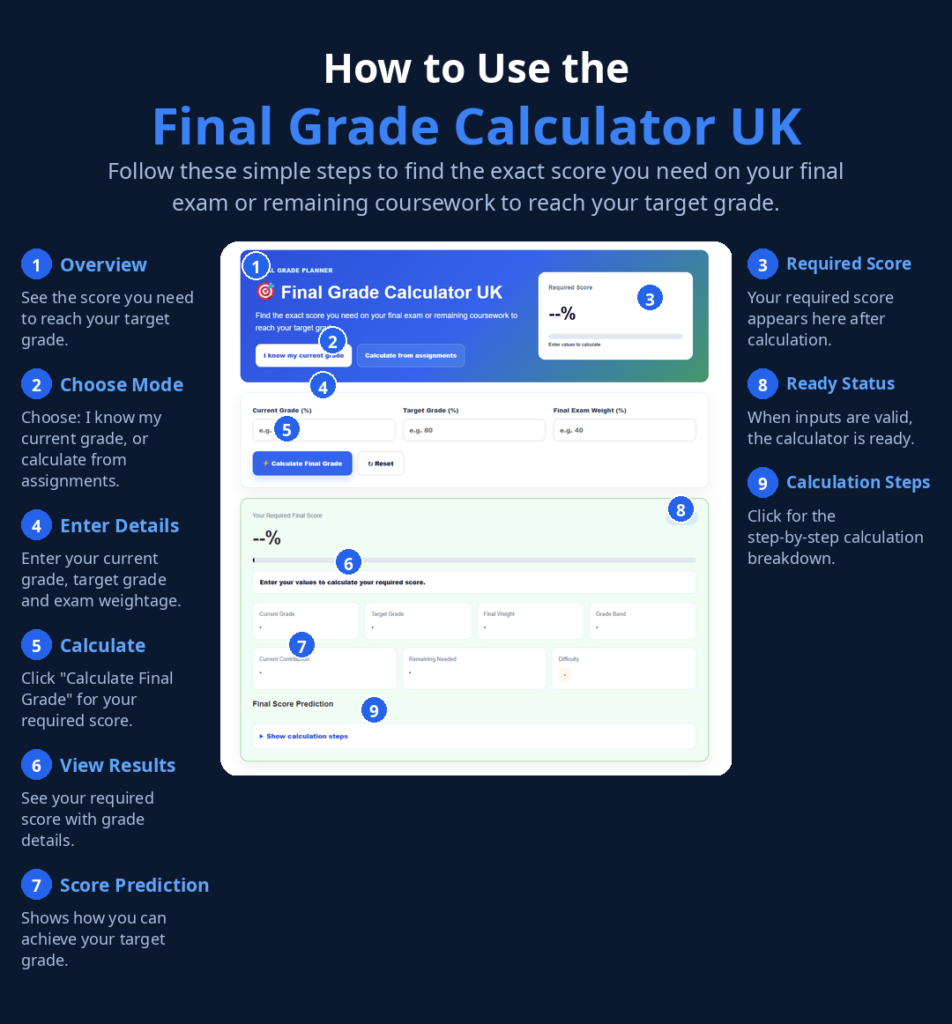
Click Here: Final Grade Calculator UK
The Only Degree Graded Twice
To understand engineering marking, forget the simple picture of “pass your modules, get your average, get your class.” Your degree’s grading sits on two layers:
- The university layer: module marks out of 100, 40% pass at levels 4–6 (50% at level 7 for MEng), credit-weighted averages, and your institution’s classification algorithm. This layer works like every other UK degree — see our degree classification calculator to model it.
- The accreditation layer: the Engineering Council’s requirements, enforced through your professional institution (IET, IMechE, ICE, IStructE, IChemE, RAeS). These add hard constraints universities must apply: limits on compensated fails, compulsory project modules that cannot be compensated, and no-resit project modules at some universities.
The accreditation layer is invisible until it bites. A student with a clean 2:1 average can still lose accredited status by failing the wrong 15-credit project module twice — or by carrying too many marginal fails. Universities spell these rules out in programme specifications, but students rarely read them until exam-board season. The sections below quote what those specs actually say.
How the Marks Split: Exams vs Labs vs Coursework
Forget the sixth-form idea that a degree is mostly exams. Engineering assessment shifts dramatically between years, and the exact split depends on your discipline and your electives. Imperial College London’s published programme specifications give an unusually honest indicative breakdown for Electrical and Electronic Engineering:
| Year | Coursework | Exams | Practical |
|---|---|---|---|
| 1st year | 15% | 65% | 20% |
| 2nd year | 9% | 70% | 21% |
| 3rd year | 43% | 54% | 3% |
Three things jump out. First, the first two years are exam-heavy (65–70%) — this is the mathematical boot camp: engineering science, maths, circuits. Second, by third year coursework has nearly caught up with exams (43% vs 54%), driven by design projects and dissertations. Third, practical lab assessment is substantial in years 1–2 (around a fifth) and then fades as project work takes over. The same Imperial spec notes that year 3 autumn modules are examined in December while the spring term is coursework-only, deliberately freeing students for industrial placements from late March.
Bath’s framing is even starker for MEng students: around 60–70% coursework and practical assessment against 30–40% exams. The takeaway for grade strategy: if you’re an exam-day performer, years 1–2 are your harvest years — but year 1 usually doesn’t count toward classification, and by the years that do count, the exams are sharing the stage. If you’re stronger at sustained project work, the degree gets friendlier as it gets more important.
One question students ask every year: is there negative marking in engineering exams? We found no published evidence of negative marking in UK engineering exam modules — the only compensatory-marking scheme we could verify was in Southampton’s physics provision, a different discipline. If your module handbook doesn’t say it explicitly, assume every mark counts and attempt everything. Check the handbook; don’t trust forum rumours.
Lab Reports and Practicals: The Quiet 20%
Laboratories are the assessment type most engineering students underestimate. In the first two years they’re worth roughly a fifth of your marks at research-intensive universities, they’re marked to tight rubrics, and they reward a very specific skill: writing up method, results and error analysis to professional standards, not just getting the circuit to work.
Lab marking typically splits between the experimental work itself and the written report, with error analysis and discussion of results carrying disproportionate weight — a working rig with a thin write-up scores worse than a misbehaving rig with an honest, analytical report. Imperial’s assessment handbook lists the project-marking criteria it applies to practical work: evidence of enquiry and creative ability, level of understanding, level of effort and competence, and clarity of presentation including viva voce. Read that list as a marking rubric: understanding and presentation are named alongside effort. Turn up with results but no analysis and you’ve left marks on the bench.
Strategically, labs are the cheapest marks in an engineering degree. They’re frequent, small-stakes, and rubric-driven — the opposite of a 3-hour thermofluids paper. Students who treat lab weeks as holidays and cram for exams are misreading where the marks live, especially in years 1–2 where practical assessment can be a fifth of the total.
The Final-Year Project: Your 30-Credit Lever
Every engineering degree culminates in an individual capstone project — typically 30 credits, a quarter of your final-year marks. It is assessed through some combination of a written report, a demonstration or prototype, an oral presentation or viva, and supervisor assessment. Cambridge’s Part IIB model shows the anatomy: the project is graded from 360 guidance marks, with the written report alone worth 200 — the report is the project, in marking terms.
Two features make the capstone unlike any other module. First, it is double-marked: a supervisor as first marker and an independent assessor as second marker, with the two reconciled into the module grade. Cambridge grades projects into classes (I, II.1, II.2, III) with no numeric marks released to students and no scaling applied — your supervisor and assessor’s judgement is final. Second, it is the single biggest lever on your classification. A 30-credit module in a year where 120 credits count contributes a quarter of that year’s mean, and the final year is usually the most heavily weighted year of the degree.
Worked example: a 20-mark project swing decides the class
Take Amara, a BEng student on a 1:2 year-weighting scheme (year 2 counts once, year 3 twice — so year 3 is two-thirds of the final average). Her year-2 average is 63%. Her year-3 modules, excluding the 30-credit project, average 61%. Now compare two project outcomes:
- Project at 75%: year-3 mean = (61 × 90 + 75 × 30) / 120 = 64.5%. Final degree = (63 + 2 × 64.5) / 3 = 64.0% — a 2:1.
- Project at 55%: year-3 mean = (61 × 90 + 55 × 30) / 120 = 59.5%. Final degree = (63 + 2 × 59.5) / 3 = 60.7% — a 2:2.
The same student, the same everything else — and a 20-mark difference on one module moves the final average by 3.3 percentage points and costs a full degree class. That is the arithmetic of the capstone lever: each project mark is worth (30/120) × (2/3) ≈ 0.167 points on the final degree, roughly six times the weight of a mark on a 15-credit year-2 module. If you have one module to over-invest in, this is it.
There is a darker side. The Engineering Council requires that major project modules cannot be compensated — a failed project must be passed, not carried. Leicester’s programme specification goes further: its designated project modules (EG3005 and EG3008 for BEng; EG4007 and EG4009 for MEng) are required to be passed at honours level and cannot be treated as compensated fails, and the MEng pair have no resit option at all because the combination of practical and team working makes a resit impractical. Fail one of those twice and the degree itself is at risk — and even a single-attempt failure can be enough to strip accredited status, as the next section explains.
Group Design Projects: When Your Mark Depends on Teammates
Engineering is one of the few disciplines where group work is a professional accreditation requirement, not just a teaching preference. The Engineering Council expects accredited programmes to develop teamwork, so group design projects are compulsory — and they’re assessed in ways that catch free-riders. The standard mechanism is peer assessment: the team gets a group mark, and each member’s individual mark is adjusted by a peer-contribution factor, moderated by academic staff.
The mechanics vary by university, and the swings are real. Imperial’s Bioengineering department adjusts the group mark by up to 25% through WebPA peer assessment — an 80% group mark can become a 60% individual mark for a student the team rates as a passenger. UCL uses the IPAC system, where tutor-moderated peer ratings produce an individual adjustment factor applied to the team score. Edinburgh and Surrey run similar peer-contribution adjustments with academic moderation, so the factor isn’t a popularity contest — tutors see the ratings and can override anomalies.
Worked example: the peer factor on a 72% team project
Daniel’s four-person team scores 72% on their second-year design project (15 credits). Three peer-assessment models, three outcomes for Daniel:
- Flat team mark (no adjustment): Daniel gets 72%, whatever he contributed.
- Moderate peer factor (0.9): the team rates Daniel’s contribution slightly below average → 72 × 0.9 = 64.8%.
- Free-rider factor (0.75, Imperial-style): the team rates him well below average → 72 × 0.75 = 54.0%.
On a 15-credit module in a year where 120 credits count equally, that 18-point peer swing moves Daniel’s year mean by 2.25 percentage points — and at a borderline, that’s a classification. The defence is evidence: keep a dated log of your contributions, volunteer for the documentable work (CAD models, test rigs, report sections with your name on them), and take peer assessment seriously when you rate others — departments cross-check for retaliatory scoring. Our full guide to how group project marks are calculated covers the WebPA, Buddycheck and IPAC systems in detail.
Accreditation Rules That Override Your University
Here’s the part of engineering grading that has no equivalent in other subjects. The Engineering Council — the UK regulator for the engineering profession — requires accredited programmes to apply rules that can be stricter than the university’s own. Leicester’s published programme specification shows exactly how this works, because it prints the accreditation conditions verbatim:
- Compensated fails are capped: finalists on accredited BEng and MEng programmes may carry no more than 30 credits of compensated fail across their degree. A compensated fail must be no lower than 35% at levels 4–6, or 40% at level 7.
- Project modules are exempt from compensation: major individual or group project modules — and any modules covering accreditation learning outcomes not assessed elsewhere — must be passed at honours level. They cannot be compensated, whatever your average.
- Some project modules have no resit: at Leicester, the MEng project pair (EG4007, EG4009) offer no resit option, because the mix of practical and team working can’t be recreated.
- The penalty for breaching them: finalists who can’t meet the accreditation criteria after resits are still awarded a degree if they meet the university’s own rules — but it’s the non-accredited BSc in General Engineering, not the accredited BEng or MEng.
That last point is the one students miss. Your university can pass you while your profession withholds its stamp. The non-accredited award is a real degree, but it doesn’t count as an accredited qualification for chartership — you’d need to demonstrate equivalence through a technical report instead of the straightforward accredited route. The Engineering Council’s course-search tool lets you check whether a specific programme holds current accreditation before you apply; never assume it, because accreditation is reviewed periodically and can lapse.
This is also why engineering students should care about the sector-wide algorithm debate: the Office for Students has ruled that discounting your lowest marks is “inherently inflationary,” and several universities are already changing their classification algorithms. Our coverage of the OfS degree-algorithm ruling and what algorithm changes mean for your grade explains what’s shifting.
Chartership: CEng, IEng and the Degree-Class Myth
Ask engineering students what chartership requires and most will say “a 2:1 and an accredited degree.” Half of that is wrong. The academic requirements are set out in the Engineering Council’s UK-SPEC standard (4th edition, the current version — there is no 5th edition), and the professional institutions apply them precisely:
| Registration | Academic requirement (UK-SPEC) |
|---|---|
| CEng (Chartered Engineer) | Accredited MEng or accredited BEng (Hons) plus an accredited Master’s, EngD, or approved further learning to Master’s level |
| IEng (Incorporated Engineer) | Accredited bachelor’s degree or HND / foundation degree plus approved further learning to bachelor’s level |
Notice what isn’t in that table: a degree class. IMechE’s published academic-requirements page lists only accredited degree types — there is no 2:1 or 2:2 threshold for chartership registration. What CEng actually tests is the five UK-SPEC competence areas (A: knowledge and understanding, B: design and problem-solving, C: responsibility and leadership, D: communication, E: professional commitment), demonstrated through a written submission and a professional review interview after several years of responsible work experience. The “Chartered Engineer” title itself is protected by law under the Engineering Council’s royal charter.
The institutions licensed to assess you include the IET, IMechE, ICE, IStructE, IChemE and the Royal Aeronautical Society, among others — you apply through the body closest to your discipline. And if your degree isn’t accredited, the door isn’t shut: you can demonstrate equivalence through a technical report, though it’s a longer road than the accredited route. Interim registration exists so graduates can bank their accredited academic qualifications while they build the competence evidence.
The practical consequence: a 2:2 on an accredited MEng keeps every chartership door open that a First would. What the class affects is getting hired in the first place — which is the next section’s territory. Don’t confuse the employer’s filter with the profession’s standard.
Resits, Borderlines and the Fail Ladder
Engineering resit rules follow the UK norm with sharper teeth. Failed modules are resat capped at the 40% pass mark (50% at level 7) — the resit mark replaces your fail for progression but the cap stands in your average. Sheffield’s regulations illustrate the attempt ladder: two further attempts at level 4, one further attempt at levels 5 and 6. Run out of attempts and you’re looking at repeating the year or exiting with a lower award.
Fail the resit and the referral rules kick in — the failed-components-only principle, uncapped EC resits, and the repeat-year ladder are the same across disciplines. Our guide to university referrals walks through the full process. In engineering, add the accreditation overlay: some project modules can’t be resat at all (Leicester’s MEng pair), and failed modules below the compensated-fail floor can’t be carried.
Borderline rules — the discretionary uplift at classification boundaries — are where engineering departments show their personalities. Three verified examples:
- Southampton: students within 2 marks of a boundary are considered for uplift if at least 50% of their credits sit in the higher class.
- Surrey: students within 2% of a classification boundary get an automatic review.
- Imperial: borderline zones run from n8.00 to n9.49 (so 68.00–69.49 below a First), with board-specific algorithmic criteria deciding uplift — and no rounding up into the zone.
Sheffield adds a structural twist: it computes classification two ways (weighted mean and credit-distribution) and applies borderline bands like 68.0–69.4, promoting students with at least 50% of level 5–7 credits at the threshold. The pattern across all of them: borderlines reward profile, not pleading. A 68.6% with half your final-year credits at 70+ is promotable; a 68.6% built on a flat 68s profile usually isn’t. If you’re anywhere near a boundary, the distribution of your marks matters as much as the average — see how UK universities round marks for the full mechanics.
Placement Years: The Year That Doesn’t Count
Many engineering degrees offer a year in industry — and the grading surprise is that it usually doesn’t count toward your classification at all. Southampton’s Year in Employment and Sheffield’s industrial placement year (38 weeks minimum) are both assessed on a pass/fail basis: complete the placement satisfactorily and it appears on your transcript, but it contributes zero to your degree average.
That doesn’t make it worthless for your grades. A placement year is a 12-month head start on the competences chartership will later demand, it feeds directly into final-year project ideas (many students base their capstone on a placement problem), and placement employers convert a remarkable share of interns into graduate offers. It just isn’t a lever on the classification number — plan your effort accordingly, and don’t coast through final year assuming the placement “year” bought you marks. It bought you something better: evidence.

Does a 2:2 in Engineering Still Work?
This is the most-asked question on student forums, and the honest answer has two halves. On The Student Room, engineering graduates with 2:2s report a consistent experience: it’s not catastrophic the way students fear — engineering skills are demonstrable in technical interviews in a way essay-subject skills aren’t — but the 2:1 filter on graduate schemes is real, and most large employers’ online applications screen at 2:1 before a human ever sees your CV.
The two halves, stated plainly:
- Employers: most structured graduate schemes filter at 2:1. A 2:2 doesn’t end your career — SMEs, startups, and technical roles that test you directly care far less — but it narrows the biggest, best-advertised pipeline. Our analysis of whether degree classification matters to employers puts the numbers on this.
- The profession: chartership doesn’t care about your class at all, as shown above. And a 2:2 on an accredited MEng is still the full CEng academic route, while a First on a non-accredited degree is not. Accreditation status beats classification for the professional standard, every time.
The strategic implication: if you’re tracking toward a 2:2, the highest-value move isn’t panic — it’s protecting accreditation (pass the project modules, stay within the compensated-fail cap) and building demonstrable technical evidence (placement, capstone, competitions like Formula Student) that bypasses the CV filter. A 2:2 with a strong project portfolio and a placement reference outperforms a bare 2:1 with nothing else on the page.
5 Mistakes Engineering Students Make About Their Marks
- 1. Studying like it’s all exams. By the years that count, exams can be under half your marks. Students who neglect lab reports and coursework in years 1–2 are throwing away the cheapest, most rubric-driven marks in the degree.
- 2. Treating the final-year project as “just another module.” At 30 credits it’s worth roughly six ordinary module-marks on your final average. A 20-mark swing on it decided a full degree class in our worked example above.
- 3. Free-riding on the group project. Peer assessment can cut your individual mark by up to a quarter. The team knows exactly who did what, and the adjustment is tutor-moderated — it sticks.
- 4. Assuming accreditation is automatic. Fail the wrong project module or carry too many compensated fails and you can graduate with a non-accredited degree while your coursemates get the accredited one. Check your programme spec’s accreditation conditions before exam season, not after.
- 5. Thinking a 2:2 blocks chartership. It doesn’t — no class is required for CEng or IEng. What a 2:2 affects is graduate-scheme filters. Confusing the two leads students to despair over the wrong gate.
What is the pass mark for engineering modules at UK universities?
The standard pass mark is 40% for undergraduate levels (levels 4–6) and 50% at master’s level (level 7 on MEng programmes). Resits are normally capped at the pass mark, so a resat module contributes 40% to your average even if you score higher.
How much of an engineering degree is exams vs coursework?
It shifts by year. Imperial’s published breakdown for Electrical and Electronic Engineering shows roughly 65–70% exams in years 1–2, moving to about 54% exams and 43% coursework by year 3, with practical lab work around 20% in the early years. Bath’s MEng states roughly 60–70% coursework and practical assessment versus 30–40% exams overall.
Can you fail your final-year engineering project and still graduate?
You can still be awarded a degree under your university’s own rules, but major project modules cannot be compensated under Engineering Council accreditation rules — they must be passed. At some universities, such as Leicester’s MEng project modules, there is no resit option at all. Breaching the accreditation conditions can mean graduating with a non-accredited degree instead of the accredited BEng or MEng.
Do you need a 2:1 to become a Chartered Engineer (CEng)?
No. Chartership has no degree-class requirement. Under the Engineering Council’s UK-SPEC standard, CEng requires an accredited MEng, or an accredited BEng (Hons) plus an accredited Master’s or further learning to Master’s level, followed by demonstrated professional competence and a professional review interview. A 2:2 on an accredited degree keeps every chartership route open.
How are group design projects marked in engineering degrees?
The team receives a group mark, then each member’s individual mark is adjusted by a peer-contribution factor moderated by academic staff. Imperial’s Bioengineering department adjusts the group mark by up to 25% through WebPA peer assessment, and UCL uses the IPAC system — so a free-rider on an 80% team project can end up with 60% individually.
Does a placement year count toward your engineering degree classification?
Usually not. Industrial placement years at universities such as Southampton and Sheffield are assessed on a pass/fail basis and contribute nothing to the classification average. They still appear on your transcript and build the competence evidence chartership later requires.
What is the difference between an accredited and a non-accredited engineering degree?
An accredited degree has been assessed by a professional engineering institution (such as the IET or IMechE) as meeting the Engineering Council’s standards, and it counts directly toward chartership. A non-accredited degree — which a student can end up with by breaching accreditation conditions like the compensated-fail cap — is still a real degree, but the graduate must demonstrate equivalence through a longer technical-report route.
Is a 2:2 in engineering enough for graduate jobs?
It’s workable but narrower. Most large graduate schemes filter applications at 2:1, so a 2:2 closes the biggest structured pipelines. Smaller employers, startups and roles with technical testing care far less about the class — and a 2:2 with a strong final-year project, placement experience and demonstrable skills regularly outperforms a bare 2:1. Chartership itself is unaffected by your class.
Conclusion
Engineering degrees are graded through more mechanisms than any other undergraduate subject: shifting exam-to-coursework ratios, rubric-driven lab reports, a 30-credit capstone with outsized leverage, peer-adjusted group marks, and — uniquely — an accreditation layer that can override your university’s own regulations. The students who do well aren’t necessarily the best exam-takers; they’re the ones who read the assessment structure early and put effort where the marks actually live.
If you take three things from this guide, make them these. First, weight your effort by credit and year-weighting, not by anxiety — the final-year project deserves a disproportionate share of your time because the arithmetic says so. Second, protect your accredited status as fiercely as your average: pass the project modules, stay inside the compensated-fail cap, and check your programme specification’s accreditation conditions before exam season. Third, stop worrying about the wrong gate — chartership never asked for your degree class, but graduate employers will, so build the project and placement evidence that gets you past the filter even if the number disappoints.
Model it yourself: plug your module marks into our Final Grade Calculator to see what your remaining exams and projects need to deliver, and the degree classification calculator to test borderline scenarios. In engineering, the students who compute their position early are the ones who act while there’s still time to change it.
![Read more about the article Easiest UK Universities to Get Into: Lowest Entry Requirements [2026]](https://gradeforuni.com/wp-content/uploads/2026/10/featured-easiest-universities-to-get-into-300x192.png)