
![You are currently viewing How Are Business Degrees Graded in the UK? [2026]](https://gradeforuni.com/wp-content/uploads/2026/10/featured-business-degrees-graded.png)
How Are Business Degrees Graded in the UK? [2026]
Business and management is the UK’s most popular degree subject — HESA’s 2023/24 enrolment data shows it accounts for 21% of all students in UK higher education, up from 20% the year before. One in five undergraduates is studying some form of business. And yet ask those students how their degree is actually graded and you will mostly get blank looks, because business degrees are graded through a more complicated machine than most subjects: a mixed diet of exams, group coursework and presentations, folded into year weightings that vary sharply between universities, with a second parallel scoreboard — professional accreditation thresholds — running quietly alongside the first.
This guide explains exactly how business degrees are graded at UK universities: the exam-versus-coursework split (with real module-level numbers), the year-weighting schemes at named universities and why the same marks can produce different classifications at different institutions, the outsized role of the final-year dissertation or consultancy project, the accreditation thresholds that decide whether you keep your ACCA, ICAEW or ICAS exemptions, how placement years are treated, and how group work and peer assessment can move your individual mark up or down.
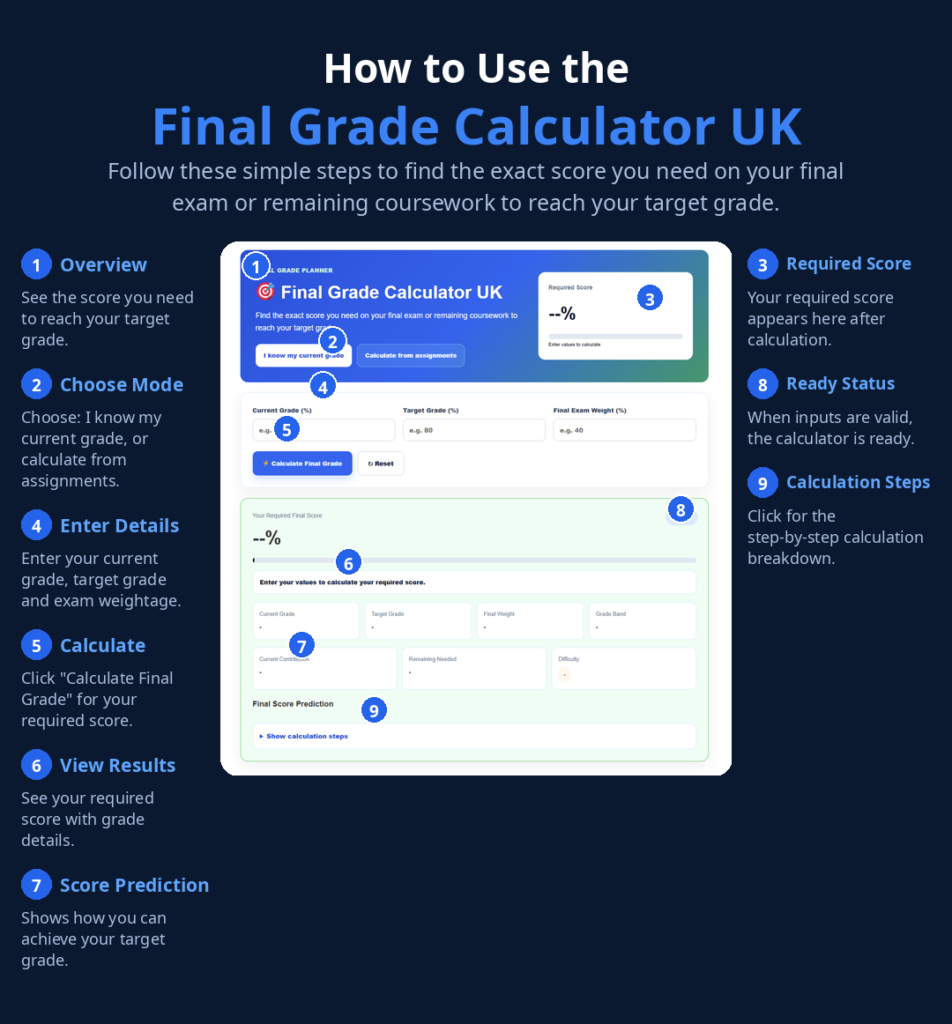
If you are weighing up a business degree, already studying one, or trying to work out what your final-year marks need to be, this is the full picture. Use the Final Grade Calculator alongside it to model your own position.
Click Here: Final Grade Calculator UK
The assessment mix: exams, coursework and everything in between
Business schools deliberately grade through a mixed diet. Warwick Business School describes its assessment as a mix of exams, individual and group work, and tests, with some modules including a peer-assessment element on group assignments. The University of Bath’s course pages publish ranges: on BSc Economics and Mathematics, assessment is typically 50% to 75% exams and 25% to 50% essays, reports and presentations, while BSc Finance and BSc Accounting and Finance strike “a broad balance between examinations and coursework”. Most Bath business courses assess you primarily as an individual but include some group-assessed work.
The single most useful rule of thumb is that the mix follows the module type. Quantitative modules — accounting, finance, statistics, economics — skew exam-heavy. Discursive and applied modules — marketing, strategy, HR, organisational behaviour — skew coursework-heavy. Warwick’s published module catalogue shows this precisely:
| Module (Warwick, official catalogue) | Coursework / participation | Exam or project |
|---|---|---|
| IB114 Financial Management | 10% coursework | 90% exam |
| IB116 Foundations of Management Accounting | 10% participation | 90% centrally-timetabled exam |
| IB394 International Financial Management | 10% coursework | 90% exam |
| IB150 Foundations of Data Analysis for Management | 10% participation | 90% project (effectively no exam) |
Notice the implication. A student who is brilliant at exams but slow on essays can rack up first-class marks on the finance side of the degree and leak marks on the strategy side — or vice versa. Because business degrees span both styles, your module choice matters as much as your effort. Options let you lean toward the assessment style that suits you, and picking a coursework-heavy option slate when you are exam-strong (or the reverse) is one of the quietest ways students leave a classification on the table. Two authoritative external references for the patterns above: Warwick’s module pages (for example IB114) and Bath’s BSc Finance course page.
Year weightings: the same marks, different degrees
The most consequential fact about how business degrees are graded is not the 40% pass mark — it is which years count and how much. Year one never counts toward your classification at any UK university. What counts, and in what ratio, differs by institution. Here is the published picture at the universities business applicants most often ask about:
| University | Year weighting (Y1 : Y2 : Y3) | Notes |
|---|---|---|
| Bath | 0 : 32 : 68 | Stage 2 at 32%, final stage at 68%; four-year versions count Stage 2 at 32% and Stage 4 at 68% |
| Warwick | 0 : 50 : 50 | Year 2 and final year equally weighted; borderline within 2.0pp promoted if >50% of year-weighted credits are at or above the boundary |
| King’s College London | 0 : 2 : 3 | Four-year variants with a year away weight it at 0 (0:2:0:3) — only King’s marks count |
| Manchester | 0.1 : 0.3 : 0.6 (university default) | Schools may adopt an alternative model; boundary zones at 68.0–69.9 etc. with two-thirds of level-6 credits at or above the class |
| Leicester | 0 : 33 : 67 | Straightforward two-year split per the university’s classification guide |
| LSE | Mark-count scheme | Not a percentage weighting: 16 classification marks from years 2 and 3 (full units count twice), aggregate thresholds; resit marks capped at pass for classification |
Read that table again, because it is the whole game. At Warwick your second year and final year matter equally. At Bath your final year is worth more than twice your second year. At LSE there is no percentage average at all — your classification is built from how many first-class marks you collected and what your aggregate reached (a first typically needs 12–14 first-class marks plus an aggregate of at least 1700). The same set of module marks can therefore land in different classes at different universities. If you ever transfer institutions — or if you are choosing between business schools — the algorithm matters as much as the teaching. (The sector trend here is real: regulators now scrutinise exactly these algorithms — see our guide to the recent degree-algorithm changes.)
A practical consequence: borderline rules are part of the grading system, not a bonus round. Warwick promotes borderline candidates within 2 percentage points of a higher class if more than half their year-weighted credits sit at or above the boundary. Manchester considers students in zones like 68.0–69.9 if two-thirds of their final-year credits reach the class. If your average sits at 68.5%, whether you graduate with a first or a 2:1 can depend on which university’s rules you are under — worth knowing before results day, not after. Our borderline grades guide walks through how these discretions work.
The final-year dissertation or consultancy project: your biggest lever
On a business degree, the final year is where the classification is usually won or lost — and inside the final year, one module dominates. A typical final-year dissertation or major project carries 30 credits out of the 120 available at level 6, making it a quarter of your entire final year and, at Bath-style 68% weightings, a very large share of your degree.
The dissertation is marked like any other module on the 0–100 scale; it is not separately double-weighted. Its leverage comes purely from size: a 30-credit module counts twice as much as a 15-credit module and three times a 10-credit one. And the size varies. Bath Spa’s BA Business and Management runs its level-6 project at 40 credits — a third of the final year in a single assessment. At the other end of the spectrum, Warwick Business School gives students a choice: a 6,000-word dissertation or an applied “Business in Practice” capstone module. If extended academic writing is not your strength, that choice is genuinely valuable — a weak dissertation is the single most expensive module to fail on a business degree.
Here is why the dissertation moves classifications. Take a Bath-style 32:68 weighting with a 40-credit project. Suppose the final year is a 40-credit project at 74% and 80 other credits averaging 62%:
Final-year average = (40 × 74 + 80 × 62) ÷ 120 = 7,920 ÷ 120 = 66.0%.
Overall degree = 0.32 × 60 + 0.68 × 66.0 = 19.2 + 44.88 = 64.08% → 2:1.
Now swap the project mark to 52% while everything else stays the same. The final year drops to (40 × 52 + 80 × 62) ÷ 120 = 58.67%, and the degree becomes 0.32 × 60 + 0.68 × 58.67 = 59.1% → 2:2. One module, one classification class. This is why the dissertation deserves the disproportionate share of your final-year effort — and why starting it in October rather than February is worth more than any revision technique.
The second scoreboard: professional accreditation thresholds
Here is the part most business students discover too late. Your degree is graded on the 0–100 scale with a 40% pass mark — but if your course carries professional accreditation, there is a second set of thresholds running in parallel, and they are stricter than the degree pass mark.
The mechanics: accountancy bodies such as ACCA, ICAEW and ICAS grant exemptions from their professional exams to graduates of accredited degrees, but only if the underlying modules were passed at a higher bar. ACCA’s own exemption-accreditation rules require that acceptable examinations contribute at least 50% of the total marks of each module considered for exemption, with no individual final exam shorter than 1.5 hours — and exemptions apply at the Applied Knowledge and Applied Skills levels only, never at Strategic Professional level. The University of Edinburgh Business School’s official accreditation handbook shows how this bites in practice: for ICAEW Certificate-level exemptions you need 50% in each listed module (Accounting, Assurance, Law, Management Information, Principles of Taxation), and the Business, Technology and Finance paper is exempted only with a 2:1 or first in a related degree. ICAS keeps a minimum 50% pass in all modules counting toward its exemptions, with a single auditing module held to 60%.
The trap this creates is real and arithmetic. A module mark of 43% passes your degree comfortably — but it loses the professional exemption that required 50%. You graduate with the same classification as someone who scored 52% in that module, but you sit the professional exam they skip. Edinburgh’s handbook covers its Accounting & Finance, Accounting & Business, Economics & Accounting and LLB Law & Accountancy degrees (graduates 2025–2029) — the full mapping is worth checking before you decide which modules to prioritise.

The accreditation world extends beyond accountancy. CIMA’s qualification structure runs through Certificate, Operational, Management and Strategic levels plus three years’ practical experience for CGMA membership — the typical destination for management-accounting-oriented business graduates. The Chartered Management Institute takes a different form: Queen Margaret University’s Business Management degrees carry CMI Level 5 dual accreditation (the degree plus a CMI Level 5 qualification, with a route toward Chartered Manager), and Arden University’s BA Business Management awards a CMI Level 5 Diploma in Management & Leadership plus Foundation Chartered Manager status. These do not change your degree classification — but they are the reason employers ask about specific modules, and the reason a 43% pass can cost you more than a few percentage points.
Placement years: three models, check yours
Business is the subject where sandwich years are most common — but “doing a placement year” means three different things for your marks depending on the course:
| Model | How the year counts | Named example |
|---|---|---|
| Recorded but excluded | You must pass the placement, but it contributes 0% to classification | Bath (standard placement year does not contribute to final degree marks); Warwick intercalated year (0% weighting; failing it transfers you back to the 3-year variant) |
| Year away weighted at zero | The year away is part of the algorithm but weighted 0 | KCL: 0 : 2 : 0 : 3 — only King’s marks count |
| Counted | Placement years carry real percentage weight | Bath BSc Business with two six-month placements: Year 2 16%, Year 3 16%, final year 68% |
The financial arithmetic still works in the excluded model’s favour. The Institute of Student Employers reports a median placement-student salary of £23,000 (2022/23 survey), and a sandwich year costs roughly half the tuition of a standard year while often generating a full-time salary. But know which model you are on before you assume your placement performance can rescue a weak second year — at Bath, Warwick and KCL it mathematically cannot. If it counts, treat it like a year of study; if it does not, treat it like a paid internship that buys you a graduate job, not grade points.
Group work, peer assessment and presentations
Business degrees assess teamwork explicitly, and this is where your mark can move independently of the group’s. Warwick officially advertises a peer-assessment element on some group assignments, and peer-adjusted marking is standard practice across UK universities. The most widely used mechanism is WebPA (deployed at Loughborough, Edinburgh, Cardiff and others): the group earns a shared mark, and each member’s individual mark is adjusted from peer scores. A group awarded 66% might become 73% for a strong contributor and 59% for a weak one after the adjustment — same group, a full degree band apart.
Our dedicated guide to how group project marks are calculated walks through the shared-mark, split-weighting and peer-adjusted models in detail. For business students the practical lesson is narrow: on group modules, document your contribution. Peer assessment is only as accurate as the evidence your teammates see, and the students who complain about “carrying the group” are often the ones whose work was invisible to the people scoring them.
Presentation-heavy assessment is the other business-school signature. Warwick’s “Management for Business Excellence” module lists reports, essays, individual and group presentations, simulation reports, consultancy reports, online tests and video presentations as its assessment mix. If public speaking terrifies you, know that some business schools lean much harder on it than others — and that, unlike an exam hall, a presentation mark rewards preparation more than talent.
Worked example 1: the second-year comeback (Warwick-style 50:50)
Amara is on a three-year business degree with a 50:50 year weighting — second year and final year count equally. Her second-year module marks are 55, 60, 58, 52, 63 and 57:
Second-year average = (55 + 60 + 58 + 52 + 63 + 57) ÷ 6 = 345 ÷ 6 = 57.5% — a mid 2:2.
In her final year she has a 30-credit dissertation (72%) and six 15-credit modules (66, 68, 61, 63, 59, 65). First, weight the final year:
Final-year average = (30 × 72 + 15 × (66 + 68 + 61 + 63 + 59 + 65)) ÷ 120 = (2,160 + 5,730) ÷ 120 = 7,890 ÷ 120 = 65.75%.
Overall degree = (57.5 + 65.75) ÷ 2 = 61.6% → 2:1.
Two things to notice. First, the dissertation alone contributed (30 ÷ 120) × 50% = 12.5% of the entire degree — more than any other single module, and it carried her best mark. Second, 61.6% is nearly 6.4 points clear of the 2:2 boundary, but had she scored 55 on the dissertation instead of 72, the final year would have been 61.5% and the degree 59.5% — a 2:2, and not even in Warwick’s 2-point borderline zone. The classification turned on one module.
Worked example 2: the accreditation trap
Daniel’s marks look healthy. On his Accounting & Finance degree he scores 43% in Financial Accounting, 61% in Management Accounting, and 58% everywhere else. His year average is a comfortable 2:2, comfortably above the 40% pass mark on every module. He graduates.
But his degree carried ICAEW accreditation, and the exemption for the Certificate-level Accounting paper requires 50% in that specific module. Daniel’s 43% passes the degree and fails the exemption. The classmate who scored 52% in Financial Accounting graduates with the identical classification — but skips a professional exam Daniel must now sit, pay for, and study for in his evenings.
This is the two-scoreboard system in miniature. Every module on an accredited business degree is being graded twice: once for your classification, once for your exemptions. Before final year, pull up your business school’s accreditation handbook and list the threshold modules. For those modules — and only those — a 45% is not “nearly a pass”, it is a failure that your degree certificate will not show.
Six mistakes business students make
- Treating all years the same. On a 32:68 or 0.1/0.3/0.6 scheme, an hour spent on a final-year module is worth two to six hours spent on a first-year one. Effort should follow the weighting, not the timetable.
- Ignoring the borderline zone. If you are sitting at 67–69%, read your university’s borderline rules now — Warwick’s 2-point rule and Manchester’s boundary zones can turn a strong dissertation term into a first. See how universities round marks for the mechanics.
- Assuming a passed module is a safe module. The 43%-pass/50%-exemption gap means some of your modules need a higher target than the pass mark. Know which ones.
- Starting the dissertation in February. The 30-to-40-credit project is the single biggest lever on your classification, and it is the module where early effort compounds — data collection and supervisor feedback cannot be crammed.
- Leaving group contribution undocumented. With peer-adjusted marking, the visible contributor gets the adjustment. Keep a dated record of what you did and circulate it.
- Forgetting compensation rules differ. A condoned or compensated pass counts for the degree but can lose you the professional exemption — check whether your business school allows compensation on accredited modules at all. See how condoned passes work.
If your second year has left you needing a strong final year, our 2:2 to 2:1 recovery guide applies the same arithmetic with a 12-week plan.
What percentage of a business degree is exams?
There is no single figure — it varies by module, option choices and university. Published ranges from the University of Bath put BSc Economics and Mathematics at 50–75% exams, with finance degrees striking a broad balance between exams and coursework. As a rule of thumb, accounting and finance modules are exam-led (Warwick’s IB114 Financial Management is 10% coursework, 90% exam), while marketing, strategy and HR modules are coursework-led.
Do first-year marks count towards a business degree classification?
No. At every UK university, year one is a qualifying year: you must pass it to progress, but its marks contribute 0% to your final classification. What counts differs by university — common models include Warwick’s 50:50 (year 2 : final year), Bath’s 32:68, KCL’s 0:2:3, Manchester’s 0.1/0.3/0.6 default and LSE’s mark-count scheme.
What mark do I need on each module to get a 2:1 in business?
You need a credit-weighted average of at least 60% across the years that count. Because of year weightings, individual module targets vary: on a Bath-style 32:68 scheme with a 60% second year, the final year needs roughly 60% too, while a weaker second year (say 57.5%) needs about 61–62% in the final year. Use the Final Grade Calculator to model your exact position.
Do I need professional accreditation exemptions with my business degree?
Not for the degree itself, but they matter for accountancy and finance careers. ACCA, ICAEW and ICAS grant exemptions from professional exams only if you hit higher thresholds than the 40% degree pass mark — typically 50% in each relevant module, with some papers (like ICAS’s auditing module at 60%, or ICAEW’s Business, Technology and Finance paper requiring a 2:1 or first) stricter still. A 43% module pass keeps your degree but loses the exemption.
Can I fail a module and still get my business degree?
Usually yes, through resits (normally capped at 40%) or compensation/condoned passes within your university’s credit limits. But beware the accreditation catch: a resat or compensated module that fell below 50% will normally lose its professional exemption, since exemption bodies typically require first-attempt marks at their threshold.
How much does the final-year dissertation count on a business degree?
Typically 30 credits out of 120 in the final year — a quarter of the year’s marks, and around 12.5–17% of the whole degree depending on the year weighting. Some courses go bigger: Bath Spa’s Business and Management project is 40 credits. It is the single largest lever on your classification.
Does a placement year count towards my business degree classification?
It depends on the course. Three models operate: recorded but excluded (Bath’s standard placement year and Warwick’s intercalated year carry 0% toward classification), year-away weighted at zero (KCL’s 0:2:0:3 scheme), and counted (Bath’s BSc Business with two six-month placements weights Year 2 at 16%, Year 3 at 16% and the final year at 68%). Check your course regulations — never assume.
Can peer assessment change my mark on a group project?
Yes. On modules using peer-adjusted marking (such as WebPA, used at several UK universities), the group earns a shared mark and each member’s individual mark is adjusted from peer scores — a group awarded 66% might become 73% for a strong contributor and 59% for a weak one. Warwick Business School advertises a peer-assessment element on some group assignments. Document your contribution throughout the project.
Conclusion
Business degrees are graded through two machines running at once. The first is the classification machine: a mixed diet of exam-heavy finance modules and coursework-heavy strategy modules, averaged through a year weighting that is a property of your university, not your subject — 50:50 at Warwick, 32:68 at Bath, 0:2:3 at KCL, a mark-count scheme at LSE. The second is the accreditation machine: a parallel set of thresholds where 50% per module is the real pass mark and 40% is a pass that costs you an exemption. Understanding both is what separates the students who graduate with a 2:1 and nine exemptions from the ones who graduate with a 2:1 and a pile of professional exams to sit in their evenings.
The practical takeaway is short. Learn your university’s weighting scheme and borderline rules before final year, not during it. Give the dissertation the share of effort its 30 or 40 credits demand. Pull up your business school’s accreditation handbook and mark the 50%-threshold modules in red. And whenever you need to know exactly what your remaining modules must deliver, run the numbers through the Final Grade Calculator — because on a business degree, the students who do the arithmetic are the ones who get the class they aimed for.