

How Are Economics Degrees Graded in the UK? [2026]
Ask an economics undergraduate what their degree feels like and you will hear two answers at once. One is essays about inflation, trade and fiscal policy. The other is pages of algebra — differentiating, integrating and running regressions until the symbols blur. Both are real, and both count. Economics is among the most exam-heavy degrees in UK higher education, it front-loads serious mathematics from the first term, and it has a quirk almost no other subject shares: at some of the country’s most famous universities, there is no dissertation at all.
That combination makes economics degrees graded in the UK a system worth understanding before your marks start landing. The assessment mix tilts hard toward timed written exams — a sector survey of 60 UK economics departments found an average of 68% written exams in year 1, 70% in year 2 and 63% in year 3. The quantitative modules (maths, statistics, econometrics) are where classifications are most often won and lost, because they are compulsory, credit-heavy and brutally honest about preparation. And the year weightings that decide your final class vary sharply: Warwick’s BSc counts year 2 and year 3 at 50/50, UCL uses a 1:3:5 split across all three years, LSE runs a preponderance-based scheme unlike almost anything else, and Oxford’s Economics & Management counts Finals only.
This guide sets out the whole machinery with real, published numbers: the exam-versus-coursework splits, the maths and econometrics hurdles, the BSc-versus-BA distinction, the dissertation question, four universities’ real year-weighting schemes, two fully worked arithmetic examples — a borderline-First case and a weak-econometrics counterfactual — and the borderline, resit and must-pass rules that decide outcomes at the margins.
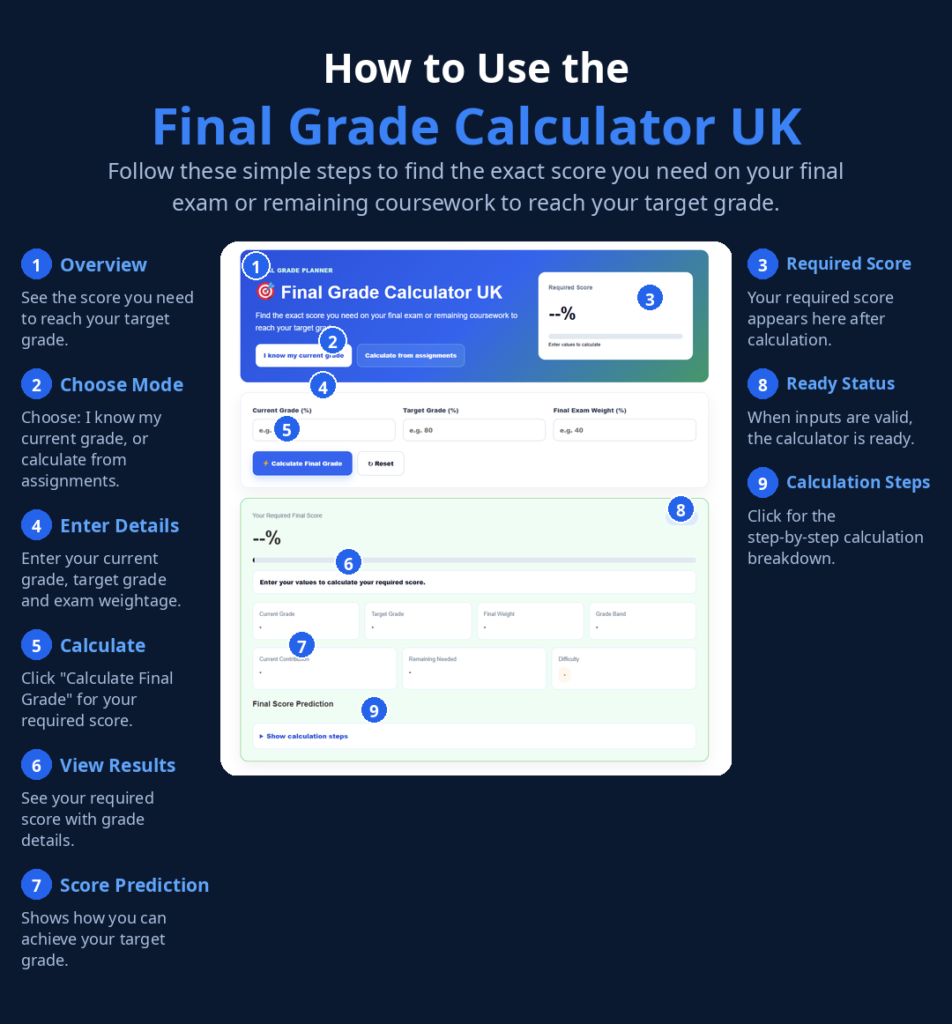
Click Here: Final Grade Calculator UK
How economics degrees are assessed: the exam-heavy reality
Economics remains, at its core, an examination subject. The most authoritative sector-wide figures come from the Economics Network’s survey of 60 UK economics departments (drawn from UNISTATS/KIS data). Across the sector, the mean share of a year assessed by written exams was 68% in year 1, 70% in year 2 and 63% in year 3 — with coursework averaging 28%, 28% and 30% respectively. Note the ranges as well as the means: the exam share ran from 13% to 100% in year 1, so department culture and module choice matter enormously.
Individual universities confirm the pattern with their own published breakdowns:
| University | Published assessment split | Source detail |
|---|---|---|
| Southampton (BSc Economics) | Year 1: 58% exam / 36% coursework / 6% practical; Year 2: 72% exam / 28% coursework; Year 3: 61% exam / 39% coursework | Published breakdown for 2025/26 |
| Bath (BSc Economics) | 50–75% examinations; 25–50% essays, reports and presentations | Course page assessment statement |
| Reading (BSc Economics and Econometrics) | Coursework capped at 20% of any module mark (special cases excepted) | Programme specification |
| Warwick (BSc Economics) | Typical module in years 1–2: 20–30% coursework, 70–80% final exam; some modules 50/50 | Course page assessment statement |
Two things stand out. First, the exam share is highest in year 2 — the year that counts toward classification everywhere — which means your most heavily examined year is also the one that moves the needle on your degree class. Second, the coursework share rises in final year, driven by projects and dissertations where they exist (see below) — so students who are stronger on sustained written work than on timed papers tend to close the gap late.
What this means practically: revision technique and timed-exam practice are not optional extras on an economics degree. Southampton’s 72% exam share in year 2 means that for every hour of assessed coursework you produce, roughly two and a half hours of equivalent mark weight will be decided under exam conditions. The students who treat January and May exam seasons as the main event — not the aftermath of coursework — are reading the incentives correctly.
The quantitative core: maths, statistics and econometrics
Every serious economics degree has a spine of quantitative modules running through it, and this spine is where the grading stories concentrate. The modules are compulsory, they are assessed heavily by exam, and they separate students who arrived with strong school maths from those who did not.
At LSE’s BSc Economics, the quantitative spine starts immediately: year 1 includes EC1C1 Econometrics I (a half-unit paper) alongside ST109 Elementary Statistical Theory I, plus a full mathematics paper — students choose between MA100 Mathematical Methods (the harder option) and MA107 Quantitative Methods. Year 2 then makes EC2C1 Econometrics II a compulsory full-unit course. This is why LSE’s standard offer is A*AA with an A* in Mathematics: the department is telling you, via the offer, exactly how maths-heavy the assessment will be.
UCL is even more explicit. Its economics FAQ tells prospective students they will take “two mathematics courses in your first year which will teach the mathematics you’ll need for the rest of your degree”, plus a first-year statistics course and a second-year quantitative economics and econometrics course. Applicants “not likely to achieve a grade A* in A Level Mathematics are advised not to apply” — mathematics, the department says, “plays an important part in the course”. That is not admissions marketing; it is a forecast of where your marks will come from.
How these modules are actually marked matters as much as their existence. Warwick’s EC203 Applied Econometrics — a compulsory year-2 core module — shows the standard anatomy: 70% centrally-timetabled written examination and 30% coursework, with the coursework itself split into an empirical assignment (10%) and two tests (10% each), including Stata coding skills. The resit, notably, is 100% examination — if you fail the module, you lose the coursework cushion entirely and sit the whole thing as a single paper. The year-3 follow-on, EC338 Econometrics 2: Microeconometrics, runs 40% coursework / 60% exam.
The honest student-forum verdict, repeated across years of threads, is that econometrics divides opinion: some students call it their highest-marking module, others call it the hardest. What is not disputed is its leverage. Quantitative modules are typically 15–30 credits each, compulsory, and exam-assessed — a weak mark in one cannot be dodged by module choice, and as our second worked example shows, a single 45 in econometrics can cost three full percentage points on a final classification.
BSc vs BA economics: what the letters actually mean for your marks
Students agonise over the BA/BSc distinction, and the answer is: it depends on the university, not the letters. The Economics Network’s sector survey gives the hard data on where the two labels diverge. Quantitative Methods modules appear on 22% of BA economics degrees versus 56% of BSc degrees; Econometrics on 59% of BAs versus 71% of BScs; Applied Econometrics and Forecasting on 18% of BAs versus 26% of BScs. Game theory skews BSc (41% vs 33%); behavioural economics is one of the few areas that skews BA (18% vs 6%).
Where a university offers both — Manchester Metropolitan is a clear published example — the distinction is structural: its BA (Hons) option “examines social and economic issues using a mix of discussion and statistics”, while the BSc (Hons) “emphasises advanced statistics and forecasting techniques”. If both labels exist at the same department, the BSc is the more quantitative track and your marks will reflect that: more problem-based exams, more econometrics, less essay work.
But the letters are a university convention, not a national standard. As one long-running student-forum thread puts it, the BA/BSc inference is “a red herring”: Cambridge, Oxford and Durham all award BAs in economics, and nobody would call those maths-light. You cannot read the quantitative intensity of a degree off its title. Read the module list — specifically, whether quantitative methods and econometrics are compulsory, and how they are assessed — and ignore the letters.
The one case where the structure genuinely changes the arithmetic is joint honours. Oxford’s PPE is a four-year programme with its own classification scheme, separate from the three-year norm (LSE had to introduce a distinct four-year scheme when it launched its own PPE in 2015/16). More broadly, joint-honours credit rules live in departmental handbooks and can alter how many credits you need in each subject — check them before assuming your economics marks carry the same weight as a single-honours student’s.
The dissertation question: there is no UK-wide rule
Ask whether an economics degree includes a dissertation and the honest answer is: sometimes, and the variation is extreme. The Economics Network’s survey found an economics dissertation is offered on 37% of BA and 46% of BSc degrees — offered, not compulsory. The rest of the sector assesses the final year entirely through exams and coursework modules.
| University | Dissertation rule | Detail |
|---|---|---|
| LSE (BSc Economics) | None | The programme regulations list examined papers only — a full-text search of the official regulations returns zero hits for “dissertation” |
| Warwick (BSc Economics) | Optional | Final year offers “the opportunity to undertake a final-year project” (15–30 credits) as an optional core choice |
| Reading | Optional | Dissertation (20 credits) is an optional Part 3 module |
| Manchester Metropolitan | Compulsory | Final-year dissertation on a topic of the student’s choice, testing data-handling skills |
The LSE case is worth pausing on because it surprises people. One of the most famous economics degrees in the country has no dissertation at all: assessment is via examined papers, full stop. That is a deliberate design choice — LSE’s assessment philosophy is examination-led — and it means an LSE economics student never gets the coursework-heavy final-year tailwind that lifts averages elsewhere.
Where a dissertation is optional, the choice itself is a grading decision. A 20–30 credit dissertation at, say, 75% contributes as much to your final-year average as a strong exam module — and for students who write better than they perform under timed conditions, it is the single highest-leverage module choice available. But it is also the most volatile: dissertation marks have some of the widest spreads in any department, because supervision quality, topic difficulty and data luck all vary. Choose it for genuine interest, not as a marks arbitrage.
How economics degrees graded: the year weightings behind your classification
Year weighting is the quietest but most consequential variable in how economics degrees are graded. Four leading universities, four completely different systems — and your classification can swing by a full class depending on which one you are under.
| University | Year weighting | How it works |
|---|---|---|
| Warwick (BSc Economics) | 50 : 50 | Year 2 and final year each contribute 50%. Year 1 does not count toward classification — it is pass-to-progress. |
| UCL (BSc Economics) | 1 : 3 : 5 | Weighted average of year averages: year 1 counts 1/9, year 2 counts 3/9, year 3 counts 5/9. Final year is five times year 1. |
| LSE (BSc Economics) | Preponderance scheme | Best 6 of 9 year-1 classification marks plus all 16 year-2/3 marks; you need 5 of 9 marks at the class level, or 4 marks plus a qualifying aggregate. All years count. |
| Oxford (BA Economics & Management) | Finals only | First-year Prelims are pass/fail and do not count. Classification is determined by Final University examinations in years 2–3 (eight courses, mostly written exams; a thesis can replace one optional paper). |
The spread is remarkable. Under Warwick’s 50/50, your second year is half your degree — a bad year 2 cannot be outrun. Under UCL’s 1:3:5, year 1 still counts (unlike Warwick), but your final year is worth five first years. Oxford’s system is the purest form of back-loading: nothing counts until Finals, so the entire degree is decided in one examination season.
LSE’s scheme deserves a closer look because it is genuinely unusual. Instead of a simple weighted average, LSE uses a preponderance principle: classification marks are counted, and you need a preponderance of them (5 out of 9) at a given class level — or 4 marks plus a qualifying aggregate score. Your best 6 of 9 first-year marks count, which builds in a small forgiveness mechanism, and all 16 second- and third-year marks count. Every paper matters, and there is nowhere to hide a cluster of weak modules. Note also that LSE is strict on second chances: students get 3 attempts at year-1 courses and 2 attempts at years 2–3, but only the first attempt is uncapped — resits are capped at a bare Pass.
One more Oxford peculiarity: alongside the standard 70/60/50/40 boundaries, Oxford’s Economics & Management regulations include a 30–39 band for a Pass without honours — below that is a Fail. Most universities stop publishing bands at the Third (40+); Oxford’s extra band is a reminder to read your own university’s regulations rather than assuming the familiar four classes are universal.
We have not attributed a scheme to Manchester’s BAEcon here deliberately: the university’s published regulations give its schools a choice between two weightings (0 / 0.33 / 0.67 or 0.1 / 0.3 / 0.6 across the three years), and we could not verify which the economics programme uses. If that is your university, the programme handbook — not this guide — is the source of truth.
Worked example 1: the borderline First — exit velocity under Warwick’s 50/50
Take a Warwick BSc Economics student. All modules are 30 CATS. Year 2 marks: Microeconomics 2: 62, Macroeconomics 2: 60, Applied Econometrics: 66, Option module: 68.
Year 2 average = (62 + 60 + 66 + 68) ÷ 4 = 256 ÷ 4 = 64.0
Year 3 marks: 76, 72, 75, 73.
Year 3 average = (76 + 72 + 75 + 73) ÷ 4 = 296 ÷ 4 = 74.0
Final weighted mark = (0.50 × 64.0) + (0.50 × 74.0) = 32.0 + 37.0 = 69.0
69.0 sits below the 70 boundary for a First — but Warwick’s published conventions say that where a student’s mean mark falls below a class boundary but is within 2.0% of it, the Board of Examiners “shall reconsider the student’s performance and consider whether to promote them to the higher class”. This student’s case is the textbook example of what the rule is for: a final-year average of 74.0, clearly above the First boundary, showing strong “exit velocity”. The board’s stated criteria include performance above the class boundary in the final year — met — and a preponderance of module marks above the boundary. Promotion is discretionary, not automatic, but this is exactly the profile that gets promoted.
The lesson generalises beyond Warwick. Under any system with borderline discretion — UCL’s published tables, Manchester’s boundary zones — the shape of your marks matters as much as the average. An upward trajectory, a strong final year, and marks clustered above the boundary all help. A flat 69.0 with a declining year 3 is a much weaker case than 69.0 built on a 74.0 finish.

Economics degrees are among the most exam-heavy in UK higher education — and the quantitative modules carry the most classification weight.
Worked example 2: one weak econometrics mark — and what it costs
Now the same Warwick 50/50 scheme, but with a weak quantitative module. Year 2 marks: Microeconomics 2: 66, Macroeconomics 2: 64, Applied Econometrics: 45, Option module: 72.
Year 2 average = (66 + 64 + 45 + 72) ÷ 4 = 247 ÷ 4 = 61.75
Year 3 marks: 70, 68, 72, 66.
Year 3 average = (70 + 68 + 72 + 66) ÷ 4 = 276 ÷ 4 = 69.0
Final weighted mark = (0.50 × 61.75) + (0.50 × 69.0) = 30.875 + 34.5 = 65.4 → a solid 2:1, nowhere near a borderline.
Now the counterfactual: suppose that econometrics mark had been 70 instead of 45. Year 2 average becomes (66 + 64 + 70 + 72) ÷ 4 = 272 ÷ 4 = 68.0. Final = (0.50 × 68.0) + (0.50 × 69.0) = 34.0 + 34.5 = 68.5 — within 2.0% of 70, and therefore a borderline-First case under Warwick’s rule.
One module, one 25-point swing: 3.1 percentage points on the final classification, and the difference between a comfortable 2:1 and a genuine borderline case. Note the honest nuance, though: in the counterfactual the final-year average is 69.0 — below the First boundary — so Warwick’s “performance above the class boundary in final year” criterion is not met, and promotion would be uncertain even in the borderline zone. The board could consider the preponderance of module marks, but it would not be the clean exit-velocity case of example 1.
This is why the quantitative spine matters so much in economics. A 45 in a 15-credit optional essay module is a dent; a 45 in compulsory second-year econometrics is a classification event. If you are choosing where to direct scarce revision hours in year 2, the core quantitative modules have the highest marks-per-hour of effort of anything in the degree — partly because they are the most predictable to prepare for (past papers, problem sets, formula sheets), and partly because everyone else finds them hard, which keeps grade distributions honest.
Borderlines, resit caps and must-pass rules
What happens at the margins is published — but the rules differ enough that you must check your own university’s version:
Warwick. Within 2.0% below a boundary, the board reconsiders and may promote. Separately, since 2018/19, a final mark of 70.0–70.9 automatically awards a First — no discretion needed.
UCL. The borderline table is exact and mechanical. A weighted average of 68.50–69.49 earns a First only with at least 60 final-year credits at 70% or better — otherwise it stays a 2:1. The same structure applies at the 2:1/2:2 boundary (58.50–59.49 needs 60 final-year credits at 60%+) and the 2:2/Third boundary (48.50–49.49 needs 60 final-year credits at 50%+). At 69.50 the First is automatic. Notice what this rewards: not a high average, but a high final year. UCL has effectively codified exit velocity.
Manchester. Published boundary zones (First: 68.0–69.9, Upper Second: 58.0–59.9, Lower Second: 48.0–49.9, Third: 37.0–39.9) mark the territory where boards exercise discretion.
Resit caps. Second chances are systematically devalued. LSE caps resits at a bare Pass. UCL caps resits at 40% for all undergraduate modules. And as noted, Warwick’s EC203 resit is 100% examination — the 30% coursework component vanishes. The pattern is consistent across the sector: the resit tests whether you can pass, not whether you can excel, and the cap makes sure your classification reflects that. (Our guide to rounding and borderline marks covers the general mechanics in more depth.)
Must-pass and progression. Reading requires at least 40% in all compulsory Part 1 modules to progress to Part 2, alongside a 40% overall average. UCL requires at least 90 credits at Level 6 or above for the BSc, with no more than 150 credits at Level 4 — a structural rule that stops students loading up on easy first-year modules. And LSE will only award a degree if you have attempted every component of assessment for every course: non-submission is not a grading event, it is a degree event.
Accreditation: economics has no equivalent of the physics watchdog
One striking difference from subjects like physics: there is no professional body that accredits UK economics degrees. No economics equivalent of the Institute of Physics exists for the degree itself, and there is no chartership pathway tied to accreditation. A department’s economics degree is validated by its university and reviewed through the normal quality-assurance machinery — not by an external professional gatekeeper.
What does exist is the QAA Subject Benchmark Statement for Economics (current edition published March 2023), which defines what can be expected of a graduate “in terms of what they might know, do and understand at the end of their studies”. It is, in the QAA’s own words, “not a regulatory requirement” — a sector-owned reference point written by academics, not a set of audited conditions. It shapes curriculum design across the sector, but it does not reach into your marks the way a professional body’s accreditation framework can.
Practically, this means two things. First, there is no external standardisation of economics assessment — which is why the LSE/Warwick/UCL/Oxford schemes above differ so wildly, and why reading your own programme handbook is non-negotiable. Second, employers do not hire on accreditation; they hire on the degree class and the university’s reputation. Your classification is the credential.
7 mistakes that cost economics students marks
- Arriving under-mathed. The forum evidence is consistent: students without A-level Mathematics (or with weak Further Maths) spend their first year catching up while everyone else is being examined on the catch-up material. At LSE, roughly two-thirds of entrants have full Further Maths — the teaching assumes it. If your maths is thin, the summer before year 1 is the cheapest revision time of your degree.
- Treating econometrics as “just another module”. It is compulsory, credit-heavy, exam-assessed, and — as worked example 2 showed — a single weak mark can cost three points on your final classification. It also rewards preparation more predictably than essay modules: past papers, problem sets and Stata practice translate directly into marks.
- Ignoring the resit trap. Resits are capped at 40 or a bare Pass almost everywhere, and Warwick’s EC203 resit drops the coursework component entirely. A failed core module in year 2 does not just cost you the summer — it permanently caps what that module can contribute to your classification.
- Misreading your year weightings. A Warwick student who coasts through year 2 has thrown away half their degree; a UCL student who ignores year 1 has thrown away a ninth of it; an Oxford E&M student who treats Prelims as the main event has misunderstood the system entirely. Know your scheme before you allocate effort.
- Choosing the optional dissertation for the wrong reasons. Where it is optional, a dissertation is the highest-variance module in the degree. Choose it because the topic genuinely interests you and you write well — not because it looks like an easy 20 credits. The mark spread on dissertations is brutal.
- Skipping past-paper practice for “understanding”. Economics exams reward problem-solving speed under time pressure, especially in the quantitative modules. Students who can explain the intuition but have never done a timed paper discover the difference in May. Oxford E&M students sit college collections every term for exactly this reason — manufacture your own equivalent.
- Assuming the BA/BSc letters tell you the maths load. Cambridge, Oxford and Durham award BAs in economics that are fully quantitative. Read the compulsory module list, not the degree title — and check whether econometrics and quantitative methods are compulsory before you commit.
Economics rewards a particular kind of student: comfortable with mathematics under timed conditions, disciplined about problem-set practice, and strategic about where effort converts into marks. The grading system is unusually transparent — every weighting, borderline rule and resit cap above is published — which means there is no excuse for being surprised by it. Plug your own numbers into the degree classification calculator and the final grade calculator, and you will know exactly where you stand. (The sibling guides in this series — how maths degrees are graded, how business degrees are graded, and how law degrees are graded — cover the neighbouring subjects.)
Frequently asked questions
How much maths is actually in an economics degree?
A lot — it is one of the most mathematical non-STEM subjects. Core modules in mathematical methods, statistics and econometrics run through most degrees, and at departments like LSE and UCL an A* in A-level Mathematics is effectively an entrance requirement. A sector survey found quantitative methods modules on 56% of BSc and 22% of BA economics degrees. If you arrive without A-level Maths, expect to spend your first year catching up while being examined on the catch-up material.
Do I need A-level Further Maths to study economics?
Not formally at most universities, but it is a significant advantage at the most quantitative departments. At LSE, roughly two-thirds of entrants hold full Further Maths, and teaching is pitched accordingly. UCL advises applicants unlikely to achieve an A* in A-level Maths not to apply. At less mathematical departments, students without A-level Maths do cope — one Sheffield student reported the first-year maths (differentiation, integration, matrices, logs) was manageable with effort. Check the compulsory module list of your specific course: that is the real answer.
Is econometrics the hardest module in an economics degree?
Student opinion is genuinely split — some call it their highest-marking module, others their hardest. What is not disputed is its leverage: it is usually compulsory, credit-heavy and exam-assessed. Warwick’s compulsory EC203 Applied Econometrics is 70% exam / 30% coursework (an empirical Stata assignment plus two tests), and its resit is 100% examination. Our worked example shows a single 45 in econometrics costing 3.1 percentage points on a final classification. Treat it as the highest marks-per-hour module in year 2.
What is the difference between a BA and a BSc in Economics — does it matter to employers?
Where a university offers both, the BSc is the more quantitative track (a sector survey: quantitative methods on 56% of BSc vs 22% of BA degrees; econometrics 71% vs 59%). But the letters are a university convention, not a national standard — Cambridge, Oxford and Durham all award BAs in economics that are fully mathematical. Employers hire on the degree class and the university, not the letters. Read the compulsory module list, not the title.
How much of an economics degree is exams vs coursework?
Exams dominate. A sector survey of 60 UK economics departments found a mean of 68% written exams in year 1, 70% in year 2 and 63% in year 3 (coursework 28%, 28%, 30%). Published university breakdowns confirm it: Southampton’s BSc runs 72% exams in year 2, Bath 50–75% exams, Reading caps coursework at 20% of any module mark, and Warwick’s typical module is 20–30% coursework with 70–80% final exam. Coursework shares rise in final year where projects and dissertations exist.
Does my first year count towards my final degree classification?
It depends on the university. At Warwick, no — year 1 is pass-to-progress and the classification is 50/50 on years 2 and 3. At UCL, yes — the 1:3:5 weighting means year 1 contributes one-ninth of the final mark. At LSE, yes — the best 6 of 9 first-year marks feed the preponderance scheme. At Oxford’s Economics & Management, no — Prelims are pass/fail and classification comes from Finals only. Check your own programme handbook; the variation is extreme.
Do all economics degrees include a dissertation?
No — and the variation is striking. LSE’s BSc Economics has no dissertation at all: the official programme regulations list examined papers only. Warwick and Reading make it optional (15–30 credits at Warwick, 20 credits at Reading). Manchester Metropolitan makes it compulsory. A sector survey found a dissertation is offered on 37% of BA and 46% of BSc economics degrees. Where optional, choose it for genuine interest — dissertation marks have some of the widest spreads in any department.
What happens if I fail a core module like econometrics — are resits capped?
Almost always, yes. LSE caps resits at a bare Pass; UCL caps all undergraduate resits at 40%; and at Warwick the EC203 econometrics resit is 100% examination — the 30% coursework component vanishes. A capped resit means the module can only ever contribute a pass-level mark to your classification, which is why a failed core module in year 2 is a classification event, not just a lost summer. Check whether your department offers uncapped resits for first-sit extenuating circumstances.
Conclusion
How economics degrees graded in the UK comes down to a few hard facts. The degree is exam-heavy — roughly two-thirds to three-quarters of your marks decided under timed conditions in most years — and the quantitative spine of maths, statistics and econometrics is where classifications are most often won or lost. A single weak mark in a compulsory econometrics module can cost three full percentage points on a final classification; the same effort directed at problem-set practice there buys more marks than anywhere else in the degree.
The second fact is that the system is not one system. Warwick’s 50/50, UCL’s 1:3:5, LSE’s preponderance scheme and Oxford’s Finals-only model produce completely different incentives — different years matter, different trajectories are rewarded, and different borderline rules apply. LSE’s lack of a dissertation, UCL’s codified exit-velocity borderlines, Warwick’s automatic First at 70.0–70.9: these are not footnotes, they are the rules of the game you are playing. Read your programme handbook before you allocate a single hour of revision.
The one habit to take from this guide is measurement: work out your weighted average under your own university’s actual scheme, check what your final year needs to deliver, and see where the quantitative modules sit in your remaining credits. The final grade calculator will do the arithmetic — in a subject built on incentives, guessing is the one strategy guaranteed to lose.