

How Are Law Degrees Graded in the UK? LLB Marks, SQE & Training Contract Grades [2026]
Law is one of the most applied-to degree subjects in the UK, and it has the most confusing grading landscape of any of them. Your marks do not live in one system. They live in three. First, your university grades your LLB on the standard 70/60/50/40 scale and hands you a First, a 2:1, a 2:2 or a Third. Then, when you qualify as a solicitor, the Solicitors Qualifying Examination grades you on a pass/fail scale out of 500 that has nothing to do with percentages. And sitting above both is a third, unofficial grading system: the 2:1 filter most law firms apply before they even read your application.
Students mix these systems up constantly. A 65% LLB average is a comfortable 2:1, but it tells a firm nothing about whether you will pass SQE1, where the July 2026 pass rate was 42%. A distinction on the GDL sounds impressive, but the LPC it once fed into took its final intake in September 2026. And the seven “core” law modules your degree makes you take? The regulator stopped requiring them in 2021, yet most firms still care how you performed in them.
This guide maps all three grading worlds: how your LLB classification is calculated, how the SQE’s pass/fail mechanics actually work, and how employer grade filters operate in practice. It includes the verified numbers behind each stage, two fully worked examples with complete arithmetic, and the honest options if your grades land short of the magic 2:1. Every figure below comes from the universities’, firms’ and regulators’ own published pages.
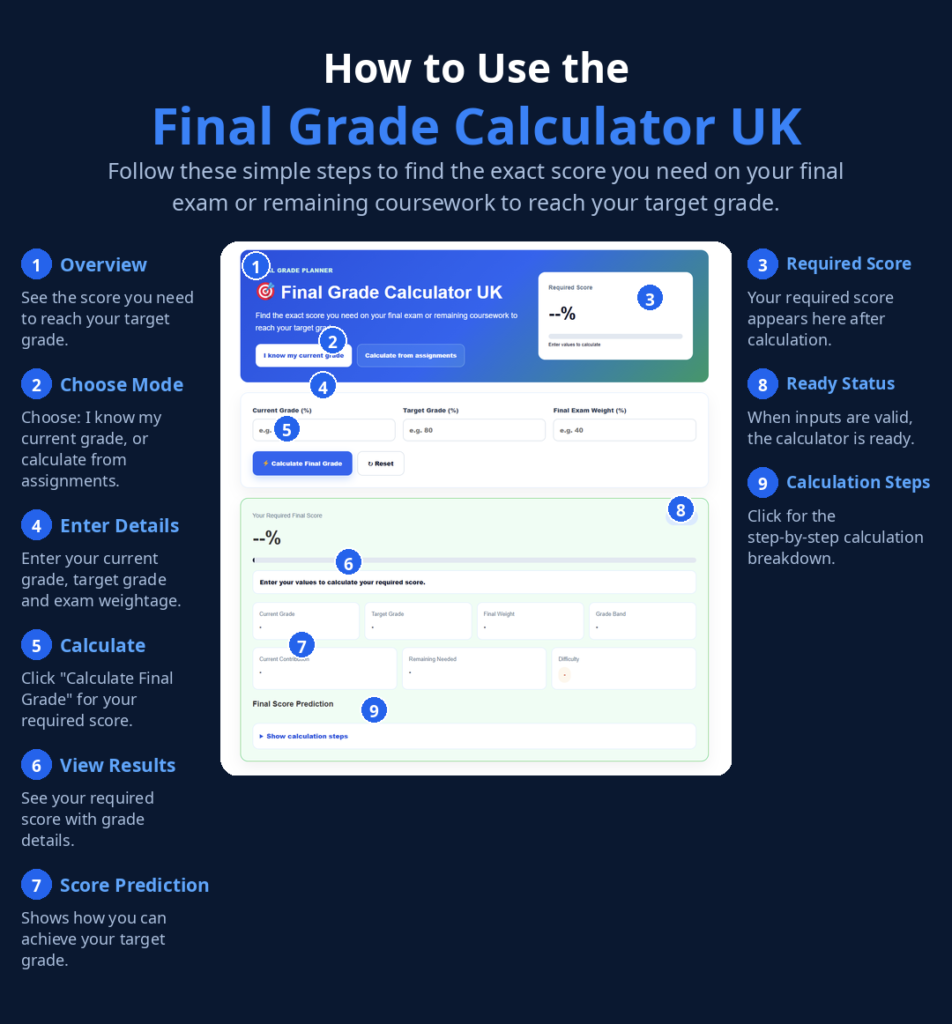
Click Here: Final Grade Calculator UK
Your LLB Is Graded Like Any Other UK Degree
Start with the reassuring part. An LLB (Bachelor of Laws) is classified exactly like any other honours degree: the standard percentage bands, the same honours classes, the same credit-weighted averaging machinery. Prospects and individual law school programme specifications (such as Reading’s LLB spec) confirm the bands below, which will look familiar from every other subject.
| Percentage band | Degree class | What it means |
|---|---|---|
| 70% and above | First-class honours | Outstanding; the top slice of the cohort |
| 60–69% | Upper second-class (2:1) | The standard training-contract threshold |
| 50–59% | Lower second-class (2:2) | A pass with honours; limits City firm options |
| 40–49% | Third-class honours | A pass; professional routes become very hard |
| Below 40% | Fail | Module must be retaken or compensated |
Your final class is computed from your credit-weighted module marks across the years your university counts — typically years 2 and 3 at weightings like 40:60 — exactly as our degree classification calculator models it. Law’s twist is not the arithmetic but the assessment diet: LLBs are unusually exam-heavy, built around problem questions and essays rather than coursework portfolios, and a single three-hour paper can carry an entire 20-credit module. That makes each exam a high-stakes event in a way coursework-based subjects rarely are.
The 7 Core Modules (and Why They Still Matter After 2021)
Until 1 September 2021, the Solicitors Regulation Authority required a “qualifying law degree” (QLD): an LLB covering seven foundations of legal knowledge. When the SQE launched, the SRA dropped the requirement entirely. Its own common-protocol page states it plainly: candidates “will no longer need to study for a QLD or CPE”, and the SRA “will no longer specify the academic content of law degrees”. In principle, any degree subject followed by the SQE can now lead to solicitor qualification.
In practice, the seven foundations refuse to die, for three good reasons. First, SQE1 tests them directly, so skipping them at degree level just moves the pain later. Second, the Bar Standards Board still requires the seven foundations for the academic stage of barrister training — confirmed in Cambridge’s academic requirements paper — so any LLB that wants to keep the Bar route open must teach them. Third, most LLBs simply kept them as mandatory modules anyway: Royal Holloway’s M100 programme specification, for example, still requires all seven. And several training-contract recruiters still scan transcripts for core-module performance, because a 72 in Contract Law says more about your SQE1 readiness than a 72 in an optional module on space law.
| Foundation | Typical module names | Why it still matters |
|---|---|---|
| Criminal Law | Criminal Law | Core SQE1 (FLK1) territory |
| Obligations 1: Contract | Contract Law | Core SQE1 (FLK1); firms read this mark closely |
| Obligations 2: Tort | Law of Tort | Core SQE1 (FLK1) |
| Property / Land Law | Land Law | Core SQE1 (FLK2) |
| Equity and Trusts | Equity and Trusts | Core SQE1 (FLK2); historically the hardest core exam |
| EU Law | EU Law | Still examined; post-Brexit retained-EU-law wrinkle |
| Public Law | Constitutional and Administrative Law | Core SQE1 (FLK1) |
How Your LLB Classification Is Actually Calculated
The machinery is the familiar one: each module mark is weighted by its credit value, averaged within each year, then the years are combined at your university’s weighting (40:60 is common, but schemes vary — check your own regulations rather than assuming). Here is a complete worked example showing how a 2:1 is built, module by module.
Worked example — Amara’s LLB. Amara’s university counts years 2 and 3 at 40:60. Her Year 2 modules (all 20 credits): Contract 68, Tort 64, Land 61, EU Law 66, Criminal Law 70, Public Law 62. Year 2 average: (68 + 64 + 61 + 66 + 70 + 62) ÷ 6 = 391 ÷ 6 = 65.17%. Her Year 3 modules (all 20 credits): Equity and Trusts 71, Jurisprudence 66, Company Law 63, Family Law 66, Evidence 69, Commercial Law 62. Year 3 average: (71 + 66 + 63 + 66 + 69 + 62) ÷ 6 = 397 ÷ 6 = 66.17%. Final degree mark: (0.40 × 65.17) + (0.60 × 66.17) = 26.07 + 39.70 = 65.77% — a comfortable 2:1, nearly four points clear of the 2:2 boundary.
Two things are worth noticing. First, Amara’s strongest mark (Criminal Law, 70) sat in Year 2 where it only counted at 40% weight — had it been a Year 3 module, her final mark would have been higher. Second, her dissertation-era modules in Year 3 did the heavy lifting: at 60% weighting, every extra mark in the final year is worth 1.5 times a Year 2 mark. If your university discounts your lowest marks or offers borderline uplift rules, those mechanics apply to law degrees too — see our guides on discounting your lowest module marks and recovering from a 2:2 to a 2:1 in final year.
After Graduation, the Rules Change: SQE1 and SQE2 Are Pass/Fail
Here is the mental shift every law student needs to make. The SQE does not give you a 2:1, a 68%, or a distinction. It gives you one of two words: pass or fail. Both stages are scored on a scale of 0 to 500, and the pass mark is always 300 — but 300 does not mean 60%. The pass mark for each paper is set using the Modified Angoff method, where a panel of solicitors judges how a borderline-competent candidate would perform on every question, with statistical equating across sittings. Your raw score is then scaled so that the pass line always lands on 300. There is no pre-published “you need X correct answers” figure, and comparing raw scores across sittings is meaningless.
SQE1 tests functioning legal knowledge through two papers (FLK1 and FLK2) of 180 single-best-answer multiple-choice questions each. Each paper is sat as two sessions in one day: 90 questions in 2 hours 33 minutes, twice. One format change to note: from the January 2027 sittings, each paper trims to 170 questions (85 per session) — every 2026 sitting uses the 180-question format. The headline number that should sober up anyone who assumes a 2:1 guarantees smooth qualification: the July 2026 sitting had an overall pass rate of 42% across 6,315 candidates (47% for first-time sitters), reported by Legal Cheek on 6 October 2026 from the SRA’s statistical report. The January 2026 sitting passed 53%. These are not university exams where most of the cohort passes; SQE1 fails most candidates in some sittings.
SQE2 tests practical legal skills across 16 stations: 12 written and 4 oral, covering exercises like client interviews, advocacy, case and matter analysis, legal drafting and legal research. There is a single overall pass mark of 300 out of 500 — no per-station pass mark, so a weak station can be carried by strong ones. The April 2026 sitting passed 83% overall (2,966 candidates; 85% for first-time sitters), published 27 August 2026; results for the July 2026 sitting are due 17 November 2026. Fees, set by the SRA: SQE1 costs £1,934 for sittings up to September 2026 and £2,006 after; SQE2 costs £2,974 rising to £3,086. On top of both stages sits two years of qualifying work experience (QWE), which is not graded at all — it simply has to be signed off as meeting the SRA’s competence threshold.
| SQE1 | SQE2 | |
|---|---|---|
| Format | 2 papers × 180 multiple-choice questions (170 from Jan 2027) | 16 stations: 12 written + 4 oral practical exercises |
| What it tests | Functioning legal knowledge (FLK1 + FLK2) | Practical skills: interviewing, advocacy, drafting, analysis |
| Pass mark | 300/500, set per paper by Modified Angoff + equating | 300/500 single overall mark; no per-station pass mark |
| Latest pass rate | 42% overall, July 2026 (6,315 candidates) | 83% overall, April 2026 (2,966 candidates) |
| SRA fee (from Sept 2026) | £2,006 | £3,086 |
The SRA publishes full details of the assessments and the current fees on the official SQE hub and its cost page — check both before you budget, because preparation course fees from commercial providers sit on top of the SRA’s own charges and can easily double the total.

Worked Example: Daniel’s 58.9% — a 2:2, and the Honest Options
Worked example — Daniel’s LLB. Daniel’s university also uses 40:60 weighting. His Year 2 average across six 20-credit modules is 57.3%; his Year 3 average is 59.9%. Final degree mark: (0.40 × 57.3) + (0.60 × 59.9) = 22.92 + 35.94 = 58.86%, which rounds to 58.9% — a 2:2, just 1.1 percentage points short of the 2:1 boundary. One better exam in Year 3 (a 66 instead of a 60 in a 20-credit module) would have added exactly 1.0 point at 60% weighting and put him on 59.9% — still short. He needed roughly two such improvements. That is how thin the margin is: a 2:2 and a 2:1 can be separated by a single exam answer.
A 2:2 closes the standard City training-contract filter, which is real and non-negotiable at most large firms. It does not close a legal career. The honest options, ranked by how commonly they work:
| Route | How the 2:2 affects it | Realistic? |
|---|---|---|
| Paralegal, then self-funded SQE | Many firms hire paralegals with 2:2s; qualify through work-based QWE | Yes — the most common 2:2 solicitor route |
| Regional and in-house roles | Smaller firms and in-house teams often drop the 2:1 filter | Yes |
| CILEx route | Qualify as a CILEX Lawyer via the CPQ, then sit the SQE | Yes — no degree class barrier |
| Masters (LLM/GDL) then reapply | Many postgraduate providers accept 2:2s; a strong PG performance helps | Sometimes — see masters with a 2:2 |
| Non-legal graduate schemes | Outside law the 2:2 matters far less after 2–3 years’ experience | Yes — see does your classification matter |
One caveat before despair or complacency: if your 2:2 came with genuine mitigating circumstances — illness, bereavement, a strike-disrupted assessment period — say so on the application. Several major firms explicitly invite mitigating-circumstances explanations and run contextualised recruitment that adjusts grade expectations for disadvantaged backgrounds. The box exists because firms know a transcript is not the whole candidate.
The Training-Contract Filter: Why the 2:1 Matters More Than Your SQE Score
Here is the irony of the system. Most large firms will never see your SQE scores, because they filter on degree class first. Squire Patton Boggs asks for candidates “predicted to obtain, or have obtained, a 2:1”. Allen & Overy, Goodwin, Latham & Watkins and Dechert all publish 2:1 minimums on their graduate recruitment pages. The typical A-level benchmark sitting alongside it is AAB. Your LLB classification is, for practical purposes, the first and harshest exam in the solicitor pipeline — harsher than the SQE itself, because the SQE at least lets you resit.
The picture is softening at the edges, and the direction of travel matters if you are applying in 2026–27. Ashurst has dropped A-level requirements entirely; DWF asks only for “good” grades without publishing a threshold. Contextualised recruitment — notably Allen & Overy’s long-running partnership with Rare — adjusts academic expectations for candidates from less advantaged backgrounds, and several major firms (Dechert, Mayer Brown, Freshfields among them) explicitly invite mitigating-circumstances explanations on their forms. What no firm publishes is “we accept 2:2s” — it is handled case by case, which is exactly why the extenuating-circumstances box exists on the application. Vacation schemes, the main pipeline into training contracts, use the same filters, so the 2:1 gate bites a full year before the training-contract application itself.
And once you clear the filter, grades recede. At assessment-centre stage firms test commercial awareness, written communication and teamwork far more than they re-examine your transcript. Your LNAT score got you into the degree (see our LNAT score guide); your 2:1 gets you through the filter; everything after that is about the candidate in the room.
Non-Law Graduates: GDL Grading and the LPC’s Final Intake
If your first degree was not in law, the conversion route still runs in 2026. The Graduate Diploma in Law (GDL) — sold as the PGDL by some providers — remains on offer: the University of Law took a September 2026 PGDL start, and BPP and City St George’s still run the course. BPP grades the GDL on a pass/merit/distinction scale: pass at 50%, merit at 60–69%, distinction at 70% and above. A GDL distinction will not rescue a weak first degree at the training-contract filter, but it evidences commitment and its content overlaps heavily with SQE1’s functioning legal knowledge, so it doubles as expensive preparation.
The Legal Practice Course, by contrast, is effectively over. The SRA confirmed in March 2026 that the LPC route has been replaced by the SQE and continues only on a transitional basis. The University of Law is no longer accepting LPC applications — its final intake was September 2026 (part-time online) — and BPP’s LPC is no longer offered. There are no new LPC starts in 2026. Anyone beginning the solicitor journey now goes through the SQE; the LPC survives only for students already on it.
| Route | Who it is for | How it is graded | Status in 2026 |
|---|---|---|---|
| GDL / PGDL | Non-law graduates converting to law | Pass 50%, merit 60–69%, distinction 70%+ (BPP) | Still running (ULaw, BPP, City St George’s) |
| LPC | The old solicitor vocational stage | Pass 50% (skills: competent / not yet competent); commendation 60%, distinction 70% | Final intake Sept 2026; no new starts |
| SQE | Everyone qualifying as a solicitor now | Pass/fail; 300 out of 500 on each stage | The live route |
The Barrister Route in Brief
Pupillage filters are, if anything, stricter than training-contract ones: Cambridge’s careers service advises that “a good 2:1 will be” the minimum most chambers expect. The Bar Training Course itself is graded Outstanding (85–100%), Very Competent (70–84%) and Competent (60–69%) under published provider regulations such as UWE’s, while the Bar Standards Board’s centralised assessments are simply marked competent or not competent. And unlike the solicitor route, the Bar still requires the seven foundations of legal knowledge at the academic stage — the 2021 SRA deregulation does not apply to barristers. This article focuses on the solicitor path because that is where most law graduates head, but the degree-class maths is identical either way.
5 Mistakes Law Students Make About Grades
| The mistake | The reality |
|---|---|
| “A First guarantees a training contract” | Firms filter on a 2:1, then assess everything else. A First with no commercial awareness loses to a 2:1 with vacation-scheme experience. |
| “The core modules don’t matter since 2021” | SQE1 tests them, the Bar still requires them, and recruiters still read them on transcripts. |
| “My 68% average means I’ll pass SQE1” | Different skill, different scale: 42% passed in July 2026, and the Angoff-set 300/500 line has no fixed raw-score equivalent. MCQ technique needs separate preparation. |
| “A 2:2 ends my legal career” | It closes the standard City filter, not the profession — see the options table above, plus contextualised recruitment. |
| “The LPC is still the safe default” | Its final intake was September 2026. The SQE is the route now; plan and budget for it instead. |
Do law degrees use the same grade boundaries as other UK degrees?
Yes. An LLB is classified on the standard UK scale: 70%+ is a First, 60–69% a 2:1, 50–59% a 2:2, 40–49% a Third, and below 40% is a fail. Your final class is calculated from credit-weighted module marks across the years your university counts, typically years 2 and 3. Law’s difference is the assessment diet — exam-heavy problem questions and essays — not the arithmetic.
Is my law degree still a “qualifying law degree”?
The qualifying law degree (QLD) concept ended on 1 September 2021, when the SQE launched and the SRA stopped specifying the academic content of law degrees. In principle any degree subject plus the SQE can now lead to solicitor qualification. In practice most LLBs still teach the seven foundations of legal knowledge as mandatory modules, SQE1 tests them, and the Bar Standards Board still requires them for the barrister academic stage.
What is the SQE1 pass mark?
There is no fixed raw-score pass mark. Each SQE1 paper’s pass mark is set using the Modified Angoff method with statistical equating, then scaled so the pass line is always 300 out of 500. The July 2026 sitting had an overall pass rate of 42% across 6,315 candidates (47% for first-time sitters); the January 2026 sitting passed 53%. From January 2027 each paper trims from 180 to 170 questions.
What is the SQE2 format and pass mark?
SQE2 consists of 16 stations — 12 written and 4 oral — testing practical skills such as client interviews, advocacy, legal drafting and case analysis. There is a single overall pass mark of 300 out of 500 with no per-station pass mark, so a weak station can be carried by strong ones. The April 2026 sitting passed 83% overall (2,966 candidates; 85% for first-time sitters).
Can I get a training contract with a 2:2?
It is difficult at large City firms, which almost universally publish a 2:1 minimum, but it is not the end of a legal career. No firm publishes “we accept 2:2s”, but several run contextualised recruitment and invite mitigating-circumstances explanations. Realistic alternatives include paralegal work followed by the self-funded SQE, regional and in-house firms that drop the 2:1 filter, and the CILEx route. A 2:2 one point short of the boundary is also worth checking against your university’s borderline rules.
What A-level grades do law firms want?
The typical published benchmark is AAB, sitting alongside the 2:1 degree requirement. The direction of travel is softening: Ashurst has dropped A-level requirements entirely and DWF asks only for “good” grades without a threshold. Contextualised recruitment can adjust expectations for candidates from less advantaged backgrounds.
Is the GDL still worth doing in 2026?
For non-law graduates, yes. The GDL (PGDL) is still running in 2026 — the University of Law took a September 2026 start, and BPP and City St George’s still offer it. BPP grades it pass (50%), merit (60–69%) and distinction (70%+). Its content overlaps heavily with SQE1, so it doubles as preparation. The LPC, by contrast, took its final intake in September 2026 and has no new starts.
Can I become a solicitor without a degree?
Yes. The solicitor apprenticeship takes around six years, requires no law degree (typical entry is around five GCSEs and three A-levels at grade C), and the employer funds the study. Alternatively, the CILEx route lets non-graduates qualify as a CILEX Lawyer through the CPQ and then sit the SQE to become a solicitor. Both routes end at the same SQE pass/fail line as the graduate route.
Conclusion
Law degrees are graded in three separate currencies, and the mistake is treating them as one. Your LLB runs on the familiar 70/60/50/40 bands, calculated from credit-weighted module marks like any other degree — except that each exam-heavy module carries more jeopardy, and the seven core foundations still shape both your transcript and your SQE1 readiness despite the SRA deregulating them in 2021. The SQE then resets the board entirely: two pass/fail stages on a 300-out-of-500 scaled line, with SQE1’s 42% July 2026 pass rate standing as a warning that degree success does not automatically transfer. Above both sits the employer filter, where a 2:1 remains the standard key to the training-contract door, softening only at the edges through contextualised recruitment and mitigating-circumstances routes.
The practical through-line is simple: each stage’s grades unlock the next gate, so model your trajectory early rather than discovering the maths in your final year. Run your current marks through the final grade calculator to see exactly what your remaining modules need to deliver, check whether your university discounts low marks or uplifts borderlines, and treat SQE1 as a separate mountain — multiple-choice technique on a 180-question paper is a skill your degree never taught you. A 2:2 is a detour, not a dead end; a First is an advantage, not a guarantee. In law, the grades get you into the room. What you do there is up to you.