Could an Algorithm Reject Your University Application? AI Admissions Filters Explained [2026]
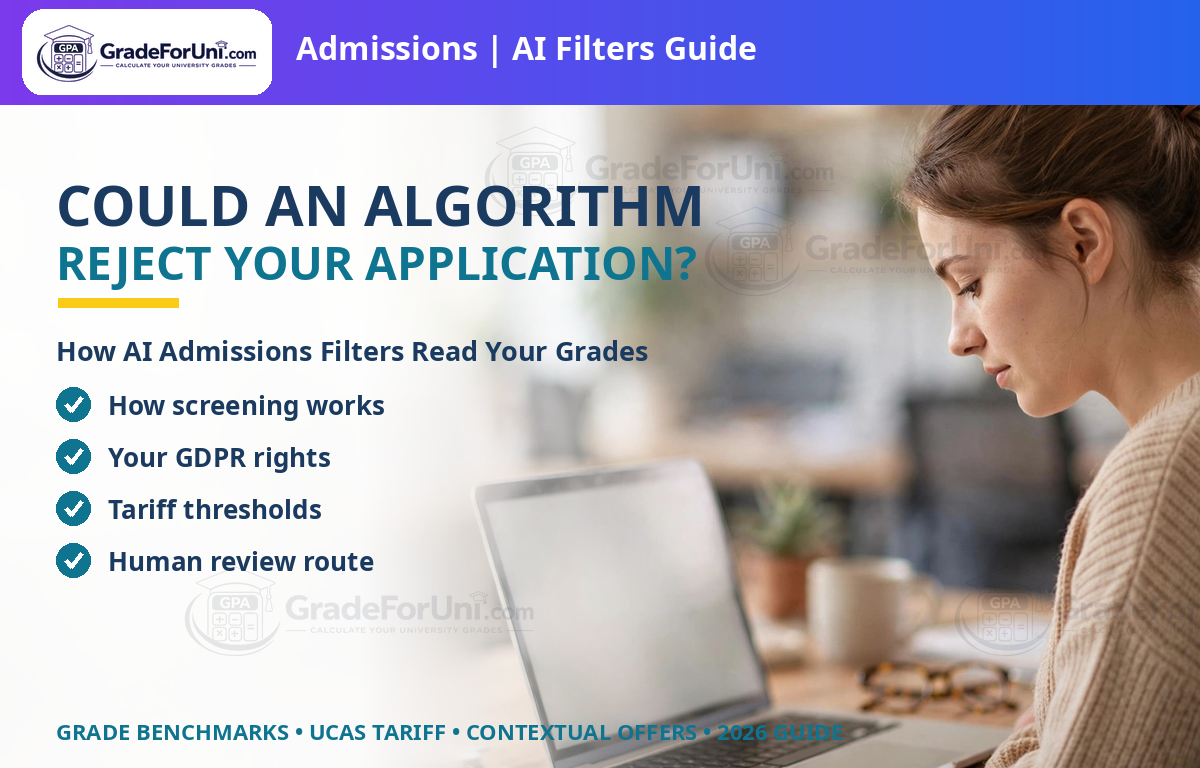
Before you press send on your UCAS application, ask the question almost no applicant asks: who — or what — reads it first? In the last few years, AI admissions filters have quietly entered the conversation about how universities handle the tens of thousands of applications they receive each cycle. Most students picture an admissions tutor reading their personal statement over coffee. The reality is more industrial: applications are first screened against grade benchmarks — minimum GCSEs, predicted A-levels, UCAS tariff totals — before any human looks at them. That screening has existed for years. What is new is the AI layer being added on top — and one respected school in west London has just decided the risk is too big to ignore.
This guide explains, neutrally and concretely, how admissions screening actually works: the three layers of it, why standard qualifications like GCSEs became the machine-readable currency every screen can parse, what happens to your application when your qualifications don’t match the standard benchmarks, what your rights are if a machine had a hand in your outcome, and the seven practical steps that put you back in control. Every factual claim below is attributed to its source — and where the evidence is one school’s stated reason rather than a verified sector-wide fact, we say so plainly.
One scope note before we start, because it matters: this is the reverse of the story we covered earlier today. Our AI marking at UK universities guide is about machines deciding your marks once you are enrolled. This guide is about machines screening your application before you get in. Same family of rights — very different battleground.
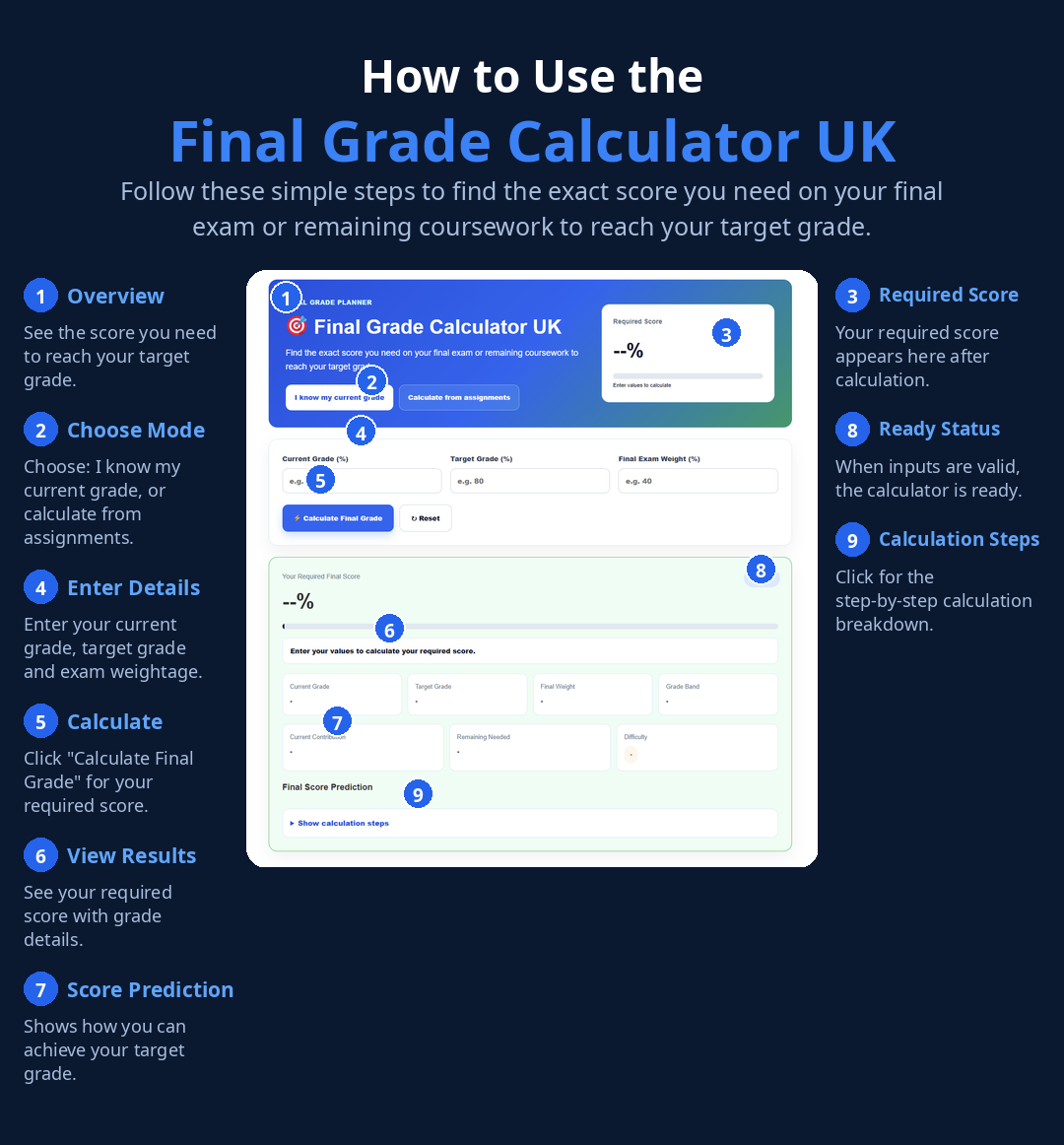
Click Here: Final Grade Calculator UK
The Latymer Story: Why One School Just Scrapped Its GCSE Replacement
In mid-October 2026, Latymer Upper School in Hammersmith, west London, scrapped a plan three years in the making. The independent school had announced in 2023 that from 2027 it would replace most GCSEs — keeping only English and maths — with its own in-house qualifications, built around a portfolio and transcript and graded on a pass/merit/distinction scale. The curriculum, the school still insists, needs a thorough rethink. But the replacement is dead — killed, in the school’s own account, by admissions algorithms.
The reporting is specific. The Times carried the story around 14 October 2026, and Independent School Management — the Financial Times’ schools title — published its own account on 2026-10-14T10:10:54+00:00 (read it here). Both quote senior deputy head Ian Emerson, and his explanation is worth reading in full — because every word of it is Latymer’s stated reason, not an independently verified fact about how universities operate:
“The decisive factor was that we weren’t prepared to risk our young people’s future university applications.” On the changing landscape: “Funding pressures have led to the decentralisation of admissions offices and advances in AI mean applications are increasingly filtered through algorithmic criteria. We came to realise there was no way to avoid our students being automatically evaluated against standard GCSE benchmarks, both in the UK and in Europe.” And the line that ended the plan: it was not worth the risk of “a pupil’s application being rejected by an algorithm before being read by a human”. Dropping most GCSEs, Emerson said, risked pupils being “filtered out by universities’ automated selection processes” — systems he notes were largely introduced since the plan was first revealed in The Times in 2023. The decision was taken “reluctantly”, he added, because the school still believes “the GCSE curriculum needs a thorough rethink”.
There was a second pressure behind the reversal. Per Independent School Management, staff had been “full steam ahead” on the new qualifications — until, the FT’s schools title reports, a number of UK universities and medical schools, plus universities in continental Europe, showed reluctance to recognise alternative qualifications. That reluctance, as much as the AI question, changed the school’s course.
The contrast is deliberate, and it is the honest frame for this whole guide. Bedales in Hampshire is still going ahead with its own in-house qualifications — the Bedales Assessed Courses, which it has run since 2006 — with head Will Goldsmith arguing that assessing pupils at 16 is “fundamentally inequitable”. Two respected schools, opposite conclusions, same evidence. The AI-filter question is genuinely unresolved — which is exactly why it is worth understanding before it touches your application.
One rule governs everything that follows: Latymer’s account of university admissions is Latymer’s stated reason for its decision. We present it exactly as that — attributed, dated, sourced — never as independently verified sector-wide fact. And no named UK university is claimed anywhere in this guide to use AI to filter admissions, because no dated primary source establishes it.
How AI Admissions Filters Actually Work: Three Layers of Screening
“Automated selection” sounds like one thing. It is really a stack of three — and your rights, and your remedies, are different for each. Anyone telling you “the algorithm decides everything” is flattening a three-layer process into a slogan:
| Layer | What happens | How long it has existed | What it checks |
|---|---|---|---|
| 1. Rules-based minimum-requirement screening | Hard yes/no checks against published minimums. No AI involved — just if/then rules. | Decades | Minimum GCSEs (e.g. five at grades 9–4 including English and maths); subject-specific minimums; standard-offer floors. |
| 2. Predicted-grade and tariff scoring | Predicted A-levels converted to UCAS tariff points; applications ranked or flagged against the offer line. | Years — computerised for a long time | Predicted grades, UCAS tariff totals, subject combinations against the standard offer. |
| 3. AI/ML-assisted screening | Statistical models trained on past admissions data help score, rank or shortlist; some reported pilots use language models on statements and references. | New — the layer Latymer is reacting to | Patterns in the data the model was trained on — which is precisely why the training data, and human oversight of it, matter so much. |
Layers 1 and 2 are the honest baseline, and they deserve emphasis: universities have screened applications against grade benchmarks via UCAS data for years — minimum GCSEs, predicted A-levels, UCAS tariff totals. Nothing about that requires AI, and none of it is new. Layer 3 is the murky part: where a model helps decide which applications a human ever sees. The distinction matters because the first two layers are fully described by published entry requirements — you can read them, meet them, and plan around them — while the third is where opacity creeps in.
Where does the human sit in all this? On competitive courses — the Russell Group grade requirements we track show just how high the bar runs — the screens narrow thousands of applications to a shortlist that humans then assess: personal statements, references, interviews, admissions tests. Tests are themselves another human-designed screening layer — our Oxbridge admissions tests guide explains how they work. And thresholds vary enormously across the sector: our easiest universities to get into guide shows how different the offer landscape looks outside the most competitive courses. The filter is not one national machine — it is thousands of local processes, some automated, most still human-led.
The Standard-Benchmark Problem: Why GCSEs Became Machine-Readable Currency
Here is the mechanism underneath the Latymer story. GCSEs and A-levels are not just qualifications — they are a data format. A GCSE grade 7 in English parses instantly into every admissions system in the country: it answers “does this applicant meet the English minimum?” with a yes or no, and it converts into UCAS tariff points without argument. A-levels do the same at the offer stage. That machine-readability is why standard qualifications became the currency of admissions screening: they are comparable, countable and unambiguous.
The tariff anchors are worth knowing cold, because every screen in the country speaks this language. At A-level: A* = 56 points, A = 48, B = 40, C = 32. So AAB = 48 + 48 + 40 = 136 points, and ABB = 48 + 40 + 40 = 128 points. Memorise those two numbers — 136 and 128 — because the worked example below turns on the eight points between them.
Now the problem. When your qualifications don’t match the standard benchmarks, the screen has nothing to latch onto. International qualifications, Access to HE diplomas and BTECs mostly have established tariff values — they parse. But a school’s own in-house qualifications, graded pass/merit/distinction with no GCSE grades and no UCAS tariff points, do not parse at all. The system looks for GCSE grade fields and finds transcript lines it cannot read; it looks for tariff points and finds none attached. That is not malice and it is not a judgement on ability — it is a format mismatch. But the outcome is the same as a rejection at the screening stage: the application never reaches the human who could have understood it.
This is the precise risk Ian Emerson described — “a pupil’s application being rejected by an algorithm before being read by a human” — and it is worth stating its exact shape: the danger is not that the machine dislikes your grades. It is that the machine cannot see them.
Worked example 1: the tariff-threshold funnel
Take a competitive course with a hypothetical automated filter line at 136 tariff points — the AAB equivalent. Two caveats before the arithmetic: universities do not publish their filter lines, and we invent none here. The line is illustrative; the maths is the point.
Applicant Daniel is predicted AAB. His tariff total: 48 + 48 + 40 = 136 points — sitting exactly on the filter line. At the application stage, the screen runs on predicted grades, so Daniel passes: 136 meets 136.
On results day, Daniel achieves ABB: 48 + 40 + 40 = 128 points. One grade slip — a single A becoming a B — costs exactly 8 tariff points (48 down to 40), and moves him from sitting on the line to sitting 8 points below it. That is the funnel’s cruelty in one number: at A-level, a single grade is worth 8 tariff points, and filter lines do not round up.
Now the human counterweight. A contextual offer for the same course might sit at ABB — 128 points — for applicants meeting the university’s published contextual criteria (which vary by institution; nothing is standardised here). Against the adjusted line, Daniel’s 128 passes. Structurally, that is what contextual offers are: the designed human override to hard automated lines — a second, lower line drawn deliberately by people, for people the standard screen would miss.
And note the timing, because it changes what you control. The application-stage screen runs on predicted grades — Daniel’s predicted 136 passed it. The achieved-grade check happens at confirmation, where near-miss decisions are made by humans, not screens. Two different filters, two different moments: align your predictions with the offer line first — our predicted grades guide shows how — then make the grades real.
Your Rights If a Machine Filters Your Application
Beyond the practical steps, you have legal rights — and they bite hardest exactly where reassurance is thinnest. UK GDPR — which applies UK-wide — provides that a decision is solely automated “if there is no meaningful human involvement in the taking of the decision”. Significant automated decisions about you may only be made with safeguards, including a right to “obtain human intervention” and a right to “contest such decisions”. We present that framing as cited from the legislation itself — and as with any summary of law, check the current statutory wording before relying on it, including on this page.
Read the test carefully: meaningful human involvement. A human rubber-stamping a machine’s shortlist — glancing at the ranked list and confirming it — is the admissions-world twin of the marking-world problem we covered in our AI marking guide: if the human never genuinely redoes the thinking, the decision may still count as solely automated, and the rights above may still apply.
The practical move is the same one that runs through this whole guide: ask in writing. “Could you confirm whether any automated or AI-assisted process was used in assessing my application, and whether a human reviewer considered it in full?” Universities are not obliged to show you the model — but a clear answer, or a notably evasive one, tells you where you stand, and it creates the dated record any formal challenge would need. Keep it.
Be clear-eyed about what these rights do not do. They do not entitle you to a place. They do not override academic judgement on whether your grades meet the standard. And no court has yet tested them against a UK admissions filter — anyone telling you otherwise is getting ahead of the law. What they secure is a fair, human-reviewed process. That is worth having — and worth asking for.
Worked example 2: the non-standard applicant
Now the Latymer-style scenario, walked through end to end. Zara is a fictional applicant — strong student, non-standard qualifications at 16. Her profile: GCSEs in English (grade 7) and maths (grade 6) only; eight other subjects assessed through her school’s own in-house qualifications on a pass/merit/distinction scale — no GCSE grades, no UCAS tariff points attached. Her A-levels: predicted AAB, which is 48 + 48 + 40 = 136 tariff points. Academically, she is exactly the kind of applicant competitive courses want.
The course’s published minimum — a common, generic requirement on competitive courses — is five GCSEs at grades 9–4 including English and maths. Watch the rules-based screen do its work: it counts parseable GCSE grades at 9–4. Zara has two. Two is less than five — so she is flagged as not meeting the minimum, and the application is filtered before her 136 tariff points are ever weighed. Nobody judged her transcript. The screen simply had no fields for it.
That is how benchmark screening fails: the system looks for GCSE grade fields and finds transcript lines it cannot parse; it looks for tariff points and finds none, because in-house school qualifications carry no UCAS tariff. Format mismatch — not a verdict on ability, but with the same outcome as one.
The routes back in are all human, and all start before the filter runs. First, contact admissions pre-application: email the team with your exact qualification profile before the UCAS deadline — admissions teams advise on alternative qualifications individually, and many universities publish accepted-qualification lists that cover more than applicants assume. Second, ask in writing how non-standard qualifications are assessed against the course’s benchmarks — and keep the reply. Third, check contextual-offer and individual-assessment routes where the university publishes them. Fourth, if a rejection arrives and you suspect the filter, ask the GDPR question from the section above and request human review. None of these is guaranteed — but each one converts an invisible filter into a visible, human decision.
Zara’s case is exactly the one Ian Emerson priced as not worth the risk: “a pupil’s application being rejected by an algorithm before being read by a human”. The fix is never to hope the filter is clever. It is to get a human to look.

Your 7-Step Checklist: Before and After You Apply
Everything in this guide compresses into seven steps. Do them in order — each one builds the record the next one needs:
| Step | Do this | Why it matters |
|---|---|---|
| 1. Read the real entry requirements | Standard offer plus minimum GCSE and subject requirements — screenshot and save the page as published. | Screens enforce the published minimums first; the minimums, not the headline offer, are what filter you. |
| 2. Check how your qualifications are treated | If your qualifications are non-standard — international, Access, BTEC, or your school’s own — check each university’s accepted-qualifications pages. | Non-standard qualifications are where benchmark screens fail silently. |
| 3. Contact admissions before the deadline | Email the admissions team with your exact qualification profile before you submit through UCAS. | Creates a human record — and human context — before any filter runs. |
| 4. Align predicted grades with the offer | Make sure your predicted grades convert to a tariff total at or above the standard offer line. Our predicted grades guide shows the conversion. | Application-stage screens run on predicted grades and tariff totals. |
| 5. Check contextual-offer eligibility | Read each university’s published contextual criteria — they vary everywhere. | The designed human override to hard automated lines; it can move the line a grade or two. |
| 6. Keep a records file | Every email, every requirements screenshot, your own tariff calculation. | Appeals and GDPR questions are won on documents, not memories. |
| 7. After a rejection, ask in writing | “Could you confirm whether any automated or AI-assisted process was used in assessing my application, and whether a human reviewer considered it in full?” | Establishes whether the solely-automated frame — and your right to human review — applies. |
A final practical note, and it is the same one we give students challenging a mark: do all of this calmly and in writing. The applicants who get human review are the ones with dated emails, saved requirement pages and clean tariff arithmetic — not the ones with the loudest complaint.
Is this the same as AI marking my university work?
No — and the distinction matters. AI marking is about a machine touching your marks after you are enrolled: who, or what, decided the number on your essay. That is the subject of our AI marking at UK universities guide. AI admissions filtering is about a machine screening your application before you are admitted: whether your grades ever reached a human reader. Different stage, different decision, different remedies — but the same family of rights. The UK GDPR “solely automated” framing that protects you against an unreviewed machine mark protects you against an unreviewed machine filter too.
Do UK universities actually use AI to filter applications?
Here is the honest answer: no named UK university has a dated primary source confirming it — and this guide names none. What is established is that universities have screened applications against grade benchmarks via UCAS data for years: minimum GCSEs, predicted A-levels, UCAS tariff totals. That is rules-based screening, not AI, and it is uncontroversial. The AI layer — models helping to score, rank or shortlist — is the stated reason one school changed its plans (see the Latymer story above), reported by The Times and the FT’s schools title in October 2026. We present it exactly as that: the school’s stated reason, attributed and dated, not an independently verified sector-wide fact.
Should I be worried my application will be rejected by an algorithm?
No — worry is the wrong frame, and this guide is deliberately not written as a scare piece. The overwhelming majority of applications are assessed by humans against published criteria, and a straightforward application with standard qualifications meeting the entry requirements is not the case this guide is about. The risk it addresses is narrow: standard-benchmark screens mishandling non-standard qualifications, and hard tariff lines with no human override. Both have practical fixes — the seven-step checklist above — and both start from knowing how the screening works rather than fearing it.
What are contextual offers, and do they help here?
Contextual offers are the designed human counterweight to hard automated lines. Where the standard offer might be AAB (136 tariff points), a contextual offer — for applicants meeting the university’s published criteria, which vary by institution — can sit a grade or two lower, for example ABB (128). Structurally, that moves the filter line: an applicant at 128 who fails the standard screen can pass the contextual one. They do not guarantee anything and the criteria differ everywhere, but where a filter draws a hard line, the contextual policy is the mechanism built to soften it. Check the published criteria for each university you apply to — they are not the same anywhere.
What can I ask a university about how my application was assessed?
Ask in writing — email creates the record. Three questions cover almost everything: was any automated or AI-assisted process used in assessing my application; did a human reviewer consider it in full; and how are non-standard qualifications assessed against your benchmarks? What a university can tell you: the published entry criteria, whether a human reviewed your case, and how your qualification type is treated. What it typically will not: the internal weighting of its process or the details of any model — and neither the law nor fairness requires it to hand those over. A clear answer, or a notably evasive one, tells you where you stand either way.
What are my rights under UK GDPR if a machine filtered my application?
UK GDPR — which applies UK-wide — provides that a decision is solely automated “if there is no meaningful human involvement in the taking of the decision”. Significant automated decisions about you may only be made with safeguards, including a right to “obtain human intervention” and a right to “contest such decisions”. Presented here as cited from the legislation: check the current statutory wording before relying on any summary, including this one. The practical move is the written question from the checklist — was this solely automated, and will a human review it? Be clear-eyed about the limits: these rights secure a fair, human-reviewed process. They do not entitle you to a place, and they do not override academic judgement on whether your grades meet the standard.
My qualifications aren’t standard GCSEs and A-levels — what should I do?
Do not assume the screen will understand them — assume it won’t, and act accordingly. Check each university’s accepted-qualifications pages; contact the admissions team before the UCAS deadline with your exact qualification profile; ask in writing how your qualifications will be assessed against their benchmarks; and keep the reply. This is the Zara scenario from the worked example above: the students who get through benchmark screens with non-standard qualifications are the ones who got a human to look before the filter ran, not the ones who hoped the filter was clever.
How do predicted grades and UCAS tariff points feed into screening?
Predicted A-levels are converted into UCAS tariff points — A* = 56, A = 48, B = 40, C = 32 — and applications are screened or ranked against the standard offer line: AAB is 48 + 48 + 40 = 136 points, ABB is 48 + 40 + 40 = 128. Our predicted grades and UCAS guide covers the full conversion. The timing matters: application-stage screens run on predicted grades, because achieved grades don’t exist yet; achieved grades are checked at confirmation, where near-miss decisions are made by humans. Two different screens, two different moments — align your predictions with the offer line first, then make the grades real.
Conclusion
The Latymer decision is best read not as a verdict on AI, but as a verdict on machine-readable currency. GCSEs and A-levels became the data format every admissions screen can parse; anything else is friction. That is neither a conspiracy nor a reason for panic — it is a design fact about how tens of thousands of applications get processed each cycle. The students who navigate it best are the ones who know which benchmarks the screens check, and make sure a human sees everything the screen cannot.
You have two levers. The first is grades: know your tariff total, know where it sits against the standard and contextual lines, and remember that a single A-level grade slip is worth exactly 8 tariff points — in our worked example, the difference between sitting on the 136 line and sitting 8 points below it. Model your own numbers until the arithmetic is boring. The second is questions: ask in writing how your application was assessed, whether any automated process was involved, and — if it was — for a human to review it. The Degree Classification Calculator will matter once you are in; getting in is about making sure the machine-readable version of you matches the real one.
An algorithm should never be the last word on an application. In the overwhelming majority of cases, it isn’t — but where screens draw hard lines, your job is to make sure a human drew them deliberately, and looked at you before they held.