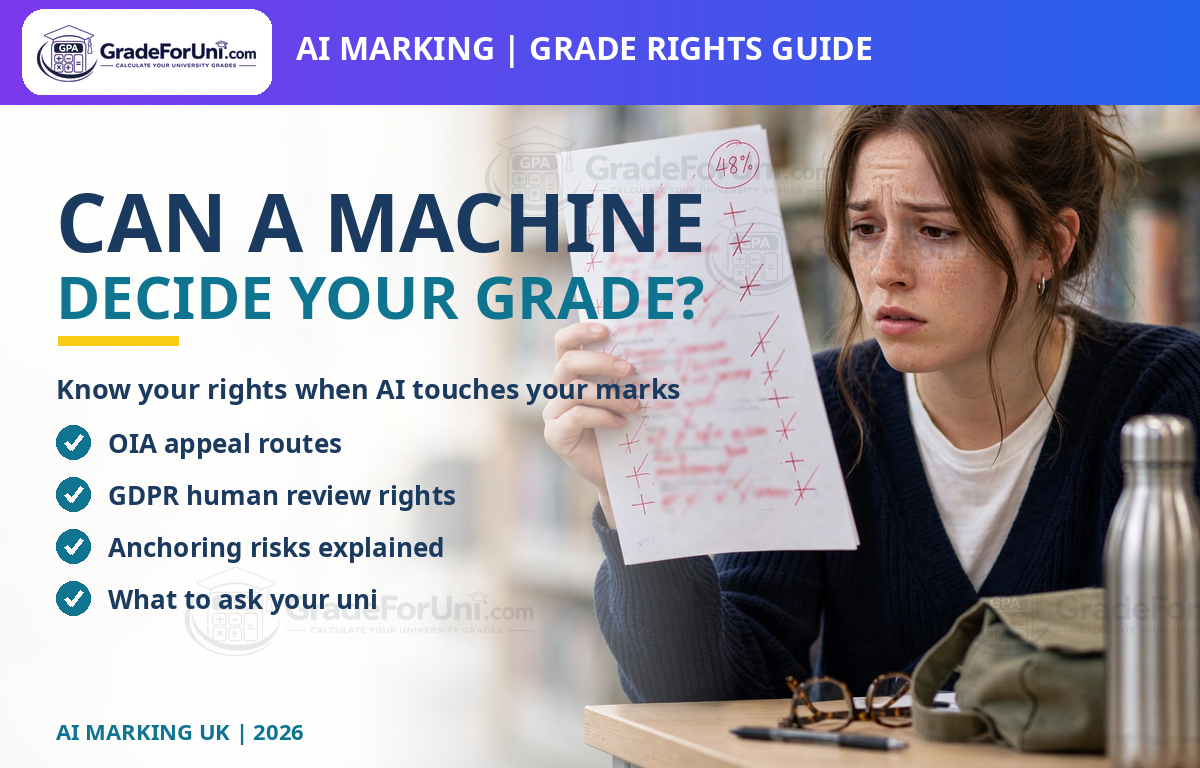
AI Marking at UK Universities: Can a Machine Decide Your Grade? [2026]
Here is a question most UK students have never thought to ask about their marks: who — or what — decided this number? A recent analysis by Wonkhe, the higher-education policy platform, argues that universities quietly putting AI into their marking workflows may be trading away their single strongest legal shield: the principle of “academic judgement” that lets them — and the student ombudsman — refuse to second-guess a mark. AI marking is no longer a thought experiment. Staff are using models to draft feedback and suggest marks, working groups are debating “human in the loop” designs, and the evidence on what actually happens when a human “checks” a machine’s mark is not reassuring.
This guide is not about the technology. It is about your rights when a machine touches your marks: the hole in the academic-judgement shield that lets you challenge how a mark was produced, the anchoring effect that makes “checked by a human” weaker than it sounds, the UK GDPR rights you hold over automated decisions, the benchmark the rest of education has set — and a concrete checklist for what to do if you suspect AI marked your work. Every regulatory and research claim below was re-verified against the primary source on the day of writing.
One scope note before we start: this is the reverse of the more familiar story. We are not talking about students using AI to write essays — that is academic misconduct, covered in our academic misconduct guide, and the detection side is covered in can Turnitin use your essay to train AI. This is about the other direction: AI deciding, or helping to decide, the marks that determine your degree.
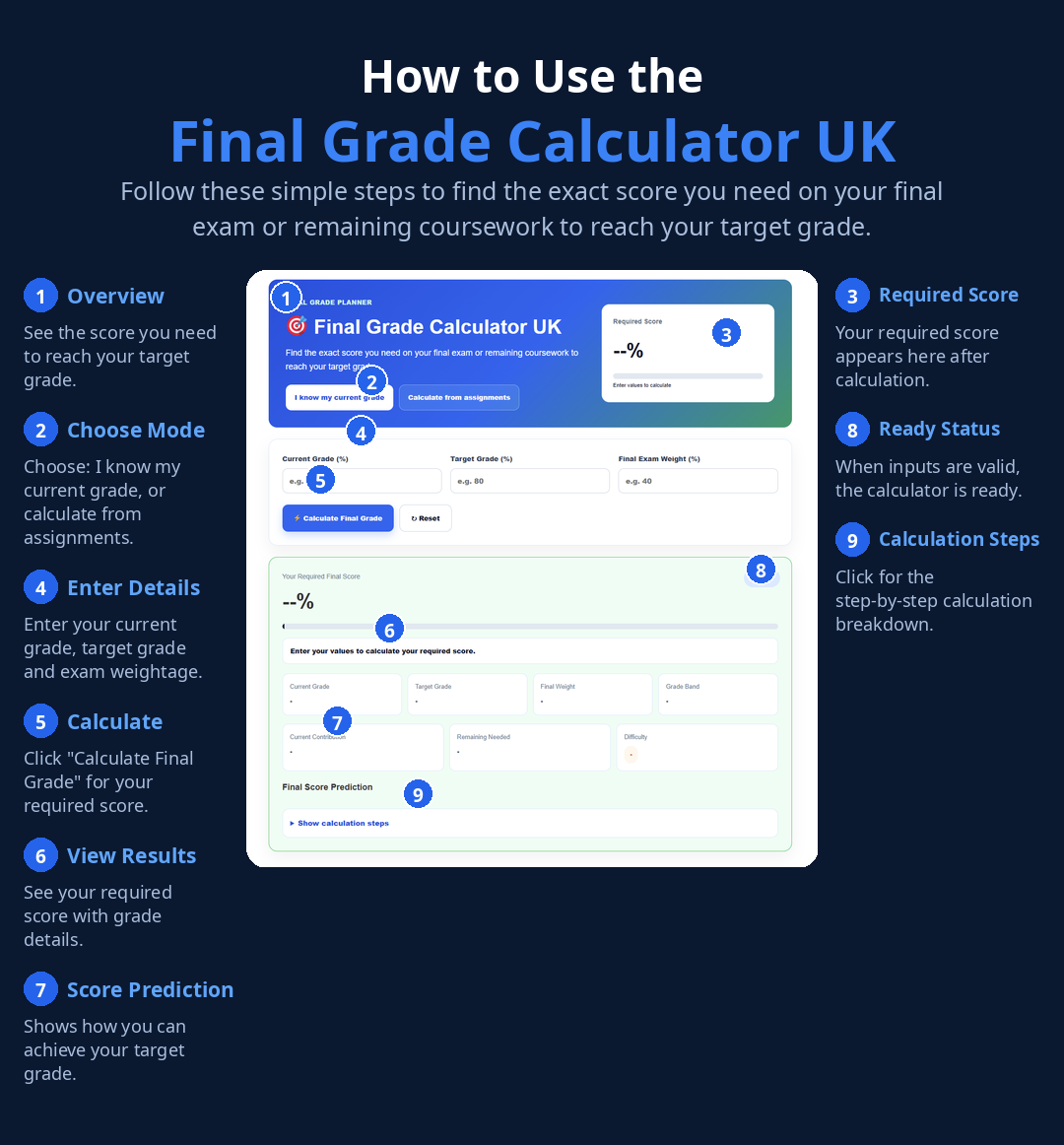
Click Here: Final Grade Calculator UK
What AI Marking Actually Means at a UK University
“AI marking” covers at least three very different practices, and your rights depend entirely on which one touched your work. Universities rarely spell out which they mean, so pin down the vocabulary first:
| Model | What happens | Why it matters to you |
|---|---|---|
| 1. AI as sole marker | The model reads your work and produces the mark; no academic reviews it. | The weakest legal ground. Ofqual has said outright that using AI as “the sole mechanism for awarding marks does not comply with our current regulations” for school exams — and under UK GDPR a solely automated decision triggers your rights to human intervention and to contest it. |
| 2. AI first pass, human signs off | The model suggests a mark; the academic reviews it and confirms. The familiar “human in the loop”. | Sounds safe, but the evidence says the human rarely redoes the thinking — which is exactly when the mark stops being the academic’s judgement (see the anchoring section below). |
| 3. Human first, AI in parallel | The academic marks blind; the model marks separately; large gaps trigger a second human look. | The responsible design. AI acts as a moderator, not a decider, and the academic’s judgement is genuinely formed first. |
There is a second distinction worth making: what is being marked. Checking multiple-choice answers, verifying references exist, or spotting arithmetic errors on a mark sheet were never really “academic judgement” in the first place — they were always reviewable, and mistakes there get caught. The evaluative calls — does this essay deserve 63 or 68, is this dissertation a high 2:1 or a low First — are where the shield is strongest. As Wonkhe’s analysis notes, putting a model in the evaluative bit places the least reproducible tool exactly where the law allows the least scrutiny.
So the question to carry into every section below is not “was AI involved?” but where in the workflow did it sit, and did a human genuinely form a judgement?
Why “a Human Checked It” Is Not the Safety Net It Sounds
The standard reassurance — from working groups, vice-provosts and AI vendors alike — is that a human stays in the loop: the model does a first pass, the academic checks it and signs it off, and judgement stays, as one vice-provost put it, “firmly with the educator”. Anyone who has ever been handed a draft with a number already on it knows what happens next: the number becomes the default, and disagreeing with it becomes work.
The regulator’s own research backs that intuition. Ofqual’s January 2026 research on AI in marking describes the risk of humans reviewing AI marks as an “anchoring effect and/or risk of uncritical human review”, warns that “human performance at checking may not equal their performance on the original task”, and worries about process designs that let the human “omit the thinking required by the original task”. Its conclusion is blunt: marking in parallel “avoids anchoring” — which is another way of saying that sequential check-the-AI designs do not.
Then came the experiment that put numbers on it. A randomised study published in PNAS Nexus in June 2026 gave 1,339 teachers in Greece a piece of student work carrying a deliberately wrong mark of five out of ten, labelled either as a colleague’s or as an AI’s. Where the mark was too harsh, teachers were less likely to correct it when it came from the AI — the gap from the right answer was 22% larger. Where it was too generous, they corrected both just as readily. In Wonkhe’s summary: the deference runs in the direction that hurts students.
There is also an efficiency paradox hiding in the same paper. Ofqual notes that if a human properly reviews every response there is “no efficiency gain” — the savings from a first pass only materialise if the academic doesn’t really redo the thinking, which is exactly when it stops being their judgement. A delegate at a recent sector summit made the same point from the other end: if AI does the marking and someone still has to check it properly, the cost has just moved somewhere less visible.
And the machine’s number is less solid than it looks. Researchers at Thinking Machines ran the same prompt 1,000 times on the setting meant to make models maximally repeatable — and got 80 different answers, tracing the cause to server-load nondeterminism. Ofqual adds that a model’s performance shifts when the underlying model is updated. A mark generated in January on a model retired by June cannot even be regenerated. Hold that thought: it becomes an appeal argument later.
Worked example 1: what one anchored mark costs (Amara)
Amara is in her final year at a university weighting years 25:75 (second year : final year). Her second-year average is 70.0%. Her final year has six 20-credit modules. Marked blind by a human, her module marks are 66, 70, 70, 72, 68 and 66 — an average of 68.67%. Her final classification: 0.25 × 70.0 + 0.75 × 68.67 = 17.50 + 51.50 = 69.00%, a strong upper second.
Now suppose the first module was AI-marked with a human “sign-off” — and the model’s suggested 62 anchored the reviewer, who confirmed it instead of awarding the 66 a blind mark would have given. Her final-year average becomes (62 + 70 + 70 + 72 + 68 + 66) ÷ 6 = 408 ÷ 6 = 68.00%, and her final classification is 17.50 + 51.00 = 68.50%. One anchored module has cost her half a percentage point on her degree.
Now compound it. If three of her six final-year modules were AI-anchored four marks low — 62, 66 and 66 instead of 66, 70 and 70 — her final-year average is (62 + 66 + 66 + 72 + 68 + 66) ÷ 6 = 400 ÷ 6 = 66.67%, and her final classification is 17.50 + 50.00 = 67.50%: 1.5 percentage points below the 69.00% her work actually earned. No single four-mark anchor flips a class on its own — the maths rarely works that way — but three of them move a student from the edge of a borderline-First conversation to a mid-2:1, and on a tighter boundary the same drift decides the class outright. Model your own modules to see which of yours sit near a boundary.
The Hole in the “Academic Judgement” Shield
Universities defeat most mark appeals with two words: academic judgement. Under the Higher Education Act 2004, the Office of the Independent Adjudicator (OIA) — the ombudsman covering universities in England and Wales — cannot consider a complaint “to the extent that it relates to matters of academic judgment”. Courts have said much the same about grades. It is, as Wonkhe calls it, the sector’s get-out-of-jail-free card.
But the protection attaches to expertise, not to academics as people. The OIA defines academic judgement as “a judgment that is made about a matter where the opinion of an academic expert is essential” — and is explicit that a judgement does not qualify just because an academic made it. Its draft new Scheme goes further, describing it as a decision only someone with the appropriate expertise can make. The word doing the work, as Wonkhe’s analysis puts it, is “someone”: the whole protection rests on an expert having looked at the work and formed a view. Which is why a student cannot argue with the view — and can argue about whether a view was ever formed.
The facts of a case, and the fairness of the process that produced a mark, are not academic judgement — so the OIA can look at them. And “who, or what, decided this mark?” is a question of fact. That single sentence reframes the entire appeal:
| A question of FACT (challengeable) | A matter of academic JUDGEMENT (protected) |
|---|---|
| Who or what produced this mark — human, model, or both? | Whether the essay deserves 63% or 66% |
| Which model version and prompt were used? | How much weight the argument deserved vs the writing |
| Whether a human genuinely reviewed the decision, or just signed it | Whether the dissertation is a high 2:1 or a low First |
| Whether the mark scheme was applied as published | Where this piece sits against the grade descriptors |
There is already case law-shaped precedent. One of the OIA’s AI case summaries, from July 2025, concerned an MBA student who argued that AI had written their dissertation feedback. The provider denied it, and the OIA found it reasonable to give more weight to the marker’s account of how they had marked the work than to a detection tool. Fair enough — but as Wonkhe notes, once AI is formally part of the marking workflow, the marker’s account changes, and so, presumably, does the defence. “I marked it myself” stops being available the moment the university’s own policy says a model did the first pass.
The courts point the same way on process. The High Court in Siddiqui held that negligent teaching methods are actionable in principle, and that “simple operational negligence in the making of educational provision” is fair game (Wonkhe’s citation). Courts will not rule on what grade you deserve — but they can rule on whether the machinery that produced it was operated with reasonable care. A university could argue that a responsible body of practitioners now uses AI-assisted grading — Wonkhe notes one university is reported as allowing AI-assisted grading subject to review — but the practice also has to stand up to logical scrutiny, and that gets harder when the schools regulator says the sole-marker model does not comply with its rules.
Your Rights When a Machine Marks Your Work
Beyond appeals, you have statutory rights — and they bite hardest exactly where the “human in the loop” reassurance is thinnest. As Wonkhe reports, UK GDPR provides that a decision is solely automated “if there is no meaningful human involvement in the taking of the decision”. Universities may make significant automated decisions about students, but only with safeguards — including a right to “obtain human intervention” and a right to “contest such decisions”.
Read that test carefully: meaningful human involvement. A rubber-stamp sign-off — the model proposes 62, the academic glances and confirms, the thinking never redone — is precisely the workflow the anchoring research says produces the worst outcomes, and it is hard to call it meaningful involvement. So a university relying on “a human checked it” as its whole defence may find itself inside the very regime it was presumably trying to stay out of. And as Wonkhe observes, it is hard to see how an appeals regulation could wave away a statutory right to contest a decision just by saying the words “academic judgement”.
Two jurisdictional notes. The OIA route described above covers England and Wales; in Scotland, the equivalent body is the Scottish Public Services Ombudsman (SPSO). And these rights are reported here as Wonkhe sets them out, citing the legislation — if your case ever turns on them, check the current statutory wording rather than relying on any summary, including this one.
If you think a decision about your marks was effectively automated, the practical move is the same as in the checklist below: ask in writing how the mark was produced, keep the answer, and — if the answer is evasive — put your internal appeal in promptly. Time limits are short, and the appeal grounds and deadlines guide walks through the process step by step.
The Benchmark: What the Rest of Education Demands
It helps to see what the rest of the education system requires — because your university is operating in the same country, and students are entitled to ask why a lower standard should apply to their degree.
On 16 July 2026, Ofqual published its approach to regulating AI in the qualifications sector. The core of it: AI is embraced as a support to marking, but the awarding organisation retains accountability for valid, reliable and fair results, with expert human involvement and oversight — and Ofqual has made clear to awarding organisations that AI may not be used as a sole marker in any assessments that are part of regulated qualifications. Its approach has been in place since April 2024 and is built on five objectives: fairness for students, validity of qualifications, security of assessments, public confidence, and enabling innovation.
Fresh research sharpens the point. New Ofqual research, reported by UKAuthority, concludes that “AI is not yet capable of replacing human examiners”, citing fairness, transparency and bias concerns. Jo Handford, Ofqual’s associate director, said: “AI lacks the semantic understanding and human-like judgment needed for high-stakes assessments,” adding that the “black box” nature of AI systems makes it difficult to explain how marks are awarded — “which is essential for maintaining public trust.” Research fellow Joanna Williamson put the stakes plainly: “If students can’t challenge or understand how their marks were awarded, the social contract of assessment breaks down.”
The school-exam world draws the same line: JCQ’s guidance to schools on AI use in assessments lets centres decide whether teachers use AI to help mark, but an AI tool cannot be the sole marker of assessments counting toward a qualification. And here is the precision that matters: Ofqual regulates qualifications in England — GCSEs, A-levels, BTECs — not university degrees. Its sole-marker ban is not the law for your degree. Treat it as the benchmark instead: the minimum standard the rest of the system considers fair, and a sharp question for your own institution — why should my degree be held to less?
Worked example 2: the appeal that writes itself (James)
James receives 63 for an essay he believes deserved more. His university’s published AI policy — obtained after he asked in writing — confirms the module used a named model, version and prompt for first-pass marking, with academic sign-off. James runs his essay through the same model ten times and screenshots every result: 62, 64, 68, 63, 66, 61, 65, 67, 64, 66.
The statistics: ten runs, a range of 61 to 68 — seven marks of spread — and a mean of 64.6 against his awarded 63. Now the classification arithmetic. On a 40:60 year weighting, a 20-credit module contributes one-sixth of the final year, so seven marks of model spread represent 7 ÷ 6 × 0.6 ≈ 0.7 percentage points of James’s final average — before anyone has even discussed whether 63 was right. But the number is the weaker half of his evidence. The stronger half is the fact the spread exists at all: a mark that cannot be regenerated — on a model already updated twice since January — is not a judgement anyone can stand behind at appeal. If arbitrariness is what takes a decision outside academic judgement, as Wonkhe argues, ten screenshots are an appeal that writes itself.
Be honest about this tactic’s limits: it only works where you know the model, version and prompt — which is exactly why the transparency question in the checklist below comes first. A university that will not say what marked your work has already told you something.
What Responsible AI Marking Looks Like
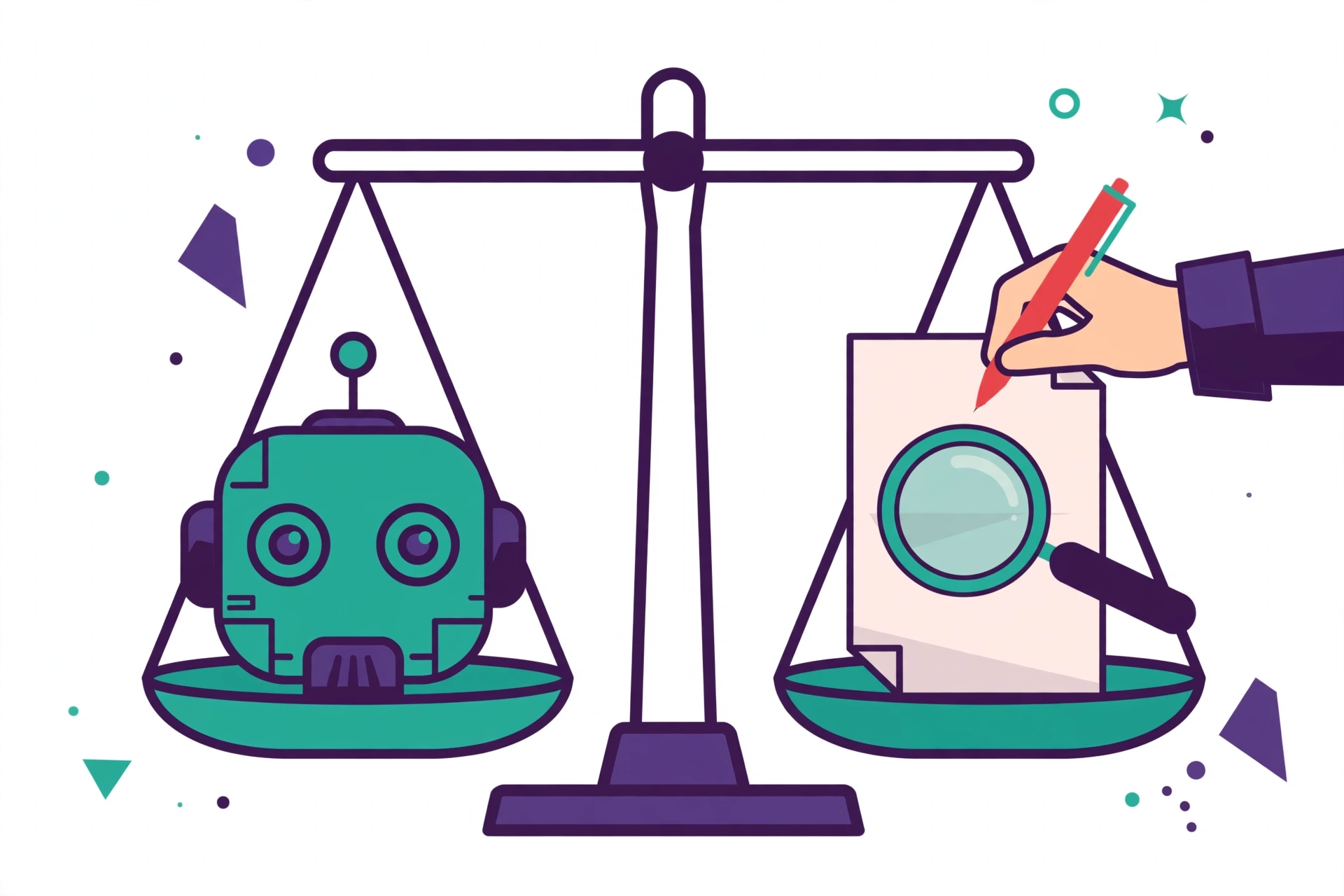
This guide is not an argument for banning AI from marking workflows — it is an argument for putting it in the right place, with the right safeguards. The responsible design, sketched in Wonkhe’s analysis, flips the usual order:
| Principle | What it means in practice |
|---|---|
| Human marks first, blind | The academic forms a genuine judgement before seeing any machine output — so the judgement exists to be defended. |
| AI marks in parallel | The model runs separately, as a moderator. Large gaps between human and machine go back for a second human look. |
| Students are told | Transparency is the default: which modules use AI, in what role, and what the human oversight actually consists of. |
| Human-only marking on request | Students can ask for their work to be marked without AI involvement — Wonkhe cites the University of Newcastle in Australia as offering this. |
| Everything is logged | Every mark records the model, the version and the prompt — so a decision can be audited, explained and, if necessary, challenged. |
| AI tidies; humans judge | AI may polish an academic’s comments but cannot originate the judgement behind them — the line Wonkhe attributes to King’s, LSE and Southampton. |
Note the attributions: the Newcastle example and the King’s/LSE/Southampton line are reported by Wonkhe, and the report that one UK university now allows AI-assisted grading subject to review is Wonkhe’s reporting too — not something to quote as established fact about any named institution without its own published policy. If your university’s policy already looks like the table above, say so loudly in its favour; good practice deserves credit, and it gives other students a template to demand.
One more honest caveat from the research: none of this is free. Ofqual’s own paper concedes that proper human review of every AI-marked response delivers “no efficiency gain”. A university promising both AI marking and lower costs is promising something the evidence says cannot both be true — which tells you where to look when the oversight turns out to be a rubber stamp.
What to Do If You Suspect AI Marked Your Work
Suspect is the right word — start from questions, not accusations. Work through these steps in order; each one builds the record the next one needs.
| Step | What to do | Why it matters |
|---|---|---|
| 1. Ask in writing | Email your module leader or registry: “Could you confirm whether AI was used in any part of the marking of [module code], and if so, what human oversight was applied to my mark?” Keep the reply. | Puts the university on record. A vague or evasive answer is itself evidence. |
| 2. Ask for the specifics | If AI was used: which model, which version, what prompt or instructions, and what the human reviewer actually did. | Without the model/version/prompt, neither you nor an appeal panel can assess whether the process was sound — or reproduce it. |
| 3. Check your marks yourself | Request your marked script and the mark breakdown, then recompute your module and year averages from your transcript. | Catches the ordinary errors first — wrong credit values, missing components — before you argue about AI at all. See how to check your marks. |
| 4. Build your evidence | Your own re-mark arithmetic; the ten-run spread screenshots if the model is disclosed; the timeline of what you were told and when. | Appeals are won on documents, not feelings. The worked examples above show the arithmetic to include. |
| 5. File the internal appeal promptly | Use the academic-appeal route (not the complaints route), framed around process: who/what decided, what oversight applied. | Time limits are short and the framing decides whether it is treated as judgement (rejected) or fact (investigated). Grounds, evidence and deadlines. |
| 6. Consider the EC route in parallel | If the timing or circumstances affected your performance, an extenuating-circumstances claim runs alongside an appeal. | An upheld EC claim can grant an uncapped first-attempt resit — often worth more than the appeal itself. How EC claims work. |
| 7. Escalate if needed | If the internal process concludes and you remain dissatisfied: the OIA (England and Wales) or the SPSO (Scotland). | The ombudsman cannot re-mark your work — but it can investigate whether a mark was ever genuinely someone’s judgement. |
A final practical note: do all of this calmly and in writing. The students who win process arguments are the ones with dated emails, saved policy PDFs and clean arithmetic — not the ones with the loudest complaint. Your marks deserve the same care from the system that the system demands from your work.
Is AI marking actually allowed at UK universities?
There is no sector-wide ban on AI marking at UK universities — which is exactly why you should know where your own institution stands. What matters is how the AI is used: as a support tool under genuine human oversight it sits on much firmer ground than as the sole decider of your mark. The school-exam regulator Ofqual has made its position explicit: AI may not be used as a sole marker in any regulated qualification, with the awarding organisation retaining accountability for valid, reliable and fair results. That rule does not legally bind universities — Ofqual regulates GCSEs, A-levels and BTECs in England, not degrees — but it is the fairness benchmark every other part of education is being held to. If your university cannot explain its own position as clearly as Ofqual explains its, that is worth asking about.
Can I ask my university whether AI marked my work?
Yes — and you should put the question in writing. Ask your module leader or registry: was any part of the marking of this module done or assisted by AI, and if so, which model, which version and what instructions was it given? A polite, specific question is harder to wave away than a vague complaint: “Could you confirm whether AI was used in any part of the marking of [module code], and if so, what human oversight was applied to my mark?” Keep the reply. If the university holds information about you, a subject access request can also surface what was recorded about your assessment — though it will not hand you the model’s internal reasoning, which is part of the transparency problem.
Can I appeal a mark I think AI decided?
You can challenge the process that produced your mark, which is a different — and often stronger — route than arguing the mark itself is wrong. Universities routinely reject appeals that amount to “my essay deserved 66, not 63” as matters of academic judgement. But “who, or what, decided this mark?” is a question of fact, not judgement: whether AI was used, whether the correct model version and prompt were applied, and whether a human genuinely reviewed the decision are all factual questions an appeal — and ultimately the ombudsman — can investigate. Frame your appeal around the process: what was used, who checked it, and what the records show. Our how to appeal a university grade guide covers grounds, evidence and deadlines in full.
What is “academic judgement” and why does it block so many appeals?
Under the Higher Education Act 2004, the Office of the Independent Adjudicator (OIA) — the ombudsman for universities in England and Wales — cannot consider a complaint “to the extent that it relates to matters of academic judgment”. The OIA defines that as “a judgment that is made about a matter where the opinion of an academic expert is essential”, and it is explicit that a decision does not qualify merely because an academic made it. As Wonkhe’s analysis puts it, the protection rests on an expert having actually looked at the work and formed a view — which is precisely why a student can question whether a view was ever formed, for example when a model produced the number and a human only signed it off.
Does Ofqual’s ban on AI as the sole marker apply to my degree?
No — and you should be wary of anyone who tells you otherwise. Ofqual is the regulator of qualifications in England: GCSEs, A-levels, BTECs and apprenticeship end-point assessments. University degrees sit outside its remit. Its July 2026 position — AI embraced as a marking support, the awarding organisation retaining accountability, human oversight required, and AI never the sole marker in a regulated qualification — is a benchmark, not a law for universities. Use it as one: it shows what the rest of the education system considers the minimum for fairness, and it makes a sharp question to put to your own institution — “why is a lower standard acceptable for my degree?”
What rights do I have under UK GDPR if a machine marks my work?
As reported by Wonkhe, UK GDPR provides that a decision is solely automated “if there is no meaningful human involvement in the taking of the decision”, and that significant automated decisions about students may only be made with safeguards — including a right to “obtain human intervention” and a right to “contest such decisions”. The key phrase is meaningful: a rubber-stamp sign-off, where the academic does not genuinely redo the thinking, is unlikely to count as meaningful human involvement. That means a university relying on “a human checked it” as its whole defence may find itself inside the very regime it was trying to stay out of — and it is hard to see how an appeals regulation could wave away a statutory right to contest a decision merely by saying the words “academic judgement”.
How could I actually prove a mark came from AI?
You do not need to catch the model red-handed; you need to show the process was not what the university claims. The strongest evidence is comparative: researchers have shown that running the same prompt 1,000 times on a determinism-maximising setting produced 80 different answers, so a mark no human can regenerate is inherently hard to defend. If your university discloses the model, version and prompt — the transparency norm responsible institutions should meet — anyone can run the same essay through the same model ten times and screenshot the spread. If arbitrariness is what takes a decision outside academic judgement, as Wonkhe argues, that spread is an appeal that writes itself. A mark generated in January on a model retired by June cannot even be regenerated, which is a fact worth stating in any appeal.
Should I just ask for a human re-mark?
Ask — it is the simplest request in this whole guide, and some institutions already allow students to request human-only marking (Wonkhe cites the University of Newcastle in Australia as an example). Check your university’s assessment regulations and AI policy first: look for the marking section, any statement on AI use by staff, and the academic-appeal route. If the policy is silent, your question itself does useful work — it puts on record that you asked, and the answer (or non-answer) becomes part of any later appeal. And while you are checking, run your own numbers: our Final Grade Calculator UK shows exactly what each module mark is doing to your classification, so you know which marks are worth challenging.
Conclusion
The uncomfortable truth at the centre of this story is simple: a mark is only as defensible as the judgement behind it. Universities have spent decades — quite reasonably — insisting that marks are matters of expert academic judgement, shielded from second-guessing by students, ombudsmen and courts alike. But that shield was built for a world in which an expert looked at the work and formed a view. The moment a model produces the number and a human merely signs it off, the protection’s own logic starts to work against the university: “who, or what, decided this mark?” is a question of fact, and facts can be investigated.
None of this means every AI-marked grade is wrong, or that AI has no place in assessment. The responsible design exists — human marks first and blind, the model in parallel, gaps triggering a second human look, students told, human-only marking available on request, every decision logged. What it does mean is that you are entitled to know where your university sits on that spectrum, to ask for human intervention where a machine decided, and to contest a process that cannot explain itself. Ofqual’s line for school exams — AI as support, never the sole marker, accountability retained — shows what the rest of education considers the minimum. Your degree should be held to no less.
So ask the question. In writing, politely, with the module code in the subject line. Then model what each disputed mark is actually doing to your classification — because the students who know their numbers, as our Degree Classification Calculator keeps proving, are the students who get taken seriously. A machine may one day mark your work well. Until then, make sure a human did.