

What Grades Do You Need for a PhD in the UK? [2026]
Of every grade gate in UK higher education, the PhD’s is the strictest. Graduate employers are relaxing the 2:1 filter year by year, taught masters courses will talk to strong 2:2s, but doctoral programmes still publish a minimum — and funded studentships enforce it. If you are weighing up a doctorate, the question is not whether grades matter. It is exactly where the line sits, how firm it is, and what to do if you are on the wrong side of it.
This guide benchmarks PhD entry requirements as they actually operate in 2026: the 2:1 standard and what “good honours” means in marks, the masters grade bands that admissions tutors look for, why funded and self-funded routes run different bars, what international qualifications map to, and two worked examples showing the arithmetic of clearing — or rescuing — the line. Every threshold below comes from a published set of entry criteria, linked or named. Grade cut-offs are one of the few areas of university admissions where the rules are written down; there is no need to guess.
One framing note before the numbers. UK universities are legally free to admit anyone to a PhD — there is no national regulator setting a minimum. The bars in this guide are the ones universities and funders publish for themselves, and departments apply them with varying strictness. Treat the published minimum as the floor of the conversation, not the profile of a successful applicant: at competitive programmes, the typical intake sits above it.
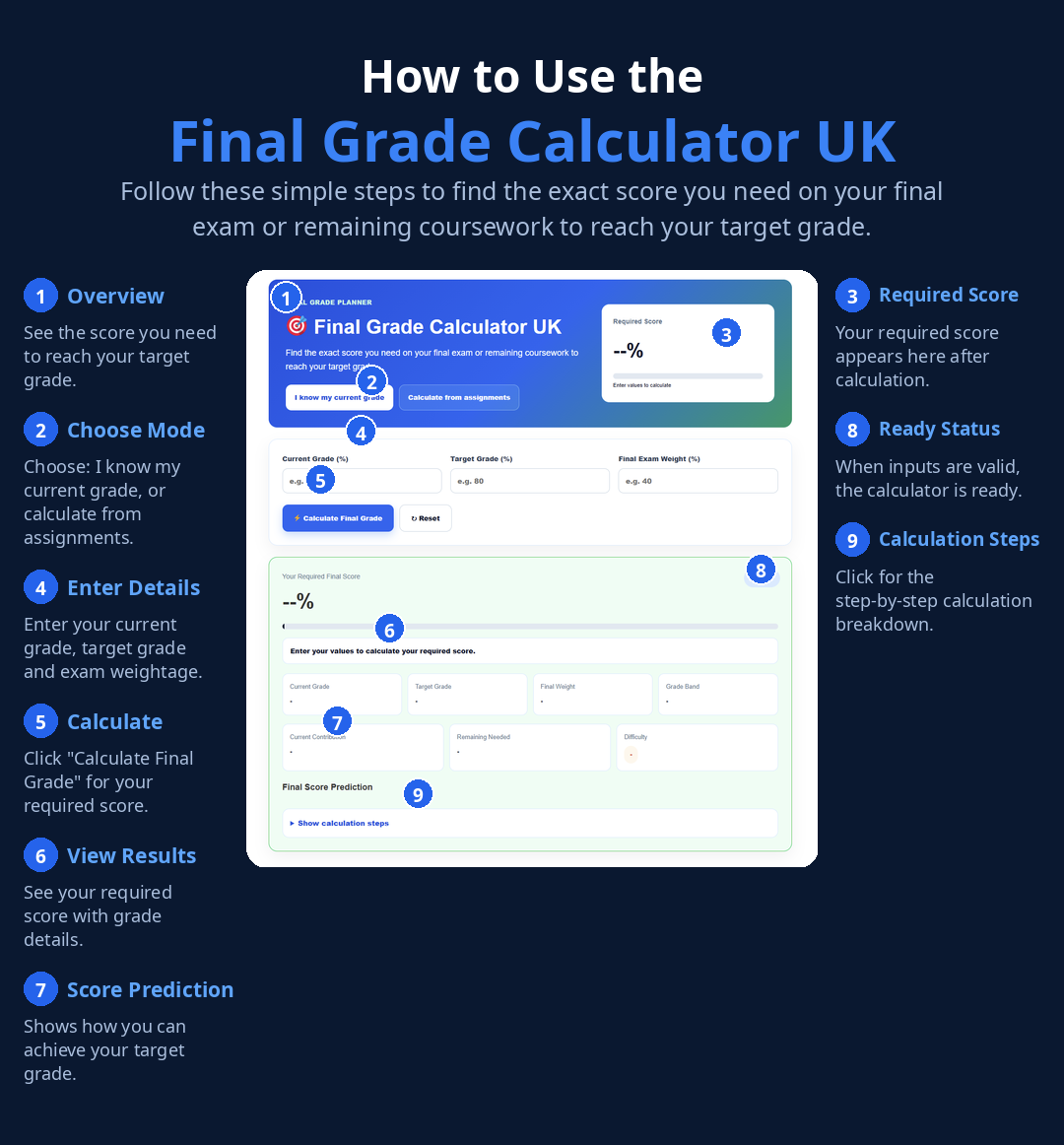
Click Here: Final Grade Calculator UK
The short answer: a 2:1 is the line
Strip away the variation and the UK doctorate has a single standard answer: an upper second-class honours degree — a 2:1, 60 per cent or above — in a subject relevant to the proposed research. The UNRISK Centre for Doctoral Training states its minimum entry requirement as “a 2.1 honours degree, or equivalent, in a subject relating to your proposed area of research,” with a masters-level course also taken into account (UNRISK entry requirements). The University of Edinburgh’s E4 doctoral training partnership “would normally require applicants to have a minimum of 2.1 undergraduate degree or equivalent,” while taking relevant work experience or a masters into account (E4 DTP entry criteria). Manchester’s PhD in Nursing asks for “an honours degree (minimum Upper Second (2:1))” plus postgraduate research training. Different institutions, same line.
You will often see the requirement phrased as a “good honours degree.” In UK admissions language that phrase has a settled meaning: a First or a 2:1. A 2:2 is, by definition, not “good honours” — which is why 2:2 holders face a separate set of routes rather than the standard one. And note the second half of the standard phrasing: “in a relevant subject.” The grade bar and the subject bar are a package. A First in an unrelated field does not clear a requirement written as “2:1 in a relevant subject”; admissions tutors need evidence you can handle the field’s methods, literature and technical demands from day one.
The 2:1 line also matters because of what sits behind it. A 2:1 is the classification the UK system is built around — it is what most graduate employers screen for and what most taught masters courses require, as our guide to whether your degree classification matters shows. Doctoral admissions simply apply the same line one rung higher: where employers treat the 2:1 as a filter, PhD programmes treat it as the entry ticket.
What “good honours” actually means in marks
Not all 2:1s are equal in a PhD admissions tutor’s eyes. Funded schemes in particular grade the 2:1 internally — a high 2:1 and a low 2:1 are different propositions. The Midlands Integrative Biosciences Training Partnership, a UKRI-funded doctoral training partnership across six universities, publishes one of the clearest gradations in the sector: applicants with a First or a high 2:1 are eligible; those with a low 2:1 — plus a masters or at least three years of postgraduate experience — may be eligible; and 2:2 holders are only likely to be considered if their additional experience is exceptional. That three-band structure is a useful map of how the whole sector thinks, even where other programmes do not spell it out:
| Your undergraduate result | How PhD admissions reads it | What it typically unlocks |
|---|---|---|
| First (70%+) | The strongest signal; effectively required at the most competitive funded schemes | Any funded studentship, subject to the rest of the application |
| High 2:1 (65-69%) | Comfortably above the line; competitive for funding | Funded DTP/CDT places and standard doctoral entry |
| Mid 2:1 (60-64%) | Clears the published minimum | Standard doctoral entry; funded places possible but contested |
| Low 2:1 (60-63%) | On the line — tutors look harder at the rest of the file | Entry with a masters or strong research experience alongside |
| 2:2 (50-59%) | Below “good honours” — the standard route is closed | Masters-rescue routes, professional doctorates, self-funded places |
Two things to notice. First, the boundary that matters most is 60, not 70: crossing from a 2:2 into a 2:1 changes which routes are open to you, while moving from a mid-2:1 to a First mostly changes how competitive you are within routes that were already open. Second, the low-2:1 band is where the rest of your file does the heaviest lifting — a 61 with a Distinction masters and a published dissertation reads very differently from a 61 on its own. If your average sits near 60, our Final Grade Calculator UK will show you exactly what your remaining modules need to average to lift you clear of the band.
The masters question: do you need one — and what grade?
The masters sits in an odd position in PhD entry requirements: widely expected, rarely an absolute rule. Many UK doctorates — particularly in the arts, humanities and social sciences — treat a masters as the expected preparation, because the UK PhD is only three to four years and research-intensive from day one; the assumption is that you arrive with advanced subject knowledge and some research training already in place. Manchester’s nursing doctorate makes the expectation explicit: a 2:1 plus “a very good MSc/MPhil/MRes degree” or a full year of postgraduate-level research training. But the same page allows an exceptional route — a First or Distinction with research experience — without both degrees, which tells you the masters is evidence, not a sacrament.
Where a masters is expected, its grade bar mirrors the undergraduate one. The standard published expectation is a Merit — 60 to 69 per cent — with a Distinction, 70 per cent and above, marking you as competitive for funding. Several universities publish explicit 2:2-plus-masters combinations: a 2:2 bachelor’s paired with a masters Merit is an accepted route at a number of institutions, effectively letting the postgraduate result rehabilitate the undergraduate one. And the requirement is not universal even within single universities: Edinburgh’s E5 doctoral training partnership states plainly that it does not consider a masters a requirement, aiming instead to recruit from diverse backgrounds on academic and professional experience together. In STEM, structured doctoral training centres are often designed for direct entry from an undergraduate degree, with a taught first year built in.
The practical rule: read the department page, not the university’s generic postgraduate wording. A department that runs a 1+3 programme (masters year plus PhD) will state it; a department that expects you to arrive research-ready will say so too. If you are doing a masters now with a PhD in mind, treat 60 as the floor and 70 as the target — our masters grading guide explains exactly what separates a Merit from a Distinction in marking terms, including the dissertation weighting that usually decides it.
Funded vs self-funded: two different grade bars
This is the distinction that most prospective applicants miss, and it matters more than any single threshold. A funded studentship has two gatekeepers — the university and the funder — and the funder’s eligibility rules are the stricter of the two. UKRI doctoral training partnerships and centres for doctoral training publish the toughest bars in the sector, because they are allocating public money competitively:
| Route | Typical published grade bar | How strict is it in practice? |
|---|---|---|
| UKRI DTP / CDT studentship | First or high 2:1; low 2:1 only with a masters or 3+ years postgraduate experience | Very — the bar is a funding eligibility rule, not a guideline |
| University scholarship / departmental funding | 2:1 minimum, often “good honours”; masters Merit expected | Strict, but the department controls the whole decision |
| Standard self-funded PhD place | 2:1 in a relevant subject (the published norm) | The supervisor has real discretion — no funder rules in play |
| Professional doctorate (EngD, DBA, DClinPsy) | Varies: often 2:1 plus professional experience | Experience can carry weight the grades do not |
The consequence is straightforward: the same transcript can be fundable at one university and only self-fundable at another. A mid-2:1 with a Merit masters clears the published bar for a standard doctoral place almost everywhere, but may not survive a DTP shortlist where Firsts and high 2:1s are competing for a handful of studentships. And remember that published minimums describe eligibility, not the successful profile — at competitive schemes the typical intake sits above the line. If funding is essential for you, apply across multiple schemes and treat the grade bar as the start of the assessment, not the whole of it: the proposal, supervisor fit and interview decide between candidates who all clear it.
What counts if your degree isn’t British?
International applicants face the same bars, translated. There is no single national conversion table — each university publishes its own country-by-country equivalencies, and borderline cases are judged individually. But the rough mappings below are the ones departments work from, and they are worth knowing before you read a department’s international page:
| Your qualification | Rough UK equivalent | Caveat |
|---|---|---|
| US / Canadian GPA 3.0+ (4.0 scale) | 2:1 / Merit | Widely used as the minimum; competitive programmes want 3.3-3.7 |
| Indian bachelor’s 60%+ | 2:1 (standard minimum) | Russell Group departments informally expect 65-70% or Distinction-level marks |
| European ECTS-based degree | Depends on the national scale | No uniform mapping — check the department’s country list |
| Masters 60%+ / GPA 3.0+ | Merit | The masters bar most programmes publish |
Treat every row as an approximation, not a promise. A 3.0 GPA does not equal a 2:1 in any legal sense — it is the level at which most departments will treat your file as clearing the bar, subject to everything else. The only conversion that matters is the one on the department page you are applying to. If your country’s scale is unusual, or your marks sit near a boundary, email the admissions tutor with your transcript before you apply: departments answer this question every week, and a two-line email beats a wasted application fee.
Worked example 1: Amara clears the bar comfortably
Take Amara, finishing a BSc on a standard 25:75 year weighting — Year 2 at 25 per cent, final year at 75 per cent. Her Year 2 average is 65.0; her final year, including a 30-credit dissertation, averages 69.0. Her final classification is (0.25 × 65.0) + (0.75 × 69.0) = 16.25 + 51.75 = 68.0 per cent — a high 2:1.
She follows it with an MSc: taught modules average 70, dissertation 74. Her masters result is (70 + 74) ÷ 2 = 72 per cent — a Distinction. Against the sector map, Amara sits in the strongest band on both measures: a high 2:1 clears every published undergraduate bar including the strictest DTP criteria, and a Distinction masters makes her competitive for funding rather than merely eligible. Her application will be decided on the proposal, supervisor fit and interview — the grades have done their job, which is to get her file read seriously.
Worked example 2: James takes the masters rescue route
Now James, on the same 25:75 weighting. His Year 2 average is 57.0; his final year averages 59.2. His degree is (0.25 × 57.0) + (0.75 × 59.2) = 14.25 + 44.4 = 58.65 per cent — a 2:2, a point and a half short of the 2:1 line. The standard doctoral route is closed to him: he is below “good honours,” and no funded scheme will shortlist a 2:2 on its own.
James does an MSc and takes it seriously: taught average 61, dissertation 65, giving (61 + 65) ÷ 2 = 63 per cent — a Merit. That single result reopens the map. A 2:2 bachelor’s paired with a masters Merit is a published acceptable combination at a number of UK universities — the postgraduate result rehabilitates the undergraduate one, because it is the most recent and most relevant evidence of research ability. James can now apply through the standard route at those institutions, and through supervisor-led self-funded places more broadly. His full set of options — including the professional-doctorate and exceptional-experience doors — is mapped in our guide to doing a PhD with a 2:2.
The arithmetic moral is the same one that runs through all of university grading: boundaries are where the value is. James was 1.35 points short of a 2:1, and a single stronger final-year module — a 62 instead of a 58 on one 20-credit unit, worth 0.67 points on his weighted average — would have changed his whole route map. If you are still studying, model the boundary with our Final Grade Calculator UK before your marks are final: near a line, targeted effort on your weakest remaining assessments is the highest-value studying you can do.

Borderline at 58 or 59 per cent? Your three realistic routes
If your final average sits at 58 or 59 per cent, you are one or two marks below the standard 2:1 line — and this is the exact position where a PhD application is neither hopeless nor straightforward. Universities cannot normally waive their published minimum, but the minimum itself is not the only door. Three routes are realistic, and which one fits depends on whether you are still studying or have already graduated.
Route one is the masters rescue, done properly. A Merit (60 per cent or above) at masters level is the single most common way borderline undergraduates become fundable PhD candidates, because most doctoral training partnerships treat a strong masters as fresher, more relevant evidence than a three-year-old undergraduate average. A Distinction makes the case stronger still, but a solid Merit with a high dissertation mark (65 or above) usually carries more weight than the overall grade alone, because supervisors read it as proof you can sustain a long research project.
Route two is the borderline review itself. Many universities round a final average of 59.5 per cent or above up to a 2:1 automatically, and exam boards can also lift a classification where a student’s final-year marks sit mostly in the higher band. Before assuming you have missed the line, check your own transcript against your university’s borderline policy — a student on 59.6 per cent may already hold a 2:1 without realising it.
Route three is experience plus a named supervisor. For self-funded places especially, two or three years of research-assistant work, a conference presentation, or a published paper can shift the conversation from your undergraduate average to your current ability. This route rarely works by email alone: it works when a supervisor who wants the project champions the application through the admissions panel.
What does not work is applying everywhere and hoping. Each rejected application costs you a reference cycle and a year. Pick the route that matches your position, strengthen the weakest piece of evidence first, and then apply narrowly to supervisors whose work genuinely fits yours.
Grades aren’t the whole application
It would be misleading to end at the grade bars, because no PhD offer is decided on grades alone. The published minimum gets your file past the first filter; what wins the place is everything around it. Admissions panels — and individual supervisors, who often drive the decision — are assessing whether you can sustain three to four years of independent research. The evidence they look for:
1. The research proposal. Usually 1,500 to 3,000 words identifying a specific, answerable research question, a viable methodology, and a credible plan for completing it in the time available. A sharp, feasible proposal from a mid-2:1 beats a vague one from a First. 2. Supervisor fit. Most UK PhDs are agreed with a named supervisor before the formal application; contacting potential supervisors early, with a tailored proposal, is the single highest-leverage step. 3. Research experience. A strong undergraduate or masters dissertation, a research assistant post, a summer placement, a conference paper — anything showing you have designed, carried out and written up research. 4. References. Academic referees who can speak to your research potential specifically, not just your seminar attendance. 5. The interview. Funded schemes and competitive departments interview shortlisted candidates; expect to defend your proposal and discuss the field.
None of this rescues a file that misses the published minimum — panels cannot waive a funder’s eligibility rule because they liked the proposal. But among candidates who clear the bar, these are the differentiators. The grades open the door; the proposal and the supervisor walk you through it.
How to check your own position: a six-step checklist
If you are reading this with a transcript in hand, work through these in order:
1. Compute your true final average. Not a guess, not a vibe — the weighted figure your university will actually report. Use our Final Grade Calculator UK with your real module marks and your university’s year weighting. Know which side of 60 you sit, and by how much.
2. Read the department page, not the generic page. Entry requirements live at department level. The university’s postgraduate prospectus may say “good honours degree” while the department specifies “2:1 with a masters Merit” — or the reverse. Funded schemes publish separately again.
3. Identify which route you are aiming at. Standard entry, funded studentship, 1+3 programme, professional doctorate, self-funded — each has its own bar, as the table above shows. Match your profile to the route before you invest weeks in an application.
4. Email before you apply. Send the admissions tutor or a prospective supervisor a short email with your transcript and proposed topic, and ask directly whether a profile like yours has been accepted before. Departments answer this weekly; the reply tells you more than any guide can.
5. Ask what “or equivalent” covers. Most criteria include the phrase for a reason — professional experience, publications, and postgraduate certificates can all count. If your grades are borderline, make the equivalence case explicitly rather than hoping it is noticed.
6. Mind the timeline. Funded studentship deadlines cluster months before the start date — often January for an October start — and popular supervisors fill their capacity early. A strong file submitted late loses to an equivalent file submitted on time.
What grades do you need for a PhD in the UK?
The standard minimum is an upper second-class honours degree (a 2:1, 60 per cent or above) in a subject relevant to the proposed research. Many programmes — especially funded ones — also expect a masters degree, usually with a Merit (60+) or Distinction (70+). A First strengthens any application and is effectively required for the most competitive funded studentships, but the 2:1 is the line most UK universities publish.
Can I do a PhD with a 2:2?
Yes, through specific routes rather than the standard one: a strong masters (Merit or Distinction) can rehabilitate a 2:2 at universities that publish 2:2-plus-masters criteria, professional doctorates and supervisor-led self-funded places are more flexible, and exceptional research experience can outweigh the undergraduate class. Our full guide to doing a PhD with a 2:2 maps the three doors in detail.
Do I need a masters degree to do a PhD?
Often, but not universally. Many UK doctorates — particularly in the arts, humanities and social sciences — treat a masters as the expected preparation, because the UK PhD is short and research-intensive from day one. But direct entry from a bachelor’s exists, especially in STEM doctoral training centres designed for undergraduates, and some funded schemes state explicitly that a masters is not required. Check the department page, not just the university’s generic wording.
Do I need a Distinction in my masters to do a PhD?
Not as a universal rule. A Merit (60-69 per cent) clears the published bar at many programmes, and several universities explicitly pair a 2:2 bachelor’s with a masters Merit as an acceptable combination. Distinction (70+) becomes the realistic expectation at the most competitive end — elite funded studentships and Russell Group departments where a First or Distinction is the informal filter. Our masters grading guide explains what each band signals to admissions tutors.
What GPA is equivalent to a 2:1 for PhD entry?
As a rough rule, a GPA of 3.0 or higher on a 4.0 scale is treated as approximately equivalent to a UK 2:1 at undergraduate level, or a Merit at masters level. But equivalencies are set by each university, not by a national table — departments publish their own country-by-country requirements, and borderline cases are judged individually. Always check the specific department’s international entry page rather than relying on a converter.
Are funded PhDs harder to get into than self-funded ones, grade-wise?
Yes. Funded studentships — UKRI doctoral training partnerships and centres for doctoral training — typically publish the strictest bars: a First or high 2:1 as the eligible band, with a low 2:1 considered only alongside a masters or substantial postgraduate experience. Self-funded places follow the same published 2:1 norm but give supervisors more discretion, because no funder’s eligibility rules are in play. The published minimum is also not the successful profile: competition means actual intakes skew higher.
Does my undergraduate subject have to match the PhD topic?
It has to be relevant, not identical. Every set of entry criteria in this guide specifies a degree “in a relevant subject” or “relating to the proposed area of research” — admissions tutors need evidence you can handle the field’s methods and literature. Interdisciplinary moves are common, but you will need to show the bridge: relevant modules, a masters in the new field, or research experience that demonstrates the switch is credible.
How do I check whether my grades are enough for a PhD?
Work through the checklist in this article: compute your true final average (not a guess) with our Final Grade Calculator UK, read the specific department’s entry page, and email the admissions tutor or prospective supervisor with your transcript before you apply. Ask directly whether a near-miss profile like yours has been accepted before — departments answer this question every week, and a two-line email can save a wasted application.
Conclusion
The PhD grade bar is strict, but it is also unusually legible. Unlike undergraduate admissions — where contextual offers, predicted grades and admissions tests blur the picture — doctoral entry requirements are written down, in numbers, on department pages: a 2:1 in a relevant subject as the standard line, a masters Merit or Distinction where one is expected, and a First or high 2:1 where funding is competitive. There is no hidden formula to decode. The work is in reading the right page — the department’s, the funder’s — and matching your real, computed average against it.
If your grades clear the bar, the task shifts: the proposal, the supervisor relationship and the interview decide between candidates who all qualify. If they do not — a 2:2, a low 2:1 without a masters — the task is different but not hopeless: a strong masters result is the most travelled rescue route in UK doctoral admissions, and the 2:2-plus-Merit combination is a published, legitimate path at a number of universities. Either way, the worst strategy is guessing. Compute your average with our Final Grade Calculator UK and Degree Classification Calculator UK, read the criteria as written, and ask the department directly. Grade bars reward the prepared — and at doctoral level, preparation starts with knowing exactly where you stand.