
![You are currently viewing Oxbridge Admissions Tests Explained: TMUA, ESAT & TARA Scores [2026]](https://gradeforuni.com/wp-content/uploads/2026/10/featured-admissions-tests-uk.png)
Oxbridge Admissions Tests Explained: TMUA, ESAT & TARA Scores [2026]
On Monday 12 October 2026, the first testing window for the new Oxbridge admissions tests opens. For one week, thousands of applicants for 2027 entry will sit the TMUA, the ESAT or the TARA — the three tests that now run Britain’s most competitive university admissions. Booking for this sitting closed on 28 September at 6pm, so if you are in, you are committed; if you are not, the next window is January 2027, and for most Oxford and Cambridge applicants that window simply does not count.
What confuses nearly everyone about these tests is the score. Your result will be a number between 1.0 and 9.0 — and that number is not a percentage, not a grade, and not a pass mark. It is a scaled position on a statistical curve, anchored so that a typical candidate scores 4.5. This guide decodes all three tests: which courses need which one, how the 1.0–9.0 scale is really calculated, what the sittings mean for your application, and the mistakes that cost good applicants their shot.
One important caution before we start: no university publishes a “required score” for any of these tests. They are used to compare applicants from different school systems and to support interview shortlisting — not as pass-fail hurdles. Anyone quoting a magic number to you is guessing.
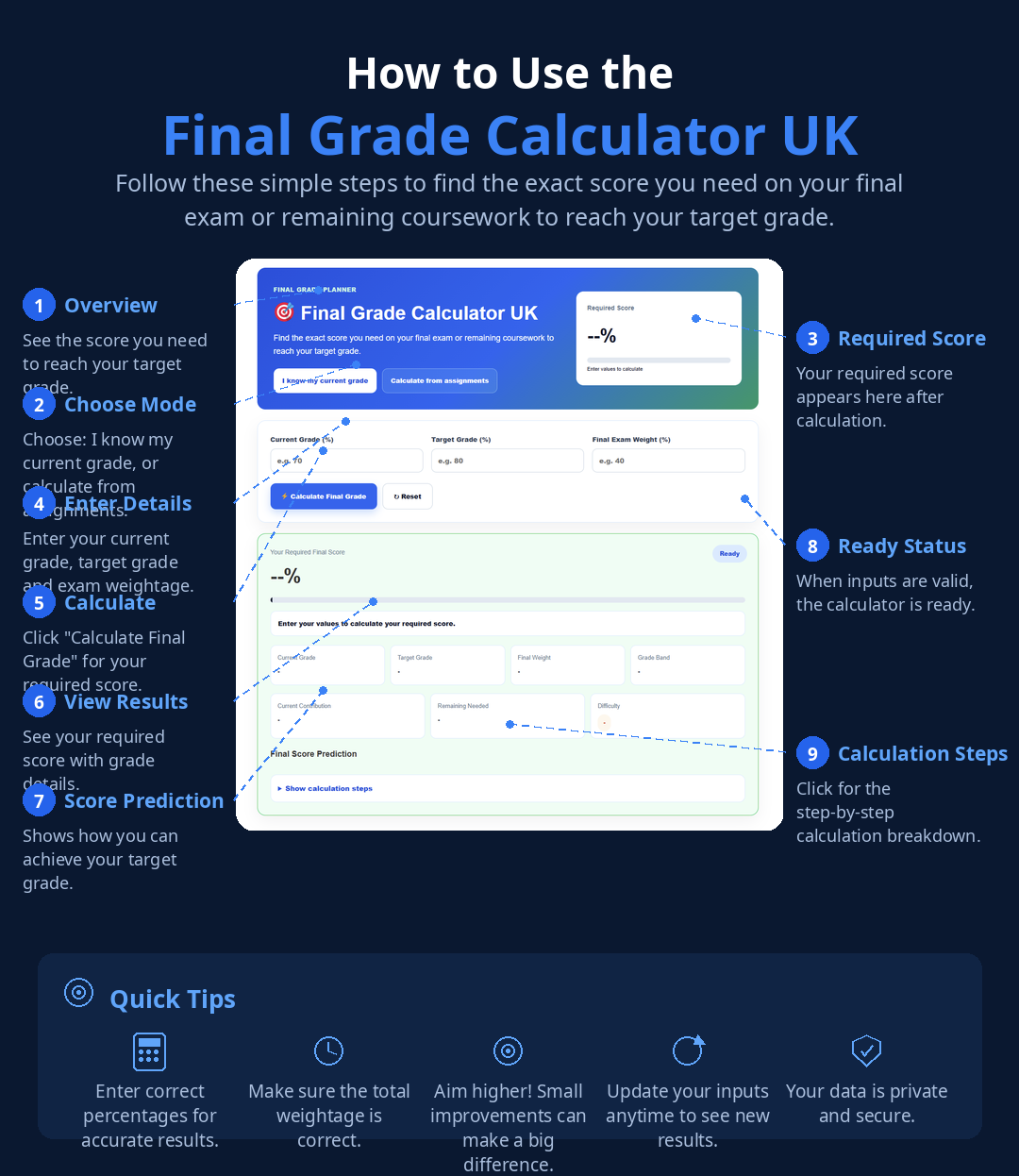
Click Here: Final Grade Calculator UK
The Three Tests at a Glance
The three tests are run by UAT-UK and share one scoring scale, but they measure completely different things. Picking the wrong one to prepare for is the single most common error applicants make — and preparing for all three when you only need one is the second.
| Test | What it actually tests | Format | What you receive |
|---|---|---|---|
| TMUA (Test of Mathematics for University Admission) | Mathematical application and reasoning; simple ideas from elementary logic | Two papers, 20 multiple-choice questions each, 75 minutes per paper | One overall score (1.0–9.0) |
| ESAT (Engineering and Science Admissions Test) | School-level maths and science, tested fast | Maths 1 (compulsory) + two modules chosen from Biology, Chemistry, Physics, Mathematics 2; 27 multiple-choice questions per module, 40 minutes each | One score per module (1.0–9.0 each) |
| TARA (Test of Academic Reasoning for Admissions) | Generic critical thinking and problem solving — no subject knowledge needed | Critical Thinking (22 MCQs, 40 min), Problem Solving (22 MCQs, 40 min), Writing Task (one essay from three prompts, 750-word limit) | Two scores — Critical Thinking and Problem Solving (1.0–9.0 each); the Writing Task is not scored by UAT-UK |
Notice what is missing from that table: knowledge of your school syllabus. Only the TMUA and ESAT touch subject content — the TMUA is built on Higher GCSE and AS-level mathematics, and ESAT modules mirror school science and maths. The TARA deliberately tests none of it. If you are sitting the TARA, revising your A-level notes is the wrong use of your time; reasoning drills are the right one.
Which Admissions Tests Do You Actually Need?
The decisive document is not your university’s prospectus — it is the course page for your exact course and entry year. Oxford uses different tests for different departments: the TMUA for Mathematics and mathematics-adjacent courses, the TARA for social-science and interdisciplinary courses such as PPE and Human Sciences, and the ESAT for Physics and Engineering Science in the 2027-entry list. The same subject at a different university can name a different test entirely: UCL names the TARA for its Computer Science courses, while Oxford names the TMUA for Computer Science.
Here is a course map for the main admissions-test courses. Treat it as a starting point, and then verify against each course’s own page — course lists change year to year.
| University | Courses naming the TMUA | Courses naming the ESAT | Courses naming the TARA |
|---|---|---|---|
| Oxford | Mathematics, Computer Science, Mathematics and Statistics, Mathematics and Computer Science, Mathematics and Philosophy, Computer Science and Philosophy | Physics, Engineering Science | Economics and Management, PPE, Human Sciences, Experimental Psychology, Psychology, Philosophy and Linguistics |
| Cambridge | Mathematics-adjacent courses | Engineering and science subjects | Selected courses — check each course page |
| UCL | Economics-type courses | Electronic and Electrical Engineering and other engineering courses | Computer Science (BSc and MEng), Mechanical Engineering |
| LSE | BSc Economics | — | — |
If your application spans courses that need different tests, you sit more than one test: one score never substitutes for another. And if you are sitting the ESAT, choose your modules with extreme care — every candidate must take Mathematics 1, most must take two further modules from Biology, Chemistry, Physics and Mathematics 2, and UAT-UK warns that the module combination cannot be changed at the test centre. Pick the wrong pair and you cannot quietly swap on the day; you would have to cancel and re-book, and the booking deadline for October has already passed.
How the 1.0–9.0 Scoring Scale Really Works
Your result arrives as a decimal number — something like 6.4 or 5.9 — and the instinct is to read it like a percentage. It is not. After your test, UAT-UK analyses every candidate’s answers using a statistical model called Rasch item response theory. There are multiple versions (forms) of each test, and some forms are slightly harder than others. The Rasch model puts every question and every candidate on one common difficulty scale, which removes the differences between forms — so a 6.4 means the same thing whether you sat on Monday morning or Friday afternoon.
That common scale is then mapped onto the reported 1.0–9.0 range. Two facts define the whole system:
- The scale is anchored so that the median (50th percentile) of the October candidate population scores 4.5. Remember: this is the median of an already elite group — people applying to Oxford, Cambridge, UCL and Imperial — not the general population.
- 9.0 is set at the 90th percentile, with low scores capped at 1.0 and high scores capped at 9.0. Scores are reported to one decimal place.
UAT-UK’s explanation-of-results documents add the distribution shape: typical candidates score around 4.5, and approximately 10% of candidates achieve scores above 7.0. There is no pass mark and no fail mark — universities use the scores alongside predicted grades, written work, interviews and everything else in your application. Oxford has said its tests are used to assess academic reasoning, to compare applicants from different educational backgrounds, to support interview shortlisting, and to contextualise predicted grades like AAA. If you are wondering how those predicted grades fit the picture, our guide to predicted grades for UCAS covers the other half of that equation.
| Score band | What the official distributions imply |
|---|---|
| 1.0–3.9 | Below the median of the October candidate population. Remember the cohort is self-selected and highly able, so this does not mean “bad” in absolute terms — but it is below the typical applicant. |
| 4.0–5.0 | Around the median (4.5). Typical for the candidate population. |
| 5.1–6.9 | Above typical — solidly into the upper half of applicants. |
| 7.0–8.9 | Top roughly 10% of candidates. Only about one in ten scores above 7.0. |
| 9.0 | Capped top band, anchored at the 90th percentile of October candidates. |
One important footnote: the TMUA scaling process was revised for 2024/25, and UAT-UK warns that scores should not be compared directly with TMUA scores from earlier years. Old forum posts quoting “a 6.2 was fine in 2021” are not calibrated to the scale you will be scored on.
Worked Example: The Pacing Arithmetic Nobody Does
The format tables hide one decisive number: seconds per question. The ESAT is not hard because the science is advanced — it is hard because the clock is brutal. Here is the arithmetic:
| Test module | Questions | Time | Seconds per question |
|---|---|---|---|
| TMUA Paper 1 or Paper 2 | 20 | 75 minutes | 225 seconds (3 min 45 s) |
| ESAT module (each) | 27 | 40 minutes | 89 seconds |
| TARA Critical Thinking / Problem Solving | 22 | 40 minutes | 109 seconds |
An ESAT candidate answers 81 questions across three 40-minute modules — 120 minutes of testing at under 90 seconds a question. Compare that with the TMUA’s generous 3 minutes 45 seconds per question: the TMUA rewards deep reasoning, the ESAT rewards triage. If you spend 4 minutes wrestling with one ESAT question, you have burned the time for nearly three others. The practical rule: in the ESAT, a question you cannot crack in about 90 seconds should be skipped and returned to, because every question carries equal weight and the clock does not care which one was hard.
For the TARA, the pacing trap is different. Three separate 40-minute modules feel nothing like one long paper, and candidates who plan their energy as if it were do one thing wrong: they spend the Writing Task the same way as the multiple-choice modules. The writing task is unscored by UAT-UK — but it is sent to your universities, who evaluate it themselves. Blowing it because you are exhausted is a real risk.
Worked Example: Reading a Real-Style Result
Suppose Priya sits the ESAT for an engineering course and receives: Mathematics 1: 6.8, Physics: 5.9, Mathematics 2: 4.3. And suppose Daniel sits the TMUA and receives a single score of 7.1, while his friend got 6.4. How should each of them read those numbers?
First, Daniel and his friend. Both sit above the 4.5 median. Daniel’s 7.1 is just inside the band only about 10% of candidates reach — but the scale is capped and percentile-anchored, so the gap between 6.4 and 7.1 is smaller than it looks. Both are strong scores that will be read alongside the rest of each application.
Priya’s case is more instructive, because the ESAT reports a score per module and universities read the split, not an average. Her 6.8 on Mathematics 1 is solid; her 5.9 on Physics is typical; her 4.3 on Mathematics 2 is below the median. The key point most candidates miss: there is no averaging. UAT-UK does not combine her three scores into one number, so she cannot hide a 4.3 behind a 6.8. A tutor sees module-by-module evidence — which is exactly why the ESAT module choice at booking mattered so much.
And the TARA writing task? Because it carries no UAT-UK score, candidates treat it as optional effort. It is not. The sample goes directly to your universities, and for courses like PPE or Experimental Psychology — where the tutorial system runs on argued essays — it is arguably the most diagnostic part of the test.
The Two Sittings: Why October Is the One That Counts
UAT-UK runs two test windows per admissions cycle. The October 2026 sitting ran 12–16 October (with regional delivery windows: in China, Macau and Hong Kong, ESAT ran 12–13 October, TARA on 14 October and TMUA on 15–16 October). The January 2027 sitting runs 4–8 January 2027. Here is the rule that matters: the January sitting is not a second chance for standard Oxford and Cambridge applicants. UAT-UK states it is not applicable for Cambridge or Oxford applicants unless you are applying to a Cambridge mature college with a January admissions deadline, or an Oxford Foundation Year programme that also has a January deadline.
The key dates for this cycle, all from UAT-UK’s official deadlines page:
- 28 September 2026, 6pm UK time — booking closed for the October sitting.
- 12–16 October 2026 — October test window.
- 16 November 2026 — results released via your UAT-UK account (approximately four weeks after the test).
- 4–8 January 2027 — January test window (limited eligibility, as above).
- 8 February 2027 — January-sitting results released.
On results day, you do not send your scores anywhere. They are matched to your UCAS application automatically and released to the relevant institutions — and you cannot choose which institutions see them. The matching happens course by course: if you sat a test but one of your chosen courses does not use it, that score simply is not passed on. You only need to sit each test once per admissions cycle.
Two smaller facts worth knowing now. You do not need your UCAS PID to set up a UAT-UK account — you can add it later, and UAT-UK matches scores using the other data you supplied at booking. And if you cannot attend, you can cancel at least 48 hours before your scheduled test and receive a full refund; after that, the fee is forfeited.
7 Mistakes That Cost Good Applicants Their Shot
- Registering the wrong ESAT modules. The combination cannot be changed at the test centre. Check every course page, including the compulsory-versus-free-choice rules when your courses disagree, and contact UAT-UK before booking if they conflict.
- Treating January as a backup. For standard Oxford and Cambridge applicants it is not one. Missing October with no valid January route means no test score for that cycle.
- Choosing by university instead of course. UCL Computer Science names the TARA; Oxford Computer Science names the TMUA. Course, university and entry year travel together.
- Reading the score as a percentage. A 4.5 is the median of an elite candidate pool, not “45%”. And ~10% of candidates scoring above 7.0 means a 7.x is rarer than a raw number suggests.
- Comparing scores across years. The TMUA scaling was revised for 2024/25. Old forum benchmarks are not calibrated to the current scale.
- Ignoring the TARA writing task. Unscored by UAT-UK, but sent to your universities — who do score it, in their own way.
- Paying the fee before a bursary is confirmed. Bursaries cover the full test cost for eligible UK candidates, but you must apply through your UAT-UK account before booking — UAT-UK cannot refund a fee you paid before the bursary was confirmed. Access arrangements work the same way: request them well before booking, as confirmation can take up to ten working days.
Once the tests are done, the waiting begins — and knowing how results actually reach your university takes the anxiety out of results week. Our guide to university results day explains how marks, boards and decisions work once you are inside the system.
After the Sitting: Results Day and What Happens Next
You will be notified by email when your results are available in your UAT-UK account — 16 November 2026 for the October sitting, about four weeks after your test. Along with the number, UAT-UK provides an explanation of what your scaled score means, so read that document before you panic or celebrate.
Then the universities take over. Scores go to every institution on your UCAS application that is an official user of the test you sat. What happens next is theirs: Oxford describes using test scores to support interview shortlisting and to contextualise predicted grades, which means your 6.4 does not exist in a vacuum — it sits next to your AAA prediction, your personal statement and your written work. A lower score is not an automatic rejection, and a higher one is not an offer. It is one more piece of evidence in a file the tutors read as a whole.
If the whole process has you thinking about what universities actually demand at entry, our Russell Group entry-grades analysis shows how entry standards have shifted — and why published requirements and typical offers are two different things.

What is the difference between the TMUA, ESAT and TARA?
The TMUA tests maths application and reasoning over two 75-minute papers and gives one overall score. The ESAT tests school-level maths and science in fast 40-minute modules (Maths 1 compulsory, plus two of Biology, Chemistry, Physics or Maths 2) and scores each module separately. The TARA tests generic critical thinking and problem solving plus a Writing Task, giving two scores. All three run on the shared 1.0–9.0 scale.
Which admissions tests do I need for Oxford, Cambridge or UCL?
It depends on your exact course, not the university. Oxford names the TMUA for maths-adjacent courses, the TARA for courses like PPE and Human Sciences, and the ESAT for Physics and Engineering Science. UCL names the TARA for Computer Science and Mechanical Engineering but the ESAT for engineering courses, while Oxford names the TMUA for Computer Science. Always check the course page for your entry year.
How is the 1.0–9.0 admissions test score calculated?
UAT-UK analyses answers with the Rasch statistical model, placing all questions and candidates on one difficulty scale so differences between test versions are removed. That scale maps to 1.0–9.0: the median of the October candidate population scores 4.5, the 90th percentile scores 9.0, and results are reported to one decimal place.
Is there a pass mark for the TMUA, ESAT or TARA?
No. There is no pass or fail on any of the three tests. Universities use the scores alongside predicted grades, written work, interviews and the rest of your application to compare applicants and support shortlisting. About 10% of candidates score above 7.0.
When do I get my Oxbridge admissions test results?
October 2026 sitting results are released via your UAT-UK account on 16 November 2026, roughly four weeks after the test, with an email notification. January 2027 sitting results follow on 8 February 2027.
Can I use the January sitting as a second chance?
For standard Oxford and Cambridge applicants, no. UAT-UK says the January sitting does not apply to them unless they are applying to a Cambridge mature college with a January admissions deadline or an Oxford Foundation Year programme. Treat October as your one shot.
Do universities see all my admissions test scores?
Scores are matched to your UCAS application automatically and released to every institution on it that officially uses the test you sat — you cannot choose. But matching is course by course: a course that does not use the test never receives your score.
Does the TARA Writing Task matter if it is not scored?
Yes. UAT-UK does not score it, but the essay goes directly to your universities, who evaluate it themselves. For essay-driven courses like PPE or Experimental Psychology it is one of the most diagnostic parts of the test.
Conclusion
The October 2026 test window is where the admissions-test season is decided for most Oxbridge and UCL applicants. If there is one thing to carry into it, it is this: the 1.0–9.0 scale rewards position, not perfection. You are being measured against the most competitive applicant pool in the country, where a 4.5 is the median and anything above 7.0 puts you in the top tenth. Prepare for the test you actually need — TMUA depth, ESAT speed, or TARA reasoning — pace yourself with the real seconds-per-question arithmetic, and do not leave the writing task as an afterthought.
And when the number arrives on 16 November, read it with the scale decoder, not your gut. No score is a pass and no score is a fail; it is one piece of evidence in a file that also holds your predicted grades, your written work and, for most of you, an interview. Control what you can control this week — the right test, the right modules, the right pacing — and let the Rasch model do the rest.
![Read more about the article What Grades Do You Need for a Russell Group University? Entry Requirements Explained [2026]](https://gradeforuni.com/wp-content/uploads/2026/10/featured-russell-group-grades-300x192.png)