

Top-Up Degrees UK: How Your Final Year Decides Your Classification [2026]
Here is the question almost every HND student asks before applying for a top-up: “I finished my HND with a Merit profile — does any of that count towards my degree classification?” It is a reasonable question, and the answer genuinely surprises people. No. Not a single mark carries over. When you enrol on one of the top-up degrees UK universities offer, your honours classification is calculated from your final top-up year alone: 120 credits at Level 6, one academic year, and everything riding on it.
That single fact reshapes every decision around the top-up route. For some students it is a gift — a mediocre HND cannot drag down a brilliant final year, so the slate is wiped clean. For others it is a warning — a Distinction-level HND will not rescue a lazy twelve months, because the university never looks at those earlier marks when it classifies your degree. Your entry grades get you through the door; after that, they are history.
This guide explains exactly how top-up degrees work in the UK: who they are for, the entry grades universities actually ask for, the classification rule verified against real university regulations, two fully worked grade calculations, what student finance covers, and the mistakes that cost applicants every year.
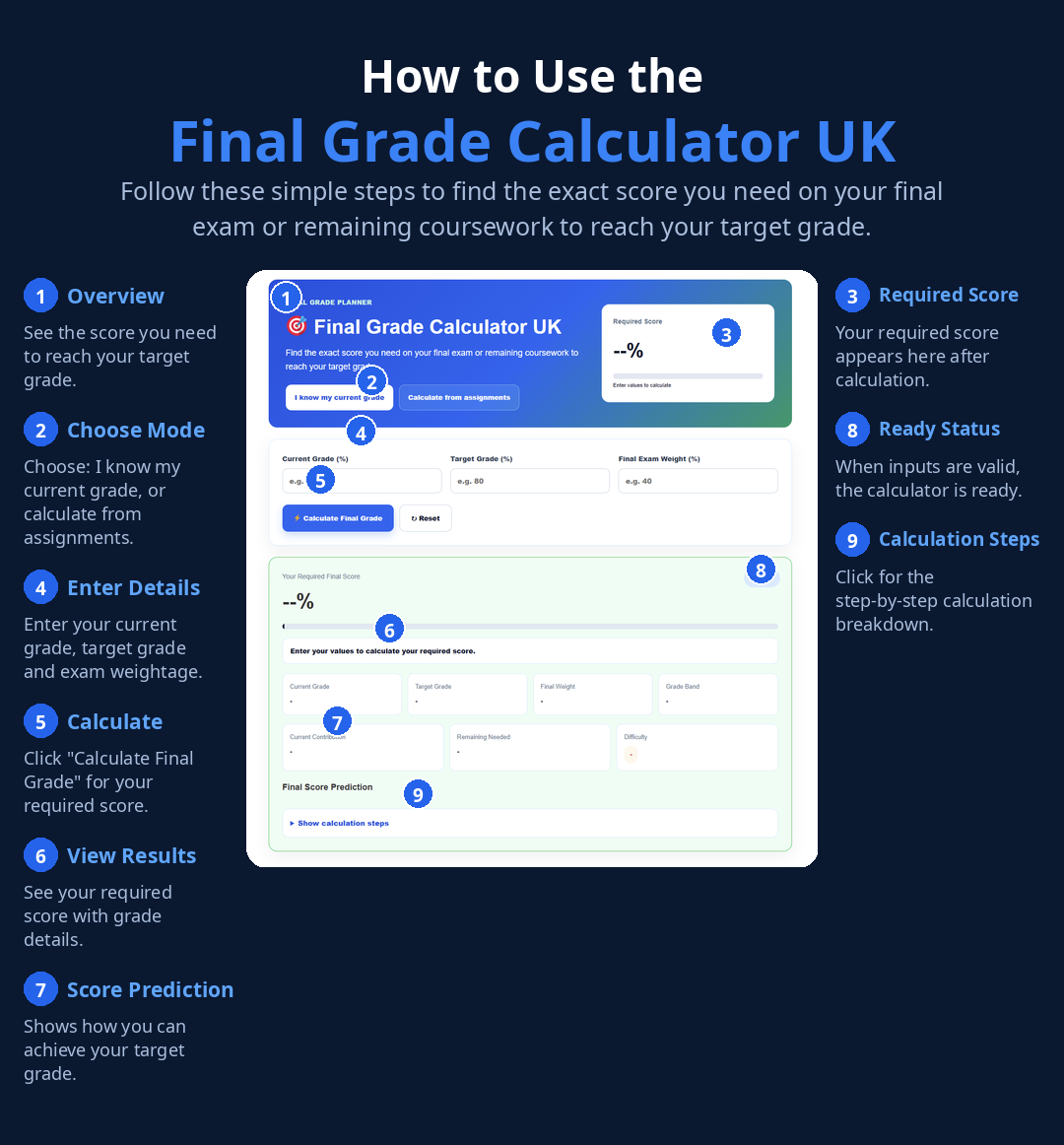
Click Here: Final Grade Calculator UK
What a Top-Up Degree Actually Is
A UK bachelor’s degree is built from 360 credits: 120 at Level 4, 120 at Level 5 and 120 at Level 6. An HND covers the first two levels. A top-up degree is simply the Level 6 year — the final year — packaged and taught as a one-year course in its own right. You join the final year of the degree programme, complete 120 credits of honours-level modules (often including a dissertation or major project), and graduate with the same BA (Hons) or BSc (Hons) as students who spent all three years at that university.
The route exists for holders of Level 5 qualifications: the Higher National Diploma (HND), Foundation degrees (FdA and FdSc), and the Diploma of Higher Education (DipHE). In practice you need 240 credits behind you — 120 at Level 4 and 120 at Level 5 — in a subject closely related to the top-up. It typically takes one year full-time, and part-time options over two years exist at some universities. Top-ups are most common in business, computing, engineering, health-related subjects and the creative industries, though availability varies by institution.
Why do students do it? The honest answer is that an HND or Foundation degree, good as it is, closes certain doors. As Prospects notes, you generally need a full bachelor’s degree to apply for graduate schemes or graduate-level jobs, and a significant number of HND graduates top up for exactly that reason. An honours degree also unlocks postgraduate study — most taught master’s programmes ask for honours-level entry, which an HND alone does not satisfy.
Entry Grades: What Universities Actually Ask For
Top-up entry requirements follow a clear pattern: a grade threshold on your Level 5 qualification, a subject-match check, and the usual GCSE English and maths bar. Here is what real universities and UCAS listings asked for recently — quoted, not paraphrased into vagueness:
| University / provider | Top-up course | What they ask for |
|---|---|---|
| Bournemouth University | BA (Hons) Business and Management (Top-up), September 2027 entry | Foundation Degree with 60% or above, or HND with Merit or above, in a required subject; GCSE English and Maths at grade 4/C |
| Brunel University of London | BEng Electronic Engineering (Top Up) | HND in electronic engineering with Merit (or equivalent) for all modules at Level 5 |
| South and City College Birmingham (via UCAS) | Business and Management Final Year Entry (Top-up) | A merit profile — a minimum of 50% of module grades at Merit or above — normally in a Foundation degree or HNC/HND in a business-related subject |
| University of Greater Manchester (via UCAS) | Crime and Criminal Justice (Final Year Top-Up) | At least 120 credits at Level 4 and 120 credits at Level 5, e.g. Foundation Degree, HND or DipHE in a related subject |
Three things stand out. First, the bar is almost always expressed as a Merit profile (or 60%+) rather than a single number — admissions teams read across your Level 5 unit grades. Second, the subject match matters more than applicants expect. A business HND fits a business or finance top-up; it does not fit a psychology or computing top-up, because you would be missing the Level 5 knowledge the final year assumes. Universities map your modules before making an offer, and a weak match is the most common reason for rejection. Third, an HNC on its own (120 credits, Level 4 only) does not normally buy direct entry to a top-up — the standard expectation is the full 240 credits.
International applicants face the usual English-language requirement on top — Bournemouth, for example, asks for IELTS 6.0 with no component below 5.5 for its business top-up. Applications for full-time top-ups go through UCAS, where courses carry their own course codes and the standard January equal-consideration deadline (recent listings showed mid-to-late January dates). Some universities also accept direct applications, so if you miss the UCAS deadline it is worth asking the admissions team directly — but do not assume places roll on indefinitely.
How Top-Up Degrees Are Classified: The Rule That Surprises Everyone
Here is the core mechanic, verified against the published academic regulations of three UK universities. On a top-up degree, your honours classification is calculated from your top-up year marks alone. Your HND, Foundation degree or DipHE grades — Merit, Distinction, 60%, whatever they were — contribute precisely nothing to the classification algorithm.
Birmingham City University states it most bluntly. Regulation 5.2 of its 2026/27 Academic Regulations gives the classification rule for top-up honours as the “stage mean for 120 credits stage 3 (level 6) only”, with the rationale spelled out: “this ensures consistency by not using imported marks.” Imported marks — that is your HND grades — are deliberately excluded.
Swansea University’s undergraduate assessment regulations say the same thing in different words: for “direct entry to the final year / top up degree”, the classification uses the marks of modules totalling 120 credits at Level 6, each given equal weight — a straight credit-weighted average of the top-up year. A separate note in the same regulations confirms that students admitted directly to the final year are classified on “the straight average of the modules pursued… in the final year.” Norwich University of the Arts puts it plainly on its classification page: “if you are a direct entrant to Year 3, your award will be calculated using your Year 3 marks only.”
Every set of regulations checked for this article works this way, for a simple reason: a university can only classify you on honours-level work it has itself assessed. It cannot meaningfully blend another institution’s HND Merits with its own Level 6 percentages, so it does not try. The consequence cuts both ways:
| Student | HND average | Top-up year average | Real classification (top-up year only) | Hypothetical 50:50 blend (illustrative only) |
|---|---|---|---|---|
| A | 72% (Distinction) | 58% | 2:2 | 65% → 2:1 |
| B | 48% (Pass) | 71% | First | 59.5% → 2:2 |
| C | 63% (Merit) | 66.3% | 2:1 | 64.7% → 2:1 |
The right-hand column is purely illustrative — no university in this guide blends HND and top-up marks 50:50 — but it shows what is at stake. Student A’s Distinction-level HND buys nothing when the top-up year lands at 58%. Student B, written off after a weak HND, graduates with a First on the strength of one excellent year. The top-up year is a genuine clean slate, and it rewards students who understand that from week one.
One practical note: because only the top-up year counts, the standard Degree Classification Calculator needs a small adjustment for top-up students — enter your Level 6 modules as the final year and set every other year’s weight to zero. And if you are wondering, by analogy, what else does or does not count towards a degree, our guide on whether foundation year grades count covers the same “entry ticket vs classified work” distinction from the other direction.
Worked Example 1: Amara’s Top-Up Year, Mark by Mark
Amara finished her HND in Business with a Merit profile — mostly Merits, a couple of Distinctions. That profile earned her a place on a business top-up. It will not earn her a single percentage point of her classification. Here is her top-up year, with every step of the arithmetic shown.
Her modules (120 credits at Level 6):
| Module | Credits | Mark | Mark × credits |
|---|---|---|---|
| Dissertation / major project | 40 | 68% | 2,720 |
| Strategic Management | 20 | 62% | 1,240 |
| Global Marketing | 20 | 71% | 1,420 |
| Business Analytics | 20 | 58% | 1,160 |
| Leadership and Change | 20 | 66% | 1,320 |
| Total | 120 | 7,960 |
Step 1 — multiply each mark by its credits (done in the table). Step 2 — add the weighted marks: 2,720 + 1,240 + 1,420 + 1,160 + 1,320 = 7,960. Step 3 — divide by total credits: 7,960 ÷ 120 = 66.33%. Step 4 — apply the boundaries (First 70%+, 2:1 60–69%, 2:2 50–59%, Third 40–49%): Amara graduates with a 2:1.
Notice two things. First, the 40-credit dissertation does exactly what its credit weight says: at 68%, it contributes 2,720 of the 7,960 total — more than any two 20-credit modules combined. On a top-up year, where every credit counts towards the only average that matters, the big project module is the single highest-leverage piece of work you will do. Second, Amara’s HND Merit profile is invisible in this calculation. Had her HND average been 52% or 74%, the answer would still be 66.33% and a 2:1. Entry grades open the door; only Level 6 marks decide the room you end up in.
Worked Example 2: The 59.8% Borderline
Borderline cases hurt more on a top-up because there is no second counting year to dilute them. Take Daniel, whose top-up year looks like this:
| Module | Credits | Mark | Mark × credits |
|---|---|---|---|
| Final-year project | 40 | 63% | 2,520 |
| Module A | 20 | 55% | 1,100 |
| Module B | 20 | 61% | 1,220 |
| Module C | 20 | 57% | 1,140 |
| Module D | 20 | 60% | 1,200 |
| Total | 120 | 7,180 |
7,180 ÷ 120 = 59.83% — a 2:2 on the raw average, just 0.17 points short of a 2:1. This is where borderline rules matter, and they apply to the top-up-year average exactly as they would to any other classification average, because for a top-up student that average is the classification.
Using Swansea University’s published borderline rules as a concrete example: the “window of opportunity” covers averages within 2% of a boundary, so 59.83% qualifies. The preponderance principle then asks whether marks in the higher band (60%+) cover at least half of the classification credits. Daniel has 80 of his 120 credits at 60% or above (the 40-credit project at 63, plus modules B and D) — more than half — so under Swansea’s rules his classification would normally be raised to a 2:1. Swansea also runs an “exit velocity” check on the final-year average, which for a top-up student is the same number.
Two cautions. First, borderline rules differ by university — some use a narrower window, some require a higher proportion of credits in the upper band, and none of it is automatic. Second, notice how thin the margin is: a single mark of 55 instead of 57 on one 20-credit module would have cost Daniel 0.33 points (2 × 20 ÷ 120) and dropped him to 59.5% — still borderline at Swansea, but with less room. On a top-up year, every stray mark moves the needle roughly twice as far as it would across a two-year classification.

Is a Top-Up Worth It? A Decision Framework
The top-up decision is really four options, not two. Laid out side by side, the trade-offs become concrete:
| Route | Time to honours | Tuition cost | Grade risk | What it unlocks |
|---|---|---|---|---|
| Top-up year | 1 year | One year of undergraduate fees | High — one year decides the entire classification; no second counting year to absorb a bad module | Full BA/BSc (Hons); graduate schemes; taught master’s entry |
| Stop at HND / Foundation degree | None | Nothing further | None — but also no honours | Direct employment and many technician/associate roles; most graduate schemes and master’s programmes closed |
| Full 3-year degree from year 1 | 3 years | Three years of fees; student-finance previous-study rules usually leave the first year’s tuition fee loan uncovered | Medium — classification typically spread over two counting years | Full honours; widest subject-switching freedom |
| Work now, top up later | 1 year, deferred | Same one-year cost later; earnings meanwhile | Medium — maturity and workplace context often lift Level 6 performance, but study skills rust | Same honours, plus work experience — a combination employers rate |
The grade-risk row is the least intuitive. A three-year student with a bad 20-credit second-year module sees the damage diluted across two counting years. A top-up student feels the full weight in a single 120-credit average: a 20-credit module at 40% instead of 65% costs (65 − 40) × 20 ÷ 120 ≈ 4.2 percentage points — easily the gap between a 2:1 and a 2:2. The top-up is the cheapest and fastest route to honours, but also the highest-variance. Protect the big-credit modules first.
One related scenario: topping up at a different university from the one that awarded your HND. That is completely normal — most top-up students move — but treat it as a transfer decision. Our guide to transferring universities in the UK covers the credit, funding and deadline mechanics, and if postgraduate study is the goal, check whether you can do a master’s with a 2:2 before setting your target classification.
Resits, Capped Marks and Compensation on a Top-Up Year
Fail a module on your top-up year and the standard machinery kicks in — but every part of it bites harder when the year is the whole degree. Start with the cap. Birmingham City University’s Regulation 2.8 states the sector-standard rule plainly: where a resit is taken, “the mark achieved will stand, capped at the module pass mark for the purpose of award classification.” In plain terms: score 68% on your resit and your transcript may show 68, but the number that feeds your classification is 40%.
Run the arithmetic on a 20-credit module inside a 120-credit top-up year. Genuine resit performance of 68, capped to 40: the classification loses (68 − 40) × 20 ÷ 120 = 4.67 percentage points. That is roughly a full classification sub-band — the difference between a comfortable 2:1 and a borderline one, or between a borderline 2:1 and a 2:2. The capped mark does not just let you progress; it sits inside your only classification average all year. BCU’s regulations underline the point: “the capped stage mean will always be applied for award classification.”
Compensation and condonement — passing a failed module without a resit because the rest of your profile is strong enough — are also tighter on top-ups. BCU’s 2026/27 regulations allow automatic compensation of up to 40 credits per stage where the failed module sits at 35–39% and the stage mean is at least 40%, plus condonement of up to 20 further credits. Those allowances are per stage, and your top-up year is a single stage — there is no second year of allowances to fall back on, and some universities set lower caps specifically for top-up awards. The practical lesson: a “near miss” at 37% on a 20-credit module might be compensatable, but the 37 still counts in your average. Compensation saves the credit; it does not save the grade.
Resits are not a strategy, though. Because the cap applies for classification purposes, a resit can never contribute more than the pass mark. If a module is heading for trouble, an extenuating-circumstances claim before the assessment — which can secure an uncapped sit — is worth far more than a capped resit afterwards.
Student Finance for the Top-Up Year
Money first, because this is where the nasty surprises live. The good news is official and explicit. GOV.UK’s student finance eligibility pages state: “You may get limited funding if you’re ‘topping up’ a higher education qualification, for example you’ve finished an HNC, HND or foundation degree and now want to do an Honours degree.” Topping up is a recognised exception to the usual “first qualification only” rule — you are not treated as starting a second degree.
The less good news is the previous-study arithmetic. Student Finance England calculates tuition fee loan entitlement as (years of the new course + 1) − (years of previous higher-education study), with the available years applied to the final years of the course. Maintenance loans are more generous: GOV.UK says you will usually get them for every year of the new course. Work the classic case honestly: a one-year top-up after two funded HND years gives 1 + 1 − 2 = zero years of tuition fee loan on the strict formula. The “+1” — the gift year — has normally already been consumed by the HND years.
So does that mean no tuition fee loan for the top-up year? Not necessarily — which is why you must check rather than assume. GOV.UK’s explicit topping-up exception exists precisely because the raw formula would otherwise shut top-up students out, and Student Finance advisers have confirmed top-up-year eligibility in practice. The outcome depends on your history: how many years of previous study SFE counts (years of study, not just years you took funding), whether any of your HND was part-time or self-funded, and whether you have repeat years on record — our guide to repeating a year at university covers those mechanics.
Apply for student finance early, read the entitlement letter line by line, and if the tuition fee loan is missing or short, call SFE with your HND dates and the top-up course details in front of you — before you enrol, not after. University money advisers see this exact case every September.
External reference: GOV.UK — Student finance for undergraduates: eligibility. Classification rules referenced above: Swansea University undergraduate assessment regulations, Section 3.
If the Top-Up Year Goes Wrong: Exit Awards
First, the reassurance: you cannot lose your HND, Foundation degree or DipHE by failing a top-up year. It is a separate, completed qualification from a separate course. It stays on your record and your CV whatever happens in the top-up year.
What varies is whether the university gives you anything for the failed top-up year itself. Birmingham City University’s regulations are explicit that for top-up honours, “exit awards [are] not permitted” — fail the year and there is no consolation certificate from the top-up course. Other universities handle it through their normal repeat-stage rules: resit the failed modules (capped), or in some cases repeat the stage. A small number of institutions may consider an ordinary (unclassified) degree where enough Level 6 credit has been passed, but that is the exception rather than the rule, and it depends entirely on your university’s regulations — ask the exams office, not the internet.
If the worst happens, read our guide to university exit awards (CertHE, DipHE and ordinary degrees) for the full landscape, and remember the strategic point from the classification section: because only the top-up year counts, returning for one more attempt means the failed year’s marks do not permanently poison your record the way a failed second year can. The slate stays clean — you just have to earn it again.
6 Mistakes Top-Up Applicants Make
| # | Mistake | Why it hurts | Do this instead |
|---|---|---|---|
| 1 | Assuming HND grades lift the classification | Universities classify top-ups on the 120 Level-6 credits only; a Distinction HND contributes nothing | Treat entry grades as the admission ticket and plan the top-up year as a fresh start |
| 2 | Applying for an unrelated subject | Admissions map your Level 5 modules; a weak subject match means rejection or a brutal first term | Check the required-subject lists and ask admissions to map your modules before you apply |
| 3 | Assuming student finance is automatic | The previous-study formula can leave the tuition fee loan uncovered if the gift year is already used | Run the (years + 1 − previous study) calculation and confirm with SFE before enrolling |
| 4 | Banking on a resit to rescue the average | Resits are capped at 40% for classification; a capped 20-credit module can cost 4–5 points | Protect the big-credit modules first; use extenuating circumstances before assessments, not resits after |
| 5 | Missing the UCAS January deadline | Top-ups are UCAS-listed courses with equal-consideration deadlines; late applications depend on leftover places | Apply by the January deadline; if late, contact the university about direct applications |
| 6 | Choosing on price or speed alone | Not every one-year course is a full honours top-up with the classification rules you expect | Confirm it awards BA/BSc (Hons), check professional accreditation, and read the classification regulations |
Do my HND grades count towards my degree classification on a top-up?
No. At every university whose regulations were checked for this guide — including Birmingham City University (Regulation 5.2), Swansea University and Norwich University of the Arts — the honours classification for top-up students is calculated from the final-year Level 6 modules alone, normally the 120 credits of the top-up year. Your HND grade profile decides whether you get admitted, not the class you graduate with.
Can I get a First on a top-up degree?
Yes. The same boundaries apply: 70% or above is a First whether you studied three years or one. Because only your top-up-year average counts, a First is entirely about your Level 6 marks — which also means a weak year cannot be rescued by a strong HND. Put your heaviest effort into the 40-credit project or dissertation, since it carries the most weight in your only classification average.
What grades do I need to get onto a top-up degree?
Most universities ask for a Merit profile at Level 5. Bournemouth University asks for a Foundation Degree at 60% or above, or an HND at Merit or above, for its business top-up; Brunel asks for Merit in all Level 5 HND modules for its engineering top-up. Typical UCAS listings ask for at least half of module grades at Merit or above, plus 240 credits (120 at Level 4 and 120 at Level 5) in a closely related subject. GCSE English and Maths at grade 4 (C) is also commonly required.
Is a top-up degree the same as a normal honours degree?
Yes. You graduate with the same BA (Hons) or BSc (Hons) as students who spent all three years at the university. That is the point of the route: an HND alone generally does not meet the honours-degree requirement for graduate schemes or taught master’s programmes, while the topped-up honours degree does.
Can I get student finance for a top-up year?
GOV.UK explicitly lists ‘topping up’ — finishing an HNC, HND or Foundation degree and moving to an Honours degree — as eligible for limited student funding. Tuition fee loan entitlement is (years of the new course + 1) minus years of previous higher-education study, so a one-year top-up after a two-year HND gives 1 + 1 − 2 = 0 on the strict formula, with the ‘gift year’ usually already used. In practice the topping-up exception means many students do get the tuition fee loan for the top-up year — but confirm your personal calculation with Student Finance England before you enrol. Maintenance loans are usually available for the full year regardless.
What happens if I fail a module on my top-up year?
The normal resit rules apply: usually one resit, capped at the 40% pass mark for classification purposes — so even a strong resit feeds only 40 into your average. Limited compensation may be available (for example, up to 40 credits at 35–39% with a 40% stage mean under Birmingham City University’s 2026/27 regulations), but compensated marks still count in your average. Because the top-up year is your only classification year, a capped resit drags your final average roughly twice as far as it would across a two-year classification.
If I fail the top-up year, do I lose my HND?
No. Your HND, Foundation degree or DipHE is a separate, completed qualification and remains yours. What varies is whether you get any award for the failed top-up year itself: Birmingham City University’s regulations state that exit awards are not permitted for top-up honours, while other universities apply their normal repeat-stage or resit rules. Check your own university’s regulations and talk to the exams office early if you are struggling.
Do I apply for a top-up through UCAS?
Usually, yes. Full-time top-ups are listed on UCAS with their own course codes and entry points (normally Year 3), and the standard January equal-consideration deadline applies. You will need Level 5 transcripts showing 240 credits (120 at Level 4 and 120 at Level 5) in a related subject. Some universities also accept direct applications — a useful fallback if you miss the UCAS deadline.
Conclusion
The top-up degree is the most misunderstood bargain in UK higher education. On paper it looks like a shortcut: one year, one set of fees, and a full honours degree at the end. In grade terms it is actually the opposite of a shortcut — it is the most concentrated assessment you will ever face, with your entire classification resting on roughly eight modules and a single 120-credit average. Students who thrive on it are the ones who internalise that early: the HND got you in, but from the first lecture of the top-up year, nobody cares what it said.
If you take one number from this guide, take the arithmetic, not the reassurance. Work out your credit-weighted average before every assessment period, know exactly which modules carry the weight, and remember that a capped resit or a compensated near-miss lives inside your only classification average all year. Run your top-up-year modules through the Degree Classification Calculator with every other year zeroed out, and you will always know precisely where you stand — which, on a top-up, is the one advantage that actually matters.