![You are currently viewing What Happens at a University Exam Board? How Your Final Grades Get Decided [2026]](https://gradeforuni.com/wp-content/uploads/2026/10/featured-exam-board-uk.png)
Somewhere on your campus, probably in a room you have never entered, a group of academics once sat around a table and decided what class of degree you would get. Not your lecturers marking essays. Not a computer adding up percentages. An actual committee, with a chair, a secretary, printed spreadsheets, and a visiting academic from another university — and their decision, signed and minuted, is the moment your results stop being provisional and become final.
Most students never hear the phrase “board of examiners” until something goes wrong: a result looks strange, a module fails, a classification lands a fraction below the boundary. But the exam board is quietly the most powerful body in your academic life. At UCL, the Academic Manual states plainly that the Board of Examiners is “the primary decisionmaking body for student progression, award and classification decisions”. Every UK university has one — actually, several — and understanding how they work explains half the mysteries of university results: why marks are “provisional” for weeks, why nobody can tell you your classification early, and why a borderline case sometimes gets uplifted while an identical-looking one does not.
This guide walks through what a university exam board is, who sits in the room, the exact journey your marks take before they reach it, what the board can and cannot do, and two fully worked examples showing how real board decisions move final averages. The regulations quoted come from UCL, Manchester, Newcastle, Edinburgh, York, Sheffield Hallam and the Royal Veterinary College — the rules differ in detail, but the machinery is the same everywhere.
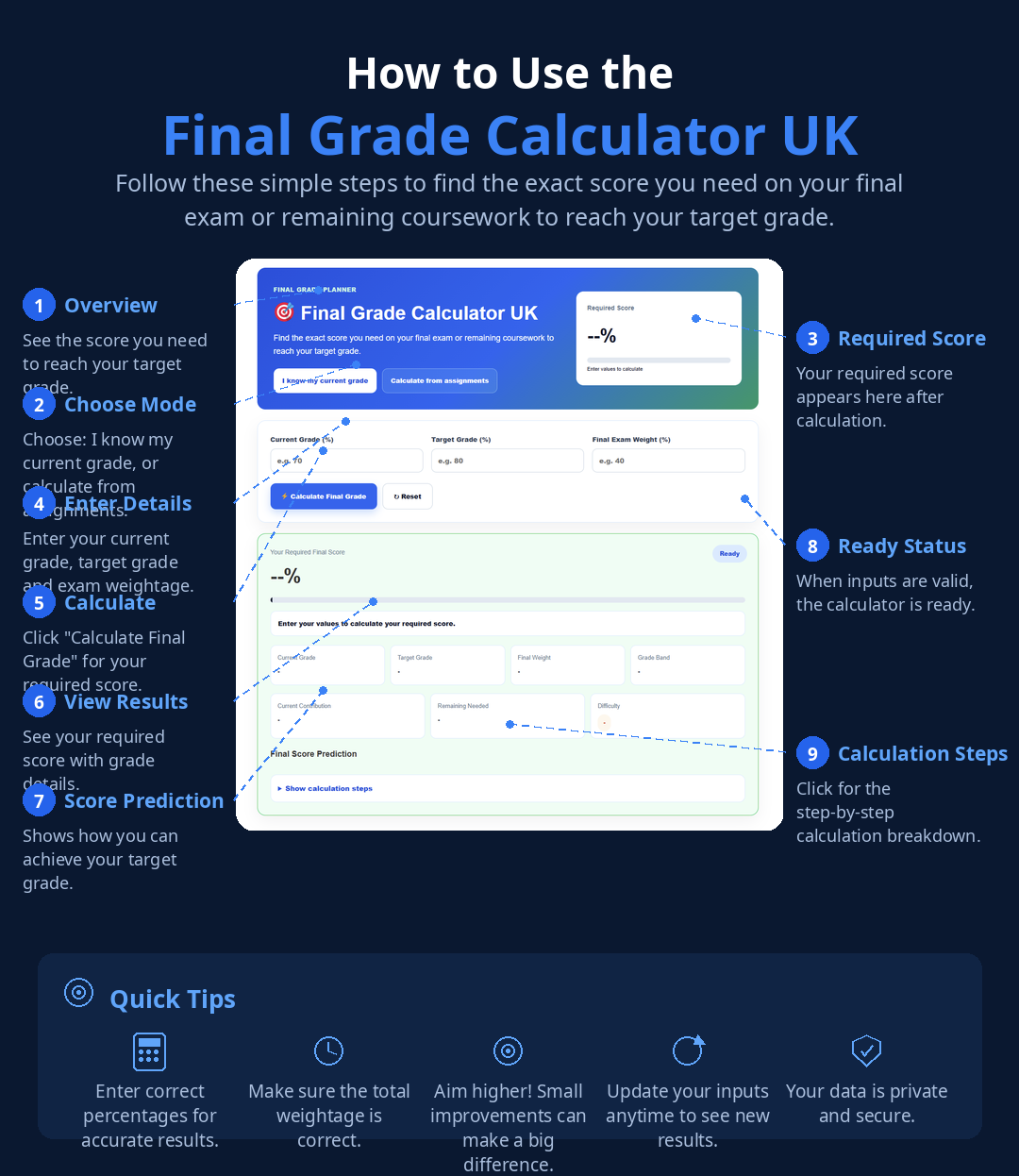
Click Here: Final Grade Calculator UK
First, This Is Not That Kind of Exam Board
The phrase “exam board” means two completely different things in the UK, and the confusion is understandable. If you did GCSEs or A-levels, your exam board was a national awarding organisation — AQA, Edexcel, OCR, WJEC — a company that wrote your papers, employed thousands of markers, and issued your certificates. A university exam board is nothing like that. It is an internal committee of the university itself, made up of the academics who taught you, and it only concerns your university’s own students.
| Feature | GCSE/A-level exam board (AQA, Edexcel…) | University exam board |
|---|---|---|
| What it is | A national awarding organisation | An internal university committee |
| Who runs it | Thousands of contracted examiners | Your department’s academics, plus external examiners |
| Whose work it judges | Millions of school students | Only that university’s students |
| When it meets | Year-round examining seasons | Fixed points in the academic year (usually June, September) |
| Decisions it makes | Grades on certificates | Progression, awards, and degree classifications |
| Can you appeal to it directly? | Yes, via review of marking | No — it only acts on cases referred through official processes |
This article is about the second kind. And unlike the A-level kind, where the mystery is mostly how the marking works, the university board’s mystery is where your mark actually becomes your result. Between your essay being marked and your degree being awarded, there are more steps — and more people — than most students ever suspect.
The 7-Stage Journey of Every Mark
A mark does not travel in a straight line from marker to transcript. At most UK universities it passes through roughly seven stages, and each one has a different job. Here is the full journey, as assembled from the published regulations of Manchester, Newcastle, UCL, York and Sheffield Hallam.
| Stage | What happens | Who is involved | Do you know your name is attached? |
|---|---|---|---|
| 1. Marking | Your work is marked against the criteria, usually anonymously by candidate number | First marker | No |
| 2. Second marking / moderation | A sample (or all) of work is checked by a second marker; marks may move here | Second marker / moderator | No |
| 3. External examiner sampling | An academic from another university reviews a sample of work and the marking standards | External examiner | No |
| 4. Module / moderation board | Module marks are confirmed; cohort-wide adjustments (if any) happen here | Department academics + external examiner | No |
| 5. Extenuating circumstances panel | Accepted EC claims are converted into recommendations (e.g. uncapped resit) | Separate panel, before the main board | No |
| 6. Progression / award board | The board applies the regulations: progression, resits, condonement, classifications, borderline reviews | Full board + external examiner(s) | No — names revealed only after decisions (Edinburgh) |
| 7. Ratification and release | Minutes and a pass list are checked and signed; results are published | Chair, secretary, registry | Yes — results now belong to you |
Three things in that table surprise almost every student. First, the external examiner — an academic from a different university — is involved before and during the board, not as a courtesy but as a full member whose job is to guarantee that your university’s standards match everyone else’s. Second, everything until stage 7 is provisional: Sheffield Hallam’s assessment policy puts it in one sentence — “All marks and results are provisional until they are ratified by the appropriate assessment board.” Third, anonymity survives almost to the very end. Edinburgh’s regulations require that names stay hidden until the board has decided the final marks and classifications; only then are they revealed for a final error check.
Who Actually Sits in the Room
Exam boards are confidential — Manchester’s official guidance states flatly that “Boards are confidential” — so no student has watched one. But the regulations describe the cast list precisely, and it is more structured than most people imagine.
- The chair. Usually a senior academic (head of department or a nominee). The chair runs the meeting, keeps the board inside the regulations, and co-signs the minutes and pass list afterwards. At Manchester, the chair and secretary must ensure minutes are produced “promptly, normally within one working week”.
- The secretary. A registry or departmental administrator. They prepare the mark sheets, record decisions, and make sure the paper trail is exact — because the minutes are the legal record of why each student got the result they got.
- The internal examiners. The module leaders and programme directors whose students are being discussed. They can explain context — for example, that a particular cohort sat an unusually hard paper — but they cannot simply vote their own students a better outcome.
- The external examiner(s). Academics from other universities, appointed for a fixed term (usually around four years). Warwick’s external examiner handbook states they are “full members of the Board of Examiners” with the right to attend all examiners’ meetings, and that they are required to be present at boards where awards are recommended. UCL’s regulations say the same: the Full Board meets with “all members in attendance (subject to quoracy provisions), including the External Examiner(s)”. Their views carry particular weight on borderline classifications — but, crucially, they approve the rationale for a decision, they do not remark your work.
- The faculty representative. At UCL, faculty-appointed staff attend boards to check that the board is operating “in accordance with the UCL Academic Manual and in a proper and impartial manner” — an observer with a whistle, in effect.
Some universities split the work across several boards rather than one giant meeting. Manchester’s guidance describes departments dividing into Moderation Boards (confirming module marks), Progression Boards (deciding who moves to the next year), and Award Boards (final-year classifications) — or handling everything in a single meeting, depending on the programme’s size. UCL uses a similar layered system: a Board of Examiners, a Faculty Board of Examiners overseeing it, and the central Education Committee with overarching responsibility for awarding degrees.
Anonymity: How They Grade You Without Knowing You
Anonymous marking is one of the most misunderstood parts of the system, mostly because students experience only the first half of it. Here is how the two halves work.
Half one: marking is anonymous. Your exam scripts and (where technically possible) your coursework are identified only by candidate number. Canterbury’s regulations state that anonymity “ends at the point at which the marking procedure is complete, and the marks are handed over to the person who transfers the marks to the mark sheet by name rather than examination number”. York’s guide adds that “marks under consideration by a Board of Examiners should remain anonymous” — the board itself discusses candidate numbers, not names.
Half two: anonymity ends on purpose. Once the board has decided every mark, grade and classification, Edinburgh’s regulations require the names to be made visible “then” — so the board can do a final check for errors that candidate numbers would hide (two students with similar numbers, a transposed mark, a missing EC flag). At that point, Edinburgh says, changes can only be made if an error is detected that “was not detectable when examination numbers were used”, and any change is recorded in the minutes.
The practical consequence: nobody in the marking chain knows whose work they are judging, and the board cannot favour — or penalise — any individual student while it is making its decisions. Anonymity is lifted only for the error check, after the judgments are already made.
What the Board Actually Decides About You
By the time the main board sits, the raw material — confirmed module marks, EC panel recommendations, misconduct outcomes — is already on the table. The board’s job is to feed that material through the regulations and produce decisions. UCL’s old Board of Examiners regulations list the options for finalists plainly: classify normally where all marks are available, recommend a provisional pass with honours where the board is satisfied the student deserves a degree but some marks are missing, or defer the decision and refer the case up to the Faculty Board where the picture is incomplete.
In practice, the decisions fall into a short menu, and almost every student’s result is one of them:
- Progress. You met the credit and average requirements — you move to the next year.
- Progress with conditions. You trail a failed module into next year, or you must resit in the late-summer window. The board decides which, and whether the resit is capped.
- Resit / repeat options. For failed modules the board applies the regulation menu: capped resit, repeat of the year, or withdrawal with an exit award. (See our guides to university referrals and repeating a year.)
- Condonement / compensation. Where the regulations allow, the board forgives a failed module so you can graduate — see our condoned pass guide. Manchester’s regulations, for example, let a board award special compensation for up to 40 credits at level 6 of a bachelor’s degree (or 60 credits with a classification penalty) provided the student has passed enough credits at the award level.
- Classification. For finalists, the board confirms the degree class the algorithm produces — and reviews the borderline cases, where human judgement enters. Our borderline grades guide covers the uplift rules in detail.
- Exit awards. Where a student cannot continue, the board recommends the highest award their credits support — CertHE, DipHE or an ordinary degree. (See exit awards explained.)
Everything is minuted. Edinburgh’s regulations require the minutes to record the examiners present, the EC outcomes considered, the discussion and outcomes of borderline cases, details of any modification of marks, grades or classification with reasons, and the external examiner’s comments and approval of the agreed results. Those minutes are confidential — but they are the reason a board’s decision can be audited later if something looks wrong.
Worked Example 1: Priya’s 69.72% and the Borderline Review
Priya is a final-year BSc student. Her second-year average was 68.4% and her final-year average is 70.6%, on a 40:60 weighting (the Leicester-style model). Her final average is therefore:
0.40 × 68.4 + 0.60 × 70.6 = 27.36 + 42.36 = 69.72%
That is 0.28 percentage points short of a First. The algorithm alone gives her a 2:1. But because she is within the borderline zone, her case goes to the board for a review — and what happens next depends on the university’s rules.
At Manchester, her case would enter Classification Review. The university’s own guidance is explicit about what this is and is not: “Classification Review does not remark or change marks”, it “can only result in an increase in class”, it “does not result in a lower classification”, and the board exercises “its collective academic judgement in deciding which cases can be subject to Classification Review”. During the review, the external examiner approves the rationale for raising the class — they do not look at Priya’s individual assessments or remark them. Her mark stays 69.72%; the question is only whether the class attached to it becomes a First.
At UCL, the test would be profile-based: the board would check whether enough of her final-year credits sit at 70 or above (the published threshold is 50% or more of final-year credits at 70+ for First consideration from 68.50%). Priya’s final-year average is 70.6% — if five of her six 20-credit modules (100 of 120 credits) are at 70+, she clears the preponderance test comfortably; if only three are, she does not, despite the identical average.
The lesson students miss: at 69.72%, the number has already done all it can do. The board is not recalculating — it is judging. And that judgement is made anonymously, by candidate number, with the external examiner in the room, and recorded in the minutes with reasons. For the full mechanics of borderline zones at different universities, see our borderline grades guide.
Worked Example 2: Tom’s Failed Module and the Board’s Menu
Tom is also a finalist. He passed 90 credits at an average of 63% but failed one 30-credit module with 34%. The board cannot simply ignore the failure — its regulations give it a menu, and each option produces a different number.
Option A — capped resit. Tom resits the failed module and passes; the mark is capped at the pass mark (40%). His final average becomes:
(90 × 63 + 30 × 40) ÷ 120 = (5,670 + 1,200) ÷ 120 = 6,870 ÷ 120 = 57.25% — a 2:2.
Option B — compensation (Manchester-style). Tom has passed 90 credits at the award level, comfortably above the threshold for special compensation of up to 40 failed credits. The board forgives the 30-credit failure and awards the degree on the marks as they stand:
(90 × 63 + 30 × 34) ÷ 120 = (5,670 + 1,020) ÷ 120 = 6,690 ÷ 120 = 55.75% — also a 2:2, but Tom graduates without a resit summer.
The two outcomes differ by 1.50 percentage points — and the board, not Tom, chooses which applies, by checking his profile against the regulations. If his programme is accredited by a professional body, the menu may shrink further: many PSRB rules forbid compensation on core modules. This is why two students with near-identical marks can leave the same board with different outcomes — the regulations, not the raw numbers, are the deciding factor. (The related guides: referrals, late submission penalties.)
What the Board Cannot Do
The board is powerful, but its power has hard edges — and knowing them saves students from wasting appeals on things no board can grant.
- It cannot remark your work. Manchester’s guidance could hardly be clearer: Classification Review “does not remark or change marks”. If you believe a specific essay was mis-marked, that is a different process — see our guide to asking for a remark.
- It cannot adjust marks after they are locked. Newcastle’s rules for boards state that once marks have been returned to the Board of Examiners they “shall not be adjusted, except that the correction of errors in the transcribing of marks is permitted” — and explicitly add that board discretion “shall not result in any adjustment of marks”. Any cohort-wide scaling happens before the board meeting, not during it.
- It cannot overturn misconduct sanctions. Newcastle’s regulations again: sanctions imposed under the academic misconduct procedure “take precedence over the Board of Examiners’ decisions, and therefore cannot be overturned” by it.
- At some universities, it has no discretion at all. Cranfield’s postgraduate assessment rules state there is “no borderline range for classification”, “nor is any rounding up applied”, and “boards of examiners do not have discretion to amend award classifications”. If your university’s regulations say the same, no amount of pleading at the board stage changes the algorithm.
- It cannot hear “I deserve more” arguments. Academic judgement — the actual mark a marker gave your work — is not something a board revisits. Appeals go through the formal appeals process on procedural grounds only (see how to appeal a university grade), and extenuating circumstances go through the EC process before the board meets (see our EC guide). By the time the board sits, those inputs are already decided.
When Boards Meet and When You Actually See Results
The academic year has a rhythm dictated by board meetings. UCL expects its boards to meet three times in a programme’s annual cycle — roughly the start, the middle, and the end. For most undergraduates, the pattern is: a main board in June or July that decides progression and final awards, and a second board in late August or September that handles resits and late-summer assessments (UCL formally delegates these to a smaller “Sub Board”). Finalists waiting on resit results, or students with deferred assessments, get their decisions from that second meeting.
Between the meeting and your inbox, there is a formal choreography. Manchester’s guidance requires minutes within one working week, and results go out through the student record system (or by post/email) — never over the telephone, and any public lists are anonymous. At the Royal Veterinary College, the sequence is even more ceremonial: after the board, a pass list of awards is checked by officers, signed by the Academic Registrar, and that signature date is the official date of conferment of your degree. Your degree is not awarded when the board votes; it is awarded when the paperwork is signed.
This is also why “provisional” marks can sit unchanged for weeks. Your coursework marks, released within the usual 20-working-day turnaround, are genuinely your marks — Newcastle’s rules say coursework marks should be disclosed as soon as available — but they carry the explicit warning that they are provisional and subject to moderation. The number on your portal is real; it just isn’t final until the board has ratified it.
5 Things Students Get Wrong About Exam Boards
| The misconception | The reality |
|---|---|
| “My tutor decides my final grade.” | Your tutor marks your work, but the board — applying the regulations, with an external examiner present — decides your progression, award and classification. |
| “The board can bump my 68% up to 70%.” | Boards do not change marks. At most, they can raise a borderline classification without touching the number — and only where the regulations allow it. |
| “I can email the board to explain my situation.” | Boards do not take direct representations. Personal circumstances go through the extenuating circumstances process before the board meets; after the board, the route is a formal appeal. |
| “If my marks are already on the portal, the board is a formality.” | Provisional marks are subject to moderation and ratification (Sheffield Hallam, Newcastle, York, RVC all say so explicitly). The board is the formality that makes them real. |
| “External examiners re-mark everyone’s work.” | They sample work and scrutinise standards; at Manchester’s Classification Review they approve the rationale for a uplift without looking at individual assessments at all. |
Your Result Looks Wrong — What Actually Works
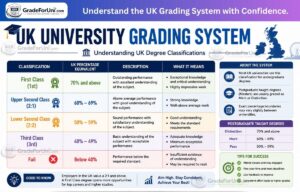
If your published result is not what you expected, work backwards through the stages rather than firing off an angry email. First, check the arithmetic yourself: module marks, credit weightings, year weightings. Our Final Grade Calculator and the 2:2-to-2:1 recovery guide walk through the standard algorithms — many “wrong” results turn out to be a misunderstood weighting.
Second, check whether the mark is still provisional. If the board has not met yet, a query to your department about a suspected marking or transcription error is reasonable — transcription errors are one of the few things that can be corrected at board stage (Newcastle, Edinburgh).
Third, once results are ratified, the board itself is no longer a route. Suspected marking errors go through the administrative-check / re-mark process (guide here); procedural errors — a regulation misapplied, an EC claim ignored, bias in the process — go through a formal academic appeal (guide here). Appeals cannot challenge academic judgement, which is why “my essay deserved 65 not 58” fails while “the board applied the wrong compensation rule” can succeed.
The unifying theme: the exam board is a machine for applying regulations fairly and anonymously, watched by an external examiner, recorded in minutes. It is not a court of personal appeal — and once you understand that, you also understand exactly which lever to pull when something really is wrong.
What is a university exam board?
A university exam board (formally a board of examiners) is the committee that makes the official decisions about your academic results. UCL’s Academic Manual describes it as the primary decision-making body for student progression, award and classification decisions. It is made up of your department’s academics, an external examiner from another university, and registry staff — and its decisions are recorded in confidential minutes.
Is a university exam board the same as AQA or Edexcel?
No. AQA, Edexcel and OCR are national awarding organisations that set and mark GCSE and A-level exams for millions of school pupils. A university exam board is an internal university committee that only considers that university’s own students. The names sound alike, but they are completely different bodies.
Can the exam board change my marks?
No. Boards apply the regulations to confirmed marks; they do not remark work or adjust marks. Newcastle’s rules state that once marks have been returned to the board they shall not be adjusted, except to correct transcription errors. If you believe a specific piece of work was mis-marked, you need the administrative-check or re-mark process, not the board.
Can the exam board raise my degree classification if I am borderline?
At many universities, yes — within strict rules. Manchester’s Classification Review lets the board raise a borderline classification (never lower it) using collective academic judgement, with the external examiner approving the rationale. UCL and others use profile-based tests, such as requiring a proportion of final-year credits at the higher boundary. At some universities (for example Cranfield for postgraduate awards) the board has no discretion at all. Always check your own regulations.
Do external examiners look at my individual work?
They review a sample of work to check marking standards, and they attend the board as full members whose views carry particular weight on classifications. But they do not re-mark individual students. At Manchester’s Classification Review, the external examiner approves the rationale for raising a class without looking at individual assessments at all.
Why do my results say provisional?
Because every mark is provisional until the exam board ratifies it. Sheffield Hallam’s assessment policy states that all marks and results are provisional until ratified by the appropriate assessment board. Your coursework marks are genuine, but they can still be moderated — and only the board’s decision makes them final.
Can I contact the exam board about my result?
No — boards do not accept direct representations from students, and their meetings are confidential. Personal circumstances must go through the extenuating circumstances process before the board meets. After results are published, suspected errors go through the re-mark process and procedural problems through a formal academic appeal.
When do university exam boards meet?
Most undergraduate boards meet in June or July to decide progression and final awards, with a second meeting in late August or September for resits and deferred assessments. UCL expects boards to meet about three times per annual cycle. Results are published after the minutes and pass list are checked and signed — at some universities, such as the Royal Veterinary College, the registrar’s signature date is the official date your degree is conferred.
Conclusion
The university exam board is the quiet engine room of your degree: anonymous marking, sampled by an external examiner from another university, decided by candidate number in a confidential meeting, minuted with reasons, and signed off before a single result becomes final. It explains the “provisional” label on your portal, the weeks of silence before results day, and the strange fact that a 69.72% can become a First in one university and stay a 2:1 in another.
The two things worth carrying away are simple. First, the board judges rather than calculates — by the time your case reaches it, the numbers are locked and only the regulations and the borderline rules are still in play. Second, the board is a machine for applying rules, not a court of personal appeal: marking disputes go to the re-mark process, circumstances go to the EC process, and procedural errors go to appeal. Aim your effort at the right lever, and model the numbers yourself before the meeting — once the board has ratified your marks, they are final.