
![You are currently viewing What Is a Good LNAT Score? UK Law Admissions Test Explained [2026]](https://gradeforuni.com/wp-content/uploads/2026/10/featured-lnat-score-uk.png)
What Is a Good LNAT Score? UK Law Admissions Test Explained [2026]
If you are applying for law at Oxford or Cambridge for 2027 entry, your clock is ticking: the LNAT testing window closes on 15 October 2026 — four days from now. Miss that date and there is no late sitting, no exception, and effectively no application. For everyone else on the LNAT list of nine universities, the deadlines stretch into winter and spring, but the question that matters is the same one asked in every applicant forum each autumn: what is a good LNAT score?
The honest answer is less straightforward than most prep companies admit. The LNAT does not publish pass marks, most universities refuse to name cut-offs, and the only number you ever see — a Section A score out of 42 — is read very differently by each of the nine LNAT universities. Oxford’s offer-holders cluster around 30–32 out of 42, while Oxford’s published statistics put the all-applicant average at 22.5. That ten-point gap is the whole game. This guide breaks down exactly what your score means, what each university’s published averages say about the realistic target, how the unscored essay really works, and the deadlines you must not miss — including the big change for this cycle: Cambridge has moved to the LNAT as its pre-interview admissions assessment for 2027 entry.
In this article you will find the 2026 score benchmarks for all nine LNAT universities, a worked target-setting example, the Section A vs Section B split explained, and a final-week checklist if you are sitting the test this week.
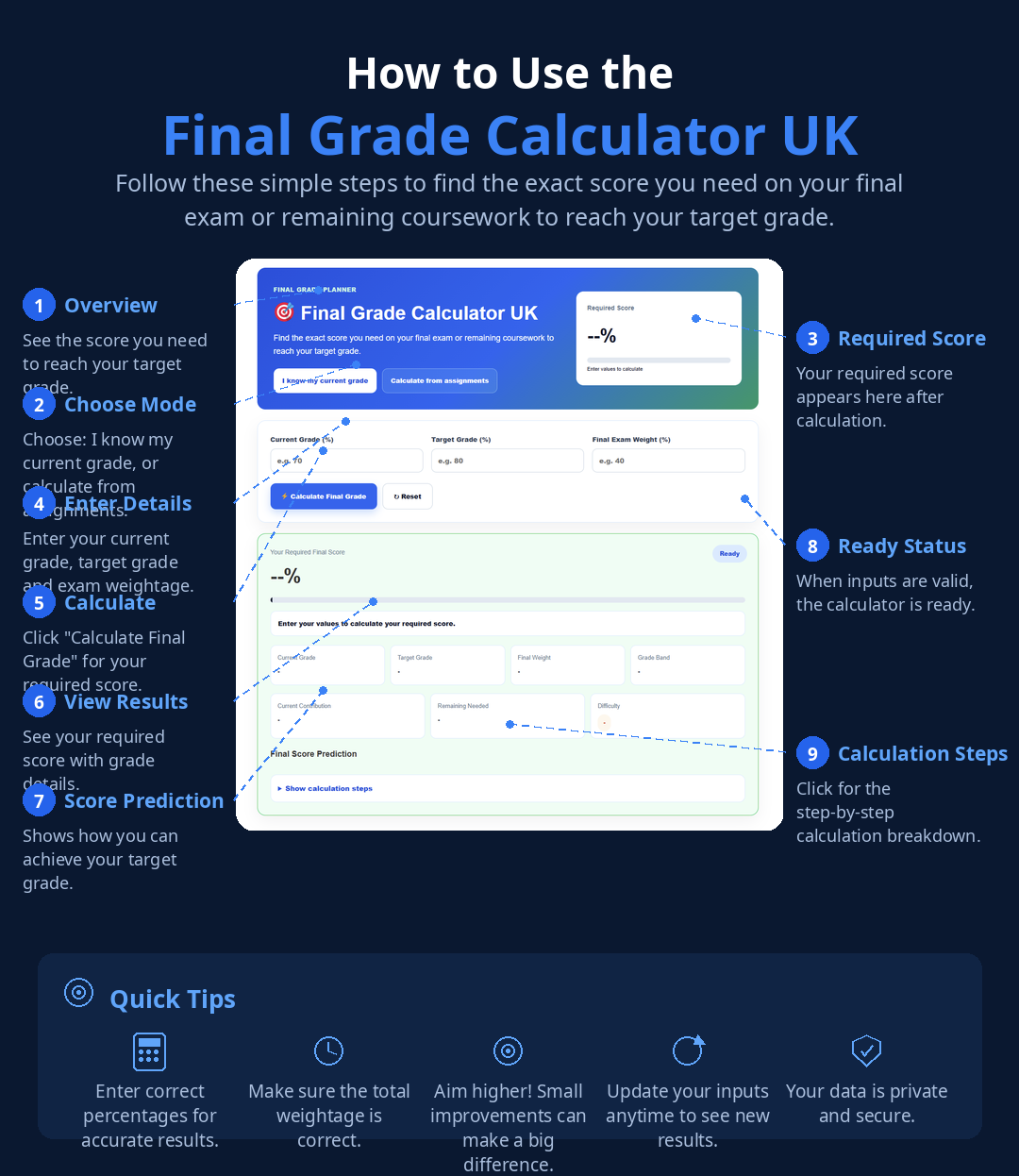
Click Here: Final Grade Calculator UK
How the LNAT Actually Works
The LNAT (Law National Aptitude Test) is not a law exam. It tests the skills that law degrees demand: reading closely, reasoning about arguments, and writing clearly under time pressure. It runs as a single two-hour-and-fifteen-minute sitting at a Pearson VUE test centre, and it has two sections with very different lives after the test:
| Section A | Section B | |
|---|---|---|
| What it is | 42 multiple-choice questions | One essay from a choice of three questions |
| Time | 95 minutes | 40 minutes |
| Scoring | 1 mark per question, no negative marking — your score is out of 42 | Not scored by LNAT at all — sent “as is” to your universities |
| Who sees it | Your universities receive the score; you may see it after them | Read and assessed by each university with its own criteria |
| Skill tested | Comprehension, interpretation, analysis, reasoning | Clear, structured written argument |
The most misunderstood fact about the test is right there in the table: the LNAT itself never scores your essay. Your essay is forwarded to each university you applied to, and each reads it their own way — some weight it heavily, some barely look at it, and one of the nine (LSE) states it does not consider it at all. More on that below, because it changes how you should divide your preparation time.
The Only Score That Counts: Section A Out of 42
When people talk about “a good LNAT score”, they mean one number: your Section A mark out of 42. There are no grades, no percentiles on your result, and no pass/fail. Each of the 42 questions carries one mark, and because there is no negative marking, a blank answer and a wrong answer cost you exactly the same: one unbanked mark. That makes the arithmetic of the test brutally simple:
- Every question you answer correctly adds 1 to a fixed 42-mark pot — there is no weighting, no scaling, and no grade boundary to game.
- Oxford’s published admissions statistics show all applicants averaging 22.5 out of 42 — just over half. If you are scoring in the low 20s in practice, you are roughly typical, not behind.
- Each additional correct answer is worth the same as any other: moving from 26 to 30 means 4 more correct answers out of 42, not a percentage jump to chase.
The practical consequence is that small improvements compound fast at the top end. Admissions guides report only about 2% of test-takers score above 34, which means the difference between a 28 and a 32 — four questions — can move you from “competitive” to “standout” at the most selective universities. We will put numbers on that in the benchmark table next.
What Is a Good LNAT Score? The 2026 Benchmarks by University
No university publishes an official minimum LNAT score, so every figure below is a typical/average figure — the scores that real offer-holders and shortlisted candidates have achieved in recent cycles — not a cut-off. Frame them as targets, not guarantees: universities stress that the LNAT is one component among predicted grades, personal statements, references, and (at Oxford and Cambridge) interviews.
| University | Typical / average Section A | How they use it |
|---|---|---|
| Oxford | Offer-holders ~30–32 (Oxford’s published admissions data: average ~30.96; shortlisted ~29.18) | Pre-interview shortlisting; one of several shortlisting factors |
| Cambridge (new for 2026) | No Cambridge-specific LNAT history yet — treat Oxford-level targets as the working benchmark | Replaces the old Cambridge Law Test; alongside interview and written work |
| UCL | Offer-holders about 29 (per UCL’s published FAQs) | Weighed alongside predicted grades and personal statement |
| LSE | Successful ~25–27; essay NOT considered | Section A only — the essay plays no part at LSE |
| KCL | Competitive in the high 20s | Part of holistic assessment with academics and statement |
| Durham | Competitive in the mid-to-high 20s | Balanced with predicted grades and context |
| Bristol | Competitive in the mid-to-high 20s; Bristol has previously published the LNAT as 40% of the overall application with the essay counting 40% of the LNAT component, though its current statement no longer restates the internal split | The essay matters here more than almost anywhere else |
| Glasgow | Competitive in the mid-20s | One factor among several |
| SOAS | Competitive in the low-to-mid 20s | One factor among several |
Read the table in tiers, not as nine separate targets. 28+ puts you in serious contention everywhere including Oxford and Cambridge; 25–27 is competitive for UCL, LSE, KCL, Durham and Bristol; 22–24 — around the all-applicant average — keeps Glasgow and SOAS live and leaves the door open elsewhere if the rest of your application is strong; below 20 is where the test starts actively working against you at the most selective universities. And remember the spread: the average applicant scores 22.5 in Oxford’s published admissions data, so a 28 is not “a bit above average” — it is roughly six questions, or about a sixth of the entire paper, above the typical performance.
Worked Example: Turning Practice Scores Into a Target
Take two applicants aiming at different universities. Both have done six timed practice papers and averaged a score — the only honest way to set a target.
Zara — Oxford applicant, practice average 27/42. The Oxford offer-holder average is about 31, so Zara needs roughly 4 more correct answers per paper. Over 42 questions, that is a 9.5 percentage-point improvement — meaningful but entirely realistic with two weeks of focused work on her weakest question types. Because there is no negative marking, Zara’s floor strategy is simple: on any question she cannot crack in 90 seconds, she picks her best guess and moves on — a guessed answer has a 1-in-4 chance of banking a mark, a blank has none. If those 4 questions come from the 8 she currently leaves hardest to last, her realistic ceiling this week is 29–30: shortlist-competitive, close to offer-holder average.
Tom — Durham and Bristol applicant, practice average 23/42. Tom sits just above the 22 average, which is already mid-20s-adjacent — the competitive band for both his universities. His target is narrower: +2 correct answers to sit at 25. That is 2 out of 42, or under 5 percentage points. But Tom’s bigger lever is the essay: Bristol has previously published the LNAT as 40% of the whole application with the essay counting 40% of the LNAT component (its current statement no longer restates the split). A strong 40-minute essay at Bristol is worth far more to Tom than two extra MCQs — which is exactly the kind of allocation maths most applicants never do.
The takeaway: convert your practice average into a gap (target minus average), then ask where the cheapest marks are. For Oxbridge applicants that is almost always Section A accuracy; for Bristol applicants, the essay can outweigh several multiple-choice questions.
The Essay: Unscored by LNAT, Decisive at Universities
Section B gives you 40 minutes to answer one of three essay questions. LNAT does not mark it — it is transmitted to your universities exactly as you wrote it, typos and all — and each university then does what it likes with it. That produces the most uneven part of the whole process:
- Bristol is the essay university. Bristol has previously published the LNAT as 40% of its overall assessment with the essay counting 40% of the LNAT component (its current statement no longer restates the split). A weak essay at Bristol therefore dents a significant share of your entire application — more than at any other LNAT university.
- LSE ignores it entirely. LSE states that it does not consider the essay; its assessment of your LNAT is Section A only. If LSE is your firm choice, every minute of essay practice is a minute taken from the 42 questions that actually count.
- Oxford and Cambridge read it as writing evidence. At Oxford it feeds into shortlisting alongside the multiple-choice score; at Cambridge it sits next to submitted written work and interview performance. Neither publishes how much weight it carries — treat it as a tiebreaker that rewards clarity, structure, and argument rather than legal knowledge.
- Everywhere else, assume it matters moderately. UCL, KCL, Durham, Glasgow and SOAS all receive the essay and none publishes a weighting. The safe assumption is that a strong essay helps and a sloppy one hurts — especially one with basic errors, since it is your only piece of timed writing they see.
The essay topics are deliberately non-legal — expect questions on current affairs, ethics, and general argument (“Should voting be compulsory?”, “Is privacy dead?”). No legal knowledge is required or expected; examiners are looking for a clear position, developed reasoning, and coherent structure in 500–600 words. Practise writing one complete essay in 40 minutes at least three times before test day: most candidates’ first timed essay runs 15 minutes over.
2027-Entry Deadlines: The Two-Track Calendar
The LNAT deadlines split the nine universities into two groups, and the split matters more than most applicants realise:
| Deadline | Universities | What it means |
|---|---|---|
| 15 October 2026 | Oxford, Cambridge | You must have sat the test by this date — same day as the UCAS early deadline (18:00 UK time) for Oxbridge, medicine, dentistry and veterinary courses |
| 31 December 2026 | UCL, KCL, LSE | Two and a half extra months — sit after your UCAS application is in |
| 13 January 2027 | Durham, Bristol | Aligned with the main UCAS equal-consideration deadline |
| 25 January 2027 | Glasgow, SOAS | The longest window of all nine |
Two things to note. First, registration closed on 15 September 2026 — if you registered, you can still choose a test date within your universities’ windows, but if you never registered, the Oxbridge track is already closed to you for this cycle. Always confirm the current dates on the official LNAT test-dates page before booking, as deadline tables can move between cycles. Second, the testing window itself opened on 1 September 2026, so January-deadline applicants can sit the test any time from now — there is no advantage in sitting early, and results are released to universities in batches (February and early August), so universities may see your score before you do.
Cambridge Is New for the 2026 Cycle — What Changes
The biggest structural change this year: from the 2026 admissions cycle, Cambridge requires law applicants to sit the LNAT as the pre-interview admissions assessment (admissions guides describe this as replacing the old Cambridge Law Test). For 2027 entry, Cambridge law applicants register for the LNAT by 15 September and sit it by 15 October, exactly like Oxford applicants.
What this means in practice:
- There is no Cambridge-specific LNAT track record — no published averages, no historical shortlisting data. The sensible working assumption is Oxford-level competitiveness: shortlisted candidates in the high 20s, offer-holders around 30–32.
- Cambridge still runs its own admissions machinery around the test — interviews, submitted written work, and the SAQ (Supplementary Application Questionnaire) all remain. The LNAT is an additional data point, not a replacement for any of them.
- If you prepared for the old Cambridge Law Test (a written exercise), redirect that preparation: the skills overlap heavily with LNAT Section B, so your essay practice transfers directly.
How Universities Actually Use Your LNAT Score
The score does not work the way most applicants imagine. It is not a threshold you clear and forget — it is a ranking input, and each university feeds it into a different machine:
- Screening for interview (Oxford, Cambridge): the score helps decide who gets interviewed. Oxford’s published data shows shortlisted candidates averaging about 29 — meaning a 27 with a stellar application can still make the cut, and a 33 with a weak one is not safe.
- Holistic scoring (UCL, KCL, Durham, Bristol, Glasgow, SOAS): the LNAT is one weighted component among predicted grades, personal statement, and reference. Bristol is the most explicit about this (40% of the application); the others publish no weights, which means a below-average LNAT can be offset — but only by something genuinely strong elsewhere.
- Score-only assessment (LSE): Section A alone, no essay. LSE’s successful-applicant band of roughly 25–27 is lower than Oxford’s, but remember LSE is reading only those 42 questions — there is no essay to soften a weak multiple-choice performance.
- Contextual consideration: several LNAT universities apply contextual flags (school performance, area, care experience) to admissions decisions. A contextual offer can shift the effective competitiveness of your whole application, LNAT included — check each university’s contextual admissions page rather than assuming.
One more structural fact: you can only sit the LNAT once per admissions cycle. There are no retakes within the cycle — your single sitting is the score every university on your UCAS form sees. That makes the “should I sit now or later” decision the highest-stakes call in the process: for January-deadline universities, sitting in November or December after more preparation is almost always better than rushing an October date.
Six Myths About LNAT Scores
| Myth | Reality |
|---|---|
| “There is a pass mark” | There is none. Universities compare your score against the applicant pool and their own typical offer-holder averages — it is relative, not absolute. |
| “The essay doesn’t matter” | It is unscored by LNAT, but every university except LSE receives and reads it. At Bristol, previously published figures put the essay at 40% of the LNAT component, which was 40% of the whole application (its current statement no longer restates the split). |
| “You need legal knowledge” | No law content is tested or expected. The essay rewards clear argument; legal references add nothing and can look forced. |
| “A 30 guarantees an offer” | About 2% of test-takers score above 34, and even they are rejected when the rest of the application is weak. Oxford shortlists — and rejects — high scorers every year. |
| “You can retake it this cycle” | You cannot. One sitting per admissions cycle; every LNAT university on your UCAS form sees the same score. |
| “Sitting early looks keen” | Universities do not know or care when you sat within the window. Sit when you are ready, not when registration opens. |

If You Are Sitting This Week: The Final Countdown
For Oxford and Cambridge applicants with the 15 October deadline four days away, this is not the time for new material. It is the time for arithmetic and logistics:
- Do two timed papers, no more. Your score is largely set; the goal is familiarity with the 95-minute rhythm, not new knowledge. Review every error for its question type, not its topic.
- Fix your guessing protocol. With no negative marking, an unanswered question is a wasted lottery ticket. Decide now: 90 seconds per question, then best guess and move on.
- Write one timed essay. 40 minutes, 500–600 words, no pausing. Most candidates discover their structure collapses under time — better to discover it in practice.
- Check your test centre logistics. Pearson VUE centres require photo ID; know your route, your reporting time, and what you are allowed to bring. A calm arrival is worth marks.
- Protect your sleep. The LNAT is a 95-minute concentration test followed by a 40-minute essay. Two short nights before the test cost more marks than any last-minute revision gains.
- January-deadline applicants: do not sit this week. If your universities are UCL, KCL, LSE, Durham, Bristol, Glasgow or SOAS, every extra week of preparation moves your single, unrepeatable score. Book November or December.
For the related admissions tests — TMUA, ESAT and TARA for other Oxbridge courses — see our Oxbridge admissions tests guide. If you are still weighing predicted grades and conditional offers, our predicted grades for UCAS guide and the Russell Group entry grades breakdown cover the rest of the application picture.
What is a good LNAT score for Oxford?
Oxford does not publish a minimum, but recent data shows offer-holders averaging around 30–32 out of 42 on Section A, with shortlisted candidates averaging about 29. Admissions guides report only around 2% of all test-takers score above 34. Treat 30+ as the competitive target, while remembering the LNAT is one shortlisting factor among several.
Is 25 a good LNAT score?
A 25 out of 42 is above the all-applicant average of about 22.5 reported in Oxford’s published statistics and sits in the competitive band for UCL, KCL, Durham, Bristol, Glasgow and SOAS — LSE’s successful-applicant band is roughly 25–27 on Section A. It is below the typical Oxford offer-holder average of 30–32, so for Oxbridge it is workable only alongside a very strong wider application.
Does the LNAT essay get marked?
No — LNAT itself does not score the Section B essay. It is sent exactly as written to each university you applied to, and each assesses it with its own criteria. LSE does not consider the essay at all; Bristol weights it as 40% of its LNAT component (which is 40% of the whole application); Oxford and Cambridge read it as evidence of clear written argument.
Can you retake the LNAT in the same year?
No. You may only sit the LNAT once per admissions cycle, and every LNAT university on your UCAS form sees the same score. This is why January-deadline applicants (UCL, KCL, LSE, Durham, Bristol, Glasgow, SOAS) should sit later in the window after proper preparation rather than rushing an early date.
Which universities require the LNAT for 2027 entry?
Nine UK universities: Oxford, Cambridge, UCL, King’s College London, LSE, Durham, Bristol, Glasgow and SOAS. Cambridge is new for the 2026 cycle, now requiring the LNAT as its pre-interview admissions assessment. Oxford and Cambridge require you to sit by 15 October 2026; UCL, KCL and LSE by 31 December 2026; Durham and Bristol by 13 January 2027; Glasgow and SOAS by 25 January 2027.
Is there negative marking on the LNAT?
No. Each of the 42 Section A multiple-choice questions carries one mark and wrong answers lose nothing, so you should answer every question — a guess has a one-in-four chance of banking a mark while a blank answer has none.
Do you need to study law for the LNAT?
No legal knowledge is tested or expected. Section A tests comprehension, interpretation and reasoning; the Section B essay rewards a clear position, developed argument and coherent structure on general topics. Legal references in the essay add nothing.
When do universities see my LNAT score?
LNAT releases results to universities in two batches — in February and in early August — which means universities may see your score before you do. There is no advantage to sitting early in the window; sit when you are best prepared within your universities’ deadlines.
Conclusion
A good LNAT score is not a number — it is a number for a specific university. Around 30–32 out of 42 makes you competitive at Oxford and (by extension, in its first LNAT year) Cambridge; 25–28 keeps every other LNAT university genuinely in play; Oxford’s published statistics put the all-applicant average at 22.5, so anything in the mid-20s is already meaningfully above typical performance. And the essay, unscored but widely read, is the part of the test most applicants under-prepare — except at LSE, where it does not count at all, and at Bristol, where it carries more weight than anywhere else.
If your deadline is 15 October, the strategy for this week is simple: two timed papers, one timed essay, a fixed guessing protocol, and an early night. If your deadline is December or January, the strategy is even simpler: do not sit yet. You get one sitting per cycle, and every extra week of preparation moves the only number that all nine universities will see. Set your target from the benchmarks above, close the gap question by question, and give the essay the share of your time your universities actually give it weight.
![Read more about the article Can You Retake a University Module to Improve Your Grade? UK Rules Explained [2026]](https://gradeforuni.com/wp-content/uploads/2026/10/featured-retake-module-improve-grade-300x192.png)

![Read more about the article Do UK Universities Drop Your Lowest Module Marks? Discounting Rules Explained [2026]](https://gradeforuni.com/wp-content/uploads/2026/10/featured-drop-lowest-marks-300x192.png)