
![You are currently viewing Is Your University’s Degree Algorithm Under Fire? OfS ‘Inherently Inflationary’ Ruling [2026]](https://gradeforuni.com/wp-content/uploads/2026/10/featured-ofs-degree-algorithm.png)
Is Your University’s Degree Algorithm Under Fire? OfS ‘Inherently Inflationary’ Ruling [2026]
In November 2025, the Office for Students (OfS) published a report with a deliberately dry title — “Bachelor’s degree classification algorithms” — and conclusions that have put a spotlight on how every English university turns your module marks into a degree class. After investigating three universities, the regulator found that two had breached one of its core conditions of registration, and it used some of the strongest language it has ever directed at assessment practice: certain ways of calculating degrees are, in its view, “inherently inflationary”. The ruling lands at a moment when the numbers themselves look striking: by 2023-24, more than one in four first degrees in England was a First.
The investigation focused on the hidden machinery most students never examine. Your final degree class is not simply your average mark. Most universities run your module marks through a multi-step degree algorithm — weighted averages, borderline rules, sometimes alternative calculation routes — and the rules inside that algorithm decide which of your marks count, and how much each is worth. The OfS has now put two specific features of those algorithms under formal fire: steps that discount students’ credit with the lowest marks, and steps that take the best result from a choice of multiple algorithms. Its verdict, quoted in full once below, is worth every student understanding word for word: “Our view is that such steps are inherently inflationary, and that providers should move away from the use both of steps that discount students’ credit with the lowest marks and of steps that take the best result from a choice of multiple algorithms.”
Here is what this ruling actually changes — and what it does not. No university is being asked to reclassify degrees already awarded; the OfS explicitly did not question or dispute any individual student’s classification. But two universities were found in breach of condition B4, which requires that the qualifications a university awards must be “credible”, and the regulator has introduced new reporting duties that are live now. This guide walks through the three verdicts, shows with real arithmetic exactly how discounting moves your marks, sets out the sector statistics behind the “one in three firsts” headlines, and gives you a practical checklist for finding out how your own university’s degree algorithm works. Note throughout: the OfS regulates universities in England only — Scotland, Wales and Northern Ireland have different regulators and their own rules.
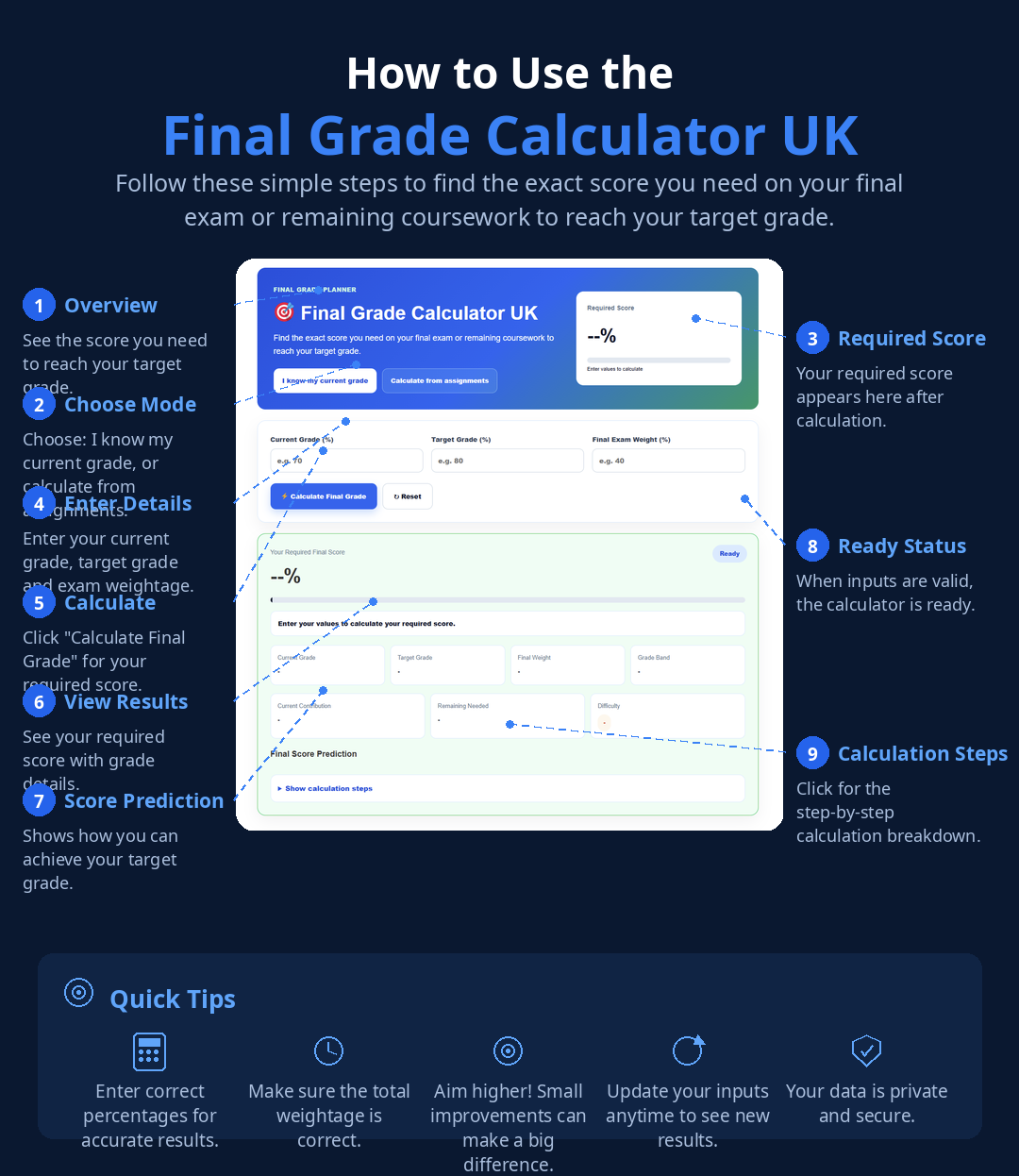
Click Here: Final Grade Calculator UK
What the OfS Actually Did: Three Universities, Three Verdicts
The report, published on 6 November 2025 and available as the OfS’s full investigation document, examined the degree classification algorithms of three providers. The legal hook was condition B4 of the OfS’s regulatory framework: every qualification a university awards must be “credible”. If the algorithm a university uses systematically lifts results beyond what students’ attainment justifies, the OfS’s position is that the credibility condition is not being met.
| Provider | OfS verdict | Key finding |
|---|---|---|
| St Mary’s University Twickenham | Breached condition B4 | Continued to use algorithm steps introduced after May 2022, when the new OfS regulations took effect; OfS modelling showed the new algorithm awarded 79.5% good degrees versus 74.8% under the old one |
| University of West London (UWL) | Breached condition B4 | Algorithm changes in 2015-16 — including discounting the lowest 20 credits — pushed good degrees to 85.3% versus 81.7% under the old regulations in an OfS sample of 856 students |
| Teesside University | Found at risk of breaching B4 | “Best grade” / multiple-algorithms approach; the observed 1.9 percentage-point rise in good degrees was not statistically significant; the university agreed to further checks |
Two points in the verdicts matter for how seriously to take them. First, the OfS took no further action against St Mary’s and UWL, because both universities had already changed their regulations before 2022 — that is, before the investigations opened. The breach findings relate to the period when the older rules were in force. Second, and equally important for any student reading this in alarm: at Teesside, the OfS did not question or dispute the classification awarded to any individual student. A Teesside spokesperson made that point explicitly when the reports landed, and nothing in the OfS’s publications says anyone’s degree is being revisited. If you are trying to understand how your own university’s marking is quality-assured generally, our guide to university marking and moderation in the UK explains the standard machinery.
The numbers the OfS modelled at St Mary’s are worth dwelling on, because they show how small rule changes compound. The university replaced a single classification algorithm with two algorithms, and the share of “good degrees” (Firsts and 2:1s combined) rose by 11.4 percentage points between 2015-16 and 2016-17. OfS modelling put the new algorithm’s good-degree share at 79.5% against 74.8% under the old one — a 4.7 point gap — and Firsts at 35.8% versus 28% under the old rules, a 7.8 point gap. The context: the university’s own strategy had targeted a 13% increase in “good degrees” to reach 73% by 2025. At UWL, the changes introduced in 2015-16 combined discounting the lowest 20 credits with changed mark weightings and more generous borderline rules, and the OfS’s representative sample of 856 students showed 85.3% good degrees against 81.7% under the old regulations.
The Two Degree Algorithm Features in the Crosshairs
For a student, the OfS’s objections to these degree algorithm features sound technical, so it helps to translate each one into what it does to your marks.
Discounting credit with the lowest marks. Many universities let you drop — or count at reduced weight — a set amount of your weakest credit when they calculate your final degree average. A common version is discounting the lowest 20 credits out of 120 in a year. In practice, this means your worst module can partly or wholly vanish from the calculation. The OfS’s objection is straightforward: if the algorithm systematically removes your weakest marks before it averages, the average it produces no longer represents your attainment across the full set of modules you studied. The more credit you can discount, the more inflated the result. For a full walkthrough of how this normally works at UK universities, see our guide to dropping your lowest module marks — and then read the worked example below to see the arithmetic with the discounting switched off and on.
Taking the best result from multiple algorithms. Some universities do not use a single degree algorithm at all. They run your marks through two (or more) different algorithms and award you the higher of the results. The OfS’s objection is a matter of pure logic: if you always pick the better of two outcomes, the expected outcome rises. A student whose marks land just under a boundary on the standard calculation gets a second bite, but a student whose marks land just under on both routes gets nothing — the system only ever moves classifications upward. Teesside’s “best grade” approach fell into this category, and the OfS concluded the university was at risk of breaching condition B4 over it.
How common are these features? The honest answer is that nobody knows precisely — and the OfS says so itself. Josh Fleming, the OfS’s head of strategy and delivery, told Times Higher Education in November 2025: “We cannot say how widespread these practices are, but we know it goes beyond the three providers in these reports.” The best older estimate comes from a 2020 Quality Assurance Agency (QAA) finding, reported by Scottish Legal News, that about a third of universities practised discounting, with a similar proportion using algorithms that could lead to grade inflation. So the practices are widespread enough to be common, but not universal — you cannot assume your university discounts marks just because others do.

Worked Example: How Discounting Moves the Number
Below is a Year 2 in the style of several English universities: 120 credits, a mix of module sizes, and a degree algorithm that discounts the lowest 20 credits. Watch what happens to the average when the discounting is applied.
The marks. A student has four result lines:
- 68 in a 15-credit module
- 63 in a 15-credit module
- 61 in a 30-credit module
- 67 in a 60-credit module
Plain weighted average — no discounting. Multiply each mark by its credits and divide by 120:
- 68 × 15 = 1,020
- 63 × 15 = 945
- 61 × 30 = 1,830
- 67 × 60 = 4,020
- Total: 1,020 + 945 + 1,830 + 4,020 = 7,815
- 7,815 ÷ 120 = 65.13%
Now with the lowest 20 credits discounted. The weakest result is the 61 in the 30-credit module, so 20 of those credits are dropped — the 61 now counts at only 10 credits, and the year is averaged over 100 credits:
- 68 × 15 = 1,020
- 63 × 15 = 945
- 61 × 10 = 610
- 67 × 60 = 4,020
- Total: 1,020 + 945 + 610 + 4,020 = 6,595
- 6,595 ÷ 100 = 65.95%
The discount lifts the student’s year average from 65.13% to 65.95% — an 0.82 percentage-point gain from a single rule. Both numbers are 2:1 territory, so no classification changes here, but two things are worth noticing. First, the gain is larger than it looks: near the 60% or 70% boundary, a similar lift is exactly what flips a classification. Second, the OfS’s objection applies even where no boundary is crossed — the published average no longer describes the student’s attainment across all 120 credits. When you model your own final-year requirements with our Final Grade Calculator UK, run the numbers both ways: with and without your university’s discounting rule, so you know how much of your predicted result the degree algorithm itself is supplying.
Worked Example: When One Rule Flips a Classification
This example is illustrative — a fictional but plausible final year — designed to show how a single discounting rule can change the degree class itself.
The marks. A final-year student takes four 30-credit modules and scores 66, 63, 58 and 52. The university’s degree algorithm discounts the worst 30 credits.
Plain average — no discounting. With all four modules counting equally:
- (66 + 63 + 58 + 52) ÷ 4 = 239 ÷ 4 = 59.75%
- 59.75% sits in the 50–59 band: a 2:2 (see the standard UK grade boundaries)
With the worst 30 credits discounted. The 52 disappears from the calculation:
- (66 + 63 + 58) ÷ 3 = 187 ÷ 3 = 62.33%
- 62.33% sits in the 60–69 band: a 2:1
The classification jumps a full band — from 2:2 to 2:1 — on the strength of one rule. This is the mechanism the OfS is objecting to: the student’s actual attainment across the four modules averaged 59.75%, but the algorithm presents 62.33%. Nothing about the student’s knowledge or skills changed between the two calculations; only the rules did. For many students, this is also the most practically important insight in the whole ruling: your degree class can depend less on your marks than on which marks your university’s degree algorithm chooses to count. If you do not know whether your university discounts credit, you do not fully know what your target marks are.
The Scale of the Problem: One in Three Firsts
The algorithm debate sits on top of a decade of headline statistics that the OfS itself publishes. The numbers below are the regulator’s own figures for first degrees awarded by English providers:
| Measure | 2010-11 | 2020-21 | 2023-24 |
|---|---|---|---|
| Firsts | 15.8% | 37.7% | 28.8% |
| Firsts + 2:1s (“good degrees”) | — | — | 77.2% |
The trajectory is unmistakable. Firsts more than doubled from 15.8% in 2010-11 to 37.7% in 2020-21 — the peak of the pandemic-era assessment years — before falling back to 28.8% in 2023-24. The combined good-degree share in 2023-24 was 77.2%, down from 77.6% in 2022-23 and 80.7% in 2021-22, a gentle recent decline. But the longer arc is stark: since 2010-11, the share of firsts plus 2:1s is up 9.7 percentage points, and Firsts alone are up around 13 percentage points. The OfS does not claim these trends are caused by algorithms alone — improved teaching, changing student profiles, and the pandemic years all play in — but its position is that inflationary algorithm features are one contributory factor regulators can actually act on.
The press has certainly noticed. The Times ran the story on 18 September 2026 under the headline “One in three graduates leave with a first-class degree”, reporting — attributed to the newspaper’s own analysis — that the Royal Northern College of Music has the highest share of Firsts of any provider at 55.4%. In the same coverage, Jean Arnold, the OfS’s director of quality and access, said students, employers and the public need confidence that degrees accurately reflect attainment, adding: “We will continue to carefully monitor this work.” (A useful summary of the coverage, including the OfS’s own framing of the findings, is available via Research Professional News.) If you want context on how these numbers compare with grading practice elsewhere, our piece on whether UK universities curve grades explains why British degrees work so differently from the US system.
New Rules, Live Now: What Universities Must Report
Perhaps the most consequential part of the November 2025 report is not the three verdicts but the new standing duties it introduced. The OfS set out — in paragraphs 59 to 63 of the report — new “reportable events” that apply to every provider with degree-awarding powers. These are not proposals; they are live now, and the OfS said it will confirm the events to the sector once they are formally introduced.
| Event providers must report | Detail | Timing |
|---|---|---|
| Algorithm change that raises good-degree share | Any change to a bachelor’s degree classification algorithm where the provider’s own modelling shows it will increase the proportion of Firsts and 2:1s awarded — always reportable, no exceptions | In force now |
| Algorithm containing the flagged features | Any algorithm that includes best-result-from-multiple-algorithms steps or discount-lowest-marks steps | From September 2026; reports were due by 31 July 2026 |
This is a significant shift in how the regulator watches assessment. Previously, an algorithm change that nudged results upward would only surface if the OfS went looking. Now, any university whose own modelling predicts more Firsts and 2:1s from a rule change has to tell the regulator — effectively forcing every provider to model the inflationary impact of its own algorithms before it introduces them. And the second event is a standing register: from September 2026, any provider still running one of the two flagged features has had to declare it. For students, the practical upshot is that the rules governing your degree class are about to become more visible, because universities will be thinking twice before keeping a rule that now has to be reported by name.
What This Means for You as a Current Student
Strip away the regulatory language and the ruling leaves current students with four concrete takeaways:
1. Your awarded degree is safe. The OfS did not question or dispute any individual student’s classification at any of the three providers, and it has not asked for any degree to be reclassified. The findings are about rules and future risk, not about taking marks away from people who already graduated.
2. The rules can still change going forward. Algorithms are not fixed. St Mary’s was found in breach over steps introduced after the regulations changed in May 2022; UWL’s breach dated to 2015-16 changes. Universities do revise their classification algorithms — and under the new reportable events, any change their own modelling predicts will raise good-degree shares must now be declared to the regulator.
3. You can — and should — find out how your university’s algorithm works. Most students never read their assessment regulations, but the worked examples above show why it matters: a discounting rule can be worth nearly a full percentage point, or in some cases a whole degree class. Work through this checklist:
| What to find | Where to look | What to check for |
|---|---|---|
| Degree outcomes statement | Your university’s website (search “degree outcomes statement” + university name) | The published explanation of how degree classifications are awarded and how they have changed over time |
| Assessment / academic regulations | Student handbook or registry pages | Any clause that discounts the lowest credits, drops the worst module, or runs multiple calculation routes and takes the best |
| Borderline and compensation rules | Same regulations document | How close to a boundary you must be for uplift, and whether compensation passes can rescue a failed module |
| UUK and UKSCQA principles | University statements of compliance | Whether your university has signed up to the sector’s agreed principles on protecting the value of qualifications |
| Your marks, both ways | Your transcript plus a calculator | Model your average with and without any discounting rule, so you know exactly what the algorithm is doing to your result |
4. Remember who regulates you. The OfS regulates universities in England only. If you study in Scotland, Wales or Northern Ireland, different regulators apply and this ruling does not directly cover your provider — though the same algorithm questions are live across the whole UK sector. Check your own regulator’s publications for the equivalent position.
The Calibration Exercise: What St Mary’s Must Do Now
The one forward-looking obligation to come out of the investigations falls on St Mary’s University Twickenham. As part of its agreed action with the OfS — set out in the university’s compliance document — St Mary’s must conduct a “calibration exercise” for its bachelor’s degree classification algorithm, or for any algorithm it intends to introduce from September 2026.
A calibration exercise, in the OfS’s definition, is a rigorous exercise using objective academic judgement to assess whether the class of degree awarded appropriately reflects the knowledge and skills attained — across the full range of attainment profiles. In plain terms: the university has to get real academics to look at real student profiles and judge whether the algorithm’s answer matches what the student actually achieved. As part of the exercise, St Mary’s must specifically reconsider whether it continues to discount credits with the lowest marks, and then report back to the OfS.
This is the template to watch. If the calibration exercise at St Mary’s concludes that discounting does not survive objective academic judgement, expect other English providers still running similar rules — the ones who had to report them by 31 July 2026 — to face the same question. For students at any English university, the message is that the era in which your worst marks could quietly disappear from your degree calculation is, at minimum, now under formal scrutiny from the regulator charged with keeping your qualification credible.
What is a degree algorithm?
A degree algorithm is the set of rules your university uses to turn your module marks into a final degree class (First, 2:1, 2:2 or Third). It usually starts with a weighted average of your marks, but most algorithms add extra steps: rules for students near a boundary, rules that discount your lowest-marked credit, or alternative calculation routes where you are given the better result. Which steps are included can change your classification, which is why the OfS investigated them in 2025.
Did the OfS say universities must stop discounting lowest marks?
Not quite an order, but close. The OfS said such steps are ‘inherently inflationary’ and that providers ‘should move away’ from both discounting students’ lowest-marked credit and awarding the best result from multiple algorithms. From September 2026, any English university still using either feature had to report it to the OfS as a reportable event, with reports due by 31 July 2026. The regulator will now be watching these rules by name.
Which universities were investigated by the OfS?
Three: St Mary’s University Twickenham and the University of West London were both found to have breached condition B4 (qualifications must be ‘credible’) by using algorithm steps introduced after the new regulations took effect in May 2022. Teesside University was found to be at risk of breaching B4 over its ‘best grade’ approach, and agreed to further checks. No further action was taken against St Mary’s and UWL because both had already changed their regulations before the investigations opened.
Will my degree classification be changed because of this ruling?
No. The OfS did not question or dispute the classification awarded to any individual student at any of the three investigated universities, and it has not asked for any degrees to be reclassified. The findings concern the rules universities use and the risk of future inflation, not retrospective changes to degrees already awarded.
How can I find out if my university discounts my lowest marks?
Read your university’s assessment or academic regulations — the section on degree classification — and look for clauses about discounting the lowest credits, dropping the worst module, or running more than one calculation and taking the best. Your university’s published degree outcomes statement should also explain how classifications are awarded. If the wording is unclear, ask your registry or student union advice service to confirm what your algorithm does.
Does this ruling apply to universities in Scotland, Wales and Northern Ireland?
No. The Office for Students regulates universities in England only, so condition B4 and the new reportable events apply to English providers. Scotland, Wales and Northern Ireland have different regulators with their own rules. The wider questions about degree algorithms are, however, a live debate across the whole UK higher education sector.
What is the ‘calibration exercise’ St Mary’s must carry out?
A calibration exercise is a rigorous review, using objective academic judgement, to check whether the degree class an algorithm produces actually reflects the knowledge and skills the student attained — tested across the full range of student profiles. St Mary’s agreed with the OfS to run one on its bachelor’s degree classification algorithm (or any replacement from September 2026), specifically reconsidering whether it keeps discounting credits with the lowest marks, and to report the outcome back to the OfS.
How much can a discounting rule change my degree result?
Enough to matter. In a worked example with a 120-credit year, discounting the lowest 20 credits lifted the average from 65.13% to 65.95% — an 0.82 percentage-point gain from one rule. And where a student sits near a boundary, the effect can be bigger: dropping a worst module can move an average from 59.75% (a 2:2) to 62.33% (a 2:1). Model your own marks with and without your university’s discounting rule to see exactly what it does to your result.
Conclusion
The OfS’s ruling on degree algorithms is that rare regulatory moment that genuinely matters to individual students. The headline verdict — two universities in breach, a third at risk, and two common algorithm features branded “inherently inflationary” — translates into something very personal: the degree class on your certificate may depend not only on your marks, but on the hidden rules your university’s degree algorithm applies to them. The worked examples above put numbers on that: a 0.82-point lift from one discounting rule, and a full classification flip from 2:2 to 2:1 in another plausible case. Those are not abstractions; they are the difference between the transcript you earn and the transcript you are awarded.
At the same time, the ruling is reassuring in the ways that count. Nobody’s degree is being revisited — the OfS explicitly did not dispute any individual classification — and the new reportable events mean universities must now model and declare any rule change that would push more Firsts and 2:1s. St Mary’s calibration exercise will be the first test of whether discounting survives objective academic judgement. What you can do now is simple and entirely within your control: read your own university’s assessment regulations, find out whether your marks are being discounted or run through more than one degree algorithm, and run your predicted results both ways so no rule works on your degree without your knowledge.
![Read more about the article Does Attendance Affect Your Grades at UK Universities? Monitoring Rules Explained [2026]](https://gradeforuni.com/wp-content/uploads/2026/10/featured-attendance-grades-uk-300x192.png)
![Read more about the article Academic Probation UK: What It Means at UK Universities [2026]](https://gradeforuni.com/wp-content/uploads/2026/10/featured-academic-probation-uk-300x192.png)