Resitting GCSE English & Maths in November 2026: Dates, Costs & What Universities Require
The first GCSE November resits of 2026 start in three weeks — on Tuesday 3 November, tens of thousands of students will sit down for the November GCSE series. If you missed the grade you needed in English Language or maths this summer, this is your earliest chance to fix it, and for many college students the autumn sitting is the default next step their tutor has already pencilled in.
But the November series is not a repeat of the summer exams. It carries only two subjects, it is open only to students who are at least 16, and the entry deadline has already passed — which changes the meaning of every question about cost and eligibility below. The published exam timetables also reveal a detail students keep getting wrong: your board’s paper dates are not identical across subjects, and English Language is a different paper on each of its two days.
This guide covers the November 2026 resit dates for every major board, who is allowed to enter the series, exactly how much it costs (and when it is free), what a grade 4 means versus a grade 5 for university entry, and the tier-choice arithmetic that decides whether Foundation or Higher is the right paper for you. No revision tips — just the dates, rules and numbers.
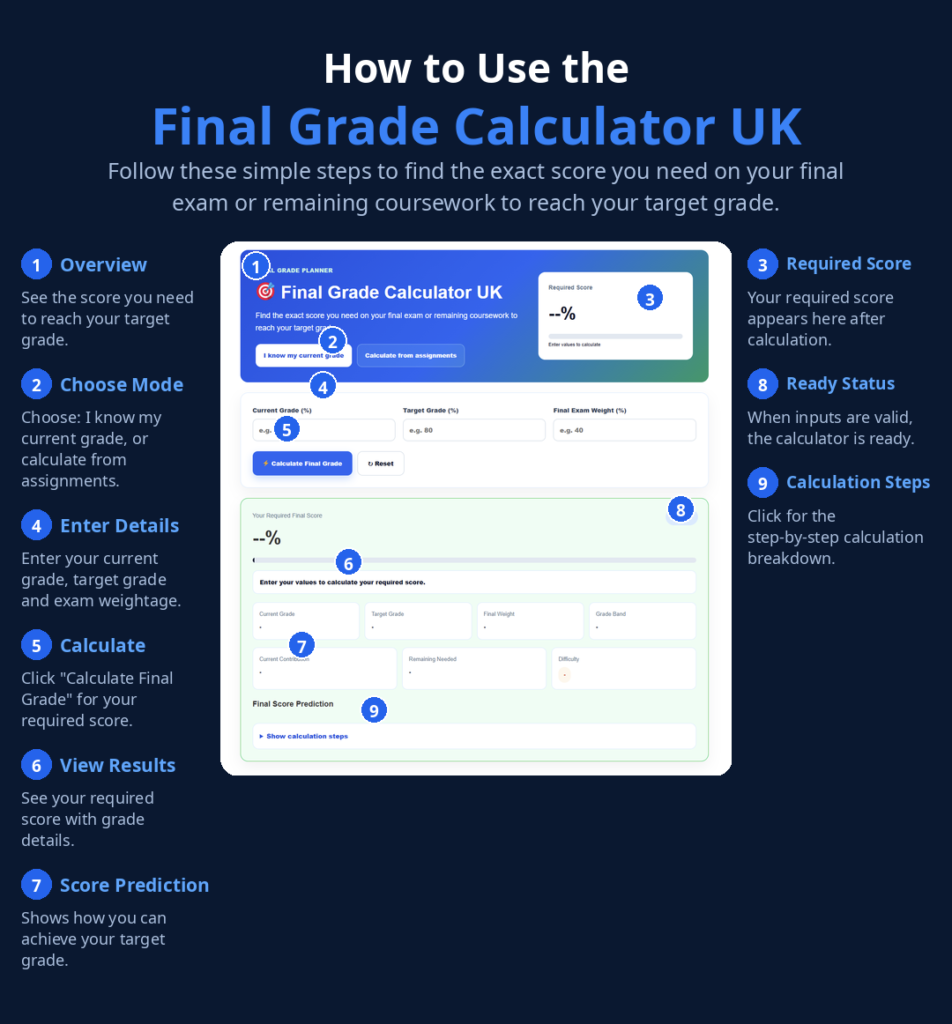
Click Here: Final Grade Calculator UK
What the November series actually is
Every November, the exam boards run an autumn GCSE series — and it is a deliberately narrow one. The only subjects on offer are GCSE English Language and GCSE Mathematics (plus Welsh language papers in Wales). Every other subject — sciences, humanities, English Literature, the lot — has no November sitting at all and has to wait for the summer 2027 series.
The reason the autumn window exists is policy, not tradition. Under England’s 16-to-19 condition of funding, any student without a grade 4 in English or maths must keep studying that subject alongside whatever they do next. The November series is the pressure valve the government built for exactly those students: a quick, cheap, targeted second chance instead of making everyone wait eight months for summer. It is why colleges treat the November resit as routine — tens of thousands of students sit it every year, and there is nothing remedial or shameful about being in that cohort.
One myth to clear up first: your school is not legally forced to enter you in November, and you are not legally forced to sit it. The Department for Education’s rule is that you must continue studying English or maths if you do not hold a grade 4 — the government is explicit that this is not the same as being required to sit an exam in any particular series. Your institution decides when you are ready to be entered. In practice, colleges enter most of their grade-3 students in November because an early second attempt beats a delayed one, but a student who is clearly not ready can be held back for summer.
The November 2026 exam dates
The common GCSE timetable window runs from 2 November to 11 November 2026, but your actual papers fall in a much tighter cluster. Here are the confirmed dates from the published timetables — always confirm your own sitting on your entry slip, because centres can vary morning start times.
| Date | Subject and paper | Duration |
|---|---|---|
| Tuesday 3 November 2026 | English Language Paper 1 — Explorations in creative reading and writing (AQA 8700/1; Edexcel 1EN0/01; OCR papers equivalent) | 1h 45m |
| Wednesday 4 November 2026 | Mathematics Paper 1 — non-calculator (AQA 8300/1F+1H; Edexcel 1MA1/1F+1H) | 1h 30m |
| Thursday 5 November 2026 | English Language Paper 2 — Writers’ viewpoints and perspectives (AQA 8700/2; Edexcel 1EN0/02) | 1h 45m (Edexcel 2h 05m) |
| Friday 6 November 2026 | Mathematics Paper 2 — calculator (AQA 8300/2F+2H; Edexcel 1MA1/2F+2H) | 1h 30m |
| Monday 9 November 2026 | Mathematics Paper 3 — calculator (AQA 8300/3F+3H; Edexcel 1MA1/3F+3H) | 1h 30m |
Three things to notice in that table. First, the whole series is over in five exam days spread across seven calendar days — English students sit just two papers, maths students three, and none of them overlap if you are doing both subjects. Second, the Edexcel English Language second paper runs longer (2 hours 5 minutes) than AQA’s (1 hour 45 minutes) — the two boards do not mirror each other’s specifications, so learn your own board’s format. Third, the maths papers are split non-calculator/calculator/calculator in that exact order every November; there is no surprise paper waiting on the 9th.
Results are released to candidates on 14 January 2027 — a full 66 days after the final maths paper on 9 November (21 remaining days of November, 31 in December, 14 in January). That wait is long enough to matter for planning: if your January result decides a college course change or an apprenticeship application, line up the paperwork before Christmas rather than chasing it in mid-January. Your school or centre sets its own collection time and method, so confirm how you will receive the result — it is not automatically emailed.
Who can enter the November series — the 31 August rule
Entry to the autumn series is restricted. The hard rule: you must be aged 16 or over on 31 August 2026. A Year 11 student who has just finished school and is moving into sixth form or college qualifies; a Year 11 student still at school in September does not sit November papers through this route, because the autumn series is designed for post-16 students, not for pupils still in compulsory schooling.
There are three ways in. Most students are entered by their school or college — if you are continuing into sixth form, further education college or an apprenticeship provider, your exams officer handles the entry. Private candidates — adults returning to education, home-educated students, anyone studying independently — must go through an approved exam centre that accepts private entries; a tutor cannot enter you, and you cannot enter yourself directly with a board. And there is the third category: students in Wales, where the Welsh and Cymraeg papers join English and maths in the autumn window under WJEC’s own timetable.
The entry deadline was 4 October 2026, and this is where students keep getting caught out. 4 October is the date the exam board must receive your entry — not the date you decide you want to sit. Schools and colleges set their own internal cut-offs, almost always in mid-to-late September, and several London private centres had closed standard entries by late September with late fees from 27 September. If you are reading this after the deadline, a late entry may still be possible through your centre — but the fee structure makes it an expensive afterthought, as the next section shows.
How much GCSE November resits cost
For students enrolled at a school or college, the answer is simple: nothing. Resit entries are part of your funded programme, and your institution pays the board fee on your behalf. The November resit is designed to be free for exactly the students who need it most — the 16-to-19 learners the funding condition applies to.
Private candidates pay. The board’s entry fee is roughly £45 to £65 per subject for most boards, and the exam centre adds its own admin fee on top — the centre’s surcharge, not the board’s, is usually the bigger number on the invoice. So a private candidate resitting both English and maths is looking at roughly £110 in board fees alone, plus whatever the centre charges for the room, the invigilator and the paperwork.
Now the late-entry arithmetic, which is where the numbers turn ugly. AQA’s published fee schedule charges a late entry fee of 100% of the standard fee for entries submitted on or after 5 October, and a very late entry fee of 150% on top for entries after 25 October. Worked through: a £55 English Language entry submitted on 10 October costs £110; submitted on 26 October it costs £137.50 — before the centre’s own admin fee. The lesson is not just “enter early” but “know your centre’s deadline, not the board’s,” because every centre’s internal cut-off arrives first and each adds its own surcharge on top of the board’s.
Grade 4 vs grade 5: what universities actually require
Grade 4 is the line that matters for most purposes. Officially called a “standard pass,” it is the modern equivalent of the old C grade, and it is the threshold written into the 16-to-19 funding condition, most college course entries, and most university offers that mention GCSEs at all. Grade 5, the “strong pass” (roughly a high C / low B in old money), is required by a smaller number of competitive courses and professional pathways.
This is not abstract. University of Surrey’s Nursing Studies BSc requires GCSE English Language and Mathematics at grade 4, accepting a Functional Skills pass as an alternative — the grade 4 is a hard entry gate for the course, not a preference. Birmingham City University’s Adult Nursing course phrases it as “Maths and English language GCSE qualifications need to have been achieved at grade C/4 or above,” with the same Functional Skills level 2 alternative. Nursing, midwifery, teaching and social work are the degree families where a missing grade 4 is most likely to block an application outright, because professional bodies behind those courses treat literacy and numeracy as patient-safety and classroom-safety prerequisites.
One caution: never trust a general claim that “every university course needs grade 4.” Many university offers never mention GCSEs beyond “acceptable passes,” and some courses accept equivalents without saying so upfront. The verified move is to open the actual entry-requirements tab of the courses you want — the Surrey and Birmingham City examples above come from their published course pages, and yours should too. If your target course lists a grade-4 requirement and you are sitting on a grade 3, the November series is precisely the tool the system built for you.
Foundation vs Higher tier: the arithmetic of the choice
GCSE maths comes in two tiers, and the choice between them is the single biggest strategic decision of a November resit. Foundation tier papers offer grades 5 down to 1 — grade 5 is the absolute ceiling, and no Foundation candidate can earn a 6, no matter how many marks they score. Higher tier offers grades 9 down to 4, with a safety-net grade 3 for candidates who fall just short of the 4 boundary.
Here is the worked arithmetic that makes the choice concrete. AQA’s maths qualification is marked out of 240 — three papers of 80 marks each. On Foundation, all 240 marks map onto grades 1–5; on Higher, the same 240 marks map onto grades 9–4. So a Foundation paper is, in effect, an easier paper where the top half of the ability range is compressed out: the highest-achieving Foundation candidates all cluster at grade 5, because there is nowhere higher to go. A Higher paper is harder per mark, but its grade scale has room at the top.
The decision framework colleges use is therefore simple. If your June result was a grade 2 or a low grade 3 and your target is a grade 4, Foundation is the rational November choice: the paper is pitched at exactly your range, and a grade 5 remains available as an upside. If your June result was a secure grade 4 or 5 and your target is a 6 or above — for a competitive course or a subject with a grade-6 gate — only Higher can take you there, because Foundation physically cannot award it. The dangerous middle is the student who sat Higher in June, scraped a grade 3 safety net, and is talked into Higher again for November “because it looks better” — a Higher paper where you cannot reliably reach the 4 boundary turns into a gamble that Foundation would have avoided.
For English Language there is no tier choice — everyone sits the same two papers — so the equivalent strategic decision is between resitting the full GCSE and taking Functional Skills Level 2, which colleges and universities accept as an alternative for most purposes (the Surrey and Birmingham City nursing pages both name it explicitly). Functional Skills suits students whose target is a pass for employment or a non-competitive course; the full GCSE suits anyone targeting a university course that names the GCSE specifically.
Do universities care that you resat a GCSE?
Short answer: far less than students fear. GCSE resits do not appear on UCAS in the way A-level resits do — there is no “resit” flag attached to the qualification, and admissions teams see only the grade you hold at the point of application. The question universities actually ask is “do you meet the stated requirement,” not “how many attempts did it take.”
Where timing does matter is competitive courses with fixed decision windows. A nursing applicant sitting the November resit will have their result on 14 January 2027 — after the January UCAS deadline for most courses. That means the application goes in with the GCSE listed as pending or with the previous grade declared, and the university is told the resit is in progress. Most admissions teams handle this routinely; what they cannot do is hold a place open for a qualification requirement you ultimately miss. If your course needs the grade 4 by enrolment, a November result that arrives in January is early enough for a September start — but a failed November that forces a summer resit is not, which is why the November attempt carries real weight for 2027 entry.
One honest caveat: a tiny number of the most competitive courses — medicine being the usual example — state preferences about first-sitting GCSE grades in their published admissions policies. If that applies to you, it will be written on the medical school’s own page, not whispered on forums. For everything else, the grade is the grade.
If November does not go to plan: the next window
Missing the November series — or missing the grade in November — is not the end of the road. The summer 2027 series opens to every subject, including English Language and maths, with the first exams in mid-May and results on 20 August 2027. That is the full resit safety net, and it is available to every student regardless of what happened in autumn.
The trade-off is time. A November resit resolved in mid-January leaves the whole spring and summer of 2027 free for whatever comes next — A-levels, an apprenticeship application, a college course. A summer resit pushes the resolution to late August, which collides with results day, Clearing and every September start date. If you are applying to university for 2027 entry and you need that grade 4, November is not just earlier — it is the only sitting that leaves you a contingency.
And if you missed the 4 October entry deadline entirely? Talk to your centre now about a late entry before the very-late surcharge kicks in after 25 October — and if even that is past, ask your college what it plans for your summer entry, because the institution, not the calendar, decides when you are ready. For more on how grades feed into university applications, see our guides to predicted grades and UCAS and what to do if you miss a UCAS deadline; for the grade requirements landscape across institutions, our lowest-entry-requirements guide is a useful companion, and degree apprenticeship grading covers the alternative route where GCSE passes unlock employer-funded degrees.

When are the GCSE November 2026 resits?
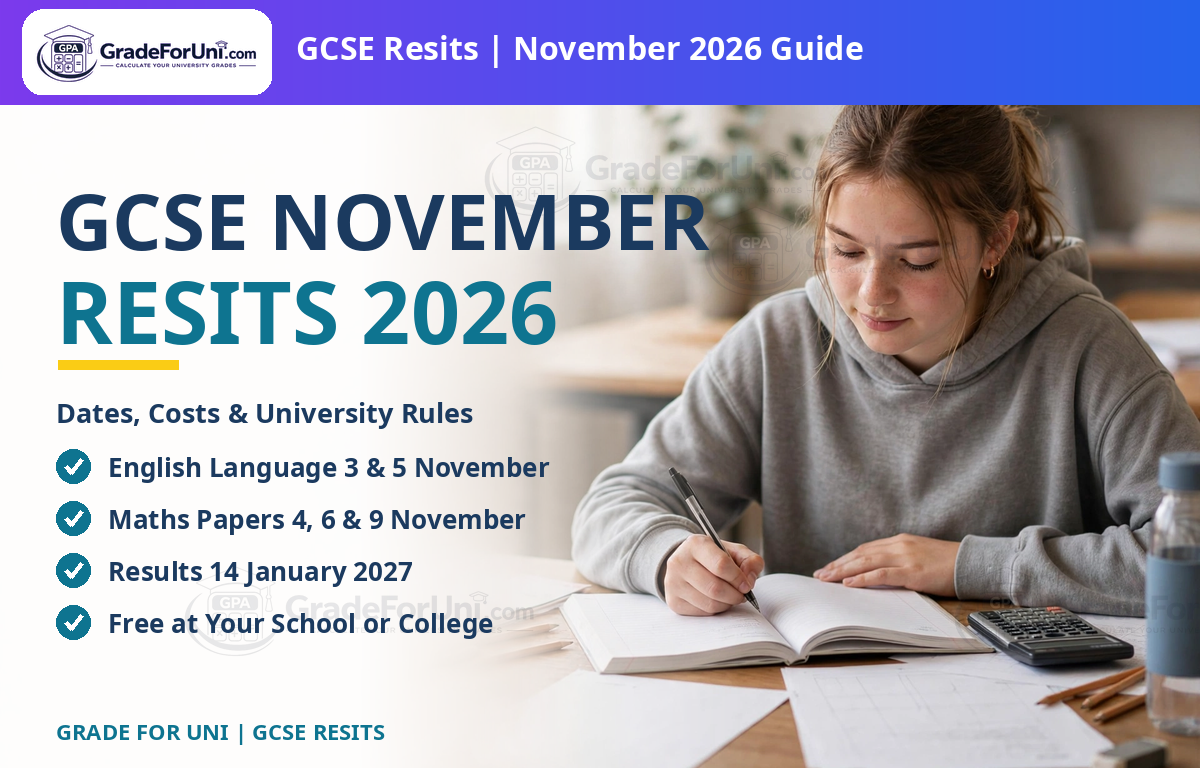
English Language papers are on Tuesday 3 November and Thursday 5 November 2026; maths papers are on Wednesday 4, Friday 6 and Monday 9 November 2026. Morning sessions. Results are released to candidates on 14 January 2027.
Which subjects can you resit in November 2026?
Only GCSE English Language and GCSE Mathematics (plus Welsh language papers in Wales). Every other subject, including English Literature and the sciences, has no November sitting and must wait for summer 2027.
Who is allowed to sit GCSE resits in November?
You must be aged 16 or over on 31 August 2026. Most students are entered by their school or college; private candidates must go through an approved exam centre that accepts private entries.
Are GCSE November resits free?
Yes, for students enrolled at a school or college — resit entries are part of the funded programme. Private candidates pay the board’s entry fee of roughly £45 to £65 per subject plus the exam centre’s admin fee.
Was the entry deadline 4 October 2026?
Yes — 4 October 2026 was the date exam boards had to receive entries. Most schools and colleges set earlier internal cut-offs in September. Late entries attract a 100% fee surcharge from 5 October and a 150% surcharge after 25 October (AQA schedule).
What is the difference between grade 4 and grade 5 at GCSE?
Grade 4 is the standard pass (equivalent to the old C) and is the threshold for the 16-to-19 funding condition and most university course requirements. Grade 5 is the strong pass (roughly a high C / low B), required by some competitive courses.
Should I take Foundation or Higher tier for a maths resit?
Foundation papers award grades 5 to 1; Higher awards grades 9 to 4 with a safety-net grade 3. If your target is a grade 4 or 5, Foundation is the rational choice; only Higher can award grade 6 or above. There is no tier choice for English Language.
Do universities know you resat a GCSE?
GCSE resits carry no resit flag on UCAS — universities see the grade you hold, not the number of attempts. What matters is meeting the stated requirement, ideally in time for your application’s decision and enrolment windows.
Conclusion
The November 2026 series is a narrow, fast tool: English Language and maths only, five exam days from 3 to 9 November, free at your college, with results on 14 January 2027. Its value is timing — a grade 4 banked in January leaves every 2027 option open, while a summer resit leaves none. The decisions that matter are the tier choice in maths, the entry status of private candidates, and — for anyone eyeing nursing, teaching or social work — the grade-4 gate on real university course pages.
If you are entered, the countdown is 21 days: check your entry slip against the board timetable, confirm which tier of maths you are on, and talk to your exams officer about anything that looks wrong. If you missed the 4 October deadline, find out today whether your centre will still process a late entry before the very-late surcharge lands. And if November does not deliver the grade, the summer 2027 series is the full safety net — but plan for it now, not in January. You can check the marks you need across your papers with our Final Grade Calculator.