What Happens After You Submit Your UCAS Application? Next Steps for 2027 Entry [2026]
The equal-consideration deadline closed at 18:00 UK time today, and if you are reading this with a racing pulse, you are not alone. Submitting a UCAS application to Oxford, Cambridge, or a medicine, dentistry or veterinary course ends months of personal statements, admissions tests and reference chasing with a sudden, hollow silence. The panic in the waiting window is real — and almost always unnecessary.
Here is the reassuring truth: what happens after UCAS is not random. The weeks between the 15 October deadline and the December interviews run on a published timetable of hard deadlines — an extra Cambridge form, written-work submissions, test results, shortlisting — each announced months in advance. Miss one and your application genuinely stalls; hit all of them and you have done everything a serious applicant can do.
This guide covers the official post-submit timeline, what Cambridge’s My Cambridge Application collects, which courses ask for written work (and when), when test results land, how shortlisting works, how to read your UCAS Hub statuses, and when the January decisions arrive. Every date below was re-verified against the universities’ own admissions pages on the day this article was written.
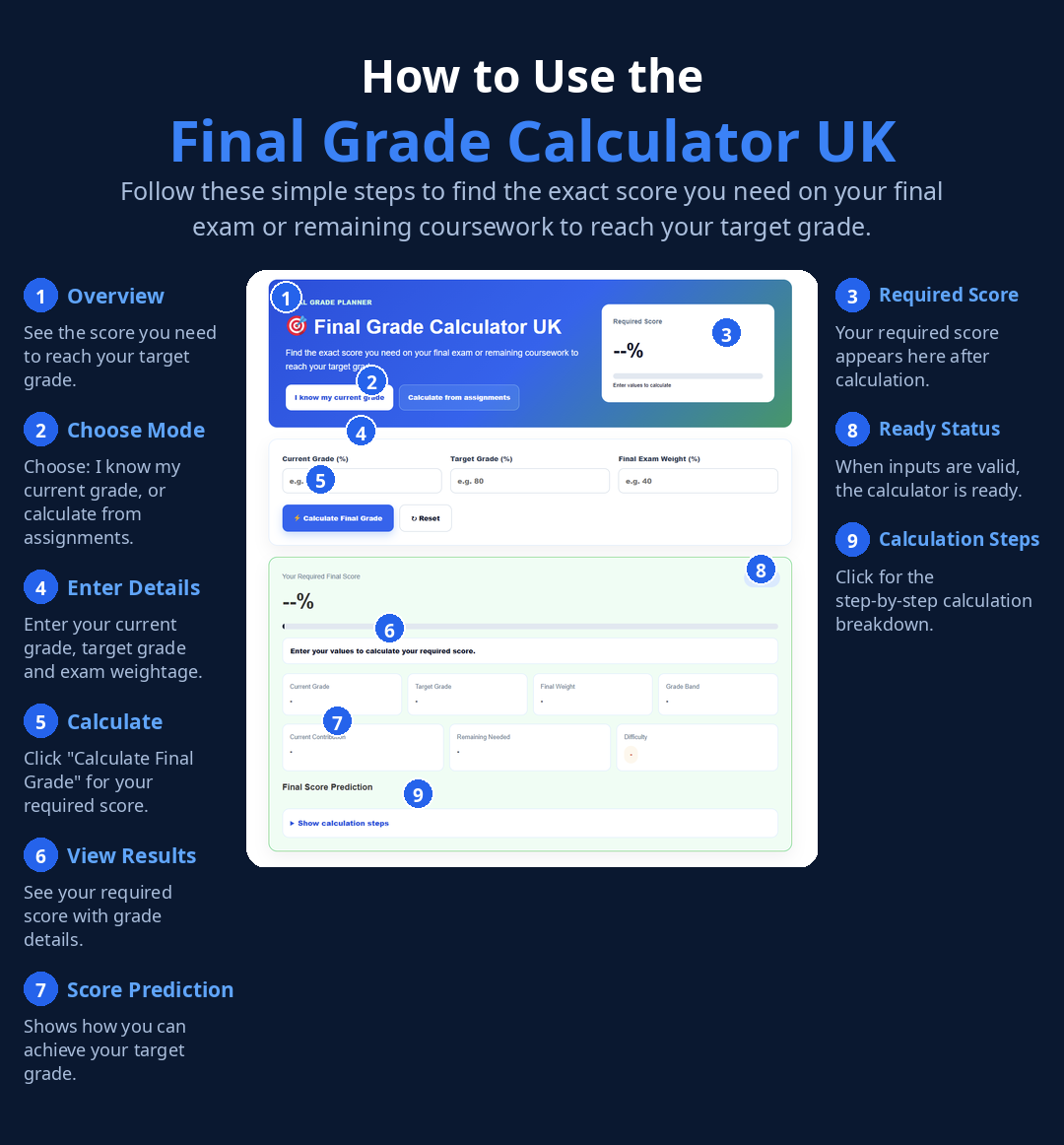
Click Here: Final Grade Calculator UK
 Your Post-Submit Timeline: 15 October to August 2027
Submitting your UCAS form was the starting gun, not the finish line. Below is the complete post-submit timeline, built from Cambridge’s official application dates page and Oxford’s applicant guide, both checked this week.
| Date | What happens | Who it applies to |
|---|---|---|
| 15 October 2026, 6pm UK | UCAS equal-consideration deadline for Oxford, Cambridge and most medicine, dentistry and veterinary courses | Everyone in this article |
| 22 October 2026, 6pm UK | My Cambridge Application and transcript submission deadline | Cambridge applicants (except Graduate Medicine) |
| 4–5 November 2026 | Written-work deadlines at Cambridge colleges (each college sets its own — e.g. 4 Nov at St Catharine’s, 5 Nov at Sidney Sussex) | Cambridge applicants whose course requires it |
| 10 November 2026 | Written-work submission deadline at Oxford | Oxford applicants whose course requires it |
| 16 November 2026 | UAT-UK test results released via your test account (ESAT, TMUA, TARA) | Applicants who sat admissions tests |
| 18–20 November 2026 | Cambridge college-registered at-interview assessments (registered automatically if you are invited to interview) | Shortlisted Cambridge applicants in relevant subjects |
| Late November – early December | Interview invitations sent out | Shortlisted Oxford and Cambridge applicants |
| First 3 weeks of December | Interviews take place | Shortlisted applicants |
| 12 January 2027 | Oxford decisions released via UCAS | Oxford applicants |
| 27 January 2027 | Cambridge decisions released | Cambridge applicants |
| May–June 2027 | A levels, IB and other examinations | Everyone with exam conditions |
| August 2027 | Results day; universities confirm final decisions on conditional offers | Everyone |
Keep this table open in a browser tab. Notice the pattern: deadlines cluster in the three weeks after submission, then a genuine quiet period while tutors read and score applications, then the pace picks up again from mid-November. Understanding that rhythm is what separates calm applicants from panicked ones.
First on Your List: My Cambridge Application (Cambridge Only)
If you applied to Cambridge, one email arrives within 48 hours of your UCAS submission: a personal link to My Cambridge Application, the additional form every Cambridge undergraduate applicant must complete (Graduate Medicine applicants get a separate emailed form instead).
The deadline is 22 October 2026 at 6pm UK time — exactly one week after the UCAS deadline. The form takes about an hour, answers save automatically, and you can return to it any time before the deadline. Because it is personalised, you will only see the questions relevant to your application, but the university’s own guidance says you may need:
- Your transcript — a certified record of your academic achievements, due the same 22 October deadline. Cambridge will not download or review any extra documents you uploaded to UCAS; everything required goes through this form or your college.
- Details of topics you studied at school, if you left school this year or last year — interviewers may ask you to discuss them.
- English language test scores and dates (e.g. IELTS), and SAT scores only where they are required qualifications (e.g. US applicants). If you already hold A levels or the IB, you do not need to declare the SAT.
- Funding details, if you are an international student, and a £60 application fee if you are applying from outside the UK, Ireland, the Channel Islands or the Isle of Man.
One feature catches applicants out every year: the optional Cambridge-specific personal statement. You get 1,200 characters — far shorter than the UCAS statement — and the university recommends it only when your Cambridge course is significantly different from your other UCAS choices. Never repeat your UCAS statement, and never use it to explain your college choice. If your other choices are all in the same subject, leave it blank.
What happens if you miss the 22 October deadline? Use the official wording, because it matters: Cambridge’s dates page says applicants “will need to meet all relevant deadlines for your application to be considered”, and Sidney Sussex College states that “we will not be able to accept any late applications” for My Cambridge Application. If the 48-hour email has not arrived, check spam for applicationhelp@ug.admin.cam.ac.uk and no-reply@apply.undergraduate.study.cam.ac.uk — then contact the university rather than waiting.
Written Work: The Essays You’ve Already Written
Written work is the part of what happens after UCAS that applicants overthink the most. The good news: nobody is asking you to write anything new. Both universities want writing you already produced as part of your normal school work, ideally marked by a teacher. Tutors read it to assess your academic writing — structure, evidence, analysis — not to grade it like an exam.
At Oxford, the deadline is 10 November, and not every course asks for it — check your course page first. The rules are consistent: the work must be your own and original, written in English, produced during your school studies, and sent to your college with a completed cover sheet for each sample. Keep a copy: shortlisted applicants often find their written work becomes the starting point for discussion at interview. (Fine Art portfolios are the one exception, with an earlier deadline.)
At Cambridge, there is no single university-wide deadline — each college sets its own, which is where applicants get caught. St Catharine’s sets 4 November 2026; Sidney Sussex sets 5 November 2026, 6pm UK time. Your college contacts you directly with instructions and an online upload link. The subjects that typically ask for written work include Anglo-Saxon, Norse and Celtic, Archaeology, Classics, Education, English, History, History and Modern Languages, History and Politics, Human, Social and Political Sciences, Land Economy, Modern and Medieval Languages, Music, Psychological and Behavioural Sciences, and Theology, Religion and Philosophy of Religion — most asking for two pieces, a few (like Archaeology) for one. Engineering, Computer Science, Economics and Geography ask for none.
On length: there is no universal word count, and you should not invent one. Colleges describe expectations differently — one asks for essays not normally longer than 2,500 words, another usually receives pieces of 1,000–3,000 words, and individual subjects may cap a piece at 1,500 words. Submit your strongest recent marked essays as they are, and follow your own college’s guidance to the letter. One firm rule from Cambridge colleges: the work must be original and must not have been rewritten or corrected for your application.
If you have no suitable piece, both universities say the same thing: contact your college and ask. For the course-by-course breakdown of test and written-work requirements, see our Oxbridge admissions tests guide.
Admissions Test Results: 16 November
If you sat one of the new UAT-UK admissions tests — the ESAT, TMUA or TARA — your results arrive on 16 November 2026, released through your UAT-UK test account. The tests ran between 12 and 16 October, so by the time you read this they are behind you.
A few facts worth knowing while you wait. UAT-UK is a collaboration between Imperial College London and the University of Cambridge, and Oxford uses its tests alongside the existing UCAT and LNAT — so ESAT, TMUA and TARA scores can now be compared directly across the universities that use them. The universities receive the results automatically; there is nothing to forward. And Oxford states that all undergraduate applicants must take the October sitting — your 16 November result is the one that counts.
For medicine applicants, the UCAT window closed in September. Our good UCAT score guide benchmarks recent successful scores against the deciles universities actually use. Whatever your result, no Oxbridge university publishes a fixed test cut-off, and strong written work or GCSEs can compensate, as the shortlisting section below explains.
Interview Shortlisting: Late November to Early December
From mid-November, the quiet period ends. This is the part of what happens after UCAS that tutors spend the most time on: scoring applications and inviting shortlisted candidates to interview. Cambridge’s official dates page says most invitations are sent in November, with some arriving in early December; colleges such as Sidney Sussex aim to send invites from mid-November onwards and to give every candidate at least two weeks’ notice. If you are invited, the Cambridge interview window is usually the first three weeks of December — UK-based candidates generally attend in person, international candidates online.
What is being scored? Oxford’s own decisions page lists the ingredients: your interview, any admissions tests or written work required for your course, prior academic attainment and predicted grades, your UCAS personal statement, and the academic reference. That is the whole funnel — and it explains why predicted grades still matter after submission: they are part of the evidence tutors score when allocating limited interview slots. Our predicted grades guide breaks down the data behind them.
One documented example shows how finely the scoring works. For Oxford’s English course, published admissions feedback from a recent round describes the process: each piece of written work is double-marked by faculty markers, the average of the two marks is used (significant disagreements trigger a third marking), and the written-work score is combined with the UCAS form score and a contextualised GCSE score into a pre-interview score. Candidates are ranked into deciles; the top 50% are automatically shortlisted, with tutors able to add promising candidates from below the line. Every course has its own formula, but the principle is the same: nothing you have submitted is wasted — tests, essays and GCSEs all feed the same calculation.
Oxford typically receives more than 23,000 applications for around 3,300 places, so the shortlist is genuinely competitive. For what the interviews themselves involve, see our Oxbridge interviews guide.

UCAS Hub: Your Application Status Decoder
Once your application is in, you track what happens after UCAS through UCAS Hub — the applicant portal UCAS now uses in place of the old Track system. After your welcome email arrives, sign in to see the status of each choice as the universities update it. There is no need to refresh hourly; for the 15 October cohort most decisions land in January.
Here is what the statuses you will see actually mean:
| Status you see | What it means | What you should do |
|---|---|---|
| Received / being processed | The university has your application and it is in the queue for assessment | Nothing — this is normal for November |
| Under consideration | Tutors are actively reading and scoring your application against the shortlist criteria | Nothing — checking daily changes nothing |
| Interview invitation | You have been shortlisted and the college will email practical details | Read the invitation email carefully; check the college’s interview pages |
| Conditional offer | You have a place if you meet the stated conditions (usually grades) | Reply by the stated deadline; keep your grades on track |
| Unconditional offer | Your place is confirmed because you already meet the requirements | Reply by the stated deadline; confirm your firm/insurance choices |
| Unsuccessful | The university will not be offering you a place this cycle | Request feedback (Oxford allows this before 15 February); focus on your other choices |
| Withdrawn | The application was withdrawn by you or the university | If unexpected, contact the university immediately |
| Changed-course offer | You are offered a different course, start date or point of entry | Consider it on its merits; you can accept or decline |
Two cautions. First, universities phrase these updates slightly differently, and some email news before UCAS Hub reflects it — so check your email (including spam) as well as the portal. Second, silence in November is not a signal: most 15 October applicants hear nothing until January, and that is exactly how the system is designed to work.
Decision Day: January
The waiting ends on fixed dates. Oxford tells shortlisted candidates the outcome on 12 January 2027 via UCAS, with colleges following up later that day. Cambridge applicants interviewed in the main December period learn their outcome on 27 January 2027.
Oxford’s decisions page is unusually candid about what goes into the verdict: interview, tests, written work, prior attainment, predicted grades, personal statement and reference are all weighed together — no single element decides it. If the news is good, expect offer-holder newsletters in the months that follow. If it is not, two practical points: colleges can be asked for feedback on decisions before 15 February in the year after the application was made, and many unsuccessful applicants go on to thrive elsewhere — some return for postgraduate study.
For Cambridge, the January decision follows the same holistic logic, and strong candidates may also be placed in the winter pool, where other colleges can make offers. Either way, a conditional offer is a promise with a price tag: your summer 2027 grades — which brings us to the arithmetic that matters most in the months ahead.
What to Do Each Week: Your November-to-December Checklist
Anxiety thrives on vagueness, so here is the waiting window reduced to concrete weekly actions:
Week of 15 October (this week): Confirm your UCAS application shows as submitted with all five choices and a complete reference. Cambridge applicants: watch for the My Cambridge Application email within 48 hours and add the Cambridge admissions addresses to your safe-senders list.
Week of 20 October: Complete My Cambridge Application and upload your transcript well before the 22 October 6pm deadline. If you are applying for a Cambridge course that requires written work, confirm your college’s exact deadline (early November) and dig out your marked essays now.
Week of 27 October: Finalise and submit written work for Oxford (deadline 10 November) and your Cambridge college (early November). Attach the cover sheet to every sample, keep a copy of everything you send, and re-read your own essays — tutors may discuss them at interview.
Week of 10 November: Check your UAT-UK test account on 16 November. Sit any Cambridge at-interview assessments (18–20 November) if invited. Predicted grades are fixed, but achieved grades are still yours to earn.
Late November to early December: Watch your email and UCAS Hub for interview invitations. If invited, note the date, format and any pre-interview reading immediately, and confirm your availability for the college’s stated window.
December: Attend interviews. After that, the honest advice is to step back: decisions arrive on 12 and 27 January, and refreshing the portal in mid-December changes nothing.
The Grades Thread: What Actually Carries You Through
Strip away the forms and deadlines and what happens after UCAS is a grades story in three acts: predicted grades helped shortlist your application, tests and written work were scored in November, and a January conditional offer is decided by your summer 2027 grades.
Worked example 1 — the results-day near miss. Suppose your conditional offer requires AAB, i.e. 136 UCAS tariff points (A = 48, B = 40, so AAB = 48 + 48 + 40 = 136). On results day you open your envelope and find ABB: 48 + 40 + 40 = 128 points — 8 points short of your offer conditions. Eight tariff points is one grade boundary on one paper. Universities do sometimes exercise discretion on near misses, but nothing is guaranteed, which is why our UCAS deadline guide treats predicted grades as a floor to defend. To model your own scenarios — what happens if one grade slips, or two — our Final Grade Calculator UK runs the arithmetic in seconds.
Worked example 2 — how predicted grades feed the shortlist gate. Take the documented Oxford English shortlisting mechanics: written work double-marked and averaged, combined with the UCAS form score and a contextualised GCSE score into a pre-interview score, with the top 50% of ranked candidates automatically shortlisted. Imagine two applicants with identical statements. Candidate A is predicted A*A*A (168 tariff points) with a contextualised GCSE profile of 7.5/10; candidate B is predicted AAB (136 points) with 6.5/10. If both submit written work averaging 7.0, A is stronger at every point of the calculation — but if B’s written work averages 8.5 instead, that 1.5-point written-work advantage can offset the weaker GCSE profile, because the score is genuinely composite. Predicted grades weight the gate, but the tests and essays you control can still move you across it.
The lesson is simple. Every number you can still influence — your mock performance through winter, your actual summer grades — is worth more than every number already submitted. The waiting window is not a dead period; it is the last stretch of revision time before the exams that decide conditional offers.
Five Things Not to Do After Submitting
Finally, the mistakes that cost applicants every single year:
1. Do not email colleges to “check” your application. Colleges will not tell you where you stand in the shortlist. Watch for their emails instead.
2. Do not resubmit documents unprompted. Cambridge will not download extra documents uploaded to UCAS; everything required goes through My Cambridge Application or your college. Extra certificates just create confusion.
3. Do not miss a deadline assuming there is flexibility. The 22 October My Cambridge Application deadline and the written-work deadlines are hard — colleges state they cannot accept late submissions. Put every date from the timeline table in your calendar with a three-day buffer.
4. Do not rewrite your essays for Cambridge written work. Colleges require the work to be original and explicitly forbid pieces rewritten or corrected for the application. Submit marked school work as it was.
5. Do not panic-refresh UCAS Hub. Universities update statuses when they act, and for most 15 October applicants nothing changes until January. Check once a week and spend the saved hours on your A levels — those grades are the part you can still control.
If the deadline itself is what is on your mind rather than what comes after it, our UCAS 2027 deadline guide and our personal statement guide cover the submission side in detail.
How long after submitting my UCAS application will I hear back from Oxford or Cambridge?
Most 15 October applicants hear nothing until the January decision dates: Oxford informs shortlisted candidates on 12 January 2027 via UCAS, and Cambridge applicants interviewed in December learn their outcome on 27 January 2027. Interview invitations arrive in between, in late November or early December. Silence in November is normal.
What is My Cambridge Application and when is the deadline?
My Cambridge Application is an additional online form every Cambridge undergraduate applicant must complete after UCAS (Graduate Medicine applicants complete a different emailed form instead). Cambridge emails a personal link within 48 hours of your UCAS submission, and the deadline is 22 October 2026 at 6pm UK time. Colleges state that late submissions cannot be accepted.
Which courses require written work, and when is it due?
At Oxford, some courses require written work, due by 10 November. At Cambridge, written work is required for essay-based subjects such as English, History, Classics, Modern and Medieval Languages, HSPS and Theology, with each college setting its own early-November deadline (4 November at St Catharine’s, 5 November at Sidney Sussex). The work must be school writing you already produced, ideally marked by a teacher.
When do UAT-UK admissions test results come out?
Candidates who sat the ESAT, TMUA or TARA between 12 and 16 October 2026 receive their results on 16 November 2026 through their UAT-UK test account. The universities receive the results automatically, so there is nothing to forward. All Oxford undergraduate applicants must sit the October window, so this is the result that counts.
What do the different UCAS Hub application statuses mean?
In UCAS Hub, choices move through statuses as universities act: received or being processed means the application is in the queue, under consideration means tutors are scoring it, and an interview invitation means you are shortlisted. Final outcomes are conditional offers, unconditional offers, unsuccessful, withdrawn or changed-course offers. Wording varies slightly between universities.
What happens if I miss the My Cambridge Application deadline?
Cambridge states that applicants must meet all relevant deadlines for their application to be considered, and colleges such as Sidney Sussex state that late My Cambridge Application forms cannot be accepted. If the email link has not arrived within 48 hours of your UCAS submission, check your spam folder and contact the university rather than waiting.
Do predicted grades still matter after I submit my UCAS application?
Yes. Predicted grades are one of the components tutors score when shortlisting for interview, alongside tests, written work, prior attainment, your statement and your reference. And if you receive a conditional offer in January, your actual summer 2027 grades decide whether the place is confirmed.
Conclusion
What happens after UCAS is not a mystery and it is not a lottery. It is a published sequence: Cambridge’s extra form by 22 October, written work by early-to-mid November, test results on 16 November, interview invitations in late November, interviews in December, and decisions on 12 and 27 January. Every applicant who hits those deadlines and keeps their school work on track has done everything the process asks.
The applicants who struggle in the waiting window are rarely the ones with weaker applications — they are the ones who let the silence turn into anxiety, stop revising because the form is submitted, and learn too late that the grades thread runs all the way to August. Take one habit from this guide: forms first, essays second, then put the portal down and spend the hours on the summer exams that will decide your conditional offer.
And when January brings your conditional offer — as it does for thousands of applicants every year — our Final Grade Calculator UK will tell you exactly what each remaining paper needs to deliver to turn that offer into a place.