
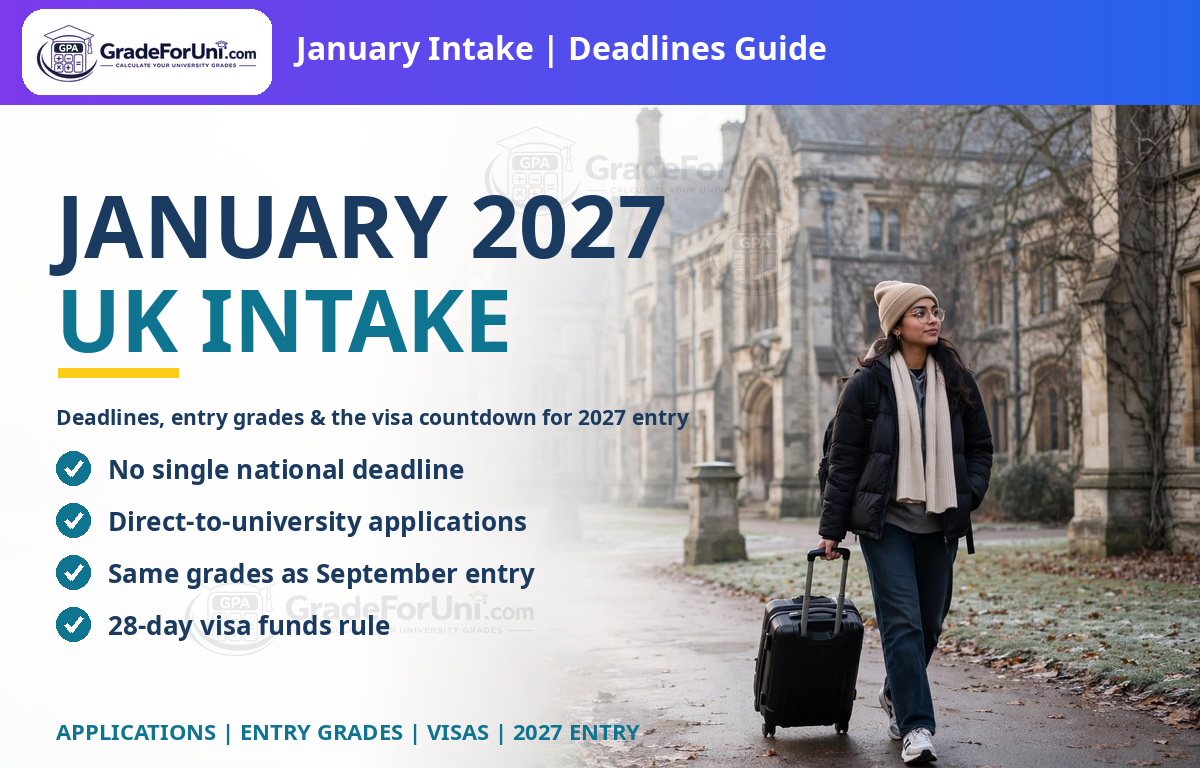
January 2027 UK University Intake: Application Deadlines, Entry Grades & the Visa Countdown
The January 2027 intake UK universities are recruiting for right now is the best-kept secret of the British admissions calendar — and the most misunderstood. Applications are open at this moment, and the first international deadlines land within two weeks. Yet there is no single national deadline, no UCAS form, and no one date you can circle on a calendar and assume applies to you. Every university, and often every course within it, sets its own cut-off.
That decentralisation is the whole story. If you are aiming for a January 2027 start, your application deadline might be 30 October 2026 or 18 December 2026 depending on the university — and the visa chain behind it (offer, conditions, deposit, CAS, the 28-day funds hold, the visa decision) needs roughly seven weeks after your money is settled. This guide re-verifies the published deadlines university by university, explains why January entry is mostly postgraduate, shows the exact academic bar you must clear, and works the visa countdown backwards from a real deadline.
One clarification: this is not a visa explainer. The money rules changed — applications on or after 30 November 2026 use the new, higher maintenance figures, detailed in our guide to the maintenance funds rise. This article does the part no single university page shows you: how the deadlines, the entry grades, and the visa timeline fit together into one countdown.
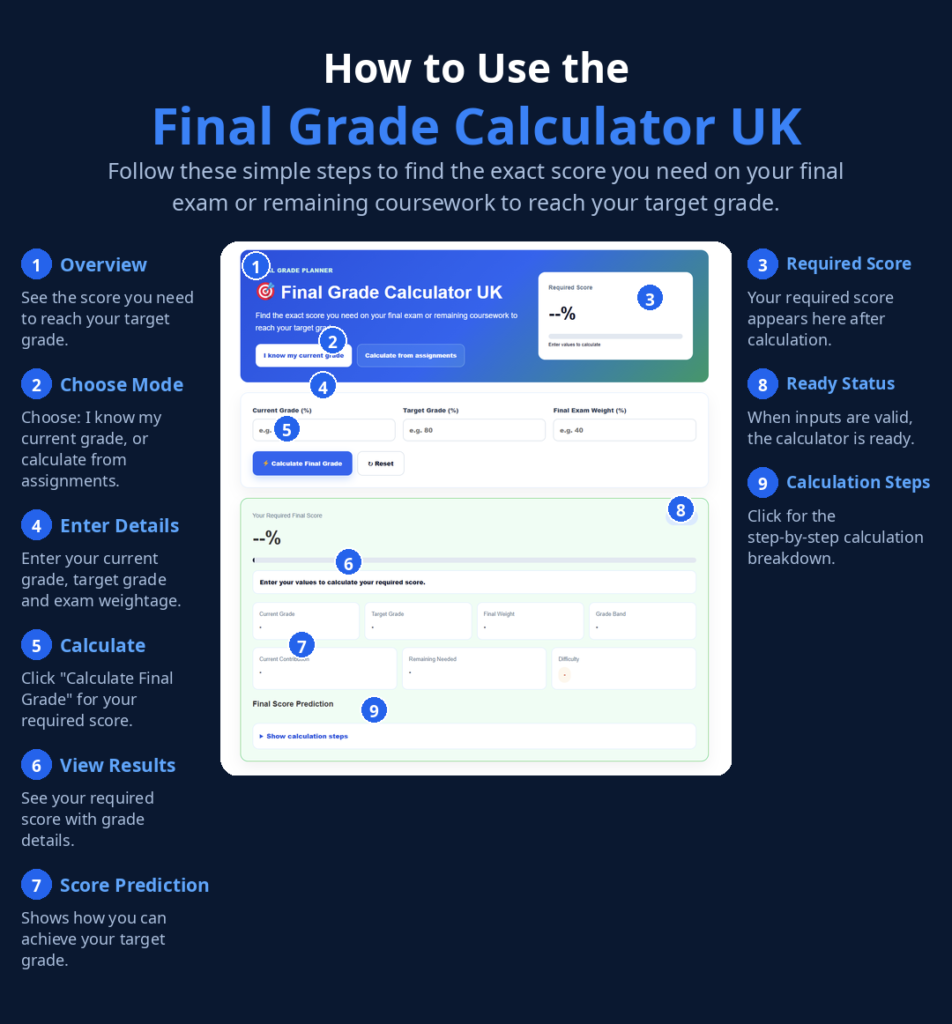
Click Here: Final Grade Calculator UK
January 2027 Intake UK: The Verified Deadlines, University by University
The single most important sentence in this article: there is no national January deadline. Applications go directly to each university — not through UCAS — and each institution publishes its own cut-off, often different for international and home applicants and sometimes between courses. The table below re-verifies the deadlines currently published for January 2027 entry; every date was re-checked against live sources today, and dates that could not be re-verified were left out.
| University | Published January 2027 deadline | What it covers |
|---|---|---|
| University of Birmingham | 30 October 2026 | Most overseas postgraduate taught applications (one aggregator lists 18 December for some courses — confirm on your course page) |
| University of Huddersfield | 31 October 2026 | International applications for many January 2027 courses; offer conditions to be met by 15 November 2026 |
| Brunel University of London | 13 November 2026 | Recommended postgraduate application date — applications after this are accepted only if spaces remain and there is time for the visa process (Brunel’s official how-to-apply page) |
| University of Westminster | 20 November 2026 | International applications for January 2027 postgraduate courses (Westminster’s official how-to-apply page; conditions and deposit due 11 December; CAS requests from outside the UK by 18 December) |
| Royal Holloway, University of London | 7 December 2026 | January postgraduate courses; later applications considered individually |
| Kingston University London | 11 December 2026 | Standard January international admissions |
| Queen Mary University of London | 14 December 2026 | Overseas postgraduate applications; some courses close earlier |
| University of Liverpool | 18 December 2026 | Most international postgraduate applications; selected Engineering courses close 30 November 2026 |
Notice what the table does not do: it does not give you one answer. Birmingham closes while Liverpool is still accepting applications. A Brunel deadline is a recommendation with capacity behind it; a Westminster deadline sits inside a published chain of follow-on dates. And aggregator sites disagree with each other on Birmingham — one lists 30 October, another 18 December. That disagreement is proof that aggregator dates are summaries; the course page is the document that binds.
Why January Is Mostly a Postgraduate Intake
Almost every January 2027 course in the table above is a taught master’s — MSc, MA, MBA. That is the norm, not the exception. Universities run a January intake for a straightforward operational reason: postgraduate courses are taught in modular cohorts that can start at multiple points in the year, whereas undergraduate programmes are locked to the September rhythm of school-leaver results, UCAS cycles, and three-year course structures that begin together. Running a January undergraduate cohort means duplicating the entire teaching timetable for a fraction of the students, so most universities do not do it.
The exceptions prove the rule. The University of Buckingham runs a January undergraduate entry because its two-year accelerated degrees have four entry points a year rather than one, and it evaluates each file individually rather than through fixed rounds. Published deadline figures for Buckingham’s January 2027 undergraduate entry currently conflict between secondary sources, so this article quotes none: if Buckingham is your target, the deadline on your specific course page is the only number that counts.
The practical consequence: January applications are made directly to each university’s own application portal, not through UCAS — UCAS handles September undergraduate entry (see our UCAS 2027 deadline guide for that contrast). You create an account per university, upload transcripts, English test results, references and a personal statement, and track the decision there. And that is why “check the course page” is not filler advice: on UCAS one deadline covers everyone, but in the January system Westminster can set 20 November for international applicants, 7 December for home applicants, and different dates again per course — and it does. There is no central list. The course page is the list.
Entry Grades: The Same Academic Bar as September
Here is the part applicants routinely get wrong in both directions: a January start does not mean lower standards. Universities apply the same requirements as September entry on the same course — for postgraduate courses, a UK bachelor’s classification, typically a 2:1 (60%+) for competitive courses and a 2:2 (50%+) for the rest, spelled out per course. Huddersfield’s January 2027 management courses ask for 2:1 or above on some programmes and 2:2 or above on others (with ~60% guidance for Indian-system applicants); Buckingham’s postgraduate entry sits at a 2:2 or above.
International qualifications are converted, not waived — every university publishes country-by-country equivalencies mapping your percentage, GPA or degree class to the UK 2:1/2:2 line. If your final results are not out yet, you apply with predicted results and receive a conditional offer; our predicted grades guide explains how universities treat those, and our degree classification calculator shows exactly where your current average lands against the 60% and 50% boundaries.
The handful of January undergraduate courses use UCAS tariff points instead of degree classifications, and the tariff is where near-misses hide. The current UCAS tariff values each A-level grade: A* = 56, A = 48, B = 40, C = 32, D = 24, E = 16. That gives the anchor combinations every applicant should memorise: AAA = 144, AAB = 136, ABB = 128, BBB = 120. The gap between two adjacent combinations is exactly 8 points — one grade on one A-level.
Work it through. Suppose a January undergraduate course asks for AAB — 136 tariff points. You hold ABB: A (48) + B (40) + B (40) = 128. You are 8 points short: one grade boundary on one paper, and the entire margin. If you are sitting on results, add up your three best grades against those anchors before paying any fees: 136 is in, 128 is a conversation with admissions, and 120 means looking at courses with lower published requirements.
The same boundary logic applies at postgraduate level: the line between a 2:2 and a 2:1 is 60.0% — a student on 59.2% does not hold a 2:1, and a course requiring a 2:1 will treat the application accordingly. January does not soften this. If your degree is still in progress, run your weighted average through the Final Grade Calculator now: knowing whether you project to 61% or 58% decides which courses are realistic before you spend anything on applications.
The Visa Countdown: Worked Backwards from a Real Deadline
Deadlines are only the first domino. Behind every application deadline sits a chain — offer, conditions, deposit, CAS, the 28-day funds hold, the visa application, the decision, travel, enrolment. Work it backwards from a real, officially published chain: the University of Westminster’s January 2027 postgraduate timeline — application deadline (international) 20 November 2026; last date for international offers 23 November; conditions met and deposit paid 11 December; last CAS request from outside the UK 18 December; enrolment 11 January 2027; teaching from 18 January. From deadline to enrolment is 52 days — about seven and a half weeks — and every link must fit inside them.
Now layer the visa mechanics on top. GOV.UK’s student visa guidance confirms the two facts that govern the calculation: the earliest you can apply from outside the UK is 6 months before your course starts, and decisions usually arrive within 3 weeks. The third governing fact is the 28-day rule: funds must have sat in your account for 28 consecutive days before you apply, with evidence dated within 31 days of the application. So the honest minimum after your money is settled is 28 days of holding + ~21 days of decision ≈ 7 weeks to visa in hand — and that assumes nothing goes wrong.
Run the arithmetic. To request your CAS on 18 December, conditions and deposit are settled by 11 December, and the 28-day funds hold must be complete before the visa application — so the money needs to be in place and untouched from roughly mid-November. Apply for the visa around 19–20 December, add the ~3-week decision window, and the visa lands around 10 January — one day before enrolment. The chain fits, but there is no slack: a week lost anywhere can push you past the final enrolment date, and Westminster is explicit that there are no extensions past 5 February.
There is a money-rule trap built into exactly this window. Applications made on or after 30 November 2026 use the new maintenance figures — £1,570/month for London (up to £14,130), £1,203/month elsewhere (up to £10,827). A Westminster applicant whose visa application lands in mid-December falls under the new figures, not the old ones: the trigger is the application date, not the CAS date, and the 28-day hold means the higher amount must have sat in the account for the full holding period. Full detail is in our maintenance funds rise guide — but do this one calculation first: if your visa application is dated 30 November 2026 or later, your 28-day hold must cover the new totals.
The lesson travels to every university in the table: count back roughly seven weeks from your visa-application date for the funds hold plus decision, and ask whether your money is already settled. If it is not, your real deadline is not the published one — it is today, for the bank transfer. And the chain can break at the university end too: an offer can be withdrawn if conditions are not met by the published date (see when universities can withdraw offers), and a missed condition-meeting deadline delays the CAS, which delays everything after it.
Why Students Choose the January Intake
January exists for three kinds of applicant. The first missed September — a late offer, a visa that did not arrive in time, results that slipped a grade — and January is the earliest route back in without losing a full year, which is why the deadlines above deserve urgency, not relaxation. The second finished their qualifying degree late in the year: some education systems release final results in October or November, making September impossible but January perfectly timed — Huddersfield’s timeline, with its 15 November condition-meeting deadline and 5 January enrolment, is visibly built for exactly this applicant. The third needed more financial preparation time: deposit, 28-day hold, visa fee and Immigration Health Surcharge add up to a five-figure commitment, and three extra months of saving is the difference between a viable application and a refused one.
All three groups share one genuine advantage: January cohorts are smaller, which often means less competition for places on oversubscribed courses, faster admissions decisions, and a calmer housing market than September. None of that lowers the academic bar — but a well-prepared January application can move faster through the system than the same application would in the September crush.
The Single Biggest Trap: Assuming One National Deadline
The most expensive mistake in the January system is importing September thinking: one UCAS deadline, one national rhythm. In the January system that model fails at every level — deadlines differ between universities, between international and home applicants, between courses, and even between sources reporting the same university, as the Birmingham 30 October versus 18 December disagreement shows. Every layer rewards the applicant who reads the specific course page.
The checking discipline, in order: find your exact course on the university’s own website — not an aggregator, not a forum, not a video. Read the international applicant timeline if one is published (Westminster and Huddersfield both publish the full chain: application, conditions, deposit, CAS, enrolment). Note whether the date is a hard deadline or a recommendation with capacity behind it — Brunel’s 13 November is the latter, and “recommended” still means apply before it, because after it you are competing for leftover spaces and a shrinking visa window. And write down the follow-on dates, not just the application deadline: the condition-meeting date and the CAS-request date are the ones that actually break applications.

Is there a single national deadline for the January 2027 UK intake?
No. There is no national deadline for January entry. Each university — and often each course — sets its own cut-off, and international applicants usually face earlier dates than home applicants. Published January 2027 international deadlines range from 30 October 2026 (Birmingham) to 18 December 2026 (Liverpool). Check your specific course page.
Do I apply for January 2027 through UCAS?
No. January intake applications are made directly through each university’s own application portal. UCAS handles September undergraduate entry; the January system is separate, with its own per-university deadlines. Some universities list UCAS as an alternative route for international postgraduate applications, but the direct form is the standard path.
Are January intake entry requirements lower than September?
No. Universities apply the same academic bar as September entry: typically a 2:1 for competitive postgraduate courses and a 2:2 for others, with international qualifications converted to the UK scale. Undergraduate January courses use the same UCAS tariff points as September. January changes the start date, not the standard.
Can undergraduates start in January 2027?
Rarely. The January intake is overwhelmingly postgraduate — taught master’s courses whose modular structure allows multiple start dates. A few universities, notably the University of Buckingham with its two-year accelerated degrees, offer January undergraduate entry. Most undergraduate programmes start in September only.
How long does the visa process take for a January 2027 start?
Budget roughly seven weeks from the day your funds are settled: 28 consecutive days of holding the required amount, then usually around three weeks for a decision on an application made outside the UK (per GOV.UK guidance). Add the university chain before that — offer, conditions, deposit, CAS — which itself takes several weeks after the application deadline.
Do the new maintenance fund figures apply to January 2027 applicants?
Almost certainly yes. Applications made on or after 30 November 2026 use the new figures — £1,570 per month for London (up to £14,130) and £1,203 per month elsewhere (up to £10,827). Since most January 2027 visa applications will be submitted in December, the higher amount must have been held for the full 28-day period. See our full guide to the maintenance funds rise for the complete breakdown.
What happens if I miss the January application deadline?
It depends on the university. Some treat published dates as recommendations and accept later applications if spaces remain and the visa timeline still works (Brunel’s 13 November date works this way); others enforce hard cut-offs. Missing a follow-on deadline is more serious — a missed condition-meeting or CAS-request date delays or ends the application. If January slips, the next window is September 2027 entry.
Which is better: January 2027 or September 2027 entry?
Neither is better academically — the degree, the teaching and the entry bar are the same. January suits applicants who missed September, finished their previous qualification late in the year, or needed more financial preparation time. September offers a wider choice of courses and the full undergraduate range. Choose by your timeline, not by prestige.
Conclusion
The January 2027 intake rewards one habit above all: reading the specific page. The deadlines are real, they are soon — Birmingham’s 30 October is two weeks away as this article publishes — and they are different at every university. The entry grades are the same bar as September, the application goes direct to the university rather than through UCAS, and the visa chain behind the deadline needs roughly seven weeks from the day your funds are settled. None of that is complicated. All of it is unforgiving of assumptions.
So the plan writes itself. Read each course page’s international timeline, not an aggregator’s summary. Check your grades against the real bar now — the Final Grade Calculator and the degree classification calculator will tell you in seconds whether you clear the 2:1 or 2:2 line. Get the full maintenance amount into the right account and start the 28-day clock, because every visa application from 30 November onward uses the new figures. And work backwards from your deadline the way this guide did — the chain behind it decides whether you enrol in January or wait for September.