
Two-Year Degrees UK: How Accelerated Degrees Are Graded & Classified [2026]
The maths of an accelerated degree looks impossible at first glance. Three years of university squeezed into two, the same honours degree at the end, the same Firsts and 2:1s — and nobody can quite explain how the grading survives the compression. Students ask the same three questions every admissions cycle: do I do less work, does my first year count, and is a two-year degree actually worth the same piece of paper? This guide answers all three with the actual regulations open on the desk, mostly the University of Buckingham’s — the institution that has run two-year degrees since 1976 and therefore has the longest paper trail of how the grading really works.
Here is the short version before we decode the long one. An accelerated degree is not a cut-down degree. It is the same 360 credits, the same honours classification bands, and — per the government’s original design — the same number of teaching weeks as a three-year degree (two years of 45 weeks instead of three years of 30). What changes is the calendar: the long summer holidays become teaching terms, the weekly workload rises to roughly 46 hours, and the classification maths adapts — the familiar “first year doesn’t count” rule is replaced by something cleverer, a best-240-credits rule that protects your early marks in a different way. If you understand that mechanism, the whole format makes sense.
What we will work through: exactly what an accelerated degree is and who regulates it; a head-to-head comparison with the standard three-year degree; the classification rules decoded from Buckingham’s published regulations; a full worked example computing a 2:1 under those rules; resits, capping and condonation on a compressed timetable; the real money maths with verified fee figures; the workload truth; a decision framework; and where you can actually study one. Every policy claim in this article is checked against at least two sources — full list at the end.
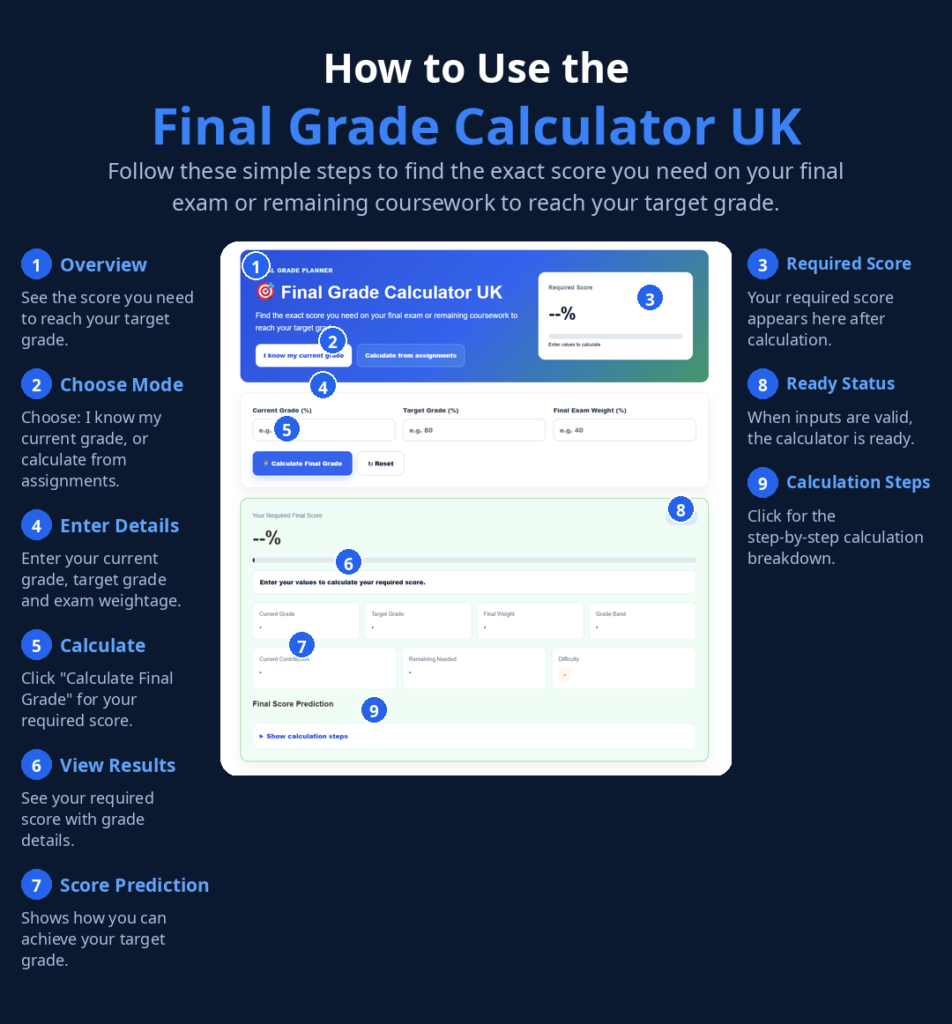
Click Here: Final Grade Calculator UK
Decoded: what an accelerated degree actually is
An accelerated degree — universities also call it a two-year degree or fast-track degree — is a full UK honours degree completed in two years instead of three. The defining feature is not less content but less holiday. Where a standard degree teaches for roughly 30 weeks a year across three years, the government’s 2018 accelerated-degree framework (announced by the Department for Education under universities minister Sam Gyimah) defined the format as 45 teaching weeks a year across two years. Two times 45 is 90; three times 30 is 90. The total teaching is, by design, identical. As the DfE’s announcement put it, students take “the same number of modules and receive the same amount of contact hours” — the Office for Students’ chief executive at the time, Nicola Dandridge, welcomed the plans as offering students “a shorter period of time, at a lower overall cost.”
The pioneer is the University of Buckingham, a private university that has offered two-year degrees since 1976 — decades before the government policy push. Buckingham’s model runs four 13-week terms a year, using what would otherwise be the long summer vacation as an additional teaching term. Its General Academic Regulations set the minimum period of study for an undergraduate degree at two years (eight terms), and a standard Buckingham module carries 30 “units” — where one unit equals ten hours of study, so a 30-unit module means 300 hours of work, mapping one-to-one onto the 30 credits other universities would award. That unit system is worth understanding because Buckingham’s classification rules are written in it, and we will decode them below.
Regulation-wise, nothing about the qualification is diluted. An accelerated degree must meet the same Framework for Higher Education Qualifications (FHEQ) level-6 standard as any honours degree, and providers are regulated by the Office for Students and quality-assured by the Quality Assurance Agency just like three-year programmes. The certificate does not say “accelerated” or “fast-track” — it says BA (Hons) or LLB (Hons), exactly like everyone else’s. If an employer or a postgraduate admissions tutor ever asks, the honest answer is that the degree is the same qualification delivered on a compressed calendar.
Accelerated vs standard degree: the head-to-head
Put the two formats side by side and the trade-offs become concrete. This comparison uses the government’s 90-teaching-weeks framework and Buckingham’s published term structure — the two most authoritative descriptions of the model available.
| Feature | Standard 3-year degree | Accelerated 2-year degree |
|---|---|---|
| Total credits | 360 | 360 — identical |
| Teaching weeks | ~30/year × 3 = 90 | ~45/year × 2 = 90 — identical |
| Long summer break | Yes, ~3 months | No — the summer is a teaching term |
| Typical weekly workload | ~40 hours in term | ~46 hours in term (Buckingham’s own estimate: 600 study hours per 13-week term) |
| Classification bands | 70 / 60 / 50 / 40 | 70 / 60 / 50 / 40 — identical |
| “First year doesn’t count” rule | Year 1 usually excluded from classification | Replaced by the best-240-credits rule (decoded below) |
| Resit recovery time | Long vacations to recover and resit | Short — resits slot into the next term |
| Dissertation | Spread over final year | Same project, compressed timetable |
| Time to graduation | 3 years | 2 years — one year earlier into work or postgraduate study |
Two rows in that table deserve emphasis because they are the ones students misunderstand most. The teaching-weeks row: you are not doing a third less work, so anyone choosing the format to “get it over with” is misreading it. And the classification row: the bands are the same numbers, but the machinery that feeds marks into them is different — which is the subject of the next section.
How accelerated degrees are graded: the best-240 rule
On a standard three-year degree, most universities simply exclude the first year from the classification calculation — year 1 is a threshold you pass, and the degree class is computed from years 2 and 3. An accelerated degree cannot do that, because there is no light first year to throw away: every term is doing serious assessed work. So the pioneers of the format invented something that does the same protective job in a different way. Buckingham’s General Academic Regulations contain the clearest published version of it, and it is worth reading carefully because it shows how seriously these providers take grading fairness.
Buckingham splits the degree into a Preliminary stage and everything after it. Marks from the Preliminary stage count towards the 360 credits you need for the award, but they are excluded from the classification calculation entirely (Regulation 12.7). That is the direct equivalent of “first year doesn’t count” — same protective effect, different name. Our guide to whether first year counts explains how the standard version works; on an accelerated degree the principle survives in this Preliminary-stage form.
Then comes the clever part. Classification is based on the highest-scoring 240 classifiable credits achieved after the Preliminary stage, with a minimum of 90 credits at Level 6 (Regulation 12.8). Read that again: not all of your post-Preliminary credits — your best 240. If you take 300 classifiable credits and two modules went badly, the classification calculation simply drops the weakest 60. Those credits still count towards your 360 for the award; they just cannot drag your class down. On a compressed timetable where one bad term could otherwise wreck a degree, that buffer is doing real protective work.
The bands themselves are the familiar national ones, published in Regulation 12.13: First 70–100%, 2:1 60–69%, 2:2 50–59%, Third 40–49%. But Buckingham does not hand out classes on the weighted mean alone — three guard conditions sit on top of it, and they matter at the borderlines. First, more than half of the best-240 credits must fall within or above the class. Second, at least 105 of those credits must be in the class, and the overall weighted mean must clear a slightly lower bar (68 for a First, 58 for a 2:1, 48 for a 2:2, 38 for a Third). Third, a First has its own triple lock: 90 credits of classifiable modules graded at First level, at least 60 of those in Part II (the final stage), and an overall weighted mean of 66% or above.
Three more rules from the same regulations are worth pocketing. The final weighted mean is rounded to the nearest integer, with exactly 0.50 rounding up (12.3) — so 69.50 becomes 70 and a First, while 69.49 does not. Where the programme includes a substantive dissertation, the classification will normally not exceed the dissertation’s classification (12.5) — a 68-average with a 2:2 dissertation stays a 2:2. And you cannot re-sit a passed module to improve your classification once the programme is complete (12.4). If you are chasing a First on an accelerated degree, our guide to getting a First is worth reading alongside these rules — the guard conditions above are the specific arithmetic it has to satisfy.
One honest caveat: this is Buckingham’s scheme, the most fully published one in the sector. Other providers write their own regulations, and accelerated programmes at different universities can weight stages differently. The bands (70/60/50/40) are the national norm, but the machinery behind them — what counts, what gets dropped, what the borderline rules are — lives in your own university’s assessment regulations. Always read them. The principle to carry away is general though: accelerated grading is designed so that the compression does not punish you for early wobbles.
Worked example: a 2:1 computed under the best-240 rule
Time for the numbers. Take a fictional Buckingham-style student, Daniel, on a two-year honours degree. His Preliminary stage is passed and out of the classification picture. After it, he takes 300 classifiable credits: 120 in Part I (Level 5), 120 in Part II (Level 6), and 60 of free-choice modules. Here are his marks.
| Module | Stage | Credits | Mark |
|---|---|---|---|
| Module 1 | Part I (Level 5) | 30 | 62 |
| Module 2 | Part I (Level 5) | 30 | 58 |
| Module 3 | Part I (Level 5) | 30 | 71 |
| Module 4 | Part I (Level 5) | 30 | 55 |
| Module 5 | Part II (Level 6) | 30 | 68 |
| Module 6 | Part II (Level 6) | 30 | 74 |
| Module 7 | Part II (Level 6) | 30 | 52 |
| Module 8 | Part II (Level 6) | 30 | 66 |
| Free-choice A | Elective | 30 | 48 |
| Free-choice B | Elective | 30 | 43 |
Step one: apply the best-240 rule. Daniel has 300 classifiable credits, so the weakest 60 are dropped — Free-choice A (48) and Free-choice B (43) fall out of the classification calculation. (They still count towards his 360 credits for the award.) Step two: the weighted mean of the remaining 240 credits. Every module is 30 credits, so the mean is simply the average of the eight marks: (62 + 58 + 71 + 55 + 68 + 74 + 52 + 66) ÷ 8 = 506 ÷ 8 = 63.25, which rounds to 63. That sits in the 60–69 band: a 2:1 on the headline number.
Step three: the guard conditions. More than half of the best-240 credits must be at 60 or above — Daniel’s marks of 62, 71, 68, 74 and 66 give him 150 of 240 credits in the 2:1 zone, comfortably over half. At least 105 credits must be in the class, with the overall weighted mean clearing 58 for a 2:1 — 150 credits and a mean of 63 satisfy both. And the Level 6 minimum: he has 120 Level 6 credits, above the required 90. Result: Upper Second-Class Honours (2:1).
Now see what the buffer did for him. If all 300 credits had counted, the mean would be (506 + 48 + 43) ÷ 10 = 597 ÷ 10 = 59.7, rounding to 60 — a 2:1, but hanging on the boundary by a thread, one bad exam away from a 2:2. The best-240 rule turned a borderline classification into a secure one. That is the whole point of the mechanism: on a two-year timetable there is no time to repair a bad term, so the regulations let you leave it behind instead. Try your own numbers in our degree classification calculator to see how close your own profile is to a boundary.
Resits on a compressed timetable: capping and condonation
Failing a module hurts more on a two-year degree than on a three-year one, and not just emotionally — the calendar gives you less room to recover. The resit rules therefore deserve a harder look than most applicants give them. Buckingham’s regulations are again the clearest published example, and they are stricter than many students expect.
The headline: re-taken modules are normally capped at a bare pass, and a fee is charged (Regulation 10.13). A late resubmission is capped at a bare pass and counts as the second and therefore final attempt. If a module is substituted after a late withdrawal or recorded fail, the mark is restricted to a bare pass. Compare that with some three-year programmes where first resits can carry the full mark, and you see the trade: the compressed degree moves faster, but a failed module leaves a capped 40 sitting in your credit profile where a first-attempt 65 might have been. Our referrals guide explains how capped resits work generally — on an accelerated degree the same cap applies with less calendar to absorb it.
There is, however, a safety net at the far end. At the point of classification, Buckingham’s Board of Examiners may condone failures worth up to 60 credits (no more than 30 at Level 6) and award the credits anyway, provided the failed module scored at least 35 and the student’s weighted mean across all modules is 40 or above (Regulation 12.12). Professional-body requirements can block condonation on specific modules — law and other regulated subjects often do. And the progression rules show the other side of the coin: a student carrying failures worth less than half the term’s credits may proceed at the board’s discretion, but carrying more than 90 credits of failures is not permitted, and failing to attempt a re-assessment within a year of being held back normally means termination of studies.
The practical lesson is blunt. On a three-year degree, a failed module costs you a summer of resits; on a two-year degree, it can cost you the pace of the whole programme, because there is no long vacation to resit in — the next term is already starting. Students who fail more than one module are normally expected to restart the stage, which on an accelerated degree effectively converts it back towards a three-year timeline. If that happens, our guide to repeating a year covers the mechanics — the one consolation in Buckingham’s rules is that a restarted stage is treated as a first attempt for resit purposes, and only two restarts are ever permitted.
The money maths: is a two-year degree actually cheaper?
The financial pitch for accelerated degrees has two halves: pay less tuition overall, and start earning a year earlier. Both are real, but both need the actual numbers rather than the brochure version. Here is what the published figures say.
| Cost element | Standard 3-year degree | Accelerated 2-year degree |
|---|---|---|
| Tuition (Staffordshire Law LLB, listed on UCAS) | £9,535 × 3 = £28,605 | £11,100 × 2 = £22,200 |
| Tuition saving | — | £6,405 |
| Living costs | 3 years of rent, food, travel | 2 years — one full year saved |
| Maintenance borrowing | 3 years of maintenance loan | 2 years |
| Earnings | Graduate in year 3 | Graduate in year 2 — up to a year of graduate salary earlier |
| Cut-price example (Buckingham, select courses, 2026) | — | £7,830 × 2 = £15,660 total |
Walk through the Staffordshire example, because the figures are published on UCAS and therefore checkable. A standard three-year degree at the £9,535 annual fee cap costs £28,605 in tuition. Staffordshire’s two-year accelerated Law LLB is listed at £11,100 a year — higher per year, as the format allows (the government’s framework always permitted accelerated courses to charge more per year), but £22,200 in total. The tuition saving is £6,405. Then add the year’s living costs you do not pay — rent, bills, food for twelve months — and the year’s maintenance loan you do not borrow. Study International’s reporting on Staffordshire’s own figures puts the combined tuition-plus-living saving at just under £14,000.
Buckingham’s 2026 move is even more striking. Reported by Times Higher Education, the university cut fees on selected accelerated business and English programmes to £7,830 a year — £15,660 for the whole degree — against its traditional two-year price of £27,750 and the £28,605 a three-year degree costs at the standard cap. That is a £12,945 tuition saving on those courses, with the registrar explicitly framing it as pricing “at the lower limit available on the student loan.” Note the caveat: Buckingham is a private provider, so its students cannot access the full tuition fee loan available at most English universities — check the funding position course by course.
Then the second half of the pitch: the salary year. Suppose you graduate in summer 2028 instead of summer 2029 and walk into a job paying £35,000 — an illustrative figure, not a promise. That is a £35,000 gross head start over the three-year graduate, plus a year of pension contributions, a year of National Insurance record, and a year of seniority. Against that, set the honest costs: you forgo a year of part-time student earning, you forgo the summer internships that three-year students use to build CVs, and the intensity we describe below means holding down a substantial part-time job during term is much harder. The format pays best for students who are confident about converting the saved year into earnings or funded postgraduate study.
The 46-hour week: workload reality
This is the section the brochures underplay. Remember the arithmetic: the same 90 teaching weeks, the same 360 credits, the same contact hours — just fewer calendar weeks to fit them in. Buckingham’s Academic Framework puts a number on it: one 30-unit module represents 300 hours of study, and each 13-week term represents 600 hours. Six hundred hours over thirteen weeks is roughly 46 hours a week, every week of term, for two years — and there are four terms a year, not three, so the “holiday” between them is measured in weeks, not months.
What does 46 hours feel like? It is a full-time job’s hours devoted to study, sustained across the year including the summer months when three-year students are working, travelling, or resting. Reading weeks and assessment weeks are built into the terms, but the long restorative summer break — the period when many students consolidate learning, do internships, or simply recover — does not exist. The government’s original consultation acknowledged this implicitly: the format was pitched particularly at mature students changing careers, people who wanted pace rather than the traditional student experience.
Burnout is the real risk, and the regulations quietly acknowledge it. Buckingham caps students at 60 units in any single term and 90 per progression period — guardrails against overloading. The maximum registration period is double the standard programme length, so a two-year degree can stretch to six years with suspensions if life intervenes. But the students who thrive are the ones who treat it like the intensive professional training it resembles: strong time management, no illusions about the summer, and a clear reason for wanting the speed. The ones who struggle are usually those who chose it to “get university over with” — the workload does not reward that motivation.
Decision framework: is an accelerated degree right for you?
Run yourself through this scorecard honestly. The format is excellent for the right student and punishing for the wrong one, and the difference is rarely academic ability — it is circumstances and temperament.
| Factor | Accelerated degree suits you if… | Think twice if… |
|---|---|---|
| Motivation | You have a specific career or postgraduate goal and want the fastest credible route | You mainly want “to get it over with” — the intensity punishes vague motivation |
| Study stamina | You can sustain ~46-hour study weeks year-round, including summers | You need long breaks to recharge, or you burn out under continuous assessment |
| Finances | Saving a year’s tuition and living costs matters, and you can manage higher annual fees | You depend on substantial term-time work — the timetable barely allows it |
| Life stage | You are a mature student or career-changer who values pace (the government’s original target group) | You want the full traditional student experience: societies, long summers, slow exploration |
| Risk tolerance | You are confident academically — capped resits and no long recovery windows raise the stakes of a bad term | You have a history of needing resits; a failed module on this timetable is expensive in time |
| Career plans | Your field values the qualification, not the duration (law, business, computing) | You need a placement year or extensive internships built into the degree |
Score yourself: four or more left-column answers and the format is probably a genuine fit; three or more right-column answers and the standard three-year degree is likely the better investment of the same 90 teaching weeks. Either way, the decision should be about the calendar and the workload, not about prestige — the qualification at the end is the same.
Where you can study an accelerated degree in the UK
The sector’s accelerated provision is smaller than the marketing suggests, and third-party lists go out of date fast. These are the providers whose own published pages confirm accelerated undergraduate degrees at the time of writing — verified directly, not copied from a listicle.
| University | What is confirmed | Source |
|---|---|---|
| University of Buckingham | Two-year honours degrees since 1976 across business, law, humanities, computing and more; four terms a year; LLB from £13,875/year (UK, 2-year entry) | University’s own course pages and academic regulations |
| University of Staffordshire | Dedicated “two-year accelerated degrees” study route, including Law (two-year accelerated) LLB; £11,100/year UK | University’s study-options page and UCAS course listings |
| University of Law | Two-year Accelerated LLB (Hons), same material as the three-year LLB; entry ABB / BTEC DDM / 128 UCAS points | University’s own accelerated-LLB course page and UCAS |
To find others, search UCAS course listings for “(Accelerated)” in the course title — that suffix is how universities flag the format in the national admissions system. Treat any other list with scepticism: accelerated provision opens and closes with demand, some universities quietly withdrew fast-track courses after the 2018 policy push, and a 2021 blog post is not evidence a course still runs. The university’s own course page, with a duration of two years stated, is the only confirmation that counts. And when you find one, read its assessment regulations before you apply — the classification and resit rules we decoded above are the terms you are actually signing up to.

Accelerated degrees FAQs
Is an accelerated degree worth the same as a normal degree?
Yes. An accelerated degree is the same qualification as the three-year version: 360 credits, the same honours classification (First, 2:1, 2:2, Third), and the same FHEQ level-6 standard. The certificate does not say ‘accelerated’, and OfS-registered providers are quality-assured exactly like standard programmes. The University of Law notes, for example, that its accelerated LLB covers all the same material as its three-year LLB.
Do first-year marks count on a two-year degree?
It depends on the university, but the mechanics differ from standard degrees. At the University of Buckingham, marks from the Preliminary stage count towards the 360 credits needed for the award but are excluded from the classification calculation entirely — the same protective effect as the ‘first year doesn’t count’ rule on a three-year degree. Classification then uses the highest-scoring 240 classifiable credits after the Preliminary stage.
How is an accelerated degree classified? What average do I need?
The bands are the familiar national ones: 70%+ First, 60-69% 2:1, 50-59% 2:2, 40-49% Third. At Buckingham the class comes from the weighted mean of your best 240 classifiable credits after the Preliminary stage (minimum 90 at Level 6), with 0.50 rounding up — plus guard conditions: more than half of those credits must be in the class, at least 105 credits must be in the class, and a First needs 90 credits at First level including 60 in Part II. Other providers publish their own schemes, so always read your course regulations.
How many teaching weeks does a two-year degree involve?
Roughly the same as a three-year degree: the government’s accelerated-degree framework described two years of 45 teaching weeks versus three years of 30 — 90 weeks either way, with the same modules and contact hours. The University of Buckingham runs four 13-week terms a year and estimates about 46 hours of study a week per term. You are not doing less work; you are doing the same work in fewer calendar weeks.
Are resits capped on accelerated degrees?
At Buckingham, re-taken modules are normally capped at a bare pass and a fee is charged, and late resubmissions are capped at a bare pass as a second and final attempt. That matters more on a compressed timetable because there is no long summer to absorb a resit. At the point of classification, the Board may condone failures worth up to 60 credits (maximum 30 at Level 6) if the failed module scored at least 35 and your overall weighted mean is 40 or above.
Is a two-year degree actually cheaper than a three-year degree?
Usually, yes — check the course-level figures. Staffordshire University lists its accelerated Law LLB at £11,100 a year: £22,200 over two years against £28,605 for three years at the £9,535 standard cap, a £6,405 tuition saving. Buckingham cut selected accelerated programmes to £7,830 a year in 2026 (£15,660 total). On top of tuition you save a full year of rent and living costs, and you can enter salaried work a year earlier.
Can I do a two-year degree part-time, or with a placement year?
Not normally. The entire model depends on full-time, year-round study — spreading it part-time would stretch the same 90 teaching weeks back towards three years, defeating the point. Placement years are generally incompatible too, because there is no spare year to place. If you want work experience, look for accelerated courses that embed placement modules rather than a placement year.
Which UK universities offer accelerated degrees?
Confirmed providers with their own published accelerated undergraduate degrees include the University of Buckingham (the pioneer — two-year degrees since 1976), the University of Staffordshire (two-year accelerated degrees, including Law), and the University of Law (two-year accelerated LLB). Search UCAS course listings for ‘(Accelerated)’ in the course title, and confirm on the university’s own course page before applying — third-party lists go out of date.
Conclusion
An accelerated degree is best understood as a scheduling innovation, not an academic shortcut. The same 360 credits, the same 90 teaching weeks, the same 70/60/50/40 bands — delivered without the long summers, at roughly 46 hours a week, for two years. The grading machinery adapts intelligently: the Preliminary stage protects your early marks the way a non-counting first year does elsewhere, and the best-240-credits rule means one bad term cannot sink a classification the way it could on a standard degree. Those mechanisms exist precisely because the timetable is unforgiving, and understanding them before you apply is the difference between choosing the format and merely enduring it.
The honest summary for the decision: choose it for the calendar, not for an easier ride. The financial case is genuine — several thousand pounds of tuition saved, a year of living costs avoided, and a year of earnings brought forward — but it is paid for in workload and in risk, because capped resits and short recovery windows raise the stakes of every term. Run your own marks through the arithmetic first: plug your expected module scores into our Final Grade Calculator and see where you land against the 70/60/50 boundaries, then read your chosen university’s assessment regulations the way this article read Buckingham’s. If the numbers and the timetable both still appeal, the two-year route is one of the most efficient qualifications in UK higher education.
Sources: University of Buckingham, Academic Framework (term structure, 600 study hours per term) and LLB 2-year degree course page (fees, module structure); Buckingham General Academic Regulations (classification regs 12.3–12.13, resit/condonation regs 10.12–10.14, 11.3–11.8 — classification, capping and condonation figures verified October 2026); Department for Education, “Government boosts student choice with two-year degrees” (Nov 2018 — 45/30 teaching weeks, £11,150 fee proposal, £5,500 saving); University of Law, Accelerated LLB (Hons) course page (2-year structure, entry requirements); University of Staffordshire, study options page and UCAS accelerated Law listing (£11,100/year); Times Higher Education (June 2026 — Buckingham £7,830/year cut-price offer). Claims from each source were cross-checked against at least one other before publication.