
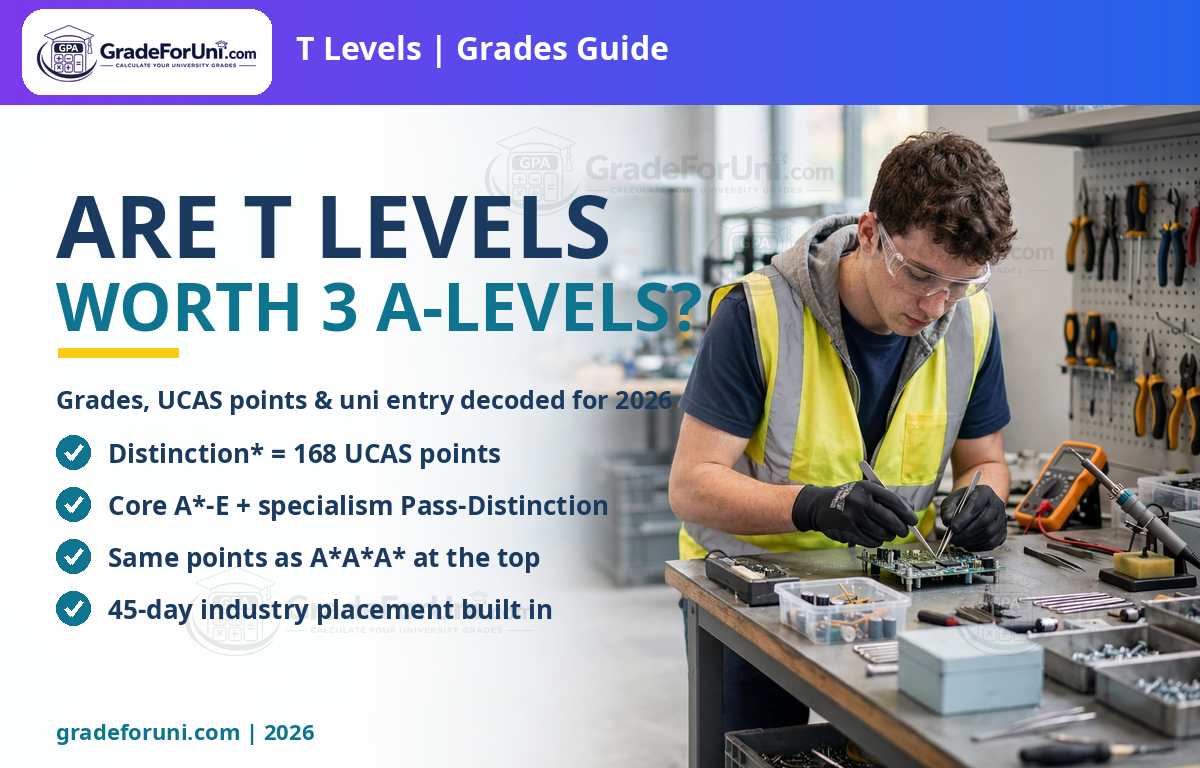
Are T Levels Worth the Same as A-Levels? Grades, UCAS Points & Uni Entry [2026]
T Levels were designed to be the technical equal of A-levels: the same size as three A-levels, the same maximum UCAS tariff, results published on the same August day. So are T Levels really worth three A-levels? On paper, the answer is an unambiguous yes — a T Level Distinction* carries 168 UCAS points, exactly what A*A*A* is worth. But step inside a university admissions office and the answer gets more careful: whether those points open the door depends on the course, the university, and sometimes the exact T Level you studied.
The confusion is understandable, because T Levels are graded like nothing else in the English system. Instead of three separate subject grades, you get an A*–E grade for a core component, a Pass/Merit/Distinction for an occupational specialism, and a 45-day industry placement that carries no grade at all yet can sink the entire qualification if you don’t complete it. Your overall T Level grade — and therefore your UCAS points — comes from how those pieces combine, and the combination rules catch out students every year.
This guide decodes exactly how T Level grades work, maps every overall grade to UCAS points and A-level equivalents with the official 2026 tariff, shows what universities actually say about T Level applicants in their own published policies, and works through real grade combinations so you can see precisely what your results are worth for 2026 entry.
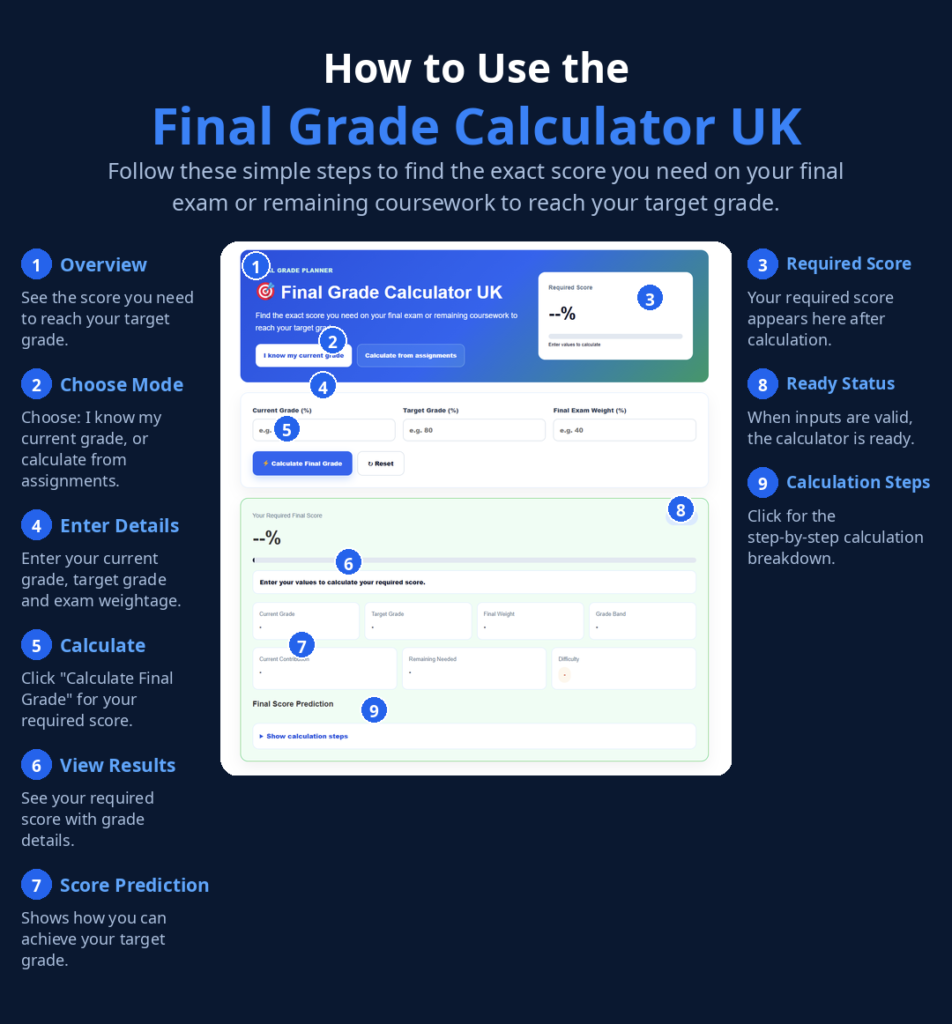
Click Here: Final Grade Calculator UK
What T Levels actually are: the 3-A-level-sized qualification
T Levels are two-year courses taken after GCSEs, launched in September 2020 and developed with employers so the content matches what industry actually needs. The Department for Education positions them as one of the three main post-16 routes, alongside apprenticeships (for students who want to learn a specific occupation on the job) and A-levels (for students continuing academic education). The defining fact for university applicants is size: a T Level is broadly equivalent in size to three A-levels, which is why it carries a three-A-level tariff allocation rather than a single-subject one.
Every T Level has the same skeleton: a technical qualification plus an industry placement with an employer. The typical programme runs to 1,100–1,300 classroom hours across the two years, plus a mandatory placement of at least 315 hours — roughly 45 working days. That means around 20% of your time is spent on placement and 80% in the classroom, which is the mirror image of an apprenticeship (typically 80% on-the-job, 20% classroom). The placement is where T Levels earn their reputation with employers, but as we’ll see, it also introduces a pass/fail tripwire that A-level students never face.
There are now 21 T Levels available, with marketing the most recent addition (first teaching September 2025). The catalogue spans digital software development, digital data analytics and digital support and security; health and healthcare science; engineering and manufacturing routes; construction and building services; accounting, finance and management and administration; education and early years; legal services; and agriculture, land management and production. Two smaller print details matter more than most students realise. First, if you haven’t achieved GCSE grade 4 in English and maths, you’ll work towards it on the programme — but you are not required to achieve it to pass your T Level. Second, there is a one-year T Level foundation year for students who want extra preparation before starting the full qualification.
How T Levels are graded: two components, one placement, one overall grade
Forget everything A-levels taught you about grading, because a T Level certificate shows four different things at once. The nationally recognised certificate displays an overall grade for the T Level (Pass, Merit, Distinction or Distinction*), a separate grade for the core component on the familiar A*–E scale, a separate grade for each occupational specialism (Pass, Merit or Distinction), and confirmation that you’ve completed the industry placement and met any additional mandatory requirements. Universities see all of it — the overall grade that drives your tariff points, and the component breakdown behind it.
The core component is the academic engine of the qualification: written exams plus an Employer Set Project, graded A* to E. The occupational specialism is the practical half: an Occupational Specialist Project testing your skills in a specific occupation, graded Pass, Merit or Distinction. The industry placement is the odd one out — it is not formally graded at all, but you must meet your provider’s placement requirements or you cannot pass the T Level overall. That makes the placement the only ungraded element in the English level 3 system that can still fail your entire qualification.
The pass rule is strict and worth memorising. To be awarded a T Level at all, you must achieve at least an E on the core component, pass the occupational specialism, and complete the industry placement. Miss any one of the three and there is no overall grade — instead you receive a T Level statement of achievement listing the elements you did complete. A statement of achievement carries no overall T Level grade and earns no UCAS tariff points, which is why the “near-miss” scenario later in this guide matters so much. One consolation the system does offer: the Department for Education has agreed partial-achievement UCAS points with UCAS for students who pass the core and complete the placement, or pass the specialism and complete the placement — the amounts vary between T Levels and sit on the UCAS tariff calculator.
The T Level grade decoder: how your core and specialism combine
This is the part no prospectus explains clearly. Your overall T Level grade is worked out from your core grade and your occupational specialism grade — but the exact combination matrix is published by each awarding organisation, and the relative weighting of the two components varies between T Levels. The Department for Education publishes only the anchors of the system nationally. Everything else follows rules rather than a single national lookup table, so here is the decoder that actually governs your result:
| Decoder rule | What it means for your grade |
|---|---|
| The D* rule | Only one combination earns Distinction*: an A* in the core AND a Distinction in the occupational specialism. Miss either half and D* is off the table, whatever else you achieve. |
| The weighting rule | The core and specialism are weighted differently in different T Levels, so the same pair of component grades can produce different overall grades in different subjects. Check your awarding organisation’s specification, not a generic table. |
| The floor rule | An E in the core plus a Pass in the specialism plus a completed placement is the minimum combination that earns an overall Pass. Anything below E in the core fails the whole qualification. |
| The all-or-nothing rule | Fail any element — core below E, specialism failed, or placement incomplete — and there is no overall grade at all, only a statement of achievement worth zero UCAS points. |
| The split-Pass rule | An overall Pass is worth 96 UCAS points with a core grade of C or above, but only 72 with a core grade of D or E. Your core grade follows you into the tariff even after the overall grade is set. |
Four worked scenarios show how the decoder plays out in practice, with the full arithmetic:
Scenario 1 — the perfect run. A* in the core and Distinction in the specialism gives an overall Distinction* under the DfE’s published rule. Distinction* = 168 UCAS points. Compare A*A*A*: 56 + 56 + 56 = 168. At the very top, “worth three A-levels” is literally, arithmetically true — the single highest T Level grade and the highest possible three-A-level haul are worth exactly the same tariff.
Scenario 2 — the realistic middle. An overall Merit = 120 UCAS points, which is exactly BBB at A-level (40 + 40 + 40 = 120). This is where most T Level students land — over half of all 2026 awards were Merits. Now the near-miss arithmetic: slip one overall grade to a Pass with a C in the core and you’re on 96 points, the equivalent of CCC (32 + 32 + 32). That’s a 24-point drop from a single grade boundary — the difference between meeting a 120-point BBB-equivalent offer and missing it by a full A-level grade.
Scenario 3 — the placement tripwire. A D in the core plus a Pass in the specialism with the placement completed gives an overall Pass (D/E on the core) = 72 UCAS points, the equivalent of DDD (24 + 24 + 24). The same student with an incomplete placement gets no overall grade at all — a statement of achievement and zero tariff points, despite passing both examined components. No A-level student can lose everything this way; for T Level students the ungraded placement is the highest-stakes element of the qualification.
Scenario 4 — the partial safety net. Pass the core (say, a B) and complete the placement, but fail the specialism: no overall T Level grade, but you’re eligible for partial-achievement UCAS points instead of walking away empty-handed. The amounts differ between T Levels because the component weightings differ, and they sit on the UCAS tariff calculator rather than in the headline tables. Almost nobody applying to university knows this safety net exists — but if your specialism project goes wrong, it’s the first thing to check before assuming your application is dead.
T Level grades to UCAS points: the official 2026 tariff table
UCAS allocates tariff points to the overall T Level grade only — never to the core or specialism separately. The official 2026 allocation, published identically by the Department for Education and the T Levels support service, lines T Levels up against three A-levels like this:
| T Level overall grade | UCAS tariff points | A-level equivalent |
|---|---|---|
| Distinction* (A* on the core and Distinction in the occupational specialism) | 168 | A*A*A* |
| Distinction | 144 | AAA |
| Merit | 120 | BBB |
| Pass (C or above on the core) | 96 | CCC |
| Pass (D or E on the core) | 72 | DDD |
Two features of this table deserve attention. First, the split Pass is unusual in the tariff system: most qualifications give one points value per overall grade, but a T Level Pass is worth 96 or 72 depending on your core grade — so two students with the same overall “Pass” can be 24 points apart. Second, the tariff tells you nothing about acceptance. A 144-point Distinction matches AAA numerically, but a course asking for AAA including A-level Mathematics will not wave through a 144-point applicant whose T Level contained no A-level Maths. Points are the currency; each university decides what it will accept as payment. For the full tariff tables covering A-levels, BTECs and other qualifications side by side, see our UCAS tariff points guide — the table above is the complete official T Level allocation, so nothing is missing.
Do universities accept T Levels? What they actually say
The honest answer is: many do, none automatically, and the policy is set course by course — not even university by university. The Department for Education maintains a public list of higher education providers that accept T Levels for entry onto at least one course, and it runs to well over a hundred names, from large civic universities to specialist colleges. But “accepts T Levels somewhere” tells you nothing about your course. The only policies that matter are the ones published for the exact degree you’re applying to, and universities phrase them very differently:
| University | What their published policy says about T Levels |
|---|---|
| University of Manchester | Admissions decisions are made at School level; reviewed T Levels are accepted as suitable entry qualifications for specific programme areas. The university does not accept the five Wave 4 T Levels (Agriculture, Land Management and Production; Animal Care and Management; Craft and Design; Legal; Media, Broadcast and Production) and will not set offers combining a T Level with another level 3 qualification. |
| University of Sheffield | T Levels are considered for entry to directly relevant degree courses only, and the university always requires a Distinction overall — with the specific core and specialism scores needed varying by T Level and degree course. Some courses, including Mathematics and Business Management, currently list T Levels as not accepted. |
| Loughborough University | Course-level variation in action: engineering courses list T Levels as not accepted, while Biomedical Engineering with a Foundation Year asks for Merit overall with a B in the core component for named T Levels including Accounting, Finance, Management and Administration, Engineering and Manufacturing, and Health and Science. |
Each of those rows comes from the university’s own published pages — and the pattern across them is the real lesson. Manchester shows that even T Levels themselves aren’t universally accepted: five whole subjects are currently excluded there. Sheffield shows the “relevant courses only plus Distinction minimum” model, which effectively means a 144-point floor before your application is even read. Loughborough shows that two courses at the same university can give opposite answers. And Sheffield’s own course pages show the sharpest version of the rule: the university accepts T Levels in principle, yet its Mathematics MMath page says “T Level: Not accepted” — because a maths degree needs A-level Mathematics, and no tariff total can substitute for it.
At the sector level, the direction of travel favours T Level applicants. Prospects reports that around three-quarters of Russell Group universities — 18 of the 24, including Birmingham, Durham, King’s College London, Leeds, Liverpool, Newcastle, Sheffield, Warwick and York — now consider T Levels for entry to at least some programmes. And 81% of T Level students who applied to higher education in the 2025 admissions cycle were placed, according to the Department for Education’s 2026 results release. The practical move for any applicant: check the entry requirements tab of your exact course page, and if T Levels aren’t mentioned, email the admissions team before you spend a UCAS choice on it. Since offers are made on predicted grades, make sure you understand how predicted grades work in UCAS applications — your teachers will be predicting an overall T Level grade most admissions tutors see far less often than A-level predictions.
T Levels vs A-levels for uni entry: the honest comparison
So where does “worth three A-levels” hold up, and where does it fall apart? Start with where it’s literally true: qualification size, maximum tariff (168 points either way), and results published on the same August day as A-levels. A T Level Distinction* and A*A*A* buy you the same number of tariff points at any university that prices offers in points. That’s not marketing — it’s the official UCAS allocation.

Now the five ways the equivalence breaks down in practice. First, points aren’t acceptance. A 144-point T Level Distinction equals AAA numerically, but AAA offers routinely come with subject strings attached — “AAA including Mathematics” — that a tariff total can’t satisfy. Second, subject specificity cuts deeper for T Levels. Three A-levels can include the exact facilitating subjects a degree wants; a T Level commits you to one occupational route, so a digital T Level won’t help you onto a chemistry degree. Third, the points ceiling is lower. An A-level student can stack an EPQ (28 points) onto A*A*A* for 196; a T Level maxes out at 168 with nothing to add, since it’s a single qualification. Fourth, the risk profile is all-or-nothing. An A-level student who bombs one subject still banks the other two; a T Level student who fails one component — or doesn’t finish the placement — gets no overall grade at all. Fifth, the top grade is exceptionally rare. Just 74 students — 0.4% of the 2026 cohort — achieved Distinction*, so “worth A*A*A*” describes a summit almost nobody reaches.
Set against that, T Levels have genuine advantages A-levels can’t match. The 45-day industry placement is real work experience in your target sector before you’re 19 — exactly the kind of evidence personal statements and interviews reward, and a head start employers notice. The content is designed with employers around occupational standards, which is why applied and vocational degrees (nursing, engineering technology, digital degrees, education) tend to welcome T Level applicants most warmly. And the structure suits students who know their direction: if you’re certain about the sector, the depth beats spreading yourself across three subjects you’ll never use. A useful rule of thumb: choose T Levels if you’re sure of your sector and targeting applied degrees or degree apprenticeships; choose A-levels if you want maximum optionality, need specific facilitating subjects, or are aiming at the most selective academic courses. Either way, the maths of your offer still matters — and once you’re at university, a completely different grading system takes over, which our degree classification calculator can help you plan for. If you’re weighing the other vocational route instead, see how BTEC grades convert to UCAS points for comparison.
T Level results 2026: what the numbers tell you
The August 2026 results — published on 13 August, the same day as A-levels — were the fifth set of T Level results and the biggest by far. Here is the headline data from the Department for Education:
| 2026 T Level overall grade | Students | Share of cohort |
|---|---|---|
| Distinction* | 74 | 0.4% |
| Distinction | 3,491 | 17.8% |
| Merit | 9,993 | 50.8% |
| Pass | 4,660 | 23.7% |
| Partial achievement | 1,421 | 7.2% |
| Unclassified | 26 | 0.1% |
Three things stand out. First, scale: 19,665 students received T Level results, up from 11,909 in 2025 — growth of over 65% in a single year, with an overall pass rate of 92.6% (up from 91.4%). Second, the shape of attainment: more than half the cohort got a Merit, 68.9% achieved Merit or above, and 18.1% got a Distinction or above — but the Distinction* remains vanishingly rare at 0.4%, far more selective in relative terms than A* at A-level. Third, breadth: three subjects were awarded for the first time (Craft and Design, Animal Care and Management, and Media, Broadcast and Production), and 97.2% of the cohort completed their industry placement on schedule. One cautionary note from analysis of the DfE figures: around 23% of those who started courses in 2024–25 didn’t make it to results day — though that dropout rate has now fallen three years in a row, from 34% to 27% to 23%. T Levels are demanding by design; the 315-hour placement plus examined core is a heavier load than most level 3 routes, and applicants should go in with their eyes open.
5 mistakes T Level applicants make
1. Treating tariff points as an offer. “I have 144 points and the offer is AAA” is not the end of the conversation — it’s the start. Check whether the course accepts T Levels at all, and whether the offer has subject requirements your T Level can’t meet.
2. Skipping the course page and reading the university page instead. University-level statements (“we welcome T Level applicants”) describe the institution’s posture; the course page describes your reality. Sheffield accepts T Levels and simultaneously lists them as not accepted for Mathematics — both statements are true at once.
3. Forgetting the placement is pass/fail for everything. Students pour revision into the core exams and polish the specialist project, then treat the placement as work experience that takes care of itself. It doesn’t: an incomplete placement means no overall grade and no tariff points, regardless of your exam marks.
4. Assuming a Pass is “good enough”. An overall Pass with a D or E in the core is worth 72 points — the equivalent of DDD. That’s below the entry threshold of the large majority of degree courses. If you’re heading for a Pass, you need a plan: which courses actually make offers at 72–96 points, and would a foundation year serve you better?
5. Picking the T Level for the wrong degree. A legal services T Level won’t help you onto a Manchester course while the university excludes Wave 4 T Levels; an engineering T Level without enough maths content can stall at the door of engineering degrees. Match the T Level to the degree first, then worry about the grade.
Is a T Level Distinction* really the same as A*A*A*?
In UCAS tariff points, yes: both are worth 168 points under the official 2026 allocation. But tariff equality is not the same as admissions equality. A course asking for A*A*A* with subject requirements (for example, including Mathematics) will not accept a 168-point T Level that lacks that subject, and some courses do not accept T Levels at all. Always check the course page, not just the points.
How are T Levels graded?
You receive four things on your certificate: an overall grade of Pass, Merit, Distinction or Distinction*; a core component grade of A* to E from exams and the Employer Set Project; an occupational specialism grade of Pass, Merit or Distinction from the Occupational Specialist Project; and confirmation you completed the 45-day industry placement. The overall grade is worked out from the core and specialism grades, and only an A* in the core plus a Distinction in the specialism earns a Distinction*.
Do all UK universities accept T Levels?
No. The Department for Education publishes a list of well over a hundred higher education providers that accept T Levels for entry onto at least one course, but acceptance is set course by course. The University of Manchester reviews T Levels at School level and currently excludes five Wave 4 subjects, while the University of Sheffield considers them for directly relevant courses only and always requires a Distinction overall. Check the entry requirements tab of your exact course.
Do Russell Group universities accept T Levels?
Around three-quarters of them do, for at least some courses. Prospects reports that 18 of the 24 Russell Group universities consider T Levels as an entry qualification, including Birmingham, Durham, King’s College London, Leeds, Liverpool, Newcastle, Sheffield, Warwick and York. Even within those universities, acceptance varies by course, and subject-specific requirements still apply.
What happens if I fail one part of my T Level?
There is no overall grade. You must achieve at least an E in the core, pass the occupational specialism and complete the industry placement; miss any one and you receive a T Level statement of achievement instead, which carries no overall grade and no UCAS tariff points. One safety net exists: partial-achievement UCAS points are available if you passed the core and completed the placement, or passed the specialism and completed the placement, with amounts varying by T Level.
How many UCAS points is a T Level Merit worth?
120 UCAS points, exactly the same as BBB at A-level. The full official allocation is: Distinction* 168 (A*A*A*), Distinction 144 (AAA), Merit 120 (BBB), Pass with a C or above in the core 96 (CCC), and Pass with a D or E in the core 72 (DDD). Points are awarded for the overall grade only, never for the separate components.
Can I take a T Level alongside A-levels?
Technically yes, but it is unusual because a T Level is the size of three A-levels on its own. The University of Manchester states explicitly that it will not set entry requirements combining a T Level with another level 3 qualification, and most universities assess T Level applicants on the T Level alone. If you want a mixed portfolio, a BTEC or A-level combination is usually the more practical route.
Is a T Level Pass enough to get into university?
It depends on the course, but usually it is a stretch. An overall Pass is worth 96 points with a C or above in the core (CCC equivalent) or just 72 with a D or E in the core (DDD equivalent), while typical offers sit at BBB (120) or ABB (128). Some foundation years and lower-tariff courses do make offers in that range, so check entry requirements course by course rather than assuming a Pass will do.
Conclusion
So, are T Levels worth the same as A-levels? In the currency universities count — UCAS tariff points — a T Level Distinction* genuinely equals A*A*A*, and the official tariff maps every T Level grade onto its three-A-level equivalent without apology. But “worth the same” was never only about points. A-levels buy optionality: three separate grades, extra qualifications you can stack, and the exact subject combinations selective courses demand. T Levels buy depth: a single large qualification, a 45-day industry placement, and content built with employers for a specific sector.
The students T Levels serve best are the ones who know their direction and play to the qualification’s strengths — strong core exam performance to protect the tariff (remember the 96/72 Pass split turns on your core grade), a completed placement treated with the seriousness of an exam, and applications targeted at courses whose published policies actually welcome T Level applicants. Do that homework course by course, and the 168 points at the top are as real as any A-level haul. If you’re still modelling what grades you need for your target offer, run the numbers through our Final Grade Calculator UK before results day makes the decision for you.