

Borderline Grades Explained: How UK Universities Decide Between Degree Classifications
69.6%. For thousands of UK students every summer, that number is heartbreak in decimal form. Four-tenths of a percent short of a First. One bad Tuesday in an exam hall, one harsh marker on a single essay, standing between you and the degree classification you worked three years for.
Here is what most students don’t realise: at most UK universities, 69.6% does not automatically mean a 2:1. There is a formal, published set of rules — borderline policies — that decide what happens in that agonising strip just below each classification boundary. These rules are not about begging, luck, or who you know. They are written into academic regulations, applied by exam boards, and they differ sharply from one university to another.
This guide explains exactly how borderline grades work: what counts as borderline, the difference between rounding and discretion, how eight real UK universities handle these cases, and — with worked examples — how to calculate whether you are in the zone and what you would need to cross the line.
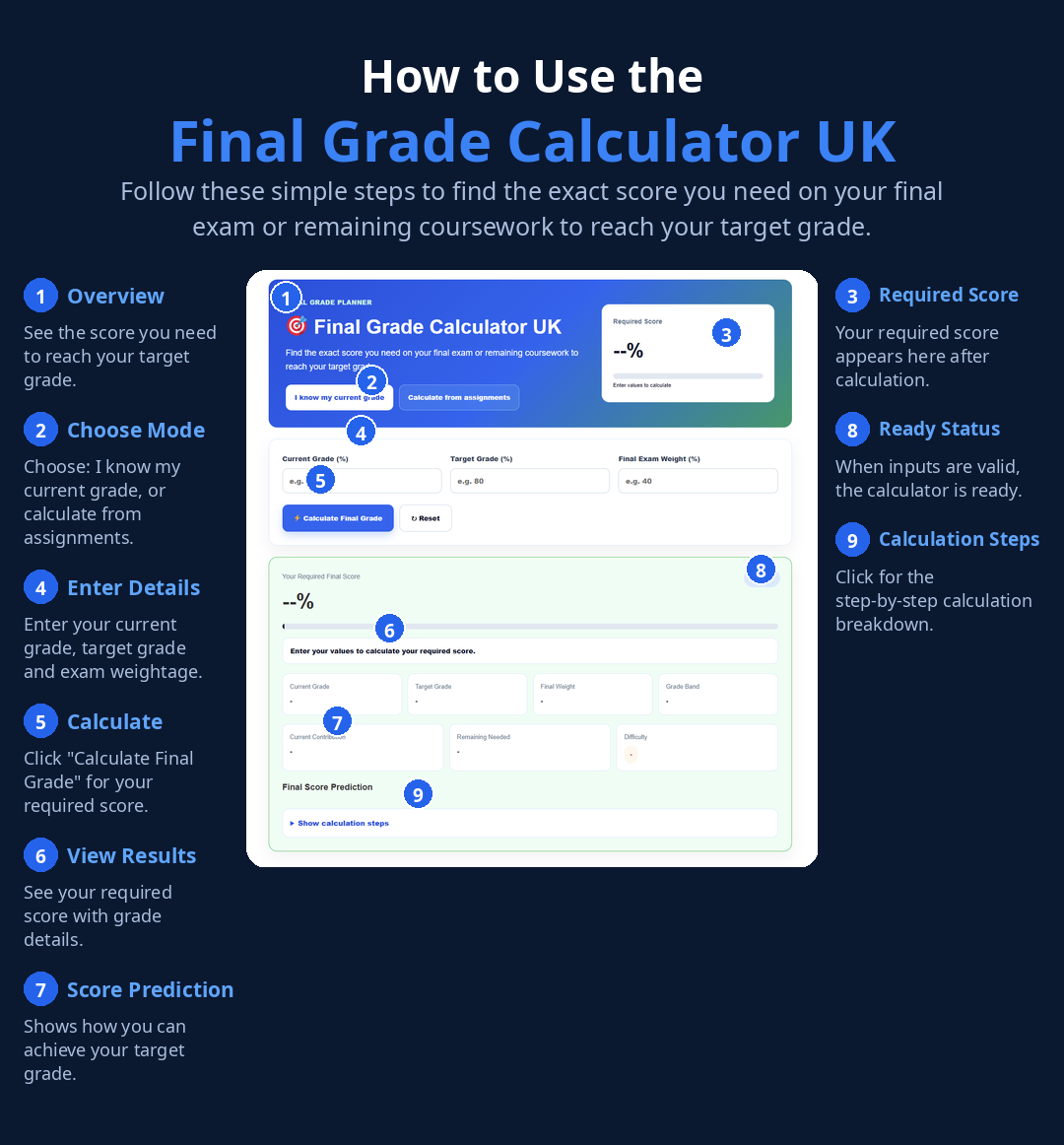
Click Here: Final Grade Calculator UK
What “Borderline” Actually Means at a UK University
A borderline grade is a final average that falls just below a classification boundary — close enough that the university agrees your case deserves a second look. The near-universal convention in the UK is a 2% borderline zone below each boundary:
| Classification boundary | Borderline zone | What it means |
|---|---|---|
| First: 70% | 68.00–69.99% | Considered for uplift to a First |
| 2:1: 60% | 58.00–59.99% | Considered for uplift to a 2:1 |
| 2:2: 50% | 48.00–49.99% | Considered for uplift to a 2:2 |
| Third: 40% | 38.00–39.99% | Considered for uplift to a Third |
The critical word is considered. Being in the borderline zone gets your profile reviewed against specific criteria. It does not guarantee the higher classification. As the University of Surrey puts it in its 2026 borderline guidance, students within 2% of a boundary are “automatically considered for an uplift” — considered, with the uplift granted only if further criteria are met.
And not every university plays this game at all. The University of Westminster’s regulations state explicitly that “the concept of a ‘borderline candidate’ is not recognised” — the arithmetical outcome is final, full stop. Same marks, different university, different degree. That is why the first rule of borderlines is: read your handbook.
Rounding vs Discretion: Two Completely Different Things
Students constantly confuse these, and the distinction decides real degrees. Rounding is pure arithmetic applied before any human judgement. Discretion is an exam board actively choosing to award the higher classification.
On rounding, universities split three ways. Many round half-marks up: Heriot-Watt presents averages to one decimal place and rounds 69.5–69.9% up to 70%, and Regent’s University London applies the same x.5–x.9 rule at every boundary. Others round to the nearest integer as a matter of course. And then there is Imperial College London, whose borderline policy states flatly that “no rounding may be applied to these weighted average marks” — 69.99 stays 69.99, and the board works from there.
| Mechanism | What happens | Example |
|---|---|---|
| Rounding (arithmetic) | Your average is mathematically adjusted before classification | 69.5% → 70% = First at Heriot-Watt |
| Discretion zone | The board reviews your profile against published criteria | 68.5% + 50% of credits at First-level → First at Heriot-Watt |
| No rounding, no discretion | The calculated number is the classification | 69.9% = 2:1 at Westminster |
The practical takeaway: before you agonise over a decimal place, check whether your university rounds at all. At some institutions the entire borderline drama evaporates at 69.5. At others, the drama is only just beginning.

The Two Classic Routes to an Uplift
Where discretion exists, UK universities overwhelmingly use two tests. The University of Reading gives them the clearest names in its Degree Outcomes Statement: dominant quality and exit velocity.
Dominant quality asks: is at least half of your weighted credit in the higher classification band? If 60 or more of your 120 final-year credits scored 70+, your profile “looks like” a First even if the average says 68-point-something. Heriot-Watt applies the same test — 50% or more of qualifying credits at the higher grade. Sheffield Hallam sets the bar at first-class marks in at least 60 credits at level 6. Northumbria goes further, expecting more than 60% of level 5 and 6 marks at 70+ before it will round a 69.6 up.
Exit velocity asks: is your final year average in the higher band? The logic is that your most recent, most advanced work best represents the graduate you are now. Surrey’s 2026 policy is built almost entirely on this: fall within 2% of the boundary and the university reviews your final-level weighted average — if that sits at or above the higher boundary, the uplift is granted. Reading applies it as an either/or: dominant quality or exit velocity gets you over the line.
Leeds Beckett publishes the clearest worked examples of the two-part test in action. Student A finishes on 68 with 60 final-level credits in the First band: both criteria met, upgraded to a First. Student B finishes on 59 with only 40 final-level credits in the 2:1 band: part two fails, and the 2:2 stands. Same borderline zone, opposite outcomes — decided entirely by the credit profile.
Read more: University Grade Boundaries Explained – What You Need to Pass
How 8 UK Universities Handle Borderlines
Policies are not interchangeable. Here is how the rules compare at institutions that publish them openly:
| University | Borderline zone | Rounding | Uplift test |
|---|---|---|---|
| Surrey | Within 2% of boundary | Standard | Final-level weighted average in higher band → automatic consideration |
| Heriot-Watt | x8.5–x9.9 (e.g. 68.5–69.9) | x9.5+ rounded up | 50%+ qualifying credits at higher grade |
| Reading | Within 2% of boundary | Standard | Dominant quality OR exit velocity |
| Leeds Beckett | Borderline band | Standard | Borderline average + final-level credits in higher band |
| Sheffield Hallam | 68.01–69.99 (First) | Standard | First-class marks in 60+ credits at level 6 |
| Northumbria | 67–69 | Conditional | >60% of level 5/6 marks at 70+ → round up |
| Imperial | n8.00–n9.99 per aspect | None permitted | Threshold met in one aspect (taught/research), borderline in the other |
| Westminster | Not recognised | To nearest integer | No discretion — arithmetic is final |
Two things stand out. First, the “automatic” uplift barely exists anywhere — even Surrey’s automatic consideration still requires the final-level average test. Second, the trend is toward transparency: several of these policies were published or revised in the last few years precisely because students were left guessing.
Worked Example: Does Amara’s 68.4% Become a First?
Amara finishes her degree with these numbers:
- Overall weighted average: 68.4% (borderline zone for a First at every university above)
- Final-year average: 71.2%
- Final-year credits at 70+: 70 out of 120
At Surrey, she is automatically considered (within 2%), and her final-level average of 71.2 clears the 70 threshold — First awarded. At Reading, she passes both tests: dominant quality (70/120 credits ≥ 50%) and exit velocity (71.2 final year) — First awarded. At Heriot-Watt, 68.4 sits below the x9.5 rounding line, but her 58% of credits at First-level clears the 50% discretion test — board can award the First.
At Westminster, none of this is discussed. 68.4 rounds to 68. The classification is a 2:1. Same student, same work, different degree — which is exactly why “what do other unis do?” is the wrong question. Only your own regulations matter.
Calculate it: Enter your marks in our Weighted Grade Calculator to see your exact average and how close you are to the next boundary.
Worked Example: What Final-Year Average Puts You in the Zone?
Suppose your university counts Year 2 at 40% and Year 3 at 60% (Year 1 doesn’t count toward classification — the most common English pattern). You finished Year 2 on 64%. What do you need in final year to reach the 68 borderline?
0.40 × 64 + 0.60 × x ≥ 68
25.6 + 0.6x ≥ 68
0.6x ≥ 42.4
x ≥ 70.67%
You need a 70.7% final-year average just to enter the borderline zone — and then you’d still need the uplift criteria on top. Here is how the target shifts with different Year 2 results:
| Year 2 average (40%) | Final-year average needed for 68.0 | Verdict |
|---|---|---|
| 62% | 72.0% | Needs a First-level final year |
| 64% | 70.7% | Needs a First-level final year |
| 66% | 69.3% | Strong 2:1 final year; then needs uplift criteria |
| 67% | 68.7% | Within reach — then needs uplift criteria |
This is the calculation that should drive your final-year effort. Don’t aim vaguely “higher” — aim at the number. Put your own figures into the Final Grade Calculator and it will tell you the exact mark required.
What Borderline Rules Can’t Do
Four hard limits students routinely misunderstand:
1. You can’t appeal the arithmetic. If your average is 67.9 and the borderline starts at 68.0, no appeal will move it. Appeals challenge procedural errors and bias, not decimal places.
2. Mitigating circumstances don’t shift boundaries. Westminster’s regulations say this outright: “under no circumstances may an award classification be amended on the basis of mitigating circumstances.” Extenuating circumstances can excuse a failed module or grant a resit — they cannot turn a 69 into a 70.
3. Consideration is not a promise. Meeting the borderline zone gets you reviewed. Failing the uplift tests — too few credits in the higher band, weak final year — leaves the lower classification standing, as Leeds Beckett’s Student B discovered.
4. Masters degrees play by tougher rules. Borderline zones exist at postgraduate level too (Heriot-Watt publishes a separate PG policy), but the dissertation is often decisive — Imperial, for instance, won’t consider you borderline if your dissertation mark falls below the threshold, regardless of your average. If your Masters journey hit trouble earlier, read our guide on what happens if you fail your dissertation.
Putting Yourself in the Best Position
If you are tracking toward a borderline, five things genuinely move the needle:
1. Know your exact number. Not “about 68” — 68.37. Weight every module by its credits and year weighting. A surprising number of students misjudge their average by a full percent.
2. Front-load effort into high-credit final-year modules. Both uplift tests reward final-year performance. A 72 in your 30-credit dissertation project does more for dominant quality and exit velocity than the same mark in a 10-credit elective.
3. Chase the credit profile, not just the average. If your university uses a 50%-of-credits test, pushing two modules from 68 to 70 can matter more than pushing your average from 68.2 to 68.6.
4. Read the rounding rule. If 69.5 rounds up at your institution, your real target is 69.5, not 70 — half a percent of breathing room.
5. Don’t bank on discretion. Treat the uplift as a bonus, not a plan. Aim to clear the boundary outright; let the borderline be your safety net, not your strategy.
Frequently Asked Questions
What are borderline grades at UK universities?
A final average that falls just below a classification boundary — usually within 2% of it (for example, 68.00–69.99% for a First). Universities review borderline profiles against published criteria, but the higher classification is never guaranteed.
Is 69.5% rounded up to a First?
At many universities, yes — institutions like Heriot-Watt and Regent’s round x.5 and above up, so 69.5 becomes 70. But some universities, notably Imperial College London, prohibit rounding entirely. Always check your own academic regulations.
Can I appeal if I’m 0.1% below the boundary?
No. Appeals challenge procedural errors, bias, or overlooked mitigating circumstances — not the arithmetic of your average. If 67.9 sits below your university’s 68.0 borderline line, no appeal will move it.
Do all UK universities have borderline discretion?
No. Most operate a borderline zone with published uplift criteria, but some — such as the University of Westminster — explicitly do not recognise borderline candidates, and the calculated classification is final.
What is ‘exit velocity’?
A term used by universities like Reading for one of the two classic uplift tests: whether your final-year average sits in the higher classification band. The logic is that your most recent, most advanced work best represents the graduate you are now.
Does borderline uplift apply to Masters degrees?
Often yes — universities like Heriot-Watt publish separate postgraduate borderline policies. But the tests can be stricter: at Imperial, for example, you will not be considered borderline if your dissertation mark falls below the threshold, whatever your average.
Will my transcript show I was uplifted?
No. Your transcript and degree certificate simply show the classification awarded. There is no marker distinguishing an uplifted First from one achieved outright.
Conclusion
Borderline grades are one of the few places in the UK degree system where the rules have genuine give in them — but only for students who understand the mechanism. The zone is usually 2% below the boundary. Rounding and discretion are different things. Uplifts are earned through credit profiles and final-year performance, not granted for proximity. And the same 68.4 can be a First in Surrey and a 2:1 in Westminster.
Work out your exact average, learn your university’s specific tests, and aim your final-year effort at the number that matters. The boundary rewards precision — so be precise.

![Read more about the article Joint Honours Grading: How Your Two Subjects Become One Degree Class [2026]](https://gradeforuni.com/wp-content/uploads/2026/10/featured-joint-honours-uk-300x192.png)
![Read more about the article Do Formative Assessments Count Towards Your Grade? UK University Rules Explained [2026]](https://gradeforuni.com/wp-content/uploads/2026/10/featured-formative-assessments-300x192.png)
![Read more about the article Do All UK Universities Use the Same Grade Boundaries? [2026]](https://gradeforuni.com/wp-content/uploads/2026/10/featured-grade-boundaries-uk-300x192.png)